C2 · Buying guide
1965 Corvette Sting Ray: four-wheel discs, the one-year 396, the last fuelie and 2026 prices
Published
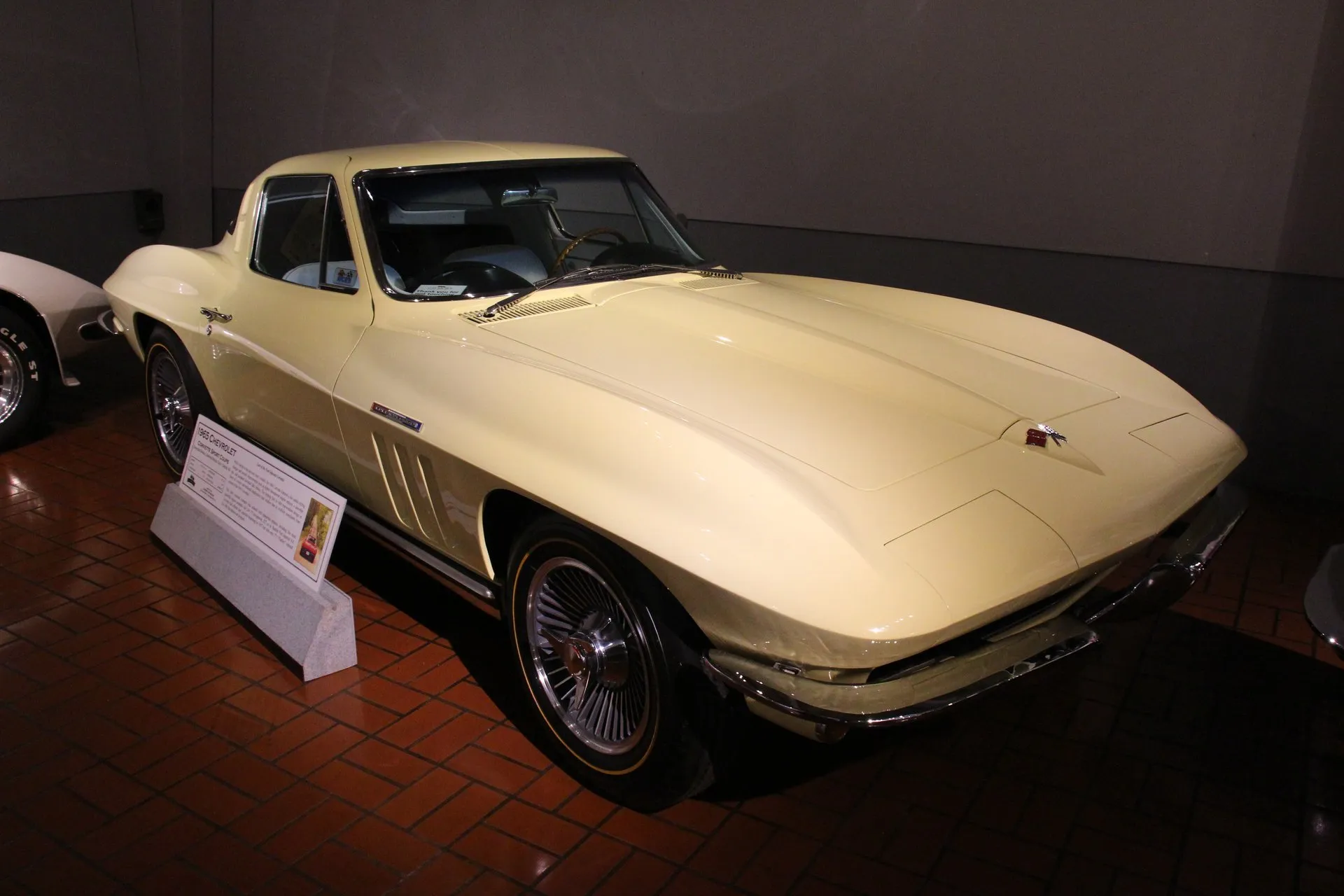
Disc brakes at all four wheels came standard on the 1965 Corvette, a first for America’s sports car, and 316 were ordered with drums anyway. GM’s price list of June 22, 1965 shows the swap as a $63.15 credit. Drag racing, distrust of the new hardware, the money: owners of the C2 (1963–1967) still argue about why.
The drums weren’t the only thing on the way out. Fuel injection had its last season until 1982, on 771 cars (owners call them fuelies), and in March the first big-block Corvette arrived, a 425 hp 396 that lasted one model year. A 1965 with a 396, a fuelie or side pipes is worth what its paperwork can prove.
- Built: 23,562: 8,186 coupes and 15,376 convertibles, all assembled in St. Louis.
- Engines: six, all rated gross: 327s of 250 to 375 hp and a 425 hp 396.
- Price new: $4,233 coupe, $4,022 convertible, on GM’s June 22, 1965 list.
- Brakes: discs at all four wheels standard; 316 cars took drums.
- The rare ones: 2,157 396s, 771 fuelies and 759 cars with side exhaust.
- What one costs: a median of $70,750 on Bring a Trailer for 22 titled-stock sales between January 1 and October 19, 2026.
- Split window? Not on a 1965: that was a 1963 coupe feature (see the 1963 guide).
- Rust, judging and the other four years: in the C2 buyer’s guide.
C2 Key figures
- Built
- 23,562
- Coupes, convertibles
- 8,186 coupes and 15,376 convertibles
- Engines
- 327s of 250 to 375 hp and a 425 hp 396
- Price new, June 1965
- $4,233 coupe, $4,022 convertible
- Brakes
- discs at all four wheels standard; 316 cars took drums
- 396s built
- 2,157
- Fuel-injected cars
- 771
- BaT median, 2026
- $70,750 on Bring a Trailer
Section 01
How a 1965 differs from a 1964 and a 1966
The brakes were the headline. GM’s dealer data calls them “Caliper disc, 4-wheel hydraulic”: 11.75 in cast-iron discs with radial cooling cavities, four pistons per caliper and 461.2 sq in of swept area, against 321 for the old drums by Car and Driver’s count. Power brakes, RPO J50 (RPO is GM’s regular production option code), went on 4,044 cars and brought a dual-circuit master cylinder; Chevrolet Service News of October 1964 says cars without them kept a single one.
The other changes, per the Corvette Black Book (a reference whose 1965 pages GM reproduced in its 1965 kit, part of this site’s manual library):
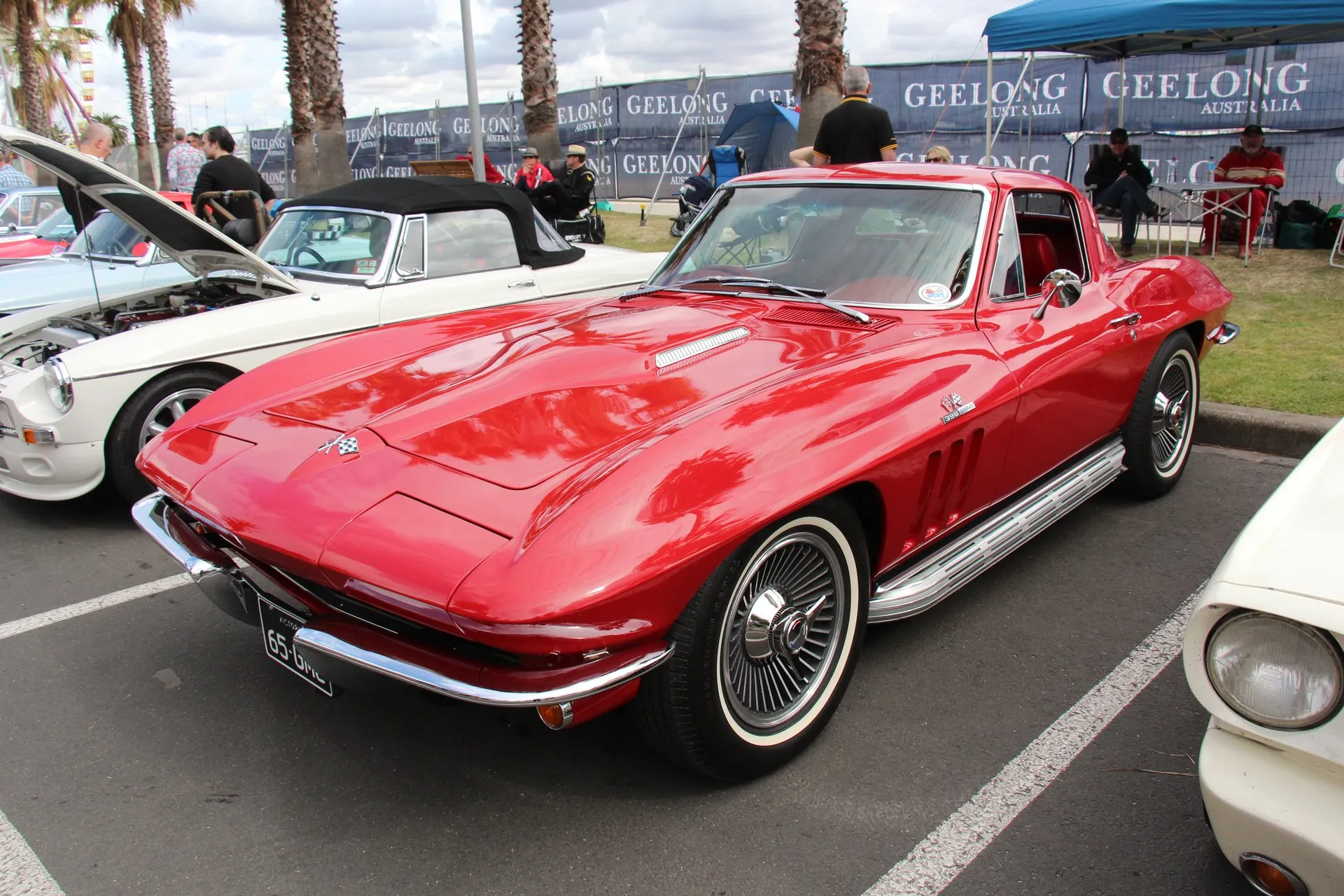
- A flat hood, without the two recesses the 1964 kept.
- Three vertical fender vents, “functional” slots in the Black Book’s word, replacing the horizontal vents of 1963–1964.
- A black grille: black bars inside bright trim, a front end Corvette Action Center calls unique to 1965.
- A new cabin: flat-faced black instruments, redesigned seats and door panels, and a painted radio surround.
- Bigger tires, 7.75 x 15 in place of 6.70 x 15 (GM’s tire data), and five new options: side exhaust, a wood steering wheel, a telescopic column, goldwall tires and a group pairing backup lamps (a 1964 option on their own) with an inside mirror.
Carried over: the 1963 chassis (ladder frame, independent rear suspension; see the 1963 guide), the 98.0 in wheelbase, the coupe’s roof-pillar vents and what GM calls a “fiber glass reinforced plastic body backboned by a steel cage”, the birdcage that rusts. GM’s curb weights: 3,135 lb coupe, 3,145 lb convertible, with the base engine and three-speed.
Telling it from a 1966
The Black Book page in GM’s 1966 kit lists engine codes for 327s and 427s only: no 396 and no fuel injection, which makes 1965 the one model year with a big-block and a fuelie on the order form. The 1966 also lost the coupe’s roof vents and gained a hood script, a square-mesh grille and standard backup lights. The hood is the quick tell: a 1965’s has no script, and two posters add that it has no mounting holes for one underneath (CorvetteForum, 2024).
Section 02
Six engines, from the 250 hp 327 to the 425 hp 396
GM’s engine data and power teams give six engines. Ratings are gross, prices are GM’s of June 22, 1965, and counts are the Black Book’s.
| Engine | Induction and lifters | Compression | Gross hp | Gross torque | GM price | Built |
|---|---|---|---|---|---|---|
| Base 327 | Carter four-barrel, hydraulic lifters | 10.5:1 | 250 at 4,400 rpm | 350 lb-ft at 2,800 rpm | Standard | 2,549 (by subtraction) |
| L75 327 | Larger Carter four-barrel, hydraulic lifters | 10.5:1 | 300 at 5,000 rpm | 360 lb-ft at 3,200 rpm | $52.65 | 8,358 |
| L79 327 | Holley four-barrel, high-lift camshaft, hydraulic lifters | 11.0:1 | 350 at 5,800 rpm | 360 lb-ft at 3,800 rpm | $105.30 | 4,716 |
| L76 327 | Holley four-barrel, high-lift camshaft, mechanical lifters | 11.0:1 | 365 at 6,200 rpm | 350 lb-ft at 4,000 rpm | $126.40 | 5,011 |
| L84 327 | Rochester fuel injection, high-lift camshaft, mechanical lifters | 11.0:1 | 375 at 6,200 rpm | 350 lb-ft at 4,400–4,800 rpm | $526.60 | 771 |
| L78 396 | Holley four-barrel, special camshaft, mechanical lifters | 11.0:1 | 425 at 6,400 rpm | 415 lb-ft at 4,000 rpm | $286.45 | 2,157 |
GM also rated the base engine at 210 hp net, the yardstick it adopted for 1972, and recommended premium fuel for all six.
The new one was the L79: the hot 327s’ high-lift camshaft and 11.0:1 compression, on hydraulic lifters. Car and Driver’s January 1965 issue set the Corvette, new 350 hp engine and all, against a Ferrari 250 GT and an Aston Martin DB5 at “over $12,000”: the Corvette cost less than half as much, and had independent rear suspension where both used a live axle. Performance per dollar was the Corvette’s case then, and it still is.
GM’s June list and power teams set the rules: Powerglide only with the 250 and 300 hp engines, power steering only up to the 350, air conditioning with anything but the fuelie and the 396, and transistor ignition only from the 350 up (required on the 396). The three-speed was for the base engine alone and the wide-ratio four-speed (2.56:1 first gear) for the 250 and 300; the 350 hp and stronger engines were four-speed only, normally with the close-ratio box (2.20:1 first). Four-speeds went into 21,107 cars, and GM also priced an M22 heavy-duty four-speed ($236.95) that the Black Book doesn’t count.
Positraction, GM’s limited-slip differential (G81, $42.10), went into 19,965 cars, 85 percent of the year, at 3.08 to 4.56:1. The standard axle was 3.36:1 with the 250, 300 and 396 (the 396 with Positraction only) and 3.70:1 with the three hot 327s.
Period times come from Corvette Action Center’s reproductions, not the magazines themselves: Motor Trend’s L79 coupe (October 1964) ran 0–60 mph in 6.2 seconds and the quarter mile in 14.9 at 94 mph; Road & Track’s fuel-injected coupe (December 1964) 6.3 and 14.4 at 99 mph, with a 138 mph top speed; and its 396 convertible (August 1965) 5.7 and 14.1 at 103 mph.
Section 03
The 396: unveiled in March, gone for 1966
GM’s paperwork came first: its specification sheets for the 396 are dated February 22, 1965, and its serial and option pages were revised that month to add it. The Black Book says the option was unveiled in mid-March, and by its month table March’s cars ran from serial 111060 to 113936. Owners’ guesses at the first 396 serial differ by thousands; a claimed factory 396 built before March needs explaining.
RPO L78, the “Turbo-Jet 396” on GM’s list, cost $286.45 and was “Available only when Positraction rear axle & transistorized ignition system are ordered”, with a four-speed and without air conditioning or power steering. It came with a special hood, per the Black Book, and added 225 lb: 3,360 lb for the coupe, 3,370 lb for the convertible. Chevrolet built 2,157.
Chevrolet’s letters to dealers about it, as Corvette Action Center transcribes them:
- The steering damper. A letter of May 17, 1965 says the assembly plant had built 47 L78 Corvettes with the production steering damper, a part that “should be deleted with this engine option” (opens in new tab) because, at the limits of tolerance, it could hit the oil pan. It doesn’t say which 47.
- Hood flutter. Early 425 hp hoods fluttered and could rap on the radiator support. An 18 in rubber seal on the support (
GM 3827365, OEM) cured it, in production from about May 6, 1965, at serial S116736. - Valve spring caps. Bulletin DR #757, July 29, 1965, cites “a few field reports” of failed caps and an engine plant change from July 26: caps marked “T” (
GM 3859909, OEM) replace the early ones marked “O”. The 1965 run ended days later, so nearly every 1965 396 left with the early caps: this guide’s reading of the dates, not Chevrolet’s words.
Section 04
Fuel injection’s last year, in the order books
Per the Black Book, no Corvette after the L84 had fuel injection until 1982’s throttle-body system. GM’s June list priced the L84 at $526.60: $240.15 more than the 396, for 50 fewer horsepower on paper.
An order-receipt report dated July 26, 1965, transcribed by Corvette Action Center (opens in new tab) without naming who issued it, shows what followed; its full-year shares match the Black Book’s counts (3.27 percent for the fuelie is 771 of 23,562). By period:
| Share of orders received | Model year to May 4 | March 31 to May 19 | May 19 to year’s end |
|---|---|---|---|
| L84 fuel injection | 3.95 percent | 1.16 percent | 0.70 percent |
| L76 365 hp | 23.40 percent | 14.67 percent | 13.16 percent |
| L78 396 | 5.66 percent | 19.95 percent | 23.21 percent |
The fuelie faded as the 396 arrived, and the solid-lifter L76 lost ground with it. That the cheaper, stronger big-block caused it is this guide’s reading; the report only counts. How Rochester injection behaves in hot traffic is on the C2 guide.
Section 05
GM’s June 1965 price list, and the eight colors
GM’s price schedule of June 22, 1965 lists the Sport Coupe at $4,233.00 and the convertible at $4,022.00 before taxes and options, which bought a 250 hp 327, a three-speed and vinyl trim. The Black Book prints $4,321 and $4,106, and its option prices run about 2 percent higher. Lists changed during the year; this guide uses GM’s dated one, as the C2 guide does.
The options that matter, most-ordered first (engines are in Six engines):
| RPO | Option | GM price | Cars |
|---|---|---|---|
| U69 | AM-FM radio with power antenna | $199.05 | 22,113 |
| M20 | Four-speed manual | $184.30 | 21,107 |
| G81 | Positraction rear axle | $42.10 | 19,965 |
| Z01 | Backup lamps and inside mirror | $15.80 | 15,397 |
| C07 | Hardtop | $231.70, or no charge in place of the soft top | 7,787 (1,277 in place of the soft top) |
| J50 | Power brakes | $42.10 | 4,044 |
| N36 | Telescopic steering column | $42.10 | 3,917 |
| A31 | Power windows | $57.90 | 3,809 |
| K66 | Transistor ignition | $73.70 | 3,686 |
| N40 | Power steering | $94.75 | 3,236 |
| C60 | Air conditioning | $412.85 | 2,423 |
| None | Leather seats | $78.95 | 2,128 |
| M35 | Powerglide automatic | $194.85 | 2,021 |
| P48 | Knock-off aluminum wheels | $315.95 | 1,116 |
| N14 | Side exhaust | $131.65 | 759 |
| J61 | Drum brakes in place of discs | $63.15 credit | 316 |
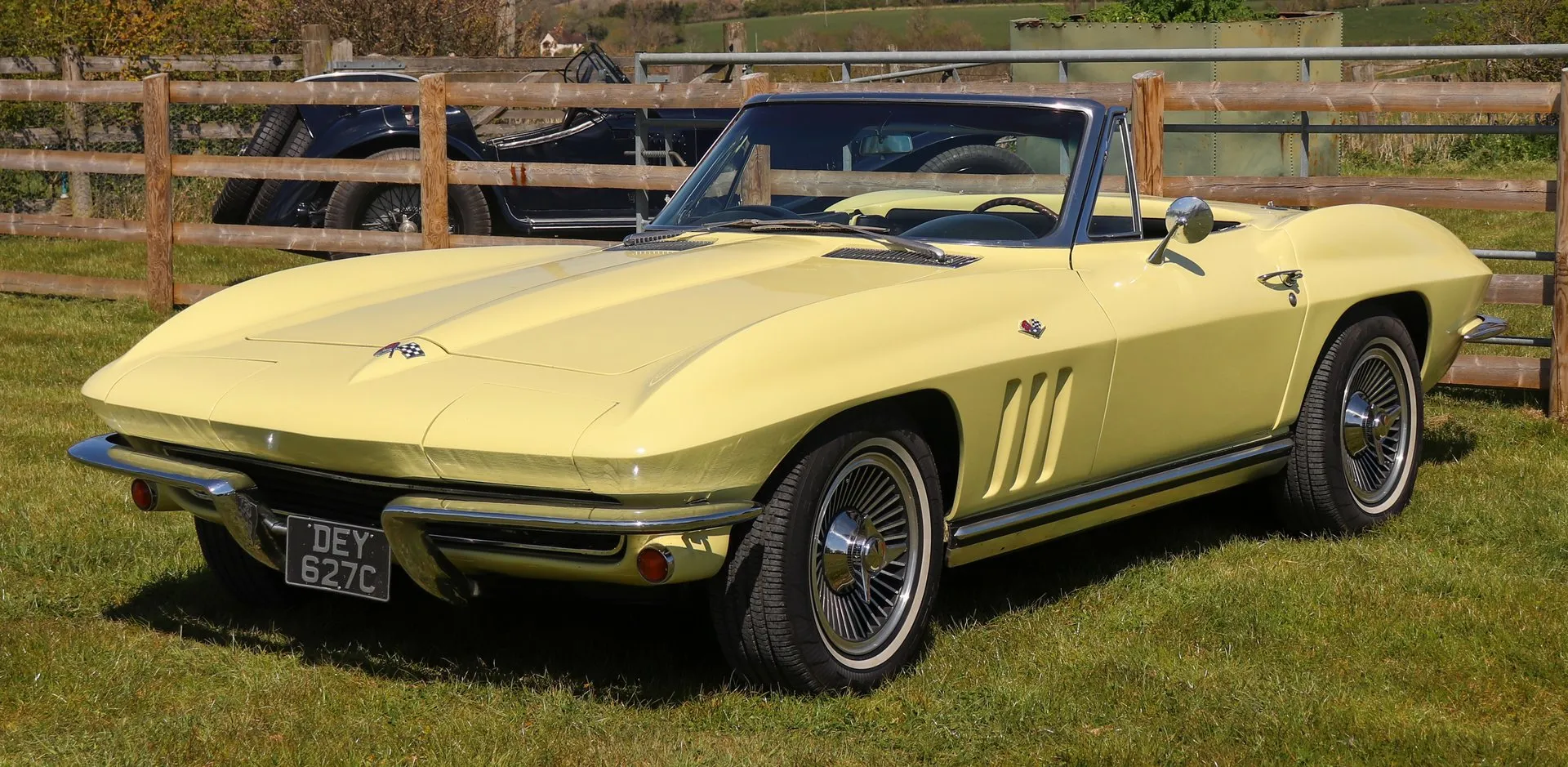
Eight colors, one car in four Nassau Blue
All solid and all at no charge: GM’s March 1965 ordering page rules out two-tones and gives each color a double-letter code. The Black Book’s counts:
| Color | Code | Cars |
|---|---|---|
| Nassau Blue | FF | 6,022 |
| Glen Green | GG | 3,782 |
| Rally Red | UU | 3,688 |
| Milano Maroon | MM | 2,831 |
| Silver Pearl | 2,552 | |
| Ermine White | CC | 2,216 |
| Goldwood Yellow | XX | 1,275 |
| Tuxedo Black | AA | 1,191 |
Tuxedo Black was the rarest. Five more cars left in non-standard paint or primer, which brings the nine figures to exactly 23,562.
Black vinyl was standard; red, blue, saddle, silver, green, maroon and three white combinations came in vinyl or leather (only the seats were genuine leather), under a black, white or beige top on any paint. GM’s pairings of paint and interior shifted during the year (its September 1964 page puts Milano Maroon with red; its March 1965 chart doesn’t), and the Black Book says other combinations were possible, so an unusual one calls for paperwork, not a verdict of repaint.
Section 06
The rare options: drums, side pipes and the big tank
Drum brakes. The Black Book calls J61 a cost-delete option while supplies lasted, yet the order report in Fuel injection’s last year still logs drums at 0.78 percent of orders after May 19. Rare doesn’t mean valuable: “rarity does not equate to more value,” says one owner (CorvetteForum, 2021). Another poster has seen drum cars sold without the seller saying so, and checks for a 1964-style master cylinder, then looks underneath (CorvetteForum, 2010).
Side exhaust. New for 1965, N14 went on 759 cars: “For off-road service only” in GM’s words, and only with an optional engine and the four-speed. Two posters 18 years apart say factory side-pipe cars had St. Louis bodies (CorvetteForum, 2006 and 2024), so by their account side pipes on a car whose trim-tag body number starts with A, for the A. O. Smith body plant, were added later.
The rest:
- N03, the 36-gallon tank: coupes only, $198.00, 41 cars, fiberglass by GM’s specification sheets and under a color-keyed cover in place of the luggage carpet (GM’s list). Hagerty’s price guide adds 150 percent for a factory one (October 2025 and January 2026).
- F40 special suspension: $36.85 on 975 cars: heavy-duty springs and shocks front and rear and a heavy-duty front bar, only with the 375 or 425 hp engine, the four-speed and Positraction.
- P48 knock-off wheels: cast aluminum, $315.95, 1,116 cars, dark grey between the fins for 1965.
Section 07
Proving a 1965 is what it claims
A 1965’s serial and trim tag date the car and name its body, never its engine. That takes the stamped pad, the hardware each engine brought and the paper, all agreeing.
The serial and the month table
GM’s identification page builds the serial from 1 for a passenger car, the model (9437 coupe, 9467 convertible), 5 for 1965 and a unit number from 100001; the cars add S for St. Louis, so the first coupe is 194375S100001. The plate is on the right side of the hinge-pillar cross brace under the glove box, and the serial is repeated with the engine number (GM’s 396 data). The Black Book’s month-end serials:
| Serials | Built in |
|---|---|
| 100001–100227 | August 1964 |
| 100228–101425 | September 1964 |
| 101426–103347 | November 1964 (the Black Book has no October entry) |
| 103348–105754 | December 1964 |
| 105755–108442 | January 1965 |
| 108443–111059 | February 1965 |
| 111060–113936 | March 1965 |
| 113937–116516 | April 1965 |
| 116517–118753 | May 1965 |
| 118754–121216 | June 1965 |
| 121217–123562 | July 1965 |
| 123563–123564 | August 1965 |
They run two past the Black Book’s own total of 23,562, and it can’t say whether the total is wrong or two numbers went unused. Corvette Action Center prints 23,564; this guide uses 23,562, as the C2 guide does.
Reading the engine pad
The engine number is stamped on a pad at the front of the block’s right side. GM’s examples read F for Flint, the month and day, and a two-letter code: F1210HG is a fuel-injected 327 built December 10. GM’s codes are HE (250 hp), HF (L75), HT (L79), HH (L76), HG (L84), HO and HP (250 and 300 with Powerglide) and IF (396, added in February 1965). The Black Book lists 19, adding versions for air conditioning and transistor ignition, such as HN for the fuelie with transistor ignition. Owners add that the pad carries the year digit 5 and the car’s production number, and that an engine assembled after the car isn’t its original (Corvette Action Center forum, 2005).
The trim tag and the Protect-O-Plate
The trim tag under the dash carries the style (65 437 or 65 467), the body number with S for a St. Louis body or A for an A. O. Smith one (an outside body maker), the trim and paint codes, and a build code: a month letter from A (August 1964) to L (July 1965) and a day, per Corvette Action Center. Final assembly was always St. Louis.
From 1965, buyers also got a Protect-O-Plate, an embossed metal plate with the warranty booklet. A Chevrolet zone letter of October 2, 1964 told dealers sent one with the wrong serial to order a corrected plate from the supplier (via Corvette Action Center). Plates were made, and remade, apart from the car: in this guide’s judgment, evidence rather than proof.
396s and fuelies: the tells and their limits
On a claimed 396, owners look for an IF pad on a 3855962 block (the Black Book’s casting number), GM’s Holley 3868826, the transistor-ignition amplifier or its mounting holes, a driver’s-side battery behind an inner-fender door (factory-air small-blocks had one too), a larger aluminum radiator, front and rear anti-roll bars, a 6,500 rpm tach and the special hood (CorvetteForum, 2002 to 2024). All of it can be copied: “Make sure that casting number is not epoxy” (opens in new tab), one 2024 poster warns. Posters trust the battery tray, which one calls hard to fake without a trace, and paper above all.
A fuelie shows even less. One 2018 poster’s sure signs are the engine stamp and genuine paperwork (a Protect-O-Plate, window sticker or invoice); air-cleaner mounting holes mean little, the same poster adds, since GM’s replacement radiator supports and inner fenders had them whatever the engine (CorvetteForum, 2018). Past an HG or HN pad and a 7017380 unit, posters compare unit serials with an owners’ survey of about 329 of the 771 cars, but repaired units went back into stock, and a plenum VIN stamp can be added later (CorvetteForum, 2020).
Honest conversions exist: a “Fuel-Injected” 1965 coupe on Bring a Trailer, bid to $72,501 without selling on October 1, 2026, discloses that it left the factory as an L76 (HH pad) and got a rebuilt Rochester unit in 2022. Stamping the pad to make that look original is what NCRS, the National Corvette Restorers Society, calls counterfeiting (see the C2 guide).
Section 08
1965 problems on record: GM’s bulletins and NHTSA
NHTSA, the US road safety agency, lists one recall that reaches the 1965, and it isn’t GM’s: campaign 03E032000, for Cardone remanufactured rear calipers 18-7019, 18-7020, 16-7019 and 16-7020 (aftermarket), made from February 2002 to April 2003 for 1965–1982 Corvettes, whose piston seals can leak. It holds no GM recall and no owner complaint (opens in new tab) for the year (checked October 19, 2026), but its complaint file begins in September 1994, so the blank proves nothing.
Chevrolet’s own record survives in dealer letters and bulletins that Corvette Action Center has transcribed. Besides the 396 letters (in The 396: unveiled in March, gone for 1966):
- Brake squeal. Bulletin DR #763, August 20, 1965: the discs could squeal under light or medium stops. From June 15, 1965 the plants fitted smaller pads, and those cars carry orange paint (opens in new tab) on the back of the caliper or on the front hub and rear spindle.
- The temperature gauge. A letter of November 16, 1965 says GM found some faulty gauges but that complaints of high readings “may be largely psychological (opens in new tab) in nature”, since a 1965’s needle sits at or right of center in normal driving. The recalibrated 1966 gauge (
GM 6402594, OEM) fits a 1965 but not a 1963–1964, and a June 1965 letter says the 13 lb pressure cap holds off boiling until about 240 degrees F. - Early-car fixes: rear crossmember mounts that could pull loose (TSB #1036, September 1964), a clunk on take-off from loose differential bracket bolts (TSB #1069, January 1965), vent control cables that loosened (new ones from about January 4, 1965) and convertible tops that let in air and water until a taller weatherstrip arrived at serial S108326 (TSB #1097, February 1965).
- Powerglide. A letter of August 5, 1965: the shift control rod’s adjuster sat where it couldn’t be turned, and misadjustment “can result in transmission failure”; the 1966 rod was released to fit.
- Transistor ignition. Chevrolet later named moisture the most common cause of pulse amplifier failure on 1965–1972 cars, which takes in all 3,686 K66 cars of 1965, every 396 among them.
The problems that cost real money belong to the generation: the birdcage, the frame kick-ups and corroded caliper bores, in Known C2 problems on the C2 guide.
Section 09
Paper, pad and brakes: checking a 1965
- Paper first. If the price leans on a 396, a fuelie, side pipes or the big tank, the documents decide, not the parts.
- Serial and month. 194375S or 194675S and a unit number no higher than 123564, dated by the table in Proving a 1965 is what it claims. A factory 396 belongs to March or later.
- The pad. A code that fits the car’s equipment, an assembly date before the car’s build, and the car’s production number.
- The trim tag. Style, paint and body plant: factory side pipes on an A body are a question for the seller.
- Brakes. Discs or drums, a master cylinder that fits the power brake claim, rear calipers checked against Cardone’s recalled numbers and, on a car built from June 15, 1965, orange paint on the caliper backs or the hubs and spindles.
- On a 396, the battery door, the aluminum radiator, the ignition hardware, both anti-roll bars and the hood, and whether the valve spring caps were ever changed.
- The real temperature, read with an infrared thermometer before trusting the gauge either way.
- Birdcage and frame, with the car in the air, against the C2 guide’s inspection list, and an inspector who knows C2s.
Section 10
1965 prices in 2026, by engine and body
How much is a 1965 Corvette worth? Bring a Trailer (opens in new tab) sold 34 cars from the 1965 model year between January 1 and October 19, 2026, at a median of $69,500, and 14 more were bid to a median of $71,000 without selling. The medians are this site’s arithmetic on sold prices, which leave out BaT’s buyer’s fee (5 percent, minimum $250, maximum $7,500, as of October 2026). Groups come from listing titles: “titled stock” means the title doesn’t call the car modified, a project or a roller, and no title shows a restamp.
| 1965s by listing title, BaT 2026 | Sold | Median | Range |
|---|---|---|---|
| All titled stock | 22 | $70,750 | $40,000–$145,000 |
| Titled-stock coupes | 6 | $80,000 | $63,000–$125,000 |
| Titled-stock convertibles | 16 | $69,500 | $40,000–$145,000 |
| L79 350 hp | 7 | $67,500 | $41,500–$117,000 |
| L76 365 hp | 4 | $86,250 | $73,500–$120,000 |
| L75 300 hp | 4 | $59,750 | $48,000–$72,000 |
| Modified | 10 | $70,000 | $34,000–$195,000 |
One convertible with a replacement 327 sold twice ($40,000 in May, $41,000 in June); counted once, the titled-stock median is $72,000 from 21 cars. The two 396s were a coupe 59 years in one family ($63,000, September 30) and a convertible with NCRS Top Flight judging awards and NCRS shipping data ($86,000, September 23); the two fuelie coupes brought $101,000 (October 5) and $125,000 (July 29). Since April 2025, five 396s have sold for $63,000 to $174,000 and four fuelies for $101,000 to $174,000. Small samples, every one. The C2 guide’s shorter window, June 10 to October 6, 2026, has 14 titled-stock 1965s at a $69,750 median, the lowest of the three disc-brake years.
In January 2026, Hagerty’s price guide (opens in new tab) (read from an Internet Archive capture) had condition #3 (Good) 1965s at these values, each about 3 percent below October 2025:
| Engine | Coupe | Convertible |
|---|---|---|
| 250 hp | $58,500 | $52,900 |
| L75 300 hp | $63,400 | $57,200 |
| L79 350 hp | $57,800 | $56,000 |
| L76 365 hp | $67,300 | $77,000 |
| L84 fuel injection | $84,800 | $75,000 |
| L78 396 | $82,900 | $78,000 |
Hagerty ranks the L79 below the L75, the opposite of BaT’s 2026 medians, and takes 10 percent off for an automatic.
classic.com’s (opens in new tab) May 2026 benchmark for the 396, a 1965-only engine, was $114,616, and its highest recorded 396 sale $313,500, for a coupe on January 14, 2023. Its fuelie benchmark, $132,533, takes in 1964 cars too.
Auction results, a guide value for a good car and a benchmark built from listings and sales count different things: read them side by side, never averaged. For the 396 that’s $63,000 and $86,000 at auction this year, about $80,000 at Hagerty and $114,616 at classic.com.
Section 11
Verdict: an L79 with papers that match
The 1965 to buy is an L79 convertible whose pad and paperwork agree. It pairs the year’s best idea, four-wheel discs, with its most livable hot engine: 350 hp on hydraulic lifters, and the strongest 1965 that could still have power steering and air conditioning. Convertibles were 65 percent of the year, so there’s choice, and the L79’s 2026 median on Bring a Trailer was $67,500 (7 sales). For solid lifters and 365 hp, an L76 ran $86,250 (4 sales); on a budget, an L75 has the same discs and body for $59,750 (4 sales). Whatever the engine, the birdcage and frame get the final say.
The 396 and the fuelie made the year famous, and with either one you’re paying for the paper: this year’s two BaT 396s brought no more than a good L76, while Hagerty and classic.com value 396s higher. Walk away from any 396, fuelie, side-pipe car or big-tank coupe the documents can’t back up, unless it’s priced as the car it can prove to be. A drum-brake car is a curiosity, not a premium.
Then use the brakes that made the year. Go into a bend deep and late on four discs, let the L79 pull to its 5,800 rpm peak on the way out, and you’ll see why the best Corvette years guide picks 1965–1967 as the C2s to drive.
Section 12
Sources
- GM Heritage Center: 1965 Corvette vehicle information kit files.zipcorvette.com This site's library. PDF pages 4 (production, serials by month, engine codes and castings, options with counts, colors with counts: Corvette Black Book pages reproduced in GM's kit), 6–7 (GM price schedule, June 22, 1965), 8 (power teams, March 1, 1965), 9–10 and 18 (paint, trim and color pairings), 13 (serial and engine numbers), 14 (option list), 17 (weights), 19 (body construction), 26 (disc brakes), 29 (wheels and tires), 31–32 (power teams and engine ratings), 40 (fuel system), 44 (gear ratios) and 74–97 (GM's specifications for the 396, issued February 22, 1965).
- GM Heritage Center: 1964 Corvette vehicle information kit files.zipcorvette.com This site's library. PDF pages 4–5: the 1964 changes, options and tire size, for comparison.
- GM Heritage Center: 1966 Corvette vehicle information kit files.zipcorvette.com This site's library. PDF page 6: what changed for 1966.
- Chevrolet Engineering Service Letter T.N. No. 6, May 17, 1965: 396 Mark IV Corvettes should not have the steering damper (via Corvette Action Center) (opens in new tab) corvetteactioncenter.com This and the bulletins that follow are Corvette Action Center's transcriptions of Chevrolet documents, not the originals, read via Internet Archive copies of February to June 2026.
- Chevrolet Engineering Service Letter T.N. No. 7, June 30, 1965: hood flutter and rapping on the radiator support, 425 hp (via Corvette Action Center) (opens in new tab) corvetteactioncenter.com
- Chevrolet Technical Service Bulletin DR #757, July 29, 1965: valve spring cap failure, 425 hp 396 (via Corvette Action Center) (opens in new tab) corvetteactioncenter.com
- Chevrolet Technical Service Bulletin DR #763, August 20, 1965: disc brake squeal (via Corvette Action Center) (opens in new tab) corvetteactioncenter.com
- Chevrolet Engineering Service Letter TNP #66-1, November 16, 1965: temperature gauge reading too high (via Corvette Action Center) (opens in new tab) corvetteactioncenter.com Also TSB DR #774, November 23, 1965 (opens in new tab), and the June 30, 1965 letter on a 350 hp air-conditioned car's operating temperature (opens in new tab).
- Chevrolet Technical Service Bulletin TSB #1036, September 15, 1964: rear suspension crossmember isolation mounts pulling loose (via Corvette Action Center) (opens in new tab) corvetteactioncenter.com
- Chevrolet Technical Service Bulletin TSB #1069, January 7, 1965: drive line noise (via Corvette Action Center) (opens in new tab) corvetteactioncenter.com
- Chevrolet Technical Service Bulletin TSB #1097, February 11, 1965: air gaps, folding top to body panel (via Corvette Action Center) (opens in new tab) corvetteactioncenter.com Follows Engineering Service Letter No. 55, December 12, 1964.
- Chevrolet Zone Service Bulletin No. 9, April 7, 1965: air ventilator control cables (via Corvette Action Center) (opens in new tab) corvetteactioncenter.com
- Chevrolet Engineering Service Letter T.N. No. 8, August 5, 1965: Powerglide transmission control rod adjustment (via Corvette Action Center) (opens in new tab) corvetteactioncenter.com
- Chevrolet service bulletins on transistor ignition pulse amplifier moisture, 1965–1972 (via Corvette Action Center) (opens in new tab) corvetteactioncenter.com Chevrolet Service News, November 1966, and TSB 68-T-8, December 19, 1967.
- Chevrolet Service News, October 1964: Corvette disc brake service procedures revised (via Corvette Action Center) (opens in new tab) corvetteactioncenter.com Single master cylinder with manual brakes, split with power brakes.
- Chevrolet Indianapolis Zone Letter, October 2, 1964: verification vouchers, Protect-O-Plates and owner guide books (via Corvette Action Center) (opens in new tab) corvetteactioncenter.com
- Corvette Action Center: 1965 Corvette planned total production (opens in new tab) corvetteactioncenter.com An order-receipt report dated July 26, 1965, as transcribed by Corvette Action Center, which doesn't name its issuer. Read via the Internet Archive's December 2025 copy.
- Corvette Action Center: 1965 Corvette production and performance numbers (opens in new tab) corvetteactioncenter.com Production, options, colors, the 1965 styling details and reproduced period road tests (Motor Trend, October 1964; Road & Track, December 1964 and August 1965). Read via the Internet Archive's January 2026 copy.
- Corvette Action Center: 1965 Corvette identification numbers (opens in new tab) corvetteactioncenter.com VIN digits and a decoded trim tag. Read via the Internet Archive's February 2026 copy.
- Corvette Action Center: 1963–1967 body build date codes (opens in new tab) corvetteactioncenter.com Read via the Internet Archive's June 2026 copy.
- Car and Driver: 1965 Chevrolet Corvette Sting Ray (opens in new tab) caranddriver.com From the January 1965 issue, republished online in 2013.
- NHTSA owner complaints, 1965 Chevrolet Corvette (opens in new tab) api.nhtsa.gov Pulled October 19, 2026: none. NHTSA's complaint file begins in September 1994.
- NHTSA recalls, 1965 Chevrolet Corvette (opens in new tab) api.nhtsa.gov Pulled October 19, 2026: no GM recall; the only listing is aftermarket campaign 03E032000 (opens in new tab) (Cardone remanufactured rear calipers for 1965–1982 Corvettes).
- Hagerty Valuation Tools: 1963–1967 Chevrolet Corvette (opens in new tab) web.archive.org Condition #3 (Good) values for every 1965 engine and body, January 2026, from the Internet Archive's March 2026 copy.
- Hagerty Valuation Tools: 1965 Chevrolet Corvette (opens in new tab) web.archive.org Archived February 2026: the adjustment notes for options in the October 2025 and January 2026 guides.
- classic.com: Chevrolet Corvette C2 market (opens in new tab) web.archive.org Archived May 17, 2026: benchmarks by engine. Also the L78 396/425 market page as archived February 14, 2026 (opens in new tab), with its record sale.
- Bring a Trailer: Chevrolet Corvette C2 results (opens in new tab) bringatrailer.com 1965 model-year results from January 1 to October 19, 2026, and back to April 2025 for the 396s and fuelies, read October 19, 2026. Groups and medians are this site's calculation from each listing's title and sold price, which excludes BaT's buyer's fee (5%, minimum $250, maximum $7,500 on car auctions, per How BaT works (opens in new tab)).
- NCRS: judging awards (opens in new tab) ncrs.org NCRS's definitions of counterfeit versus restoration.
- CorvetteForum thread: key identifiers for a 1965 L78 396 (opens in new tab) corvetteforum.com March 2006.
- CorvetteForum thread: confirming a 1965 was originally a 396 (opens in new tab) corvetteforum.com August and September 2002.
- CorvetteForum thread: original engine block ID, 1965 396/425 (opens in new tab) corvetteforum.com December 2005.
- CorvetteForum thread: 1965 396 purchase (opens in new tab) corvetteforum.com July 2024.
- CorvetteForum thread: 1965 396 L78 Corvette (opens in new tab) corvetteforum.com August 2024. 1965 and 1966 big-block hoods.
- CorvetteForum thread: 1965 Corvette big-block question (opens in new tab) corvetteforum.com June 2013.
- CorvetteForum thread: how to tell if a 1965 was originally fuel-injected (opens in new tab) corvetteforum.com January 2018.
- CorvetteForum thread: 1965 fuel injection unit serial numbers (opens in new tab) corvetteforum.com April 2020.
- CorvetteForum thread: a 1965 Sting Ray with the drum brake option (opens in new tab) corvetteforum.com March 2021.
- CorvetteForum thread: the J61 option (opens in new tab) corvetteforum.com January 2010.
- Corvette Action Center thread: quick decipher on a trim tag (opens in new tab) forums.corvetteactioncenter.com August 2005. A 1965 convertible's trim tag and engine pad.