C2 · Buying guide
1963 Corvette Sting Ray guide: the split window, the four 327s, the Z06 and 2026 prices
Published
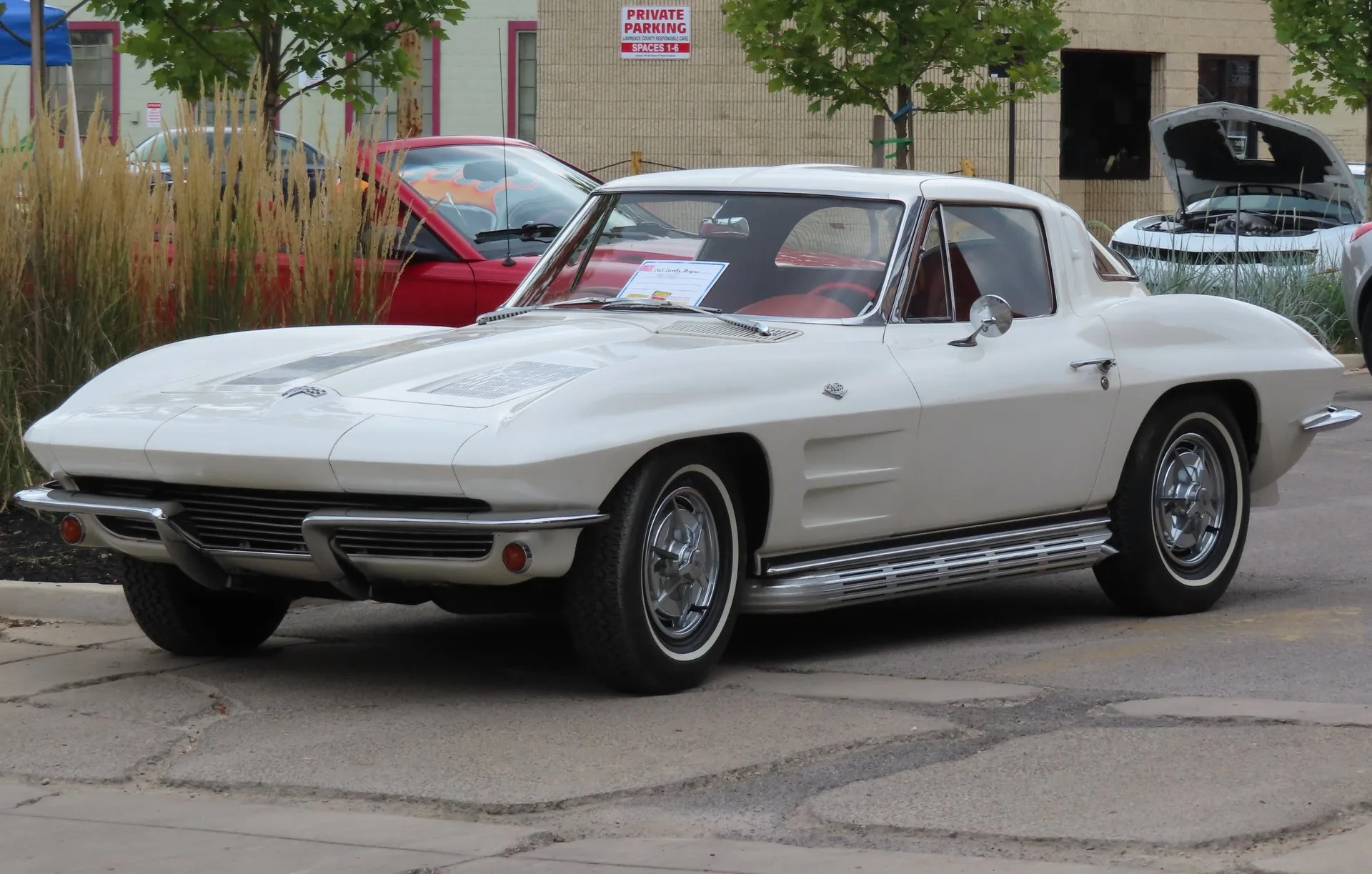
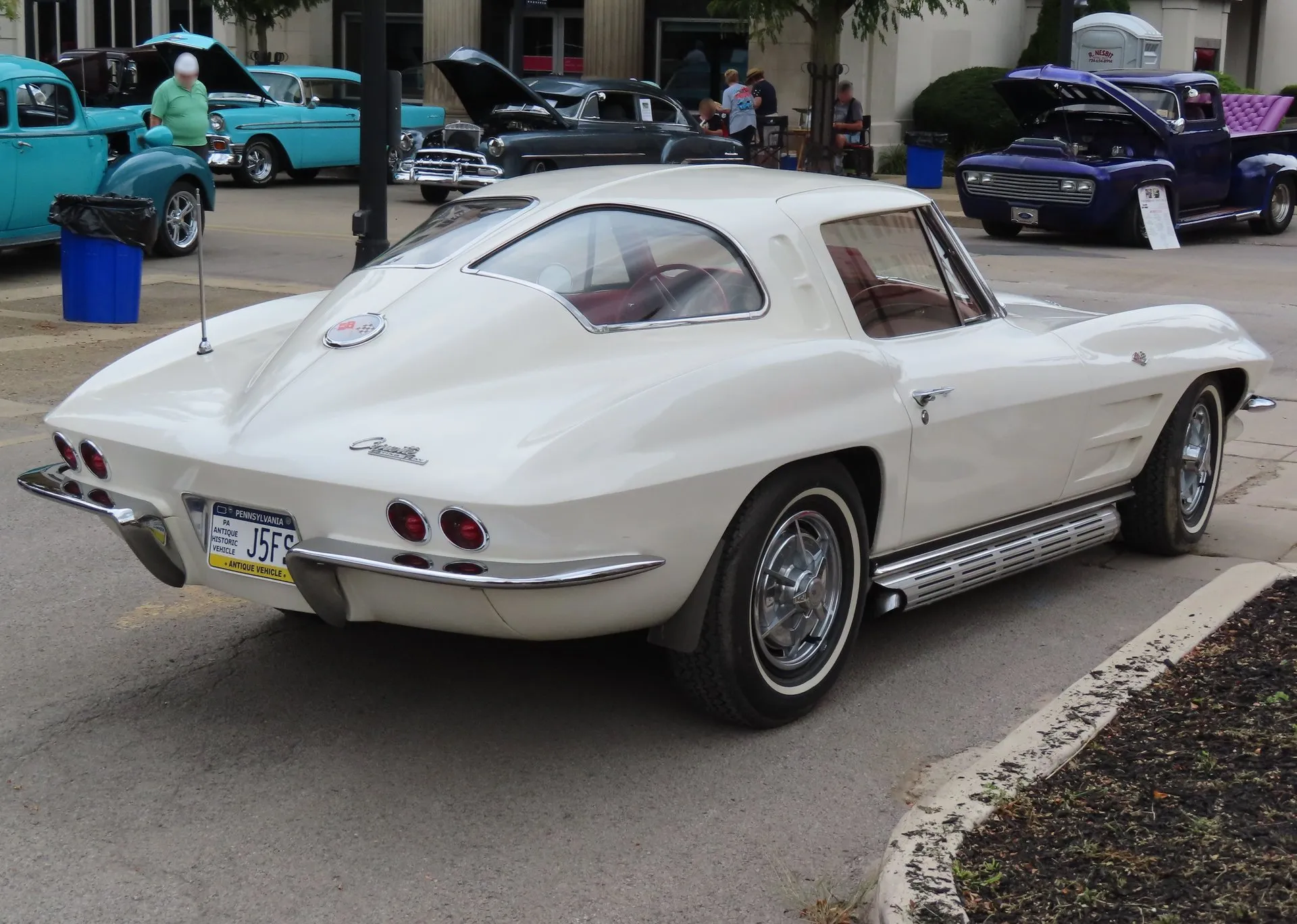
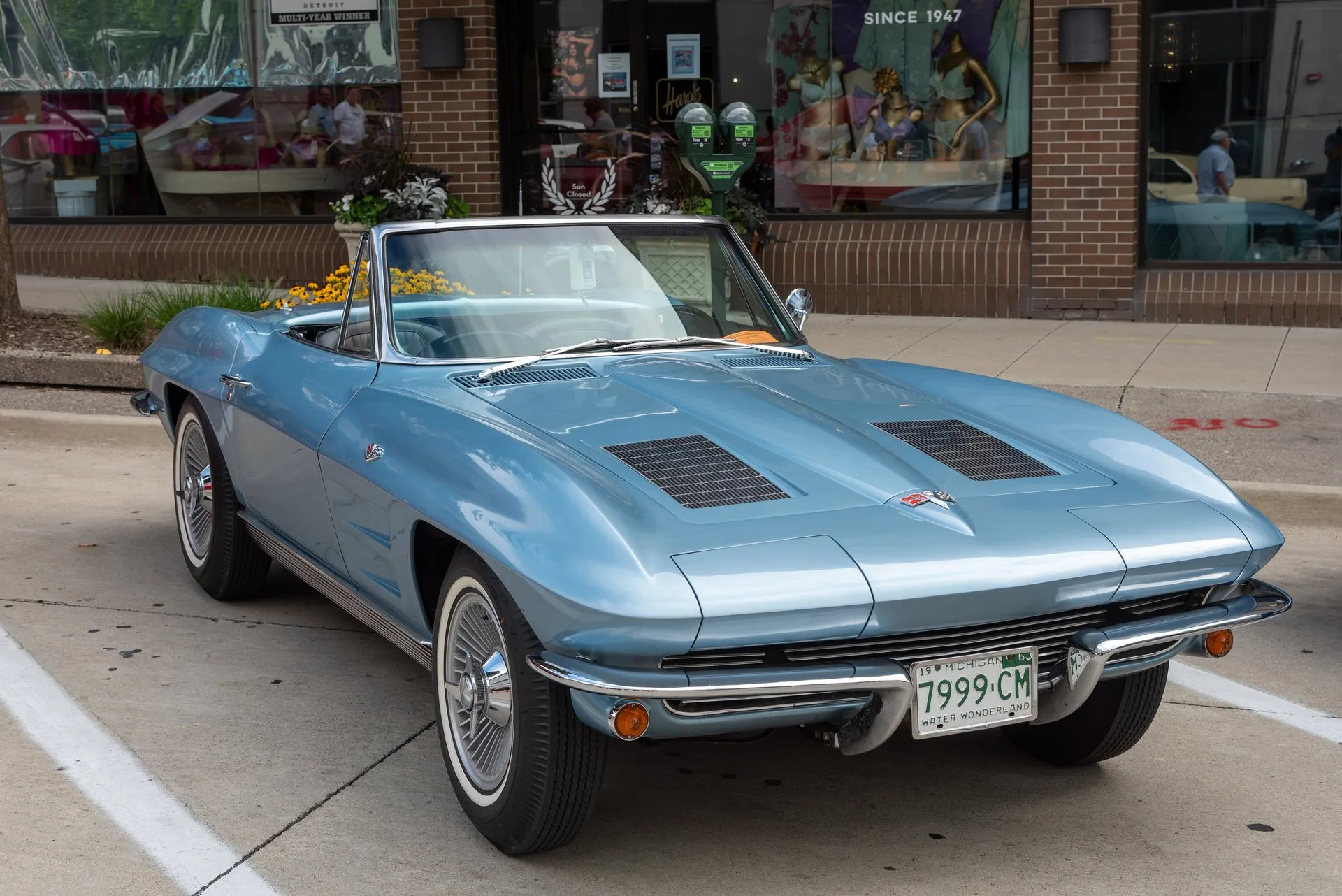
The engines carried over. Almost nothing else did. Around the 1962’s four 327s, the 1963 Corvette Sting Ray (two words in GM’s shop manual, usually written Stingray today) got a new ladder frame, independent rear suspension, headlights that rotated out of sight and, for the first time on a Corvette, a coupe body. The coupe’s roof ran a spine down through the rear glass and split it in two. The split lasted one model year: 10,594 coupes had it, and no other factory Corvette did.
GM’s shop manual called the first C2 (1963–1967) “an extensively redesigned vehicle.” Sixty-three years on, the split window sets a 1963’s price, and the numbers stamped into the car, checked against GM’s own records, decide whether a seller’s story holds up.
- Built: 21,513: 10,594 coupes and 10,919 convertibles, all assembled in St. Louis.
- Engines: a 327 V8 at 250, 300, 340 or 360 hp, all gross ratings. The 360 hp L84 had Rochester fuel injection and went into 2,610 cars.
- Price new: $4,252 coupe, $4,037 convertible, on GM’s June 14, 1963 price list.
- Split window: coupes only, and 1963 only.
- Z06: 199 built.
- What one costs: between January 1 and October 18, 2026, split-window coupes titled as stock sold for a median of $195,000 on Bring a Trailer (28 sales), and convertibles for $70,000 (13 sales).
The C2 buyer’s guide covers the whole generation: the steel birdcage and frame that rust, judging awards, and the 1964–1967 cars. This page stays on 1963.
C2 Key figures
- Built
- 21,513
- Coupes, convertibles
- 10,594 coupes and 10,919 convertibles
- Engines
- 327 V8 at 250, 300, 340 or 360 hp
- Price new, June 1963
- $4,252 coupe, $4,037 convertible
- Fuel-injected cars
- 2,610
- Z06 built
- 199
- 2026 split-window median
- $195,000 on Bring a Trailer
Section 01
The first Sting Ray: what was new for 1963
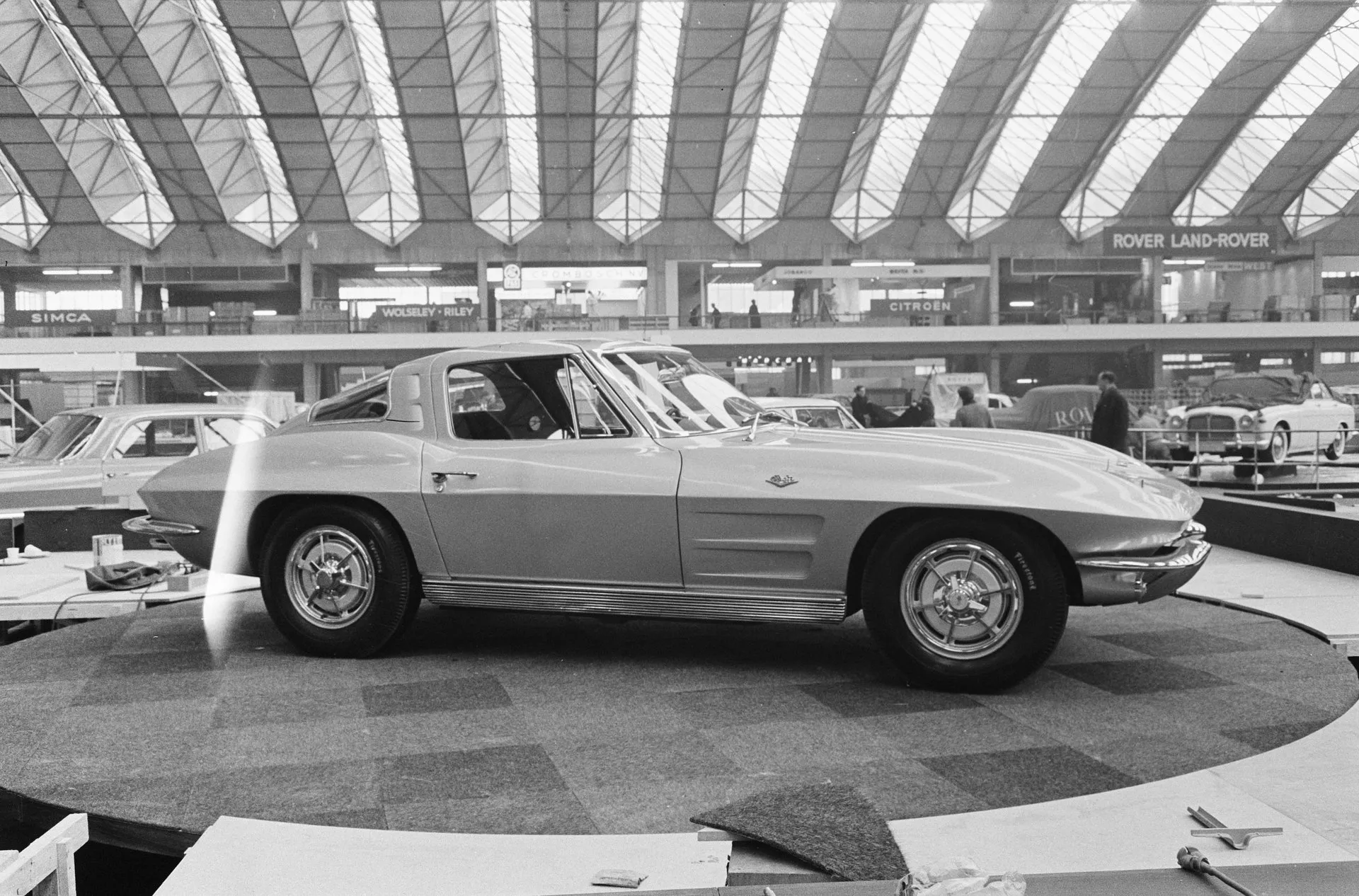
GM built two bodies on the new chassis: the model 837 Sport Coupe and the model 867 convertible, which could also take a removable hardtop (GM’s shop manual). The frame was an all-welded ladder with five crossmembers, replacing the X-braced frame of the C1 (1953–1962), and the rear suspension was independent: a fixed differential, a nine-leaf transverse spring, lateral struts and U-jointed half shafts (GM’s specifications).
GM gives a 98.0 in wheelbase, 175.3 in overall length and curb weights of 3,015 lb for the coupe and 3,037 lb for the convertible, with the base engine and three-speed. Its standard equipment list opens with four retractable headlights, worked by a rotation switch and watched by a position warning light. The tank held 20 gallons, filled at the center of the rear deck, and the brakes were 11 in self-adjusting drums all round, on a single hydraulic circuit.
The outside tells, per the Black Book (the Corvette reference whose pages GM reproduced in its kit): two rectangular trim panels glued into the hood’s forward recesses, raised pads under the door handles and, on coupes, stainless trim ahead of the vent window. CorvetteForum’s spotter’s guide adds non-functional fender vents and ribbed rocker trim with no paint between the ribs.
The four engine ratings matched the 1962’s (see the C1 guide). What grew was the order sheet: power brakes, power steering and air conditioning were all new for 1963, per Corvette Action Center.
Section 02
The split window: 1963 coupes only
The Black Book page in GM’s 1963 kit describes a center split in the coupe’s roof that carried on through the rear glass. The 1964 kit lists its removal among that year’s visible changes, along with the hood trim panels (the recesses stayed), and 1964 coupes got vents in the driver-side roof panel, with a fan pulling air through them.
Neither kit says why it went. Period testers complained that it blocked the view behind (the C2 guide has their words), and Hagerty says many drivers found it too hard to see out of.
What it means for a buyer:
- The serial number decides. Every factory split window sits on a serial starting 30837S. A split window on a serial starting 4 is a converted 1964, and conversions sell openly: on Bring a Trailer in 2026, a 1964 coupe turned into a split window, on a tube-frame chassis with an LS-based engine, sold for $250,000 on July 14 and again for $243,000 on October 6.
- It ran the other way too. One CorvetteForum poster (2015) says many more 1963s were converted into 1964s, given one-piece rear glass; nobody gives a period or a count. A 30837S coupe with one-piece glass is still a 1963 coupe, but it isn’t a split-window car and shouldn’t be priced as one.
- Faking one isn’t cheap. One poster counts over 261 parts unique to the 1963 (CorvetteForum, 2013), and another says many of the inside parts are very hard to find and very expensive (CorvetteForum, 2015).
Section 03
The four 327s, with their gearboxes and axles
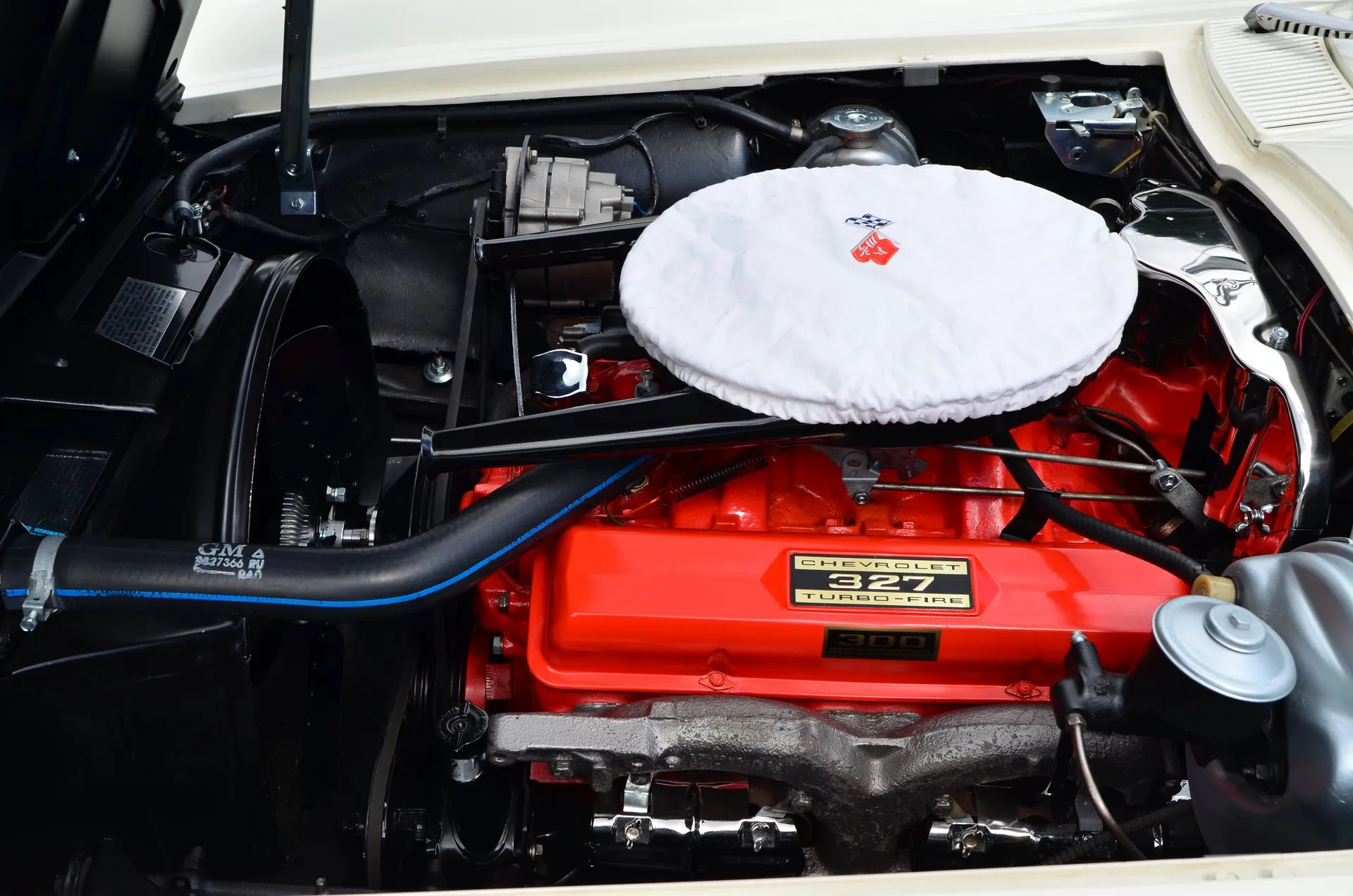
Every 1963 had a 327 cu in V8 (4.00 in bore, 3.25 in stroke) in one of four versions, rated gross in GM’s power teams chart and engine data:
| Engine | Fuel, lifters, compression | Gross hp | Gross torque | Built | GM price |
|---|---|---|---|---|---|
| Base 327 | Carter four-barrel, hydraulic lifters, 10.5:1 | 250 at 4,400 rpm | 350 lb-ft at 2,800 rpm | 3,892 (by subtraction) | Standard |
| L75 | Larger Carter four-barrel, hydraulic lifters, 10.5:1 | 300 at 5,000 rpm | 360 lb-ft at 3,200 rpm | 8,033 | $53.80 |
| L76 | Larger Carter four-barrel, special camshaft, mechanical lifters, 11.25:1 | 340 at 6,000 rpm | 344 lb-ft at 4,000 rpm | 6,978 | $107.60 |
| L84 | Rochester fuel injection, special camshaft, mechanical lifters, 11.25:1 | 360 at 6,000 rpm | 352 lb-ft at 4,000 rpm | 2,610 | $430.40 |
GM also rates the base engine at 210 hp net. The Black Book’s option line prints the L84 at 375 hp, which is the 1964 rating: GM’s 1963 price list, power teams and engine data all say 360. (GM’s shop manual table prints 5,000 rpm for the 340’s power peak and the fuelie’s torque peak; two other GM pages say 6,000 and 4,000, used here.)
- 250 and 300 hp: the standard three-speed, a wide-ratio four-speed (2.54:1 first gear) or the Powerglide automatic, on a 3.36:1 axle. Four-speed cars could have a 3.08:1 highway axle instead (G91, $2.20, 211 cars).
- 340 and 360 hp: the three-speed on a 3.36:1 axle, or a close-ratio four-speed (2.20:1 first gear) on a 3.70:1. Never Powerglide, power steering or air conditioning. On a four-speed car, every other ratio (3.08, 3.36, 3.55, 4.11 and 4.56) came only with Positraction.
The four-speed went into 17,973 cars and Powerglide into 2,621, which leaves 919 three-speeds. The Black Book says the four-speed’s maker changed from Borg-Warner to Muncie during the year, with no date or serial number, and this guide won’t guess one.
Period tests, as reproduced by Corvette Action Center (the magazines weren’t seen for this guide): Car Life’s 300 hp Powerglide coupe, December 1962, ran 0–60 mph in 7.2 seconds and the quarter mile in 15.5 seconds at 86 mph; Britain’s Motor timed a fuel-injected four-speed coupe at 6.2 and 14.6 seconds in December 1963. How Rochester injection behaves in hot traffic is on the C2 guide.
Section 04
Options, prices and colors
GM’s June 14, 1963 price list put the Sport Coupe at $4,252.00 and the convertible at $4,037.00, before taxes and options. (The Black Book and Hagerty print $4,257 for the coupe; this guide uses GM’s list, as the C2 guide does.) That bought the 250 hp engine, the three-speed and vinyl trim. The options that matter, priced from GM’s June list and counted by the Black Book:
| Code | Option | Price | Cars |
|---|---|---|---|
| G81 | Positraction rear axle | $43.05 | 17,554 |
| M20 | Four-speed manual | $188.30 | 17,973 |
| M35 | Powerglide automatic (250 and 300 hp only) | $199.10 | 2,621 |
| U65 | Signal-seeking AM radio (Black Book price) | $137.75 | 11,368 |
| U69 | AM-FM radio, phased in from about March 1963 | $174.35 | 9,178 |
| C07 | Hardtop for the convertible | $236.75, or no charge in place of the soft top | 5,739 |
| J65 | Sintered metallic brakes | $37.70 | 5,310 |
| A31 | Power windows | $59.20 | 3,742 |
| 941 | Sebring Silver paint | $80.70 | 3,516 |
| J50 | Power brakes | $43.05 | 3,336 |
| N40 | Power steering (not with 340 or 360 hp) | $75.35 | 3,063 |
| 898 | Saddle leather seats | $80.70 | 1,114 |
| C60 | Air conditioning (250 and 300 hp only) | $421.80 | 278 |
| Z06 | Special Performance Equipment | $1,818.45, later $1,293.35 | 199 |
| N03 | 36.5-gallon fuel tank, coupe only | $202.30 | 63 |
| P48 | Knock-off aluminum wheels | $322.80 | No retail delivery confirmed |
Of the hardtops, 1,099 replaced the soft top at no charge. GM’s June list no longer prints the U65 at all.
Colors. Seven, and only Sebring Silver cost extra: Tuxedo Black (code 900), Silver Blue (912), Daytona Blue (916), Riverside Red (923), Saddle Tan (932), Ermine White (936) and Sebring Silver (941). Counts survive for three: Riverside Red on 4,612 cars, Sebring Silver on 3,516 and Daytona Blue on 3,475. With no count for the other four, the surviving figures can’t name the rarest 1963 color.
Interiors and tops. Black, red, blue or saddle vinyl, or saddle leather, with a black, white or beige soft top on any paint. GM’s February 1963 color and trim chart pairs each paint with certain interiors (Riverside Red with black or red, Saddle Tan with saddle), but the Black Book suggests different pairings and says other combinations were possible, so an off-chart car isn’t wrong by default.
Section 05
The Z06, the big tank and the knock-off wheels
RPO Z06, Special Performance Equipment, launched as a coupe-only option at $1,818.45, including the N03 36.5-gallon tank and the P48 knock-off wheels. GM’s June 14, 1963 price list has it at $1,293.35 without them, and the sums agree: $1,293.35 plus $202.30 plus $322.80 is $1,818.45. (The Black Book’s $1,293.95 doesn’t add up.)
GM’s list describes power brakes with a dual-circuit master cylinder, special metallic brakes and heavy-duty stabilizers, shocks and springs, and says the price also included Positraction, the four-speed and the 360 hp fuel-injected engine. Its AMA supplement adds finned 11.2 in drums, a divided master cylinder with vacuum assist, 1.375 in rear shock pistons, a 550 lb/in front spring rate and a 0.94 in front bar. The package went on 199 cars. The Black Book says the revised Z06 was open to convertibles, and GM’s June list drops the coupe-only mark, but no convertible Z06 has been verified: Sports Car Market’s 2016 profile calls one a rumor most experts have ruled out.
The big tank
N03 fitted coupes only, at $202.30 with a wheel-house filler panel, and went on 63 of them; the Black Book counts tanks, not Z06 tankers, so how many were Z06s isn’t settled. Tank cars had their own inner rear wheel housings: in August 1964, Chevrolet Service News explained that a 1963–1964 coupe could take wide racing tires only with those housings fitted and the wheel openings cut (via Corvette Action Center). Faking a tanker is hard: one long-time poster said in 2005 that the interior fiberglass filler pieces had been unavailable for more than 30 years (Corvette Action Center forum).
The knock-off wheels
P48 listed five cast aluminum 15 x 6 in knock-off wheels at $322.80, and GM’s shop manual explains them, down to the mallet for the locking nuts. But the Black Book page in GM’s kit says porous aluminum and rim-seal trouble made tubeless tires leak, and that delivery of a 1963 with knock-offs to a retail customer “has not been confirmed”, though wheels were sold over the counter. Delivery was certain for 1964, on 806 cars. Knock-offs on a 1963 today prove nothing about how it left St. Louis.
The Grand Sport
GM says the Grand Sport legacy was established in 1963 and that only five were built (opens in new tab) before a corporate decision suspending direct motorsports involvement ended the project; Hagerty adds that privateers raced them. Five race cars, not a model anyone could order.
Section 06
How to tell a real 1963, and what gets faked
Nothing in a 1963’s serial number or trim tag records its engine, its Z06 package or its tank. The numbers still date the car and its parts, and a mismatch is where the questions start.
The serial number and the build month
GM’s identification page spells it out: 3 for 1963, 0837 for a coupe or 0867 for a convertible, S for St. Louis, then a unit number from 100001 to 121513. GM’s own example, 30837S102000, is the 2,000th car, if it was a coupe. The serial plate and the trim plate sit on the instrument panel brace under the glove box, and the Black Book’s last serial for each month dates the car:
| Built in | Last serial | Built in | Last serial |
|---|---|---|---|
| September 1962 | 100675 | March 1963 | 111833 |
| October 1962 | 102756 | April 1963 | 114128 |
| November 1962 | 104047 | May 1963 | 116409 |
| December 1962 | 105972 | June 1963 | 118524 |
| January 1963 | 107976 | July 1963 | 120990 |
| February 1963 | 109814 | August 1963 | 121513 |
Date-coded parts on an original car should fit that build date.
The trim tag
GM’s shop manual puts the body style (837 or 867), the body number and the trim and paint codes on it, and owners also read a build-date code. The Black Book says 1963 was the first year for coded tags and warns that inconsistencies exist. GM’s February 1963 chart codes the trims STD (black vinyl), 490A or 490B (blue), 490C or 490D (red), 490E or 490F (saddle vinyl) and 898A or 898B (saddle leather), coupe first, though the Black Book lists other suffix letters too. Posters on Corvette Action Center’s forum (2002) read one Z06’s tag as body 9728, the 9,728th coupe body; 490C, red vinyl; 900A, Tuxedo Black; and build code K-2, the second week of July 1963. On their reading the body number counts one body style, so it runs behind the serial.
The engine pad, and the codes 1964 reused
GM’s shop manual puts the engine number on a pad at the front of the block’s right side. Owners describe an F for Flint, date digits and a two-letter suffix, with the car’s serial derivative stamped beside it (Corvette Action Center forum, 2007). GM’s 1963 suffixes are RC and RD for the 250 and 300 hp engines with a manual gearbox, SC and SD for the same two with Powerglide, RE for the 340 and RF for the 360 hp fuelie. Per the Black Book, every 1963 block is casting 3782870, the 250’s heads are 3795896 and the other three engines’ 3782461, and the injection unit is Rochester 7017375.
The trap: the 1964 kit reuses RE for 1964’s 365 hp engine and RF for its 375 hp fuelie, keeps the other four suffixes and lists the same castings. Neither a suffix nor a casting number proves a 1963 engine; the date and the serial derivative have to fit the car.
The axle code, on the bottom of the carrier, gives the ratio: CZ 3.08, CA 3.36 and CX 3.70 for a conventional axle; CJ 3.08, CB 3.36, CC 3.55, CD 3.70, CE 4.11 and CF 4.56 for Positraction.
What gets faked
- Fuel injection. A new owner’s split-window coupe in a 2012 CorvetteForum thread wore FUEL INJECTION emblems over a Holley carburetor. Posters said to look for RF and the car’s serial digits on the pad, and that a CE stamp there (not the axle code) marks a Chevrolet replacement engine. NCRS’s definition of counterfeiting (opens in new tab) names the trick: an injection unit in place of the carburetor, with numbers and a suffix stamped on the block to look original.
- A 340 from a 300. One poster says 300 hp split windows are being turned into 340 hp cars (CorvetteForum, 2013). The two share heads and, with a manual gearbox, a carburetor number, so the pad’s suffix (RD or RE), date and derivative are where it shows, unless the pad has been restamped.
- Z06 and big tank. Sports Car Market’s 2016 profile warns that nothing on a vintage Corvette by itself proves its factory engine or options, and that restamps and faked paperwork can fool even experts. A Z06 or a tanker lives in documents and ownership history; the hardware can be added later.
The papers that help, and what NCRS and Bloomington Gold awards prove, are on the C2 guide. For a 1963, posters in a 2003 Corvette Action Center thread name NCRS’s 1963–64 Technical Information Manual and Judging Guide, GM’s assembly and shop manuals and Noland Adams’ restoration guide; part of the shop manual is in the 1963 kit, in this site’s owner’s manual library.
Section 07
GM’s 1963 bulletins: the first-year fixes
The 1963 was about four months into production when Chevrolet told dealers to start calling cars back in. What went wrong that year is on record in GM’s own dealer paperwork, as transcribed by Corvette Action Center (the originals weren’t seen for this guide):
- December 31, 1962 (bulletin DR #569 (opens in new tab)). Every 1963 built before serial S105362, the first 5,361 cars, sold or still in stock, was to come back: a stud holding one of the hood’s simulated grilles could rub through the radiator’s top-tank inlet. The same bulletin replaced parking brake levers that could be hard to release or jam (cars before S101893; lever
GM 3833251, OEM) and, on the 821 cars from S101847 to S102667, rear driveshaft flanges that might not seat (GM 3832048, OEM), with the spindle flanges’ bolt bosses checked for cracks. - February 28, 1963. Window regulator screws on early cars worked loose as their lock washers chewed into the plastic; a plain washer fixed it in production from December 27, 1962.
- April 30, 1963 (GM of Canada). The first-design glass stop could bend, letting the window drop below its lowered position and disabling the regulator; a second-design rear run assembly with a welded stop (
GM 3833307andGM 3833308, OEM) had been released. - May 27, 1963. On the 340 hp engine, an intake manifold baffle rivet hole could break into the intake passage at ports 4 and 6, causing excessive oil consumption or fouled plugs; the fix was epoxy on the rivet.
- July–August 1963 (Chevrolet Service News). On air-conditioned cars, the water outlet hose could chafe on the alternator brace.
- July 15, 1963 (GM of Canada). A badly latched hood could come open; a new lock-catch return spring (
GM 3841439, OEM) replaced the old one.
The Black Book adds running changes that help match a car to its build month: fiberglass headlight buckets on most cars and metal ones late in the year, roller-type fuel-door catches early and nylon slide catches later, and, about midyear, the under-seat depressions gone and a taller outside mirror.
NHTSA, the US road safety agency, holds no owner complaint (opens in new tab) and no recall for the 1963 Corvette (both checked October 18, 2026), and its bulletin files, which start in 1995, hold no GM bulletin for any Corvette before the 1984 model year. The complaint file starts in September 1994, three decades after these cars were new, so its silence says nothing either way.
The big bills are the generation’s, not the year’s: the steel birdcage inside the body and the frame’s rear kick-ups, which can rust on any C2. They’re in the C2 guide, with its inspection list.
Section 08
What to check before buying a 1963
- The serial: 30837S or 30867S, then 100001 to 121513. A split window on any other serial is a conversion.
- The build month, from the table in How to tell a real 1963, against the dated parts.
- The engine pad: a suffix that fits the car’s equipment, the car’s serial derivative and an assembly date ahead of the car’s build. RE or RF alone proves nothing.
- The trim tag, read against GM’s 1963 codes.
- Paper for every premium: fuel injection, a 340 hp engine, a Z06, the big tank. Knock-off wheels add nothing.
- The early-car fixes. Before S105362, rub marks at the radiator inlet; before S101893, a parking brake that releases cleanly; on S101847 to S102667, cracks in the rear spindle flanges’ bolt bosses.
- Windows, hood and headlights. Every window up and down without dropping past its stop, a hood that latches and stays shut, and headlights that rotate open on both sides with the warning light working.
- On a 340 hp car, oil smoke or fouled plugs point to the intake rivet bulletin.
- The birdcage and frame, on a lift, by the C2 guide’s checklist.
- Leave an original car original. Owners told a family with an unrestored split-window coupe to join NCRS and have it looked at before touching it, since it can only be original once (CorvetteForum, 2015). Pay an inspector who knows 1963s.
Section 09
What a 1963 Corvette costs in 2026
Bring a Trailer (opens in new tab) listed 96 Corvettes from the 1963 model year between January 1 and October 18, 2026, and sold 65, at a median of $134,000. That’s this site’s calculation from sold prices, without BaT’s buyer’s fee (5 percent, minimum $250, maximum $7,500, as of October 2026). “Titled stock” means the listing title doesn’t call the car modified, a project or a conversion. A title can’t show a restamp or a replacement engine, and BaT’s own summary of the cheapest stock coupe ($108,000, June 29) says it has a replacement 327.
| 1963s sold on Bring a Trailer, Jan. 1 to Oct. 18, 2026 | Sales | Median | Range |
|---|---|---|---|
| Split-window coupes, titled stock | 28 | $195,000 | $108,000–$282,000 |
| Of those, fuel-injected | 10 | $200,500 | $141,000–$282,000 |
| Of those, carbureted | 18 | $176,000 | $108,000–$278,000 |
| Convertibles, titled stock | 13 | $70,000 | $36,550–$144,000 |
| Of those, carbureted | 9 | $50,000 | $36,550–$93,000 |
| Modified cars | 15 | $130,000 | $43,000–$590,000 |
| Projects and body shells | 9 | $105,000 | $30,500–$150,000 |
The four fuel-injected convertibles brought $73,050 to $144,000, the top one with an NCRS Duntov award. Among coupes, a fuelie 53 years in one family made $282,000 (September 25) and a 340 hp car $278,000 (September 11). The two highest 1963 sales, $500,000 and $590,000, were builder-modified split-window restomods. No title named a Z06, and the 31 cars that didn’t sell were bid to a median of $131,000.
The C2 guide uses a shorter window, June 10 to October 6, 2026: 19 split-window coupes at a $195,000 median and 7 convertibles at $81,000. For scale, those months put the median 1964, coupe or convertible, at $60,250 (10 sales).
Hagerty’s price guide (opens in new tab), as captured by the Internet Archive, put condition #3 (Good) split-window coupes at $116,000 with the 250 hp engine, $130,000 with the L75 and $171,000 with the fuel-injected L84 in January 2026, up 7.4 to 8.3 percent from a year earlier. A big-tank Z06 was $452,000, unchanged. No convertible value was captured.
classic.com’s (opens in new tab) May 2026 benchmarks were $187,029 for a 1963 L84, $146,105 for an L76 and $608,920 for a Z06, up from $488,013 in October 2025; with one Z06 for sale in May, read that loosely. classic.com’s record 1963 Z06 sale is $1,242,500, for a 5,353-mile car at Gooding & Company’s Amelia Island auction on March 4, 2022.
The three measure different things (this year’s sales, a guide value for a car in good condition, a benchmark built from listings and sales), so don’t average them. All three put fuel injection above a carbureted coupe.
Section 10
Which 1963 to buy
The 1963 to buy is a split-window coupe with a carbureted 327 and numbers that agree with its paperwork. The split window is why collectors want the year, and in 2026 a carbureted one sold for a median of $176,000 on Bring a Trailer (18 sales), about $24,500 under the fuel-injected median (10 sales); both samples are small. If the budget stretches, make it a 340 hp L76 with an RE pad that fits the car: mechanical lifters, 11.25:1 compression and the year’s strongest carbureted rating.
A fuelie earns its premium only with proof: an RF pad, a date and a serial derivative that fit the car, and documents behind them. A Z06 is a documents purchase first and a car second.
The driver’s 1963 is a convertible: the same new chassis and engines for about a third of the coupe’s money, a $70,000 median against $195,000, and a carbureted one, at $50,000 (9 sales), is the budget way into the first Sting Ray. Fold the top, wind the 327 out through second, and the split window is the one 1963 feature you won’t miss.
Skip any 1963 whose split window, fuel injection or big tank the paperwork can’t carry, unless the price already treats it as what it can prove, and buy complete: one-year parts are what turn a tired 1963 into an expensive one. Get it right and you own the year America’s sports car grew a fixed roof, a new chassis and a split rear window it would never wear again.
The C2 guide covers 1964–1967, the C1 guide the cars before, and the best Corvette years guide shows where 1963 sits among every generation.
Section 11
Sources
- GM Heritage Center: 1963 Corvette vehicle information kit files.zipcorvette.com This site's library. PDF pages 4–5 (production, serial numbers by month, engine codes, running changes, options with counts and prices, colors: Corvette Black Book pages reproduced in GM's kit), 8 (GM price list, June 14, 1963, with the Z06 and N03 text), 9 (power teams), 10 (color and trim chart, February 1, 1963), 14 and 17 (AMA specifications and ratings), 22 (fuel system), 29–31 (gearboxes and axles), 32–36 (wheels, brakes and the Z06 supplement), 38 (rear suspension), 50 (weights), 59–61 (standard equipment, options and identification codes), 74 (engine data), 88–89 (shop manual: serial number locations and GM's description of the car), 162 (knock-off wheels) and 165 (shop manual specifications).
- GM Heritage Center: 1964 Corvette vehicle information kit files.zipcorvette.com This site's library. PDF pages 4–5: what changed for 1964, that year's engine suffix codes, knock-off wheel deliveries and production.
- Chevrolet Technical Service Bulletin DR #569, December 31, 1962: 1963 Corvette interim production changes (via Corvette Action Center) (opens in new tab) corvetteactioncenter.com Parking brake lever, rear driveshaft flange and radiator inlet, with serial number breakpoints. This and the bulletins that follow are Corvette Action Center's transcriptions of GM documents, not GM originals.
- Chevrolet Product Engineering Technical Information, February 28, 1963: loosening of door window regulator (via Corvette Action Center) (opens in new tab) corvetteactioncenter.com
- GM of Canada Product Service Bulletin, April 30, 1963: difficulty in raising door window (via Corvette Action Center) (opens in new tab) corvetteactioncenter.com
- Chevrolet Field Service Engineering, May 27, 1963: intake manifold baffle rivet hole leak, 340 hp engine (via Corvette Action Center) (opens in new tab) corvetteactioncenter.com
- Chevrolet Service News, July–August 1963: radiator service updates (via Corvette Action Center) (opens in new tab) corvetteactioncenter.com
- GM of Canada Service Bulletin, July 15, 1963: hood lock spring assembly (via Corvette Action Center) (opens in new tab) corvetteactioncenter.com
- Chevrolet Service News, August 1964: coupe body rework for larger racing tires (via Corvette Action Center) (opens in new tab) corvetteactioncenter.com The inner wheel housings used in production with the N03 tank, on 1963–1964 coupes.
- NHTSA owner complaints, 1963 Chevrolet Corvette (opens in new tab) api.nhtsa.gov Pulled October 18, 2026: none. NHTSA's complaint file begins in September 1994.
- NHTSA recalls, 1963 Chevrolet Corvette (opens in new tab) api.nhtsa.gov Pulled October 18, 2026: none.
- NHTSA manufacturer communications (TSB) file, received 1995–1999 (opens in new tab) static.nhtsa.gov This and NHTSA's later files hold no GM bulletin for any Corvette before the 1984 model year.
- GM: 2017 Corvette Grand Sport release (opens in new tab) web.archive.org Archived copy, March 2016. The Grand Sport legacy, established in 1963: five built before GM suspended direct motorsports involvement.
- Corvette Action Center: 1963 Corvette production and performance numbers (opens in new tab) corvetteactioncenter.com Production, options and colors, and reproduced period road tests (Car Life, December 1962; Motor, December 11, 1963). Fetched October 18, 2026.
- Corvette Action Center: 1963 Corvette identification numbers (opens in new tab) corvetteactioncenter.com
- CorvetteForum: Which Year is That!? The Ultimate C2 Corvette Spotter's Guide (opens in new tab) corvetteforum.com Cameron Vanderhorst, August 12, 2020.
- Hagerty: 1963–67 Corvette (C2) buyers guide (opens in new tab) hagerty.com Sajeev Mehta, April 15, 2020. Read via the Internet Archive's August 2024 copy (opens in new tab).
- Hagerty Price Guide: 1963 Chevrolet Corvette (opens in new tab) web.archive.org Condition #3 values, January 2026, from Internet Archive captures: this link is the 250 hp split-window coupe (captured February 7, 2026); also the L75 coupe (opens in new tab) (March 9, 2026), the L84 coupe (opens in new tab) (March 15, 2026) and the big-tank Z06 (opens in new tab) (February 18, 2026). The other grades need a login.
- classic.com: Chevrolet Corvette C2 market (opens in new tab) web.archive.org Archived May 17, 2026: the 1963 L76, L84 and Z06 benchmarks. Also the 1963 market page as archived October 10, 2025 (opens in new tab).
- classic.com: Chevrolet Corvette Z06 327/360 market (opens in new tab) web.archive.org Archived January 8, 2025. The record $1,242,500 sale.
- Bring a Trailer: Chevrolet Corvette C2 results (opens in new tab) bringatrailer.com 1963 model-year results from January 1 to October 18, 2026, read October 18, 2026. Counts, groups and medians are this site's calculation from each listing's title and sold price, which excludes BaT's buyer's fee (5%, minimum $250, maximum $7,500 on car auctions, per How BaT works (opens in new tab)).
- Sports Car Market: 1963 Chevrolet Corvette Z06 profile (opens in new tab) sportscarmarket.com Dale Novak, July 18, 2016.
- NCRS: judging awards (opens in new tab) ncrs.org NCRS's definitions of counterfeit versus restoration.
- Corvette Action Center thread: 1963 trim plate decode (opens in new tab) forums.corvetteactioncenter.com June and July 2002.
- Corvette Action Center thread: 1963 VIN and trim codes (opens in new tab) forums.corvetteactioncenter.com September 2003.
- Corvette Action Center thread: engine identification (opens in new tab) forums.corvetteactioncenter.com October 2007.
- Corvette Action Center thread: fuel tank question (opens in new tab) forums.corvetteactioncenter.com August 2005.
- CorvetteForum thread: 1963 split window (opens in new tab) corvetteforum.com December 2012.
- CorvetteForum thread: 1963 split window help (opens in new tab) corvetteforum.com February 2015.
- CorvetteForum thread: counterfeit 1963 coupes (opens in new tab) corvetteforum.com June 2015.
- CorvetteForum thread: fake 1963 split-window coupes (opens in new tab) corvetteforum.com February 2013.