C3 · Buying guide
1975 Corvette guide: the last convertible until 1986, the first catalytic converter and what to pay
Published
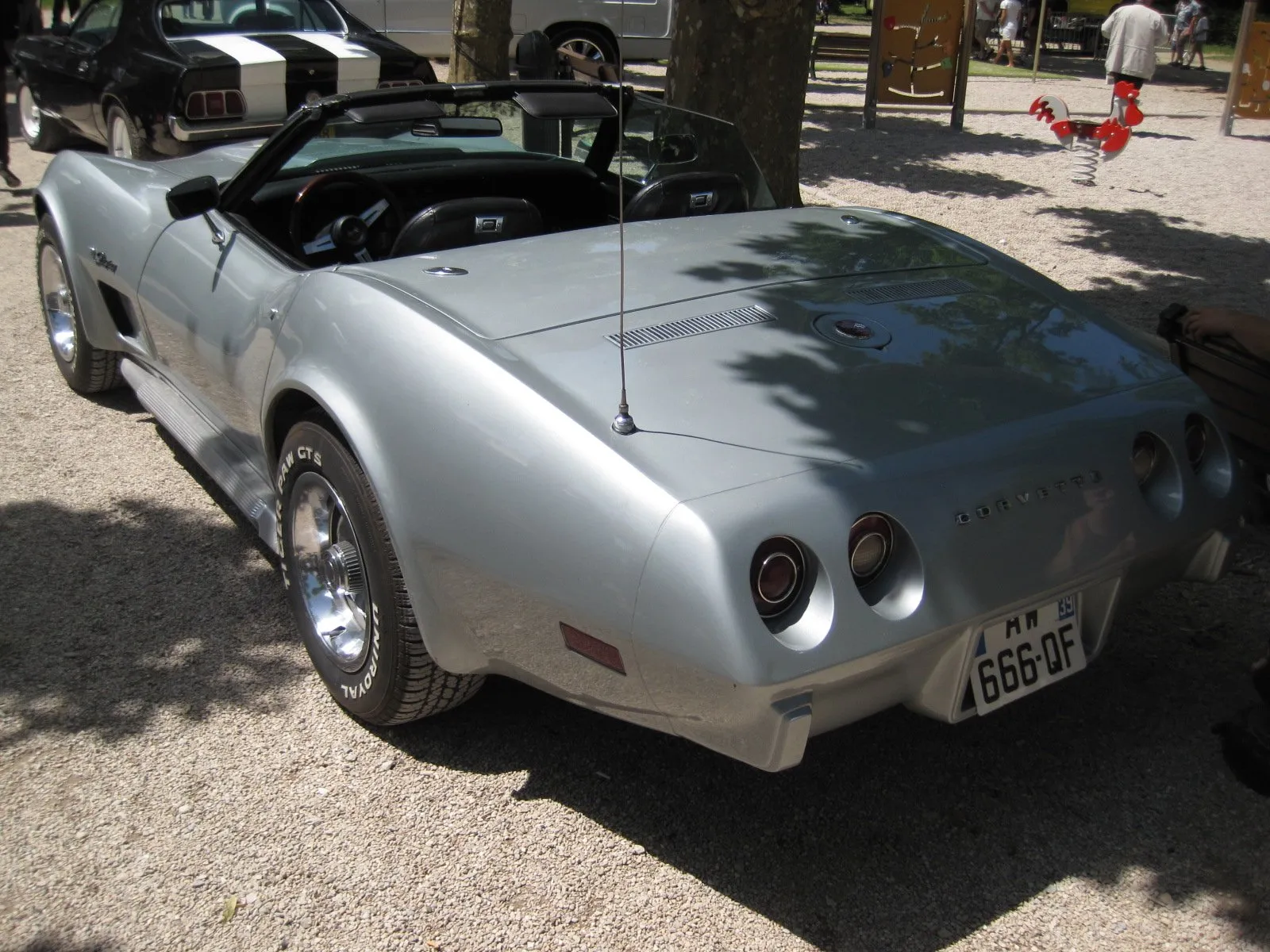
Chevrolet told its dealers in October 1974 that every 1975 Corvette shipped by rail would arrive with a 10-inch block between the right rear frame crossmember and the rear leaf spring. A tag on the inside mirror said to remove it before delivery. The reason, in Chevrolet’s Service News (opens in new tab): protecting the catalytic converter in transit. No Corvette had carried one before. The Corvette Black Book, a hobby reference whose pages GM reproduces in its Heritage Center kits, calls the 1974s “the last Corvettes without catalytic converters” (1974 kit).
That converter and the emission rules behind it made the 1975 the slowest C3 (1968–1982) on paper. Its two 350s were the 165 hp L48 and the 205 hp L82, the only optional engine. It was also the last Corvette convertible until 1986. Chevrolet built 38,465, including 4,629 convertibles, all at St. Louis.
The quick answers. A 1975 is a Stingray: GM’s standard exterior equipment list for the year includes the “Stingray” script on the front fenders (data book). GM’s price list, effective with the start of production, gives $6,810.10 coupe, $6,550.10 convertible. On Bring a Trailer in 2026, 9 sold, median $14,250. And it’s the newest Corvette California exempts from smog checks (see No smog check in California).
Frame and birdcage rust and the other problems every C3 shares live in the C3 buyer’s guide (the birdcage is the steel frame around the cabin, inside the fiberglass). This page covers what makes a 1975 a 1975, mostly from the 1975 GM Heritage Center kit in this site’s owner’s manual library.
C3 Key figures
- Built
- 38,465, including 4,629 convertibles
- Engines
- the 165 hp L48 and the 205 hp L82
- Price new
- $6,810.10 coupe, $6,550.10 convertible
- L82s built
- 2,372
- Firsts
- catalytic converter and HEI ignition
- Bring a Trailer, 2026
- 9 sold, median $14,250
- Hagerty #3 value
- $13,800 (January 2026)
Section 01
The soft top’s last summer
The Black Book’s 1975 page says the convertible “was for a time considered the ‘last’”, that production resumed in 1986, and that the last 1975 convertible was built in the last week of July 1975 (kit page 6). For 1976 GM listed one model, the coupe, and the 1976 guide picks up the story there. The C4 guide calls the 1986 car the first Chevrolet-built Corvette convertible since 1975.
How many 1975 Corvette convertibles were made? 4,629, against 33,836 coupes: 12.0 percent of the year, and about 15 percent fewer convertibles than 1974’s 5,474 (this site’s arithmetic from the two Black Book pages). The kit gives no reason for the decline or for the decision to stop, so this page doesn’t offer one.
The convertible was the cheaper car new: $6,550.10 against the coupe’s $6,810.10, a $260 gap, by GM’s price list. Its soft top came in black or white. A removable hardtop, RPO C07 (RPO is GM’s regular production option code), cost $267 and went on 2,407 cars; C08 covered that hardtop in vinyl for $350 in all, on 279. Custom shoulder belts, A85 at $41, were standard on the coupe and an option on the convertible, and 646 buyers paid for them.
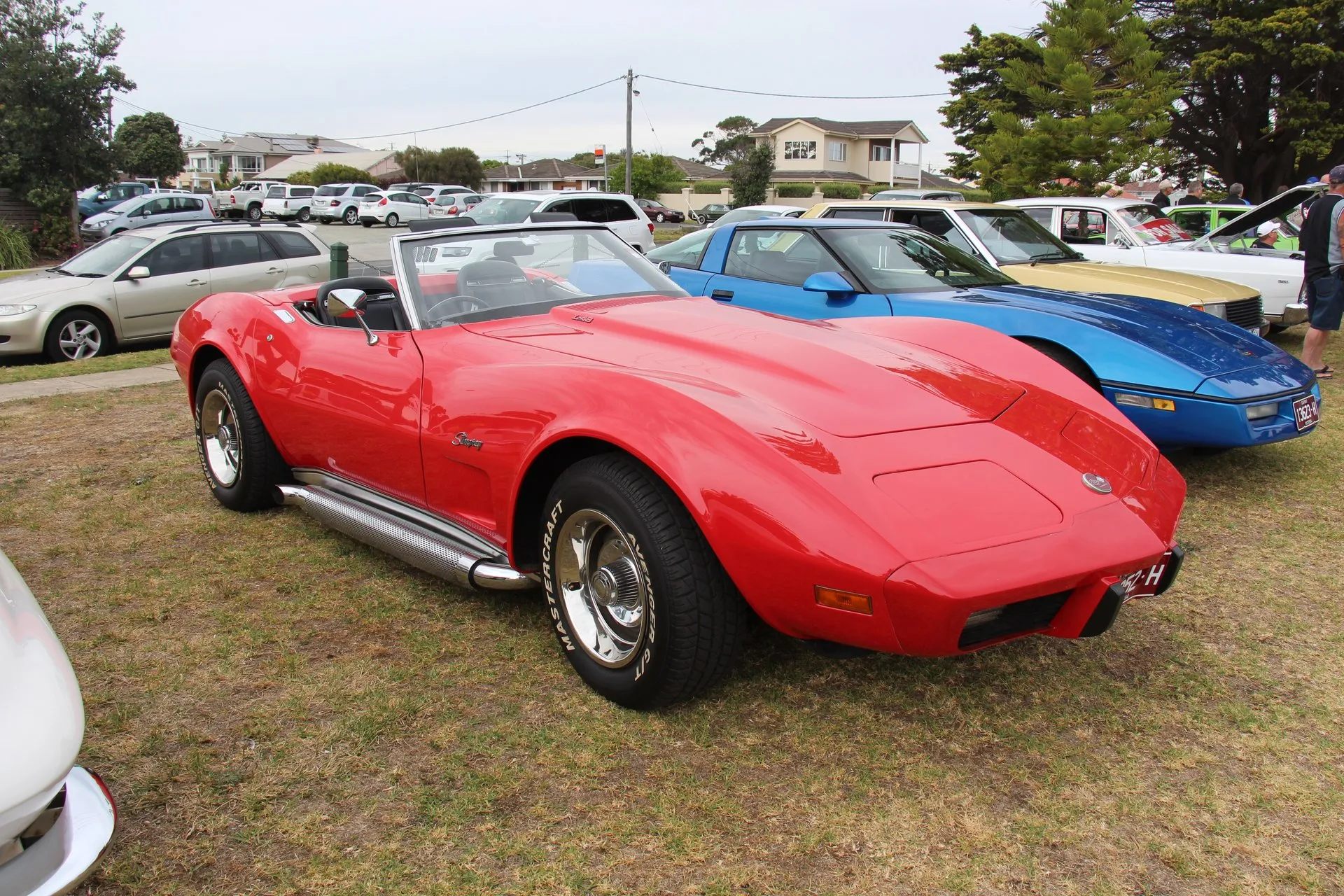
No Corvette built from 1976 to 1985 can stand in for one, and it sells that way (see What 1975s sold for in 2026).
Section 02
One converter, HEI and the 165 hp low point
GM’s data book calls the exhaust “dual, single converter with crossover”: two pipes into one converter under the floor and two out again, on every engine in every state, alongside air injection at the exhaust ports, exhaust gas recirculation (EGR), crankcase ventilation and evaporative controls (emission controls).
Two firsts define the year, then: the catalytic converter and HEI ignition. GM lists the ignition as High Energy Ignition, HEI, and the Black Book calls it the Corvette’s first distributor without breaker points. It also says HEI required the tachometer to be driven electronically, so 1975 is the first year of the electronic tach (see Four complaints, no recall: the 1975 record, for what that means now). Two smaller firsts, per the Black Book: kilometer-per-hour markings on the speedometer face and a buzzer that warns when the headlights are left on.
How much horsepower does a 1975 Corvette have? 165 hp at 3,800 rpm and 255 lb-ft at 2,400 rpm from the standard L48, and 205 hp at 4,800 rpm and 255 lb-ft at 3,600 rpm from the L82, both SAE net ratings for a 350 cu in (5.7 L) V8 with a four-barrel carburetor (engine data). The 1974 small-blocks made 195 and 250 hp beside the last 454 big-block (1974 kit), and the 1976s climbed back to 180 and 210 hp. Both 1975 ratings are the lowest of the C3, and the C3 guide and the best-years guide both put 1975 among the slowest C3s. The Black Book adds that one optional engine was the fewest choices since 1955, and that 1975 was the first year since 1964 with a single engine size.
Unlike the C3’s earlier drop, when GM switched from gross to net ratings (the C3 guide explains), this one is real: 1974’s figures were net too.
Why is the 1975 Corvette so slow? The emission rules, mostly. The National Corvette Museum records that Zora Arkus-Duntov retired as Corvette chief engineer in 1975, and that his successor, Dave McLellan, knew GM’s push to meet the decade’s emissions, safety and fuel economy rules could bring the car to its knees. GM’s service pages put a base coupe at 3,525 lb and a convertible at 3,539 lb, on a 98.0 in wheelbase.
Slow is relative. As Corvette Action Center tabulates it, Car and Driver’s May 1975 test of a base automatic ran 0–60 mph in 7.7 s and the quarter mile in 16.1 s at 87.4 mph, with a 129 mph top speed. GM’s speedometer still read to 160 mph.
Is 1975 a good year for the Corvette? For speed, no. To own, yes: the C3 guide finds no C3 year mechanically bad, and the 1975 adds a fiberglass floor and California’s smog exemption.
Section 03
The $336 L82, and the gearboxes behind both engines
The L82 cost $336 and went into 2,372 cars, about one 1975 in sixteen. GM’s specification pages for the MVMA, the carmakers’ trade association (internals) show what the money bought:
| L48 | L82 | |
|---|---|---|
| Compression | 8.5:1 | 9.0:1 |
| Power | 165 hp at 3,800 rpm | 205 hp at 4,800 rpm |
| Torque | 255 lb-ft at 2,400 rpm | 255 lb-ft at 3,600 rpm |
| Crankshaft | Cast nodular iron | Forged steel |
| Main bearing caps | 5 caps, 10 bolts | 5 caps, 16 bolts |
| Cam duration, intake and exhaust | 280° and 288° | 346° and 340° |
| Valve lift, intake and exhaust | 0.390 and 0.410 in | 0.450 and 0.460 in |
| Price | Standard | $336 |
| Built | 36,093 (this site’s arithmetic) | 2,372 |
| VIN, fifth character | J | T |
Both were legal everywhere: GM’s MVMA form lists the L82 for “all states”, and the Black Book gives a California code for an L82 automatic. For 1976 the L82 left California. The Black Book also says hood emblems naming the L82 first appeared in 1975.
When were 1975 L82s built? GM’s price list offers it from the start of production, with no monthly breakdown. An owner survey points later: a CorvetteForum poster’s count of 66 1975 L82s, gathered from 1999 to 2004, found none earlier than about serial 19,000 (opens in new tab), built around March 21, 1975. That’s owners’ data, not GM’s, but an “L82” built in the fall of 1974 deserves extra proof.
The gearboxes, by GM’s transmission pages:
- M20 wide-ratio four-speed (2.64, 1.75, 1.33, 1.00): no cost, either engine. About 8,935 cars, by subtraction.
- M21 close-ratio four-speed (2.43, 1.61, 1.23, 1.00): no cost, L82 only, 1,057 cars.
- M40 Turbo Hydra-matic automatic (2.48, 1.48, 1.00, with a 12.20 in torque converter): no cost with the L48, $120 with the L82, on 28,473 cars, 74.0 percent of the year.
One automatic served both engines, the Turbo Hydra-matic 400 by owners’ accounts (CorvetteForum, 2006 and 2008); for 1976 the L48 got a lighter one. GM’s data book codes its four-speed example to Muncie, while owners say every 1975 four-speed was a Borg-Warner Super T-10 (CorvetteForum, 2007).
Axles, from GM’s power team chart: 3.36 for an L48 four-speed (3.08 optional), 3.08 for an L48 automatic (2.73 optional), 3.55 for an L82 four-speed (3.70 optional with the close-ratio box) and 3.36 for an L82 automatic (3.55 optional). An optional ratio cost $12, on 1,969 cars. Positraction, Chevrolet’s limited-slip differential, came with every axle, and air conditioning with every ratio except 3.70.
FE7, the Gymkhana suspension, was $7 for a stiffer front anti-roll bar and springs, with any engine and gearbox, and 3,194 buyers took it. Z07, the off-road suspension and brake package, came only with the L82 and the M21: heavy-duty brakes front and rear, FE7 and power brakes, on 144 cars. GM’s price list says $403 for Z07; the Black Book says $400.
Section 04
What buyers paid for: 1975 options and prices
Prices in this table are GM’s, from the price list “effective with production of 1975 vehicles” (pages 28 and 29); the counts are the Black Book’s.
| RPO | Option | GM price | Cars |
|---|---|---|---|
| N41 | Power steering | $129 | 37,591 |
| J50 | Power brakes | $55 | 35,842 |
| C60 | Air conditioning | $490 | 31,914 |
| N37 | Tilt-telescopic steering column | $82 | 31,830 |
| QRZ | White-letter GR70-15 tires | $48 | 30,407 |
| A31 | Power windows | $93 | 28,745 |
| U58 | AM-FM stereo radio | $284 | 24,701 |
| U05 | Dual horns | $4 | 22,011 |
| UF1 | Map light | $5 | 21,676 |
| UA1 | Heavy-duty battery | $15 | 16,778 |
| C50 | Forced-air rear window defogger | $46 | 13,760 |
| U69 | AM-FM radio | $178 | 12,902 |
| QRM | White-stripe GR70-15 tires | $35 | 5,233 |
| FE7 | Gymkhana suspension | $7 | 3,194 |
| YF5 | California emission certification | $45 | 3,037 |
| L82 | 205 hp engine | $336 | 2,372 |
| Z07 | Off-road suspension and brake package | $403 | 144 |
The Black Book differs on three prices: J50 $50, YF5 $20 and Z07 $400. GM’s start-of-production figures lead here, but a window sticker with the Black Book’s isn’t automatically wrong. The $154 custom interior has no count.
Buyers paid for ease, not speed: power steering went on 97.7 percent of cars, air conditioning on 83.0 percent, the L82 on 6.2 percent (this site’s arithmetic). The base price covered the T-tops or soft top, the wide-ratio four-speed and vinyl seats, and every 1975 rode on 15 × 8 wheels painted silver, with trim rings and hub caps.
Ten colors, two sets of names
GM’s 1975 data book marks seven of the ten colors new for the year (color chart), and its names differ from the Black Book’s for every color but Bright Yellow. The counts are the Black Book’s:
| Code | GM’s name | Black Book’s name | Cars |
|---|---|---|---|
| 10 | White | Classic White | 8,007 |
| 13 | Silver Metallic (new) | Silver | 4,710 |
| 67 | Medium Saddle Metallic (new) | Medium Saddle | 3,403 |
| 76 | Red | Mille Miglia Red | 3,355 |
| 74 | Red Metallic | Dark Red | 3,342 |
| 70 | Flame Red (new) | Orange Flame | 3,030 |
| 56 | Bright Yellow (new) | Bright Yellow | 2,883 |
| 22 | Medium Bright Blue Metallic (new) | Bright Blue | 2,869 |
| 42 | Bright Green Metallic (new) | Bright Green | 1,664 |
| 27 | Dark Steel Blue (new) | Steel Blue | 1,268 |
What color is 1975 code 70? GM’s data book calls it Flame Red; the Black Book calls it Orange Flame. Same code, same paint. Steel Blue lasted about three months, per the Black Book, and the counts fall 3,934 cars short of production because some cars had non-standard paint or left in primer.
Six vinyls, five leathers
The standard vinyl came in black, dark blue, light neutral, medium saddle, dark oxblood and silver. The $154 custom interior added leather seat trim, wood-grain accents on the console and doors, lower door carpet and cut-pile carpet, in black, medium saddle, silver, dark blue and dark oxblood (the Black Book calls oxblood dark red). Every car had a 160 mph speedometer, a 7,000 rpm tachometer, an electric clock, the anti-theft alarm and a console plate with crossed flags, by GM’s list.
Section 05
The VIN, the pad and the tail that date a 1975
The VIN plate is on the left windshield pillar (serial numbers). GM’s example reads 1Z37J5S400025: 1 for Chevrolet, Z for Corvette, 37 for the coupe (67 for a convertible), J for the 165 hp engine (T for the 205 hp L82), 5 for 1975, S for St. Louis, then a serial from 400001 to 438465. How can you tell a 1975 L82? A T in fifth place. A J means an L48, whatever the hood or the valve covers say.
Dating a car by its serial. The Black Book gives the last serial built each month, so the last digits place a car in its build month:
| Month | Last serial | Month | Last serial |
|---|---|---|---|
| October 1974 | 402385 | March 1975 | 420856 |
| November 1974 | 406180 | April 1975 | 425228 |
| December 1974 | 409190 | May 1975 | 429379 |
| January 1975 | 413159 | June 1975 | 433474 |
| February 1975 | 417112 | July 1975 | 438465 |
The trim plate, with the body number, trim and paint codes, sits on the upper left door hinge pillar, per GM’s location chart. Its build-month letter runs from A for October 1974 to J for July 1975, by Corvette Action Center’s table, and its codes should match the colors and trims in What buyers paid for: 1975 options and prices.
The engine pad is at the top front of the right cylinder bank. GM’s example, F1210CHA, reads plant (F, Flint), month and day, then a suffix. The Black Book’s suffixes for 1975:
- L48 manual: CHA, CHU, CRJ, CUA, CUB. L48 automatic: CHB, CRK, and CHZ for California.
- L82 manual: CHC, CRL, CUD, CUT. L82 automatic: CKC, CRM, and CHR for California.
GM’s data book prints only the basic four (CHA, CHB, CHC, CHR) and calls CHR simply the L82 automatic; the California split is the Black Book’s. Both engines share block casting 3970010 and head casting 333882, as 1976 did, so castings can’t tell an L82 from an L48. Owners also look for a VIN derivative on the pad; the C3 guide explains what “numbers matching” can prove.
The axle code is on the bottom edge of the carrier flange: AY for 2.73, AW for 3.08, AX for 3.36, AA for 3.55 and AB for 3.70.
The tail tells the year. By this site’s reading of the 1974–1976 kits, the 1975 is the only C3 with both a one-piece urethane rear bumper cover and vents on the deck behind the rear window. The Black Book gives the 1974 a two-piece cover with a seam down the middle; the 1975’s is one piece, with shock absorbers inside and simulated pads like the front’s. For 1976 the deck vents went and a one-piece nameplate replaced the block letters. Block letters, vents and no seam make a 1975, unless parts have been swapped, so the VIN still decides.
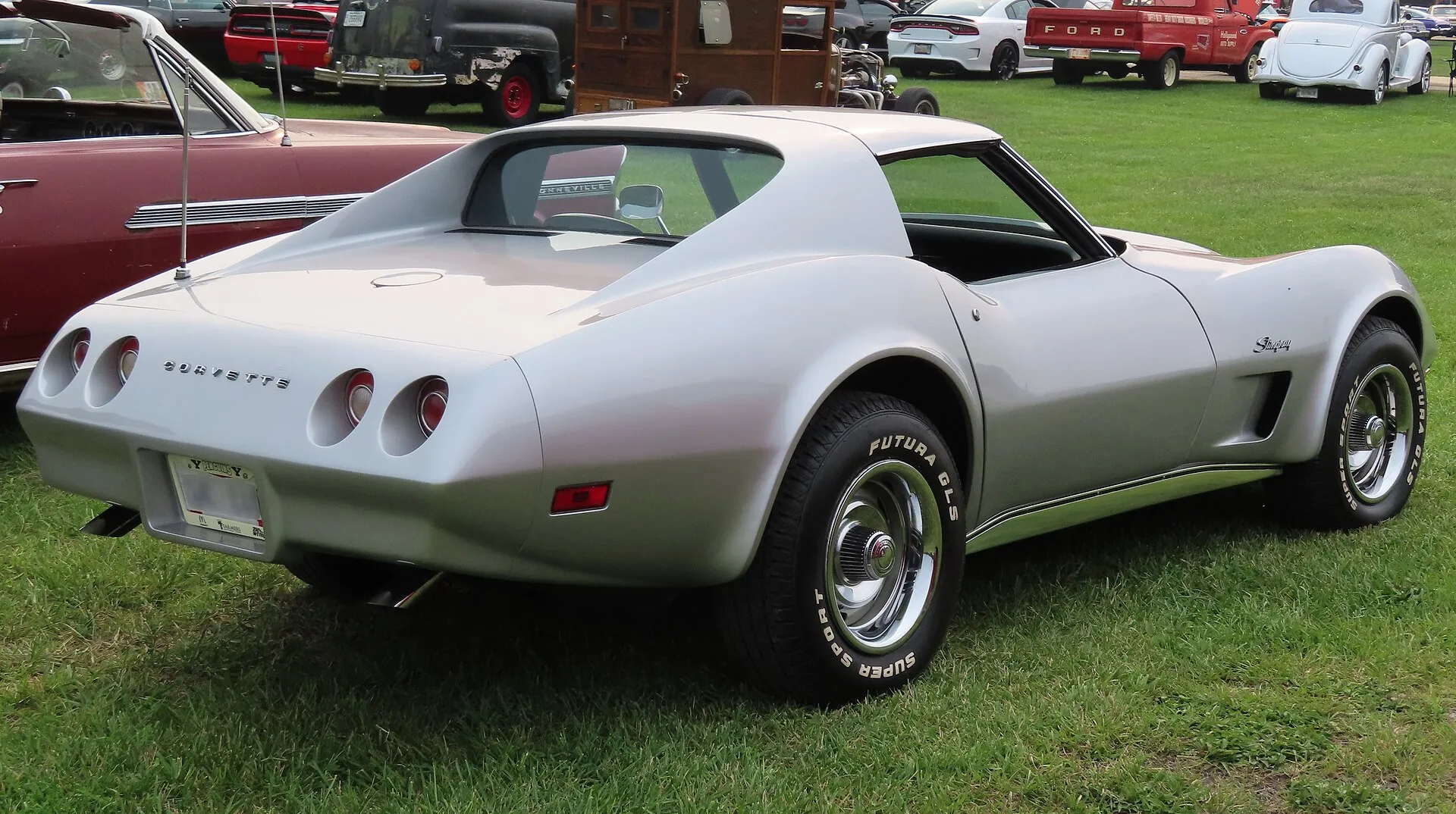
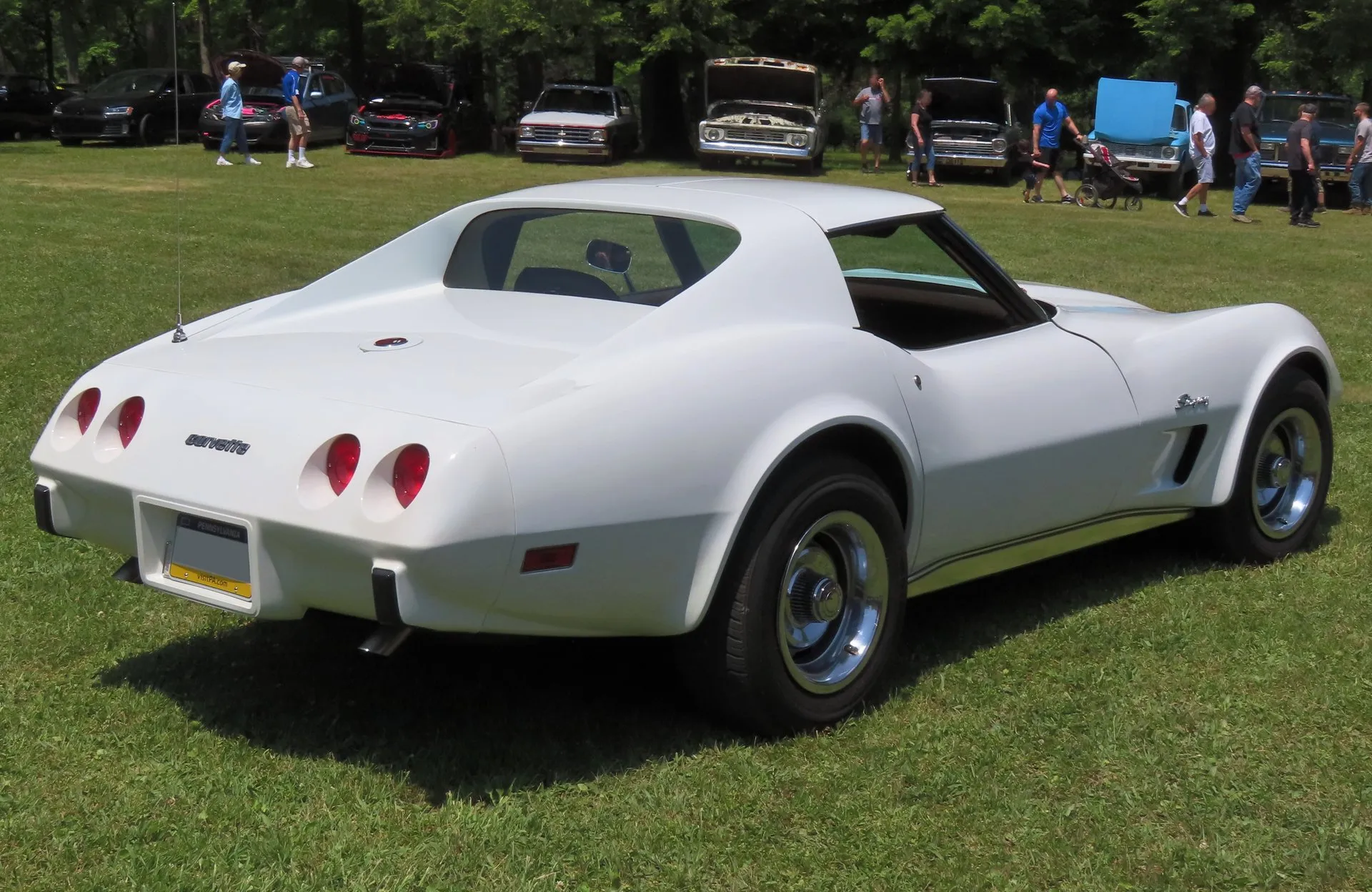
What gets faked. No special edition existed to copy, so the usual fake is an L48 dressed as an L82. Finned aluminum valve covers and L82 hood emblems prove nothing, owners warn, because anyone can bolt them on (CorvetteForum, 2020). Read the VIN, then the pad suffix, then the paperwork.
Section 06
Four complaints, no recall: the 1975 record
NHTSA’s complaint file (opens in new tab) holds four complaints for a 1975. One, filed in 2007, describes a brake pedal that dropped to the floor when its clevis pin and retaining clip fell out, with no crash; the others concern aftermarket tires (2018 and 2023) and leaks and oil filters (2019). The file starts in September 1994, so it says nothing about these cars new, and four records are not a pattern.
There is no GM recall for 1975, only two aftermarket-part campaigns (Cardone remanufactured rear calipers of 2002–2003 and Fram racing oil filters), and NHTSA’s bulletin files hold nothing for the year. Chevrolet’s own paper, transcribed by Corvette Action Center, adds three items:
- 75-T-3 (January 17, 1975): on 1974–1975 four-speed cars, a dead speedometer could mean a stripped driven gear (opens in new tab), from friction in the speedometer adapter. A low-friction adapter (
GM 1565211, OEM) and key (GM 6476870, OEM) went into production that month and were released for service. - Service News, June 1975: an HEI service update, issued because the information wasn’t in the 1975 shop manual. Only the title survives in the archived copy.
- 77-T-48 (July 1977): “torque shake”, a vibration in the steering wheel and floor at around 55–60 mph under power on 1973–1977 cars, traced to rear wheel camber and cured by resetting it.
The electronic tach. Owners say it takes its signal from the HEI distributor through a filter on the intake manifold, and that a dead or jumpy needle is usually that filter, a loose wire or the tach’s circuit board. A bad filter makes the needle read high and bounce, and owners bypass it to test before pulling the dash (CorvetteForum, 2006, 2017 and 2021).
The floor is fiberglass. GM’s 1975 body description names no steel in the underbody, where the 1976’s names a steel front section, and those steel floors rust; one owner chose a 1975 partly for that (CorvetteForum, 2017). The birdcage is still steel, and a new 1975 owner found it rusted behind the kick panels (CorvetteForum, 2021).
Everything else (frame rust, T-top and windshield leaks, vacuum headlights, calipers, rear wheel bearings, power steering) is the C3’s, covered in Known C3 problems in the C3 buyer’s guide.
Section 07
No smog check in California
Does a 1975 Corvette need a smog check in California? No, as of October 2026. California exempts gasoline cars of model year 1975 and older, per its DMV (opens in new tab), and the Bureau of Automotive Repair says 1976 and newer collector cars still need a Smog Check (both read October 22, 2026). That makes the 1975 the newest Corvette a Californian can register without one, and CorvetteForum owners have named it as a reason to buy since at least 2017. A 1976 doesn’t get the pass, whatever a seller says. Other states set their own rules; this page checked only California’s.
Section 08
Nine checks before paying for a 1975
- The birdcage and frame first, by the C3 checklist: pull the kick panels to see the body mounts, look at the windshield corners, and check the frame ahead of the rear wheels. A good frame doesn’t mean a good cage.
- The VIN’s fifth character before paying anything extra for an L82: T or nothing. Then the pad suffix (CHC, CRL, CUD, CUT, CKC, CRM or CHR).
- The build month from the serial. By the owners’ survey, a claimed L82 built before March 1975 needs paperwork behind it.
- The tail and the deck: a one-piece rear cover, block letters and deck vents. Anything else means another year’s parts, or another year’s car.
- The tachometer, with the engine running. A dead or jumpy needle is often the filter on the intake manifold, a cheap fix, but price it in.
- The speedometer on a four-speed car, especially one built before January 1975 (75-T-3).
- The catalytic converter. Some are gone, like the converter and smog parts on the car in the 2020 L82 thread. Know what your state requires before you register it.
- On a convertible, the top, the frame it folds on and any hardtop that comes with it; on a coupe, the T-tops and their seals. Damp carpet means leaks, which feed the birdcage rust.
- The paperwork: a window sticker, invoice or build sheet beats any badge. Then an inspection on a lift, by a shop that knows C3s.
Section 09
What 1975s sold for in 2026
What is a 1975 Corvette worth? On Bring a Trailer (opens in new tab), 12 1975s were listed between January 1 and October 22, 2026, and 9 sold, median $14,250, from $4,300 to $34,000 (this site’s count of sold prices, without the buyer’s fee; the last 1975 auction ended August 10):
| 1975 sales on Bring a Trailer | Sold | Median | Range |
|---|---|---|---|
| Coupes, 2026 | 7 | $13,500 | $4,300–$23,000 |
| Convertibles, 2026 | 2 | n/a | $18,750 and $34,000 |
| All, 2026 | 9 | $14,250 | $4,300–$34,000 |
| All, 2025 | 11 | $13,500 | $3,300–$25,000 |
The top sale was a 2,700-mile convertible with its hardtop and an award from the NCRS (the National Corvette Restorers Society, which judges cars against factory condition), at $34,000. An L82 four-speed convertible with side exhaust added brought $18,750. Among coupes, an 11,000-mile four-speed with an NCRS Top Flight award made $23,000, an L82 four-speed with a Holley carburetor $13,500, and a modified project $4,300. Three more were bid to $10,250–$23,500 without selling.
Across 2025 and 2026 together, 20 sold at a median of $13,875: six convertibles at a median of $19,375 against $13,000 for the 14 not titled as convertibles, and seven L82s at a median of $17,250. Samples this small are market color, not a forecast.
Hagerty’s price guide (opens in new tab), as the Internet Archive captured it in March 2026, puts a #3 (Good) L48 coupe at $13,800 (January 2026), down from $14,800 in April 2025, and adds 10 percent for a four-speed and 2 percent for the Gymkhana suspension. Hagerty’s public figure covers only that coupe, and classic.com offered no 1975 figure this site could cite.
For scale, the C3 guide’s median for all 1973–1977 cars is $11,550 (13 sales, June to September 2026), and the 1976 guide’s 2026 median is $10,500 (7 sold). On those small samples, 1975 coupes sold a little above 1976s, and the convertibles well above both.
Section 10
After 1975: the coupe-only 1976
The 1976 dropped the convertible and sold a record 46,558 coupes. Its engines climbed to 180 and 210 hp, but the L82 left California. Steel went into the front of the floor, the deck vents and block letters went, the carburetor stopped breathing through the grille at the back of the hood, and aluminum wheels arrived as an option (1976 kit). The 1976 Corvette guide covers it in full.
Section 11
Buy the soft top, if the cage is solid
The pick is a convertible with a sound birdcage. It’s why the year matters: one of 4,629, and the only 1975 no 1976–1985 car can replace. It costs more, about $19,375 at the median across 2025 and 2026 on a small sample, and it should. Check the cage and the top before the paint.
For driving, an L82 four-speed with the T in its VIN. The forged crank, four-bolt mains and bigger cam are worth having. Pay for the T and the pad suffix, never the badges, and if the owners’ survey holds, expect a build date from March 1975 on.
On a budget, a sound L48 coupe. It’s what most buyers took, the 2026 coupe median was $13,500, and parts for its 350 are everywhere. It’s also the easiest 1975 to make stronger: headers, a better cam and a freer exhaust cost no rarity at all. Nobody stops at 165 hp, and nobody should.
Skip any 1975 with a rotted birdcage unless the price already pays for the rebuild. Get the steel right, and a 1975 is America’s sports car at bargain money: the last Corvette convertible until 1986, or a T-top coupe a Californian never has to take to a smog station.
Section 12
Sources
- GM Heritage Center: 1975 Corvette vehicle information kit files.zipcorvette.com This site's library. The reproduced Corvette Black Book pages (PDF pages 6 and 7: production, VINs, engine codes, monthly serial numbers, options with counts, colors, the year's facts), GM service information (10 and 11: dimensions, curb weight, keys, serial number locations), GM's price list effective with the start of 1975 production (28 and 29), the September 1974 dealer data book (30 to 71: serial numbers 32, exterior equipment 33, interior equipment 35, colors and trims 46, body construction 47, power teams 57, engines 58, exhaust 65, emissions 66, ignition 69, transmissions 70 and 71) and the MVMA specification form issued September 1974 (72 to 100: power teams 76, engine internals 79 and 80).
- GM Heritage Center: 1974 Corvette vehicle information kit files.zipcorvette.com This site's library. Black Book pages: 1974 production and engines, the two-piece rear bumper, the last year without a catalytic converter and the last 454 (PDF pages 6 and 7).
- GM Heritage Center: 1976 Corvette vehicle information kit files.zipcorvette.com This site's library. What changed for 1976: coupe only, production, engines, the new steel underbody, the deleted deck vents and the lighter L48 automatic (PDF pages 18, 27, 34 and 119).
- NHTSA owner complaints, 1975 Chevrolet Corvette (opens in new tab) api.nhtsa.gov Four complaints, filed 2007–2023; pulled October 22, 2026. NHTSA's complaint file begins in September 1994.
- NHTSA recalls, 1975 Chevrolet Corvette (opens in new tab) api.nhtsa.gov Pulled October 22, 2026. No GM recall. Aftermarket-part campaigns 03E032000 (opens in new tab) (Cardone calipers) and 07E088000 (opens in new tab) (Fram oil filters).
- NHTSA manufacturer communications (TSB) file, received 1995–1999 (opens in new tab) static.nhtsa.gov This and NHTSA's later files hold no GM bulletin for a 1975 Corvette; the earliest Corvette model year in them is 1984.
- Chevrolet Service News, October 1974: shipping block removal, 1975 Corvettes shipped via rail (via Corvette Action Center) (opens in new tab) web.archive.org Internet Archive copy. Volume 46, Number 10. Transcriptions of Chevrolet's bulletins, here and in the entries that follow, are not GM or NHTSA originals.
- Chevrolet dealer bulletin 75-T-3: stripped speedometer driven gear, 1974–1975 Corvette with 4-speed transmission, January 17, 1975 (via Corvette Action Center) (opens in new tab) web.archive.org Internet Archive copy.
- Chevrolet Service News, June 1975: High Energy Ignition system service update (via Corvette Action Center) (opens in new tab) web.archive.org Internet Archive copy. Only the title and date survive in the copy; the scanned article did not.
- Chevrolet dealer bulletin 77-T-48: vehicle vibration during acceleration, July 1977 (via Corvette Action Center) (opens in new tab) web.archive.org Internet Archive copy. 1973–1977 models.
- California DMV: Smog Inspections (opens in new tab) dmv.ca.gov Gasoline vehicles of model year 1975 and older are exempt. Read October 22, 2026.
- California Bureau of Automotive Repair: Collector Cars (opens in new tab) bar.ca.gov Model-year 1975 and older do not require a Smog Check; 1976 and newer do (Health and Safety Code sections 44011(c) and 44012(f)). Read October 22, 2026.
- National Corvette Museum: Dave McLellan (opens in new tab) corvettemuseum.org Zora Arkus-Duntov's retirement as chief engineer in 1975 and his successor. Read October 22, 2026.
- Corvette Action Center: 1975 Corvette production and performance numbers (opens in new tab) web.archive.org Internet Archive copy. Car and Driver's May 1975 test figures as tabulated there. Also its 1975 identification (opens in new tab) page (trim plate month letters and the 1976 tooling changeover, citing Peter J. Licastro's history of the St. Louis plant).
- Hagerty valuation tool: 1975 Chevrolet Corvette L48 coupe (opens in new tab) web.archive.org Internet Archive copy of March 11, 2026. #3 (Good) value $13,800 on the value graph dated January 2026, the quarterly series before it, and the four-speed and Gymkhana adjustments.
- Bring a Trailer: Chevrolet Corvette C3 results (opens in new tab) bringatrailer.com 1975 listings only, January 1, 2025 to October 22, 2026. Counts and medians are this site's, from each listing's sold price without the buyer's fee. 2026 sales named in the text: the 2,700-mile convertible (opens in new tab) (May), the L82 four-speed convertible (opens in new tab) (April), the NCRS Top Flight four-speed coupe (opens in new tab) (May), the L82 four-speed coupe (opens in new tab) (May) and the project coupe (opens in new tab) (May).
- CorvetteForum thread: 1975 C3, how do I know if I have an L82 or L48 (opens in new tab) corvetteforum.com May 2020.
- CorvetteForum thread: how many 1975 L82 four-speed convertibles were produced (opens in new tab) corvetteforum.com November 2007. An owner survey of 66 1975 L82s.
- CorvetteForum thread: 1975 convertible value (opens in new tab) corvetteforum.com September 2018. Owner-reported prices.
- CorvetteForum thread: 1975 electronic tach problem (opens in new tab) corvetteforum.com September 2006.
- CorvetteForum thread: 1975 Corvette tach filter diagnostics (opens in new tab) corvetteforum.com July 2017 to March 2020.
- CorvetteForum thread: 1975 Corvette tachometer problem (opens in new tab) corvetteforum.com June 2021.
- CorvetteForum thread: 1975 was not a bad year (opens in new tab) corvetteforum.com March 2017.
- CorvetteForum thread: birdcage rust on a 1975 (opens in new tab) corvetteforum.com October 2021.
- CorvetteForum thread: 1976 Corvette transmission (opens in new tab) corvetteforum.com March 2006. The automatics before and after 1976.
- CorvetteForum thread: L82 with the M40 transmission (opens in new tab) corvetteforum.com November 2008.