C3 · Buying guide
1976 Corvette guide: the last Stingray script, the new steel floor and what to pay
Published
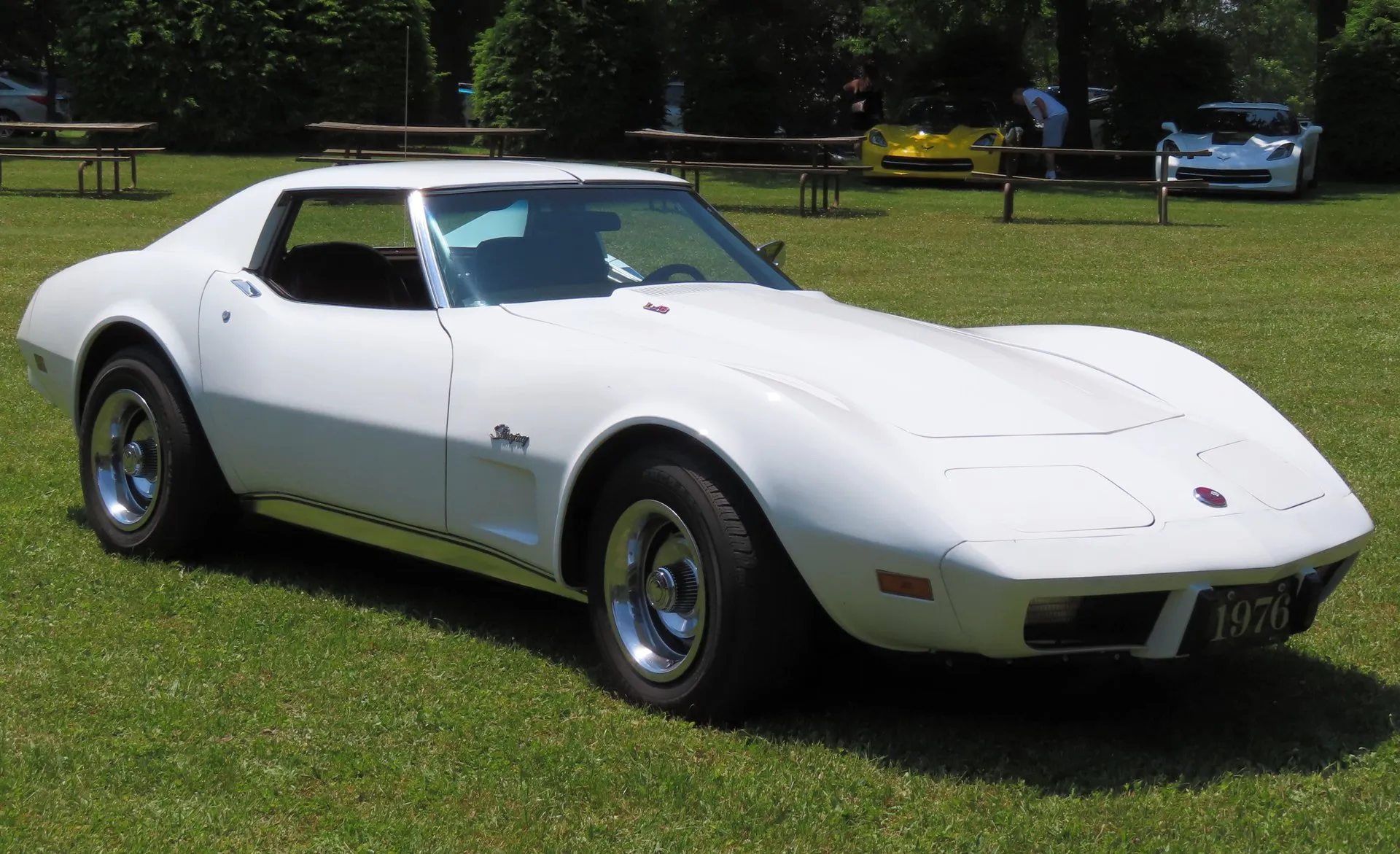
The new sport steering wheel in a 1976 Corvette was the same one Chevrolet fitted to the Vega. The Corvette Black Book, a hobby reference whose 1976 page GM reproduces in its Heritage Center kit, calls it “the same unit used for Chevrolet Vegas”, and owners add the Camaro Z28 and other Chevrolet sport models to the list (CorvetteForum, 2014–2017). That wheel sums up the eighth model year of the C3 (1968–1982): no convertible, 180 hp in base form, parts from the corporate shelf, and more buyers than any Corvette had ever had.
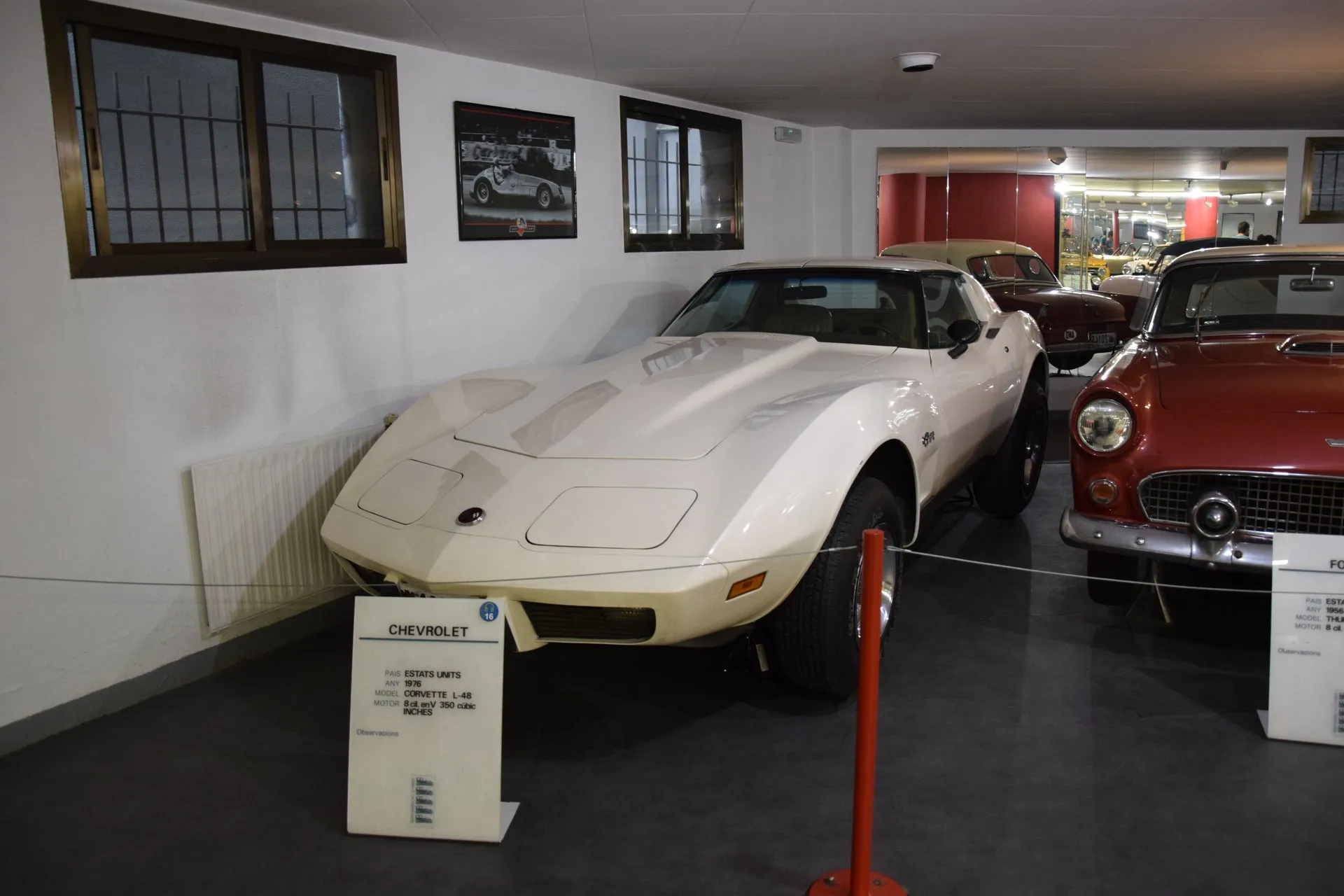
Chevrolet built 46,558, every one a coupe, all at St. Louis. The 1976 was the first C3 with steel in its underbody, the first sold with factory aluminum wheels, and the last to wear Stingray script on its front fenders.
The quick answers: a 1976 is a Stingray, the last one until the 2014 C7 (see Stingray for the last time). It had two 350s, the 180 hp L48 and the 210 hp L82, and no convertible was built. The Black Book gives the base price as $7,604.85. On Bring a Trailer in 2026, 7 sold, median $10,500, by late August.
Generation-wide trouble, frame and birdcage rust above all, lives in the C3 buyer’s guide (the birdcage is the steel frame around the cabin, inside the fiberglass). This page covers what makes a 1976 a 1976, mostly from GM’s own 1976 paper in this site’s owner’s manual library: the dealer order guide, the brochure, a specification form and the data book.
C3 Key figures
- Built
- 46,558, every one a coupe
- Engines
- the 180 hp L48 and the 210 hp L82
- Price new
- $7,604.85
- L82s built
- 5,720
- Aluminum wheels
- $299, on 6,253 cars
- Bring a Trailer, 2026
- 7 sold, median $10,500
- Hagerty #3 value
- $11,800 (January 2026)
Section 01
Coupe only, and more of them than ever
The soft top went first. GM’s 1975 Black Book page says the 1975 convertible was “for a time considered the ‘last’”, and that one came back for 1986 (1975 kit). For 1976 the order guide and the brochure list a single model, the 1YZ37, which the brochure calls the Stingray Coupe. Was there a 1976 Corvette convertible? No, not from the factory.
Buyers didn’t care. Production jumped to 46,558 from 1975’s 38,465, up about 21 percent, and past the old record, 1969’s 38,762 (see the table in the C3 guide). Hagerty calls it “an all-time record”, true for its day only: 1977 built 49,213, and 1979 the C3 high of 53,807.
The Black Book’s monthly serial numbers show the run: from August 1975, 16,696 built by the end of December, and the last of the 46,558 in August 1976, the month the first 1977s were built.
What did a 1976 Corvette cost new? The Black Book prints $7,604.85, up from $6,810.10 for a 1975 coupe. It also says power brakes ($59) and power steering ($151) began the year as options and were folded into “an increased base price during 1976”, and the December 1975 order guide no longer lists either (option index). Whether $7,604.85 was the starting or the final price, the kit doesn’t say. Every 1976 got power brakes, and all but 173 got power steering.
The car is 185.2 in long and 69.0 in wide on a 98.0 in wheelbase. GM’s service pages give 3,531 lb at the curb, the C3 guide’s figure, and GM’s specification form for the MVMA (the carmakers’ trade association) 3,541 lb.
Section 02
Stingray for the last time
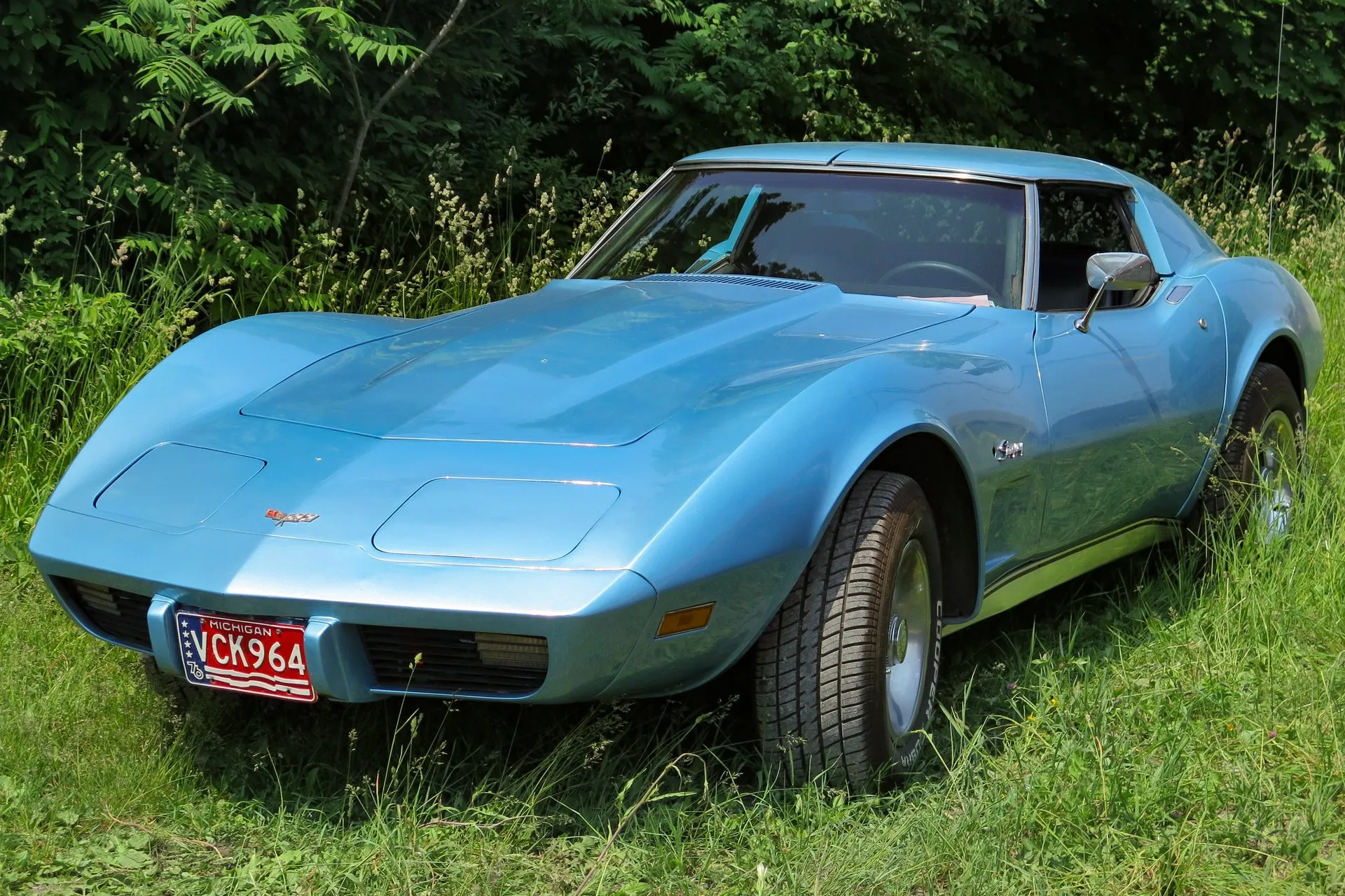
Is a 1976 Corvette a Stingray? Yes, and it’s the last C3 that is. GM’s 1976 list of standard exterior equipment includes a “Front Fender Nameplate, ‘Stingray’ Script” (data book). The 1977 list, dated September 1976, has no fender nameplate at all, and its nose emblem turns to crossed flags (1977 kit). Hagerty’s Brandan Gillogly writes that the badge ran through 1976 and the name stayed away until the 2014 C7, which is what the 1980 and 1982 guides report too.
The one-word script arrived for 1969, and the generations guide explains the spellings. A seller’s “last year of the Stingray” is true here, and only here.
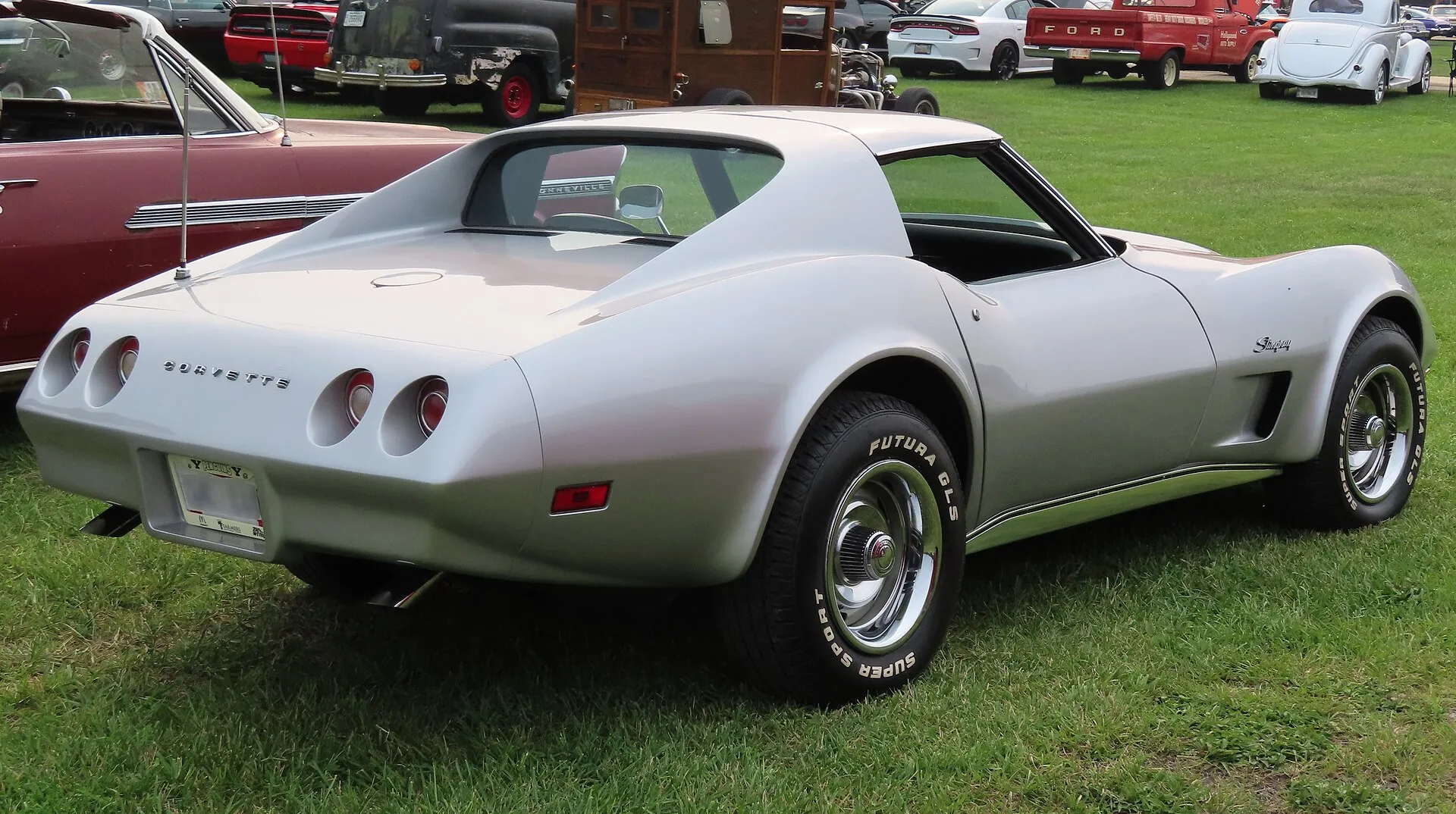
There’s a practical use for it. Earlier coupes have vents on the deck behind the rear window, which 1976 deleted, and a 1977 has no script. A car that shows the script and a smooth deck is a 1976, unless someone has swapped parts, so the VIN still has the last word (see The X in the VIN, the pad suffix and the badge trap).
Section 03
The hood that stopped howling, and the other one-year details
Through 1975, the carburetor breathed through the grille at the back of the hood, at the base of the windshield. The Black Book says air drawn in there was “producing a howl audible from within the car”, so for 1976 the inlet moved forward, above the radiator, with a temperature-controlled air cleaner that GM’s brochure draws and calls a new induction system. “The 1976 hood is unique to the year,” the Black Book says.
Owners explain why it doesn’t look unique: the 1976 hood keeps the grille at its rear edge, but the ducting under it is gone, so the grille does nothing; 1977 deleted it (CorvetteForum, 2014–2017). By that account, a 1976 with a working cowl duct, or no grille at all, is wearing another year’s hood.
The rest of the list, from the Black Book and the brochure:
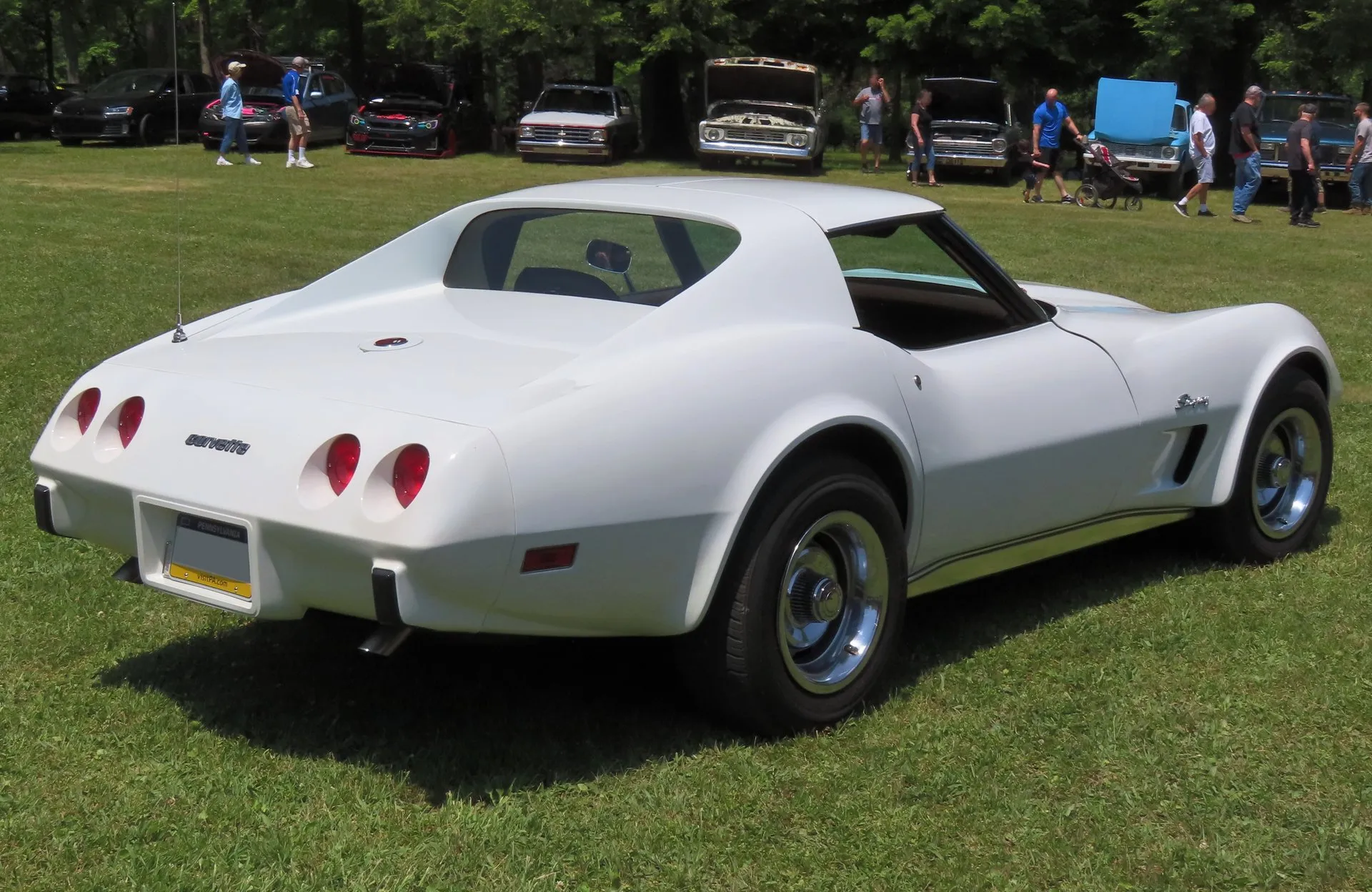
- The deck vents went. The vents on the rear deck just behind the back window were deleted. Corvette Action Center and Hagerty tie that to the end of the Astro Ventilation system.
- A new nameplate on the tail. The brochure calls the rear “Corvette” nameplate new, and Corvette Action Center calls it one piece. The Black Book says two styles were used: smaller, recessed letters first, then larger ones.
- The Vega wheel. Four spokes, color-keyed vinyl, crossed flags in the hub, by GM’s interior equipment list, which also lists a 160 mph speedometer and 7,000 rpm tachometer.
- A sealed battery. The maintenance-free Delco Freedom battery came with every 1976.
- 1977 parts in late cars. “A significant number” of late 1976s got parts normally associated with 1977, especially in the interior, the Black Book says, and owners report early and late cars taking different radiator hoses (CorvetteForum, 2021). A late car’s odd part isn’t automatically wrong.
Section 04
The steel floor, and what it means now
GM’s brochure calls it a “new partial steel underbody structure for improved body rigidity and quieter passenger compartment”, and its data book lists “steel front and plastic rear” underbody members. The Black Book adds the other reason: to better isolate the cockpit from engine heat. Engineers ran the engines hotter on purpose, it says, to raise efficiency and partly offset the power the emission rules had cost.
Are 1976 Corvette floors steel? At the front, yes, and that’s the catch fifty years on: fiberglass doesn’t rust, and steel does. Owners tie floor rot to the water that rots birdcages, coming in at the windshield frame and the T-tops. In one 2009 thread a 1976 bought out of Chicago needed new pans, and another poster says the 1978–1982 floor seemed to hold up better (opens in new tab) and can be fitted to a 1976. Another owner says buyers think these cars are all fiberglass until they find holes “everywhere” in the pans (CorvetteForum, 2011).
The repair is welding. Replacement steel pans cost owners about $250–$259 each in 2008 and 2009 (their figures, long out of date), and the originals are spot-welded at the sides (CorvetteForum, 2008 and 2009). Some owners have fiberglassed over rust holes and report years without trouble; a shop owner in a 2016 thread says he’d never swap structural steel pans for fiberglass, and that resin won’t stay bonded to steel patches. Check the seat-belt bolt mounts while you’re down there (CorvetteForum, 2012). The C3 guide covers 1976–1982 floors alongside the frame and birdcage checks that come first.
Section 05
180 hp or 210: the L48, the L82 and their gearboxes
How much horsepower does a 1976 Corvette have? 180 hp from the standard L48, 210 hp from the optional L82, both SAE net, both 350 cu in (5.7 L) V8s with a four-barrel carburetor. Both gained over 1975’s 165 and 205 hp. GM’s engine data and MVMA pages:
| L48 | L82 | |
|---|---|---|
| Compression | 8.5:1 | 9.0:1 |
| Power | 180 hp at 4,000 rpm | 210 hp at 5,200 rpm |
| Torque | 270 lb-ft at 2,400 rpm | 255 lb-ft at 3,600 rpm |
| Crankshaft and main caps | Cast nodular iron, two-bolt mains | Forged steel, four-bolt mains |
| Cam duration, intake and exhaust | 280° and 288° | 346° and 340° |
| Price | Standard | $481 |
| Built | About 40,838 (this site’s arithmetic) | 5,720 |
| California | The only engine, automatic only | Not sold |
The L82 also had a higher-lift cam and larger intake valves, about 2.02 in against 1.94 (MVMA form), and about one 1976 in eight got an L82. California buyers got the L48 with the automatic and nothing else, plus YF5 emissions equipment ($50, 3,527 cars).
Three gearboxes, two of them at no cost:
- M20 wide-ratio four-speed (2.64, 1.75, 1.34, 1.00): standard with either engine. About 7,845 cars, by subtraction.
- M21 close-ratio four-speed (2.43, 1.61, 1.23, 1.00): no cost, L82 only, 2,088 cars.
- M40 Turbo Hydra-Matic automatic: no cost with the L48, $134 with the L82, on 36,625 cars, nearly four in five.
The automatic wasn’t one transmission. GM’s data book prints two: the L48’s with a 2.52 first gear and an 11.75 in torque converter, the L82’s with a 2.48 first and a 12.20 in converter, and the brochure calls the base engine’s “new lighter weight”. Owners and Corvette Action Center name them: a Turbo Hydra-Matic 350 behind the L48, new to the Corvette for 1976, and the heavier Turbo 400 behind the L82, which owners say is why the L82 automatic cost extra (CorvetteForum, 2006 and 2008).
Axles, per the order guide’s power team chart: 3.36 for an L48 four-speed (3.08 optional), 3.08 for an L48 automatic, 3.55 for an L82 four-speed (3.70 on a close-ratio car without air conditioning), 3.36 for an L82 automatic (3.55 optional). Positraction, Chevrolet’s limited-slip differential, came with every axle.
The kit gives no acceleration figures. As Corvette Action Center tabulates them, Road Test (June 1976) ran an L82 automatic to 60 mph in 7.4 s, and Road & Track (March 1976) took 8.1 s in its L82.
Section 06
Comfort over speed: options, colors and the cabin
Comfort sold in 1976, and performance mostly didn’t. Nearly nine in ten cars got air conditioning, while the L82 and the Gymkhana suspension each went into roughly one in eight. The Black Book’s prices and counts (kit page 18):
| RPO | Option | Price | Cars |
|---|---|---|---|
| J50 | Power brakes | $59 | 46,558 |
| N41 | Power steering (N40 in GM’s data book) | $151 | 46,385 |
| N37 | Tilt-telescopic steering column | $95 | 41,797 |
| C60 | Air conditioning | $523 | 40,787 |
| QRZ | White-letter GR70-15 tires | $51 | 39,923 |
| A31 | Power windows | $107 | 38,700 |
| ZJ1 | Custom interior trim (leather) | $164 | 36,762 |
| UF1 | Map light | $10 | 35,361 |
| U58 | AM-FM stereo radio | $281 | 34,272 |
| UA1 | Heavy-duty battery | $16 | 25,909 |
| C49 | Rear window defogger | $78 | 24,960 |
| U69 | AM-FM radio | $187 | 11,083 |
| YJ8 | Aluminum wheels | $299 | 6,253 |
| L82 | 210 hp engine | $481 | 5,720 |
| FE7 | Gymkhana suspension | $35 | 5,368 |
| QRM | White-stripe GR70-15 tires | $37 | 3,992 |
| YF5 | California emissions | $50 | 3,527 |
The custom interior’s count is Corvette Action Center’s and Hagerty’s (the Black Book prints a dash), and the ZJ1 code is the brochure’s. FE7 bought a stiffer front anti-roll bar and springs. The T-tops, the four-speed and vinyl seats were in the base price.
Aluminum wheels, three years late
The cast aluminum wheels GM had announced for 1973 finally “arrived as a bona fide option” for 1976, the Black Book says: made by Kelsey-Hayes in Mexico, marked inside “as to source and build location”, sold as four wheels plus a steel spare, and the first factory aluminum wheels on a Corvette since the C2’s bolt-ons. YJ8 cost $299, on 6,253 cars, about 13 percent of the year, in the same 15 × 8 size as the standard steel wheels. Some castings were porous enough to leak air slowly (see One complaint, no recall and Chevrolet’s dealer bulletins).
Classic White and nine more
| Code | Color | Cars |
|---|---|---|
| 10 | Classic White | 10,674 |
| 13 | Silver | 6,934 |
| 72 | Red (new) | 4,590 |
| 69 | Dark Brown (new) | 4,447 |
| 37 | Mahogany (new) | 4,182 |
| 70 | Orange Flame | 4,073 |
| 56 | Bright Yellow | 3,389 |
| 22 | Bright Blue | 3,268 |
| 64 | Buckskin (new) | 2,954 |
| 33 | Dark Green (new) | 2,038 |
GM’s color chart marks five as new. The counts are the Black Book’s and fall a few cars short of production (some cars had non-standard paint or primer only), so don’t add them up. The Black Book also records one car in Dark Green under the early code 39.
Vinyl or leather
The standard seats were vinyl, in black, buckskin, firethorn or white. The custom interior added leather seat trim, wood-grain accents and cut-pile carpet, in seven colors: black, buckskin, firethorn, smoked gray, dark brown, blue-green and white. Leather became standard only for 1977.
Section 07
The X in the VIN, the pad suffix and the badge trap
The VIN plate is on the left windshield pillar, per GM’s serial number page. It reads 1Z37, then the engine (L for the 180 hp L48, X for the 210 hp L82), 6 for 1976, S for St. Louis and a serial from 400001 to 446558. How can you tell a 1976 L82? An X in fifth place, before anything else. An L there means an L48, whatever the hood says.
The engine pad, at the top front of the right cylinder bank, carries a plant letter (F, for Flint, in GM’s example), the month and day of assembly and a suffix: CKW for an L48 manual, CKX for an L48 automatic, CLS for a California L48 automatic, CHC for an L82 manual and CKC for an L82 automatic. Owners also look for a VIN derivative (a short form of the serial) on the pad, and the C3 guide explains what “numbers matching” can and can’t prove. The block casting (3970010) and head casting (333882) are the same for both engines and the same as 1975’s and 1977’s, so castings alone can’t date an engine to 1976 or tell an L82 from an L48.
The rest of the drivetrain: the axle code is on the bottom edge of the carrier flange (OA for 3.08, LR for 3.36, OB for 3.55, OC for 3.70). Owners tell the two automatics apart by the pan, square with one corner cut on the Turbo 350, and by the kickdown, a cable on the 350 and an electric switch on the 400 (CorvetteForum, 2006).
The trim tag, with the paint and trim codes, is on the upper left door hinge pillar, by GM’s location chart; check it against the colors and interiors in Comfort over speed: options, colors and the cabin.
What gets faked. Not much, since 1976 had no special edition to copy, but L82 badges on L48s are the classic. In a 2020 thread, a 1976 owner found that his “L82”, an L48 with a CKX suffix (opens in new tab), wore parts-counter hood badges and a console sticker, and a former Chevrolet parts man said they’d sold plenty of L82 badges for L48s. GM’s 1976 drawings show an L82 hood emblem (drawing 364625) and no L48 one, and owners say L48 badges are aftermarket. Read the VIN and the pad, not the dress-up.
More traps from owners: five-digit odometers roll over, so one owner’s “18,000-mile” car had 118,000 (CorvetteForum, 2011); look for front-end accident damage and for a freshly painted frame hiding repairs; and lap belts alone are wrong, since the factory belts had two retractors (CorvetteForum, 2022).
Section 08
One complaint, no recall and Chevrolet’s dealer bulletins
NHTSA’s complaint file (opens in new tab) holds one complaint for a 1976, filed in November 2005: the owner lost all steering on a straight road and stopped in the median. A note on the record says the owner was advised that the steering gear hadn’t failed, but that a castle nut had come off the linkage to it. The file starts in September 1994, so it says nothing about how these cars behaved when new, and one record is not a pattern.
There is no GM recall for 1976, only two aftermarket-part campaigns (Cardone remanufactured rear calipers and Fram racing oil filters), and NHTSA’s bulletin files hold nothing for a 1976 Corvette.
Chevrolet’s own dealer bulletins, transcribed by Corvette Action Center, fill in the year:
- 76-T-21 (May 1976): on cars with the 350 and air conditioning, the A/C belt could chafe the lower radiator hose and eventually lose the coolant. St. Louis added a belt guide (
GM 458595, OEM) from VIN 6S416060, built December 18, 1975, and dealers fitted it to earlier cars. - 76-T-43 (November 1976): on some 1976s with air conditioning, the heater hose clamp’s screw could rub through the evaporator inlet pipe (opens in new tab) and let the refrigerant out. 1977 production lengthened the hose; dealers turned the clamp and sleeved the pipe, and a pipe already worn through meant a new evaporator core. This one is a 1976 problem only.
- 78-T-6 (February 1978): some 1976–1978 YJ8 aluminum wheels leaked air slowly through porous castings, sealed from inside the rim.
- 77-T-48 (July 1977): “Corvette torque shake”, a vibration in the steering wheel and floor peaking around 55–60 mph under power on 1973–1977 cars, traced to rear wheel camber and cured by resetting it.
- Service News (January–February 1976): some 1976s left the plant with 1975 lock sets, identified by the code letter on the key shank. A quirk, not a fault.
Owners add one more check: the rear cover that carries the leaf spring (CorvetteForum, 2021). Everything else is the C3’s: frame and birdcage rust, 1976–1982 floors, T-top and windshield leaks, vacuum headlights, calipers, rear wheel bearings and power steering. Known C3 problems, in the C3 buyer’s guide, covers each.
Section 09
Floors first: checking a 1976 before you buy
- The frame and birdcage, by the C3 checklist: pull the kick panels to see the #2 body mounts, and look at the frame ahead of the rear wheels and at the windshield frame by the VIN plate (CorvetteForum, 2021). Surface rust on the frame is normal; soft metal isn’t.
- The floors, from inside and underneath. Lift the carpet in both footwells, look for patches, fiberglass over steel and fresh undercoating, and check the seat-belt mounts.
- Water. Damp carpet or stains mean leaks at the T-tops or windshield, which feed both the floor and the birdcage.
- The VIN’s fifth character, before paying anything extra for an L82: X or nothing. Then the pad suffix (CHC or CKC for an L82).
- The hood: the grille at its rear edge, and no working cowl duct under it. A missing grille or a live duct means another year’s hood.
- The air conditioning: on a car with A/C, look where the heater hose clamp meets the evaporator inlet pipe (76-T-43), and for the A/C belt guide on a car built before December 18, 1975 (76-T-21).
- Aluminum wheels for slow leaks, and for the source markings cast inside.
- The odometer against the wear on the pedals, seat and steering wheel, since five digits roll over.
- The paperwork: a window sticker or build sheet beats any badge, then an inspection on a lift by a shop that knows C3s.
Section 10
Seven sales, one L82: 1976 prices in 2026
How much is a 1976 Corvette worth? On Bring a Trailer (opens in new tab), 7 sold, median $10,500, between January 2 and August 28, 2026, with every 1976 listed finding a buyer, at $8,000 to $19,000 (this site’s count of sold prices, without the buyer’s fee). Four of the seven had a replacement or modern engine, or were projects; the three with their original type of drivetrain sold for $10,500, $10,950 and $19,000:
| 1976 sales on Bring a Trailer, 2026 | Sales | Median | Range |
|---|---|---|---|
| Original-type drivetrain | 3 | $10,950 | $10,500–$19,000 |
| Replacement engine, modern swap or project | 4 | $9,950 | $8,000–$17,000 |
| All | 7 | $10,500 | $8,000–$19,000 |
The top sale was the only L82 of 2025–2026: a Classic White four-speed with aluminum wheels and 12,000 miles shown, at $19,000 in February. At the bottom, a red automatic with a 1990s replacement 350 and a soft brake pedal brought $8,000 in August, the 1976 the C3 guide mentions. In 2025, 7 of 9 sold, at a median $14,500 ($9,500–$16,500). Samples this small are market color, not a valuation or a forecast.
Hagerty’s price guide (opens in new tab), as the Internet Archive captured it, puts a #3 (Good) L48 coupe at $11,800 (January 2026), after a 2025 peak of $12,700 in July. It adds 10 percent for a four-speed and 2 percent for the Gymkhana suspension. classic.com offered no 1976 benchmark this site could cite.
For scale, the C3 guide’s median for all 1973–1977 cars is $11,550 (13 sales, June to September 2026). Was 1976 a good year for the Corvette? For Chevrolet, a record. For a buyer now, it’s one of the cheapest ways into a C3 with the Stingray name on its flanks.
Section 11
The 1977 that followed
The 1977 dropped the Stingray script and, owners say, the grille at the back of the hood. It got a new console, a steering column that put the wheel two inches closer to the dash, column stalks for the wipers and dimmer, and leather as standard, and it sold 49,213 at a base price of $8,647.65 (Black Book pages, 1977 kit). The year after brought the fastback glass and the Pace Car: see the 1978 Corvette guide, and the 1980 guide for the lighter cars that followed.
Section 12
Buy the floor first, then the four-speed
The pick is a solid-floored four-speed with its paperwork, and an L82 only if the VIN has the X. Hagerty adds 10 percent for the four-speed, and a real L82, with its forged crank and four-bolt mains, is the strongest 1976 GM built. Pay for the X and the CHC suffix, never for the badge. The one L82 four-speed sold on Bring a Trailer in 2026 brought $19,000, close to double the median: one sale, but it shows what proof can be worth.
On a budget, a sound L48 automatic. The automatic is what nearly four in five buyers ordered, the median 2026 sale was $10,500, and Hagerty’s Good L48 coupe is $11,800. Parts for its 350 are everywhere, and an L48 is the 1976 to upgrade without guilt: headers, a better cam and a freer exhaust undo no rarity at all.
Skip any 1976 with soft floors or a rotten birdcage unless the price already pays for the repair. Get the steel right, and the last Stingray of the C3 is still America’s sports car at bargain money: T-tops off, long nose pointed down a back road, script on the fenders and a small-block that’s easy to make stronger.
Section 13
Sources
- GM Heritage Center: 1976 Corvette vehicle information kit files.zipcorvette.com This site's library. GM service information: dimensions, curb weight and keys (PDF page 6), serial number locations (7). The reproduced Corvette Black Book page (18): production, VINs, engine codes, options with prices and counts, colors, the year's facts. The dealer order guide revised December 15, 1975 (22 to 25). The brochure (26 to 35: new features 27, power teams 34). GM's hood emblem drawing (42). The MVMA specification form, September 1975, revised January 1976 (44 to 77: power teams 50, engine internals 53 and 54, emission controls 58, tires 66, weights 70). The September 1975 dealer data book (78 to 119: serial numbers 80, exterior equipment 81, interior 83, body construction 95, engines 106, transmissions 118 and 119).
- GM Heritage Center: 1975 Corvette vehicle information kit files.zipcorvette.com This site's library. Black Book pages: 1975 production, the last convertible until 1986, engines and prices (PDF pages 6 and 7).
- GM Heritage Center: 1977 Corvette vehicle information kit files.zipcorvette.com This site's library. Standard exterior equipment with no Stingray script (PDF page 7); Black Book pages: 1977 production, changes and prices (108 and 109).
- NHTSA owner complaints, 1976 Chevrolet Corvette (opens in new tab) api.nhtsa.gov One complaint, filed November 2005; pulled October 20, 2026. NHTSA's complaint file begins in September 1994.
- NHTSA recalls, 1976 Chevrolet Corvette (opens in new tab) api.nhtsa.gov Pulled October 20, 2026. No GM recall. Aftermarket-part campaigns 03E032000 (opens in new tab) (Cardone calipers) and 07E088000 (opens in new tab) (Fram oil filters).
- NHTSA manufacturer communications (TSB) file, received 1995–1999 (opens in new tab) static.nhtsa.gov No GM bulletin for a 1976 Corvette; the earliest Corvette model year in the file is 1984.
- Chevrolet dealer bulletin 76-T-21: A/C compressor drive belt to radiator hose interference, May 1976 (via Corvette Action Center) (opens in new tab) web.archive.org Internet Archive copy. The belt guide from VIN 6S416060, December 18, 1975. Transcriptions of Chevrolet's bulletins, here and in the entries that follow, are not GM or NHTSA originals.
- Chevrolet dealer bulletin 76-T-43: heater hose clamp interference with the A/C evaporator inlet pipe, November 1976 (via Corvette Action Center) (opens in new tab) web.archive.org Internet Archive copy.
- Chevrolet dealer bulletin 78-T-6: cast aluminum wheel porosity repair, February 1978 (via Corvette Action Center) (opens in new tab) web.archive.org Internet Archive copy. 1976–1978 YJ8 wheels.
- Chevrolet dealer bulletin 77-T-48: vehicle vibration during acceleration, July 1977 (via Corvette Action Center) (opens in new tab) web.archive.org Internet Archive copy. 1973–1977 models.
- Chevrolet Service News: 1975 model lock sets in 1976 vehicles, January–February 1976 (via Corvette Action Center) (opens in new tab) web.archive.org Internet Archive copy. Volume 48, Number 1.
- Corvette Action Center: 1976 Corvette production and performance numbers (opens in new tab) web.archive.org Internet Archive copy. The custom interior count, the 1976 changes and the magazine performance figures as tabulated there. Also its 1976 identification (opens in new tab) and 1976 index (opens in new tab) pages.
- Hagerty (via IMSA): When is a Corvette a Sting Ray and not a Stingray? (opens in new tab) web.archive.org Brandan Gillogly, Hagerty, September 6, 2022, as syndicated by IMSA. Internet Archive copy of May 4, 2023. Stingray badges through 1976.
- Hagerty valuation tool: 1976 Chevrolet Corvette L48 coupe (opens in new tab) web.archive.org Internet Archive copy of March 8, 2026. #3 (Good) value $11,800 on the value graph dated January 2026, the quarterly series before it, and the four-speed and Gymkhana adjustments.
- Bring a Trailer: Chevrolet Corvette C3 results (opens in new tab) bringatrailer.com 1976 listings only, January 1, 2025 to October 20, 2026. Counts and medians are this site's, from each listing's sold price without the buyer's fee. 2026 sales named in the text: the L82 four-speed (opens in new tab) (February), the Orange Flame four-speed (opens in new tab) (April), the silver automatic (opens in new tab) (January) and the red replacement-engine car (opens in new tab) (August).
- CorvetteForum thread: 76 floor pan rust holes, solutions (opens in new tab) corvetteforum.com November 2008. Owner-reported price.
- CorvetteForum thread: replacing 1976 floor pans (opens in new tab) corvetteforum.com August 2009. Owner-reported price.
- CorvetteForum thread: 75 and 76 floor pans (opens in new tab) corvetteforum.com April 2016.
- CorvetteForum thread: the 1976 has a unique hood (opens in new tab) corvetteforum.com August 2014 to July 2017. The hood, its latch and the sport steering wheel.
- CorvetteForum thread: 1976 Corvette transmission (opens in new tab) corvetteforum.com March 2006. The two automatics and how to tell them apart.
- CorvetteForum thread: L82 with the M40 transmission (opens in new tab) corvetteforum.com November 2008.
- CorvetteForum thread: L82 badges on the hood (opens in new tab) corvetteforum.com January 2020.
- CorvetteForum thread: buying a 1976 Corvette (opens in new tab) corvetteforum.com January 2021.
- CorvetteForum thread: buying advice for a 1976 C3 (opens in new tab) corvetteforum.com May 2022.
- CorvetteForum thread: what to look for in a 76 Corvette (opens in new tab) corvetteforum.com May 2011.
- CorvetteForum thread: 1976 Corvette wheels (opens in new tab) corvetteforum.com October 2012.