C3 · Buying guide
1978 Corvette guide: the Pace Car, Silver Anniversary paint, the fastback and 2026 prices
Published
In late May 1978, a Florida circuit judge ordered a Sebring car dealer to sell a customer a new Corvette at its $14,702 list price. The dealer had refused after learning the car could bring $20,000 or more. That same month in New Jersey, a judge temporarily barred a Passaic Chevrolet dealer from selling a car a buyer had ordered in February; the buyer’s suit claimed collectors were paying as much as $50,000. Both fights were over the Indianapolis 500 Pace Car replica, the “Limited Edition” Chevrolet built for the Corvette’s 25th anniversary, in the eleventh model year of the C3 (1968–1982).
Chevrolet built 46,776, including 6,502 Pace Cars by its final count, all of them coupes from St. Louis. Every one got the fastback rear window, the new dash, the bigger tank and 25th Anniversary emblems; about a third also got the two-tone Silver Anniversary paint.
The quick answers: a 1978 is a C3 but not a Stingray (see Proving a 1978). It had two 350s, the 185 hp L48 (175 hp in California and at high altitude) and the 220 hp L82. It cost $9,351.89, or $13,653.21 for a Pace Car. On Bring a Trailer in 2026, the median 1978 sold for about $21,200.
The C3 buyer’s guide covers what every C3 shares, from frame rust to the birdcage (the steel frame around the cabin, inside the fiberglass). Most figures here come from GM’s 1978 Heritage Center kit, in this site’s owner’s manual library.
C3 Key figures
- Built
- 46,776, including 6,502 Pace Cars
- Engines
- the 185 hp L48 (175 hp in California and at high altitude) and the 220 hp L82
- Price new
- $9,351.89, or $13,653.21 for a Pace Car
- Silver Anniversary paint
- a $399 option on 15,283 cars
- Rear glass
- 1,425 sq in, up from 293
- Bring a Trailer, 2026
- 22 sold, median $21,164
- Hagerty #3 value
- $14,500 (January 2026)
Section 01
What 1978 changed: the fastback glass, the dash and the tank
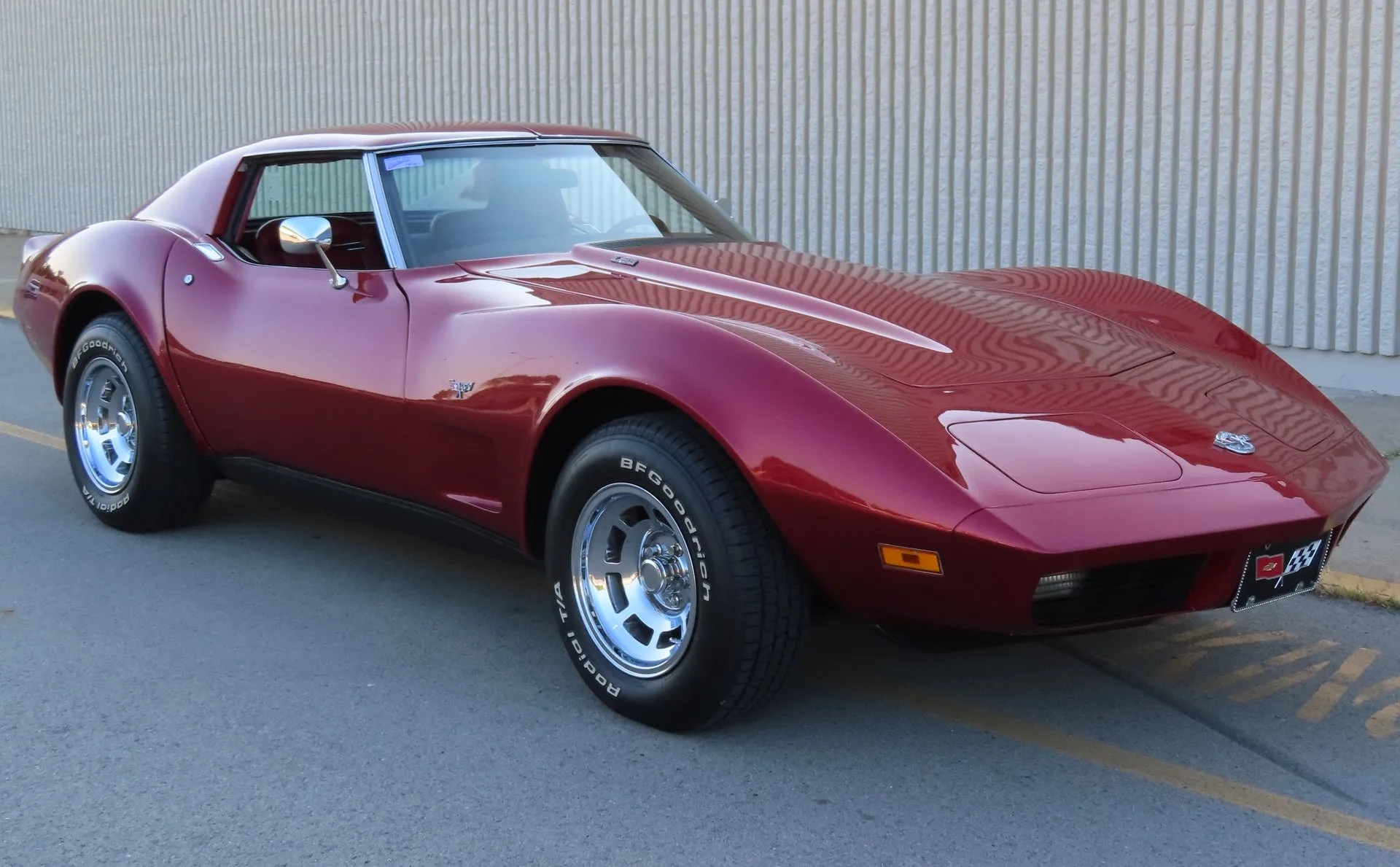
Chevrolet’s September 1977 press release called the new fastback look “the most extensive change for Corvette in several years”. Its wraparound rear glass measured 1,425 sq in, up from 293 on the 1977, per the release. The release’s summary calls that more than three and a half times larger; GM’s own figures make it nearly five times, by this site’s arithmetic. The glass is fixed, not a hatch, because the rear suspension, tank, spare and mufflers fill the tail, Car and Driver explained in its October 1977 preview. Luggage space behind the seats grew to 8.4 cu ft from 7.8 (the magazine’s figures), under a pull-over shade.
Inside, a new one-piece padded dash set the speedometer and tachometer in a squarer, upright layout and added a lockable glove box. Screwed-on armrests replaced the molded-in style used since 1965, and the wiper switch moved from a column stalk to the dash. The speedometer reads to 140 mph (GM’s interior equipment list), and 1978 was the last model year in which every car got that dial: the federal 85 mph unit arrived during 1979 production (the 1980 guide explains the rule).
Out back, a 24-gallon tank, a molded plastic liner inside a steel shell, replaced the 17-gallon one; a lighter compact spare made the room. The liner has a story of its own (see Weak spots).
Every 1978 wears crossed-flags emblems with a 25th Anniversary design on the nose and fuel filler door; the Corvette Black Book, a hobby reference whose pages GM reproduces in its kits, says no other year has them. Glass roof panels (CC1, in GM’s regular production option codes, or RPOs) were new: GM had listed them for 1977 but sold none, after a marketing dispute with the supplier (Black Book page, 1977 kit). Wider P255/60R15 tires were a new option that needed the fenders trimmed at the plant.
Section 02
The Pace Car: planned as 300, built for every dealer
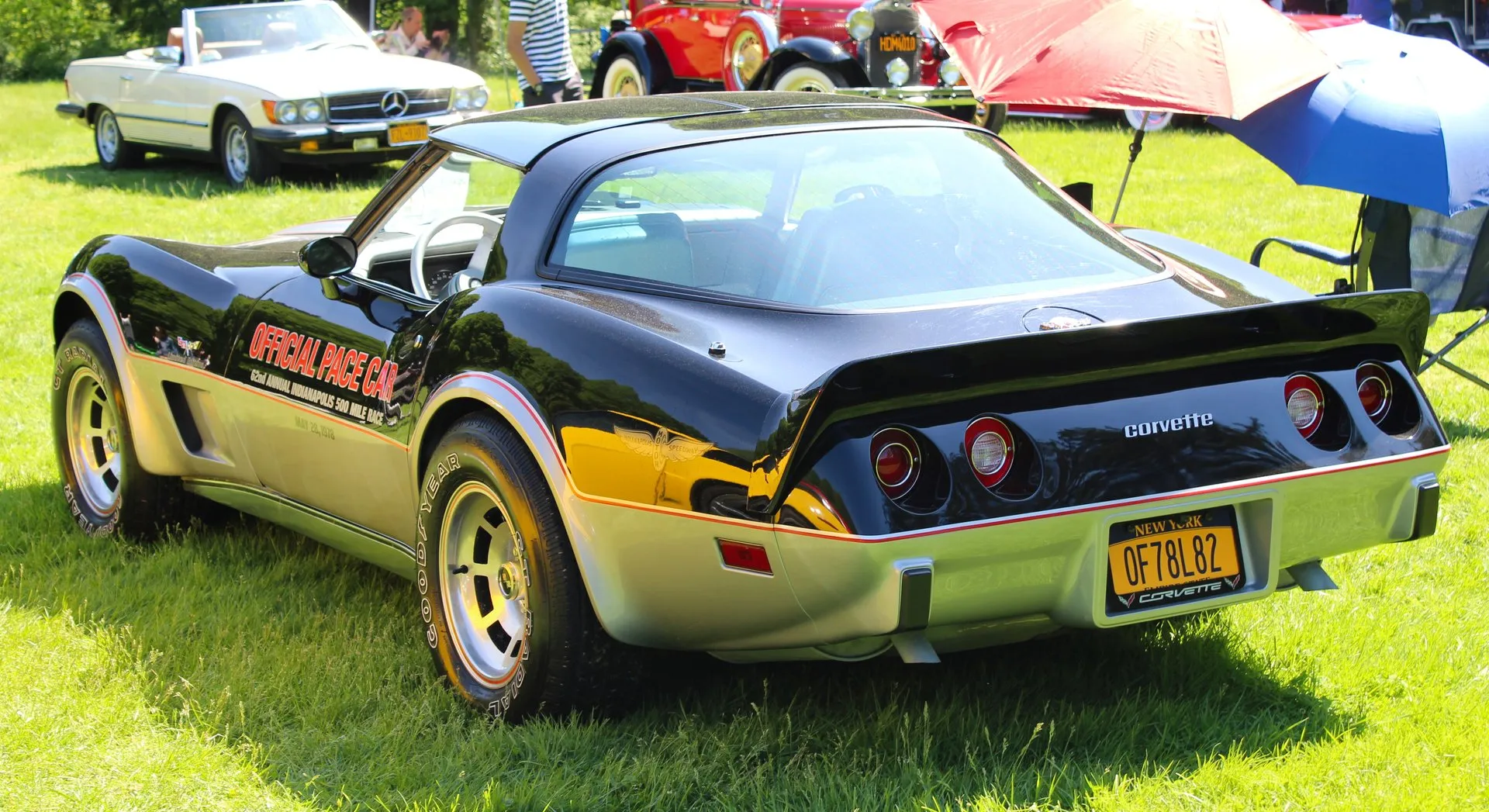
Chevrolet’s general sales manager announced the “Limited Edition” Corvette to his field managers in a memo dated December 21, 1977: model 1YZ87/Z78, pace car of the 62nd Indianapolis 500 on May 28, 1978, at a suggested retail price of $13,653.21. Orders opened in early January, every dealer was to get the chance to order one, and shipments were to begin in late March.
The plan had started smaller. The Black Book page in the 1978 kit says Chevrolet first meant to build 300, on special Goodyear tires with “Corvette” on the sidewalls; the tires were dropped, and the run grew to at least one car per Chevrolet dealer. Chevrolet’s final figure is 6,502, the one the C3 guide uses, though the page notes that “other quantities have been published”, and 1978 newspapers said 6,500.
What $13,653.21 bought, per GM’s Limited Edition order page:
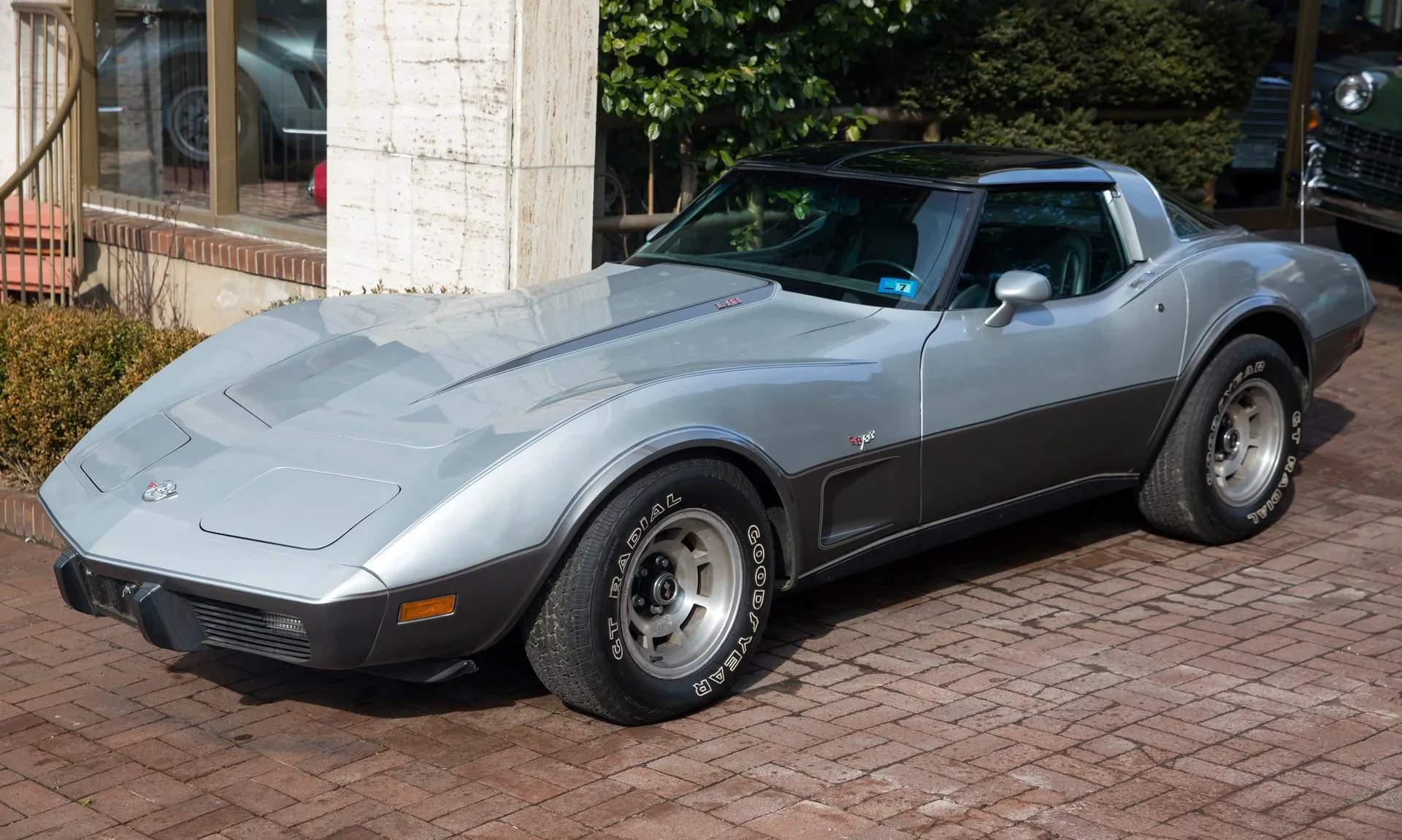
- The look: black over silver metallic (paint codes 19 upper, 47 lower) with accent stripes, “Limited Edition” decals, a front air deflector, a rear spoiler, and striped aluminum wheels on P255/60R15 white-letter tires.
- The cabin: silver seats, door trim and dash pad over silver gray carpet, with contoured buckets in leather or cloth and leather.
- Nearly every option: glass roof panels, air conditioning, power windows and locks, a tilt-telescopic wheel, an AM/FM stereo with 8-track, a power antenna, rear speakers, a rear defogger, the convenience group, sport mirrors and a heavy-duty battery.
That’s $4,301.32 more than a base coupe. The 14 regular options in the package come to $2,689.32 at the Black Book’s prices, leaving about $1,600 for the paint, decals, spoilers and seats (this site’s arithmetic; a few option prices rose during the year). Real stickers ran higher: the Florida car in the court case listed at $14,702, and one L82 Pace Car sold on Bring a Trailer in 2026 had a $14,575 window sticker.
Buyers still picked the engine and gearbox (California and high-altitude cars had to be L48 automatics) and could add cruise control, Gymkhana suspension, the trailer package or a CB radio ($170 in place of the 8-track).
Section 03
Silver Anniversary paint, and the color chart
GM’s brochure calls the whole 1978 line “The Silver Anniversary Corvette”, so when a seller says Silver Anniversary, ask which kind. Only cars with option B2Z, “25th Anniversary Two-Tone Paint” in GM’s order guide, have the paint: silver above, a darker silver below, divided by silver striping, a $399 option on 15,283 cars. The order guide, revised in January 1978, made it require the YJ8 aluminum wheels ($340), D35 sport mirrors ($40) and silver (code 13) paint, so a real B2Z car left the factory with at least $779 of options. GM announced it in September 1977, three months before the Pace Car memo, and it was never a limited run (Corvette Action Center).
GM’s color and trim chart recommends black or red inside and lists dark blue, mahogany and oyster as acceptable; a dealer could initial the order for others. The Black Book’s shorter list (black, oyster and red) is only a suggestion, and owners report original B2Z cars in blue and mahogany (CorvetteForum, 2006). Silver was the one interior a regular coupe couldn’t get: it appears only on the Limited Edition’s order page.
The ten colors and the two-tone, by the Black Book’s counts:
| Code | Color | Cars |
|---|---|---|
| 13 (two-tone, B2Z) | Silver Anniversary | 15,283 |
| 19 | Black | 11,075, including the 6,502 Pace Cars |
| 10 | Classic White | 4,150 |
| 13 | Silver | 3,232 |
| 82 | Corvette Mahogany | 2,121 |
| 83 | Corvette Dark Blue | 2,084 |
| 72 | Corvette Red | 2,074 |
| 89 | Corvette Dark Brown | 1,991 |
| 26 | Corvette Light Blue | 1,960 |
| 59 | Corvette Light Beige | 1,686 |
| 52 | Corvette Yellow | 1,243 |
The counts add up to more than the cars built (the Black Book says paint quantities exceed units sold, and 16 cars had primer only), so treat them as close, not exact.
Section 04
L48 or L82: the engines, gearboxes and axles
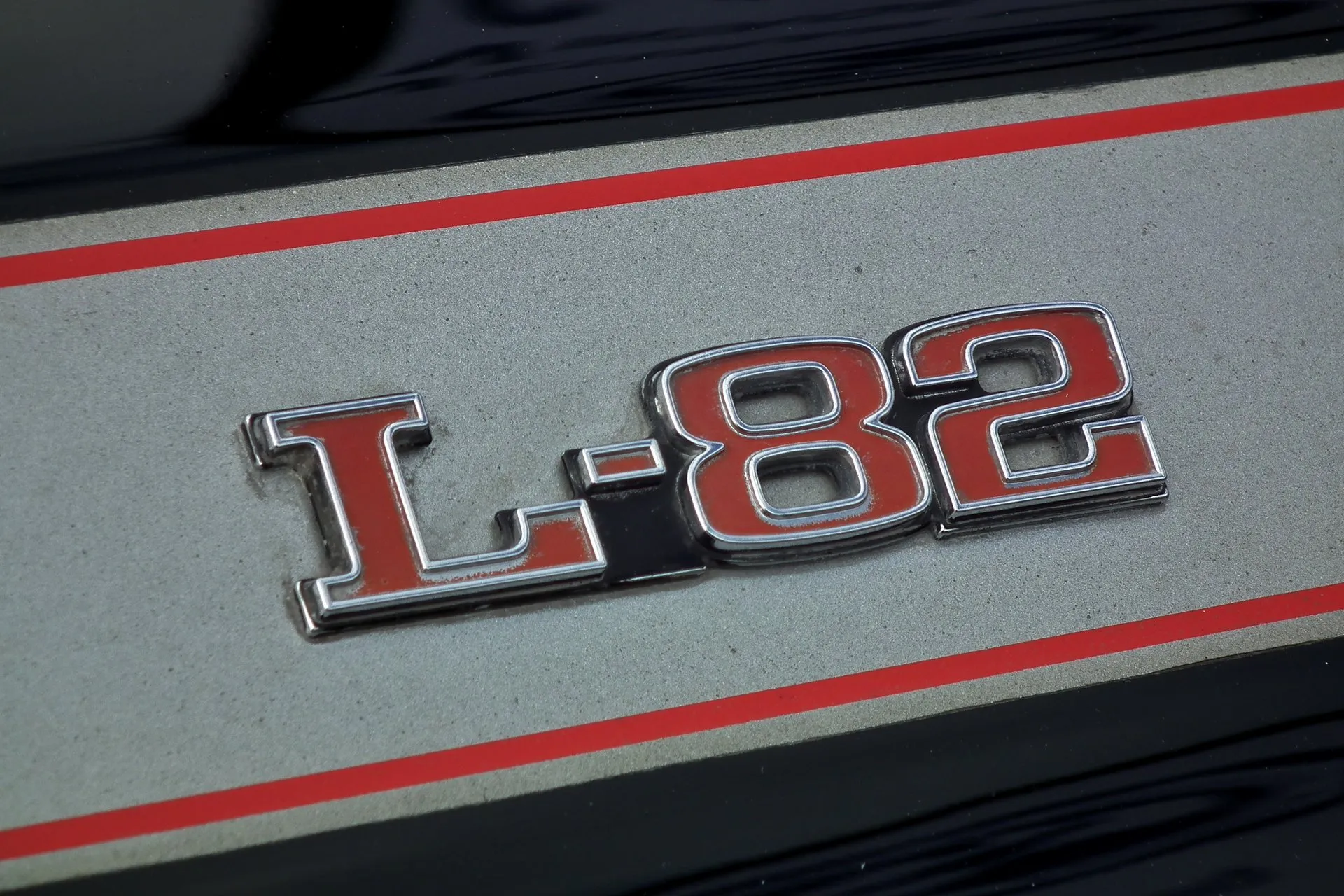
Both engines were 350 cu in (5.7 L) V8s with a four-barrel carburetor, rated in SAE net horsepower in GM’s data book:
| L48 | L48, California and high altitude | L82 | |
|---|---|---|---|
| Compression | 8.2:1 | 8.2:1 | 8.9:1 |
| Power | 185 hp at 4,000 rpm | 175 hp at 3,800 rpm | 220 hp at 5,200 rpm |
| Torque | 280 lb-ft at 2,400 rpm | 265 lb-ft at 2,400 rpm | 260 lb-ft at 3,600 rpm |
| Price | Standard | Standard, automatic only | $525 |
| Built | About 34,000, California cars included (this site’s arithmetic) | 12,739 | |
| Gearbox and axle | Four-speed with 3.36, or automatic with 3.08 | Automatic with 3.55 | Four-speed with 3.70, or automatic with 3.55 |
| VIN, fifth character | L | L | 4 |
| Engine stamp suffix | CHW manual; CLM or CUT automatic | CLR California; CLS high altitude | CMR manual; CMS automatic |
Both gained over 1977, when they made 180 and 210 hp (see the table in the C3 guide). The L82’s gain came from a new dual-snorkel intake (GM footnotes the L48 as single-snorkel) and larger exhaust pipes with lower-restriction mufflers; Car and Driver credited the intake with about 8 hp and the exhaust with about 5.
GM’s paper rules the L82 and every manual gearbox out of California and high-altitude cars, and its brochure also keeps the L82 out of Maryland, Florida, Oregon and Washington, four cities and all of Cook County, Illinois, without saying why.
GM’s data book lists three four-speeds, all in aluminum cases:
- L48, wide ratio: 2.85, 2.02, 1.35, 1.00, with a 3.36 axle, at no cost.
- L82, wide ratio: 2.64, 1.75, 1.34, 1.00, with a 3.70 axle or a 3.36 “highway” axle (RPO G95, $15, on 382 cars).
- L82, close ratio (M21): 2.43, 1.61, 1.23, 1.00, with the 3.70, at no cost, on 3,385 cars.
The three-speed Turbo Hydra-Matic 350 automatic also cost nothing and went into 38,614 cars, leaving about 8,160 1978s (17 percent) with a clutch pedal, by this site’s arithmetic. Positraction, Chevrolet’s limited-slip differential, came with every axle. Who built the L48’s four-speed is still argued: GM’s data book and Car and Driver say Muncie; owners say Saginaw or Borg-Warner (CorvetteForum, 2005–2012).
Car and Driver reported (opens in new tab) 0–60 mph in 7.8 s and a 123 mph top speed for an L48 automatic, and called the L82 four-speed “certainly the fastest American production car” (its claim, in October 1977). A 1978 rides a 98.0 in wheelbase, is 185.2 in long and weighs 3,557 lb at the curb by GM’s February 1978 sheet. Standard tires were P225/70R15 blackwalls, with white letters for $51.
Section 05
Tilt wheels to glass roofs: the 1978 options
The base price, $9,351.89, was up $704.24 from 1977’s $8,647.65 and included the L48, the four-speed (the automatic cost nothing extra), the T-top roof panels and leather. The options that mattered, with the Black Book’s prices and counts:
| RPO | Option | Price | Cars |
|---|---|---|---|
| N37 | Tilt-telescopic steering column | $175 | 37,858 |
| C60 | Air conditioning | $605 | 37,638 |
| ZX2 | Convenience group | $84 | 37,222 |
| A31 | Power windows | $130 | 36,931 |
| K30 | Cruise control | $99 | 31,608 |
| C49 | Rear window defogger | $95 | 30,912 |
| YJ8 | Aluminum wheels | $340 | 28,008 |
| UM2 | AM/FM stereo with 8-track | $419 | 20,899 |
| QBS | P255/60R15 white-letter tires | $216.32 | 18,296 |
| B2Z | Silver Anniversary paint | $399 | 15,283 |
| L82 | 220 hp engine | $525 | 12,739 |
| FE7 | Gymkhana suspension | $41 | 12,590 |
| AU3 | Power door locks | $120 | 12,187 |
| UP6 | AM/FM stereo with 40-channel CB | $638 | 7,138 |
| CC1 | Glass roof panels | $349 | 972 |
CC1’s 972 counts only panels ordered on their own: all 6,502 Pace Cars had glass panels in the package. Corvette Action Center’s copy shows a few prices rising during the year (air conditioning $605–$615).
The $41 Gymkhana suspension bought, per GM’s extra-cost equipment list, 550 lb/in front and seven-leaf 304 lb/in rear springs, a 1.12 in front bar, a 0.44 in rear bar and specific shock valving. The convenience group bundled floor mats, intermittent wipers, a headlight warning buzzer and several courtesy lights.
1978 Corvette interior. Leather came in seven colors (black, dark blue, dark brown, light beige, red, mahogany and oyster), or cloth and leather; GM’s release counted four of the seven interiors as new. Owners say regular coupes kept the 1977-style seats; the high-back buckets were the Pace Car’s alone that year (CorvetteForum, 2005).
Section 06
Proving a 1978: Pace Car, Silver Anniversary or L82
The VIN is on a plate on the driver’s side windshield pillar (GM’s serial number page): 1Z87, the engine (L for the L48, 4 for the L82), 8 for 1978, S for St. Louis and a six-digit serial. Regular coupes run 400001 to 440274, and Pace Cars have their own run, 900001 to 906502 (Black Book page), so a Pace Car’s eighth character is always 9. GM’s October 1977 data book prints the L82’s digit as X, a leftover from 1977; the Black Book and the L82 VINs read for this guide use 4.
The engine stamp, on the pad at the top front of the right-hand cylinder bank, gives a plant letter, the month and day, the suffix from the table in L48 or L82, and a VIN derivative (a short form of the serial). The Black Book lists block casting 3970010 and head casting 462624 for every 1978 engine. Owners point to a rarely used alternate derivative spot near the oil filter boss (CorvetteForum, 2013), and warn that L48s get dressed up as L82s, so read the pad, not the hood (CorvetteForum, 2021). The axle code (OK 3.08, OM 3.36, OH 3.55, OJ 3.70) is on the bottom edge of the carrier flange, per GM.
The trim tag, a small plate with the paint and trim codes, is in the driver’s door jamb, owners say. A Pace Car’s should read 19/47 and trim 152 (leather) or 15C (cloth and leather), a pairing no other 1978 has, with a build-date letter of G, H or I: March, April or May 1978 (CorvetteForum, 2012). For a Silver Anniversary car, Corvette Action Center and owners give 13/07, and one Bring a Trailer car showed “13U/07M”.
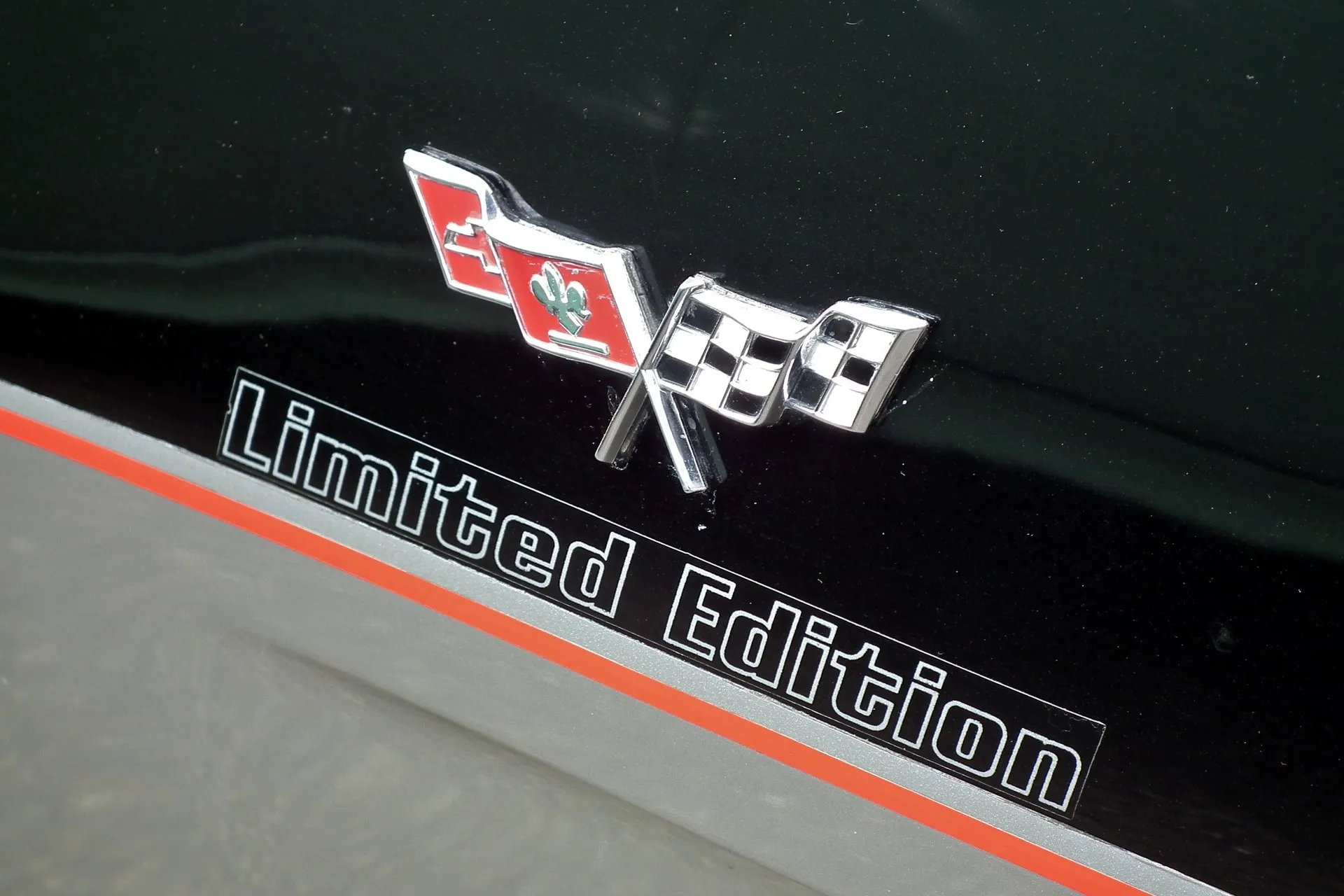
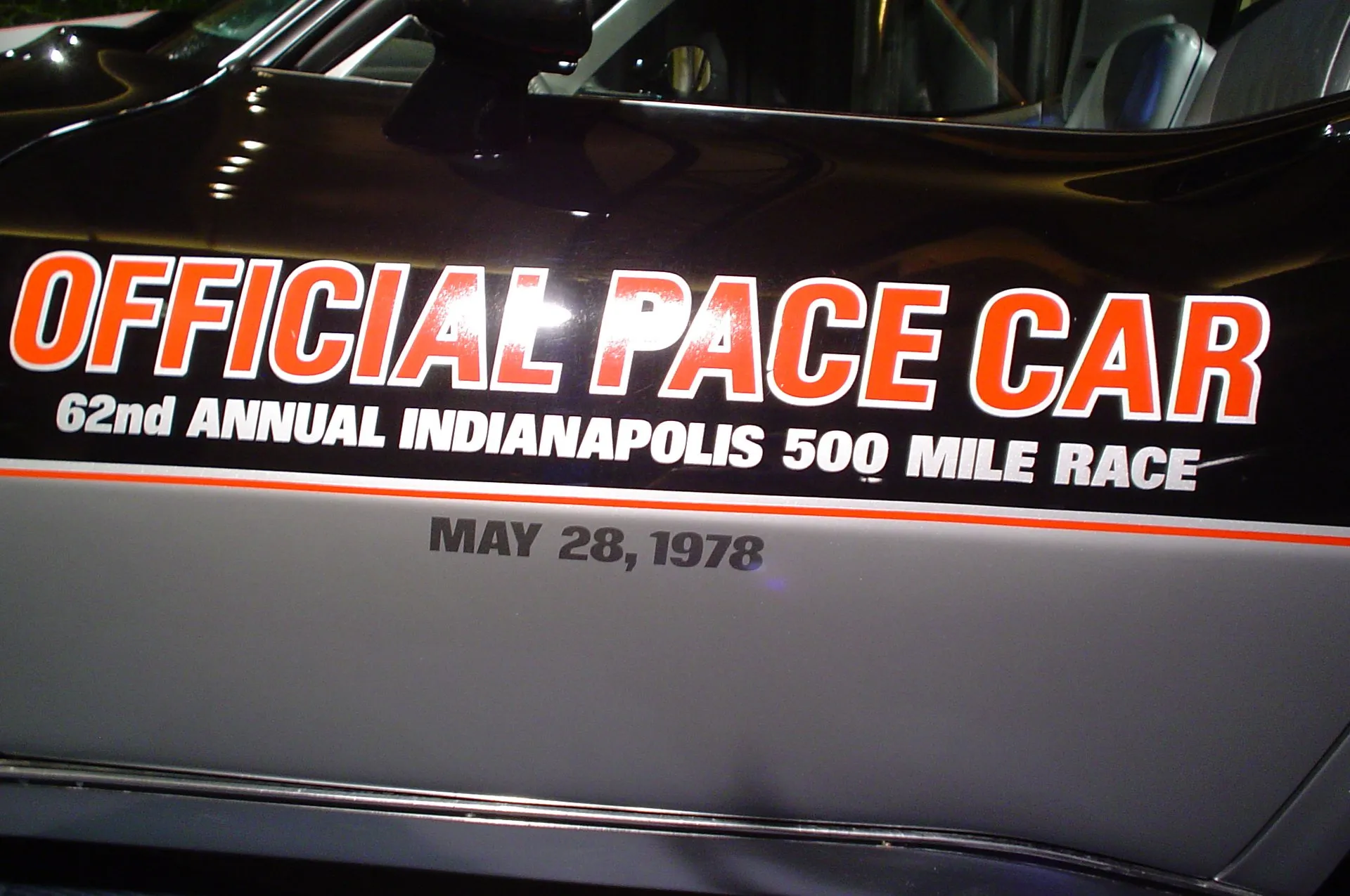
Pace Car hardware: silver interior, high-back seats, glass panels and plastic spoilers at both ends (owners say the original front one is in three pieces, where most copies are one). The decals are the weakest evidence. Owners say St. Louis applied the stripes and the “Limited Edition” fender decals, and boxed the door lettering and the other graphics in the back for the dealer or buyer to fit (CorvetteForum, 2011 (opens in new tab)); Hagerty’s valuation notes agree. So a real Pace Car may lack the lettering, and lettering proves nothing: the big Corvette parts vendors sell reproduction kits.
Silver Anniversary proof is harder, because B2Z left no mark in the VIN: look for the tag code, the required wheels and mirrors, and original paint under the door panels, the sill plates and the edge of the carpet (CorvetteForum, 2006).
Paper settles it. A window sticker, the dealer invoice (one owner says a Pace Car’s lists “Limited Edition Corvette”) or a build sheet beats any decal. A Top Flight award (opens in new tab) from the National Corvette Restorers Society, which judges cars against factory condition, needs at least 94 percent of 4,500 points.
What gets copied: a Silver Anniversary repainted black on top and sold as a Pace Car, by a seller who admitted knowing (CorvetteForum, 2005 (opens in new tab)); plain Silver cars repainted in the two-tone, like one Bring a Trailer sold for $10,378 in January 2026 with the repaint disclosed, which classic.com’s database still files as a Silver Anniversary. Paint is easy. The serial is the check.
Is a 1978 Corvette a Stingray? No. GM’s exterior equipment list gives it crossed-flags emblems, a Corvette nameplate on the tail and, on an L82, the hood emblem, with no Stingray script. The generations guide explains where the name went.
Section 07
Weak spots: the lined tank, roof panels and GM’s bulletins
NHTSA’s complaint file (opens in new tab) holds one 1978 complaint, a frame “cracked in half”, filed in February 1995; the file starts in September 1994, so it says nothing about these cars when new. There’s no GM recall for 1978, only two aftermarket-part recalls (Cardone remanufactured rear calipers and Fram racing oil filters), and NHTSA’s bulletin files hold no GM bulletin for a 1978.
Chevrolet’s dealer bulletins, as transcribed by Corvette Action Center, fill the gap:
- 78-T-9 (February 1978): residue from the new tank liner’s coating could clog the fuel filter or the tank’s pickup screen and cause a lean surge. Dealers replaced the filter and cleaned the screen and the tank, without removing it (opens in new tab).
- 78-T-23 (April 1978): early roof panels could sit bowed against the windshield header or the rear roof, from a misplaced lock receiver plate. A locating fixture went into assembly in January 1978.
- 78-T-42 (July 1978): a wavy rear bumper cover above the taillights on 1977–1978 cars, fixed with shims (
GM 473279, OEM) that reposition the bumper bar; again, a fixture from January 1978. - 78-I-44 (June 1978): from March 1, 1978, L48 automatics with air conditioning got a carburetor with a riveted, tamper-resistant choke cover (
GM 17058206, OEM). - 78-T-76 (February 1979): on L48 automatics, a rumble at idle in Drive with the A/C on, from compressor mounting bolts losing torque, fixed with a spacer (
GM 3976216, OEM) and a sleeve (GM 3922498, OEM). - Shared with other years: glass roof panel trim separating (79-T-7), sticking power antennas (79-T-8), porous aluminum wheels (78-T-6) and an instrument cluster squeak (80-T-37).
An owner adds two mid-year changes: intermittent wipers, whose module and switch fail and cost more to fix than the two-speed system, and new turn-signal and dimmer switch pivots (CorvetteForum, 2021).
The lined tank. Owners say the 1978–1982 tank’s plastic liner cracks with age, water gets behind it, and the tank rusts from the inside, so one that doesn’t leak can still be bad; reproduction tanks have no liner (CorvetteForum, 2008). One owner also says the rear spring’s mounting tabs on the differential cover can crack (CorvetteForum, 2021).
Everything else is the C3’s: frame and birdcage rust, 1976–1982 floors, T-top and windshield leaks, vacuum headlights, calipers, rear wheel bearings and power steering. Known C3 problems in the C3 buyer’s guide covers each.
Section 08
Birdcage to spring tabs: checking a 1978
- The frame and birdcage first, by the C3 checklist, and the floors: a 1978 has the partial steel underbody GM added for 1976.
- The serial against the claim. A Pace Car needs a 9 as the VIN’s eighth character; an L82 needs a 4 in fifth place and CMR or CMS on the pad.
- The trim tag and the paper: 19/47 with 152 or 15C for a Pace Car, 13/07 for a Silver Anniversary car (owners’ readings), and a sticker, invoice or build sheet.
- Pace Car hardware: silver interior, high-back seats, glass panels, the three-piece front spoiler.
- The fuel system: a fuel smell or a clogged filter; ask whether the tank has been replaced or relined.
- The roof panels: fit and leaks on an early car, and the trim molding on glass panels.
- The rear bumper cover, for waves above the taillights.
- Switches and the A/C: intermittent wipers, turn signals and dimmer; on an L48 automatic with air conditioning, listen for a rumble at idle in Drive.
- The rear spring tabs on the differential cover, then an inspection on a lift by a shop that knows C3s.
Section 09
2026 prices: Pace Car, Silver Anniversary and plain
How much is a 1978 Corvette worth? Of the 28 1978s listed on Bring a Trailer (opens in new tab) from January 1 to October 19, 2026, 22 sold, median $21,164, by this site’s count of sold prices without the buyer’s fee. Split by what each listing’s title calls the car:
| 1978s sold on Bring a Trailer, 2026 | Sales | Median | Range |
|---|---|---|---|
| Titled Pace Car Edition | 12 | $23,375 | $8,700–$45,500 |
| Titled 25th Anniversary Edition | 6 | $17,650 | $10,000–$62,500 |
| Neither | 4 | $16,000 | $10,378–$22,000 |
| All | 22 | $21,164 | $8,700–$62,500 |
Every 1978 wears 25th Anniversary emblems, so that title alone doesn’t promise B2Z paint: four of the six listings describe two-tone silver, and the other two don’t mention it. The top sale was one of the four: a 266-mile L48 four-speed with its window sticker and four judging awards, NCRS Top Flight among them, at $62,500 in February. A 96-mile L82 automatic Pace Car brought $45,500 in May, and a 45,000-mile L82 automatic Pace Car with an aftermarket stereo and a worn steering wheel $8,700 in July. Titles naming a four-speed brought a median $22,000 (9 sales), and titles naming the L82 $20,577 (11). In 2025, 20 of 27 sold, at a median $20,875, and the order flipped: seven 25th Anniversary titles brought a median $24,250, eight Pace Cars $21,625. Samples this small are market color, not a valuation or a forecast.
Hagerty’s price guide (opens in new tab), as captured by the Internet Archive, puts a #3 (Good) L48 coupe at $14,500 (January 2026), up from $13,800 a year earlier. Its Silver Anniversary L48 is $15,600 (January 2026) and its Pace Car L48 $19,300 (July 2025, the newest captured). Hagerty adds 10 percent for a four-speed on the first two and $3,500 for a close-ratio four-speed on a Pace Car, and takes 8 percent off a Pace Car automatic. classic.com’s February 2026 benchmarks, which the C3 guide uses, are $29,880 for a Pace Car and $20,427 for a Silver Anniversary, though its database can include copies: it files the repainted $10,378 car as a Silver Anniversary.
Hagerty, classic.com and 2026’s Bring a Trailer sales all put the Pace Car on top, by different margins: about $5,700 over the 25th Anniversary titles on Bring a Trailer, $3,700 on Hagerty’s figures (six months apart) and about $9,450 at classic.com. For scale, the C3 guide’s 1978–1982 median is $17,625 (18 sales, June to September 2026), and the best-years guide names a 1978–1982 coupe as the C3 most buyers should drive.
Section 10
What 1979 took from the Pace Car
The 1979 kept the fastback and took two things from the Pace Car (Black Book page, 1979 kit): its high-back seats became standard, and its front and rear spoilers became an option (RPO D80, on 6,853 cars, per the 1980 guide). The L48 gained 10 hp, to 195, from open-flow mufflers and the L82’s dual-snorkel intake, and the L82 gained 5, to 225. An AM-FM radio became standard, the high beams turned halogen, and several late 1979s got the 85 mph speedometer. With 53,807 built, 1979 was the biggest C3 year.
Section 11
Which 1978 to buy: a Pace Car that proves it
The pick is a Pace Car whose serial starts with 9 and whose trim tag and paperwork agree. It’s the 1978 buyers took dealers to court over, Hagerty, classic.com and 2026’s Bring a Trailer sales all value it highest, and its own serial range makes it the easiest 1978 edition to check. Pay for the serial and the paper, not the decals, and take the close-ratio four-speed if you find one: Hagerty adds $3,500 for it.
For driving, an L82 four-speed in any paint. At 220 hp it’s the strongest 1978, and four-speed titles brought a median $22,000 in 2026. Pull the roof panels, wind it out through second on a back road, and the 1970s stop feeling slow.
On a budget, a plain L48 coupe. Hagerty’s #3 value is $14,500, and the four 2026 Bring a Trailer sales titled as neither edition brought a median $16,000. Same fastback, same dash, same anniversary emblems, and it isn’t one of the slow C3s the C3 guide names (the 1975 and the 1980 California car).
Skip any “edition” priced as one without proof, and any 1978 with a rotten birdcage, whatever it’s wearing. Get those right, and the 1978 is America’s sports car at its 25th birthday: fastback glass, T-tops, a small-block every parts counter knows, and a nose emblem no other year wears.
Section 12
Sources
- GM Heritage Center: 1978 Corvette vehicle information kit files.zipcorvette.com This site's library. Chevrolet's December 21, 1977 Limited Edition memo (PDF page 20) and order page (21); the dealer order guide, revised January 20, 1978 (color and trim chart 23, option rules 24); the September 15, 1977 press release (28, 30 and 32); the MVMA specification form, revised February 1978 (power teams 40, fuel system 46, weights 62); the October 1977 dealer data book (serial numbers 70, exterior equipment 71, interior 73, extra-cost equipment 74, weights 80, engines 96, four-speeds 108); the Corvette Black Book pages GM reproduced (production, VINs and codes 110; options and colors 116); the brochure (120 to 135: B2Z 128, power teams 132).
- GM Heritage Center: 1979 Corvette vehicle information kit files.zipcorvette.com This site's library. Black Book page: what 1979 took from the Pace Car, the engine ratings and the 85 mph speedometers.
- GM Heritage Center: 1977 Corvette vehicle information kit files.zipcorvette.com This site's library. Black Book pages: glass roof panels listed but never sold for 1977 (PDF page 108); the 1977 base price, $8,647.65 (page 109).
- NHTSA owner complaints, 1978 Chevrolet Corvette (opens in new tab) api.nhtsa.gov One complaint, filed February 1995; pulled October 19, 2026. NHTSA's complaint file begins in September 1994.
- NHTSA recalls, 1978 Chevrolet Corvette (opens in new tab) api.nhtsa.gov Pulled October 19, 2026. No GM recall. Aftermarket-part campaigns 03E032000 (opens in new tab) (Cardone calipers) and 07E088000 (opens in new tab) (Fram oil filters).
- NHTSA manufacturer communications (TSB) file, received 1995–1999 (opens in new tab) static.nhtsa.gov No GM bulletin for a 1978 Corvette; the earliest Corvette model year in the file is 1984.
- Chevrolet dealer bulletin 78-T-9: fuel filter, February 1978 (via Corvette Action Center) (opens in new tab) web.archive.org Internet Archive copies of Corvette Action Center's transcriptions, not GM or NHTSA originals. Also 78-T-23, roof panel fit (opens in new tab) (April 1978), 78-T-42, wavy rear bumper cover (opens in new tab) (July 1978), 78-I-44, tamper-resistant choke (opens in new tab) (June 1978), 78-T-76, compressor noise (opens in new tab) (February 1979), 79-T-7, glass roof panel trim (opens in new tab), 79-T-8, power antenna (opens in new tab), 78-T-6, wheel porosity (opens in new tab) and 80-T-37, instrument cluster squeak (opens in new tab).
- Car and Driver: 1978 Chevrolet Corvette (opens in new tab) caranddriver.com Brock Yates, October 1977 issue. A preview: L48 automatic 0–60 mph in 7.8 s and 123 mph; the L82's intake and exhaust gains; luggage space; why the glass isn't a hatch.
- Corvette Action Center: 1978 Corvette production and options (opens in new tab) web.archive.org Internet Archive copy of March 12, 2026. Option price ranges, trim-tag paint codes, "production was not limited" for the Silver Anniversary paint. Also its 1978 identification page (opens in new tab) (VIN and engine codes).
- Corvette Action Center: 1978 newspaper items on Pace Car price suits (opens in new tab) web.archive.org Palm Beach Post-Times, 1978 (the Florida ruling), and the Toronto Star, May 24, 1978 (opens in new tab), reprinting a Newark Star-Ledger story (the New Jersey suit), as transcribed; Internet Archive copies.
- Hagerty valuation tool: 1978 Chevrolet Corvette L48 coupe (opens in new tab) web.archive.org Internet Archive copy of March 12, 2026. #3 (Good) $14,500 on the value graph dated January 2026, $13,800 a year earlier; adjustments for a four-speed and Gymkhana suspension. Its notes say the Pace Car stickers were packed inside the car.
- Hagerty valuation tool: 1978 Chevrolet Corvette Silver Anniversary (opens in new tab) web.archive.org Internet Archive copy of January 21, 2026. #3 (Good) $15,600, January 2026.
- Hagerty valuation tool: 1978 Chevrolet Corvette Pace Car (opens in new tab) web.archive.org Internet Archive copy of July 16, 2025, the newest available. #3 (Good) $19,300, July 2025; adjustments for the close-ratio four-speed and the automatic.
- classic.com: Chevrolet Corvette C3 market (opens in new tab) web.archive.org Internet Archive copy of February 12, 2026. Benchmarks for the Indy Pace Car (1978) and Silver Anniversary (1978). Its Silver Anniversary page (opens in new tab) (February 15, 2026 copy) lists the repainted $10,378 Bring a Trailer car.
- Bring a Trailer: Chevrolet Corvette C3 results (opens in new tab) bringatrailer.com 1978 listings only, January 1, 2025 to October 19, 2026. Counts and medians are this site's, from each listing's sold price without the buyer's fee. Sales named: $62,500 (opens in new tab), $45,500 (opens in new tab) (the $14,575 window sticker), $10,378 (opens in new tab) and $8,700 (opens in new tab).
- NCRS: judging awards (opens in new tab) ncrs.org Flight judging and the Top Flight award. Fetched October 19, 2026.
- CorvetteForum thread: how to spot a real 1978 Pace Car against a clone (opens in new tab) corvetteforum.com November to December 2005. The repainted Silver Anniversary; serial range, seats and spoilers.
- CorvetteForum thread: VIN code for a 1978 Limited Edition Pace Car (opens in new tab) corvetteforum.com March 2005. VIN ranges, the dealer invoice, reproduction decal kits.
- CorvetteForum thread: 1978 Pace Car lettering (opens in new tab) corvetteforum.com March 2011. Which decals were applied at St. Louis and which shipped in a box.
- CorvetteForum thread: how to tell a real 1978 Pace Car (opens in new tab) corvetteforum.com November 2012. Trim-tag paint, trim and build-date codes.
- CorvetteForum thread: verifying the VIN and engine stamp on a 1978 Pace Car (opens in new tab) corvetteforum.com June 2013. Reading the pad; the alternate VIN derivative location.
- CorvetteForum thread: 1978 Silver Anniversary question (opens in new tab) corvetteforum.com September 2006. The 13/07 trim-tag code and how to look for original paint.
- CorvetteForum thread: 1978–1979 four-speed Corvettes (opens in new tab) corvetteforum.com June 2005. Who built the L48's four-speed. Also factory C3 manual transmissions (opens in new tab) (November 2012) and a 1978 four-speed swap (opens in new tab) (June 2011).
- CorvetteForum thread: advice on buying a 1978 C3 (opens in new tab) corvetteforum.com October 2021. Mid-year changes, wipers and switches, spring tabs, L48s dressed as L82s.
- CorvetteForum thread: 1978–1982 fuel tank liners (opens in new tab) corvetteforum.com March to April 2008. Owner-reported liner failures.