C3 · Buying guide
1980 Corvette guide: the weight cut, three engines, California's 305 and what to pay
Published
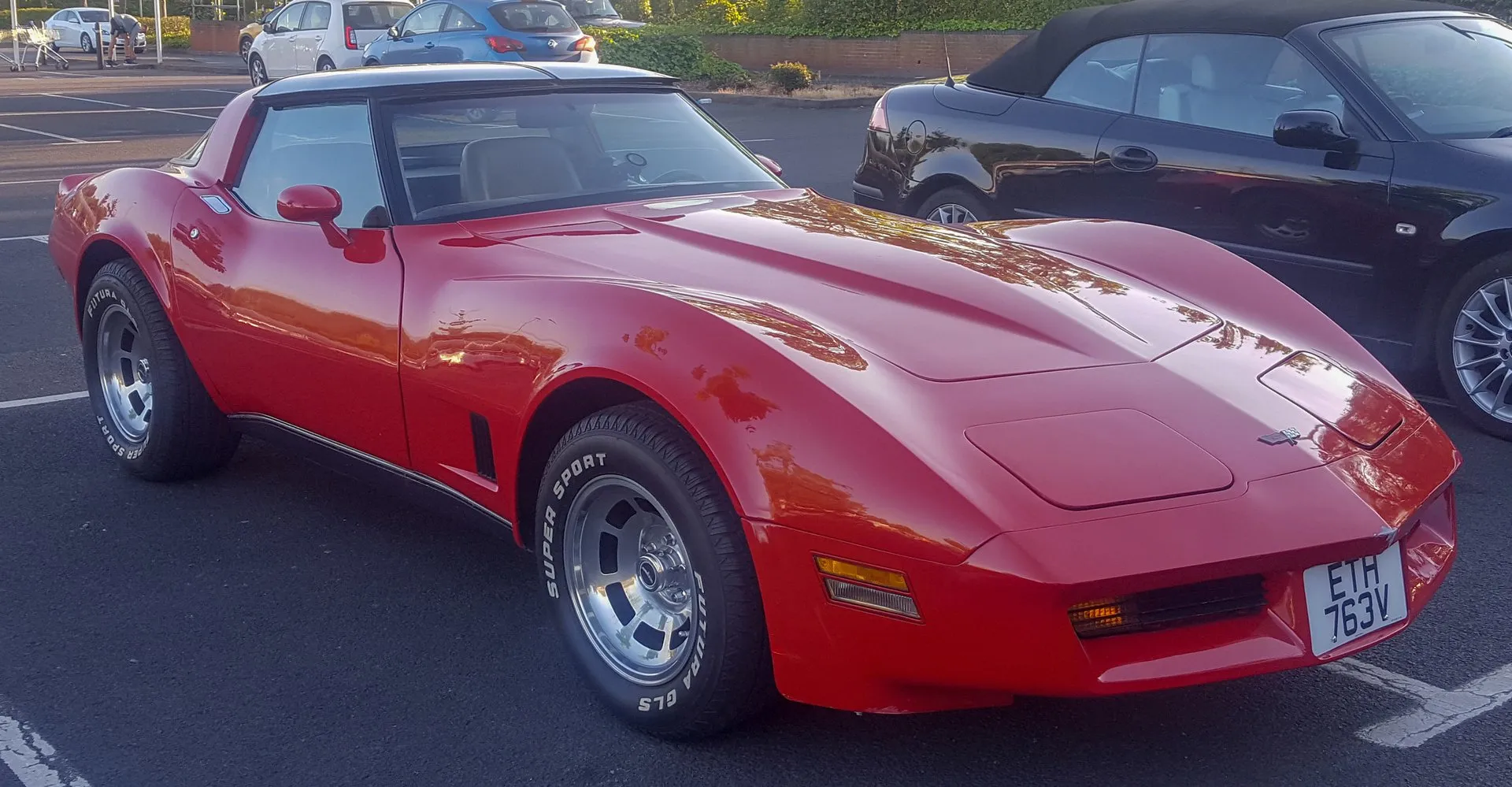
A Californian who wanted a new Corvette for 1980 got a 305, an automatic, a $250 charge for California emissions certification and a $50 credit for the smaller engine, with no say in any of it. Chevrolet didn’t certify its 350s in California that year, so 3,221 cars got a passenger-car V8 from its Tonawanda, New York, engine plant, run by a computer system the Corvette used for one year only. The other 49 states got the 350s, the last L82s and every four-speed.
Wherever it was sold, the 1980 wore a new nose and tail with the spoilers built in, and it was 169 lb lighter by GM’s base curb weights. It was the first year of the body the C3 (1968–1982) kept to the end: 40,614 coupes, every one built in St. Louis, down from 1979’s C3 record of 53,807. On Bring a Trailer in 2026, the median 1980 sold for about its base price new, not adjusted for inflation.
- Is a 1980 Corvette a C3? Yes, the thirteenth of its 15 model years. A Stingray? No (see Reading a 1980’s VIN, stamp pad and badges).
- Which one to buy? An L48 four-speed (see The verdict: buy the four-speed).
The C3 buyer’s guide covers what every C3 shares, from frame rust to the birdcage. Most figures here come from GM’s 1980 Heritage Center kit, in this site’s owner’s manual library.
C3 Key figures
- Built
- 40,614 coupes
- Engines
- 190 hp L48, 230 hp L82, 180 hp California LG4
- Four-speeds built
- 5,726
- Price new
- $13,140.24, rising to $14,345.24
- Weight cut vs 1979
- 169 lb lighter by GM's base curb weights
- Speedometer
- 85 mph, a federal rule
- Bring a Trailer, 2026
- median $14,000 from four sales
- Hagerty #3 value
- $16,200 (January 2026)
Section 01
A new nose and tail, with the spoilers built in
GM reshaped both ends for 1980. Its dealer brochure lists a new front bumper cover with an integral air dam, a recessed grille and parking lights, a lower-profile hood, functional black louvers in the front fender vents, a new rear cover with an integral spoiler, new taillights and new crossed-flag emblems.
The payoff, per the Corvette Black Book page reproduced in GM’s 1980 kit: nearly 50 percent more airflow through the radiator, and a drag coefficient of 0.443 against 0.503 for a 1979 with the optional add-on spoilers. Only 6,853 of the 1979s had those, GM option code (RPO) D80 at $265, per the Black Book page in the 1979 kit. Every 1980 has them molded in.
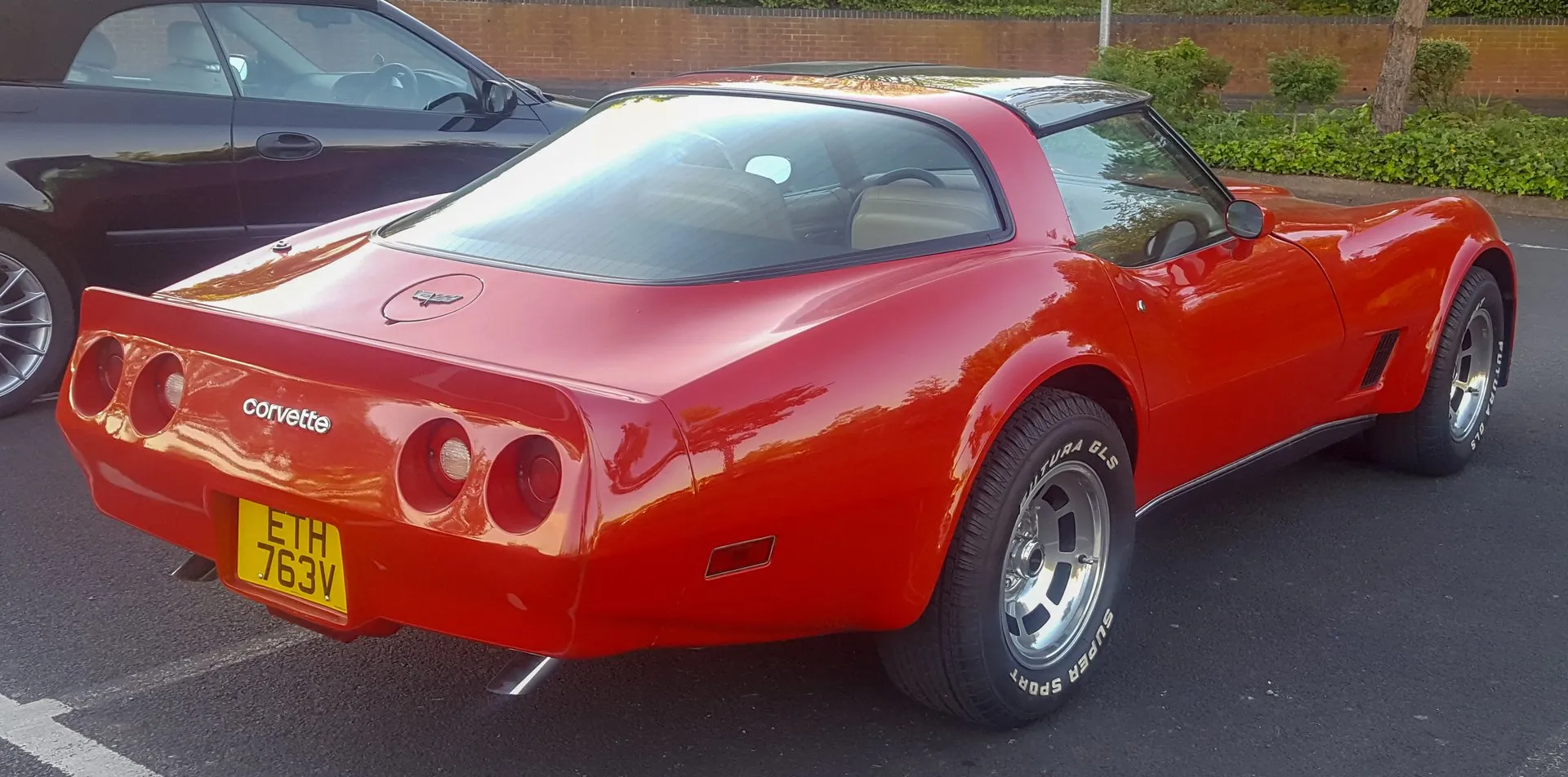
The covers are urethane (GM for the rear, owners for the front), and four decades on, owners say they crack and wave (see Known 1980 problems).
Air conditioning, power windows and the tilt-telescopic column were standard, as on 1979s built after a May 1979 price rise, and GM’s brochure adds dual sport mirrors, a convenience group and new cornering lights. Behind the seats, three storage compartments became two. The one new option was a roof panel carrier, RPO V54.
Section 02
The weight cut, and why the figures differ
GM’s weight sheets put a base L48 coupe at 3,503 lb for 1979 (1979 kit) and 3,334 lb for 1980 (1980 kit), a 169 lb drop. That understates the work: the 1979 sheet, dated October 1978, predates the May 1979 change, so its base car lacks air conditioning, power windows and the tilt column. Add back the weights it lists for them (54, 4 and 7 lb) and the like-for-like cut is 234 lb, or 241 lb with the convenience group, by this site’s arithmetic. Car and Driver (opens in new tab) said 238 lb in May 1980; Corvette Action Center’s “nearly 250 lb” and Hagerty’s 250 round it up.
How GM did it, per the Black Book page and Car and Driver: lower-density roof panels made with glass beads, a thinner hood, outer door panels and glass, a lightened frame, an aluminum differential housing and crossmember, the L82’s aluminum intake on the L48, and stainless-steel exhaust manifolds on the California 305.
On the road it bought less than the number suggests. Car and Driver’s L48 four-speed ran 0–60 mph in 7.6 s and the quarter mile in 15.9 s at 88 mph, reached 123 mph and stopped from 70 mph in 190 ft. The magazine found no significant gain in acceleration or braking over its recent Corvette tests. What improved was steering response; what didn’t was a chassis that creaked and shuddered on rough pavement.
Section 03
Three engines, two gearboxes, one axle
Three engines, then: 190 hp L48, 230 hp L82, 180 hp California LG4, all SAE net ratings from GM’s data book, with the gearboxes its order guide allowed.
| L48 | L82 | LG4 | |
|---|---|---|---|
| Engine | 350 cu in (5.7 L) V8, four-barrel | 350 cu in (5.7 L) V8, four-barrel | 305 cu in (5.0 L) V8, four-barrel |
| Compression | 8.2:1 | 9.0:1 | 8.6:1 |
| Power | 190 hp at 4,400 rpm | 230 hp at 5,200 rpm | 180 hp at 4,200 rpm |
| Torque | 280 lb-ft at 2,400 rpm | 275 lb-ft at 3,600 rpm | 255 lb-ft at 2,000 rpm |
| Where and price | Standard outside California | $595, outside California | California only, required, $50 credit |
| Gearboxes | Four-speed or automatic | Automatic only | Automatic only |
| Built | The rest, about 32,300 (this site’s arithmetic) | 5,069 | 3,221 |
| VIN, 5th digit | 8 | 6 | H |
| Engine stamp suffix | ZAM (manual), ZAK (automatic) | ZBC | ZCA |
Against 1979, the L48 lost 5 hp and the L82 gained 5. The L82’s $595 bought a higher-lift camshaft, special heads, impact-extruded pistons, a forged steel crankshaft, four-bolt main bearing caps and finned aluminum rocker covers (GM brochure), plus “L82” emblems on the front fenders. This was its last year.
The four-speed, GM’s M18 (ordered as RPO MM4), had ratios of 2.88, 1.91, 1.33 and 1.00 in an aluminum case. Buyers took 5,726, about one car in seven. The automatic was a three-speed Turbo Hydra-matic, with a lock-up torque converter behind the 350s but not the 305. Every 1980 has a 3.07 axle with limited slip, the only ratio GM offered (power team chart), in an aluminum case owners know as a Dana 44 (a name handwritten on GM’s specification form).
1980 Corvette specs, the rest. A 98.0 in wheelbase, 185.3 in long, 69.0 in wide and 48.0 in high, a 24-gallon tank, 11.75 in vented discs at all four wheels, P225/70R15 tires on 15 x 8 in wheels as standard, and one catalytic converter, under the passenger seat, feeding twin tailpipes.
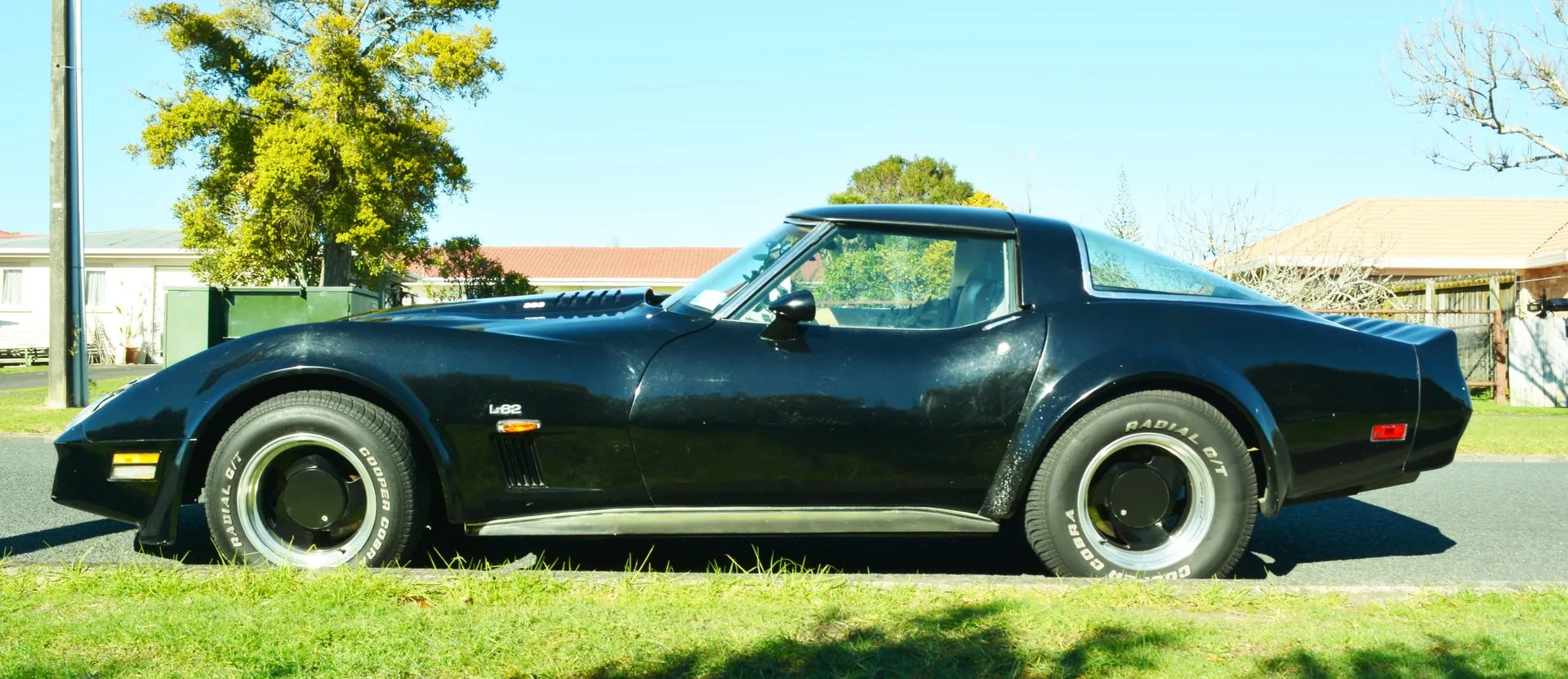
The L82 four-speed GM wouldn’t build
GM’s order guide is plain: an L82 required the automatic. One CorvetteForum member kept the printout Chevrolet’s order system sent back (opens in new tab) for the L82 four-speed he ordered in October 1979: “MUST HAVE RPO COMB L 82 MX1”. His car arrived as an L48 four-speed. The one hedge is the Black Book page, which allows for “a few early production builds” and lists a 230 hp engine suffix, ZBD, of uncertain use. Treat any “factory L82 four-speed” as a conversion unless the VIN’s fifth digit (6), the engine stamp and GM paper all agree.
California’s 305 and its one-year computer
The LG4 was a standard Chevrolet passenger-car 305 with stainless tubular headers and an oxygen sensor feeding GM’s C-4 system, the Computer Controlled Catalytic Converter (GM’s specification form), with a CHECK ENGINE lamp in the console. It made 10 hp less than the L48, and Hib Halverson (opens in new tab) calls it Chevrolet’s dress rehearsal for engine electronics, which every 1981 got as Computer Command Control.
Halverson says its control unit, in the well behind the driver’s seat, forgets trouble codes at key-off unless an orange wire from its S terminal gets battery voltage, and sends no serial data, so no scan tool reads it; codes come out as flashes. Owners add that a California car re-engined with a 350 can fail a California smog check, and that missing emissions parts are hard to find (CorvetteForum, 2011).
Section 04
The 85 mph speedometer, and the rule behind it
Every 1980’s speedometer tops out at 85 mph, a federal rule, not a styling choice. NHTSA’s Standard No. 127 applied to cars built from September 1, 1979, and an April 1981 NHTSA letter (opens in new tab) says such a scale “would have to be limited to 85 mph”. An August 1979 letter gives the reasons: less temptation to find a car’s top speed, and more respect for the 55 mph national limit, which the dial had to highlight. GM phased the dial in during 1979 production (the Black Book page), so some late 1979s have one too. NHTSA rescinded the rule in February 1982, but owners say the 85 mph dial stayed through 1982 (CorvetteForum, 2011–2018).
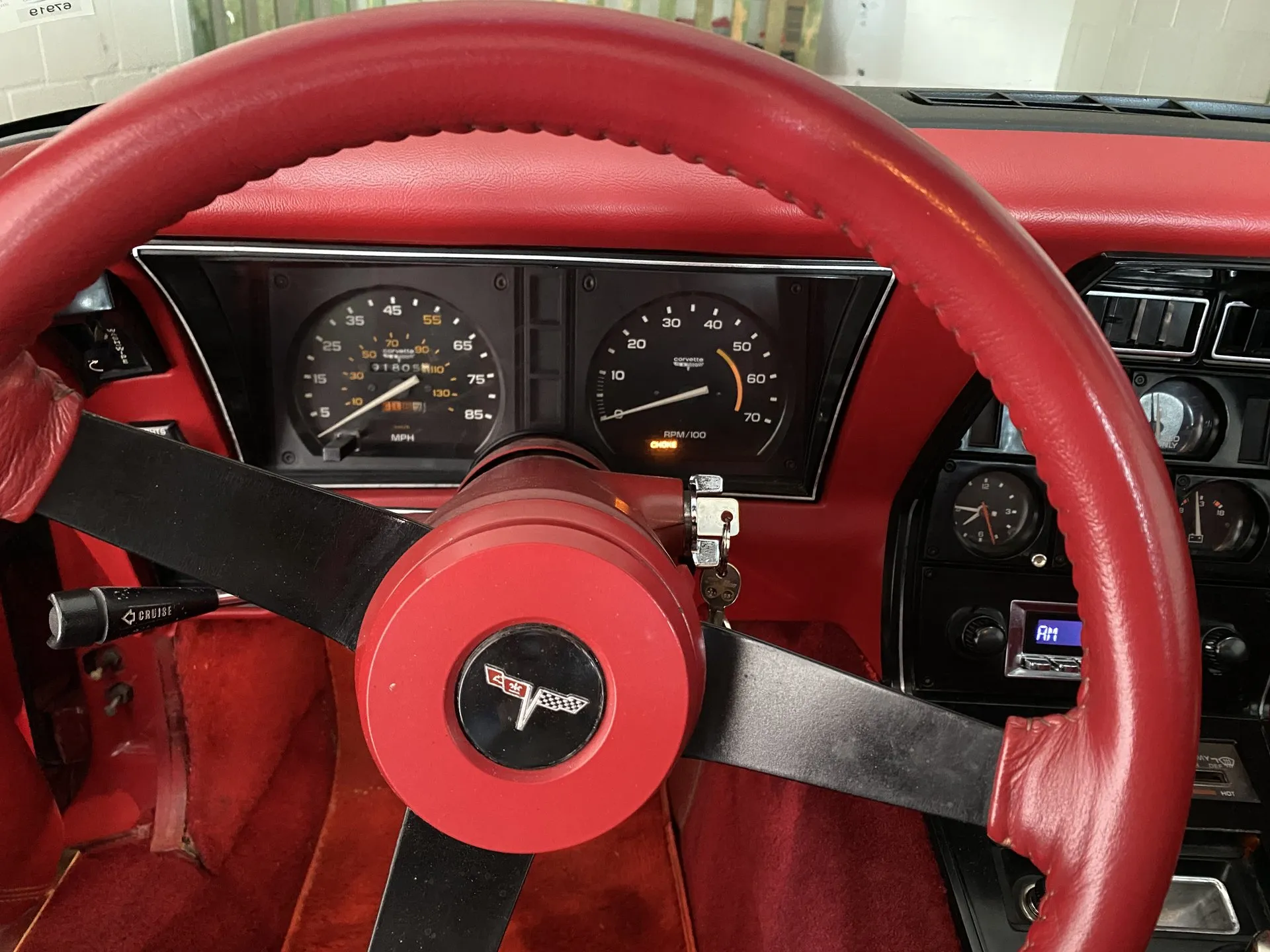
A 1980 with a 140 mph face has been changed. Owners say a 1978–1979 140 mph unit won’t read right without recalibration or a geared cable adapter, and one paid a gauge shop $165 plus tax for a new face and recalibration in 2022 (CorvetteForum). On a car sold as original, the 85 mph dial is correct, not a flaw.
Section 05
Options, colors and four price rises
The 1980’s base price was $13,140.24, rising to $14,345.24 after four increases during the year; option prices didn’t move (the Black Book’s options page). A 1979 had climbed from $10,220.23 to $12,313.23 during its year; the biggest single step, $706, came when air conditioning, power windows and the tilt column became standard (1979 kit). The options that matter, with the Black Book’s prices and counts:
| RPO | Option | Price | Built |
|---|---|---|---|
| N90 | Aluminum wheels (39 lb lighter) | $407 | 34,128 |
| CC1 | Glass roof panels | $391 | 19,695 |
| QXH | P255/60R15 white-letter tires | $426.16 | 13,140 |
| QGR | P225/70R15 white-letter tires | $62 | 26,208 |
| FE7 | Gymkhana suspension | $55 | 9,907 |
| K30 | Cruise control (automatic only) | $123 | 30,821 |
| ZN1 | Trailer package | $105 | 796 |
| UL5 | Radio delete | $126 credit | 201 |
| YF5 | California emissions | $250 | 3,221 |
The box to tick was FE7. For $55, GM’s data book lists 550 lb/in front and 304 lb/in rear springs, a 0.44 in rear anti-roll bar and specific shock valving, with the base 1.12 in front bar. The trailer package included it.
Colors. White (code 10) led on 7,780 cars by the Black Book’s count, then Black (19) on 7,250 and Red (83) on 5,714; Dark Green Metallic (58) was the rarest, on 844. The rest were Silver Metallic (13), Dark Blue Metallic (28), Dark Claret Metallic (76), Frost Beige (59), Dark Brown Metallic (47) and Yellow (52). The counts don’t add up to the production total, so treat them as close, not exact. A July 1980 bulletin for the 1980 Corvette, 80-I-68, also describes about 80 St. Louis pilot cars in two-tone enamel with special “E” paint codes on the body plate, without saying which model year they were.
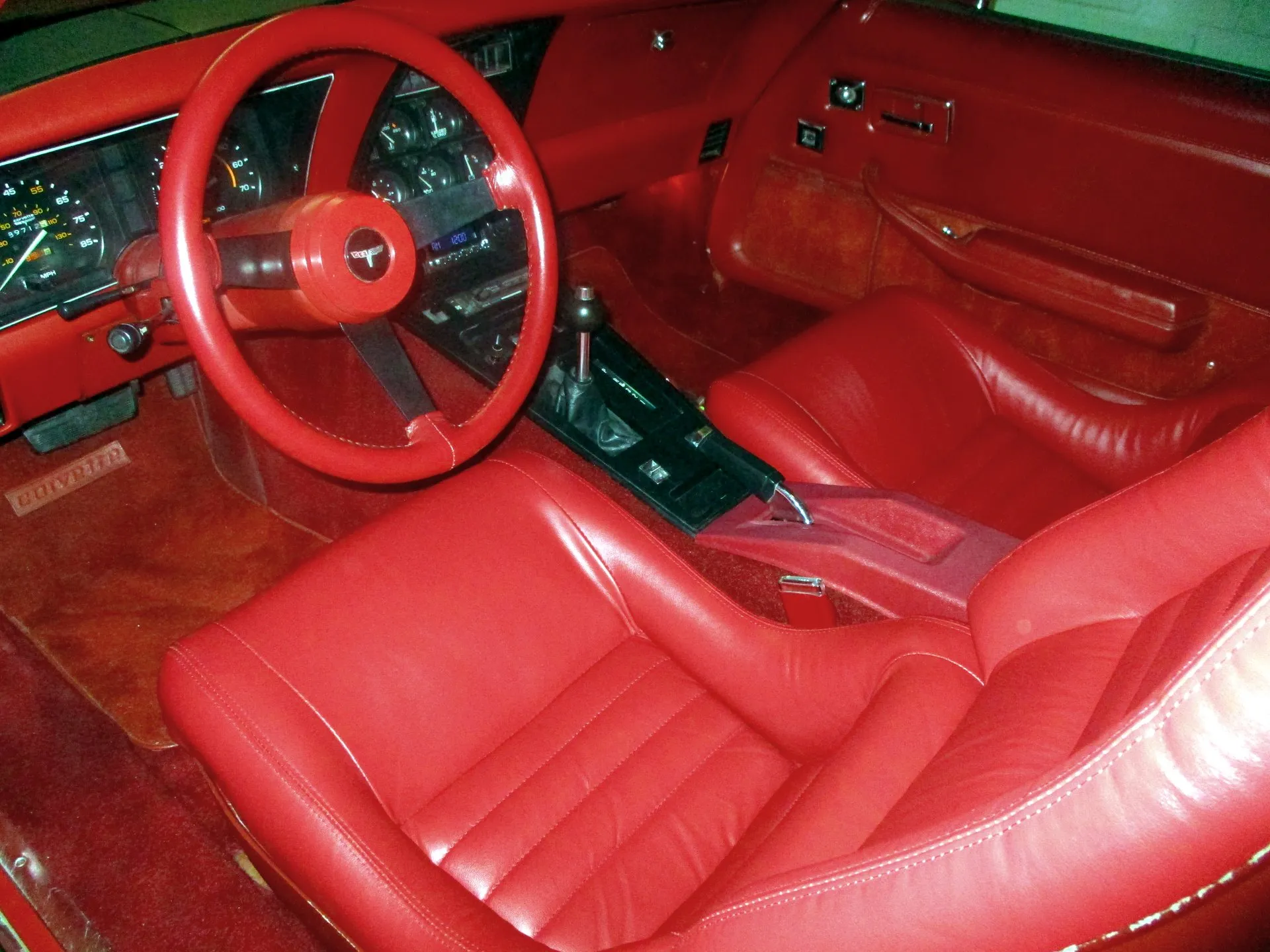
1980 Corvette interior. Leather came in six colors (black, oyster, red, dark blue, claret and doeskin) and a new ribbed cloth in four; a green leather was released, then cancelled early. A sliding sun shield for the driver and a built-in alarm, set from the driver’s door lock, were standard.
Section 06
Reading a 1980’s VIN, stamp pad and badges
The VIN is on a plate on the left windshield pillar (GM’s serial number page): 1Z87, then the engine digit (8 for the L48, 6 for the L82, H for the LG4), A for 1980, S for St. Louis and a serial from 400001 to 440614. The Black Book page in the same kit prints the L82’s digit as L, a slip: L was 1977’s base-engine code, and GM’s own page says 6. Two more mismatches: the Black Book prints the P225/70R15 white-letter tire code as QGB where GM says QGR, and Hagerty’s 1980 valuation page gives 576 four-speeds and 3,220 California cars, against GM’s 5,726 and 3,221.
The engine stamp is on the pad at the top front of the right-hand cylinder bank: a letter for the engine plant (GM’s example is F, for Flint; the Black Book says the 305s came from Tonawanda), the month and day, and the suffix from the table in Three engines, two gearboxes, one axle. Blocks are cast 3970010 for the 350s (Corvette Action Center lists 14010207 on late cars) and 4715111 for the 305.
Gearbox and axle. The four-speed’s stamp is on the right of the case at the adapter, the automatic’s nameplate on the right above the filler plug, and the axle code, OF for 3.07, on the bottom edge of the carrier flange (GM).
Trim tag and paper. Owners describe the trim tag in the driver’s door opening, with paint and trim codes that should match the car (CorvetteForum, 2024); one names the dealer’s New Vehicle Inspection Procedure sheet as the only factory document tying engine and transmission to the car (Corvette Action Center forum, 2007). One small tell, from the Black Book page in GM’s 1981 kit: a 1980’s headlamp and wiper switch bezels are black whatever the interior.
What judges check. NCRS Flight judging (opens in new tab) deducts from 4,500 points, a Top Flight award needs 94 percent, and NCRS warns that blocks get restamped. The highest sale for a 1980 on Bring a Trailer in 2025–2026 was a 2,400-mile L48 automatic with Bloomington Gold certification from 2002: $28,000 in August 2025.
Is a 1980 Corvette a Stingray? No. Hagerty says the Stingray name left the car and the brochures for 1977, not to return until the 2014 C7, and GM’s 1980 equipment list shows crossed flags, a Corvette nameplate and, on L82s, an L82 emblem, with no Stingray script. The generations guide explains the names.
What gets faked or swapped: L82 emblems and finned valve covers on an L48 (Corvette Action Center forum, 2006), the “factory” L82 four-speed, a 140 mph speedometer, a replacement 350 (two of the nine 1980s sold on Bring a Trailer in 2025 had one, as did 2026’s one no-sale), an owner-added Stingray badge (CorvetteForum, 2023) and a re-engined California car.
Section 07
Known 1980 problems, from GM’s bulletins to the bumpers
NHTSA’s file (opens in new tab) holds three owner complaints about the 1980 Corvette: a left frame rail rusted between the transmission and differential crossmembers (filed 1997), a cracked front crossmember with frame rails pulled in toward the engine (1998), and a burst aftermarket tire (2010). There is no GM recall. The complaint file starts in September 1994, so it says nothing about how these cars behaved new. Two recalls of aftermarket parts are listed against the year (Cardone rear calipers made in 2002–2003, and Fram HP4 and HP8 oil filters), and NHTSA’s bulletin files, from 1995 on, hold no GM bulletin for a 1980.
Chevrolet’s dealer paper, as transcribed by Corvette Action Center:
- Campaign 80C15, towing brackets (January 1980). GM found some 1980s could have their bumper covers damaged when lifted for towing. Dealers welded a front bracket (
GM 14028560, OEM) to the bumper extension and bolted rear brackets (GM 14028582, OEM) to the rear impact bar: front and rear on serials 400001 to 402944, rear only on 402945 to 404172, the first 4,172 cars (opens in new tab). It was a GM product campaign done by dealers, not a federal safety recall. - 80-T-44, rear wheel snapping (June 1980). Mainly on manual cars, a snap or crunch from the rear wheels as torque reverses. The fix is a moly-coated washer,
GM 14034468(OEM), between the spindle yoke and the bearing at each rear wheel. - 80-I-67, two propeller shafts (July 1980). Some early automatics got either of two driveshafts with different U-joint sizes; measure across the yoke flats (3.88 or 3.50 in) before buying a kit.
- Shared with other years. 80-T-37 (May 1980) for an instrument cluster squeak on 1978–1980 cars, 80-T-73 (January 1981) for peeling black moldings on 1977–1980 Chevrolets (a 1980 has them around its glass), and a 1983 Service News note that the redesigned 1980–1982 differential case needs puller J-34108 for its side bearings.
The bumper covers. Owners say the late C3’s urethane covers wave and shrink with age, and that once cracks start at the corners they spread within months. Most recommend fiberglass replacements fitted with bodywork; one owner’s 2020 guess was about $1,000 for covers and $2,000 for fitting and paint (CorvetteForum, 2020 and 2022).
Everything else is the C3’s: rust in the frame and the birdcage (the steel frame around the cabin, inside the fiberglass), 1976–1982 floors, water leaks, vacuum headlights, calipers, rear wheel bearings and power steering. Known C3 problems in the C3 buyer’s guide covers each.
Section 08
What to check before buying a 1980
- The frame and birdcage first, by the C3 checklist. On a 1980, owners start at the windshield pillars and ahead of the rear wheels, and press on the windshield molding for sponginess. A sun-baked dash and steering wheel mean a life outdoors, and more birdcage risk (Corvette Action Center forum, 2007; CorvetteForum, 2023).
- VIN, stamp and badges. The VIN’s fifth digit, the engine suffix and the emblems must agree. A four-speed should show 8 and ZAM; an L82, 6 and ZBC.
- The speedometer. A 140 mph face is a swap; ask whether it was recalibrated.
- The bumper covers: cracks at the corners and waves.
- An early car (serial 404172 or lower): ask whether campaign 80C15’s towing brackets were fitted.
- A California car: the control unit behind the driver’s seat, a working CHECK ENGINE lamp, the air pump and diverter valve. With a 350 in it, check that it can pass smog where it will be registered.
- A manual car: listen for snapping from the rear wheels on and off the throttle (bulletin 80-T-44).
- An inspection on a lift, by a shop that knows C3s.
Section 09
1980 Corvette values in 2026
How much is a 1980 Corvette worth? On Bring a Trailer (opens in new tab) between January 1 and October 18, 2026, 1980 Corvettes brought a median $14,000 from four sales, ranging from $10,000 to $22,750, by this site’s count of sold prices without the buyer’s fee. The two four-speeds brought the most: a refinished black car with 23,000 miles at $22,750 in January, and a car with extensive recent service at $16,250 in August. The automatics brought $11,750 (an L82 with later modifications) and $10,000 (an L48 with an aftermarket carburetor and intake). In 2025, 9 of 13 listed 1980s sold, at a median of $10,750, from $3,800 to $28,000. Samples this small are market color, not a valuation or a forecast.
Other measures. Hagerty’s #3 (Good) value for a 1980 L48 coupe is $16,200 (January 2026), down 3 percent from $16,700 a year earlier. classic.com’s benchmark for L82 cars was $21,135 in February 2026, but it covers every L82 year from 1973 to 1980. The C3 guide puts the median 1978–1982 car at $17,625 (18 sales, June 16 to September 26, 2026), and the best-years guide picks a 1978–1982 coupe as the C3 to drive.
Section 10
What came for 1981
The 1981 kept the 1980’s body, with slightly changed emblems, and changed most of what was under it (the Black Book page in GM’s 1981 kit):
- One engine, the 190 hp L81, certified in all 50 states, with the four-speed or the automatic.
- Computer Command Control on every car, replacing California’s one-year C-4 system, and the LG4’s stainless tubular exhaust manifolds on every engine.
- Lighter parts: magnesium valve covers, and a fiberglass single-leaf rear spring on automatics with the standard suspension, 8 lb against 44 for the steel one.
- A second plant. The first Bowling Green, Kentucky, car was built June 1, 1981, and the last St. Louis car August 1, so 1980 was the last model year built entirely in St. Louis.
- The last manual until 1984: 5,757 of the 40,606 1981s had one. The base price was $16,258.52.
After 1982 came the C4 (1984–1996). That leaves the 1980 as the last L82, the last C3 with an engine option, and, outside California, the last Corvette without an engine computer.
Section 11
The verdict: buy the four-speed
The pick is an L48 four-speed. It’s the only 1980 with a clutch pedal, one of 5,726, and on 2026’s small sample both four-speeds sold for more than every automatic.
For the most power, an L82 automatic: 230 hp, the strongest 1980, from the L82’s last year. A 6 in the VIN’s fifth place and ZBC on the pad prove it; fender emblems prove nothing.
On a budget, a solid L48 automatic. It’s by far the commonest 1980, and 2026’s two automatic sales brought $10,000 and $11,750.
Skip the California LG4 unless it’s cheap and complete. It’s the slowest 1980, and the C3 guide names the 1980 California car, with the 1975, as the slow C3s. Buy one only with its control unit and emissions parts in place.
Whichever it is, the frame and birdcage come first: a solid automatic beats a rusty four-speed. And of course you’ll want to drive it hard. A 20-year road racer says a stock 1980–1982 can handle a track day with fresh tires, pads and fluid and a careful look on a lift first (CorvetteForum, 2018). Forty-six years on, a good 1980 is still America’s sports car: fastback glass, a long nose and a small-block every parts counter knows.
Section 12
Sources
- GM Heritage Center: 1980 Corvette vehicle information kit files.zipcorvette.com This site's library. Corvette Black Book pages GM reproduced in the kit: production, VIN range, engine codes, the year's facts (PDF page 4), options with prices and counts, colors (page 6). GM brochure pages (12, 16, 23, 68, 73); GM dealer data book, October 1979: power teams and axle (27), engine ratings (28), transmissions (40, 41), weights (46), colors (50), serial numbers (54), exterior equipment (55), extra-cost equipment (59); dealer order guide, revised March 24, 1980 (62 to 64); MVMA specification form (77 to 100: emission controls 85, electrical 89, axle 91, brakes 94).
- GM Heritage Center: 1979 Corvette vehicle information kit files.zipcorvette.com This site's library. GM's 1979 vehicle weights, October 1978: base curb weight and option weights (PDF page 64). The Black Book page on 1979 options (page 7): base price from $10,220.23 to $12,313.23, the May 1979 increase that made air conditioning, power windows and the tilt column standard, and the D80 spoilers.
- GM Heritage Center: 1981 Corvette vehicle information kit files.zipcorvette.com This site's library. Corvette Black Book pages: what changed for 1981, the two plants, and the 1980's black switch bezels (PDF pages 20 and 21).
- NHTSA owner complaints, 1980 Chevrolet Corvette (opens in new tab) api.nhtsa.gov Three complaints, filed 1997, 1998 and 2010; pulled October 18, 2026. NHTSA's complaint file begins in September 1994.
- NHTSA recalls, 1980 Chevrolet Corvette (opens in new tab) api.nhtsa.gov Pulled October 18, 2026. No GM recall. Aftermarket-part campaigns 03E032000 (opens in new tab) (Cardone calipers) and 07E088000 (opens in new tab) (Fram oil filters).
- NHTSA manufacturer communications (TSB) file, received 1995–1999 (opens in new tab) static.nhtsa.gov No GM bulletin for any 1979–1981 Corvette; the earliest Corvette model year in the file is 1984.
- NHTSA interpretation letter on Standard No. 127, to Auto Meter Products, April 3, 1981 (opens in new tab) web.archive.org Internet Archive copy. Effective date September 1, 1979, and the 85 mph limit. Also NHTSA's letters to Veeder-Root (opens in new tab) (August 1979, the reasons for the rule), The Blunt Company (opens in new tab) (1981, the move to rescind) and Hogan & Hartson (opens in new tab) (the rescission, 47 FR 7250).
- TRID: Car and Driver editorial on the rescission of the speedometer rule, October 1982 (opens in new tab) trid.trb.org Patrick Bedard. Dates the rescission to February 18, 1982.
- Chevrolet product campaign 80C15: towing bracket installation, January 1980 (via Corvette Action Center) (opens in new tab) corvetteactioncenter.com VINs 400001 to 404172. Transcriptions of Chevrolet's bulletins on this site and below are not GM or NHTSA originals.
- Chevrolet dealer bulletin 80-T-44: rear wheel spindle yoke snapping noise, June 1980 (via Corvette Action Center) (opens in new tab) corvetteactioncenter.com Also 80-I-67, propeller shaft assemblies (opens in new tab) (July 1980), 80-I-68, enamel paint pilot program (opens in new tab) (July 1980), 80-T-37, instrument cluster squeak (opens in new tab) (May 1980, 1978–1980) and 80-T-73, black painted moldings (opens in new tab) (January 1981, 1977–1980 models).
- Chevrolet Service News: differential side bearing removal, 1980–1982 Corvette, September–October 1983 (via Corvette Action Center) (opens in new tab) corvetteactioncenter.com Puller J-34108 for the redesigned case.
- Car and Driver: Party of One, 1980 Chevrolet Corvette road test (opens in new tab) caranddriver.com Patrick Bedard, May 1980 issue. L48 four-speed test car: 238 lb lighter than a 1979 by the magazine's account; 0–60 mph in 7.6 s, 123 mph.
- Corvette Action Center: 1980 Corvette production and options (opens in new tab) corvetteactioncenter.com Option counts, colors, the weight figure. Also its 1980 identification page (opens in new tab) (casting numbers) and the 1979 (opens in new tab) and 1981 (opens in new tab) production pages. Fetched October 18, 2026.
- Corvette Action Center: Hib Halverson, "The Strange Case of the 1980 California Corvettes" (opens in new tab) corvetteactioncenter.com 2010. The LG4 and its one-year C-4 system.
- Hagerty valuation tool: 1980 Chevrolet Corvette L48 coupe (opens in new tab) web.archive.org Internet Archive copy of March 1, 2026. #3 (Good) value $16,200 on the value graph dated January 2026, and the quarterly series before it.
- Hagerty: 1968–82 Chevrolet Corvette (C3) buyers guide (opens in new tab) hagerty.com Sajeev Mehta, May 13, 2020, updated June 24, 2022. Read via the Internet Archive's June 2025 copy (opens in new tab).
- Hagerty (via IMSA): When is a Corvette a Sting Ray and not a Stingray? (opens in new tab) web.archive.org Brandan Gillogly, Hagerty, September 6, 2022, as syndicated by IMSA. Internet Archive copy of May 4, 2023.
- Bring a Trailer: Chevrolet Corvette C3 results (opens in new tab) bringatrailer.com 1980 listings only, January 1, 2025 to October 18, 2026. Counts and medians are this site's, from each listing's sold price without the buyer's fee. The 2026 sales: January (opens in new tab), April (opens in new tab), August (opens in new tab) and October (opens in new tab); the 2025 Bloomington Gold car is here (opens in new tab).
- classic.com: Chevrolet Corvette C3 L82 market (opens in new tab) web.archive.org Internet Archive copy of February 15, 2026. Market benchmark for 1973–1980 L82 cars.
- NCRS: judging awards (opens in new tab) ncrs.org Flight judging and the Top Flight award. Fetched October 18, 2026.
- CorvetteForum thread: 1980 L82 four-speed controversy (opens in new tab) corvetteforum.com June 2003 to August 2011. An owner's rejected October 1979 order.
- Corvette Action Center thread: L82 or L48, how can you tell (opens in new tab) forums.corvetteactioncenter.com July 2006.
- Corvette Action Center thread: 1980 Vette issues (opens in new tab) forums.corvetteactioncenter.com December 2006 to January 2007.
- CorvetteForum thread: what to look for before buying a 1980 Corvette (opens in new tab) corvetteforum.com August 2024.
- CorvetteForum thread: a $9,000 1980 Corvette (opens in new tab) corvetteforum.com May to June 2023.
- CorvetteForum thread: 1980 speedometer, 85 or 140 mph (opens in new tab) corvetteforum.com June 2011 to July 2013.
- CorvetteForum thread: replacing an 85 mph speedometer with a 140 mph one (opens in new tab) corvetteforum.com November 2018.
- CorvetteForum thread: 1980 Corvette speedometer (opens in new tab) corvetteforum.com November 2022. Owner-reported price.
- CorvetteForum thread: 1980 California car with a 350 fails smog (opens in new tab) corvetteforum.com March 2011.
- CorvetteForum thread: cast-iron rear for an '80 (opens in new tab) corvetteforum.com May 2008. The aluminum-case Dana 44.
- CorvetteForum thread: just bought a 1980 L82 (opens in new tab) corvetteforum.com March 2003. The 3.07 axle.
- CorvetteForum thread: 1980 urethane bumpers (opens in new tab) corvetteforum.com November 2022.
- CorvetteForum thread: cracking front and rear bumpers (opens in new tab) corvetteforum.com June 2020. Owner-estimated prices.
- CorvetteForum thread: a 1980–1982 C3 on the road course (opens in new tab) corvetteforum.com July 2018.