C4 · Buying guide
1984 Corvette guide: the first C4, its 205 hp Cross-Fire V8, the 4+3, five recalls and 2026 prices
Published
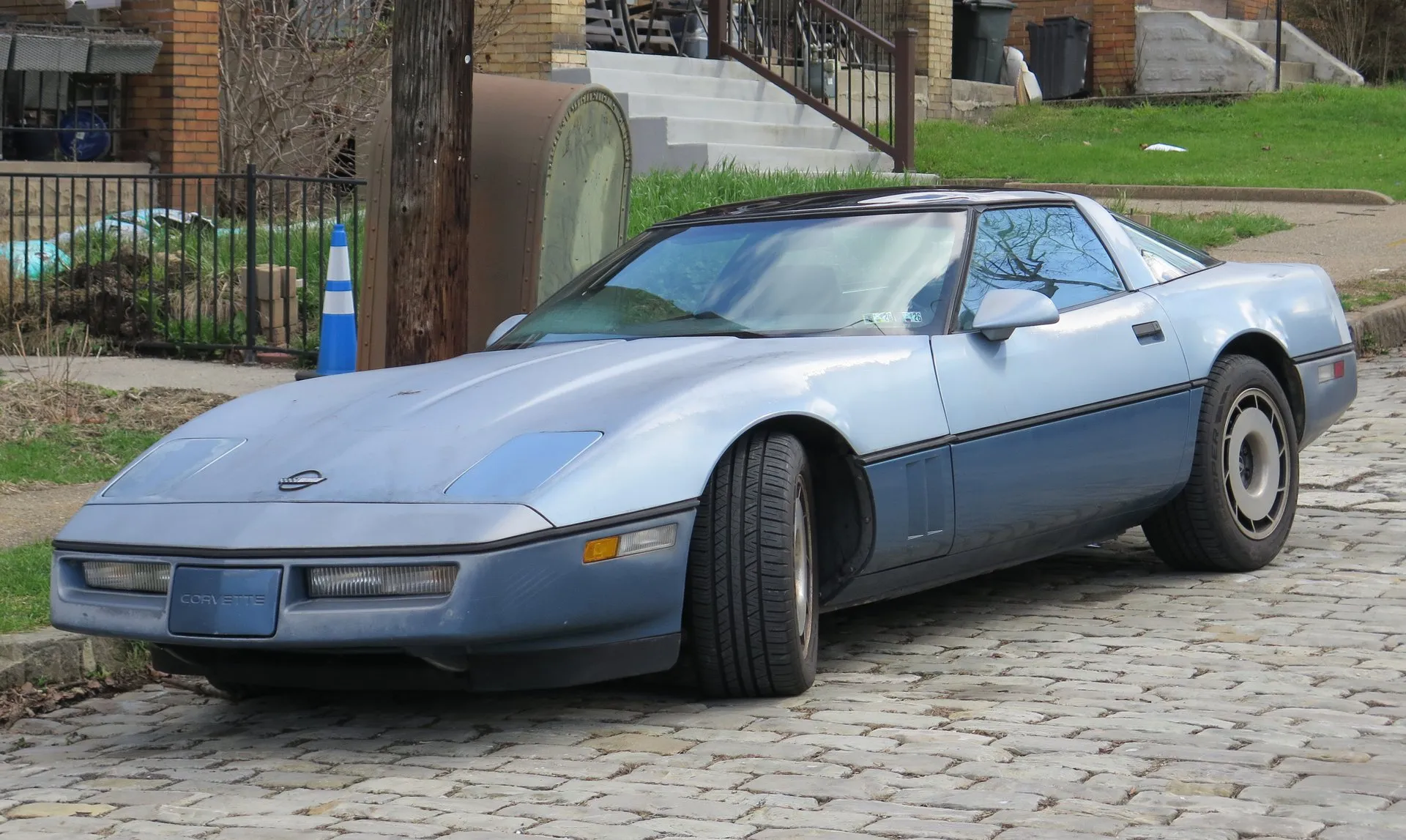
Every 1984 Corvette left Bowling Green with a $561.20 option its buyer couldn’t turn down. Chevrolet’s sales catalog, printed in November 1982, showed 15-inch cast aluminum wheels on P215/65R15 tires as standard. None shipped. RPO QZD (the regular production option code GM gave the package) was meant to put 16-inch wheels and Goodyear P255/50VR16 tires on Z51 cars and on anyone else who paid for them. It went on all 51,547 cars instead, and the 15-inch wheels and tires “were not used,” says a page from the Corvette Black Book (a reference book, not a GM publication) that GM put in its 1984 kit. A 1984 on 15-inch wheels isn’t wearing its originals.
That wheel decision is the first C4 (1984–1996) in miniature: grip came first. In its March 1983 issue, Car and Driver’s test car pulled 0.90 g on the skidpad, the highest figure its staff had recorded for a conventional car, and for 1985 GM softened the springs that did it. Under the new body sat the 1982’s Cross-Fire Injection V8, now rated 205 hp, and Bowling Green built more 1984s than any other C4 year.
Supply that deep helps make the 1984 one of the cheapest V8 Corvettes in 2026. On Bring a Trailer, seven sold between January 1 and October 18 at a median of $7,700, and the two best preserved brought about three times that. Grip Car and Driver had never measured from a conventional car, at a median under $8,000: performance per dollar doesn’t get much plainer.
Faults every C4 shares are in the C4 buyer’s guide; the GM Heritage Center kits behind most figures here are in this site’s manual library.
C4 Key figures
- Built
- 51,547 coupes
- Engine
- L83 Cross-Fire V8, 205 hp and 290 lb-ft
- 4+3 manuals built
- 6,443 cars, 12.5 percent of the year
- Z51 handling package
- 25,995 cars, 50.4 percent of the year
- Price new
- $21,800 plus the $561.20 wheel package
- Curb weight, GM
- 3,192 lb automatic, 3,164 lb manual
- Car and Driver, 1983
- 0.90 g on the skidpad, 0–60 mph in 6.7 s
- Bring a Trailer, 2026
- median $7,700 from seven sales
Section 01
Introduced in March 1983, sold as a 1984
The Black Book page in GM’s kit settles the missing 1983 in one sentence, about a car introduced in March 1983: “Because it met all 1984 federal requirements, Chevrolet decided to skip the 1983 model designation” (page 4). Chevrolet built, serial-numbered and tested 1983s, and the motoring press drove them at a “long lead” preview at Riverside Raceway in December 1982, three months before the introduction; none was released for sale. The National Corvette Museum (opens in new tab) also blames development delays and new emissions and quality standards. Most of the pre-production cars were destroyed under standard GM procedures, it says, and the one survivor is in its collection.
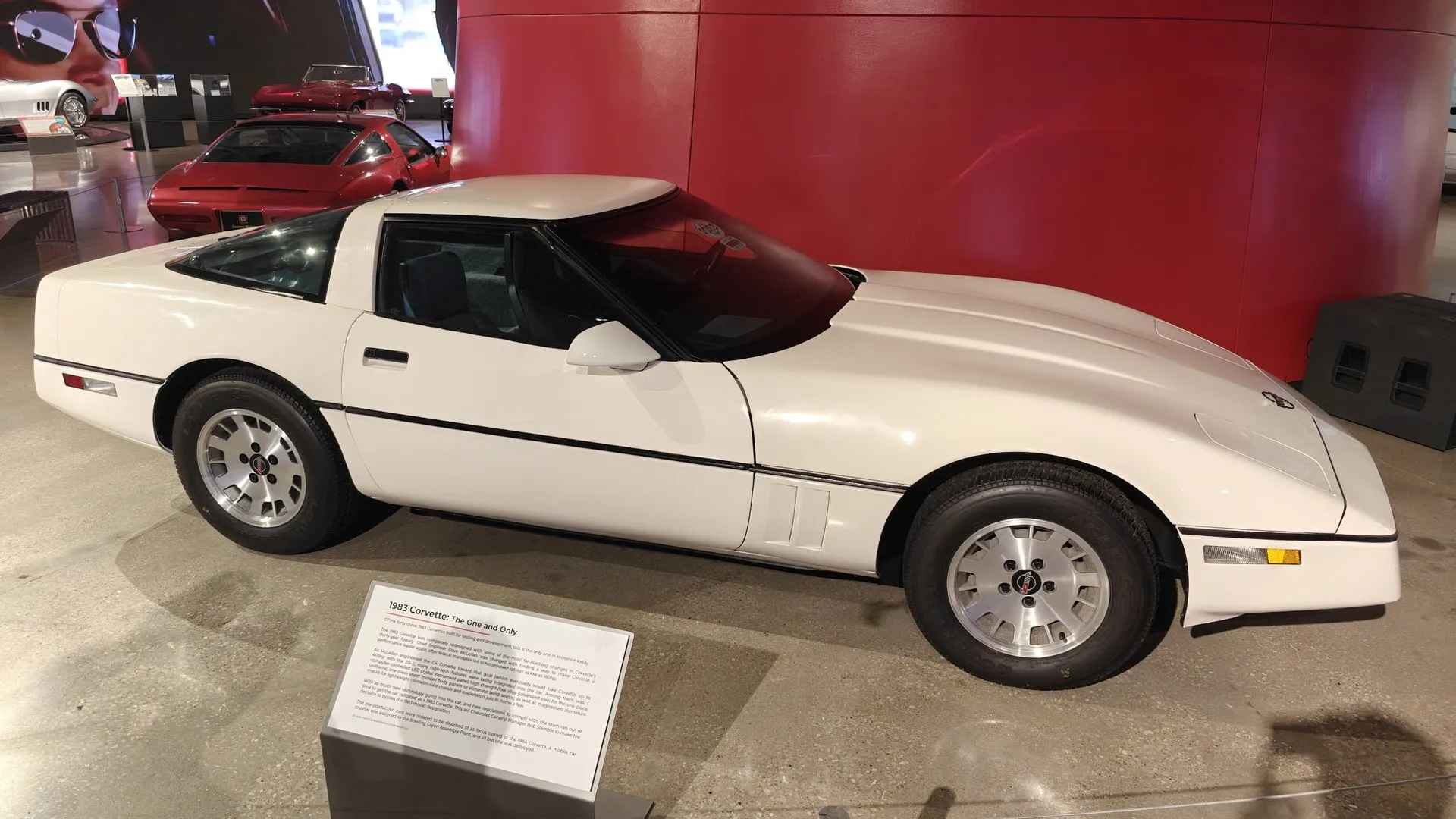
The early start made a long model year, “a very long production run” in the Black Book’s words, and Car and Driver expected the car to be sold as a 1984 for eighteen months. Bowling Green built 51,547 coupes, VINs 1G1AY0782E5100001 to 1G1AY0782E5151547 (the ninth character is a check digit), the most of any C4 year. The Black Book called it the second-biggest Corvette model year; the 2023 C8, at 53,785, has since pushed it to third, behind 1979’s 53,807. Why counts of 1983s disagree, and where the Stingray name went, are in the generations guide.
Section 02
All new, except what the 1982 handed down
Chevrolet’s ordering information billed it as “the first completely new Corvette in over fifteen years,” and GM’s papers spell out what that meant:
- The structure. An all-welded steel body-frame, 100 percent galvanized by GM’s specification form, with a bolt-on front crossmember so the engine could go in from below.
- The body. A front-hinged clamshell hood, no fiberglass seams on exposed panels, and a full-glass hatch with three remote releases, the largest compound glass yet installed in an American car, says the Black Book.
- The roof. A one-piece lift-off panel on every car: body-color fiberglass as standard, or blue-tinted transparent acrylic as RPO CC3 ($595, 15,767 cars).
- The chassis. A transverse glass-epoxy leaf spring at each end, forged aluminum arms, power rack-and-pinion steering, and vented discs at all four corners with Girlock aluminum calipers. No ABS: GM’s sheet lists anti-skid brakes as “Not Available.”
- The packaging. The exhaust runs through the center tunnel, buying ground clearance and cabin room with less height; the cost, Corvette Action Center notes, is an engine set farther back and tighter footwells.
- The instruments. Liquid-crystal displays for speed and revs, digital engine readouts in English or metric, and a driver information system with mpg and range. “Analog instrumentation was not available,” the Black Book says.
- The passenger-side pad. The padded bulge on that side of the dash, the Black Book explains, was part of a passive restraint system planned when federal rules looked set to require one. The Reagan administration dropped the proposals; the pad stayed.
Air conditioning, power windows, an anti-theft alarm with starter interrupt, pop-up halogen headlamps, a leather-wrapped tilt-telescopic wheel and a seek-and-scan AM/FM stereo were all standard.
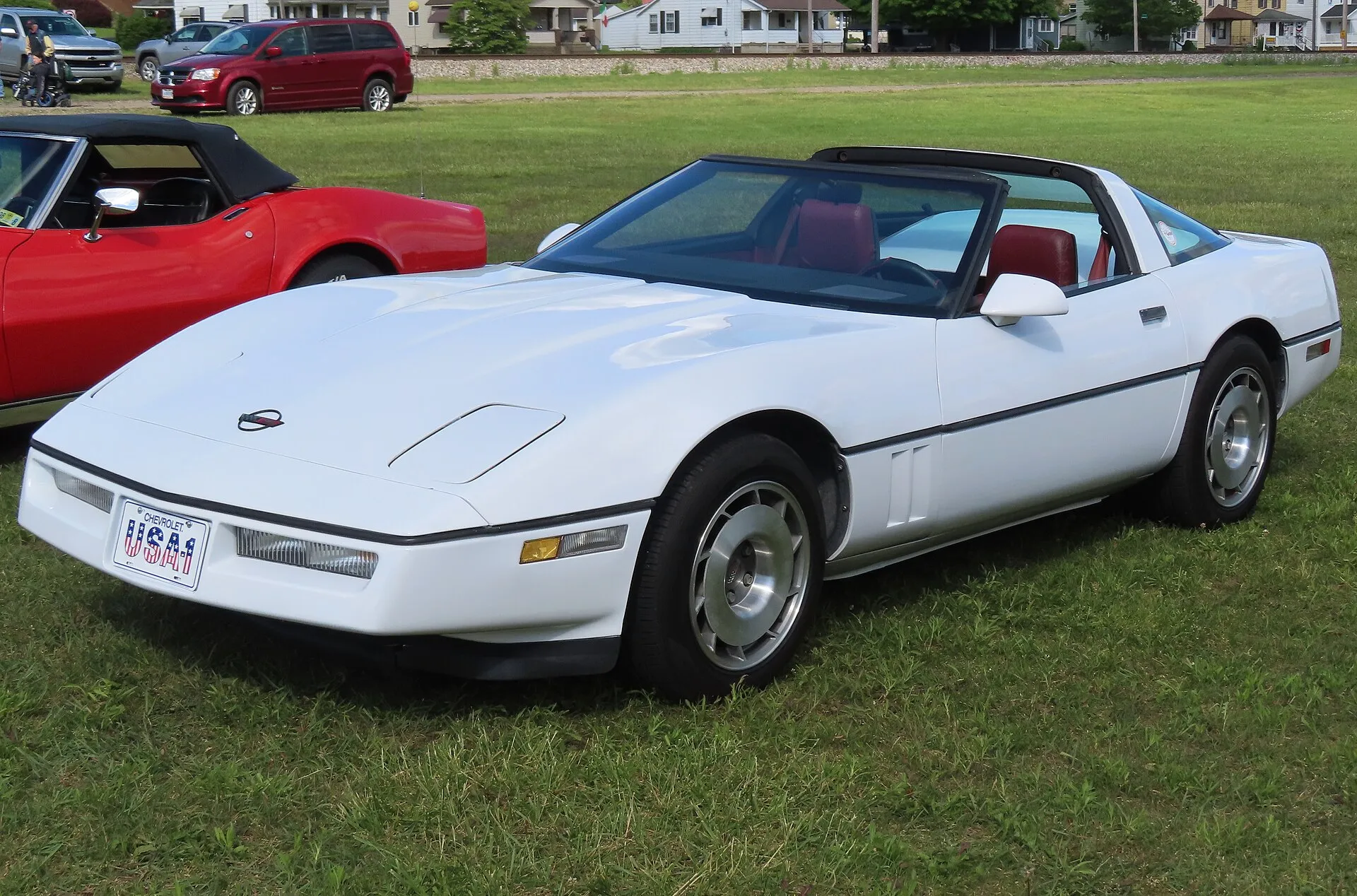
From the 1982, the last C3 (1968–1982), came the L83 V8, with the block and head castings (14010207 and 462624) the Black Book lists for 1982 and 1985 alike, and the four-speed automatic. A manual gearbox returned after the 1982 went without one. ABS and the convertible waited for 1986, the driver airbag for 1990, as the C4 guide’s year-by-year list shows.
Section 03
Cross-Fire, the 4+3 and the numbers
Under the clamshell sits the L83 Cross-Fire V8, 205 hp and 290 lb-ft, the 1982’s engine with 5 hp more (the 1982 was rated 200 hp). It’s a 350 cu in (5.7-liter) cast iron V8 with 9.0:1 compression, built for 87-octane unleaded, with its peaks at 4,300 and 2,800 rpm (GM’s power teams). Cross-Fire Injection was Chevrolet’s name for two throttle-body injector units on a tuned-runner aluminum intake, run by its Computer Command Control. The Black Book doesn’t flatter it: in GM’s 1982 kit it says Cross-Fire “wasn’t fuel injection of the type available in 1957–1965 Corvettes,” and in the 1985 kit that “genuine fuel injection returned” with the L98. The 1984 is the only C4 with the L83, and the only Corvette that pairs Cross-Fire with a clutch pedal.
The automatic was standard: GM’s 700-R4 four-speed, with an overdrive fourth gear and a torque converter clutch that locks up in second, third and fourth.
The 4+3 (RPO MM4) was a no-cost option and went into 6,443 cars, 12.5 percent of the year. Doug Nash built it: a four-speed manual with a planetary overdrive that the car’s computer engaged in second, third and fourth, for seven forward ratios (GM’s ratios). An OVERDRIVE ENGAGED lamp shows it working, and a 1984’s overdrive switch sits on the console (GM moved it to the shift knob during 1985 production). On when it arrived, the Black Book says only “Not available early.” Car and Driver reported in March 1983 that the first cars would all be automatics, and complained of the manual’s “rather clunky linkage.”
| 1984 Corvette | GM’s figures |
|---|---|
| Engine | L83 5.7-liter (350 cu in) V8, Cross-Fire Injection, 9.0:1 |
| Power | 205 hp at 4,300 rpm, 290 lb-ft at 2,800 rpm |
| Automatic (standard) | 3.06, 1.63, 1.00, 0.70 |
| 4+3 manual | 2.88, 1.91, 1.33, 1.00; overdrive 1.28, 0.89, 0.67 in 2nd, 3rd and 4th |
| Axle | 3.07 standard, 3.31 optional; limited slip standard |
| Brakes | 11.5 in vented discs front and rear; no ABS |
| Wheels and tires | P255/50VR16 on 16 x 8.5 in wheels; Z51 rears 16 x 9.5 in |
| Bolt pattern | 5 x 4.75 in (120.7 mm), M12 x 1.5 nuts |
| Size | 96.2 in wheelbase, 176.5 in long, 71.0 in wide, 46.7 in high |
| Fuel tank | 20.0 gal |
How heavy? GM’s curb weights are 3,192 lb automatic, 3,164 lb manual, calculated with standard equipment: on that sheet, the 15-inch wheels nobody got. The compulsory 16-inch package added 34.4 lb (GM’s weights). Car and Driver gave its test car 3,300 lb.
How quick? GM’s 1984 papers don’t quote a 0–60 time or a top speed. Car and Driver’s automatic test car (opens in new tab) managed 0.90 g on the skidpad, 0–60 mph in 6.7 s, the quarter mile in 15.2 s at 90 mph and 138 mph flat out. EPA’s current figures are 13 mpg city, 20 highway and 15 combined for either gearbox, on regular fuel.
Section 04
Z51 and the ride GM softened for 1985
Half the 1984s were built to corner. The Z51 Performance Handling Package cost $600.20 and went on 25,995 cars, 50.4 percent of the year (Black Book): heavy-duty springs, shocks, stabilizer bars and bushings, faster steering, an engine oil cooler, a pusher radiator fan and 9.5-inch-wide rear wheels. GM’s specification form puts numbers on it:
| Base suspension | Z51 | |
|---|---|---|
| Front spring rate | 431 lb/in | 634 lb/in |
| Rear spring rate | 431 lb/in | 525 lb/in |
| Front stabilizer bar | 24 mm | 25 mm |
| Steering | 15.5:1, 2.36 turns lock to lock | 13.0:1, 1.96 turns |
| Rear wheels | 16 x 8.5 in | 16 x 9.5 in |
GM’s order guide made two more options Z51-only: Delco-Bilstein shocks (FG3, $189, 3,729 cars) and an engine oil cooler (KC4, $158, 4,295 cars), though the Black Book also lists a cooler inside the Z51 itself. G92, a $22 “performance axle ratio” the Black Book doesn’t define, went on just 410 cars.
Car and Driver’s test car had the Z51 package, by the magazine’s account. Its 0.90 g beat the roughly 0.82 g the magazine had seen from a Porsche 928 and “assorted Ferraris,” and its 173 ft stop from 70 mph beat the best the magazine had recorded in 1982, a Porsche 928’s 180 ft. Take one to an autocross and let the timing sheet do the talking.
The bill came in the ride. The Black Book page in GM’s 1985 kit says suspension rates were lowered, “a result of harsh ride criticism”: base springs 26 percent softer at the front and 25 at the rear, Z51 springs 16 and 25 percent (1985 kit). Hagerty’s 1984 valuation page calls the car “arguably the least interesting to drive.”
The 1985 also got the 230 hp tuned-port L98, a lighter plastic brake booster, cleaner displays with larger digits and leather sport seats, at a base price of $24,403 (1985 options).
Section 05
Price, options and the 13 colors
The base price was $21,800 plus the $561.20 wheel package. The $21,800 covered the V8, the automatic, a body-color roof panel and cloth seats, and the Black Book’s options page shows how far most buyers went past it: nearly every 1984 has cruise control, power locks, a power driver’s seat and defoggers, 85 percent have the Bose stereo and 79 percent leather. Car and Driver estimated $28,000 for its test car as tested.
| RPO | Option | Price | Built |
|---|---|---|---|
| QZD | 16 in wheels, P255/50VR16 tires (required) | $561.20 | 51,547 |
| K34 | Cruise control | $185 | 49,832 |
| AU3 | Power door locks | $165 | 49,545 |
| AG9 | Six-way power driver’s seat | $210 | 48,702 |
| Z6A | Rear window and mirror defoggers | $160 | 47,680 |
| UU8 | Delco-Bose stereo | $895 | 43,607 |
| AR9 | Leather seats | $400 | 40,568 |
| Z51 | Performance handling package | $600.20 | 25,995 |
| CC3 | Transparent roof panel | $595 | 15,767 |
| V01 | Heavy-duty radiator | $57 | 12,008 |
| D84 | Two-tone paint | $428 | 8,755 |
| YF5 | California emissions | $75 | 6,833 |
| UM6 | AM/FM stereo with cassette | $153 | 6,689 |
| MM4 | 4+3 manual | No charge | 6,443 |
| AQ9 | Sport seats, cloth | $625 | 4,003 |
| UN8 | AM/FM stereo with CB | $215 | 178 |
| UL5 | Radio delete | $331 credit | 104 |
Leather seats shared the cloth seats’ design. The sport seats, with inflatable lumbar support and power side bolsters, came only in cloth; leather sport seats arrived after 1985 production started.
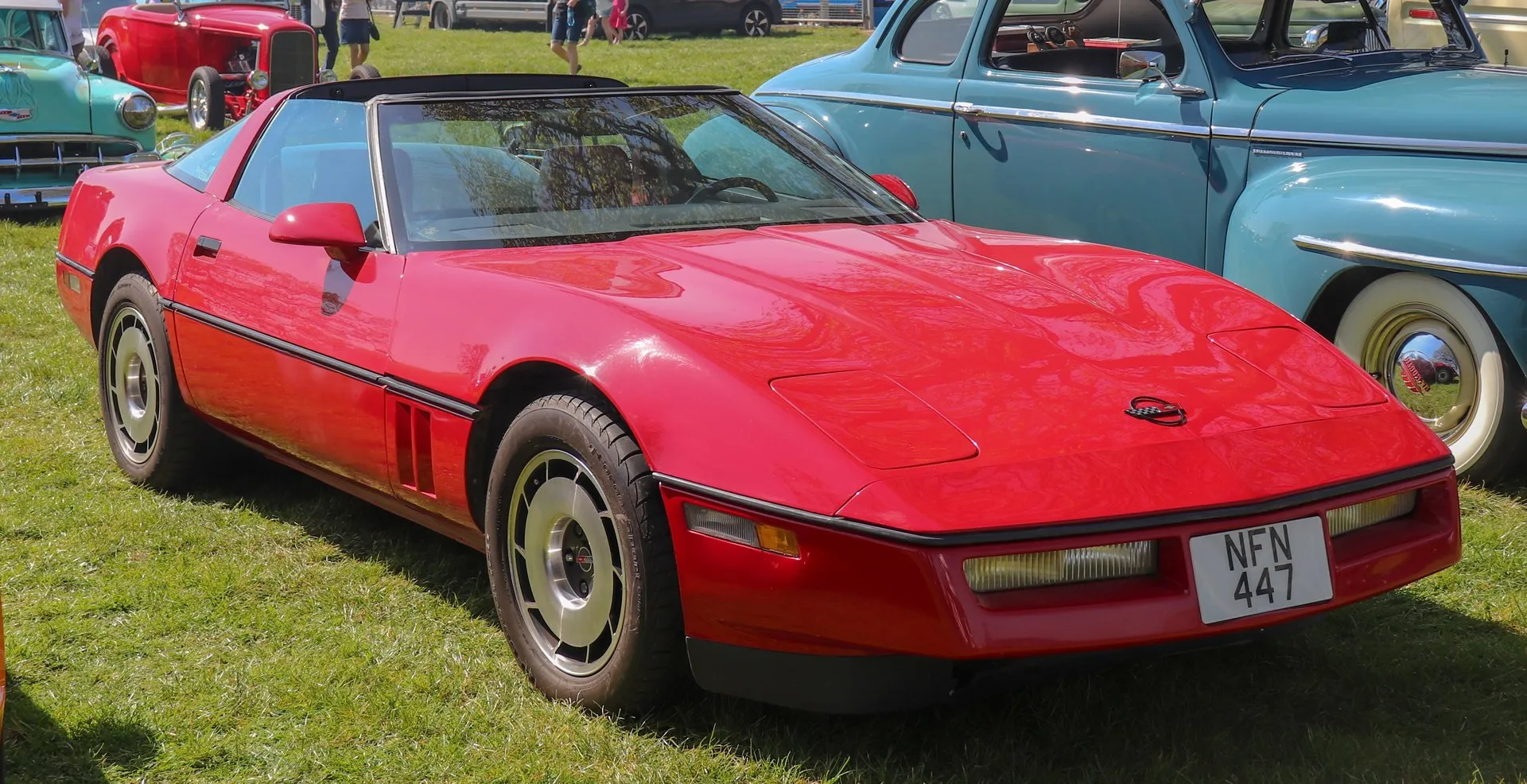
1984 Corvette colors. Thirteen choices, ten solid and three two-tone, with the Black Book’s counts:
| Paint | Built |
|---|---|
| Bright Red | 12,942 |
| Black | 7,906 |
| White | 6,417 |
| Light Bronze and Dark Bronze | 3,693 |
| Silver and Medium Gray | 3,629 |
| Medium Gray Metallic | 3,147 |
| Bright Silver Metallic | 3,109 |
| Light Bronze Metallic | 2,452 |
| Gold Metallic | 2,430 |
| Medium Blue Metallic | 1,822 |
| Light Blue and Medium Blue | 1,433 |
| Dark Bronze Metallic | 1,371 |
| Light Blue Metallic | 1,196 |
Interiors. Graphite led on 13,752 cars, then carmine (a dark red) on 12,768, bronze on 8,019, saddle on 6,685, gray on 6,541 and blue on 3,782. Carmine came only in leather and blue only in cloth, per GM’s dealer order guide. Both sets of counts add up to 51,547.
Section 06
1984-only clues: VIN, engine pad and dash
The VIN is on a plate at the top left of the instrument panel pad, readable through the windshield, and GM’s 1984 VIN chart decodes it:
| Position | On a 1984 |
|---|---|
| 1–3 | 1G1: Chevrolet passenger car |
| 4 | A: manual seat belts |
| 5 | Y: Corvette |
| 6–7 | 07: the coupe |
| 8 | 8: the L83 |
| 9 | Check digit |
| 10 | E: 1984 |
| 11 | 5: Bowling Green |
| 12–17 | 100001 to 151547 |
A 1985 starts 1G1YY07 and has F in tenth place. The serial in the last six places also decides which of GM’s campaigns could apply (see The most-recalled C4).
The engine pad is just forward of the right cylinder head, or on the vertical surface behind the oil filter, and carries a source code, the month and day, a suffix and a VIN derivative (GM). L83 suffixes begin ZF: GM’s identification page lists ZFC, ZFD, ZFF, ZFM and ZFN, and the Black Book adds four, among them the export engine’s ZFH. The castings match 1982 and 1985, so they prove nothing alone, and owners openly discuss swapping the L83 or its induction (CorvetteForum, 2024).
The axle. GM’s identification page gives three codes for a 1984 3.31 (4CB, 4CK and 4CR) and seven for the 3.07, stamped on the axle tube beside the carrier or on a tag held by a cover bolt (GM). Which cars got the 3.31, GM’s papers don’t settle: the Black Book counts 410 G92 cars without naming the ratio, the April 1983 specification sheet lists a 3.31 in the Z51, and the March 1984 order guide shows only the 3.07. Go by the code on the axle, not the ad.
The one-year parts. GM revised the displays for 1985, and owners say the 1984 cluster looks different, carries its own part number and can’t be swapped for a 1985 unit without looking wrong (CorvetteForum, 2002 and 2013). They name the 1984’s A/C control panel, power lock switch and inner door release handle as one-year parts too (CorvetteForum, 2017 (opens in new tab)). Chevrolet’s 1988 letter to owners confirms one more: the roof panel stowage bracket covers, whose molded-in fin spacers “were only on the 1984 covers.”
Paper. The window sticker and build sheet, if they survive, and campaign labels (84-C-02’s went on the radiator core support). A reproduction sticker, like the one a 2026 auction car came with, proves nothing about the car.
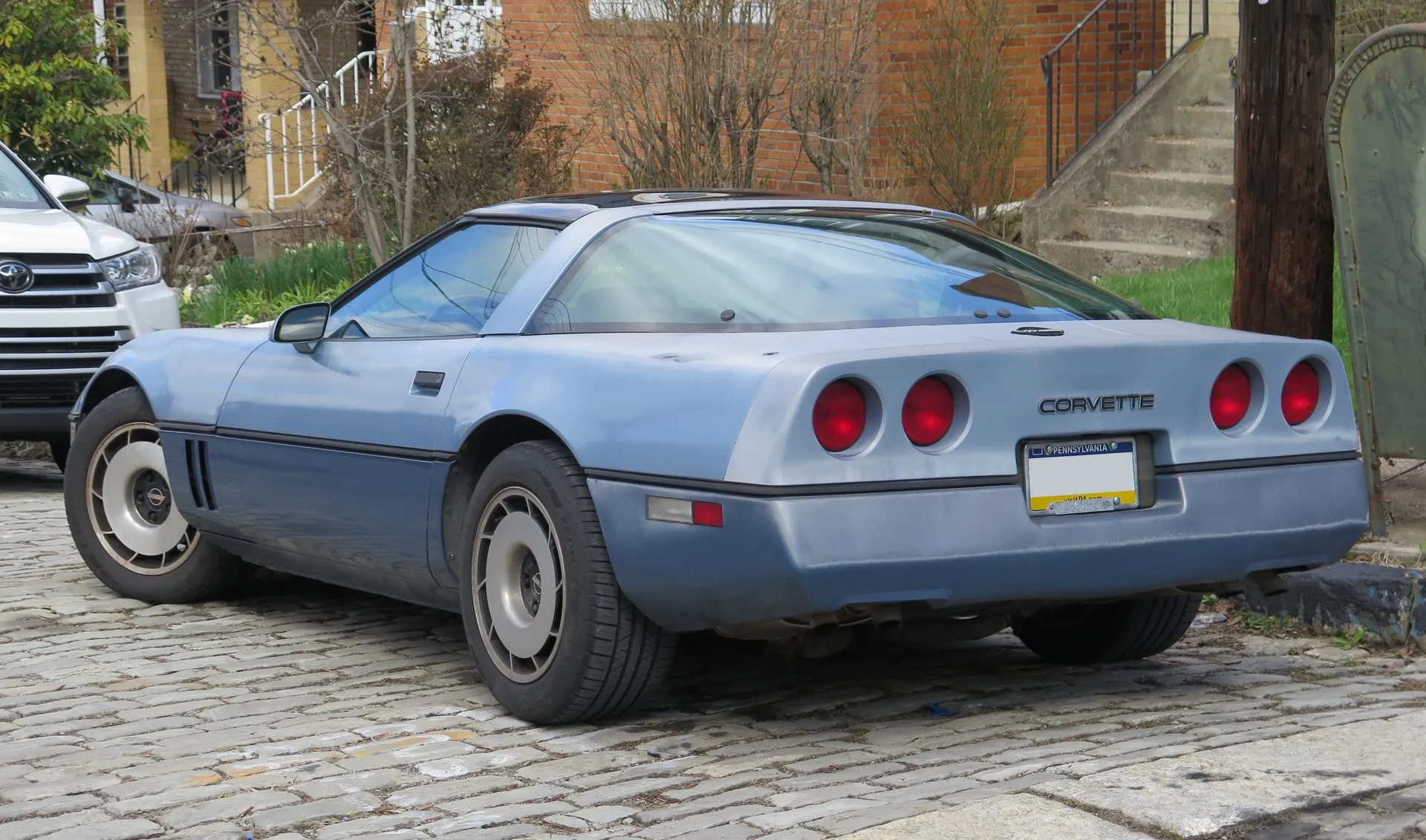
What a 1984 isn’t. A convertible (GM built only coupes, and the C4 convertible came for 1986, so a 1984 convertible is an aftermarket conversion), a Stingray (no 1984 wears the name; the generations guide explains), or a 1983 (the one survivor is in the museum).
Section 07
The most-recalled C4, and GM’s other campaigns
What goes wrong on a 1984? Its paper trail is the longest of any C4. NHTSA’s recall file (opens in new tab) lists five GM recalls for the 1984, the most of any C4 year, and four of them cover 1984s alone. Chevrolet’s dealer bulletins, as reproduced by Corvette Action Center, add GM’s campaign numbers and, for most, the VIN ranges:
- Front brake caliper bolts, 83V064000 (campaign 84-C-02). Caliper bracket bolts “mistakenly coated with a slippery material” could loosen and fall out, letting a caliper partly separate and lock the wheel. Early cars, VINs E5100001 to E5109828 (9,197 by NHTSA’s count); the replacement bolts have an orange adhesive patch on the threads.
- Battery cable, 83V081000 (84C04). The positive cable’s insulation could wear through and drain the battery, so the headlights could go out; GM adds a flickering instrument display and a dead horn as warning signs. NHTSA counts 11,909 cars; the surviving bulletin pages give no VIN range.
- Cruise control, 85V029000 (84C22). Its vacuum solenoid valves could malfunction and cause unexpected acceleration. GM’s bulletin covers every 1984 with cruise (K34; NHTSA counts 47,081 cars) and told owners, should it happen, to “apply and hold the service brakes,” stop and turn the ignition off.
- Differential, 85V118000 (84C25). Lost snap rings could let the differential cross shaft hit the carrier or pinion teeth, possibly locking the rear wheels. It covers some cars built through VIN E5148659, picked by GM’s computer listing (opens in new tab), 44,342 by NHTSA’s count; GM’s 1985 bulletin made the fix free “regardless of mileage, age of vehicle, or ownership.”
- Seat belts, 91V143000. Front belts on 1984–1991 Corvettes can lock up or jam in the retractor, and the remedy replaces a belt only once that happens. The C4 guide covers the dealer refusals and the 91C25 and 91C26 stickers.
Two more GM campaigns aren’t in NHTSA’s database: 84C01 (May 1983), for air injection pump pulleys that could loosen and throw the belt on some cars through VIN E5105256, and emission campaign 85C22 (August 1986), a high output ignition coil for 1984s from VIN E5119323 on, against misfires, hesitation and failures to restart.
Two GM service bulletins cover the weak spots owners still talk about. 84-30 (November 1983) names a vacuum leak at the throttle-body cover plate gasket as one cause of a high, rough or unstable Cross-Fire idle. 85-111 (opens in new tab) (August 1985) covers 1984–1985 4+3s that are noisy in all four gears with the overdrive off: a worn bearing on the overdrive’s planetary carrier, which left alone damages more of the unit. From overdrive serial D5C 14413 CF (on a tag on the overdrive’s oil pan), GM fitted a carrier with a higher-capacity bearing, and Corvette Action Center’s rebuild guide blames most 1984–1985 overdrive failures on that bearing and a thrust washer GM also revised.
In April 1988, Chevrolet warned owners of 1984 to early 1987 cars that the stowed acrylic roof panel could crack at its rear corners if lifted without first sliding it out of its brackets, a repair it would not pay for, and mailed new bracket covers.
The complaints. NHTSA’s complaint file (opens in new tab) holds 15 owner complaints about the 1984, all filed from December 1994 on, when the cars were already used. Eight are about jammed belts, most with GM or a dealer declining recall 91V143000 or short of parts, and two more say GM refused other recall work. None describes the Cross-Fire injection, the digital dash, the 4+3 or the ride. These are raw counts, not rates.
Beyond that, a 1984 suffers what any C4 of its age does: worn headlight motor bushings, tired weatherstrips, slow steering on a cold morning and a fading dash. The C4 buyer’s guide covers each.
Section 08
Belts first: checking a 1984 for sale
- The seat belts. Pull each front belt out to its full length and let it reel back in. A belt that jams is a safety defect, and GM’s recall only replaces one that has locked up, so price in the fix.
- The VIN against GM’s ranges. Serial 109828 or lower: look for the caliper bolt campaign’s label and orange-patch bolts. 105256 or lower: the air pump pulley. Any car with cruise: the servo. Up to 148659: possibly the differential kit. From 119323: the coil. Paper for any of it marks a cared-for car.
- A warm idle. High, rough or hunting points to bulletin 84-30’s gasket or tired vacuum lines, which a 2025 owner thread says to replace wholesale, since the originals will have rotted. Owners call Cross-Fire simple once its leaks are fixed, and one reports 240,000 miles on the original injectors (CorvetteForum, 2020).
- The 4+3, warm. Noise in all four gears with the overdrive off is bulletin 85-111’s bearing. Owners say the overdrive stays out until the engine is warm, and fix one that won’t engage with fluid, the screen and a ground wire (CorvetteForum, 2019 and 2023). Ask when its fluid and screen were last changed.
- The instruments. The speedometer, the tach graph and every digital readout legible in sun and at night. If originality matters, repair a one-year cluster rather than fit a 1985’s.
- Broken pavement. A Z51 is the stiff car GM softened for 1985; listen for the squeaks and rattles Hagerty says early owners complained of (see the C4 guide).
- The roof panel. On a transparent one, cracks at the rear corners. Original 1984 stowage bracket covers have molded-in fin spacers; Chevrolet’s 1988 replacements use separate nut-spacers.
- Originality. A ZF suffix and a VIN derivative on the pad, 16-inch wheels, the one-year A/C panel and lock switch. A swapped engine is fine on a driver, not on a car priced as original.
- The C4 basics: headlight motors, weatherstrips and damp carpet, steering on a cold start, by the checklist in the C4 guide.
- A pre-purchase inspection at a shop that has worked on Cross-Fire before.
Section 09
$4,000 to $24,251: the 2026 market
How much is a 1984 Corvette worth? Usually under $12,000, unless it’s a time capsule. Bring a Trailer (opens in new tab) sold seven 1984s between January 1 and October 18, 2026, for $4,000 to $24,251. That’s a median $7,700 from seven sales, by this site’s arithmetic on sold prices before the buyer’s fee, and no 1984 failed to sell:
- Time capsules. A 7,000-mile Z51 4+3 in the Light Bronze and Dark Bronze two-tone, with its window sticker: $24,251 in April. An original-owner black Z51 4+3 with 11,000 miles and Bloomington Gold and NCRS (National Corvette Restorers Society) Top Flight awards: $22,500 in June.
- Low miles, no clutch. A 6,000-mile white automatic: $11,500 in August.
- Drivers and modified cars. A Z51 4+3 with 77,000 miles, aftermarket body pieces, exhaust and 17-inch wheels: $7,700 in March. A red-wrapped Z51 4+3 with a touchscreen and 105,000 miles: $5,600 in September. A white Z51 automatic with 54,000 miles: $5,250 in June, the cheapest stock sale in the best-years guide’s window.
- A project. A running car with 86,000 miles: $4,000 in September.
Leave out the project and the median is $9,600. Over the last 12 months, 11 sold at a median of $11,500; in 2025, 14 sold for $5,600 to $27,500, a median of $10,375, topped by a 33-mile 4+3. Across all 22 sales from December 2024 to October 2026, the seven 4+3s brought a median of $17,250 and the 15 automatics $10,250, but four of those 4+3s had under 12,000 miles, so the gap mixes gearbox and mileage. Counts this small give a feel for the market, not a price guide.
Hagerty put a 1984 coupe in #3 (good) condition at $8,900 in February 2026, against $9,100 for a 1985 and $9,300 for a 1986 (archived copy (opens in new tab)); its 1984 page showed $7,800 in July 2024. classic.com’s last readable 1984 figure, from November 2024, was an average of $12,085 across 56 sales. None of it predicts where values go next.
Why are 1984 Corvettes so cheap? Supply first: Hagerty counts production among the reasons the whole C4 generation trails the cars on either side of it (see the C4 guide), and the 1984 is the most-built C4. Then the one-year 205 hp engine and the ride GM itself softened. One long-time owner in a 2007 thread called the 1984 the least-wanted C4, for the engine first and the ride second (CorvetteForum). Low demand is the next buyer’s opening.
Section 10
Stock, Z51, 4+3: the 1984 worth buying
Is a 1984 a good Corvette? At the right price, yes, and it’s honest about what it is: 205 hp, a stiff ride with Z51, five recalls and parts no other year used. The C4 guide’s rule stands: inspect a 1984 hardest and pay least for it.
The pick is an unmodified Z51 4+3 with its paperwork. It’s the 1984 at its most 1984: the springs and fast steering behind 1983’s skidpad number, and the only clutch pedal Cross-Fire ever had in a Corvette, one of 6,443. It’s also the version the market rewards: both 2026 sales over $20,000 were Z51 4+3s, while modified ones sold for $5,600 and $7,700. Make the seller show the overdrive’s service history and the campaign paper, then find a road with some corners on it.
For a cruiser, an automatic with the base suspension. Its front spring is about a third softer (431 lb/in against the Z51’s 634), the automatic is by far the commonest 1984 gearbox, and 2026’s three automatics sold for $4,000 to $11,500. Buy the one with the cleanest belts, dash and records.
Skip a modified car priced like an original, any car with a jammed belt and no plan to fix it, and a 4+3 that’s noisy with the overdrive off, unless the price covers the rebuild.
Or stretch. A 1985 brings 25 more horsepower and softer springs for $200 more by Hagerty’s February 2026 values, and the C4 guide’s budget pick is a 1990 or 1991. A C4 laid up for the winter belongs on a battery maintainer and under a cover, and the battery guide shows where to find the battery on one.
Forty-two years on, a sorted 1984 still does what it did for Car and Driver in 1983: corners harder than its price says it should. That’s America’s sports car, bought right.
Section 11
Sources
- GM Heritage Center: 1984 Corvette vehicle information kit files.zipcorvette.com This site's library. Corvette Black Book pages GM reproduced in the kit: production, VIN range, engine codes and the year's facts (PDF page 4), options with prices and counts, colors and interiors (page 5). GM's 1984 VIN chart (page 8), engine and axle identification (pages 10 to 12), Chevrolet's ordering information (page 13) and catalog wheel page, printed November 1982 (page 16), the dealer order guide revised March 2, 1984 (pages 18 to 20), and the MVMA specification form, January 1983 revised April 1983 (pages 22 to 50: power teams 25, engine 26, fuel 29, transmissions 31 and 32, suspension 34, brakes 35, wheels and tires 36, steering 37, body and VIN plate 40, dimensions 43, curb weights 48, option weights 49 and 50).
- GM Heritage Center: 1985 Corvette vehicle information kit files.zipcorvette.com This site's library. Corvette Black Book pages: what changed for 1985, the softer springs and the 1985 VIN range (PDF page 6); the 1985 options and price (page 8).
- GM Heritage Center: 1982 Corvette vehicle information kit files.zipcorvette.com This site's library. Corvette Black Book page: the L83 and Cross-Fire Injection in 1982, automatic only (PDF page 4).
- NHTSA recalls, 1984 Chevrolet Corvette (opens in new tab) api.nhtsa.gov Pulled October 19, 2026. GM campaigns 83V064000, 83V081000, 85V029000, 85V118000 and 91V143000, with NHTSA's counts of cars involved. The FRAM oil filter recall in the same results is not about the car.
- NHTSA owner complaints, 1984 Chevrolet Corvette (opens in new tab) api.nhtsa.gov Pulled October 19, 2026: 15 complaints (22 records), filed December 1994 to June 2019. Topics are this site's reading of the text.
- Corvette Action Center: GM campaign 84-C-02, front brake caliper bracket bolts (opens in new tab) corvetteactioncenter.com Transcription of GM's June 1983 campaign bulletin: VINs E5100001 to E5109828, the orange-patch replacement bolts and the campaign label. Not a GM or NHTSA original.
- Corvette Action Center: GM campaign 84C25, rear axle differential cross shaft (opens in new tab) corvetteactioncenter.com Transcription of GM's September 1985 bulletin, with GM's scanned pages: some cars in VINs E5100001 to E5148659, picked by GM's computer listing.
- Corvette Action Center: GM campaign 84C22, cruise control servo (opens in new tab) corvetteactioncenter.com GM's March 1985 bulletin: every 1984 with cruise control (RPO K34), and GM's advice to owners if the condition occurred.
- Corvette Action Center: GM campaign 84C04, battery cable routing (opens in new tab) corvetteactioncenter.com GM's August 1983 bulletin. Only its first page survives in the archived copies, without the VIN range.
- Corvette Action Center: GM campaign 84C01, air pump pulley (opens in new tab) corvetteactioncenter.com GM's May 1983 campaign on early 1984s through VIN E5105256. Not in NHTSA's recall database.
- Corvette Action Center: GM emission campaign 85C22, high output ignition coil (opens in new tab) corvetteactioncenter.com GM's August 1986 campaign: 1984s from VIN E5119323, and some 1985s. Not in NHTSA's recall database.
- Corvette Action Center: GM bulletin 84-30, Cross-Fire idle and the cover plate gasket (opens in new tab) corvetteactioncenter.com November 1983, 1982–1984 Corvettes with Cross-Fire Injection.
- Corvette Action Center: GM bulletin 85-111, 4+3 noise in direct drive (opens in new tab) corvetteactioncenter.com August 1985, 1984–1985 Corvettes with the 4-speed manual with automatic overdrive.
- Corvette Action Center: Chevrolet letter to owners on roof panel damage (opens in new tab) corvetteactioncenter.com April 1988, 1984 to early 1987 Corvettes with the acrylic roof panel; the fin spacers only the 1984 bracket covers had.
- Corvette Action Center: rebuilding the Doug Nash 4+3 overdrive (opens in new tab) corvetteactioncenter.com David Fulcher. Where 1984–1985 overdrive failures come from, and the fluid and screen service.
- Corvette Action Center: 1984 Corvette production, specifications and identification (opens in new tab) corvetteactioncenter.com Pages used: specifications (opens in new tab) and identification (opens in new tab). Read October 2026 from archived copies. Its production page leaves out Dark Bronze Metallic and two leather interiors; this guide uses the Black Book's counts.
- EPA fuel economy, 1984 Chevrolet Corvette (opens in new tab) fueleconomy.gov 13 city, 20 highway, 15 combined mpg, current method; the manual (vehicle 26564) is the same.
- Car and Driver: Tested, 1984 Chevrolet C4 Corvette (opens in new tab) caranddriver.com Brock Yates, March 1983 issue. Automatic test car with the Z51 package: 0.90 g, 0–60 mph in 6.7 s, 138 mph, 173 ft from 70 mph.
- National Corvette Museum: The One and Only 1983 Corvette (opens in new tab) corvettemuseum.org April 21, 2026. No retail 1983s; most pre-production cars destroyed; one survives at the museum.
- Corvette Blogger: Chevrolet releases the official 2023 Corvette production statistics (opens in new tab) corvetteblogger.com January 5, 2024. 53,785 for 2023, second only to 1979's 53,807, which puts 1984's 51,547 third.
- Bring a Trailer: C4 Corvette auction results (opens in new tab) bringatrailer.com 1984 sales from December 2024 to October 18, 2026, each 2026 listing read. Sold prices without the buyer's fee; medians are this site's calculation.
- Hagerty: 1984–1996 Corvette values (opens in new tab) web.archive.org Archived February 8, 2026. #3 (good) values: 1984 coupe $8,900, 1985 $9,100, 1986 $9,300.
- Hagerty: 1984 Chevrolet Corvette value (opens in new tab) web.archive.org Archived July 24, 2024. #3 value $7,800, and the model notes.
- classic.com: 1984 Corvette market (opens in new tab) web.archive.org Archived November 9, 2024: average $12,085 from 56 sales. No later figure was readable.
- CorvetteForum thread: so I just bought a pretty nice 1984 Corvette (opens in new tab) corvetteforum.com March 2025. First jobs on a newly bought 1984: fluids, brake lines and every vacuum line.
- CorvetteForum thread: tell me about the 1984 Cross-Fire (opens in new tab) corvetteforum.com January to March 2020. Owners on Cross-Fire's reliability, one with 240,000 miles on the original injectors.
- CorvetteForum thread: 1984 with Cross-Fire fuel injection, buy or not (opens in new tab) corvetteforum.com April 2007. Resale and demand for the 1984.
- CorvetteForum thread: 84 L83 Cross-Fire alternatives (opens in new tab) corvetteforum.com September 2024. Engine and induction swaps on 1984s.
- CorvetteForum thread: Doug Nash 4+3 diagnosis (opens in new tab) corvetteforum.com October to November 2019. An overdrive that won't engage: ground wire, fluid and screen.
- CorvetteForum thread: Doug Nash 4+3 overdrive cooldown (opens in new tab) corvetteforum.com February 2023. 1984 owners on the overdrive staying out until the engine is warm.
- CorvetteForum thread: 84 versus 85 instrument cluster (opens in new tab) corvetteforum.com May 2002. Different part numbers; a rebuilder offering a 1985 unit for a 1984.
- CorvetteForum thread: are all 84–89 dash clusters interchangeable (opens in new tab) corvetteforum.com July 2013. The 1984 cluster's different bar graph.
- CorvetteForum thread: 84 interior versus 86 (opens in new tab) corvetteforum.com August 2017. One-year 1984 interior parts, as owners report them.