C3 · Buying guide
1982 Corvette guide: the last C3, Cross-Fire Injection, the Collector Edition and what to pay
Published
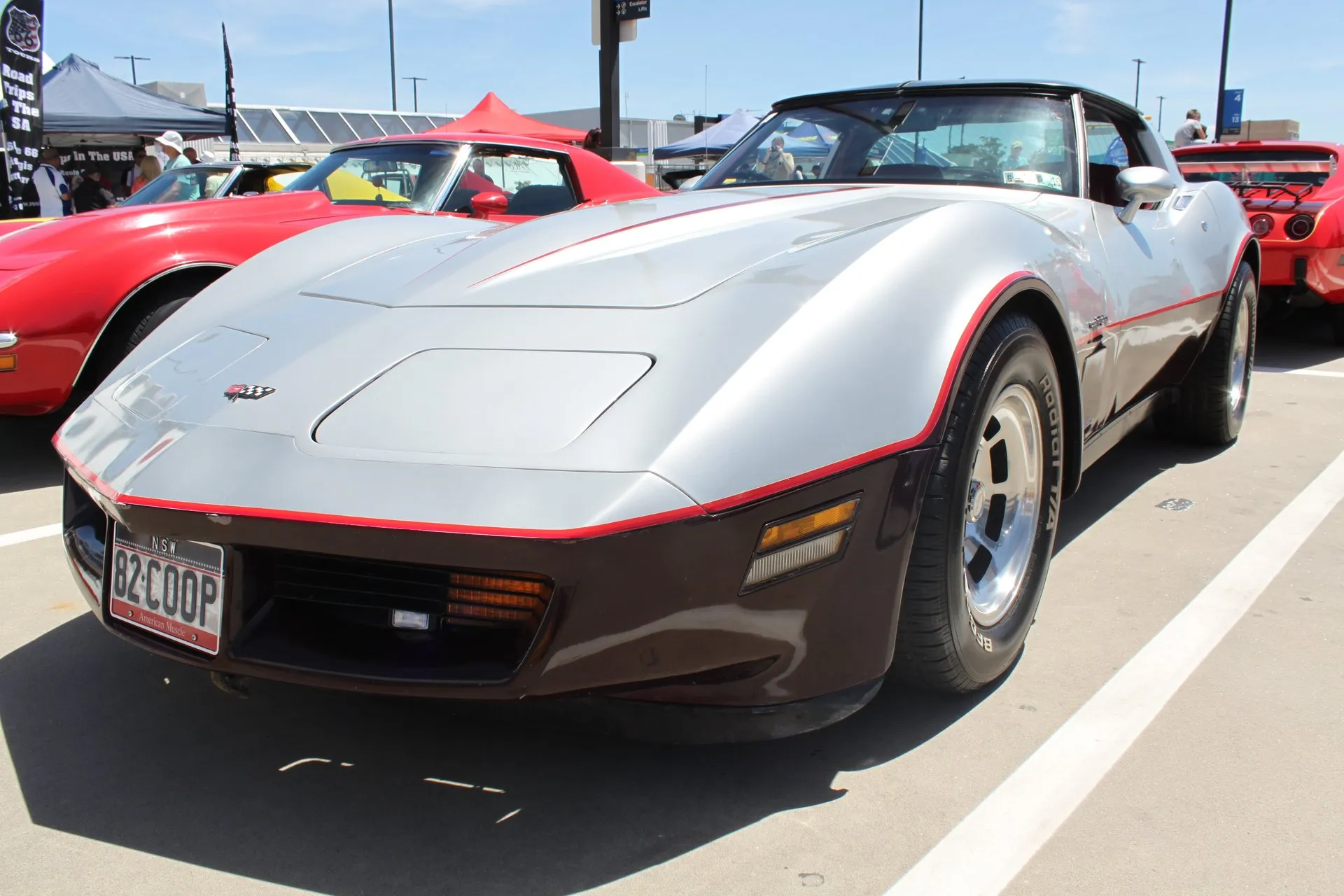
The rear axle in a 1982 Corvette came down to its wheels. GM’s dealer order guide, revised January 11, 1982, gives the coupe a 2.72:1 ratio, or 2.87:1 with the optional aluminum wheels, as GM’s specification form also says, and lists 2.87 for the Collector Edition on its own finned aluminum wheels. That was the buyer’s only say in the drivetrain: every 1982, in all 50 states, got the same engine and gearbox.
That suits the last C3 (1968–1982): one powertrain, one plant, one special edition to see the generation out. The engine was the L83 350 with Cross-Fire Injection, 200 hp, and the gearbox a four-speed overdrive automatic only. Every car came from Bowling Green, Kentucky, and there were 25,407: 18,648 coupes and 6,759 Collector Editions, the fewest Corvettes in any year since 1971. The Collector Edition listed at $22,537.59, the first Corvette with a base price over $20,000, per the Corvette Black Book page reproduced in GM’s 1982 kit (the Black Book is a reference book, not GM’s own).
The quick answers. A 1982 is a C3, the last of 15 model years, and not a Stingray (see A 1982’s numbers). No 1982 convertible was built: the C3 convertible ended with 1975, as the C3 buyer’s guide records. Prices new were $18,290.07 coupe, $22,537.59 Collector Edition. On Bring a Trailer between January 1 and October 15, 2026, 1982s brought a median $14,100 from seven sales, by this site’s count.
Unless another source is named, figures come from the 1982 Heritage Center kit in this site’s manual library: GM’s brochure, order guide and specification form, plus the Black Book page for production, prices and option counts. What every C3 shares, from frame rust to the birdcage (the steel frame around the cabin), is in the C3 guide.
C3 Key figures
- Built
- 25,407: 18,648 coupes and 6,759 Collector Editions
- Engine
- L83 350 with Cross-Fire Injection, 200 hp
- Gearbox
- four-speed overdrive automatic only
- Price new
- $18,290.07 coupe, $22,537.59 Collector Edition
- Collector Edition VIN
- a 0 as the sixth digit
- 0–60 mph, Car and Driver
- 8.1 s
- Bring a Trailer, 2026
- median $14,100 from seven sales
- Hagerty #3, coupe
- $17,200 (January 2026)
Section 01
Bowling Green only, and the rest of 1982’s changes
For 1981, Chevrolet built Corvettes in St. Louis until August 1 and in Bowling Green from June 1, the new plant making 8,995 of the 40,606 (the Black Book page in GM’s 1981 kit). GM’s 1982 brochure: “For 1982, all Corvettes will be built at a new facility at Bowling Green, Kentucky.” The other changes from 1981:
- Engine and gearbox. The carbureted 190 hp L81 gave way to the 200 hp L83 with Cross-Fire Injection. The four-speed manual, in 5,757 of the 1981s, was gone, and the automatic gained an overdrive fourth gear, its converter clutch now locking in second, third and fourth instead of second and third.
- Rear spring. The fiberglass single-leaf spring, used in 1981 only on automatics with the standard suspension, went under every car except those with Gymkhana suspension (RPO FE7, RPO being GM’s regular production option code), which got an eight-leaf steel spring (GM’s specification form).
- Underneath. New driveshaft seals and splash shields and larger U-joints (GM’s value-features sheet); by the Black Book, a smaller, lighter catalytic converter and a paper air filter in place of 1981’s charcoal one.
- Hood door. A solenoid-operated door in the hood opened at full throttle to feed outside air straight to the air cleaner.
- Paint. Bowling Green’s acrylic enamel on every car (St. Louis had used lacquer), base coat and clear coat on the metallics, and new pairings for the two-tone option, D84.
- Price. $18,290.07 against $16,258.52, about $2,032 more (this site’s arithmetic), not the $5,500 Hagerty’s C3 buyer’s guide gives.
- Dropped. The trailer package (ZN1), heavy-duty shocks (F51) and the performance axle (G92).
The body carried over with its molded-in spoilers, and so did the 85 mph speedometer: GM’s 1982 instrument panel list shows it on every car, though the federal rule behind it was rescinded in February 1982 (the 1980 guide tells that story). The Black Book adds that 1982 was the last year for a factory 8-track (UM4, 923 cars) or CB radio (UN5, 1,987).
Section 02
How Cross-Fire Injection works, and what 200 hp bought
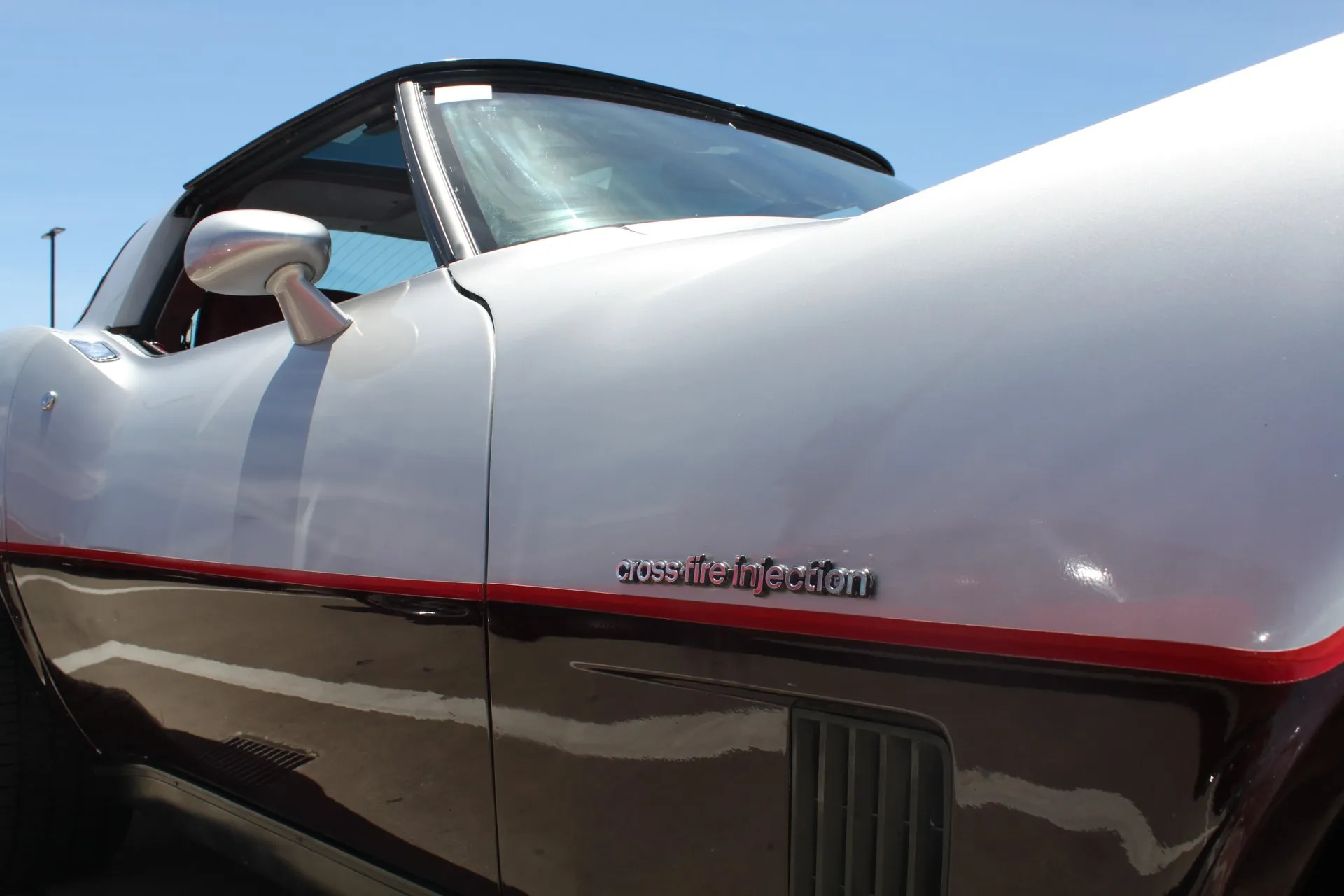
Cross-Fire Injection was Chevrolet’s name for two throttle-body injection units, one at the front and one at the rear of an aluminum intake with tuned runners, run by Computer Command Control, the engine computer. By the Black Book, that computer made eighty adjustments a second for 1982, against ten for 1981, and positive fuel cutoff kept the engine from running on after shutoff. The Black Book is blunt about what Cross-Fire wasn’t: the fuel injection of the 1957–1965 Corvettes.
| 1982 Corvette | GM’s figures |
|---|---|
| Engine | L83 V8, 350 cu in (5.7 L), 4.00 x 3.48 in bore and stroke, 9.0:1, 87-octane unleaded |
| Power, SAE net | 200 hp at 4,200 rpm, 285 lb-ft at 2,800 rpm |
| Gearbox | 700-R4 automatic: 3.06, 1.63, 1.00 and 0.70:1; reverse 2.29:1 |
| Axle | Dana, limited slip standard: 2.72:1 on steel-wheel coupes, 2.87:1 with aluminum wheels |
| Brakes | Power, 11.75 in vented discs at all four wheels |
| Wheels and tires | 15 x 8 in; P225/70R15 standard, P255/60R15 white letters optional (standard on the Collector Edition); 35 psi |
| Size | 98.0 in wheelbase, 185.3 in long, 69.0 in wide, 48.0 in high |
| Curb weight | 3,342 lb coupe, 3,351 lb Collector Edition |
| Fuel tank, luggage | 24.0 gal; 8.4 cu ft |
The figures are from GM’s brochure and specification form (power teams, gearbox and axle, tires, brakes). The form, revised in October 1981, gives heavier curb weights: 3,368 lb and 3,367 lb.
How much horsepower does a 1982 Corvette have? 200 hp, net, in all 50 states; California cars (option YF5, $46) got the same L83. That ties 1972 for the strongest C3 base engine of the net-rated years, 1972–1982 (see the table in the C3 guide), though every C3 year before 1981 offered a stronger optional engine.
No manual. The Black Book says only that none was available, and GM’s order guide and specification form list the automatic alone. Car and Driver blamed the federal gas-guzzler tax and expected manuals back the next year; one returned during the 1984 model year. (The Black Book prints first gear as 3.07; GM’s form says 3.06.)
The axle. The Black Book counts 16,844 sets of aluminum wheels (RPO N90), a coupe-only option in the order guide, which leaves about 1,800 steel-wheel coupes on the 2.72 (this site’s arithmetic). GM’s brochure shows only the 2.87.
How fast is a 1982 Corvette? Car and Driver’s test car (opens in new tab), one of the first 1982s built ($21,565 as tested), ran 0–60 mph in 8.1 s and the quarter mile in 15.9 s at 86 mph, reached 125 mph, stopped from 70 mph in 194 ft and pulled 0.82 g. The tall overdrive let the engine loaf at about 1,400 rpm at the 55 mph limit, worth 5 mpg on the EPA highway figure, the magazine says. A fuel-injected 1962 (a fuelie) in the same test reached 60 mph in 6.1 s, yet the magazine still called the 1982 a sports car, if one that could lose a tenth of its weight.
Section 03
The Collector Edition, the first $20,000 Corvette
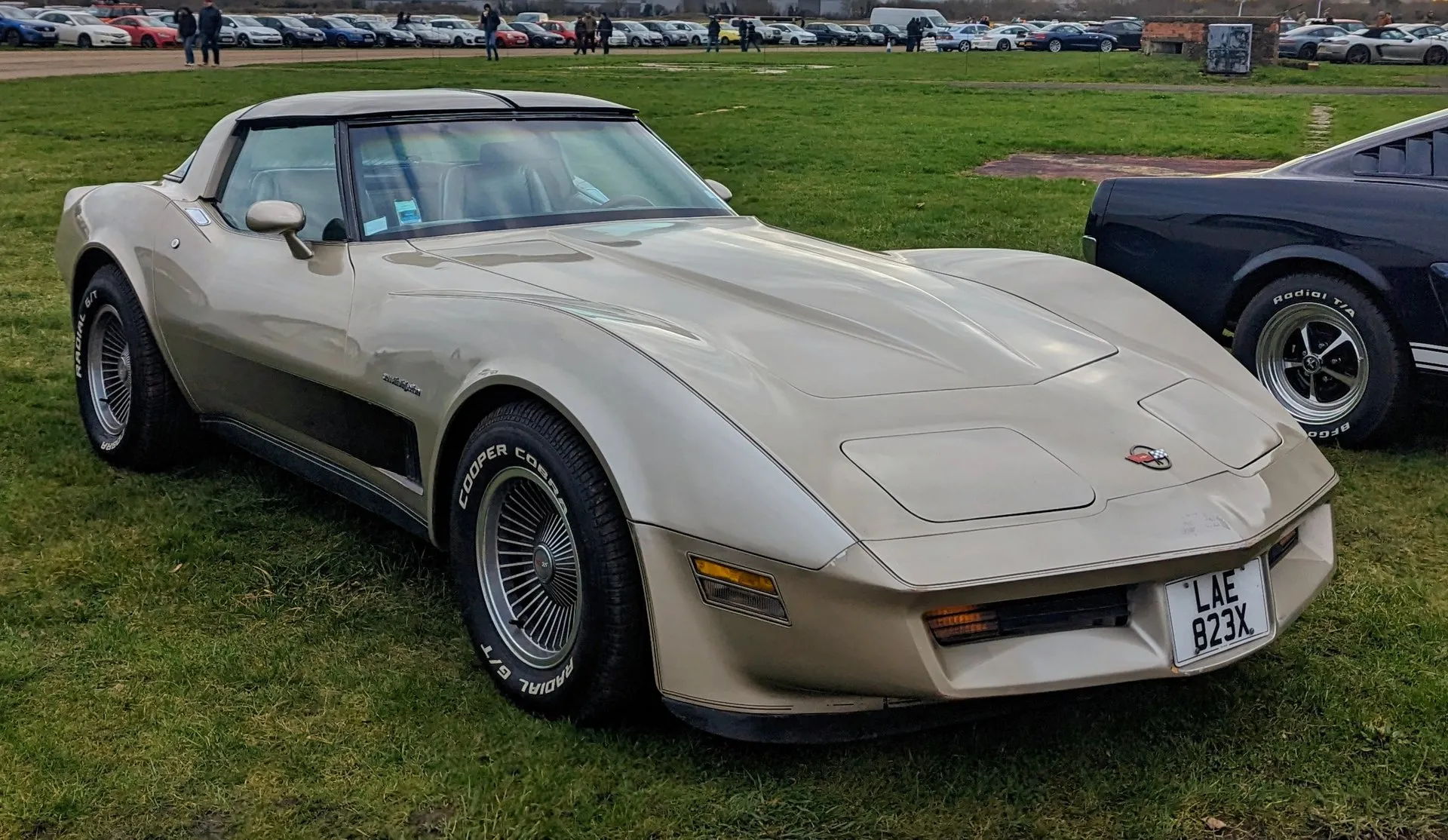
The Black Book gives the reason: the 1982 ended a generation whose body dated to 1968 and chassis to 1963, and Chevrolet marked it with a Collector Edition carrying more standard equipment. GM called it the Collector Edition Hatchback Coupe, model 1YY07: $22,537.59, or $4,247.52 over the coupe, and 6,759 built, 26.6 percent of the year (this site’s arithmetic). Options took it past $24,000; a 6,000-mile car offered on Bring a Trailer in 2026 has a $24,062.55 window sticker.
What GM’s brochure and order guide put on it:
- Silver-Beige metallic, code 59, on no other 1982, with shaded hood and side graphics and accent pinstripes. Hagerty calls the color champagne.
- Finned aluminum wheels styled after the 1967 bolt-on wheels (the Black Book), on P255/60R15 white-letter tires.
- A frameless glass hatch with a remote release, lifted by twin gas struts, says Hagerty; owners put the release lever behind the driver’s seat (CorvetteForum, 2002).
- Bronze-tinted glass roof panels, a rear defogger and a power antenna.
- Multi-tone silver-beige leather seats and door trim (interior 592, also Collector Edition only), luxury carpet and its own horn button.
- Cloisonné emblems and a special identification plate on the instrument panel.
Power locks, electric mirrors, the power seat, cruise control, radio upgrades, heavy-duty cooling, Gymkhana suspension and the roof panel carrier stayed extra (GM’s order guide).
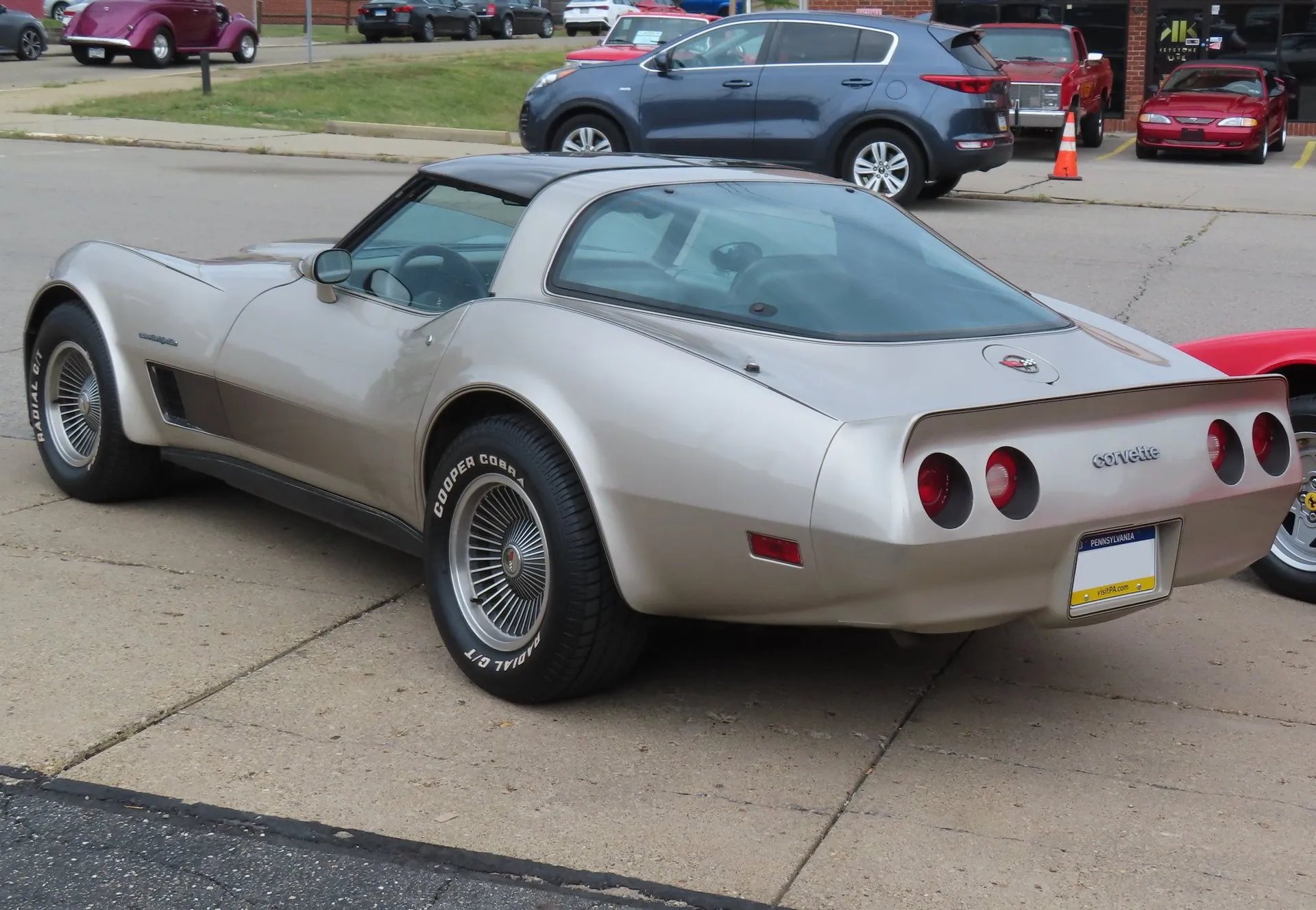
The hatch. No other factory C3 has a rear window that lifts: the fastback glass of 1978–1981 cars and 1982 coupes is fixed. A long-time poster in a 2026 thread (opens in new tab) says the hatch came from Cars & Concepts, an aftermarket converter whose licensed shops also fitted it to 1978–1981 cars, and that Chevrolet used it only on the Collector Edition; GM’s paper names no supplier. Another poster’s tell: chrome hinges mean a kit, black ones a hatch from a parted-out Collector Edition, and the glass alone runs about $3,000 when it turns up (2026). A lifting rear window proves nothing.
Section 04
The options list, and how many took each
The coupe’s base price covered the engine, the automatic, T-tops and leather-and-vinyl or cloth-and-vinyl seats (the Black Book), plus air conditioning, power windows, power steering, a tilt-telescopic wheel and an AM/FM radio (GM). The rest, with the Black Book’s prices and counts (PDF page 4):
| RPO | Option | Price | Built |
|---|---|---|---|
| K35 | Cruise control | $165 | 24,313 |
| AU3 | Power door locks | $155 | 23,936 |
| AG9 | Power driver’s seat | $197 | 22,585 |
| UM6 | AM/FM stereo with cassette | $423 | 20,355 |
| DG7 | Electric sport mirrors | $125 | 20,301 |
| QXH | P255/60R15 white-letter tires | $542.52 | 19,070 |
| C49 | Rear window defogger | $129 | 16,886 |
| N90 | Aluminum wheels | $458 | 16,844 |
| U75 | Power antenna | $60 | 15,557 |
| CC1 | Glass roof panels | $443 | 14,763 |
| V08 | Heavy-duty cooling | $57 | 6,006 |
| QGR | P225/70R15 white-letter tires | $80 | 5,932 |
| FE7 | Gymkhana suspension | $61 | 5,457 |
| YF5 | California emissions | $46 | 4,951 |
| D84 | Two-tone paint | $428 | 4,871 |
| V54 | Roof panel carrier | $144 | 1,992 |
| UN5 | AM/FM stereo with cassette and CB | $755, or $695 on a Collector Edition | 1,987 |
| U58 | AM/FM stereo | $101 | 1,533 |
| UM4 | AM/FM stereo with 8-track | $386 | 923 |
| UL5 | Radio delete | $124 credit | 150 |
The Collector Edition included CC1, C49, QXH and U75. These counts beat Corvette Action Center’s 1982 list, which repeats 1981 figures in four rows, and Hagerty’s, which misprints cruise control as 2,414. The YF5 count, though, matches the Black Book’s 1981 figure exactly: treat it with care.
Gymkhana, the sleeper. For $61, FE7 (front and rear, the order guide says) brought the eight-leaf steel rear spring and a 0.44 in rear anti-roll bar, 37.9 lb, all at the rear, by GM’s option weights. Only 5,457 cars got it, and Hagerty adds 2 percent to a coupe’s value for it.
Twelve colors, four two-tones, nine in primer
| Code | Color | Built |
|---|---|---|
| 59 | Silver-Beige, Collector Edition only | 6,759 |
| 10 | White | 2,975 |
| 19 | Black | 2,357 |
| 70 | Red | 2,155 |
| 24 and 26 | Silver Blue and Dark Blue two-tone | 1,667 |
| 13 and 99 | Silver and Dark Claret two-tone | 1,301 |
| 13 and 39 | Silver and Charcoal two-tone | 1,239 |
| 24 | Silver Blue | 1,124 |
| 39 | Charcoal | 1,093 |
| 99 | Dark Claret | 853 |
| 40 | Silver Green | 723 |
| 13 | Silver | 711 |
| 10 and 13 | White and Silver two-tone | 664 |
| 56 | Gold | 648 |
| 31 | Bright Blue | 567 |
| 26 | Dark Blue | 562 |
Add the nine cars the Black Book says had primer only, and the colors account for all 25,407 (this site’s arithmetic). GM’s order guide gives each two-tone an accent pinstripe: blue on Silver Blue and Dark Blue (gray with a silver gray interior), gray on Silver and Dark Claret (red with a dark red interior), and gray on the other two.
Interiors. Leather in silver gray (code 132), charcoal (182), dark blue (222), silver green (402), camel (642), dark red (742) and, on the Collector Edition only, silver beige (592); cloth in dark blue (22C), camel (64C) and dark red (74C).
Section 05
A 1982’s numbers: VIN, engine pad and trim tag
The VIN
The 17-character VIN is on the left windshield pillar. GM’s VIN chart reads it: 1G1 (a US-built Chevrolet), A (manual belts), Y (Corvette), 87 (coupe) or 07 (Collector Edition hatchback), 8 (the L83), a check digit, C (1982), 5 (Bowling Green) and the serial, 100001 to 125407 by the Black Book (125408 by Corvette Action Center). Collector Editions had no serial run of their own; owners say they were built all year among the coupes (CorvetteForum, 2024).
Engine and gearbox codes
GM’s identification page puts the engine code on the pad just ahead of the right-hand cylinder head, or behind the oil filter: a source letter, the assembly month and day, and a suffix. The Black Book gives ZBA (federal), ZBC (early California) and ZBN (later California); GM’s later reference prints ZFN for California. The block (14010207) and head (462624) casting numbers are the same on every 1981, 1984 and 1985, so they can’t date the engine. The transmission is GM code MD8; owners suggest checking its serial to see whether it’s the original (CorvetteForum, 2016).
The trim tag, and what a factory two-tone shows
Owners place the trim tag in the driver’s door opening, near the upper hinge. Its top line holds a build-date code (a month number and a week letter, which owners count differently) and the serial’s last five digits; the second, the interior code and paint codes marked L (lower) and U (upper). Leather codes end in 1 on the tag, so GM’s 182 charcoal leather reads 181 (CorvetteForum, 2008 and 2026).
On a factory two-tone, the L and U codes match and the second color is an accent code ending in M, as GM’s order guide lists the schemes: Silver, 13 and 13, with 39M (Charcoal) or 99M (Dark Claret); Silver Blue, 24 and 24, with 26M; White, 10 and 10, with 13M. An original Silver and Charcoal car in a 2008 thread read 13L 13U 39M, so matching codes don’t mean a repaint.
What proves a Collector Edition
- The VIN. A Collector Edition has a 0 as the sixth digit (body code 07), where a coupe has an 8, per GM’s chart and the Black Book. Every 1982 listed on Bring a Trailer in 2026 matched its model on that digit.
- The tag. Paint 59L 59U, as GM’s order guide codes Silver-Beige, and trim 591, the tag’s form of GM’s 592 leather (CorvetteForum, 2008 and 2026).
- The identification plate on the instrument panel, Collector Edition only (GM).
- Paper. Owners say GM’s heritage archive sells a copy of a car’s original dealer invoice for about $50 (CorvetteForum, 2024). The 6,000-mile car on Bring a Trailer had National Corvette Restorers Society (NCRS) and Bloomington Gold certificates.
Paint, decals, finned wheels and an aftermarket hatch can all go on a coupe; Hagerty says the special VIN was meant to spare the Collector Edition the counterfeiting the 1978 Pace Car drew. It cuts both ways: a Collector Edition sold new in Japan surfaced in black in 2026, and posters read its tag (59L 59U, 591) and leftover tan seat belts as proof of a later change (CorvetteForum, 2026).
Is a 1982 Corvette a Stingray? No. Hagerty’s Brandan Gillogly writes that the Stingray badge ended with 1976 and the name stayed away until the 2014 C7; GM’s 1982 drawings show crossed flags and a Corvette nameplate.
Section 06
What goes wrong on a 1982: bulletins, Cross-Fire and the 700-R4
NHTSA’s complaint file (opens in new tab) holds no owner complaint about the 1982 Corvette, and NHTSA lists no GM recall (both checked October 19, 2026). That’s no clean bill of health: the complaint file starts in September 1994, and NHTSA’s bulletin files, from 1995 on, are empty for a 1982 too. The two recalls listed are for replacement parts: Cardone remanufactured rear calipers made in 2002–2003 (18-7019, 18-7020, 16-7019 and 16-7020, aftermarket) and Fram HP4 and HP8 oil filters made in 2006–2007.
Chevrolet’s own dealer paper, as transcribed by Corvette Action Center (the originals weren’t seen for this guide):
- 82-T-101 (opens in new tab), August 1982. For federal-emissions cars, a new PROM (the engine computer’s calibration chip) against spark plug fouling and poor driveability: leaner when cold, with the converter clutch unlocking at a smaller throttle opening. Engine computer (ECM)
GM 16029531, PROM identification 391A36, service PROMGM 1226096(all OEM). It wasn’t a recall, though one owner calls it one (CorvetteForum, 2014). - 84-30 (opens in new tab), November 1983. A high, rough or unstable idle on 1982–1984 Cross-Fire cars can be a vacuum leak at the throttle-body cover plate gasket: fit a new gasket (
GM 14044605, OEM) and tighten the plate to 15–25 ft-lb (20–34 N·m). - Coolant, filter and paint. 83-I-26 (January 1983): top up only with coolant to GM specification 1825-M, the factory fill for the aluminum engine parts (
GM 1052753orGM 1052754, OEM). Service News (late 1982): the owner’s manual’s fuel filter, GF478, is wrong; the right one is GF482. 82-I-23: repair the enamel over a whole panel or to a feature line, because “Spot repair is not acceptable.” - Later bulletins. The 700-R4’s 93-29-7A (a buzz at idle, louder in reverse; valve
GM 8684048, OEM) and 91-371-7A (stuck in first gear) include the 1982, and the 1980–1982 differential needs puller J-34108 for its side bearings (Service News, 1983).
Cross-Fire, by the owners who keep it running
Owners mostly defend it; one 1982 owner calls it reliable and relatively simple (CorvetteForum, 2022). What they fix:
- Vacuum leaks at the cover-plate gasket and the plenum seal (CorvetteForum, 2011 and 2020).
- Worn throttle shafts. A specialist blames most Cross-Fire trouble on vacuum leaks and worn, unbushed shafts (CorvetteForum, 2018–2019). A former rebuilder saw the wear at 35,000–40,000 miles, and owners say to rebuild the throttle bodies in place with a quality kit, not a cheap one (CorvetteForum, 2020).
- Fuel delivery. One owner’s cold stalling was 6 psi at the throttle bodies, from a dry-rotted hose at the in-tank pump; a new hose gave 14 psi, inside the 12–14 psi (opens in new tab) other posters asked for (CorvetteForum, 2011).
- Sensors. Owners point to the coolant temperature and MAP (manifold pressure) sensors (CorvetteForum, 2011 and 2019). Trouble codes read out by jumping the diagnostic connector; an OBD II scanner won’t read them (CorvetteForum, 2018–2019).
The early 700-R4
Owners give the first 700-R4s a poor reputation (CorvetteForum, 2012): late, hard shifts from a sticking throttle valve (TV) or a misadjusted TV cable (CorvetteForum, 2013 and 2016). The cures they describe are a rebuild with a shift kit and the later grooved valve, or a later transmission. One owner’s, rebuilt at about 80,000 miles, was still going at 230,000 (CorvetteForum, 2012).
The rest is the C3’s: frame and birdcage rust, 1976–1982 floors, water leaks, vacuum headlights, calipers, rear wheel bearings and power steering. Known C3 problems, in the C3 guide, covers each.
Section 07
Inspecting a 1982, from birdcage to hatch
- Birdcage and frame first, by the C3 checklist; on a 1982, one owner looks behind the passenger kick panel and at the rear body mount (CorvetteForum, 2022).
- The numbers: a VIN matching the title (1G1AY, 87 or 07, 8, a check digit, C, 5, a serial from 100001 to 125407), and ZBA, ZBC or ZBN on the engine pad with an assembly date that fits.
- A Collector Edition’s proof: the 0, the 59L 59U and 591 tag, the dash plate and, ideally, the invoice copy.
- A cold start and a slow pull. A steady idle, and no stumble under slow, gentle acceleration; one owner says a stumble means the throttle bodies need rebuilding or balancing (CorvetteForum, 2022).
- Fuel pressure, 12–14 psi between the throttle bodies, and whether the in-tank pump’s hose has been replaced.
- The shifts: no late or hard upshifts, no buzz at idle in reverse, and an answer on whether the transmission is original.
- The hatch on a Collector Edition: owners say the hinges distort, the glass sticks and the seals leak (CorvetteForum, 2011 and 2026), so try the release and struts, and look for water inside.
- Emissions parts. One 2026 Bring a Trailer sale had its emissions equipment removed, and owners knock a crude exhaust with no converter (CorvetteForum, 2022). Make sure it can be registered where it will live.
- An inspection by a shop that knows Cross-Fire, which owners say is the hard part to find.
Section 08
Coupe or Collector Edition: the 2026 money
What is a 1982 Corvette worth today? On Bring a Trailer (opens in new tab), nine 1982s were listed between January 1 and October 15, 2026, and seven sold, at a median of $14,100, from $7,800 to $27,000 (this site’s count of sold prices, without the buyer’s fee):
| 1982s on Bring a Trailer, Jan. 1 to Oct. 15, 2026 | Sold | Median | Range | Not sold |
|---|---|---|---|---|
| Coupes | 4 of 5 | $13,875 | $7,800–$15,000 | Bid to $14,000 |
| Collector Editions | 3 of 4 | $18,750 | $14,100–$27,000 | Bid to $25,250 |
The $27,000 car was a 21,000-mile Collector Edition, the sale the C3 guide records. The $14,100 Collector Edition had traded its Cross-Fire for an Edelbrock intake and a four-barrel carburetor, and a coupe on Holley Sniper injection went unsold at $14,000. The $7,800 coupe had a repaint, a cracked nose and a possible odometer rollover on its Carfax. Seven sales is market color, not a valuation.
2025 ran higher: 13 of 17 sold, at a median of $23,000, lifted by four very low-mileage coupes at $29,750 to $38,828; four Collector Editions brought a median $23,000. From January 2025 to October 15, 2026, the 20 sales give $17,500: $15,000 for 13 coupes, $23,000 for seven Collector Editions.
Other measures. Hagerty’s (opens in new tab) #3 (Good) value for a 1982 coupe was $17,200 (January 2026), up 12.4 percent from $15,300 a year earlier, and its 2025 notes added $400 for aluminum wheels and $500 for glass roof panels; no Hagerty Collector Edition figure could be read. classic.com’s Collector Edition benchmark was $26,450 in February 2026, as the C3 guide also reports, and that guide puts the median 1978–1982 car at $17,625 (18 sales, June 16 to September 26, 2026). These measure different things, so don’t average them, and none is a forecast.
Section 09
No 1983, then a C4 with the 1982’s engine
There’s no 1983 Corvette. The C4 (1984–1996) was introduced in March 1983 and sold as a 1984; Chevrolet built and tested 1983s, and the press drove them at Riverside Raceway in December 1982, but none was sold, per the Black Book page in GM’s 1984 kit. The generations guide has the story.
The 1984 kept more of the 1982 than its new body suggests: the L83 Cross-Fire V8, now 205 hp, on the same block and head castings, and the 700-R4. Every 1984 got a glass rear hatch, and Hagerty says the Collector Edition’s cloisonné emblem was shaped to foreshadow the C4’s logo. A manual came back, the “4+3”, though the Black Book says not early in the year. Cross-Fire lasted one more year: for 1985, in the Black Book’s words in GM’s 1985 kit, “genuine fuel injection returned” with the L98. The C4 guide picks up from there.
Section 10
Buy the Collector Edition, with its Cross-Fire intact
Is 1982 a good year for Corvettes? For a driver, yes: it shares the strongest base rating of the net-rated C3s, and its overdrive loafs on the highway. The price is no clutch pedal and an injection system that wants an owner, or a shop, that knows it. Is it the undesirable year? No: the C3 guide names the 1975 and the 1980 California car as the slow C3s, and the best-years guide picks a 1978–1982 coupe as the C3 to drive.
The pick is a Collector Edition whose numbers agree: a 0 in the VIN’s sixth place, 59L 59U and 591 on the tag, the dash plate, the original Cross-Fire and, ideally, the invoice copy. It’s the only C3 that left the factory with a glass hatch, and its VIN settles arguments. In 2026 its premium over a coupe was about what it was new: an $18,750 median against $13,875, on tiny samples, next to $4,247.52 in 1982. Low miles are what the top sales had in common, and paperwork is what protects the premium.
The budget pick is a coupe with healthy Cross-Fire, ideally on aluminum wheels with the glass roof, and with Gymkhana if one turns up: about $14,000 on 2026’s evidence.
Skip any “Collector Edition” with an 8 in the sixth place, whatever its paint, and price any car with the Cross-Fire swapped out as a modified car; the year’s cheapest Collector Edition sale was one. If the plan is a hotter small-block anyway, a coupe someone else already converted is the cheap way in. Just don’t pay original-car money for it.
Whichever it is, check the birdcage before the badges. Then find an on-ramp, let the 700-R4 drop into overdrive and settle in: America’s sports car, closing out its longest generation at a lazy 1,400 rpm.
Section 11
Sources
- GM Heritage Center: 1982 Corvette vehicle information kit files.zipcorvette.com This site's library. The Corvette Black Book page reproduced in GM's kit: production, VIN range, engine codes and castings, the year's facts, every option with its count and price, every color with its count (PDF page 4). GM's VIN chart (8), engine and axle identification (10, 12, 14), dealer brochure and value features (16 to 28), dealer order guide revised January 11, 1982 (30 to 35) and MVMA specification form, revised October 1981 (39 to 61).
- GM Heritage Center: 1981 Corvette vehicle information kit files.zipcorvette.com This site's library. Black Book pages: the two plants and their dates, the L81, the manual's last year until 1984, 1981 options and prices (PDF pages 20 and 21).
- GM Heritage Center: 1984 Corvette vehicle information kit files.zipcorvette.com This site's library. Black Book page: no 1983 model, the Riverside preview, the L83 at 205 hp, the shared castings, the 4+3 not available early, the hatch and roof panel on every car.
- GM Heritage Center: 1985 Corvette vehicle information kit files.zipcorvette.com This site's library. Black Book page: genuine fuel injection returned for 1985.
- NHTSA owner complaints, 1982 Chevrolet Corvette (opens in new tab) api.nhtsa.gov None on file, pulled October 19, 2026. NHTSA's complaint file begins in September 1994.
- NHTSA recalls, 1982 Chevrolet Corvette (opens in new tab) api.nhtsa.gov Pulled October 19, 2026. No GM recall. Aftermarket-part campaigns 03E032000 (opens in new tab) (Cardone calipers) and 07E088000 (opens in new tab) (Fram oil filters).
- NHTSA manufacturer communications (TSB) file, received 1995–1999 (opens in new tab) static.nhtsa.gov This and the 2000–2009 files hold no GM bulletin for a 1981 or 1982 Corvette; the earliest Corvette model year in them is 1984.
- Chevrolet dealer bulletin 82-T-101: spark plug fouling and driveability improvements, August 1982 (via Corvette Action Center) (opens in new tab) corvetteactioncenter.com A new PROM for 1982 federal-emissions cars. Read via the Internet Archive. Corvette Action Center's transcriptions are not GM originals.
- Chevrolet dealer bulletin 84-30: high, rough or unstable idle from a vacuum leak, November 1983 (via Corvette Action Center) (opens in new tab) corvetteactioncenter.com 1982–1984 Corvettes with Cross-Fire Injection. Read via the Internet Archive.
- Other Chevrolet bulletins and Service News items for the 1982 Corvette (via Corvette Action Center) (opens in new tab) corvetteactioncenter.com 83-I-26, coolant, January 1983 (this link). Also 82-I-23, enamel paint repair (opens in new tab), the fuel filter correction (opens in new tab) (November–December 1982), differential side bearing removal (opens in new tab) (September–October 1983), and the 700-R4 bulletins 93-29-7A (opens in new tab) and 91-371-7A (opens in new tab). Read via the Internet Archive.
- Car and Driver: Tested, 1962 Chevrolet Corvette vs 1982 Chevrolet Corvette (opens in new tab) caranddriver.com Don Sherman, March 1982 issue. An early-build 1982 T-top coupe: 0–60 mph in 8.1 s, 125 mph, 0.82 g; the gas-guzzler explanation for the missing manual is the magazine's.
- TRID: Car and Driver editorial on the rescission of the speedometer rule, October 1982 (opens in new tab) trid.trb.org Patrick Bedard. Dates the rescission of the 85 mph rule to February 18, 1982.
- Corvette Action Center: 1982 Corvette production and options (opens in new tab) corvetteactioncenter.com Read via the Internet Archive (capture of March 14, 2026). Four option rows repeat 1981 figures; this guide uses the Black Book's counts. Also its 1982 identification page (opens in new tab) (VIN range to 125408, castings, suffixes).
- Hagerty valuation tool: 1982 Chevrolet Corvette coupe (opens in new tab) web.archive.org Internet Archive copy of March 17, 2026. #3 (Good) value $17,200 on the value graph dated January 2026, the quarterly series before it, and the adjustment notes.
- Hagerty: 1968–82 Chevrolet Corvette (C3) buyers guide (opens in new tab) hagerty.com Sajeev Mehta, May 13, 2020, updated June 24, 2022. Read via the Internet Archive's June 2025 copy (opens in new tab). The hatch on gas struts, the special VIN, the emblem shape.
- Hagerty (via IMSA): When is a Corvette a Sting Ray and not a Stingray? (opens in new tab) web.archive.org Brandan Gillogly, Hagerty, September 6, 2022, as syndicated by IMSA. Internet Archive copy of May 4, 2023. Stingray badges through 1976.
- classic.com: Chevrolet Corvette C3 market (opens in new tab) web.archive.org Internet Archive copy of February 12, 2026. Collector Edition benchmark $26,450.
- Bring a Trailer: Chevrolet Corvette C3 results (opens in new tab) bringatrailer.com 1982 listings only, January 1, 2025 to October 15, 2026. Counts and medians are this site's, from each listing's sold price without the buyer's fee. The 2026 listings: April (opens in new tab), May, $7,800 (opens in new tab), May, $13,750 (opens in new tab), June, $15,000 (opens in new tab), June, Collector Edition not sold (opens in new tab), July, not sold (opens in new tab), August (opens in new tab), September 3 (opens in new tab) and September 24 (opens in new tab).
- CorvetteForum thread: a 1982 for $16,000, a good buy? (opens in new tab) corvetteforum.com December 2022. Cross-Fire's reputation, the stumble test, the exhaust, where to look for birdcage rust.
- CorvetteForum thread: 1982 Collector Edition VIN (opens in new tab) corvetteforum.com August 2024. Collector Editions built through the year; the dealer invoice copy. Owner-reported price.
- CorvetteForum thread: decoding a 1982 VIN and trim tag (opens in new tab) corvetteforum.com January 2008. The tag's lines, the leather codes, and the L, U and M codes on a two-tone.
- CorvetteForum thread: questions about an 82 Collector (opens in new tab) corvetteforum.com March 2002. The hatch release lever.
- CorvetteForum thread: a strange 1982 Collector's Edition (opens in new tab) corvetteforum.com January 2026. A repainted Collector Edition and its trim tag.
- CorvetteForum thread: rear lift glass, a dealer option? (opens in new tab) corvetteforum.com May to June 2026. Cars & Concepts hatches, the hinge tell, the price of glass. Owner claims.
- CorvetteForum thread: an 82 rear window in a 78–81 (opens in new tab) corvetteforum.com December 2011. Hinges, sticking glass, leaks.
- CorvetteForum thread: 82 Cross-Fire driveability (opens in new tab) corvetteforum.com June 2011. Fuel pressure between the throttle bodies, the pump hose, the plenum seal, the coolant sensor.
- CorvetteForum thread: 82 Cross-Fire Corvette problems (opens in new tab) corvetteforum.com September 2014. The PROM update called a recall.
- CorvetteForum thread: 1982 Cross-Fire idle (opens in new tab) corvetteforum.com July 2019. Pump, hose and sensors.
- CorvetteForum thread: 1982 Collector Edition Cross-Fire (opens in new tab) corvetteforum.com June 2020. Rebuilding throttle bodies in place; shaft wear.
- CorvetteForum thread: 1982 Cross-Fire injector rebuild (opens in new tab) corvetteforum.com November 2018 to February 2019. Vacuum leaks and unbushed shafts; reading codes.
- CorvetteForum thread: 1982 700-R4 transmission problems (opens in new tab) corvetteforum.com September to October 2012.
- CorvetteForum thread: 700-R4 sticking TV valve (opens in new tab) corvetteforum.com April to May 2013.
- CorvetteForum thread: a question for 700-R4 experts, 1982 Corvette (opens in new tab) corvetteforum.com March 2016. The TV valve; checking the transmission's serial.