C4 · Buying guide
1985 Corvette guide: Tuned-Port Injection, the softer ride and what one costs now
Published
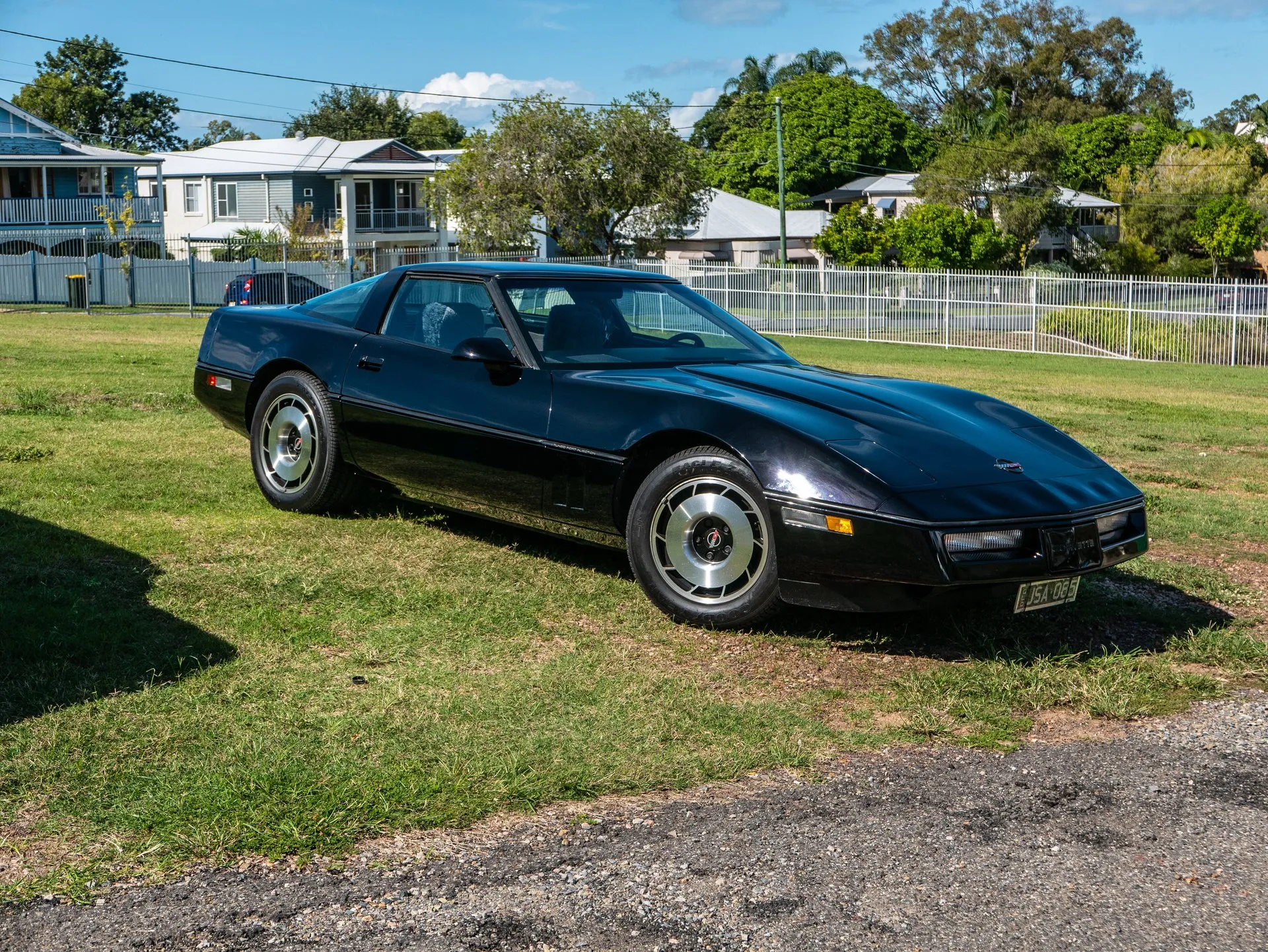
Road & Track printed the new Corvette’s numbers in a column beside a Porsche 911 Carrera’s, and the Porsche took the drag strip: 60 mph in 6.2 seconds to the Corvette’s 6.6, the quarter mile in 14.6 to 15.0. Further down, the Corvette won the rows that matter on a road with corners. It stopped from 60 mph in 136 feet to the Porsche’s 153, pulled 0.879 g of lateral acceleration to 0.831, and went through the slalom at 61.8 mph to 61.2. It also listed at $24,403, to the Porsche’s $31,950. GM reprinted the test in its 1985 kit.
That Corvette was the 1985, the second model year of the C4 (1984–1996) and the first with Tuned-Port Injection: an L98 V8 rated 230 hp and 330 lb-ft, 25 hp and 40 lb-ft up on the 1984’s Cross-Fire engine. GM also took a good share of the stiffness out of the springs that had given the 1984 its reputation, and Bowling Green built 39,729 coupes and no convertibles.
Road & Track’s table is the performance-per-dollar case in 1985 numbers, and age has only sharpened it. Four stock 1985s sold on Bring a Trailer between January and October 20, 2026, at a median of $9,500, well under half the 1985 sticker, which makes it one of the cheapest ways into a V8 Corvette.
The C4 buyer’s guide carries the problems every C4 shares. This page sticks to what is particular to 1985, mostly from the papers in GM’s kit, which sits in the site’s manual library.
C4 Key figures
- Built
- 39,729 coupes
- L98 V8
- 230 hp and 330 lb-ft
- Price new
- $24,403
- 0–60 mph, Road & Track
- 6.6 s
- Car and Driver top speed
- an even 150 mph
- Z51 cars
- 14,802, or 37 percent
- NHTSA recalls
- one, the 1984–1991 seat belt recall
- Bring a Trailer, 2026
- a median of $9,500
Section 01
Tuned-Port Injection and what else was new for 1985
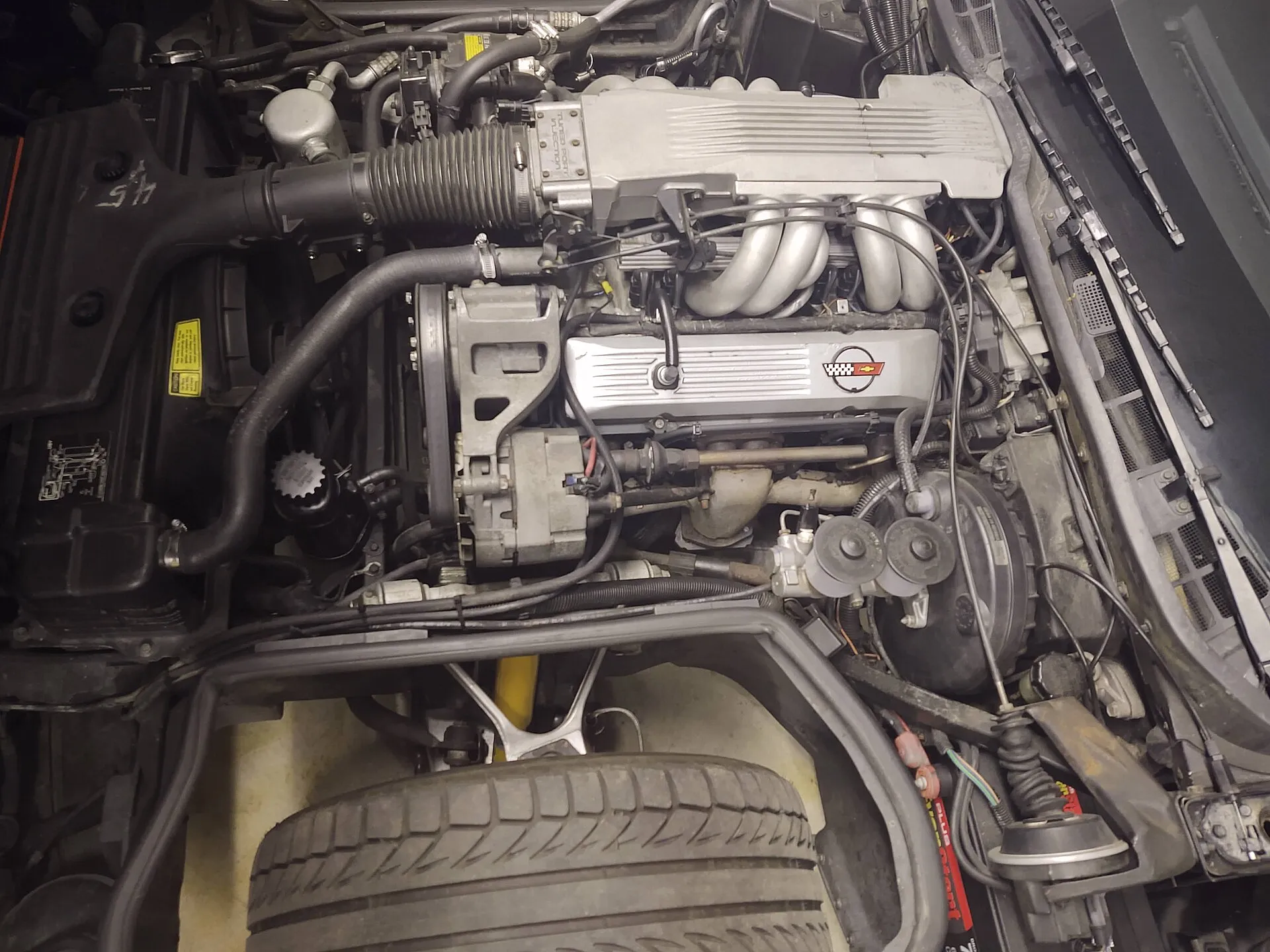
Tuned-Port Injection (TPI) puts an injector at each cylinder’s intake port, Bosch multi-point injection in Road & Track’s words. Air comes in through a filter ahead of the radiator support, past a mass airflow sensor that measures it, into a cast plenum and then down eight tuned runners made of aluminum tube. The Corvette Black Book page that GM bound into its kit (the Black Book is a reference book, not a GM publication) puts it plainly: “genuine fuel injection returned to the Corvette in 1985 for the first time in two decades” (page 6).
The gains, by the same page: 205 hp became 230, 290 lb-ft became 330, and real-world fuel economy rose about 11 percent. GM’s specification sheets, filed with the Motor Vehicle Manufacturers Association (MVMA), fill in the rest (power teams and engine):
- Engine: 350 cu in (5.7-liter) V8, cast alloy iron block and heads, 9.0:1 compression, chain-driven camshaft, firing order 1-8-4-3-6-5-7-2.
- Ratings: 230 hp at 4,000 rpm and 330 lb-ft at 3,200 rpm, SAE net.
- Pistons: “Impacted forged aluminum,” GM’s sheet says. Owners say only the 1985 (or 1984–1985) had forged pistons; this guide found no GM sheet for later L98s to check that.
- Fuel: unleaded, antiknock index 87. Road & Track’s data panel lists 91-octane. GM’s sales book says the engine’s Electronic Spark Control senses knock and adjusts, so that “as the octane level goes up, so does horsepower.”
Beyond the engine, Chevrolet’s ordering information for the 1985 adds:
- Brakes: a new master cylinder, new lining material and a higher-capacity power booster. The Black Book says the booster was plastic, 30 percent lighter, and “the first such application in an American car.”
- The differential on manual cars: a heavy-duty unit with an 8.5-inch ring gear and a 3.07 ratio. Automatics kept a 7 7/8-inch ring gear and a 2.73 ratio, with 3.07 as RPO G92 (RPO is GM’s regular production option code) and with the Z51 package.
- Instruments: the same liquid-crystal displays, with cleaner graphics, less color on the speedometer and tachometer, and larger digits.
- Small things: concealed adhesive wheel weights in place of clip-ons, a map strap on the driver’s visor, better sun screening for the glass roof panel, a reinforced oil pan gasket, and a distributor modified so its spark couldn’t ignite fuel vapor outside the engine.
What didn’t change: the body, the hatch, the one-piece removable roof, the 700-R4 four-speed automatic as standard, the 4+3 manual as a no-cost option, and the color list (the same as 1984’s, the Black Book says, with brighter Silver and Bright Red). The block and head castings carried over too, which matters when checking a car (see Proof of a 1985: VIN, engine codes, script).
Three items arrived partway through the year or didn’t arrive at all. The 4+3’s overdrive switch “was moved during 1985 production from the console to the gear shift knob,” the Black Book says, without a date or serial number. The sport seat “became available in leather after the start of 1985 production” (page 8). And electronic climate control, RPO C68, listed in GM’s January 1985 order guide with “Late Availability,” slipped into the 1986 model year.
Section 02
Softer springs, by two different counts
The 1984 was quick around a skidpad and hard on its occupants. For 1985, the Black Book says, suspension rates were lowered, “a result of harsh ride criticism,” and GM’s own sales book sold “a softer standard suspension with gas-cell shocks.” Road & Track’s test says Chevrolet “retuned the spring rates and shock valving.”
How much softer depends on which page you read. The Black Book gives percentages: base springs 26 percent softer at the front and 25 percent at the rear, Z51 springs 16 and 25 percent, the figures the 1984 guide quotes. GM’s MVMA sheets give spring rates, and they fall in a different pattern, by more in three of the four places:
| Spring rate | 1984 | 1985 | Change |
|---|---|---|---|
| Front, base | 431 lb/in | 335 lb/in | 22 percent lower |
| Rear, base | 431 lb/in | 233 lb/in | 46 percent lower |
| Front, Z51 | 634 lb/in | 433 lb/in | 32 percent lower |
| Rear, Z51 | 525 lb/in | 330 lb/in | 37 percent lower |
The 1984 rates come from a sheet GM issued in January 1983 and revised in April 1983, before 1984 production began (1984 kit); the 1985 rates from a sheet issued in July 1984 (1985 kit). The percentages are this site’s arithmetic. GM’s sheets are specifications, not measurements of built cars, and the Black Book doesn’t say where its percentages came from. Every source agrees on the direction.
The Z51 got bigger stabilizer bars: 30 mm at the front (25 mm in 1984) and 24 mm at the rear, against 24 and 20 mm on a base 1985, plus Delco-Bilstein gas shocks. Both front and rear springs are still single transverse leaves of filament-wound glass-epoxy, as on the 1984.
Section 03
How fast a 1985 Corvette is
How fast is a 1985 Corvette? Car and Driver’s January 1985 “ten best” issue named the Corvette America’s fastest production car, at an even 150 mph, as the Black Book page in GM’s kit records. The same issue gave it top honors in top-gear acceleration and a tie with Porsche for skidpad grip. Road & Track’s data panel lists an estimated 149 mph in fourth gear at 4,100 rpm. Neither is a GM figure, and this guide found no top speed or 0–60 time of GM’s own in the 1985 kit.
What’s a 1985 Corvette’s 0–60 time? 6.6 s in Road & Track’s test, which GM reprinted in its kit. Its test car was a Z51 4+3 that weighed 3,450 lb as tested, and it ran:
- 0–30 mph in 1.9 s, 0–60 in 6.6 s, 0–100 in 19.1 s
- the quarter mile in 15.0 s at 91.0 mph
- 60–0 mph in 136 ft and 80–0 in 245 ft, with brake fade “nil”
- 0.879 g of lateral acceleration and 61.8 mph through the slalom
The same table held a De Tomaso Pantera GT5 at $55,000 before options: 5.5 s to 60 and 14.0 s in the quarter, but 143 ft to stop from 60, seven more than the Corvette (Road & Track’s table). Put the two on a tight back road and the Pantera, at more than twice the price, reaches every corner first, then needs those seven extra feet to stop for it.
How much horsepower does a 1985 Corvette have? 230 hp and 330 lb-ft, the only rating GM gave the 1985 L98. The C4 guide’s spec table shows the climb from there: 235 hp with the aluminum heads of 1986, and up to 250 hp for 1990–1991.
| 1985 Corvette | Figure |
|---|---|
| Engine | L98 5.7-liter (350 cu in) V8, Tuned-Port Injection, 9.0:1 |
| Power | 230 hp at 4,000 rpm, 330 lb-ft at 3,200 rpm |
| Automatic (standard) | 700-R4 four-speed with overdrive; 2.73 axle, 3.07 with G92 or Z51 |
| Manual (MM4) | 4+3: four speeds, 2.88 first, with overdrive in 2nd, 3rd and 4th; 3.07 axle |
| Wheels and tires | 16 x 8.5 in, 16 x 9.5 in with Z51; P255/50VR-16 Goodyear Eagle VR50 |
| Size | 96.2 in wheelbase, 176.5 in long, 71.0 in wide, 46.7 in high |
| Curb weight | 3,216 lb manual, 3,224 lb automatic |
| Capacities | oil 5.0 qt with filter; cooling 14.0 qt; fuel 20.0 gal |
| EPA, current method | 15 mpg city, 21 highway automatic; 15 and 20 manual; 17 combined |
Weights are GM’s base figures (page 84); capacities are from GM’s service manual pages (page 14); the tire name is the one GM’s wheel caption gives, though another drawing on the same page calls it an Eagle GT. EPA’s ratings are on fueleconomy.gov (opens in new tab). The 4+3 (a Doug Nash four-speed whose overdrive the car’s computer engages in the top three gears) is “in effect a 7-speed,” Chevrolet’s sales book said; the 1984 guide prints GM’s ratios for it.
Section 04
$24,403 and up: the 1985 order form
How much was a 1985 Corvette new? $24,403, against $21,800 for a 1984. That gap overstates the rise. Every 1984 also paid $561.20 for the compulsory 16-inch wheel and tire package, which the 1985 price included, so like for like the 1985 cost $2,041.80 more (this site’s arithmetic on the Black Book’s prices). The base car came with the 230 hp engine, the automatic, a body-color roof panel and cloth seats, and most buyers went well past it (options page):
| RPO | Option | Price | Built |
|---|---|---|---|
| K34 | Cruise control | $185 | 38,369 |
| AU3 | Power door locks | $170 | 38,294 |
| AG9 | Power driver’s seat | $215 | 37,856 |
| Z6A | Rear window and mirror defoggers | $160 | 37,720 |
| UU8 | Delco-Bose stereo | $895 | 35,998 |
| CC3 | Transparent roof panel | $595 | 28,143 |
| V08 | Heavy-duty cooling | $225 | 17,539 |
| Z51 | Performance handling package | $470 | 14,802 |
| MM4 | 4+3 manual | No charge | 9,576 |
| FG3 | Delco-Bilstein shocks | $189 | 9,333 |
| NN5 | California emissions | $99 | 6,583 |
| D84 | Two-tone paint | $428 | 6,033 |
| (none printed) | Sport seats, cloth | $625 | 5,661 |
| G92 | Performance axle ratio | $22 | 5,447 |
| AQ9 | Sport seats, leather | $1,025 | not available |
| AR9 | Leather seats | $400 | not available |
| UL5 | Radio delete | $256 credit | 172 |
| UN8 | AM/FM stereo with CB | $215 | 16 |
Leather went into 30,955 cars, the Black Book says, without splitting AQ9 from AR9.
The Z51 package bundled the Bilstein shocks, the heavy-duty cooling, an extra pusher radiator fan, heavy-duty springs, stabilizer bars and bushings, faster steering and 9.5-inch-wide wheels. Both FG3 and V08 could also be ordered without it, and the Black Book doesn’t say whether its FG3 count includes the shocks fitted as part of Z51. V08 was new for 1985: a special radiator, boost fan, 18 psi cap and oil cooler, per GM’s order guide.
The softer ride changed what buyers ordered. The Z51 went on 14,802, or 37 percent of 1985s, at $470; in 1984 it had gone on 25,995 cars, half the year, at $600.20. The 4+3 went the other way, from 6,443 cars to 9,576, so about 30,153 1985s were automatics. Percentages are this site’s arithmetic.
Section 05
1985 Corvette colors and interiors
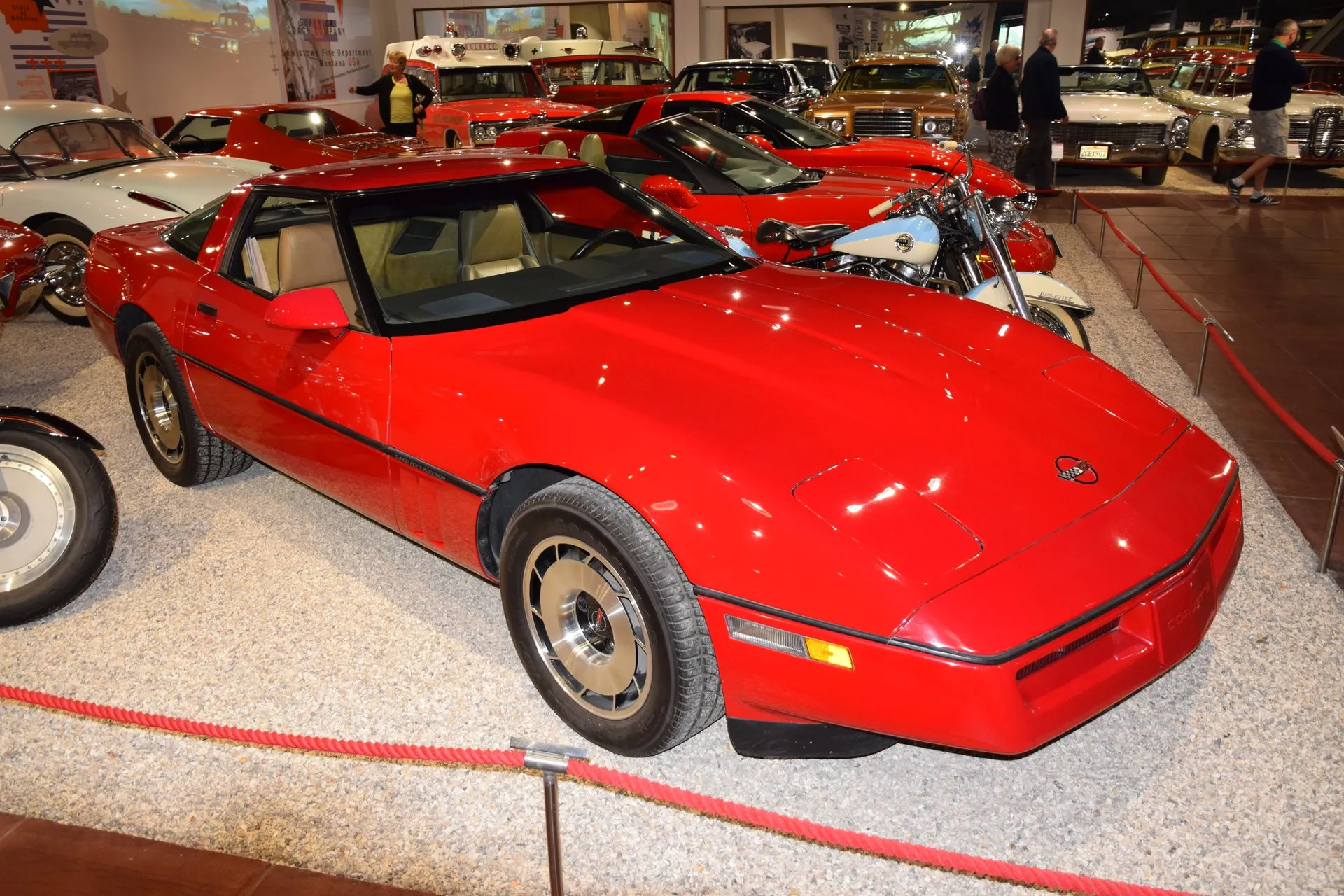
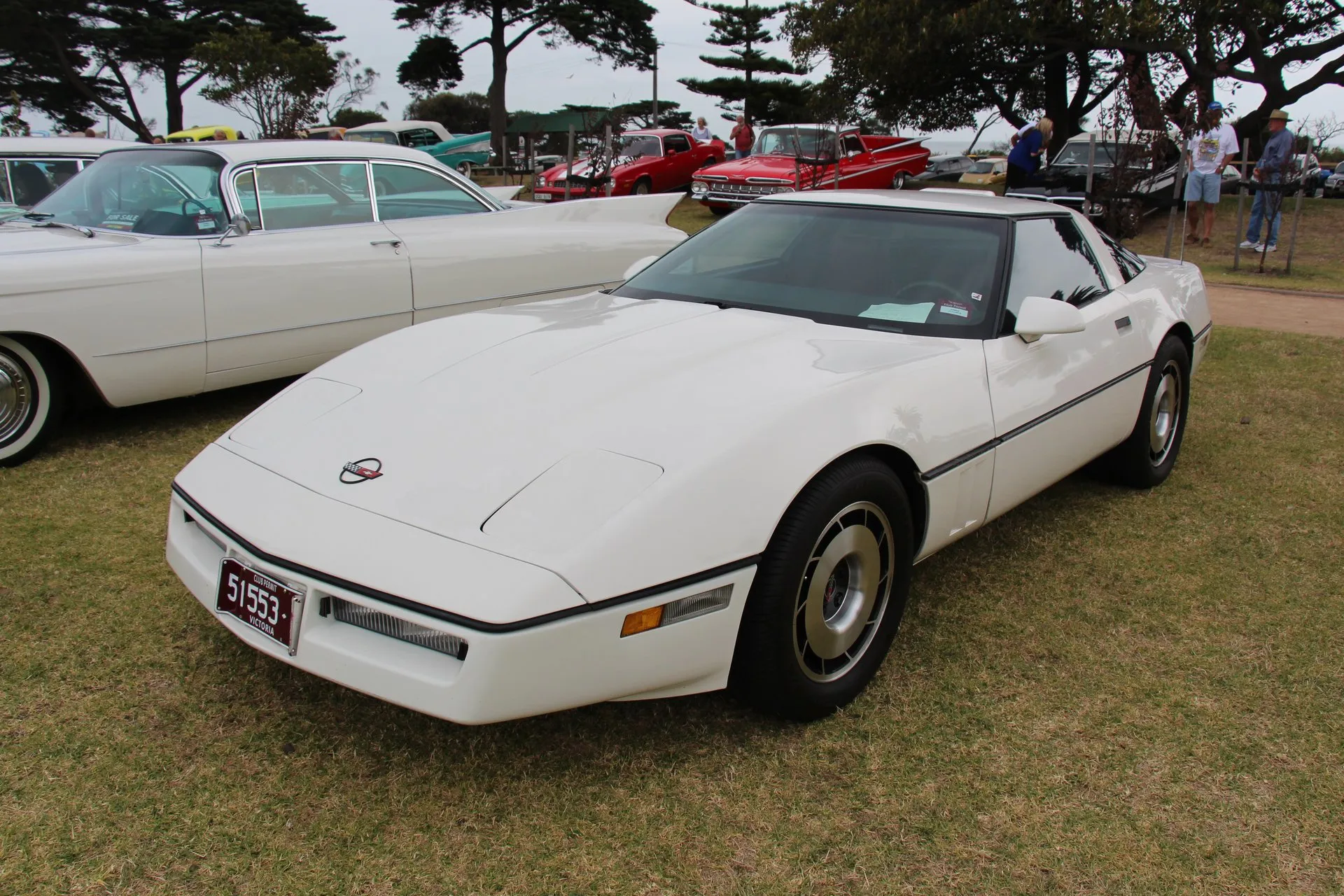
Thirteen paint choices, ten solid and three two-tone (D84), with the Black Book’s counts. They add up to 39,729, every car built:
| Code | Paint | Built |
|---|---|---|
| 81 | Bright Red | 10,424 |
| 41 | Black | 7,603 |
| 40 | White | 4,455 |
| 18 | Medium Gray Metallic | 2,519 |
| 63/66 | Light Bronze and Dark Bronze | 2,393 |
| 13/18 | Silver and Gray | 2,170 |
| 23 | Medium Blue Metallic | 2,041 |
| 13 | Silver Metallic | 1,752 |
| 20/23 | Light Blue and Medium Blue | 1,470 |
| 63 | Light Bronze Metallic | 1,440 |
| 53 | Gold Metallic | 1,411 |
| 66 | Dark Bronze Metallic | 1,030 |
| 20 | Light Blue Metallic | 1,021 |
The Black Book adds that code 33 was also used for Bright Red, so a red 1985 with 33 on its paperwork isn’t necessarily wrong.
Interiors. Graphite was the most common, on 11,927 cars, then carmine (a dark red) on 8,272, medium gray on 5,195, bronze on 5,176, saddle on 4,715 and medium blue on 4,443. Those add up to 39,728, one short of production, as the Black Book prints them.
Section 06
One recall, two campaigns, 16 complaints
Was the 1985 Corvette recalled? NHTSA’s database lists one, the 1984–1991 seat belt recall: 91V143000 (opens in new tab), for front belts that can lock up or jam in the retractor. The remedy replaces a belt only once it locks up, and the C4 guide covers the dealer refusals owners report. The 1984’s four other recalls don’t reach a 1985.
GM’s paper record is longer. Two emission campaigns, run through Chevrolet dealers and absent from NHTSA’s recall list, reach some 1985s by serial number, and Corvette Action Center has transcribed both bulletins:
- 85C12, the mass airflow sensor (September 1985). Corrosion inside the new sensor could send the computer a low signal, cutting fuel delivery, and “certain 1985 Chevrolet Corvette models may experience a stall when at idle or a no start condition.” It covers some cars within the first 1,340 serials, F5100001 to F5101340, picked by GM’s VIN listing. The fix was a new sensor (
GM 14081243, OEM), free “regardless of mileage, age of vehicle, or ownership” (GM’s bulletin, transcribed (opens in new tab)). - 85C22, the high output ignition coil (August 1986). Heat could break down the coil’s epoxy coating, and falling ignition voltage “may lead to engine misfire, hesitation, sags, or no re-start.” Dealers replaced the coil and module, regapped the plugs and added a label. It covers certain 1985s within F5100001 to F5123218 (and some 1984s, as the 1984 guide says), per GM’s scanned bulletin (opens in new tab). A June 1985 service bulletin, 85-93, had already told dealers to fit a standard-output coil (
GM 1985474, OEM) and module (GM 1976908, OEM) to cars that hesitated or cut out after long exposure to heat.
GM’s dealer service bulletins, written for professional technicians, add the rest of the year’s weak spots:
- 85-91 (May 1985): on automatics, the idle can sag under its minimum as the car rolls to a stop under 5 mph with the throttle closed, and the engine may stall, because the idle air control valve can “learn” itself to zero. Dealers raised the minimum air rate.
- 85-186 (March 1986): low idle and stalls pulling away on some manual cars, cured by a new computer calibration chip (
GM 1227806, OEM) that raises idle to 750 rpm. - 85-111 (August 1985): 1984–1985 4+3s noisy in all four gears with the overdrive off. A worn bearing on the overdrive’s planetary carrier, left alone, damages more of the unit and can leak overdrive fluid into the gearbox. A new carrier (
GM 14094571, OEM) went in from overdrive serial D5C 14413 CF, stamped on a tag on the overdrive pan’s front rail (85-111, transcribed (opens in new tab)). - 85-31 (January 1985): a longer roll pin for the manual gearbox’s reverse idler shaft, so it can’t spin or back out.
- 85-125 (September 1985): on some early 1985s the rear exhaust hanger bolt could fall out; GM changed the hardware in production on April 2, 1985, at VIN 123542.
What goes wrong with a 1985 Corvette? NHTSA’s file holds 16 owner complaints about the 1985, filed from February 1995 to December 2019. The file starts in September 1994, so none dates from when the cars were new. Eight are about seat belts, mostly dealers declining or unable to do recall 91V143000. One each describes power steering that’s weak when cold, a left rear tie rod that broke and sent the car across three lanes, a rear end that stepped out at 15 mph, “4+3 overdrive design problems,” headlight motors and a parking brake line (NHTSA’s 1985 file (opens in new tab)). None is flagged as a crash, fire or injury. The themes are this site’s reading of the text, and these are raw counts, not rates.
NHTSA’s later bulletin files add one item touching a 1985, a 1993 bulletin on 1984–1993 rear hatch glass that’s hard to open or loose at its hinge. They show no GM extended-warranty program for the year.
Section 07
Proof of a 1985: VIN, engine codes, script
The VIN is on a plate at the top left of the instrument panel, read through the windshield (GM’s VIN chart):
| Position | On a 1985 |
|---|---|
| 1–3 | 1G1: Chevrolet, made in the USA |
| 4–5 | YY: Corvette carline and series |
| 6–7 | 07: the hatchback coupe |
| 8 | 8: the L98 with TPI |
| 9 | Check digit |
| 10 | F: 1985 (E is 1984, G is 1986) |
| 11 | 5: Bowling Green |
| 12–17 | 100001 to 139729 |
The engine carries a VIN derivative on a pad at the front of the block, with an optional spot at the rear, and a suffix code. The Black Book lists five for the 1985 L98: ZDF (automatic), ZJB (manual), ZJJ and ZJK (automatic and manual with an oil cooler) and ZJC (export). The castings prove nothing alone: block 14010207 and head 462624 are the numbers the Black Book lists for 1982, 1984 and 1985, and the iron-head 1986s kept head 462624 too.
The automatic’s identification code starts with 5 for 1985, on the pan rail (GM). The Service Parts Identification label, in the rear storage area behind the seats on GM’s drawing, lists the car’s RPO codes (GM): it’s where a claimed Z51 or G92 shows up, or doesn’t.
From the outside, the “Tuned-Port Injection nameplate” on the side molding behind each front wheel (GM’s sales book) rules out a 1984, which has Cross-Fire Injection. It doesn’t rule out a 1986–1989. The 1986’s tells, from the Black Book page in GM’s 1986 kit: a third brake light mounted above the rear window, ABS, and the VATS key with its resistor pellet. A 1985 has none of the three.
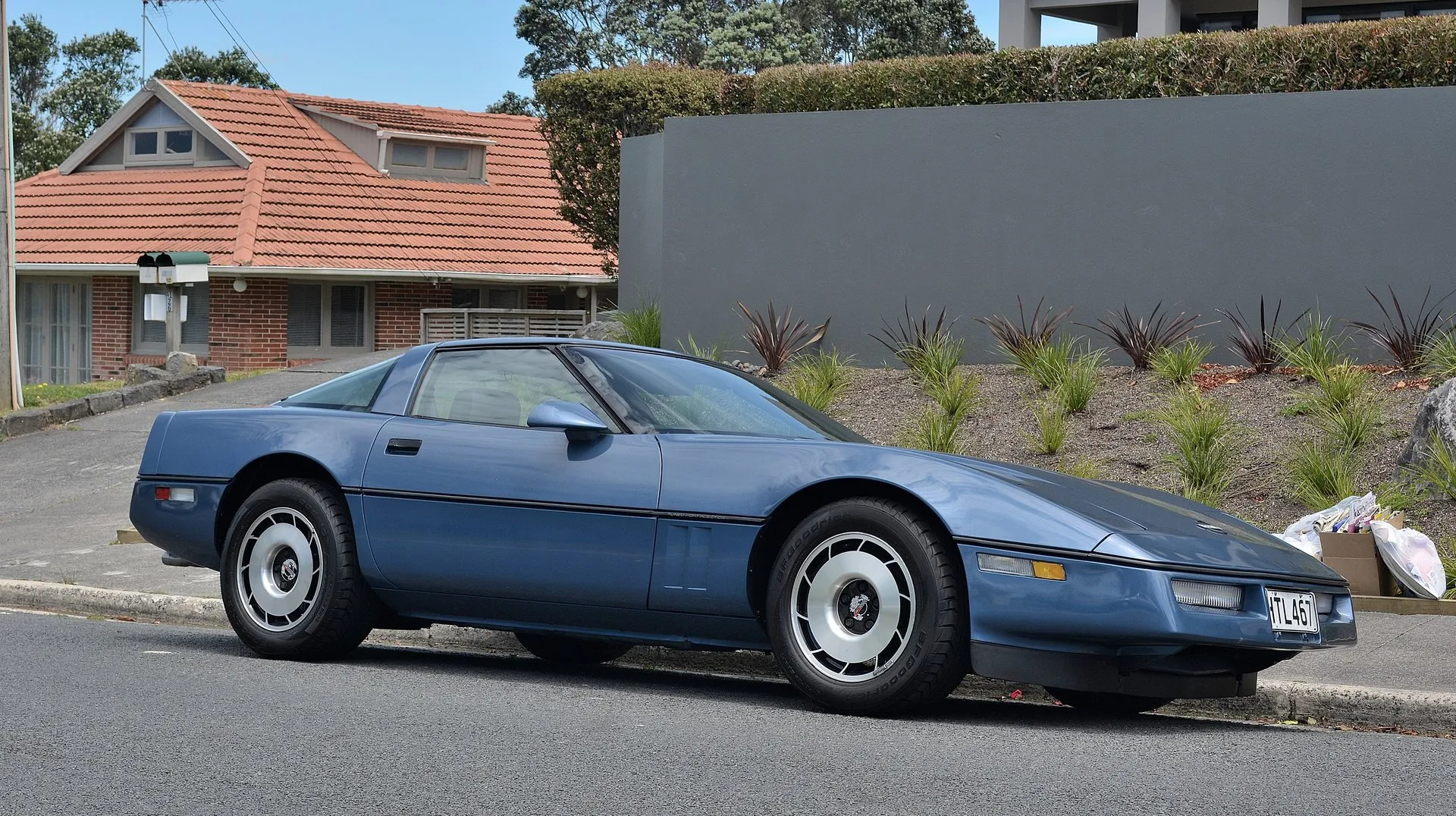
Early or late? On a 4+3 car, an overdrive switch on the console points to an early 1985 and one on the shift knob to a later car, though GM gives no serial for the change. The overdrive’s own serial tag says whether it left the factory with the revised carrier.
What a 1985 isn’t. A convertible: every 1985 is a coupe, and the convertible returned for 1986, so a 1985 convertible is an aftermarket conversion. Nor a Stingray: no 1985 wears the name, which the generations guide shows returning only with the C7.
Section 08
What to test on a 1985, hot and cold
- The seat belts. Pull each front belt all the way out and let it retract. Completed recall work leaves stickers 91C25 and 91C26 on top of the radiator, an owner points out (CorvetteForum, 2019–2023). Treat a jamming belt as a safety repair, and price it in.
- The serial against GM’s ranges. 101340 or lower: ask whether the 85C12 sensor went in. 123218 or lower: ask about the 85C22 coil. Below 123542: look at the rear exhaust hanger. Paper for any of it marks a car someone looked after; four decades on, don’t count on a dealer doing the work now.
- A hot restart. Drive it until it’s fully warm, shut it off, let it sit a while and restart. Hesitation or misfire hot was the coil’s fault in GM’s bulletins. Owners trace a long hot crank to leaking injectors, low fuel pressure and the coolant and fuel temperature sensors (CorvetteForum, 2013 (opens in new tab)), and owners in other threads report fuel pump failures too.
- A warm idle. Let it idle and roll to a stop with the throttle closed. Hunting or stalling points to the idle bulletins (85-91, 85-186) or a tired airflow sensor.
- The exhaust. Blue smoke means oil burning, and one owner’s advice on a high-mileage 1985 is to walk away (CorvetteForum, 2005).
- Leaks. Intake, water pump and valve cover gaskets were already weeping on 20-year-old cars, owners said in the same thread.
- The 4+3, warm. Listen for noise in every gear with the overdrive off (bulletin 85-111), make sure the overdrive engages and its lamp lights, and note where the switch is.
- The digital cluster. Every readout legible in daylight and after dark. A dead dash priced as a good one is a negotiation, not a deal (repair costs are in the C4 guide).
- The rear suspension. Rear tie rods, bushings and alignment: two of the 1985’s complaints describe the rear end letting go.
- The C4 basics: cold-morning steering, headlight motors, weatherstrips and damp carpet, by the checklist in the C4 guide.
- Originality. The VIN derivative and suffix on the engine pad, the RPO label behind the seats, the TPI script, 16-inch wheels. A modified car is fine to drive, not to pay original money for.
- An inspection by a shop that has worked on Tuned-Port cars.
Section 09
A $9,500 median, and what moves it
How much is a 1985 Corvette worth? Usually around $9,000 to $10,000 for a sound, stock driver. Bring a Trailer (opens in new tab) sold four stock 1985s between January 1 and October 20, 2026, for $8,200 to $13,500, a median of $9,500 by this site’s arithmetic on sold prices before the buyer’s fee, and none failed to sell:
- $8,200 for a 4+3 car in February
- $9,500 for a 4+3 car with one owner for 31 years in March
- $9,500 for another coupe later in March
- $13,500 in August, the top of the year
Over the last 12 months, six sold for $8,200 to $14,000, again at a $9,500 median, and one went unsold at $8,900. Calendar 2025 gives a wider view: 12 stock sales from $5,250 to $19,500, a median of $9,650.50. The top of that range went to low-mileage cars: a 12,000-mile 4+3 brought $19,500 in January 2025, and 9,000- and 12,000-mile Z51 4+3s brought $14,000 and $13,760. Samples this small give a feel for the market, not a price guide. Race cars, an engine swap and a car with a gearbox no 1985 had are left out of every figure.
Hagerty put a 1985 coupe in #3 (good) condition at $9,100 in February 2026, between $8,900 for a 1984 and $9,300 for a 1986 (archived copy (opens in new tab)). classic.com’s last readable 1985 figure is old: an average of $12,590 across 58 sales, in November 2024. The best-years guide’s $12,750 median for stock 1984–1989 cars covers six model years and a shorter window, with only one 1985 in it. None of this predicts where values go next.
Is 1985 a good year for a Corvette? For the money, yes. It answered both complaints the record holds against the 1984, the engine and the ride, and it still lacks the ABS, VATS key and electronic air conditioning of later C4s, which owners count as fewer things to fail (CorvetteForum, 2006). The C4 guide’s picks are still later cars: 1995–1996 for most buyers, a 1990 or 1991 for an L98 with the newer dashboard.
Section 10
Pick a late-serial Z51 with records
Buy an unmodified Z51 coupe built after serial 123542, with records. A late car falls outside both GM campaign ranges and has the revised exhaust hanger, and a Z51 1985 is the version that shows what GM did that year: softer springs than the 1984 Z51’s, bigger bars, Bilstein shocks and the heavy-duty cooling. It’s the chassis Road & Track put next to a Carrera, and low-mile Z51 4+3s brought two of 2025’s three highest 1985 prices. Earlier cars are fine with the campaign paperwork; without it, budget for a coil and a sensor.
Gearbox: the 4+3 if the car will see a road with corners, one of 9,576, with a carrier serial at or past D5C 14413 CF or proof of a rebuild. The automatic if it’s a cruiser: three in four 1985s have one, and with the base suspension it gets GM’s softest 1985 spring rates.
Skip a smoker, a modified car priced like an original, a 4+3 that whines with the overdrive off unless the price covers the rebuild, and any car with a belt that won’t retract.
A sorted 1985 belongs on a battery maintainer and under a cover when it sits, and the battery guide shows where its battery hides. Then drive it. Four decades after Road & Track set it beside a Carrera, it’s still America’s sports car at its most honest price.
Section 11
Sources
- GM Heritage Center: 1985 Corvette vehicle information kit files.zipcorvette.com This site's library. Corvette Black Book pages GM included in the kit: production, VIN range, engine codes and the year's facts (PDF page 6), options with prices and counts, colors and interiors (page 8). GM's 1985 service manual identification pages: VIN plate and chart (12, 13), capacities and the engine VIN pad (14), the automatic's ID (15), the parts label (24). Chevrolet's 1985 sales book (31, 39, 46) and ordering information (48). Road & Track's road test of the 1985, reprinted (54 to 56; the reprint prints no issue date). GM's MVMA specification sheets: power teams (61), engine (62), suspension (70), curb weight (84).
- GM Heritage Center: 1984 Corvette vehicle information kit files.zipcorvette.com This site's library. 1984 options, prices and counts (PDF page 5); GM's 1984 spring rates and stabilizer bars, MVMA sheet issued January 1983 and revised April 1983 (page 34).
- GM Heritage Center: 1986 Corvette vehicle information kit files.zipcorvette.com This site's library. What 1986 changed, on a Corvette Black Book page in the kit (PDF page 18).
- NHTSA owner complaints, 1985 Chevrolet Corvette (opens in new tab) api.nhtsa.gov 16 complaints on October 20, 2026, filed 1995 to 2019. Theme counts are this site's reading of the complaint text.
- NHTSA recalls, 1985 Chevrolet Corvette (opens in new tab) api.nhtsa.gov One GM recall, 91V143000, pulled October 20, 2026. Two aftermarket oil filter recalls in the same results are not about the car.
- NHTSA manufacturer communications (TSB) files, received 1995 to 2026 (opens in new tab) static.nhtsa.gov Searched with the later files for any communication listing a 1985 Corvette: one (rear lift window, 1984–1993), and no GM special coverage. GM's 1985 bulletins predate the index.
- GM emission campaign 85C12: mass air flow sensor replacement, 1985 Corvette (via Corvette Action Center) (opens in new tab) corvetteactioncenter.com September 1985; some cars within VINs F5100001 to F5101340. Transcriptions of GM's bulletins here and below are not GM or NHTSA originals.
- GM emission campaign 85C22: high output ignition coil, 1984–1985 Corvette (via Corvette Action Center) (opens in new tab) corvetteactioncenter.com August 1986; certain 1985s within VINs F5100001 to F5123218, from GM's scanned bulletin. The related service bulletin 85-93 (opens in new tab) is June 1985.
- GM dealer service bulletins for the 1985 Corvette (via Corvette Action Center) (opens in new tab) corvetteactioncenter.com This link is 85-111, 4+3 noise with the overdrive disengaged (August 1985). Also 85-91 (opens in new tab) minimum idle speed (May 1985), 85-186 (opens in new tab) manual-transmission idle and launch stalls (March 1986), 85-125 (opens in new tab) rear exhaust hanger (September 1985) and 85-31 (opens in new tab) reverse idler roll pin (January 1985).
- EPA fuel economy ratings (fueleconomy.gov): 1985 Corvette (opens in new tab) fueleconomy.gov Current method, automatic; the manual (opens in new tab). Pulled October 20, 2026.
- Bring a Trailer: C4 Corvette auction results (opens in new tab) bringatrailer.com Listings titled as a 1985, January 2025 to October 20, 2026, read October 20, 2026; race cars, an engine swap and a non-factory gearbox left out. Medians are this site's, from the sold prices without the buyer's fee.
- Hagerty valuation tool: 1984–1996 Corvette generation page (archived February 8, 2026) (opens in new tab) web.archive.org #3 (Good) values by year: 1984 $8,900, 1985 $9,100, 1986 $9,300.
- classic.com: 1985 Chevrolet Corvette base model market (archived November 9, 2024) (opens in new tab) web.archive.org The last readable capture; the live page is closed to automated readers.
- CorvetteForum thread: 85 Corvette, good or bad? (opens in new tab) corvetteforum.com September 2005. Oil burning, the digital cluster and aging gaskets on a high-mileage 1985.
- CorvetteForum thread: pros and cons of an 85 Vette (opens in new tab) corvetteforum.com January 2006. Owners on the 1985's simplicity and a fuel pump failure.
- CorvetteForum thread: opinion on a 1985 Corvette (opens in new tab) corvetteforum.com April 2008. A 1985 as a daily driver; computer and fuel pump failures.
- CorvetteForum thread: 1985 Corvette problems (opens in new tab) corvetteforum.com January 2013. A long hot restart on a 1985 automatic: fuel pressure, injectors and temperature sensors.
- CorvetteForum thread: need advice on buying a Corvette (opens in new tab) corvetteforum.com June 2025. A $5,500 modified 1985, and the fuel, ignition and seal work owners say to plan for.
- CorvetteForum thread: seat belt locked up, GM won't honor safety recall (opens in new tab) corvetteforum.com 2019–2023. The 91C25 and 91C26 campaign stickers on top of the radiator.