C1 · Buying guide
1954 Corvette guide: the St. Louis cars, the October price cut, Pennant Blue and 2026 prices
Published
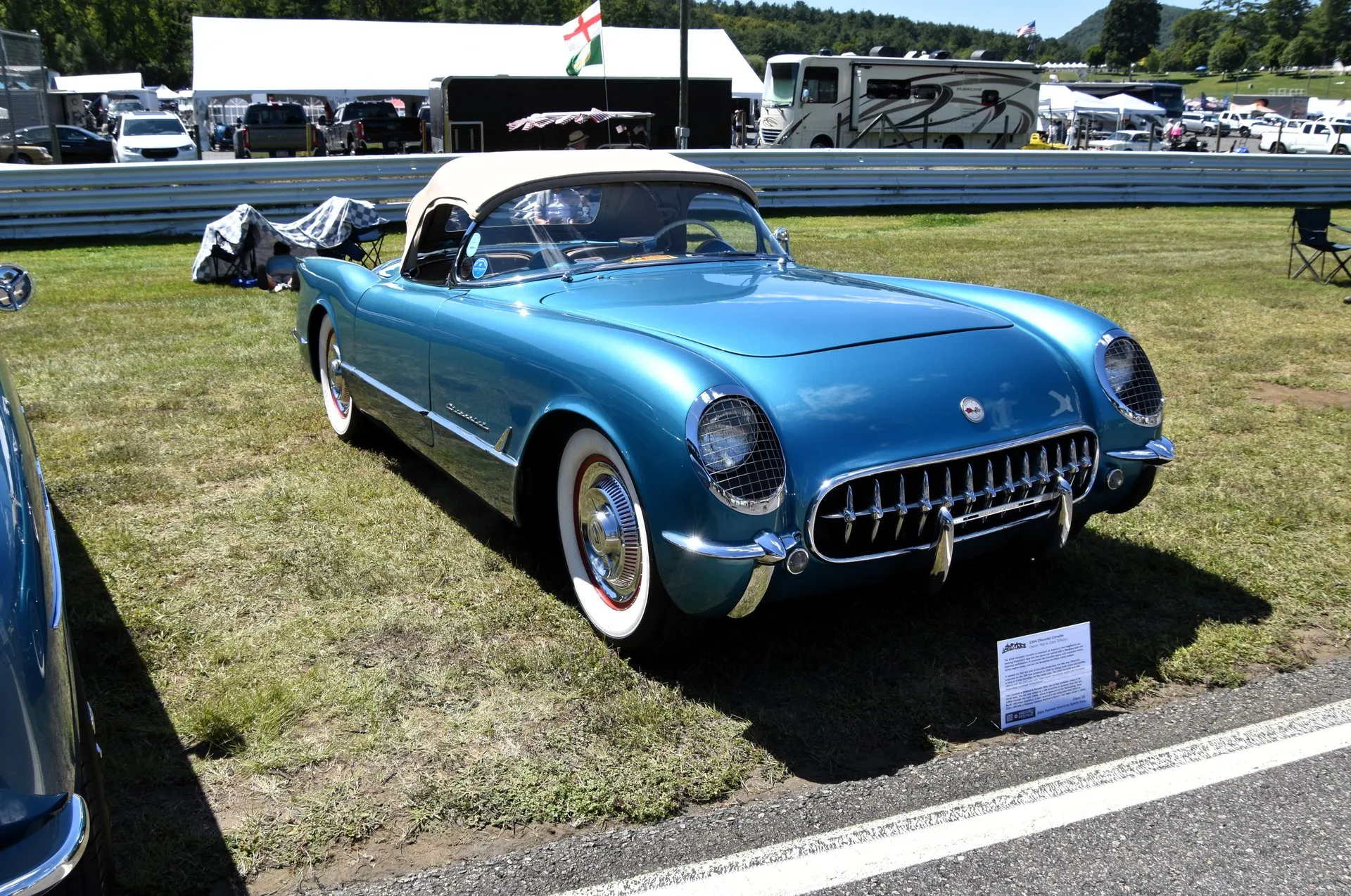
Chevrolet’s St. Louis Corvette plant was designed to build 10,000 cars a year. That’s the Corvette Black Book’s figure, from the pages GM reprints in its Heritage Center kits: Chevrolet started 1954 production in the renovated plant in December 1953. The Black Book is a hobby reference, not a GM document, and its verdict on the plan is blunt: “Demand was misjudged.” St. Louis built 3,640 for 1954, more than twelve times the 300 hand-built 1953s, and that’s what makes the second year of America’s sports car the early C1 (1953–1962) a buyer can actually find: the same shape and the same six for about a third of a 1953’s money.
- Built: 3,640, all in St. Louis, every one a two-seat roadster, serials E54S001001 to E54S004640.
- Engine and gearbox: a 235 cu in Blue Flame six, 150 hp gross, on three side-draft carburetors, with the two-speed Powerglide automatic only. The Black Book says later cars made 155 hp; Chevrolet’s 1954 paper doesn’t (see Early car or late car).
- Colors: Polo White and Pennant Blue on GM’s list, with a beige top. The Black Book adds estimated red and black cars.
- Price new: 1953’s $3,498 at first, then $2,774 from October 28, 1954, before options.
- What one is worth: Hagerty’s #3 (Good) average was $63,650 (January 2026). On Bring a Trailer, 11 stock-titled 1954s sold at a $65,005 median in the 12 months to October 22, 2026.
The C1 buyer’s guide carries the generation’s records: frame rust, fiberglass cracks, faked engines and tags. The 1953 guide covers the first year and how to tell the two apart. This page is 1954 only.
C1 Key figures
- Built
- 3,640, all in St. Louis
- Engine
- 235 cu in Blue Flame six, 150 hp gross
- Transmission
- Powerglide automatic only
- Colors
- Polo White and Pennant Blue on GM's list
- Base price
- $2,774 from October 28, 1954
- Hagerty #3 average
- $63,650 (January 2026)
- Bring a Trailer median
- 11 stock-titled 1954s sold at a $65,005 median
Section 01
St. Louis, December 1953: a plant built for 10,000 a year
The 1953s came off a pilot line in Flint, Michigan. The 1954s came from St. Louis, Missouri, and the 10,000-a-year design figure is on the Black Book’s 1954 production page, reprinted in GM’s kit in this site’s owner’s manual library. By the Black Book’s count, Corvette sales didn’t pass 10,000 a year until 1960; the C1 guide’s production table shows 1960 as the first year production did too.
Chevrolet’s own specification supplement for the car, dated April 12, 1954, gives the serial format: series letter E, then 54, then S for St. Louis, so E54S001001 was the first unit. The Black Book gives E54S004640 as the last.
Where the very first ones were built isn’t settled. The Black Book lists 001014 as the last car of December 1953. The International Registry of Early Corvettes, an owners’ registry that published reports in 1973 and 1974, first read the calendar-1953 figures as 14 1954s built in Flint before that line closed, then called the question “not resolved” in its April 1974 report. Either way, all but a handful of the year’s cars were St. Louis cars.
How many 1954s survive? No current count turned up for this guide. The one dated figure is the registry’s: owners had reported 879 1954s by April 1, 1974, 24.1 percent of production. That was a survey of owners who answered, not an audit, and it’s more than fifty years old.
Section 02
The October 28, 1954 price cut
A new 1954 started out at 1953’s price, $3,498. The Black Book’s options page says the base price of $2,774.00 took effect on October 28, 1954, and that “initial 1954 pricing was the same as 1953.” That’s $724 off the base car, by this site’s arithmetic, and it came with cars still unsold: the Black Book’s 1955 page counts over 1,100 unsold 1954s at the start of 1955 production. It adds that dealers’ actual prices “varied both high and low.”
The option list is where the 1954 gets strange. The Black Book gives every RPO (regular production option, GM’s code for a factory option) a quantity of 3,640:
| RPO | Option | Price from October 28, 1954 | Cars |
|---|---|---|---|
| 100 | Directional signals | $16.75 | 3,640 |
| 101 | Heater | $91.40 | 3,640 |
| 102 | AM radio, signal seeking | $145.15 | 3,640 |
| 290B | Whitewall tires, 6.70x15 | $26.90 | 3,640 |
| 313M | Powerglide automatic | $178.35 | 3,640 |
| 420A | Parking brake alarm | $5.65 | 3,640 |
| 421A | Courtesy lights | $4.05 | 3,640 |
| 422A | Windshield washer | $11.85 | 3,640 |
Listing the Powerglide as an option implies a manual gearbox was standard. “Not true,” the Black Book says: every 1954 had it, and it’s “nearly certain that all 1954s were built with all options.” Chevrolet’s brochure even calls the courtesy light standard. So a 1954 with everything came to $3,254.10 at the October 1954 list, by this site’s arithmetic: $480.10 of “options” on a $2,774 car.
The cut lined up with the next model. Chevrolet’s 1955 Corvette supplement is dated October 29, 1954, the day after, and the 1955 six-cylinder car listed at the same $2,774.00 (1955 kit).
Section 03
What Chevrolet’s 1954 paper describes
Three Chevrolet documents describe the car: the April 1954 supplement in GM’s kit, the 1954 owner’s manual and the 1954 sales brochure, which bills the Corvette as “The First All-American Sports Car.” The manual and brochure survive as scans Corvette Action Center hosts.
The six. GM’s supplement calls it “basically the same as the Blue Flame-125 passenger car engine”, with mechanical tappets, an aluminum timing gear, 8.0:1 compression and three Carter side-draft carburetors with a manual choke. It’s a 235.5 cubic-inch inline six rated 150 hp gross at 4,200 rpm (140 net) and 223 lb-ft gross at 2,400 rpm (216 net). Gross ratings were taken without the accessories a car carries, so they read higher than net ones.
Owners say the passenger-car Powerglide sixes had hydraulic lifters where the Corvette had solid ones, and one owner’s 1954 turned out to have been converted to hydraulic (CorvetteForum, 2020). If the valve lash won’t set, look there.
The drivetrain. A Powerglide with its selector lever in the floor at the driver’s right, a 3.55:1 rear axle and Hotchkiss drive: one open driveshaft, with the rear leaf springs locating the axle.
Chassis and body. A box-girder frame with an I-beam X-member, coil springs in front, four-leaf rear springs, 11 in drum brakes and 16:1 steering. The brochure gives the fiberglass body’s weight as 410 lb. GM’s supplement lists the car at 2,705 lb shipping, 2,850 lb curb and 3,150 lb loaded, and the brochure puts 53 percent of the weight on the front wheels. The wheelbase is 102 in and the length 167 in.
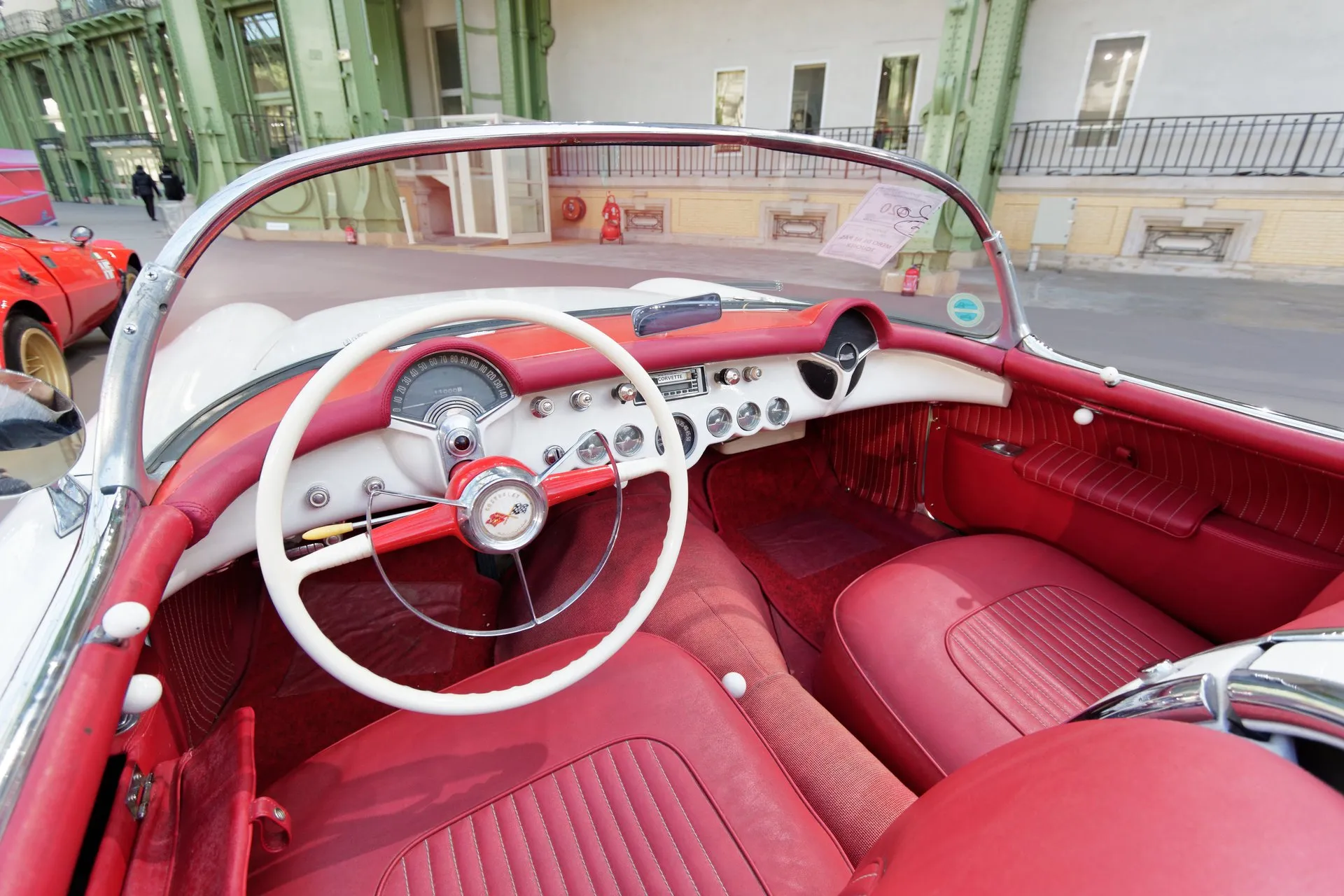
Living with it. There are no roll-up windows. The side windows sit in chrome frames with vent panes, snap into slots in the doors, and ride in the trunk when they’re off. The top folds by hand into a well behind the seats. The hood hinges at the front and stays up on a prop arm, the headlights sit behind mesh guards, and the electrics are 6-volt. Roll-up glass waited for the 1956.
How quick? Corvette Action Center reproduces Road & Track’s June 1954 test figures: 0–60 mph in 11.0 seconds (opens in new tab), the quarter mile in 17.9 seconds at 76.0 mph and 107.1 mph flat out. The magazine itself wasn’t read for this guide, and the page doesn’t say which car was tested. Two posters in a 2011 thread about a 1954 call a stock one slow and truck-like. Duntov’s March 1954 list of the early car’s handling faults is in the 1953 guide.
Section 04
Early car or late car: what changed during 1954
Chevrolet kept changing the car as it built it. The Black Book’s 1954 page dates most of the changes by serial number, which is how a buyer tells an early car from a late one (1954 kit):
- Air cleaners. Early cars kept the three chrome “bullet” inlets of the 1953. Cars later than #002906, about the 1,906th 1954, got a dual “pot” setup, “intended in part to reduce the possibility of engine fires.”
- Exhaust tips. Short stainless extensions early; longer ones with built-in baffles on cars later than #002523.
- Hood releases. Two inside the cockpit on early cars, one later.
- Starter. A two-coil starter (1107109) on very early cars, then a four-coil one (1108035).
- Small parts. Brake and fuel lines inside the frame rails and a two-band radiator surge tank, except on very early cars; a window storage bag squarer than 1953’s and keyed to the interior color.
- Tires. Tube-type at first, tubeless later, probably with both in use for a while.
- Powerglide. Chevrolet’s bulletin for 1954 Chevrolet Powerglides says units built after transmission serial C106D shift like the 1953’s; earlier ones with a “severe downshift or ‘clunk’” got the 1953 modulator spring.
- The valve cover. Chrome-plated or painted engine-enamel blue; the painted ones carried “Blue Flame” and “150” decals.
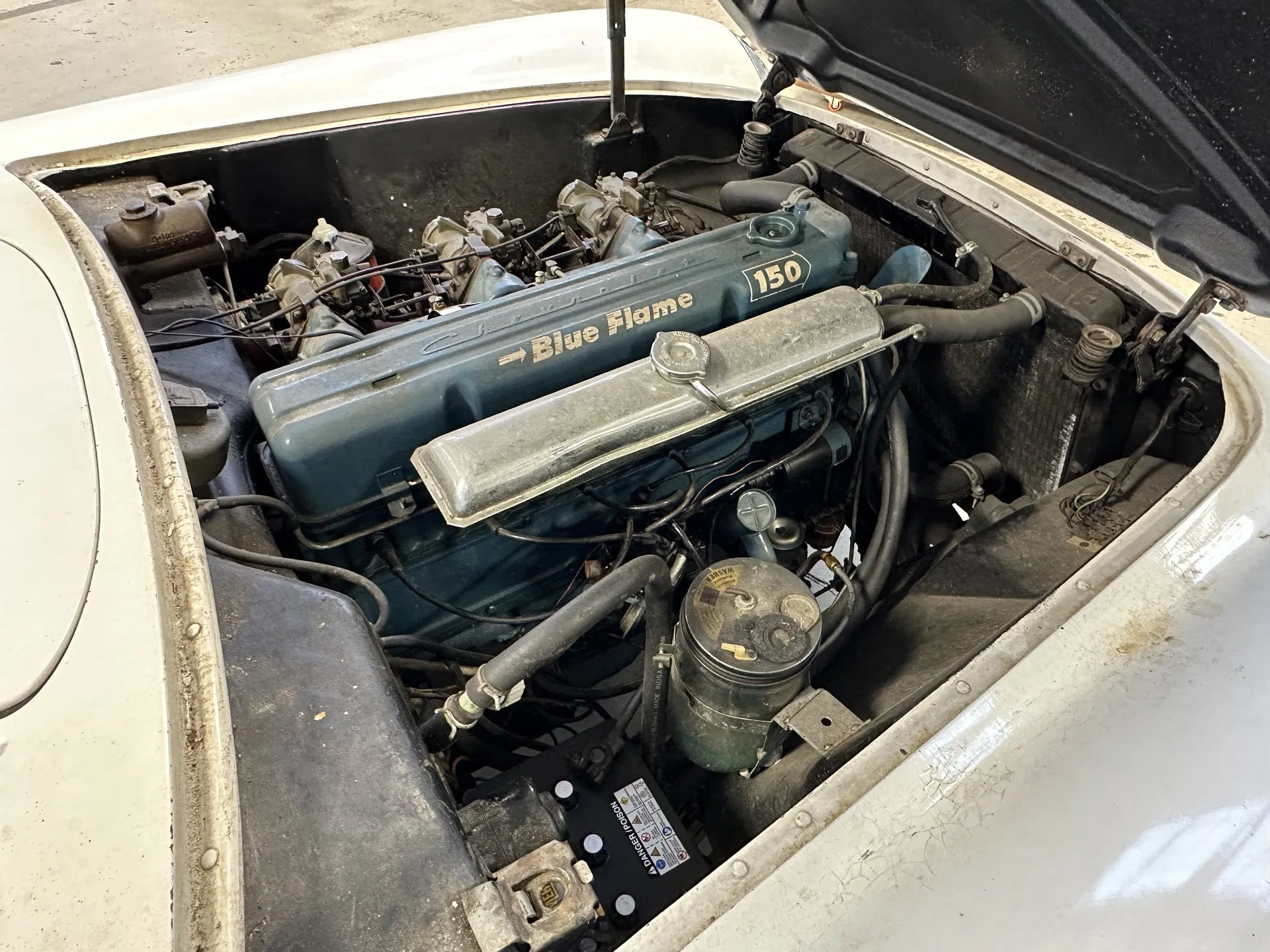
150 or 155 hp? Here the paper splits. The Black Book says a camshaft change “made during 1954 production” raised the rating to 155 hp, that the engines look the same from outside, and that later camshafts carry three dots between the fifth and sixth inlet lobes, inside the block where no test drive will find them. Hagerty values the 150 and 155 hp cars separately. But every 1954 Chevrolet document read for this guide says 150: the April 1954 supplement, the owner’s manual, the “Blue-Flame 150” brochure and the decal on the valve cover. The first Chevrolet page found with 155 hp is the 1955 supplement, dated October 29, 1954, for the 1955 six. So 155 hp for a late 1954 is the Black Book’s account, not Chevrolet’s, and no source gives the serial where the cam changed.
Section 05
Polo White, Pennant Blue and the colors nobody counted
GM’s supplement names two exterior colors: Polo White standard, Pennant Blue optional. The top is beige and the wheels red; the seats are red with white stitching as standard, beige optional, and the Black Book pairs the beige interior with Pennant Blue. The brochure lists only Polo White, a Sportsman Red cockpit and a “Tan” top, most likely another name for the same beige. That top is the quick tell against a white 1953, whose top was black: Mac’s Motor City Garage (opens in new tab) calls it the easiest way to tell them apart “from middle distance.”
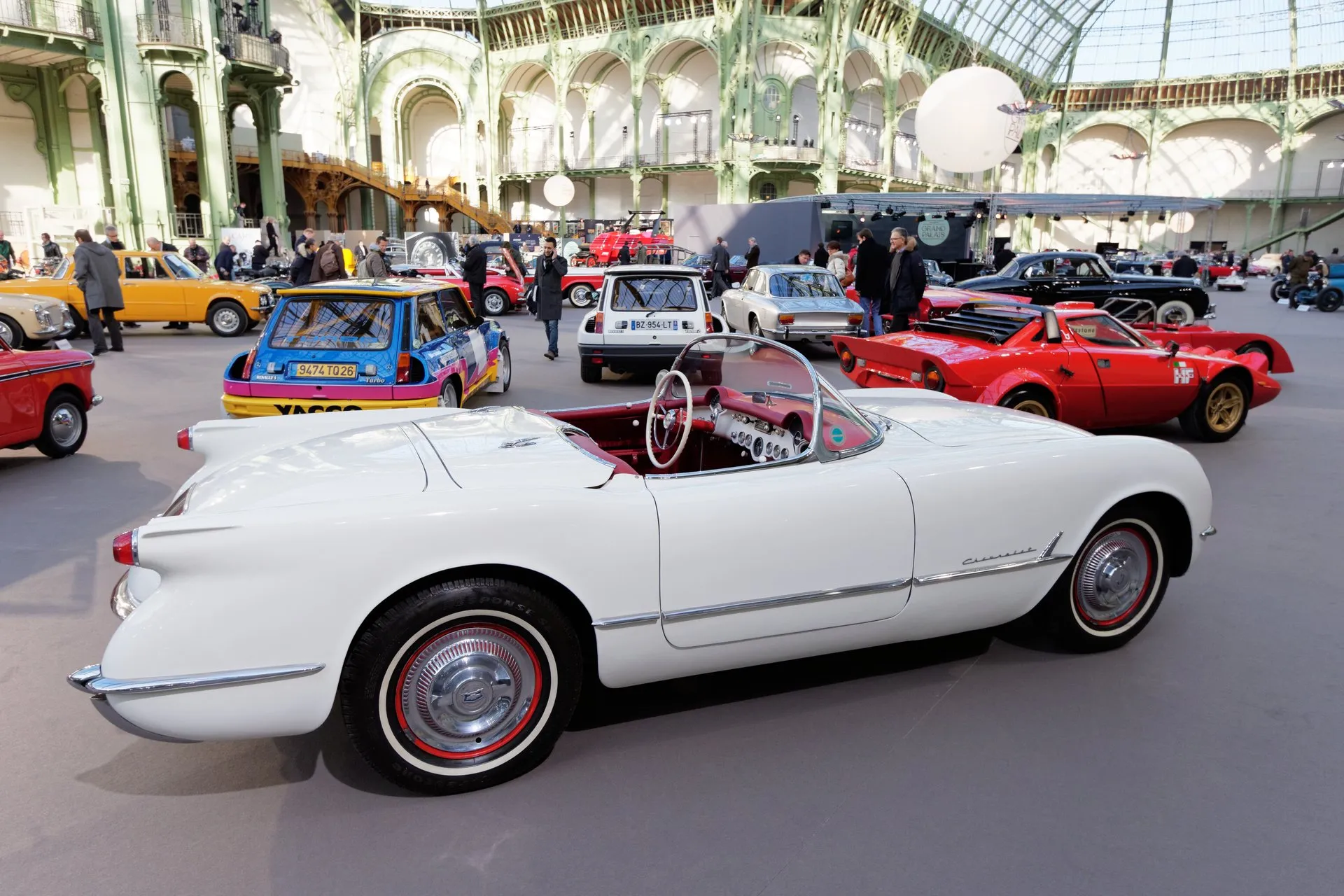
The Black Book goes further, with numbers it marks as estimates: Polo White 3,230, Pennant Blue 300, Sportsman Red 100 and Black 4. They add up to 3,634, six short of the year’s total. The Black Book says the figures “are not from Chevrolet records,” that interiors and exteriors “were not coded to individual cars,” and that owners’ reports make it reasonably probable some cars wore other colors, possibly a metallic green or bronze.
The owners’ registry reached a similar picture by another route. In January 1974 it accepted five 1954 combinations as factory: 84.6 percent of those cars were Polo White with red, 9.8 percent Pennant Blue with Shoreline Beige and 3.4 percent Sportsman Red with red, and the rest rare blue interiors with white or blue paint. Its earliest well-authenticated red car was serial 2110, its earliest Pennant Blue E54S001783. It accepted no black 1954.
So a black 1954 rests on the Black Book’s estimate of four. One Bring a Trailer seller said his 1954 left the factory black; the same listing noted that “factory records do not exist.” Nothing on the car settles it either: a 1954 has no trim tag, one owner notes (CorvetteForum, 2013), and original paint has to be found under weatherstripping and trim panels.
Pennant Blue has a shade problem too. Corvette Action Center lists it as Ditzler DAL 11238 or DuPont 1927. One restorer of a Pennant Blue 1954 says the paint maker’s formula came out with too coarse a metallic, so his shop matched an original car instead, and another poster says many Pennant Blue cars don’t look right (CorvetteForum, 2023). Compare a blue car with a known original before paying for the color.
No 1954 had a factory hardtop. Aftermarket companies made tops for 1953–1955 and some dealers sold them, the Black Book says. Corvette Action Center adds that GM styling chief Harley Earl commissioned about 20 plastic bubble tops for the 1954, most for special customers and dealers. Neither kind came from the factory, whatever a listing says.
Section 06
Matching a 1954’s numbers: plate, frame, pad, title
Chevrolet’s owner’s manual gives the two places that matter. The serial is “stamped on plate attached to left front body hinge pillar,” and the engine number is “stamped on boss on right side of cylinder block to the rear of ignition distributor” (opens in new tab).
The plate. E54S, then a six-digit number from 001001 to 004640. Reproduction tags exist: one stock-titled 1954 sold on Bring a Trailer in September 2026 for $40,000 with “the reproduction serial number tag affixed to the car,” per its listing. A reproduction tag isn’t fraud by itself, but it should match the title and the frame, and the price should reflect it.
The frame. This location comes from owners, not GM. Posters put a 1954’s frame number on top of the driver-side frame rail, roughly under the seat, single or double stamped and hard to read through scale; one says 1953s are on the X-member and 1954s on the rail (CorvetteForum, 2019). No GM page read for this guide gives the spot, so check it against the NCRS judging guide for 1954.
The engine stamp. It’s an assembly number and a suffix, not the car’s serial. In the registry’s 1973 sample of ten 1954 engines, every stamp was a seven-digit number followed by F54YG, such as 0273233F54YG on E54S001231: F for Flint, 54 for the year, YG for the Corvette six. The numbers “generally” rise with the serial, the registry said, but not precisely. The Black Book gives block casting 3835911 and head 3836241. The C1 guide explains why a Tonawanda block means a replacement.
The pad. NCRS (the National Corvette Restorers Society) judges 1953–1976 engine pads bare, and “a painted, or otherwise obscured engine pad is an automatic 38 point deduction” (opens in new tab). Ask why a pad is painted.
The title. Some states titled early Corvettes by engine number, so an old title can carry the engine stamp instead of the E54S serial. Once that engine is gone, the title matches nothing on the car. Posters in a 2024 thread (opens in new tab) say many states did it from the 1950s to the 1970s, and one owner had his title corrected after moving the car to another state. The good version of the story: a Bring a Trailer 1954 sold for $90,000 in December 2025 with a title showing an engine number that, its listing says, matches the stamp.
Swaps. In 1973 the registry found 56 percent of reporting 1954s on their original engine, 16 percent on a replacement six and 9 percent on a V8. Every 1954 had the Powerglide, so a car with a manual gearbox has been modified, however well. The camshaft dots, the air cleaners and the exhaust tips should agree with where the serial falls in the run; none of them proves anything alone.
Section 07
Records, bulletins and the faults owners know
NHTSA, the US road safety agency, lists no complaints and no recalls for the 1954 Corvette (both checked October 22, 2026). That’s an empty file, not a clean bill of health: the complaint records start in September 1994.
Chevrolet’s own paper says more. Technical Service Bulletin #307, revised September 3, 1954, deals with “Water Leaks, Corvette Doors” (opens in new tab): water getting in between the door and the cowl, just below the windshield. The fix was to take the door off, seal around the hinge covers, fit a new door seal extension, GM 3715490 (OEM), and reseat the hinge-pillar seals, shimming as needed. The scan Corvette Action Center hosts names no model year and is filed under 1953–1954. A wet footwell on a 1954 may be as old as the car.
The Powerglide bulletin in Early car or late car covers the early clunk on downshifts. Everything else is the generation’s: the frame’s rear crossmember, fiberglass stress cracks, leaking tops and a ride owners call truck-like. The C1 guide covers them, along with radial tires and the other cheap upgrades owners make. Parts are the good news: “They repro 90% of the car,” one owner says of the early cars, though a correct engine, transmission or rear end “could be harder to locate” (CorvetteForum, 2010–2014).
Section 08
Eleven checks on a 1954, numbers first
- The serial plate, on the left front body hinge pillar: E54S001001 to E54S004640, original or reproduction, and why.
- The frame number, on top of the driver-side rail by owners’ accounts, matching the plate.
- The title. E54S serial or an engine number? If it’s an engine number, is that engine still in the car?
- The engine stamp, behind the distributor on the right side of the block: a seven-digit number and F54YG, on a bare pad, in a 3835911 block.
- The running changes. Air cleaners, exhaust tips, hood releases and starter should fit an early or late serial. A late car sold as 155 hp has only the Black Book behind it.
- The Powerglide, shifting cleanly, with no hard clunk on the downshift.
- The color. Polo White, Pennant Blue or a well-documented red, with original paint traces under the trim. A black car needs extraordinary proof.
- The top and doors. Beige top, side windows and their storage bag, and a dry footwell after a hose test.
- Valve lash, if the engine ticks: a hydraulic conversion changes the job.
- The C1 checks: the frame on a lift and the fiberglass, from the C1 guide.
- An inspection by an NCRS judge or a C1 specialist before money changes hands.
Section 09
1954 prices in 2026: Hagerty and Bring a Trailer
Hagerty. Hagerty’s price guide (opens in new tab), as archived on January 23, 2026, put a 1954 in #3 (Good) condition at $61,800 with the 150 hp engine and $65,500 with the 155 hp one, an average of $63,650. It had a 1953 at $186,000 and a 1955 six at $72,200. Hagerty Media wrote in June 2025 that a #2 (Excellent) 1954 was worth less than half a 1953, $107,000 against $254,000, because about ten times as many were built. Values may have moved since.
Bring a Trailer. In the 12 months to October 22, 2026, 18 1954s finished auctions on Bring a Trailer (opens in new tab): 14 sold and 4 didn’t. These are this site’s calculations from each listing:
| Group | Sales | Median | Range |
|---|---|---|---|
| All sold 1954s | 14 | $56,250 | $13,000 to $90,000 |
| Stock-titled (no modification in the title) | 11 | $65,005 | $20,250 to $90,000 |
| Stock-titled, January 1 to October 22, 2026 | 9 | $57,500 | $20,250 to $76,600 |
The middle half of the stock-titled sales ran from about $47,500 to $71,900. That $65,005 median matches the C1 guide’s figure for its slightly earlier window. A stock title doesn’t prove a stock car (the $40,000 car with the reproduction tag was one), and with 11 sales, one car moves the median.
Single results show the spread. The top sale was the $90,000 Pennant Blue repaint with the matching engine-number title. The 12th 1954 built sold for $55,000 with no reserve in September 2026. A Pennant Blue car finished a body-off restoration in 2025, which its listing put at about $100,000, was bid to $80,500 in October 2026 and didn’t sell. A non-running project brought $20,250, and a 1954 fitted with a 283 V8 and a four-speed, not running, sold for $13,000.
Restomods are a different market. A 1954 with an LS1 V8 and a six-speed sold for $150,000 in August 2025, and another LS1 car for $299,000 in January 2024, far above any stock 1954 sold there in the past year. Owners split on whether a 1954 that has lost its six should be restored or modernized (CorvetteForum, 2011); either way, price it as what it is now.
Section 10
The pick: a late 1954 whose numbers agree
Buy a stock 1954 whose plate, frame number, engine stamp and title agree, and make it a later car if you can: one past #002906, with the pot air cleaners meant in part to cut the fire risk and the longer baffled tips. If the Black Book is right, it has the 155 hp cam too, and Hagerty already prices that version $3,700 higher. Don’t pay that premium on the cam alone: no Chevrolet paper confirms it.
Pay for color only with evidence. Polo White is the honest default and Pennant Blue the documented upgrade; a red car needs paint history, and a black one needs more proof than anyone has shown the registry. Walk away from a title that matches nothing on the car, a V8 or a manual gearbox priced as stock, or a “factory hardtop.”
The budget path is a sound white driver with the right numbers and a tired interior: half the stock-titled 1954s on Bring a Trailer in the past 12 months sold for $65,005 or less. Get the paper right and you have the early C1 for a third of a 1953’s money, the pick the best Corvette years guide makes too: the original shape, the triple-carb six, and the car Chevrolet built a 10,000-a-year plant for, then cut in price by $724 in October 1954. The V8 and the restyle that followed are in the C1 guide.
Section 11
Sources
- GM Heritage Center: 1954 Corvette vehicle information kit files.zipcorvette.com This site's library. PDF pages 2 and 4 are reproduced Corvette Black Book pages (production, serials, running changes, options, prices, color estimates); pages 8–11 are Chevrolet's own 1954 Corvette specification supplement of April 12, 1954 (serials, weights, colors, equipment, engine ratings).
- GM Heritage Center: 1955 Corvette vehicle information kit files.zipcorvette.com PDF pages 2–3 (Black Book): unsold 1954s at the start of 1955 production, the 1955 six's price, tires, hardtops. Page 34: Chevrolet's 1955 supplement dated October 29, 1954, with the six at 155 hp.
- Chevrolet: 1954 Corvette owner's manual (Corvette Operations Manual) (opens in new tab) corvetteactioncenter.com As hosted by Corvette Action Center. Technical data on PDF page 68 (printed page 64): serial plate and engine number locations, engine, transmission, weights; exhaust heat control on PDF page 42.
- Chevrolet: 1954 Corvette sales brochure (opens in new tab) corvetteactioncenter.com As hosted by Corvette Action Center. Specifications page: colors, brakes, curb weight, weight distribution and body weight.
- International Registry of Early Corvettes: Reports 1–3 (1973–1974) (opens in new tab) corvetteactioncenter.com An owners' registry, as hosted by Corvette Action Center: 1954 registry counts, engine stamps, original-engine share, calendar-year figures and the color combinations owners reported.
- Chevrolet: Technical Service Bulletin #307 (revised), water leaks, Corvette doors, September 3, 1954 (opens in new tab) corvetteactioncenter.com Scan as hosted by Corvette Action Center.
- Corvette Action Center: 1954 Powerglide vacuum modulator spring bulletin (opens in new tab) corvetteactioncenter.com Chevrolet technical service bulletin for 1954 Powerglides, as transcribed.
- Corvette Action Center: Duntov's summary report on Corvette handling and ride, March 29, 1954 (opens in new tab) corvetteactioncenter.com Chevrolet inter-organization letter, as transcribed.
- Corvette Action Center: 1954 Corvette production and performance (opens in new tab) corvetteactioncenter.com Options, color estimates, Pennant Blue paint codes and Road & Track's June 1954 test figures. Fetched October 2026.
- Corvette Action Center: 1954 Corvette identification numbers (opens in new tab) corvetteactioncenter.com Serial decoding, engine suffix and casting numbers.
- Corvette Action Center: 1954 bubble-top Corvette (opens in new tab) corvetteactioncenter.com Harley Earl's plastic bubble tops.
- Mac's Motor City Garage: car spotter's guide to the 1953–1957 Corvette (opens in new tab) macsmotorcitygarage.com The beige 1954 top, the colors, the change to two air cleaners.
- NCRS: judging awards (opens in new tab) ncrs.org Engine pad rules and NCRS's definition of counterfeiting.
- NHTSA owner complaints, 1954 Chevrolet Corvette (opens in new tab) api.nhtsa.gov Pulled October 22, 2026. None on file; the file starts in 1994.
- NHTSA recalls, 1954 Chevrolet Corvette (opens in new tab) api.nhtsa.gov Pulled October 22, 2026. None listed.
- Hagerty Price Guide: 1953–1962 Chevrolet Corvette (opens in new tab) web.archive.org Internet Archive copy of January 23, 2026; #3 (Good) values for the 150 and 155 hp 1954, the 1953 and the 1955 six.
- Hagerty Price Guide: 1954 Chevrolet Corvette (opens in new tab) hagerty.com Read via the Internet Archive's February 2026 copy (opens in new tab).
- Hagerty Media: the best Corvettes per dollar, C1 to C7 (opens in new tab) hagerty.com Andrew Newton, June 4, 2025; the 1954 against the 1953 in #2 condition.
- Bring a Trailer: Chevrolet Corvette C1 results (opens in new tab) bringatrailer.com 1954 listings only: 18 ended in the 12 months to October 22, 2026, 14 sold. Medians are this site's calculation from each listing's sold price.
- CorvetteForum thread: general questions about a 1954 Corvette (opens in new tab) corvetteforum.com 2013–2014. No trim tag; the F54YG engine suffix.
- CorvetteForum thread: where the frame number is stamped on a 1954 (opens in new tab) corvetteforum.com November to December 2019.
- CorvetteForum thread: 1954 Corvette VIN (opens in new tab) corvetteforum.com May 2024. Titles issued on engine numbers.
- CorvetteForum thread: a Pennant Blue 1954 back on its chassis (opens in new tab) corvetteforum.com July 2023.
- CorvetteForum thread: shop manual for a 1954 engine (opens in new tab) corvetteforum.com August 2020. Solid lifters and hydraulic conversions.
- CorvetteForum thread: a 1954 without its engine, restore or restomod (opens in new tab) corvetteforum.com August 2011.
- CorvetteForum thread: 1954 Corvette parts resources (opens in new tab) corvetteforum.com 2010–2014.