C1 · Buying guide
1956 Corvette guide: the first restyle, the dual quads, the factory hardtop and what to pay
Published
Two four-barrel carburetors were close to standard equipment on the 1956 Corvette, whatever the price list said. The Black Book pages GM reprints in its 1956 kit count 3,080 of 3,467 cars with them, 89 percent, which leaves 387 with the base single four-barrel. Part of the reason is on paper: on April 11, 1956, Chevrolet’s Milwaukee zone told its dealers that a Corvette “can now be ordered without” the dual quads, until then a mandatory option there. Only the 111 racing-camshaft cars are scarcer than those 387, and the base car is still the cheapest 1956 in Hagerty’s guide.
The rest of the story is the body: for 1956 the C1 (1953–1962) got roll-up windows, outside door handles, side coves that could take a second color and Chevrolet’s first factory hardtop. Then Chevrolet took it to Daytona Beach and Sebring. It’s the year the Corvette started acting like America’s sports car instead of a show car with a six.
- Built: 3,467, all convertibles, serials E56S001001 to E56S004467; 2,076 had the factory hardtop (GM’s 1956 kit).
- Engines: one 265 V8, 210 or 225 hp gross, plus 111 cars with a high-lift camshaft that GM didn’t rate. Gross means measured on a dynamometer without a fan or a charging generator (GM’s spec form); every C1 rating is gross.
- Price new: $3,120.00 with the 210 hp engine, a three-speed and a soft top.
- What one costs: Hagerty’s #3 (Good) average was $66,200 (January 2026), from $48,800 to $82,100 by engine. The Bring a Trailer median was $65,000 (12 months to October 2026), from seven sales.
- A 1956 Stingray? There isn’t one. The Sting Ray name arrived with the C2 (1963–1967).
Frames, rocker supports and stress cracks are generation-wide: see the C1 buyer’s guide. Specs here come from GM’s 1956 Heritage Center kit in this site’s manual library: GM’s specification form, plus the Corvette Black Book pages GM reprints, a hobby reference with the year’s option counts.
C1 Key figures
- Built
- 3,467, all convertibles
- Price new
- $3,120.00
- Engines
- 265 V8, 210 or 225 hp gross
- Dual four-barrels
- 3,080 of 3,467 cars
- Factory hardtop
- 2,076 cars
- Hagerty #3 average
- $66,200 (January 2026)
- Bring a Trailer median
- $65,000 (12 months to October 2026)
Section 01
The restyle: what 1956 changed, and what it kept from 1955
The Black Book calls 1956 the first major redesign of the body. What a 1955 owner would have noticed (1956 kit):
- Roll-up glass windows, with power assist optional (RPO 426, $64.60, 547 cars). RPO, regular production option, is GM’s order code.
- Outside door handles and locks, and exposed headlights in chrome bezels (painted on very early cars).
- The sculpted side cove, which made the Corvette’s first two-tone paint possible.
- A transistorized signal-seeking AM radio, “another Corvette first” in the Black Book’s words.
- A passenger seat that slid fore and aft, and seat belts, though only as a dealer-installed kit.
- A coil-spring clutch on manual cars and dual-point distributors on all but the base engine.
The dash barely changed, and the heater switched to outside air after the first 145 cars.
Scale changed as much as looks. Chevrolet built 700 1955s, still offered the six and fitted no factory hardtop; even that year’s color counts are estimates (1955 kit). For 1956 the six was gone, production rose to 3,467 and the base price went from $2,909.00 for a 1955 V8 to $3,120.00. That’s still the third-smallest C1 year, after 1953’s 300 (see the 1953 guide) and 1955’s 700.
GM’s form gives a 102 in wheelbase, 168.01 in length and a shipping weight, without fuel and water, of 2,730 lb with the manual or 2,845 lb with the Powerglide automatic (1956 kit). Brakes are 11 in drums all round, with no booster (1956 kit).
Testing early chassis #1002 for Sports Cars Illustrated’s May 1956 issue, Karl Ludvigsen found the wheel too close, the seat backs bolt upright and headroom bare for a six-footer, and still wrote: “Without qualification, General Motors is now building a sports car.” (Car and Driver’s reprint (opens in new tab))
What 1957 changed. The body stayed, dimensions and all (1957 kit). Under it came the 283 V8 at 220 to 283 hp gross (1957 kit), fuel injection, Positraction, Inca Silver paint and a four-speed, listed from December 1956 (1957 kit) but in cars only from about April 1957, by owners’ accounts. Production rose to 6,339 and the base price to $3,176.32, by Corvette Action Center’s figures. The 1957 guide has the rest.
Section 02
Three 265s, and the dual quads most cars got
Every 1956 has the same 265 cu in V8, 3-3/4 in bore by 3 in stroke at 9.25:1 compression (1956 kit). What differed was how it breathed. GM’s form rates two versions; the Black Book gives codes, prices and counts (1956 kit).
| Engine | Code and price | Fuel | Gross power and torque | Suffix | Cars |
|---|---|---|---|---|---|
| 210 hp | Standard | One Carter four-barrel | 210 hp at 5,200 rpm, 270 lb-ft at 3,200 | GV manual, FK Powerglide | 387 |
| 225 hp | RPO 469, $172.20 | Two Carter four-barrels | 225 hp at 5,200 rpm, 270 lb-ft at 3,600 | GR manual, FG Powerglide | About 2,969 |
| High-lift camshaft | RPO 449, $188.30, with RPO 469 | Two Carter four-barrels | Not rated by GM; 240 hp unofficially | GU manual | 111 |
The 387 and the 225 hp count are this site’s subtraction: RPO 449 came only with RPO 469, so the 3,080 dual-quad cars (1,510 three-speeds, 1,570 Powerglides) include the 111 camshaft cars. Dual quads brought buffed aluminum air cleaners and a cast aluminum intake; the base engine wore painted steel valve covers with Chevrolet script, the others nine-fin cast alloy covers (1956 kit).
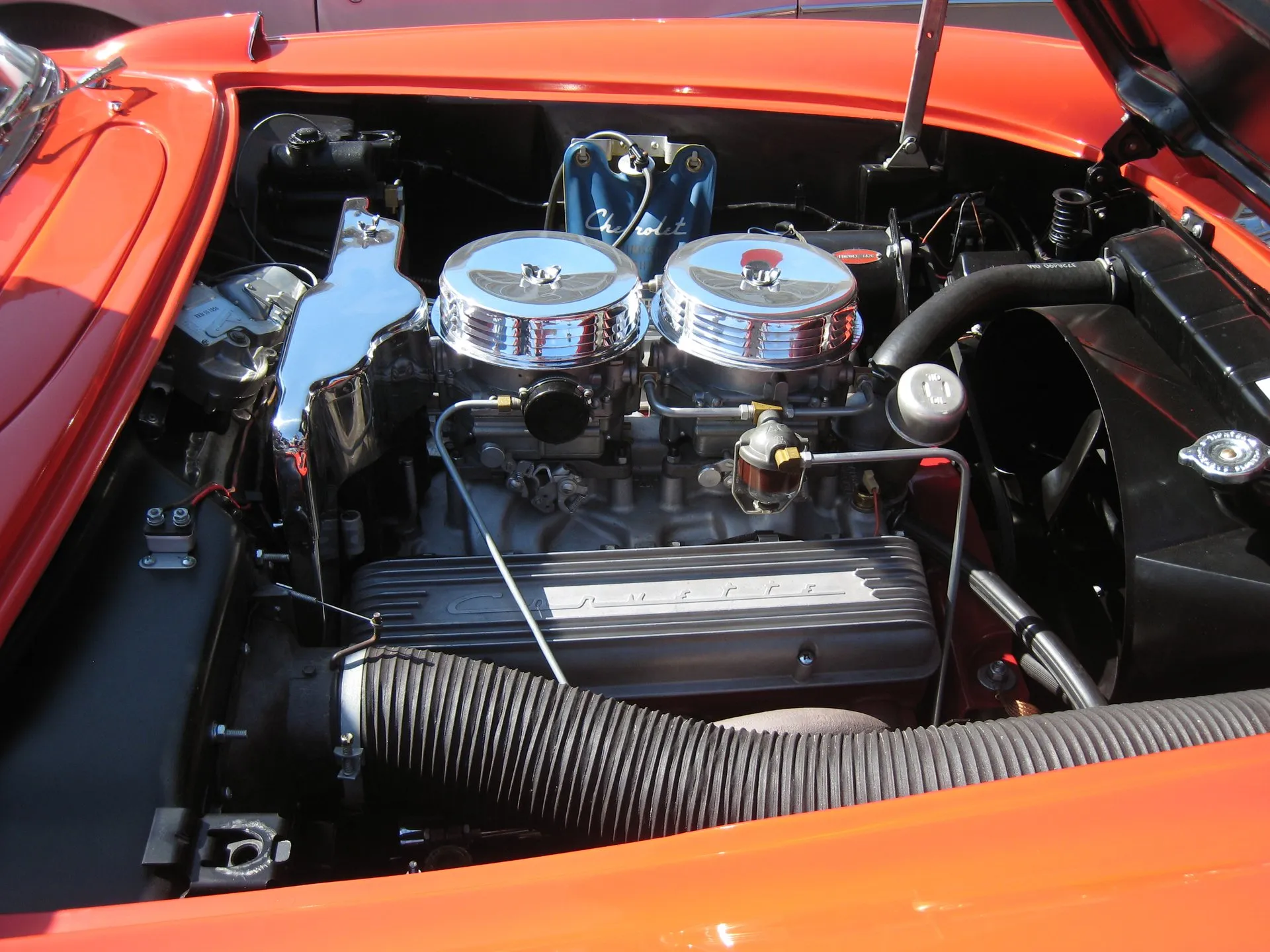
Why so few base cars? For part of the year, at least some dealers couldn’t sell one. But the Milwaukee zone letter (opens in new tab) of April 11, 1956, as Corvette Action Center transcribes it, is one zone writing to its own dealers, and no source found for this guide gives a national date. One owner of 40 years says the first roughly 700 cars were all dual-quad (CorvetteForum, 2022): it fits, but it isn’t GM paper. And buyers kept choosing dual quads, more of them with a Powerglide than a manual.
RPO 449: 111 cars “for racing purposes only”
So the 210 hp car is scarce, but the camshaft car is scarcer. The Black Book says Chevrolet recommended the special high-lift camshaft “for racing purposes only”, that it generally carried no horsepower rating, and that “the accepted, though unofficial, power output of RPO 449 is 240hp” (1956 kit). Its only engine code is a manual one.
In July 2026 Corvette Blogger told of a Polo White RPO 449 car parked in a Missouri basement since the 1980s, its order papers recognized in 2017 by the grandson of the Illinois dealer who sold it. On Bring a Trailer, three cars titled as 265/240s have sold since 2021: $155,000 (November 2021, with a four-speed), $93,500 (December 2022) and $120,000 (July 2023). A fourth was bid to $143,500 in July 2024 and didn’t sell.
Section 03
The 1956 gearboxes: three speeds, never four
GM’s form lists three forward speeds and, for fourth, “None” (1956 kit). Overdrive wasn’t offered.
- Three-speed manual, standard: 2.94, 1.68 and 1.00:1, behind a 10-1/2 in coil-spring clutch.
- Close-ratio three-speed, GM’s optional transmission on the same page: 2.2, 1.31 and 1.00:1. The Black Book’s option list gives it no code, price or count. Ludvigsen’s test car had one.
- Powerglide, the two-speed automatic, RPO 313 at $188.50. The Black Book gives no total, though 1,570 of the dual-quad cars had one.
Axles were 3.70:1 with the manual (3.27 or 4.11 optional, the 3.27 as RPO 471 at no charge) and 3.55:1 with the Powerglide (1956 kit). Positraction, Chevrolet’s limited-slip differential, waited for 1957.
The four-speed 1956. Eleven of the 51 Bring a Trailer listings titled as 1956 Corvettes since June 2019 put “4-Speed” in the title, four of them beside a swapped 283, 327 or 350. Every one of those gearboxes went in later. Wichita’s Chevrolet zone told dealers in a bulletin of October 8, 1957 (opens in new tab) that a kit (GM 3749586, OEM, with selector plate GM 3742510, OEM) “is now available” to fit a four-speed to 1956–1957 three-speed cars. A fair period upgrade, but the car isn’t as it left St. Louis, and its price should say so.
Section 04
Hardtop, power top and the rest of the order form
The Black Book’s option page gives a price and, for most items, a count (1956 kit). Ranked by count:
| Option | RPO | Price | Cars |
|---|---|---|---|
| Two four-barrels, 225 hp | 469 | $172.20 | 3,080 |
| Windshield washers | 109 | $11.85 | 2,815 |
| Courtesy lights | 108 | $8.65 | 2,775 |
| Signal-seeking AM radio | 102 | $198.90 | 2,717 |
| Parking brake alarm | 107 | $5.40 | 2,685 |
| Power folding top | 473 | $107.60 | 2,682 |
| Removable hardtop | 419 | $215.20 | 2,076 |
| Two-tone paint | 440 | $19.40 | 1,259 |
| Power windows | 426 | $64.60 | 547 |
| High-lift camshaft | 449 | $188.30 | 111 |
| Heater | 101 | $123.65 | Not recorded |
| Whitewall tires, 6.70-15 | 290 | $32.30 | Not recorded |
| Powerglide | 313 | $188.50 | Not recorded |
| 3.27:1 axle | 471 | No charge | Not recorded |
GM’s form calls the washer, with its blue vinyl bag, a dealer-installed accessory (1956 kit); the 2,815 is the Black Book’s count of RPO 109.
The hardtop. The factory hardtop came on 2,076 cars, and 629 of them got it in place of the soft top at no charge. It had a curved glass rear window, where the soft top had a flat plastic one (1956 kit), and the Black Book says its anodized header trim was unique to 1956 tops, though some were painted the top’s color. A 1961 top on a 1956 can be legitimate: by June 1961 Chevrolet supplied it as the replacement (Central Office letter 61-613, as Corvette Action Center transcribes it).
The power top. Optional, not standard: RPO 473 at $107.60, on 2,682 cars. Soft tops came in white (1,840), beige (895) or black (103), the light colors as RPO 470 at no charge: 2,838 in all, which is 3,467 less the 629 hardtop-only cars.
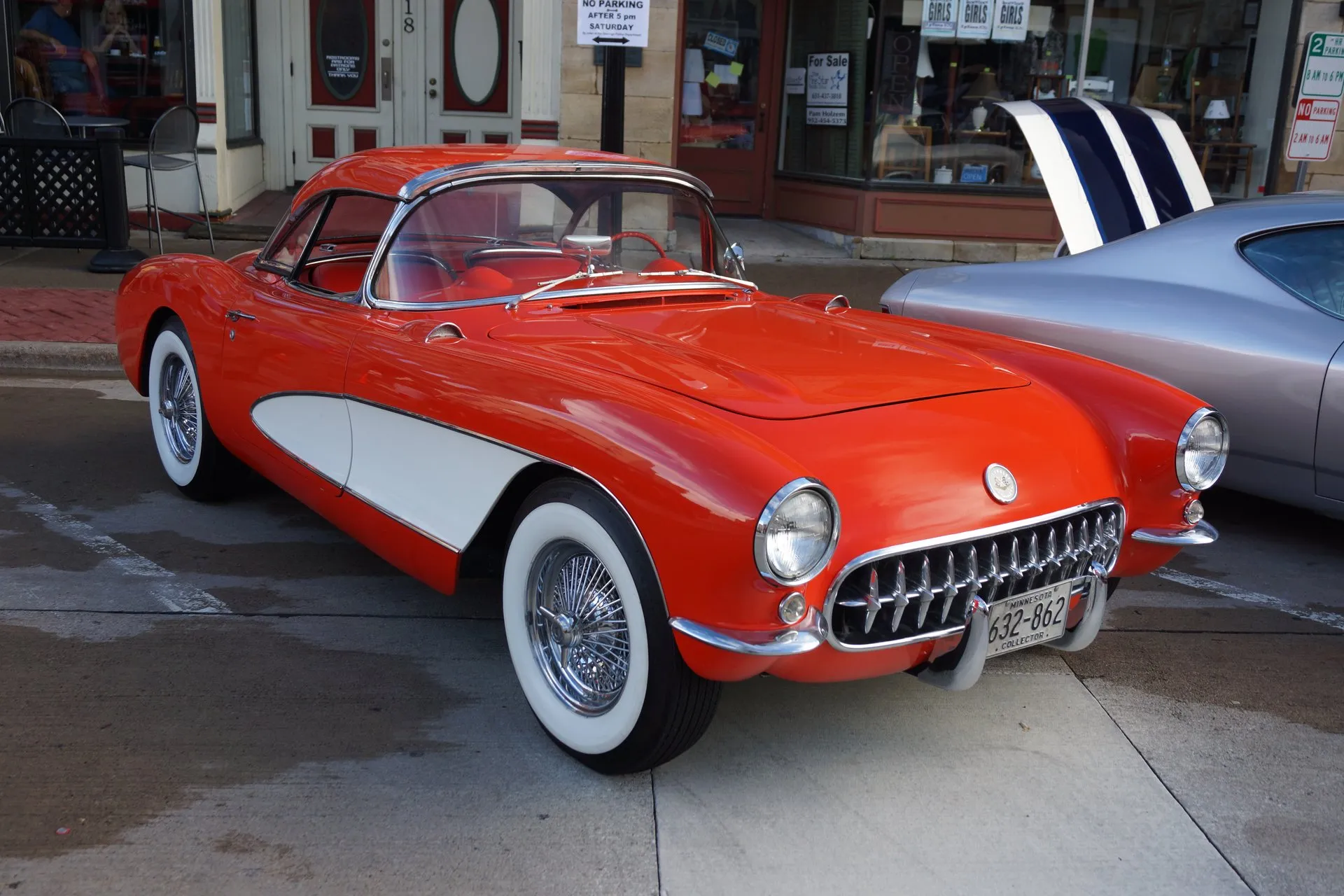
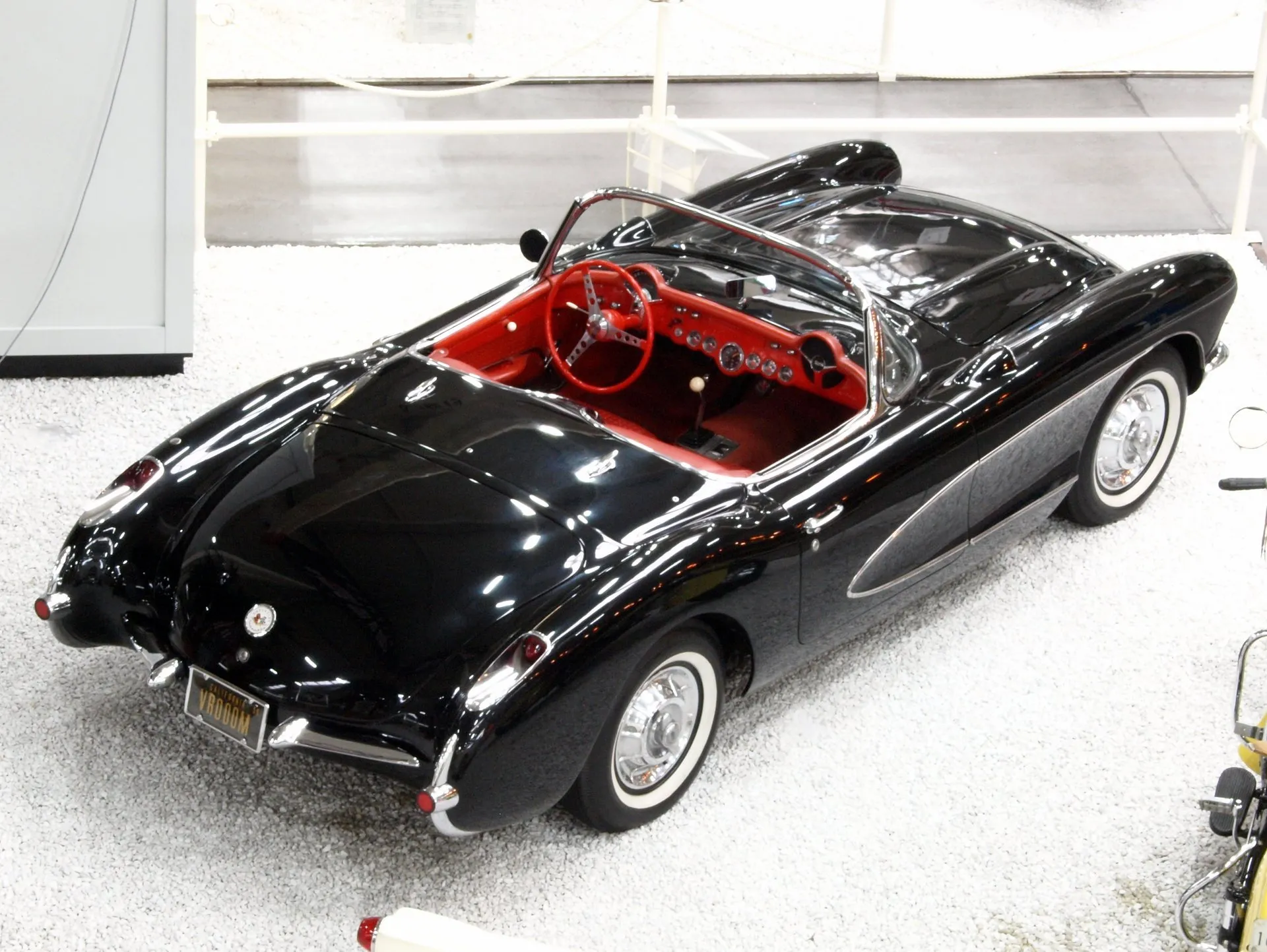
The six colors. Unlike 1955’s estimates, the Black Book’s 1956 color counts come from Chevrolet’s records, and they add up to the year’s 3,467 exactly. A contrasting cove meant two-tone paint, RPO 440, and the Black Book splits those 1,259 cars by color too:
| Color | Cars | Two-tone, cove color | Suggested interior |
|---|---|---|---|
| Venetian Red | 1,043 | 431, beige | Red |
| Onyx Black | 810 | 223, silver | Red |
| Polo White | 532 | 120, silver | Red |
| Aztec Copper | 402 | 166, beige | Beige |
| Arctic Blue | 390 | 172, silver | Beige or red |
| Cascade Green | 290 | 147, beige | Beige |
Interiors were red (2,580) or beige (887). Two-tone came partway through the run: Chevrolet’s Milwaukee zone listed the six combinations as “now available” on March 28, 1956. The Black Book is plain that interiors and exteriors were not coded to individual cars, so nothing on a 1956 records its original color.
Section 05
Sebring, Daytona and the racing parts list
Chevrolet’s internal letters, reproduced by Corvette Action Center, show how it started. Minutes dated December 13, 1955 record a Proving Ground meeting on November 30 with Briggs Cunningham, John Fitch and Zora Arkus-Duntov. Chevrolet’s E. N. Cole wanted “2 or 3 Corvette cars” at Sebring in the stock sports car class. Fitch called the car “a far cry from a competition sport car” next to the foreign ones and asked for a four-speed; Cole said the ZF gearboxes on order hadn’t come, so a three-speed would race.
A letter of January 9, 1956 (opens in new tab) planned at least 25 “2934 S.R.” Corvettes with a Duntov camshaft and Halibrand disc brakes; nothing in the file shows they were built. A memo of February 6 had “our three Corvettes” entered by a Chevrolet dealer and run by Fitch’s organization, so the dealer would insulate the factory from criticism. A March 14 memo lists “S.R.” racing parts, from windscreens to Halibrand hubs.
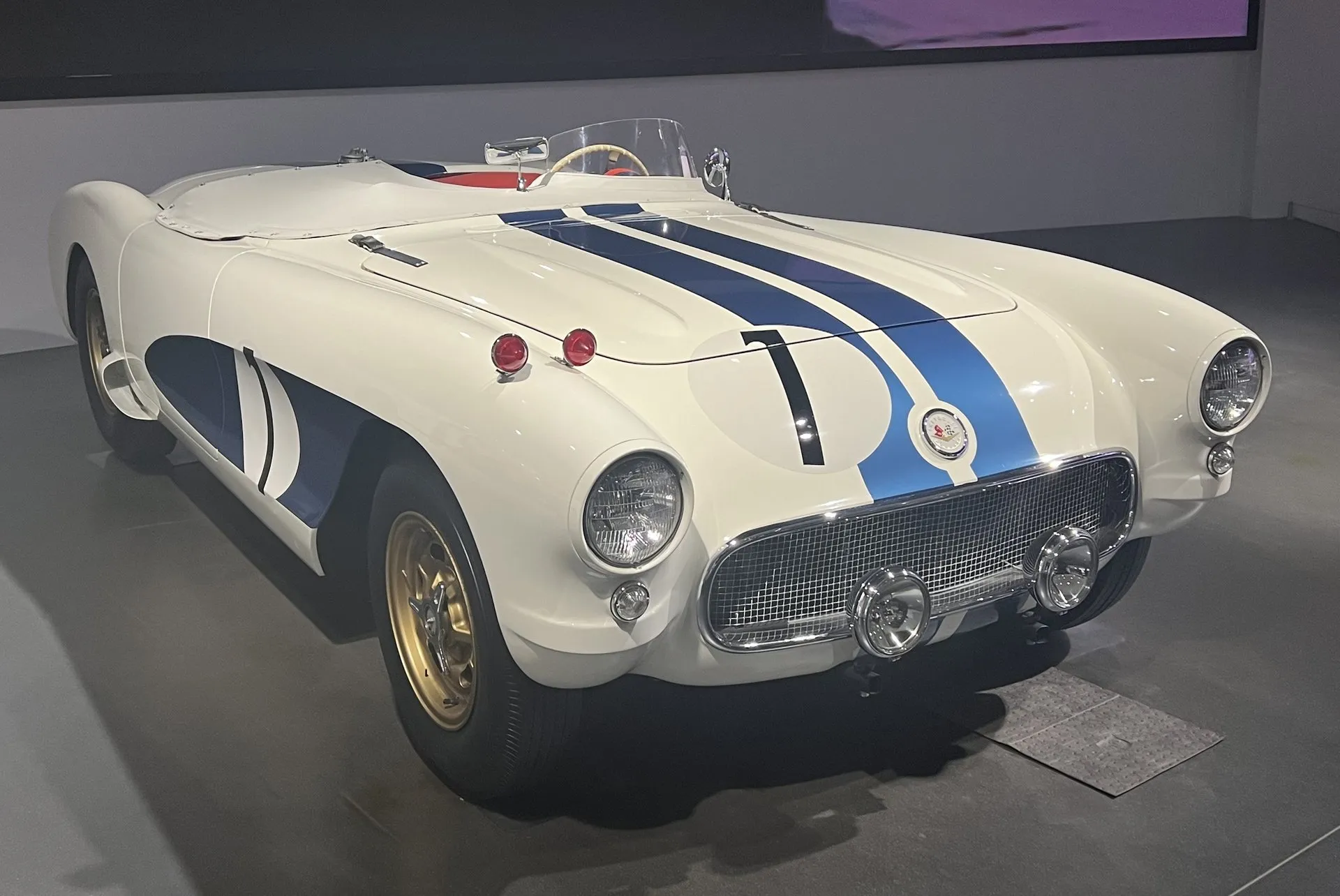
The results come from Chevrolet’s racing partner Pratt & Miller (opens in new tab), writing in 2012. Before Sebring, Duntov ran the flying mile at Daytona Beach at 150.583 mph. At the 12 Hours of Sebring on March 24, 1956, John Fitch and Walt Hansgen finished first in Class B and ninth overall. Chevrolet’s advertising agency built its “The Real McCoy” ads on the result, and the SR racers grew out of the Sebring cars.
No S.R. part made the Black Book’s 1956 option list; the closest a showroom car came is RPO 449, plus the closed breather cap on early cars (see Chevrolet’s 1956 fixes).
Section 06
Proving it’s a 1956: serial, engine pad and the 1957 look-alikes
A 1955 is easy to rule out: no coves, no roll-up windows. A 1957 wears the same body, so the case rests on numbers, small parts and paper.
The serial. 1956 serials run E56S001001 to E56S004467, so car number 426 wears E56S001426 (two posters, CorvetteForum, 2022). One owner says the plate sat on the door hinge pillar from 1956 to early 1960 (CorvetteForum, 2012); the C1 guide covers the frame stamp that should match it. Bulletin DR #265 dates car 2,844 to August 8, 1956.
The engine. A 1956 runs a 265 with a 1956 suffix: FG, FK, GR, GU or GV. The block casting is 3720991 on all of them (1956 kit). Heads are 3725306 (210 and 225 hp) or 3731762 (225 and 240 hp); carburetors are a Carter 2366SA on the base engine and a 2419S in front of a 2362S on the dual quads. Two codes changed meaning the next year: in 1956 FG and FK are 265 Powerglide engines, in 1957 a 245 hp 283 and the 250 hp fuelie. A 1955 used FG and GR too, for its 195 hp 265 (1955 kit). Read the casting with the code.
What a 1956 never had from the factory: fuel injection, a four-speed, Positraction or Inca Silver paint.
The small tells. Painted headlight bezels mark the earliest cars: “very early production” per the Black Book, the first 500 by Mac’s Motor City Garage’s count, around car 400 by one owner’s (CorvetteForum, 2022). The anodized hardtop header trim is 1956-only, and Mac’s says a 1956 adjusts its dash mirror with a thumb screw, a 1957 with a jam nut. Mirrors and trim move between cars; the serial and paper settle it.
The look-alikes. Owners describe 1956s turned into 1957 fuel-injected airbox look-alikes, one in a restorer’s shop (CorvetteForum, 2008), one by its owner (CorvetteForum, 2016–2021).
Paper. C1s carry no trim tag, and 1956 colors and options weren’t coded to the car, so only a window sticker, a dealer invoice or a documented history proves how one was ordered. Without that, one owner says, the original engine and colors are “a guessing game” (CorvetteForum, 2012).
How many survive? Nobody has a reliable count. In 2008 one poster recalled a search a decade earlier estimating about 750, and another pointed to a registry listing 118 (CorvetteForum, 2008).
Section 07
Chevrolet’s 1956 fixes: wander, leaks and fouled plugs
From Chevrolet’s bulletins, as Corvette Action Center transcribed them (the originals weren’t seen for this guide):
- Instability above 60 mph. Bulletin DR #267, October 10, 1956 (opens in new tab), covers serials “E56S 3175 and E56S 4156” (cars 2,175 to 3,156, numbering from 1001). The fix: a new steering idler and third arm (
GM 3733215, OEM), round caster shims (GM 3733479, OEM), tapered shims (GM 3733477, OEM) for more caster, and caster 1-3/4° to 2-3/4°, camber 0° to 1°, toe-in 1/8 in. It applies to the 1957 too. - Water leaks. Bulletin DR #265, October 1, 1956: new side-door weatherstrips entered production on August 8 at E56S0003844, and new seals for the door glass, the soft top header and the hardtop’s roof rails followed at about model change. The 1956 leaked, and Chevrolet said so.
- Fouled plugs on dual-quad cars. Bulletin DR #258, August 30, 1956: city driving wet-fouled the production AC-44 plugs, so Chevrolet called for AC-45 for normal driving and AC-46 for heavy traffic, and set idle at 600 rpm (regular cam) or 800–850 rpm (racing cam). The transcription calls the regular-cam suffix GH where GM’s kit says GR; go by the kit.
- The breather cap. Bulletin DR #263, September 28, 1956: early cars had a closed cap, meant to cut oil pull-over in racing; where breathing problems showed up, the vented cap with gauze (
GM 1552940, OEM) replaced it. - Shift lever seal and tail pipes. Chevrolet Service News, September 1956: a larger seal (
GM 3733482, OEM) cured a Powerglide lever binding at Park or a three-speed jumping out of third, and tail pipe U-bolts set too far forward could hit the axle or brake pipe.
NHTSA, the US road-safety agency, lists no owner complaints (opens in new tab) and no recalls for the 1956 Corvette (checked October 22, 2026). Its complaint records begin in 1994, so that says nothing about the car. Frame rust, rocker supports and stress cracks are in the C1 guide.
Section 08
Inspecting a 1956, paper first
- The paper. Window sticker, dealer invoice, history, judging sheets: nothing else proves colors, options or an RPO 449 car.
- Serial, plate and title. E56S plus a number from 001001 to 004467, matching the frame stamp and the title.
- The engine pad and block. A 1956 suffix that fits the gearbox (GV or GR manual, FK or FG Powerglide, GU for the camshaft car), casting 3720991, and no fresh paint or decking over the stamp.
- Dual-quad parts. A claimed 225 hp car needs the right pair of Carters, the aluminum intake and finned covers; a base car, one four-barrel and steel covers.
- The gearbox. Three forward speeds or a Powerglide. A four-speed was fitted later; price it that way.
- High-speed manners. On a serial from about E56S003175 to E56S004156, ask whether Chevrolet’s idler, shims and alignment are in, then drive it past 60 mph.
- Leaks. Door weatherstrips, the soft top header and, on a hardtop car, the roof-rail seals.
- The hardtop. Anodized header trim suggests a 1956 top; a 1961 top was Chevrolet’s own replacement.
- The power top and windows. Run both.
- Underneath: rear crossmember, rails and rocker supports, by the C1 guide’s checklist, then an inspection by someone who knows C1s.
Section 09
1956 values: Hagerty by engine and six 2026 sales
Hagerty’s price guide (opens in new tab), as archived on January 23, 2026, values a 1956 by engine:
| Engine | Hagerty #3 (Good), January 2026 |
|---|---|
| 265/210, one four-barrel | $48,800 |
| 265/225, two four-barrels | $67,700 |
| 265/240, two four-barrels and RPO 449 | $82,100 |
The plain average, $66,200, is the C1 guide’s 1956 figure, below a 1957 ($77,980). The base car’s $48,800 (up from $46,500 in July 2025) is the lowest figure Hagerty gives any C1, $18,900 under the more common dual-quad car.
Bring a Trailer. In the 12 months to October 22, 2026, Bring a Trailer (opens in new tab) sold seven cars titled as 1956 Corvettes (one more went unsold) at a median of $65,000, from $35,000 to $98,500, by this site’s calculation. Six sold in 2026, at a $67,500 median, and a sample that small needs reading car by car:
- $95,000 (July 28): a base 265 three-speed, 54 years in one family, with NCRS (National Corvette Restorers Society) Top Flight and Bloomington Gold judging awards from the 1980s.
- $65,000 (April 10): a dual-quad 265 with a Powerglide, refurbished in the 1990s.
- $52,617 (August 20): a base 265 three-speed, one family since new, a driver.
- $70,000 (July 5): a dual-quad 265 now with a four-speed, its stamp illegible after decking.
- $35,000 (October 20): a stored project with a 327 fitted in the 1960s, sold with a removed 265 block whose stamp pad is blank.
- $98,500 (September 28): a restomod with a 6.2-liter V8 and a six-speed, a different market.
Only three of the six kept a 265 and a factory-type gearbox, and two of those were base cars. Since June 2019, the eight cars titled as 265/225s have sold at a $79,250 median.
classic.com lumps 1956 and 1957 together ($97,979 average, archived April 2026), pulled up by one $875,000 sale. Titles are a crude screen and auctions favor presentable cars: treat all of it as a snapshot.
Section 10
The verdict: a documented dual-quad car, or the base car for less
The 1956 to buy is a documented 225 hp dual-quad car on a factory gearbox, three-speed or Powerglide. It’s the car most buyers ordered, Hagerty values it at $67,700 in Good condition, and it carries everything new for 1956. Add the factory hardtop with its anodized trim if the budget allows.
The budget path is unusually good. The base car is the scarcer of the two, 387 against about 2,969, yet Hagerty’s cheapest at $48,800, and 2026’s Bring a Trailer sales of base cars ran from $52,617 for a driver to $95,000 for a judged one. Dual quads are the obvious temptation. If they go on, keep the single four-barrel and the steel covers with the car: a documented base car is the scarcer car, and a converted one is only a 225 hp look-alike.
Buy an RPO 449 car only with paper that names it. Skip any “four-speed 1956” priced as original, any car whose serial, frame stamp and title disagree, and any car whose frame fails the C1 guide’s checks.
Get it right and you own the year America’s sports car got roll-up windows, two-tone coves and a run at Sebring. The 1957 guide takes the story on to fuel injection.
Section 11
Sources
- GM Heritage Center: 1956 Corvette vehicle information kit files.zipcorvette.com This site's library. Corvette Black Book pages reproduced by GM: PDF pages 2 (serials, codes, first-year facts) and 4 (options, prices, counts, colors). GM's AMA specification questionnaire, January 6, 1956, revised July 9, 1956: PDF pages 8–31.
- GM Heritage Center: 1955 Corvette vehicle information kit files.zipcorvette.com PDF pages 2–3 (Black Book: 1955 production, prices, colors).
- GM Heritage Center: 1957 Corvette vehicle information kit files.zipcorvette.com What changed for 1957: PDF pages 16, 27 and 29.
- Corvette Action Center: 1957 Corvette production and options (opens in new tab) corvetteactioncenter.com 1957 production (6,339) and base price ($3,176.32), as the 1957 guide gives them.
- NHTSA owner complaints, 1956 Chevrolet Corvette (opens in new tab) api.nhtsa.gov Pulled 2026-10-22: none. NHTSA's complaint file begins in 1994.
- NHTSA recalls, 1956 Chevrolet Corvette (opens in new tab) api.nhtsa.gov Pulled 2026-10-22: none.
- Corvette Action Center: Chevrolet Milwaukee zone letter, mandatory option 469, April 11, 1956 (opens in new tab) corvetteactioncenter.com As transcribed. A letter from one zone to its own dealers.
- Corvette Action Center: Chevrolet Milwaukee zone letter, two-tone paint combinations, March 28, 1956 (opens in new tab) corvetteactioncenter.com
- Corvette Action Center: Chevrolet bulletin DR #267, instability above 60 mph, October 10, 1956 (opens in new tab) corvetteactioncenter.com
- Corvette Action Center: Chevrolet bulletin DR #265, new weatherstrip seals, October 1, 1956 (opens in new tab) corvetteactioncenter.com
- Corvette Action Center: Chevrolet bulletin DR #258, spark plug fouling and idle adjustment, August 30, 1956 (opens in new tab) corvetteactioncenter.com
- Corvette Action Center: Chevrolet bulletin DR #263, crankcase breather cap, September 28, 1956 (opens in new tab) corvetteactioncenter.com
- Corvette Action Center: Chevrolet Service News, September 1956, transmission control lever seal (opens in new tab) corvetteactioncenter.com The same issue on tail pipe supports (opens in new tab).
- Corvette Action Center: Chevrolet bulletin DR #261, solvents on Lucite acrylic lacquer, October 1, 1956 (opens in new tab) corvetteactioncenter.com
- Corvette Action Center: Chevrolet Service News, October 1957, servicing Corvette heavy-duty brakes (opens in new tab) corvetteactioncenter.com
- Corvette Action Center: Chevrolet zone bulletin 108, four-speed conversion kit, October 8, 1957 (opens in new tab) corvetteactioncenter.com Wichita zone. Says a kit "is now available" for 1956–1957 three-speed cars.
- Corvette Action Center: Chevrolet Central Office letter 61-613, 1961 hardtops for earlier models, June 30, 1961 (opens in new tab) corvetteactioncenter.com
- Corvette Action Center: Chevrolet inter-organization letters on racing the 1956 (opens in new tab) corvetteactioncenter.com Meeting minutes of December 13, 1955; letters of January 9 and February 6, 1956; the S.R. options memo of March 14, 1956.
- Car and Driver: 1956 Chevrolet Corvette road test (opens in new tab) caranddriver.com Karl Ludvigsen, Sports Cars Illustrated, May 1956.
- Pratt & Miller: Sebring to celebrate Corvette's racing heritage (opens in new tab) prattmiller.com March 2012. Daytona Beach 1956 and the 1956 Sebring result.
- Mac's Motor City Garage: car spotter's guide to the 1953–1957 Corvette (opens in new tab) macsmotorcitygarage.com Telling a 1956 from a 1957: headlamp rings and the dash mirror.
- Hagerty Price Guide: 1953–1962 Chevrolet Corvette (opens in new tab) web.archive.org Internet Archive copy of January 23, 2026; #3 (Good) values by engine.
- Hagerty: 1956 Chevrolet Corvette (opens in new tab) web.archive.org Internet Archive copy of August 19, 2025; July 2025 value.
- Bring a Trailer: Chevrolet Corvette C1 results (opens in new tab) bringatrailer.com 51 listings titled as 1956 Corvettes, June 2019 to October 22, 2026; sales in the 12 months to October 22, 2026 and in 2026. Medians are this site's calculation from each listing's sold price.
- classic.com: Chevrolet Corvette C1 1956–1957 market (opens in new tab) web.archive.org Archived April 19, 2026. 1956 and 1957 combined.
- Corvette Blogger: 1956 basement find reunited with the selling dealer's family (opens in new tab) corvetteblogger.com July 8, 2026.
- CorvetteForum thread: why so few 1956s (opens in new tab) corvetteforum.com August 2008.
- CorvetteForum thread: what number in production is my 1956 (opens in new tab) corvetteforum.com March 2022.
- CorvetteForum thread: matching VIN and frame numbers (opens in new tab) corvetteforum.com January 2012.
- CorvetteForum thread: 1957 fuel injection emblems (opens in new tab) corvetteforum.com 2016–2021: a 1956 made into a 1957 airbox look-alike.