C1 · Buying guide
1953 Corvette guide: the first 300, what Chevrolet built into them, how to verify one and 2026 prices
Published
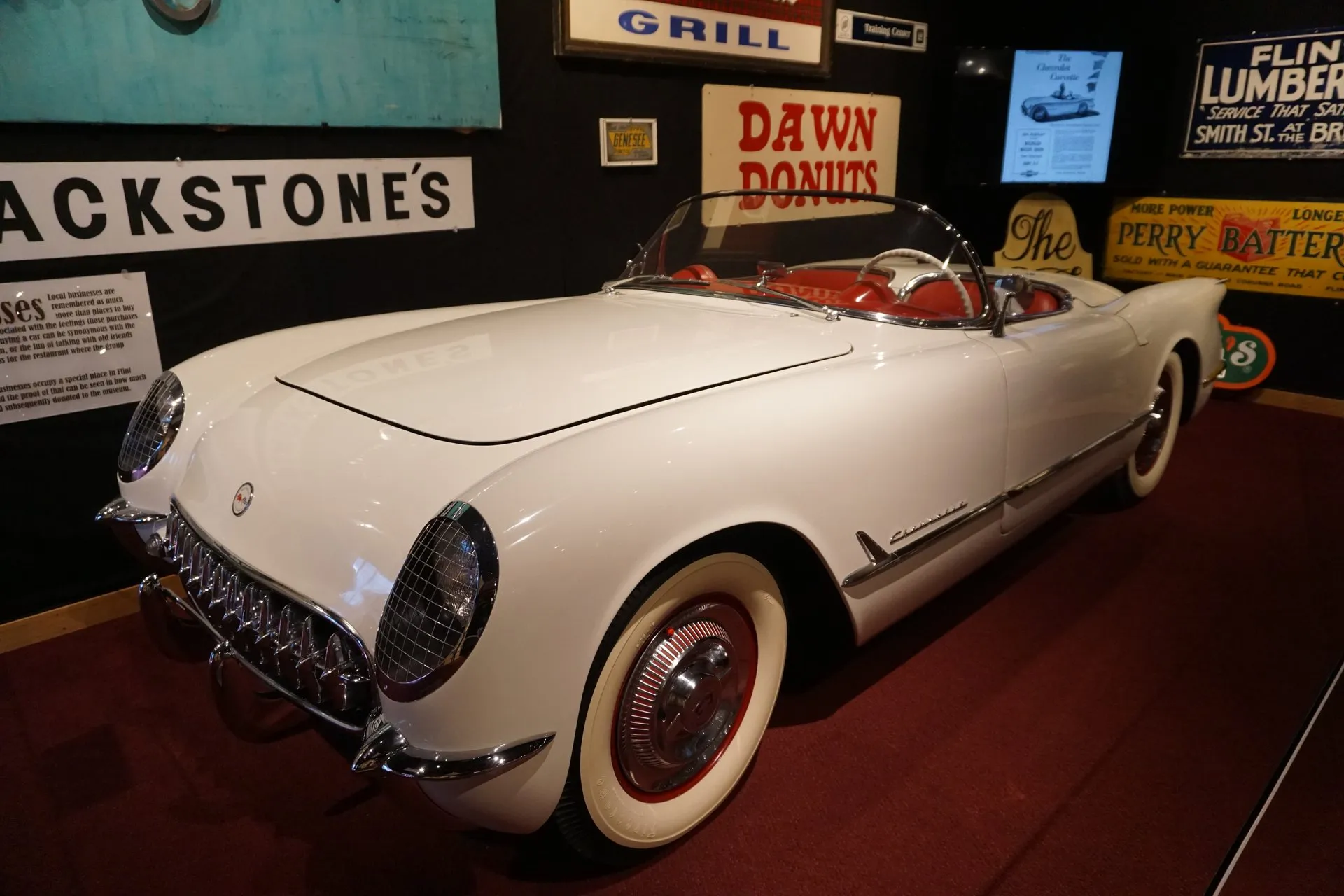
Nobody knows how many 1953 Corvettes are left. Chevrolet built 300, and the counts that followed don’t agree: about 260 “accounted for,” one CorvetteForum poster wrote in 2010; 195 different serial numbers in the profile pages of Corvette Action Center’s owner-submitted online registry, as the Internet Archive kept them from 2016 to 2025; “approximately 225,” says an enthusiast magazine that doesn’t say where its figure comes from. None of them is an audit. What is on paper is the car itself, down to the lacquer, in a specification questionnaire Chevrolet dated November 15, 1953. That sheet, a serial number and a lot of patience are how you buy the first year of the C1 (1953–1962), and of America’s sports car.
- Built: 300, all in Flint, Michigan, starting June 30, 1953. Production moved to St. Louis for 1954.
- What every one had: a 235 cu in Blue Flame six, 150 hp gross, on three carburetors; the two-speed Powerglide automatic only, with no clutch pedal; drum brakes, 6-volt electrics and a fiberglass body.
- Colors: Polo White, red interior, black top, on all 300. No factory 1953 was red or blue, and none had a factory hardtop.
- Price new: $3,498, before the heater and radio.
- What one is worth: Hagerty’s #3 (Good) value was $186,000 (January 2026). On Bring a Trailer, two 1953s sold in the 12 months to October 20, 2026, for $371,000 and $236,000.
- A 1953 Stingray? No. The Sting Ray name reached a production Corvette with the 1963.
The C1 buyer’s guide carries the generation-wide checks: the frame, the fiberglass, how serial tags and engines get faked. Everything here is 1953 only.
C1 Key figures
- Built
- 300, all in Flint
- First car
- June 30, 1953, in Flint, Michigan
- Engine
- 235 cu in Blue Flame six, 150 hp gross
- Transmission
- Powerglide automatic only
- Colors
- Polo White, red interior, black top
- Price new
- $3,498
- Hagerty #3 value
- $186,000 (January 2026)
Section 01
From show car to Flint pilot line, in under six months
The Corvette was a show car first. GM’s Motorama opened at the Waldorf-Astoria in New York on January 17, 1953, then went to Miami, Chicago, Los Angeles, San Francisco, Dallas and Kansas City and drew more than 4 million visitors, by GM’s own account (opens in new tab). GM traces the car to “Project Opel,” begun in 1951, and credits the name to Myron Scott of its public relations staff. Chevrolet’s general manager, Thomas Keating, called it “a sports car in the American tradition.”
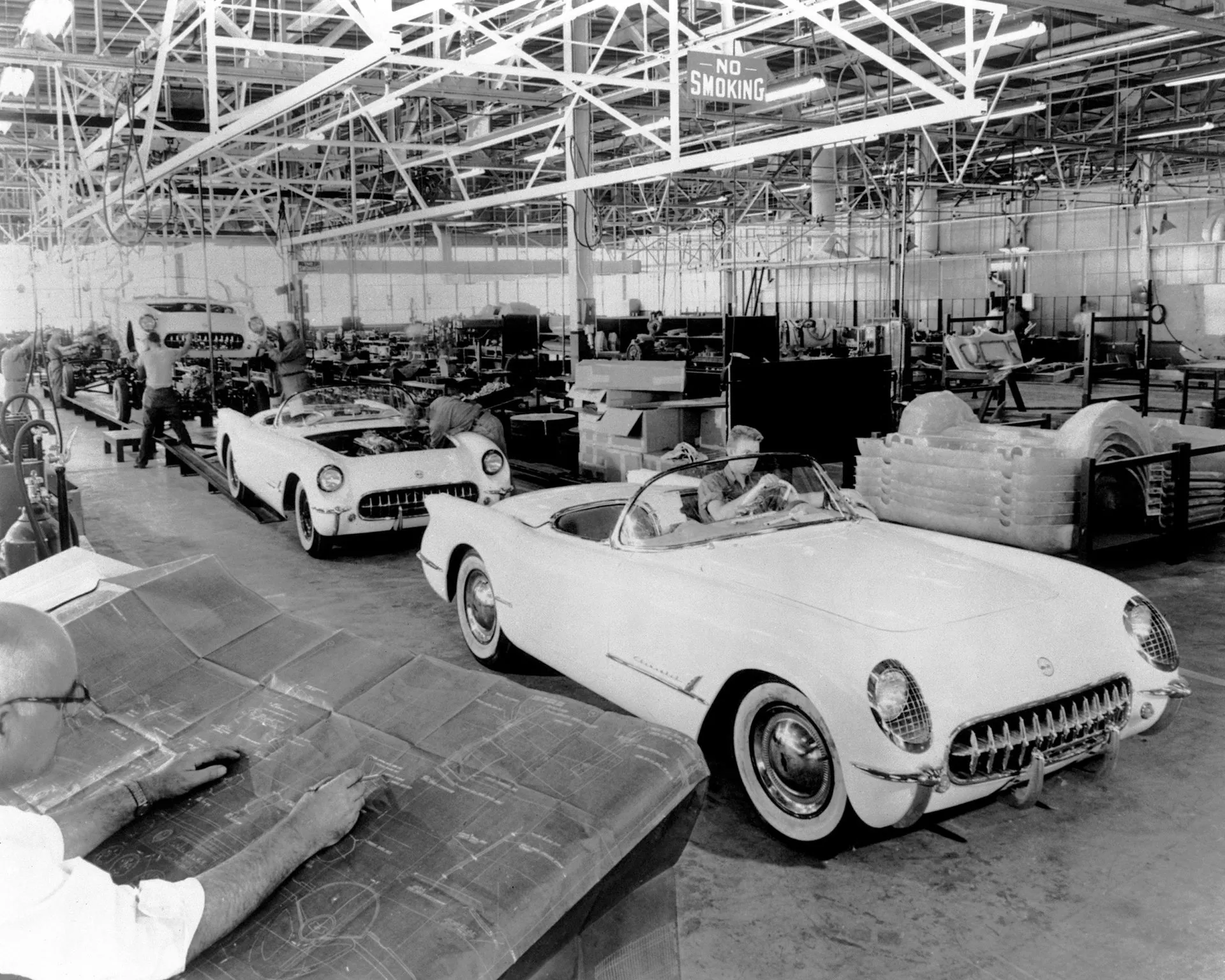
The first production car was built on June 30, 1953, in Flint, Michigan. GM’s heritage collection says all 300 were built “virtually by hand and all on a pilot line” (opens in new tab), and GM’s news site calls the Corvette “the first mass-produced car with a plastic-laminated fiberglass body.” The earliest delivery this guide found is car #5’s, sold new in July 1953 by its Bring a Trailer listing. The Corvette Black Book, a reference GM reprints in part in its 1954 kit, says St. Louis began building Corvettes in December 1953, in a plant designed to build 10,000 a year. It built 3,640 for 1954.
The price was $3,498, about $42,000 today by GM’s own reckoning. Chevrolet’s launch release, by GM’s account, offered the radio and heater as options. Corvette Action Center lists the heater, RPO 101A (RPO is GM’s regular production option code), at $91.40 and the signal-seeking AM radio, RPO 101B, at $145.15, and counts both on all 300 cars. On those figures a 1953 left at $3,734.55, by this site’s arithmetic.
What became of the Motorama car is told two ways. GM’s news site says its chassis went under the 1954 Nomad show car, its body was set on fire in a fiberglass flammability test at GM’s Milford Proving Ground, and a second pre-production car was eventually scrapped. Yet an enthusiast magazine calls a car known as EX-122 the oldest Corvette in the world and the one shown at the 1953 Motorama, and Hagerty names EX-122 as the Motorama prototype too. No GM document read for this guide settles it. Any car sold as “the Motorama car” or “the oldest Corvette” needs its own proof.
Section 02
Chevrolet’s 1953 spec sheet, page by page
GM’s Heritage Center kit for 1953 holds one document: Chevrolet’s Automobile Manufacturers Association specification questionnaire for model 2934, the 1953 Corvette, dated November 15, 1953, 24 printed pages in this site’s owner’s manual library. It has no production, price or color page; those figures come from GM’s news and heritage pages and from Corvette Action Center. The PDF’s first page is blank, so each PDF page number linked here runs one ahead of the printed one.
The six and its three carburetors
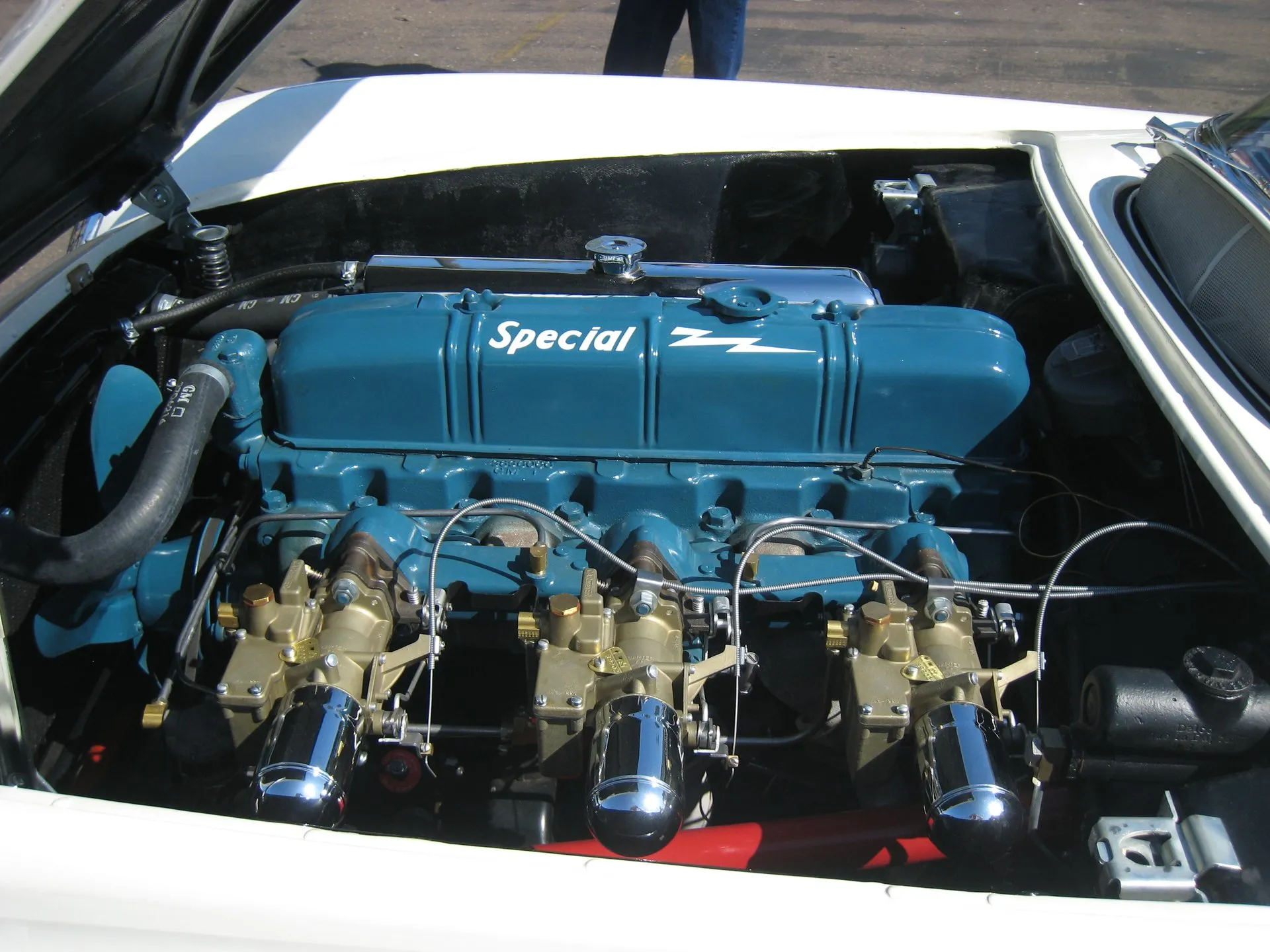
The engine was Chevrolet’s overhead-valve inline six: 235.5 cubic inches, 3-9/16 in bore by 3-15/16 in stroke, 8.0:1 compression, rated 150 bhp at 4,200 rpm and 223 lb-ft at 2,400. That rating is gross, taken with dynamometer exhaust, no fan and the generator not charging (page 3); GM’s 1954 supplement puts the same 150 hp gross at 140 net. The questionnaire never uses the Blue Flame name; GM’s 1954 pages do, and the 1954 supplement calls the engine “basically the same as the Blue Flame-125 passenger car engine,” with higher compression, mechanical tappets, an aluminum timing gear and the three carburetors.
So the first Corvette ran a hot-rodded Chevrolet passenger-car engine, about as American a way to build a sports car as there is. The questionnaire fills in the hardware: three Carter side-draft carburetors, GM number 3706989, with a manual choke, straight-through mufflers with stainless tail-pipe extensions, premium fuel and a 17.25 gallon tank. Lifters are mechanical (page 5), the head is cast alloy iron, and the battery is a 6-volt Delco on the right side under the hood, negative ground.
Powerglide, and nothing else
In the questionnaire’s transmission rows, the conventional and overdrive gearboxes read “N.A.” and the clutch reads “None”. Every 1953 has the Powerglide: a torque converter with gears, a P N D L R selector, ratios from 3.82:1 down to 1:1 in Drive and 3.82:1 to 1.82:1 in Low and Reverse, and a downshift possible up to about 48 mph (page 14). The rear axle is a semi-floating hypoid at 3.55:1. Hagerty puts 0–60 mph at 11.5 seconds, without saying who timed it, and the 108 mph top speed on GM’s news site is the prototype’s. Nobody buys a 1953 for the stoplight.
Chassis: drums, leaves and a 16:1 box
Underneath, the sheet lists conventional hardware for its day. Four-wheel hydraulic drums, 11 in front and rear, with 158 square inches of lining and no booster; 15 x 5K short-spoke disc wheels on five bolts; 6.70-15 four-ply whitewalls, with “No” in the option column (page 16). The frame is full length and welded, with box-section side rails and an I-beam X-member, under independent short-and-long-arm front suspension with coil springs (page 17) and a link-type front stabilizer. Steering is Saginaw, 16.0:1, 3.9 turns lock to lock, through a 17.25 in wheel (page 18). At the back, four-leaf semi-elliptic springs and no stabilizer bar or track bar at all (page 19).
The car sits on a 102 in wheelbase and measures 167.00 in long. GM’s shipping weight is 2,705 lb “Without Radio & Heater,” and without gas or water. The 2,850 lb some guides give is GM’s curb weight for the near-identical 1954 (1954 kit), a different measure.
The body: lacquer, plastic and a hood hinged at the front
Page 24 describes the body: “L-Convertible-2 Door - 2 Passenger,” finished in “Lacquer”, with a one-piece curved windshield, a rear window listed as “Plastic one-piece, flat,” and a hood opening “Front - Reverse Alligator,” hinged at the front, not counterbalanced, with an internal release. There were no roll-up windows. GM’s 1954 supplement describes that year’s side windows as chrome-framed panels that snap into the tops of the doors and ride in the trunk when not in use.
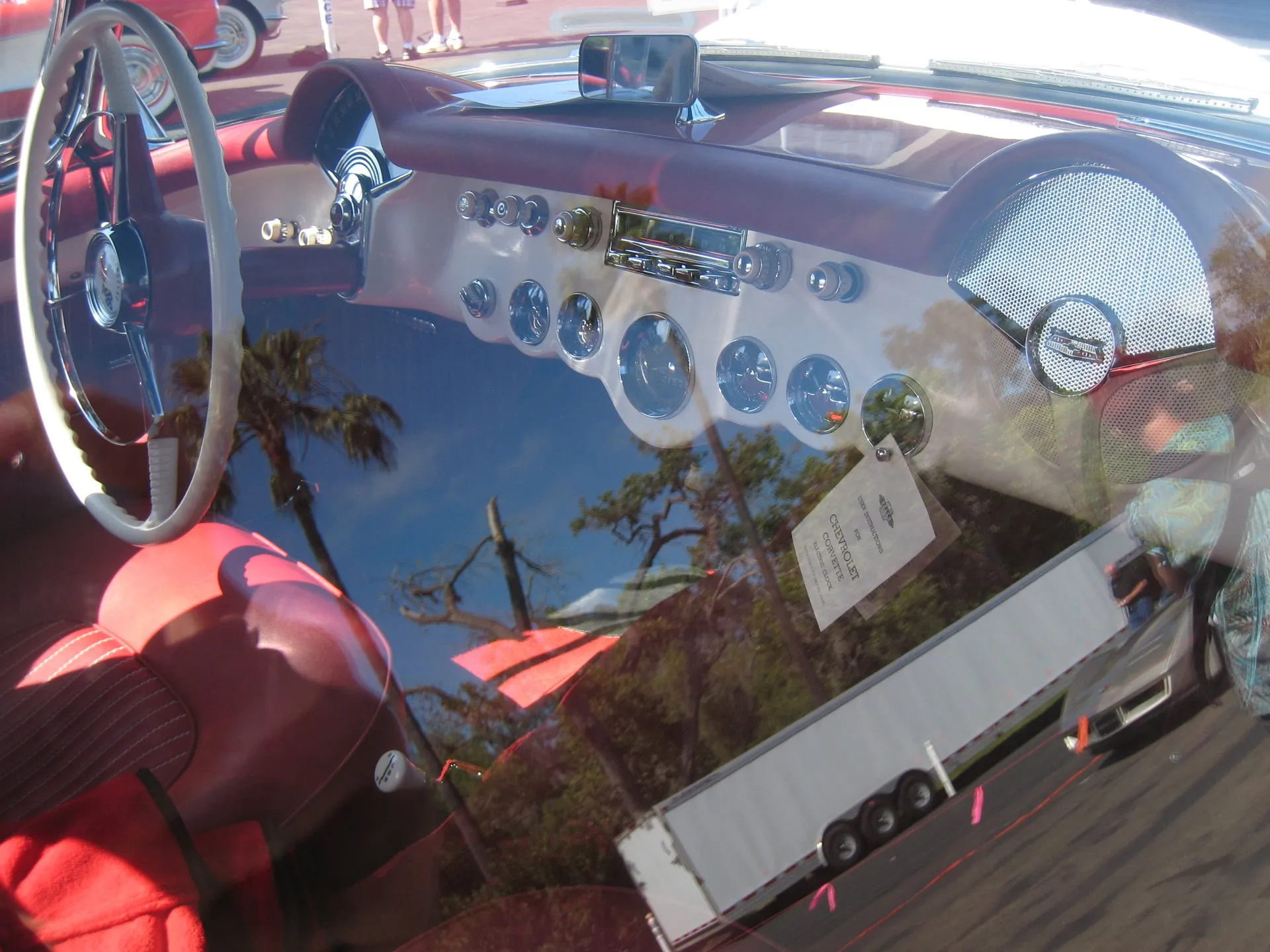
Inside, the questionnaire lists a speedometer with an “AC tachometer with totalizer,” an ammeter, oil and temperature gauges and an electric fuel gauge, with no trip odometer (page 11). The radio and the recirculating heater are marked “Accessory only”. Most of the stock cars’ Bring a Trailer listings describe a 140-mph speedometer and a 5,000-rpm tachometer at the center of the dash.
Section 03
One color for all 300, and what it looked like
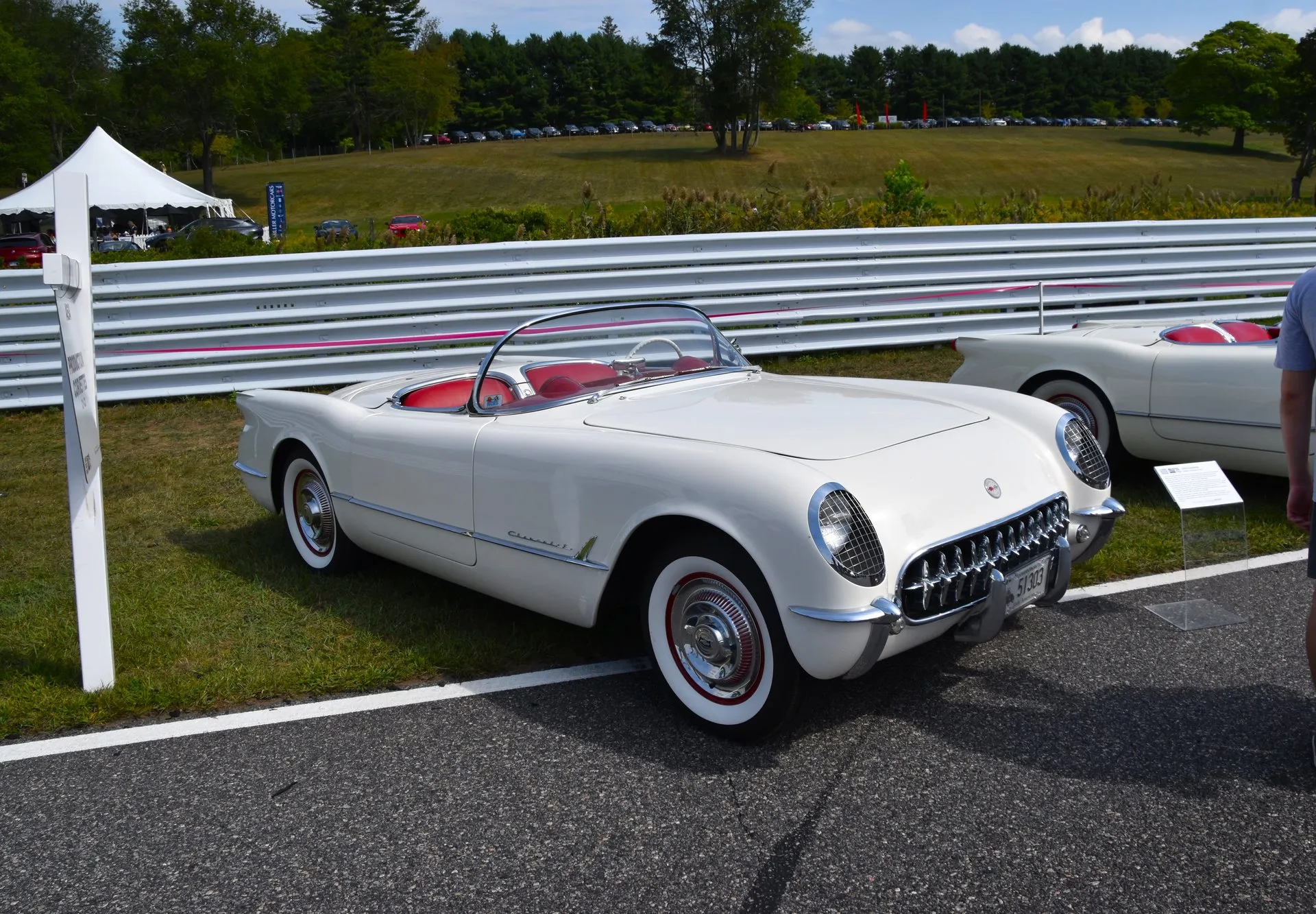
Every 1953 was Polo White, DuPont 1783-H by Corvette Action Center’s listing, with a red interior that GM’s news site calls Sportsman Red. The soft top was black, by Corvette Action Center’s color table and by Mac’s Motor City Garage (opens in new tab), which calls the top “the easiest way, from middle distance” to tell a 1953 from a white 1954. Mac’s also gives every 1953 red-painted wheels.
So a red, blue or black 1953 has been repainted, whatever its seller calls it. A hardtop on one is aftermarket: the Black Book page in GM’s 1954 kit says aftermarket hardtops existed for 1953–1955, and none came from the factory (1954 kit). Chevrolet’s first factory hardtop came for 1956, as the C1 guide explains.
The wheel covers have a story of their own. The first two dozen or so cars, by most accounts, wore Chevrolet passenger-car covers of the 1953 Bel Air type because the Corvette’s own weren’t ready: Mac’s says “approximately 25 cars,” one CorvetteForum poster says about 20 to 25, and the Bring a Trailer listing for car #5 says it got them.
Section 04
1953 or 1954: telling them apart
A 1954 looks nearly the same and costs about a third as much (see What the 300 bring in 2026), so the difference matters. GM’s 1954 kit carries two kinds of page: Chevrolet’s own 1954 supplement, dated April 12, 1954, and reproduced pages of the Corvette Black Book, a reference book, not GM’s.
From Chevrolet’s 1954 supplement (1954 kit):
- The serial. E54S001001 was the first 1954, with S for St. Louis. A 1953 reads E53F, F for Flint.
- The colors. Polo White standard and Pennant Blue optional, with a beige soft top.
- The engine code. YG for 1954. No GM page read for this guide gives the 1953’s.
From the Black Book pages (1954 kit):
- Air cleaners. The three bullet-type inlets were “common to the 1953 model” and stayed on early 1954s; cars later than #002906 got a dual pot-type unit, intended in part to reduce the risk of engine fires.
- Exhaust tips. Short extensions early, longer ones on cars later than #002523.
- The camshaft. A change during 1954 took the rating from 150 to 155 hp; later cams carry three dots between the fifth and sixth inlet lobes.
- Small parts. Most 1953 road draft tubes were smooth, where 1954s had an X stamped, and 1954 brake and fuel lines ran inside the frame except on very early cars.
- The colors, estimated. Polo White 3,230, Pennant Blue 300, Sportsman Red 100 and Black 4, figures the Black Book says are “not from Chevrolet records.”
- The price. Initial 1954 pricing was the same as 1953’s; it dropped to $2,774 only from October 28, 1954.
One CorvetteForum poster adds finer tells: on 1953s and early 1954s, hand-laid cloth body construction, dual hood pulls and three-hole door pulls; on 1953s only, a red parking-brake bracket and the “066” cylinder head, where later cars have the “241.” That’s one owner’s list, not a GM document, and every part on it can be swapped. The serial settles it.
Section 05
Proving a car is one of the 300
On a car worth $186,000 at Hagerty’s #3 and more at auction, the dangerous part isn’t mechanical. It’s a car that isn’t what its paperwork says.
The serial. 1953s run from E53F001001 to E53F001300: E for the Corvette series, 53 for the year, F for Flint, then the sequence from 001001 (Corvette Action Center (opens in new tab)).
Tag, frame and title. The plate, the number stamped in the frame and the title should all agree. No GM page read for this guide gives the 1953’s plate or frame-stamp location. One owner says a 1953’s number is stamped forward of the driver-side rear wheel, on the frame’s kick-up; the C1 guide puts the C1 stamp on top of a frame rail near the X-member. Check both against the NCRS judging guide for 1953, not a seller’s say-so. A frame is where the money hides: a 1954 frame is “a dime a dozen,” one poster says, but a frame with a real 1953 number on it “would be a different story” (CorvetteForum, 2015).
Duplicate serials and reproduction tags. In a 2009 Corvette Action Center thread, two cars claimed the same 1953 serial. One poster there, who says he has made tags, says a new tag that matches the original title and frame number is “completely legal in many states,” and anything else is fraud. In a 2021 CorvetteForum thread, an early C1 on a state-issued VIN had a frame stamp matching a tag on a car sold elsewhere, and posters walked through the DMV and theft-task-force route for sorting it out. A state-issued VIN on a 1953 is a long story, and its price should show it. Without a tag at all, one owner says, a car “is a recreation of either” year.
The engine. Corvette Action Center lists the 1953 engine suffix as LAY on all engines, block 3701481 as the first design and 3835911 as the second, and head 3836066. Owners agree on the order and disagree on how late the 911 block came in: in a 2010 thread, one calls it “questionable” on a 1953 and acceptable only on a very late car, and another says it’s correct for late 1953s. The same thread warns that a 3835913 head is a truck head, and that every 911 block used in a Corvette was cast and assembled in Flint, so a T in the stamp, for Tonawanda, means a replacement.
The pad. NCRS (the National Corvette Restorers Society) judges 1953–1976 engine pads bare: “A painted, or otherwise obscured engine pad is an automatic 38 point deduction” (opens in new tab). Ask why any pad is painted. NCRS calls making an imitation with intent to deceive counterfeiting; restoring a car to factory original isn’t. Its Top Flight award, which two of the Bring a Trailer cars in What the 300 bring in 2026 carry by their listings, needs 94 percent of 4,500 points in judging.
Replicas and kit cars. They exist, often on modern frames, and owners rate them low: “Peanuts. They’re just another kit car,” one poster answered when asked what a 1953 kit car is worth (CorvetteForum, 2010). Bring a Trailer sold two titled as replicas, a 283-powered car at $34,750 in August 2025 and a turbocharged V6 car at $50,000 in May 2026. A replica is a fine way to drive the shape; a listing that blurs it with a real 1953 is the one to walk from.
Section 06
What the records hold: no recalls, a dealer letter and Duntov’s memo
NHTSA, the US road safety agency, lists no complaints and no recalls (opens in new tab) for the 1953 Corvette (both checked October 20, 2026). That proves nothing about the cars: NHTSA’s complaint file starts in September 1994, and its bulletin files hold no GM bulletin for any Corvette before the 1984 model year.
Chevrolet’s own paper from the time says more. On December 18, 1953, Chevrolet’s Louisville zone sent dealers a repair manual for the plastic body, because the Corvette was reaching more of them. The zone letter (opens in new tab), Z-22-194, as Corvette Action Center transcribes it, says “the plastic body is entirely new in the automotive field,” and names a repair kit, GM 3708438 (OEM).
Then there’s the engineer’s verdict. On March 29, 1954, Zora Arkus-Duntov sent Maurice Olley a summary report on the Corvette’s handling and ride (opens in new tab), again as Corvette Action Center transcribes it. He listed oversteer at high cornering loads, “tail lurch,” slow roll recovery, axle tramp in rough turns, a “harsh and choppy ride,” and sensitivity to crosswinds with the wheel fighting back at speed. His test car was cured largely by a front stabilizer of about 0.843 in and changes to the rear springs and caster, which were to be tried on “a production 1953 or 1954 Corvette.” The memo doesn’t say a production change followed, so it’s no evidence a given car got one. What it is: a Chevrolet engineer listing, in writing, what the first Corvette did wrong.
The rest of a 1953’s problems are the generation’s, from frame rust to fiberglass cracks and leaky tops, and the C1 guide covers them.
Section 07
How many survive, and the cars nobody can place
The three estimates in this guide’s opening count different things. The 260 is one owner’s tally of cars “accounted for.” The 195 are serials in a registry owners joined themselves, so a car whose owner never signed up isn’t there. The 225 has no stated source at all. What can be counted: Corvette Action Center records 53 1953s gathered at Corvettes at Carlisle in 2003, for the 50th anniversary.
The first cars are murkier still. An online registry page quotes a dealer’s 2002 claim that cars 1 and 2 “are presumed to be destroyed” and that cars 3 to 13 went to GM executives or to styling, testing and the Motorama. The enthusiast magazine says two of the 300 were destroyed as engineering test cars, and a social media post’s headline says car 001 has been found. This guide found no GM or NCRS record that settles any of it. A seller with “car #1” or “#2” needs documents, not a story.
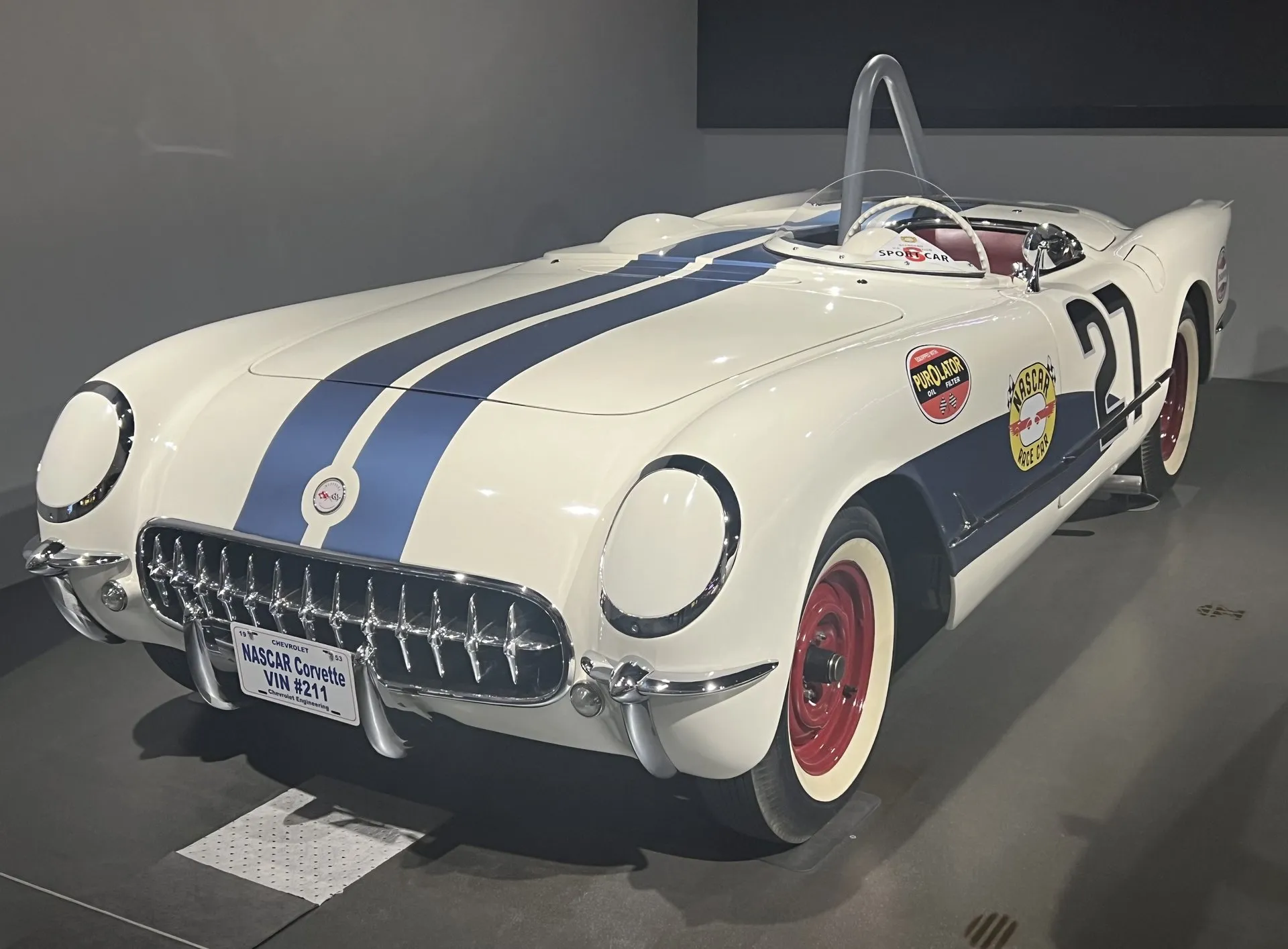
Some 1953s aren’t stock and never will be again. Car #211, shown at the Petersen Automotive Museum in 2024, raced at Daytona Beach, and Corvette Action Center says Chevrolet Engineering later reclaimed it and fitted a 1956 dual-four-barrel engine, a close-ratio three-speed and a stock-car rear axle. Its history is the value. On almost any other 1953, a change from stock costs money.
Section 08
Before you wire money for a 1953
- The serial, first. E53F001001 to E53F001300, on a tag, in the frame and on the title, all the same number. Any mismatch stops the deal until it’s explained on paper.
- The stamp’s location and the tag’s attachment, against the NCRS judging guide for 1953.
- A state-issued VIN or a reproduction tag. Ask why, get the history, and price the car accordingly.
- The year tells: a black top, bullet air cleaners, short exhaust tips and an E53F serial. They back up the serial; they never replace it.
- The engine: an LAY suffix by Corvette Action Center’s listing, a 3701481 or late 3835911 block, Flint casting, no Tonawanda T, a bare pad, and casting dates on the block, transmission and axle that fit a 1953.
- The Powerglide and the 3.55 axle. A manual gearbox or a V8 in a 1953 isn’t original, however well done.
- The color. Polo White with a red interior, or a repaint.
- Paperwork: a dealer invoice, NCRS judging sheets, registry records and owner history.
- The generation’s checks, from the C1 guide: the frame on a lift, the fiberglass, the front end.
- An inspection by an NCRS judge or a C1 specialist who has seen early cars before you wire money.
Section 09
What the 300 bring in 2026
Hagerty. Hagerty’s price guide (opens in new tab), as archived on January 23, 2026, put a 1953 in #3 (Good) condition at $186,000, the highest figure for any C1. Its 1954 figure was $63,650, the plain average of the 150 hp car ($61,800) and the 155 hp car ($65,500), as the C1 guide explains. Hagerty Media wrote in June 2025 that a 1954 was worth less than half a 1953 in #2 (Excellent) condition, $107,000 against $254,000, because ten times as many were built. Values may have moved since.
Bring a Trailer. The sample is tiny. From March 2023 to August 2026, eight real 1953s were offered there, each a different car; five sold, by this site’s count from each listing:
| Sold | Car | Price |
|---|---|---|
| March 19, 2023 | #291 | $201,000 |
| April 7, 2023 | #227, NCRS Regional Top Flight per the listing | $220,000 |
| September 7, 2024 | #154, LS1 V8 restomod | $130,000 |
| December 16, 2025 | #61, refurbished in 2003 per the listing | $371,000 |
| April 16, 2026 | #46, NCRS Top Flight in 2003 per the listing | $236,000 |
Three others were bid to a figure and didn’t sell: $410,000 for car #5 in April 2025, $162,000 in February 2026 and $243,000 in August 2026. In the 12 months to October 20, 2026, that’s two sales, at $371,000 and $236,000, and two cars unsold. The four stock-titled 1953s sold since 2023 brought a median of $228,000, from $201,000 to $371,000. With so few sales, one car moves the median a long way: read these as single results, not a market average.
What it adds up to. A stock, documented 1953 has sold for about $200,000 to $370,000 since 2023, a restomod built on one well under that, and a replica a fraction of it. On this evidence, under $100,000 buys a good 1954 or a replica, not a real 1953.
Section 10
Verdict: buy the serial, then the car
The 1953 to buy is a stock car whose tag, frame stamp and title agree, with an engine that fits the year and a paper trail behind it: a dealer invoice, NCRS judging, a registry history. The two highest Bring a Trailer sales came with a refurbishment or Top Flight history in their listings. Pay for the documents before the paint: a tired car with proof can be restored, and a shiny one with only a story can’t be proven.
Skip any 1953 without a tag, any whose numbers don’t agree, and any restomod priced like a stock car. If what you want is the shape and the six and a car you can drive without a lawyer’s file, the budget path is a 1954: the same look for about a third of the money at Hagerty’s #3 values. The C1 guide and the best Corvette years guide both name it the early C1 to buy, and leave the 1953 to collectors.
Get a real one and you own one of 300 cars built by hand in Flint, the first chapter of the story the Corvette generations guide tells. The V8 came for 1955, fuel injection and the four-speed for 1957, quad headlights for 1958, and seventy-odd years of America’s sports car after that.
Section 11
Sources
- GM Heritage Center: 1953 Corvette vehicle information kit files.zipcorvette.com This site's library. Chevrolet's AMA specification questionnaire for the 1953 Corvette, model 2934, dated November 15, 1953: PDF pages 2–25 (general data page 2, engine page 3, fuel system page 7, electrics page 9, instruments page 11, accessories page 12, transmission pages 13–14, axle, wheels and brakes page 16, frame page 17, steering page 18, rear springs page 19, body page 24). PDF page numbers run one ahead of the printed ones.
- GM Heritage Center: 1954 Corvette vehicle information kit files.zipcorvette.com PDF pages 2 and 4 (reproduced Corvette Black Book pages: what changed for 1954, prices, color estimates) and 8–9 (Chevrolet's 1954 Corvette supplement of April 12, 1954: serials, colors, weights, side windows, the engine).
- GM News: Retro Rides, the 1953 Chevrolet Corvette (opens in new tab) news.gm.com Eric J. Savitz, October 17, 2025. Motorama, the tour, Project Opel, the name, the fiberglass body, the launch release, the show car's fate. Read via the Internet Archive's June 2026 copy (opens in new tab).
- GM Heritage: 1953 Chevy Corvette (opens in new tab) gm.com The pilot line, the first production car, the price. Read via the Internet Archive's April 2026 copy (opens in new tab).
- Corvette Action Center: 1953 Corvette production and performance (opens in new tab) corvetteactioncenter.com Price, the heater and radio options and counts, colors and paint number. Read via the Internet Archive's January 2026 copy (opens in new tab).
- Corvette Action Center: 1953 Corvette identification numbers (opens in new tab) corvetteactioncenter.com Serial range, engine suffix, block, head and carburetor numbers. Read via the Internet Archive's January 2026 copy.
- Corvette Action Center: 1953 Corvette tech center and registry (opens in new tab) corvetteactioncenter.com The owner-submitted 1953 registry (its archived profile pages, captured 2016–2025, hold 195 different serial numbers, by this site's count), the 2003 gathering at Carlisle and car #211's racing history. Read via the Internet Archive's July 2026 copy.
- Corvette Action Center: Chevrolet zone letter on Corvette body repair, December 18, 1953 (opens in new tab) corvetteactioncenter.com Zone letter Z-22-194, Louisville zone, as Corvette Action Center transcribes it.
- Corvette Action Center: Duntov's summary report on Corvette handling and ride, March 29, 1954 (opens in new tab) corvetteactioncenter.com Chevrolet inter-organization letter, Zora Arkus-Duntov to Maurice Olley, as Corvette Action Center transcribes it.
- Mac's Motor City Garage: car spotter's guide to the 1953–1957 Corvette (opens in new tab) macsmotorcitygarage.com The black 1953 top against the 1954's beige, the early passenger-car wheel covers, the bullet air cleaners.
- vette-vues: the rare 1953 Corvette (opens in new tab) vette-vues.com An enthusiast magazine's survivor estimate and its account of the EX-122; neither is sourced there.
- NCRS: judging awards (opens in new tab) ncrs.org Judging guidelines from 1953 on, the engine pad rule and its 38-point deduction, Top Flight at 94 percent of 4,500 points, and NCRS's definition of counterfeiting. Fetched October 2026.
- NHTSA owner complaints, 1953 Chevrolet Corvette (opens in new tab) api.nhtsa.gov Pulled October 20, 2026. None on file.
- NHTSA recalls, 1953 Chevrolet Corvette (opens in new tab) api.nhtsa.gov Pulled October 20, 2026. None listed.
- Hagerty Price Guide: 1953 Chevrolet Corvette (opens in new tab) hagerty.com The page's description of the 1953, its 0–60 mph time and the EX-122. Read via the Internet Archive's September 2025 copy (opens in new tab).
- Hagerty Price Guide: 1953–1962 Chevrolet Corvette (opens in new tab) web.archive.org Internet Archive copy of January 23, 2026; #3 (Good) values for 1953 and 1954.
- Hagerty Media: the best Corvettes per dollar, C1 to C7 (opens in new tab) hagerty.com Andrew Newton, June 4, 2025. The 1954's #2 (Excellent) value against the 1953's.
- Bring a Trailer: Chevrolet Corvette C1 results (opens in new tab) bringatrailer.com 1953 listings only, March 2023 to August 2026: eight real 1953s (five sold, three bid to a figure and not sold) and two replicas. Medians are this site's calculation from each listing's sold price.
- CorvetteForum thread: difference in 1953 and 1954 Corvettes (opens in new tab) corvetteforum.com November 2019 to October 2020. One owner's list of differences.
- CorvetteForum thread: 1953 engine block and head (opens in new tab) corvetteforum.com January 2010.
- CorvetteForum thread: updates on 1953 #18 (opens in new tab) corvetteforum.com August to September 2010.
- CorvetteForum thread: a fake C1 (opens in new tab) corvetteforum.com May to June 2021.
- CorvetteForum thread: value of a 1954 Corvette frame (opens in new tab) corvetteforum.com May 2015.
- CorvetteForum thread: 1953 Corvette parade car hubcaps (opens in new tab) corvetteforum.com 2010–2012.
- CorvetteForum thread: 1953 Corvette kit cars (opens in new tab) corvetteforum.com December 2010.
- Corvette Action Center thread: two cars, one 1953 serial (opens in new tab) forums.corvetteactioncenter.com October 2009.