C2 · Buying guide
1964 Corvette Sting Ray: one-piece glass, the 365 and 375 hp 327s, how to verify one and 2026 prices
Published
Chevrolet’s racing package, RPO Z06, had been “initially released for the 1964 model Corvette,” its Harrisburg zone office told dealers on January 2, 1964. Then came the admission: the “contemplated design modification and refinements did not materialize.” So, “in line with customer and dealer requests,” Chevrolet split the package’s brakes and suspension (opens in new tab) into two options. Twenty-nine cars got the $629.50 J56 brakes. Eighty-two got the $37.70 F40 suspension.
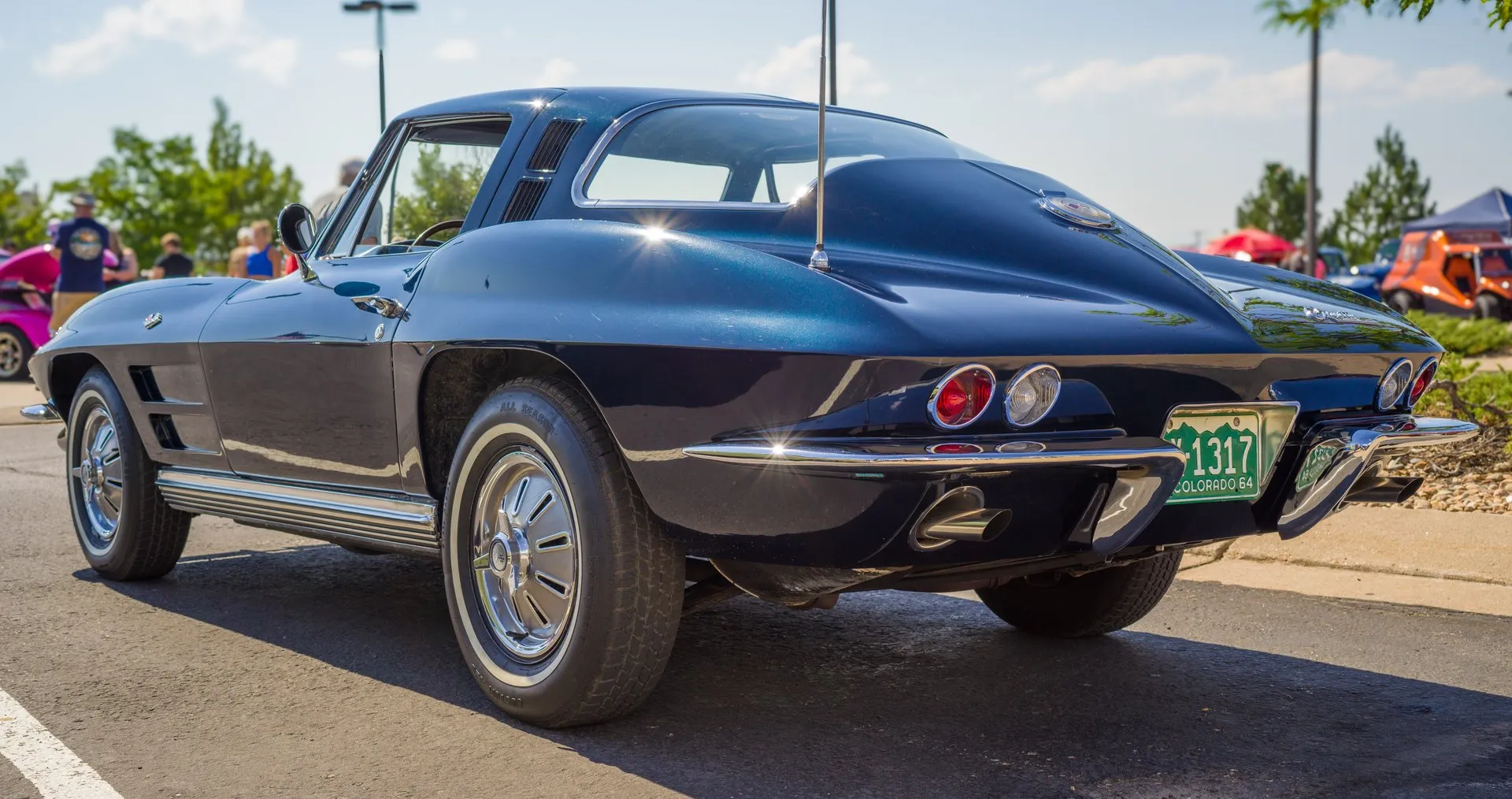
That’s the 1964 in small: the second year of the C2 (1963–1967), where GM fixed, split, tidied and re-rated rather than reinvented. Its own shop manual supplement says the 1964 would “remain basically the same as the 1963 models except for minor styling changes and product improvements.” The improvements mattered: one-piece rear glass, 365 and 375 hp at the top of the engine list, new gearbox ratios and new body mounts. And on 2026 auction results, it’s the cheapest Sting Ray to buy.
- How many were built: 22,229, made up of 8,304 coupes and 13,925 convertibles. Coupes fell from 10,594 in 1963 while convertibles rose.
- Engines: four 327s from 250 to 375 hp, all gross ratings. The 375 hp L84 was fuel-injected, on 1,325 cars.
- Price new: $4,252 coupe, $4,037 convertible, on GM’s December 2, 1963 list, the same as the 1963.
- Split window: none from the factory. Every 1964 coupe left St. Louis with one-piece glass.
- What one costs: a median of $60,500 on Bring a Trailer for 21 titled-stock sales between January 1 and October 22, 2026.
- The generation’s rust, judging and the other four years: in the C2 buyer’s guide.
C2 Key figures
- Built
- 22,229
- Coupes, convertibles
- 8,304 coupes and 13,925 convertibles
- Engines
- four 327s from 250 to 375 hp
- Price new, Dec. 1963
- $4,252 coupe, $4,037 convertible
- Fuel-injected cars
- 1,325
- Coupe curb weight
- 3,125 lb
- Median sale, 2026
- $60,500 on Bring a Trailer
Section 01
One-piece glass and a one-year hood: what GM changed
GM’s 1964 shop manual supplement puts the headline plainly: “The pillar dividing the rear window has been removed and a new, one piece rear window has been added to improve rear visibility.” The 1963 remains the only factory split window, so a 1964 with one is a conversion (see Reading a 1964’s numbers, and the fakes).
The rest, per the Corvette Black Book page reproduced in GM’s 1964 Heritage Center kit (the Black Book is a hobby reference), Corvette Action Center and Hagerty:
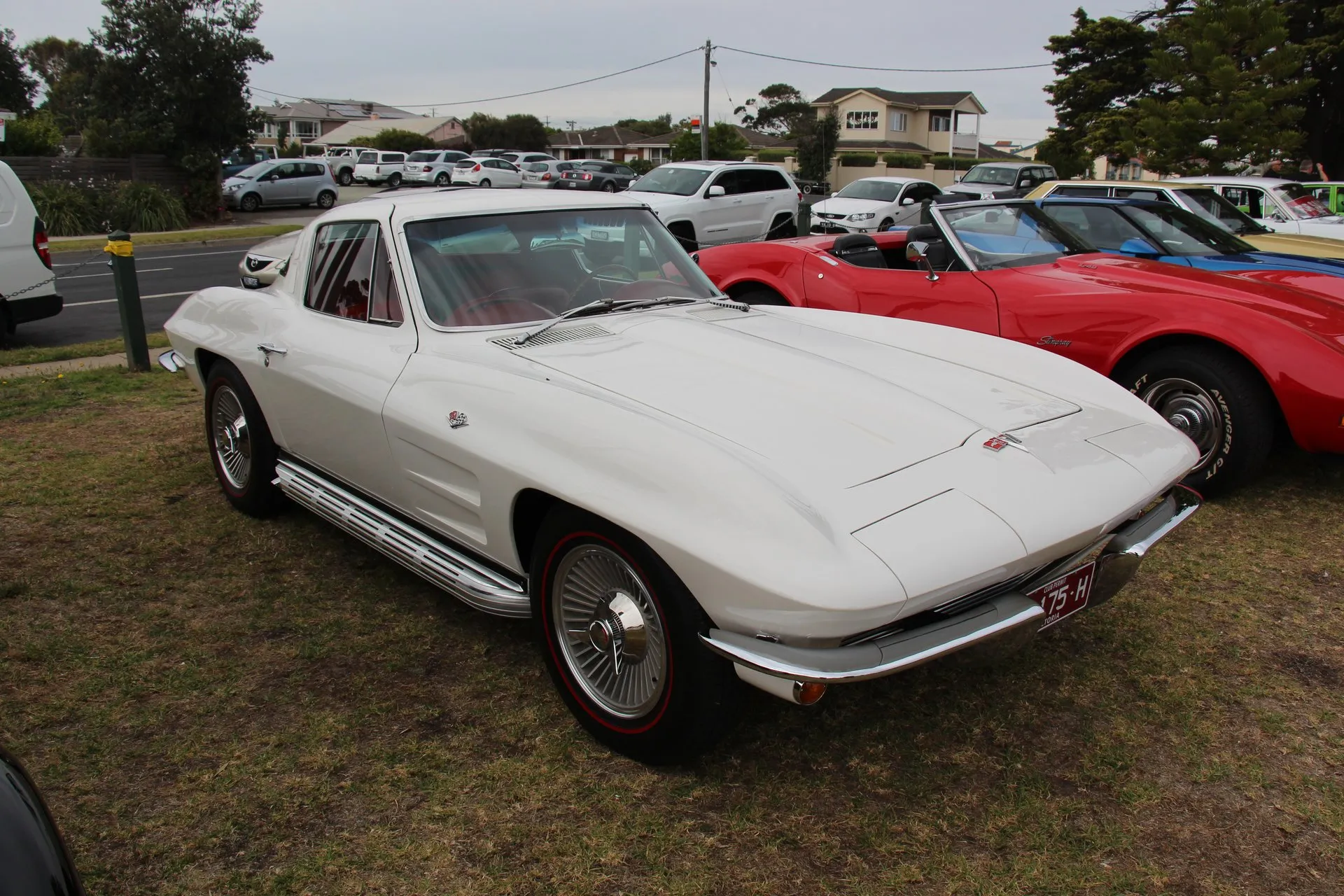
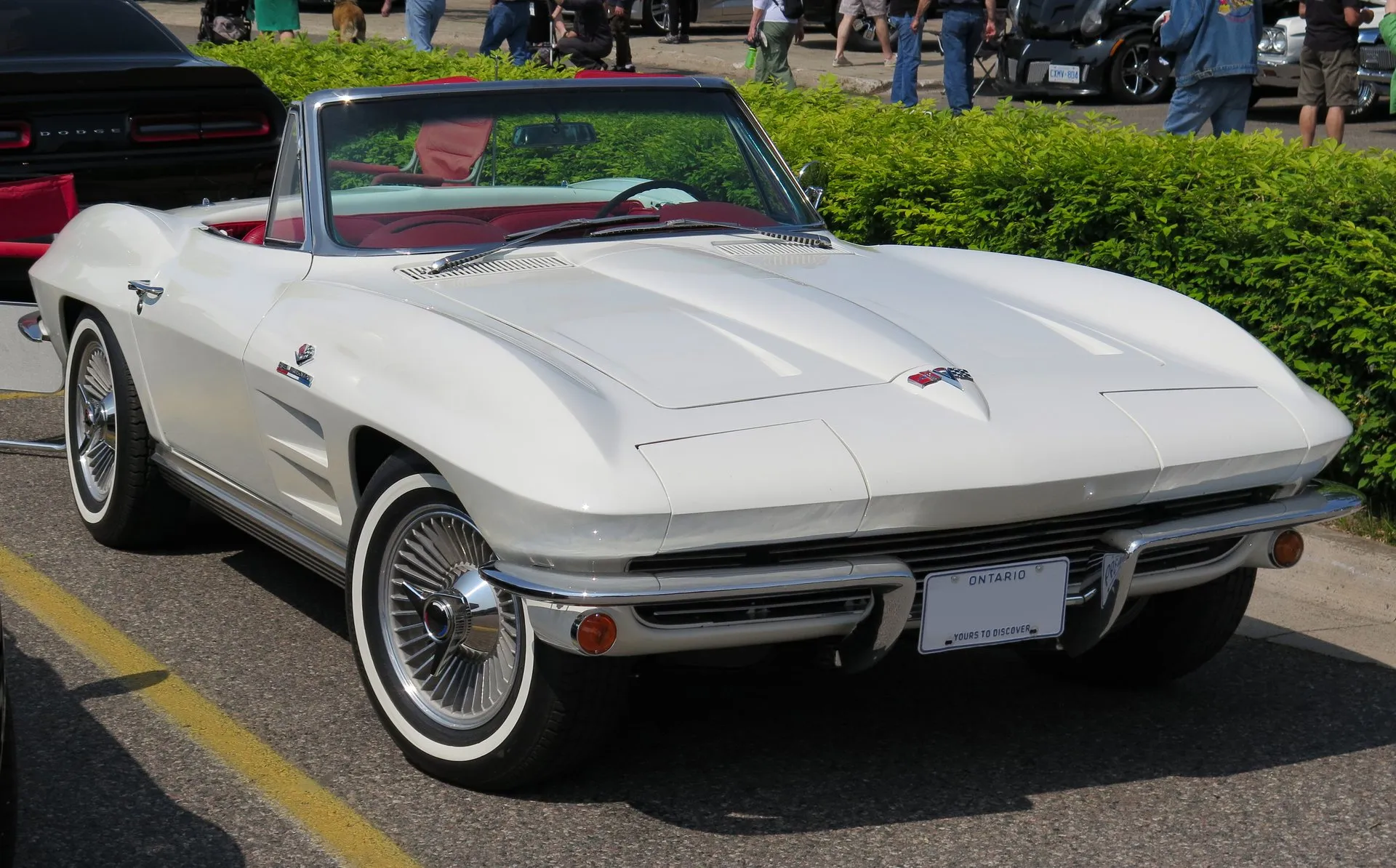
- The hood. The two recesses stayed; the 1963’s trim panels inside them didn’t. The 1965 went flat, so the 1964’s hood is a one-year design, and on a convertible it’s the quickest way to tell a 1964 from a 1963 (CorvetteForum, 2013).
- A fan in the coupe’s roof. A three-speed fan pulled cabin air out through new vents in the driver-side roof pillar, worked by a pull control under the dash. Owners say it clears stale air, not a fogged rear window (CorvetteForum, 2022). The 1966 lost the vents.
- Trim. A simpler rocker panel and a restyled fuel door (Hagerty). The two horizontal fender vents carried over; the 1965 got three vertical ones.
- Inside. A walnut-grained plastic steering wheel, black instrument recesses, squarer seat backs with no tilt mechanism, chrome door release knobs and new two-tone trims (silver or white with a second color).
- Body mounts. GM’s supplement describes “new, lower frame body mounting brackets to accommodate new body mounts”. Hagerty adds sound insulation and extra shift-linkage bushings.
- A second body maker. Some bodies now came from Dow-Smith in Ionia, Michigan, part of A. O. Smith, though every car was assembled in St. Louis. Corvette Action Center counts 1,579 coupe and 2,836 convertible bodies from Dow-Smith. That matters on the trim tag.
What stayed: the ladder frame, independent rear suspension, 11 in drums and 98.0 in wheelbase. GM’s June 1964 weights put a base three-speed coupe at 3,125 lb curb and the convertible at 3,110 lb. (The 1963’s 3,015 lb comes from a different GM form, so the gap isn’t proof of a weight gain.)
Section 02
Four 327s, and the rules for the two hot ones
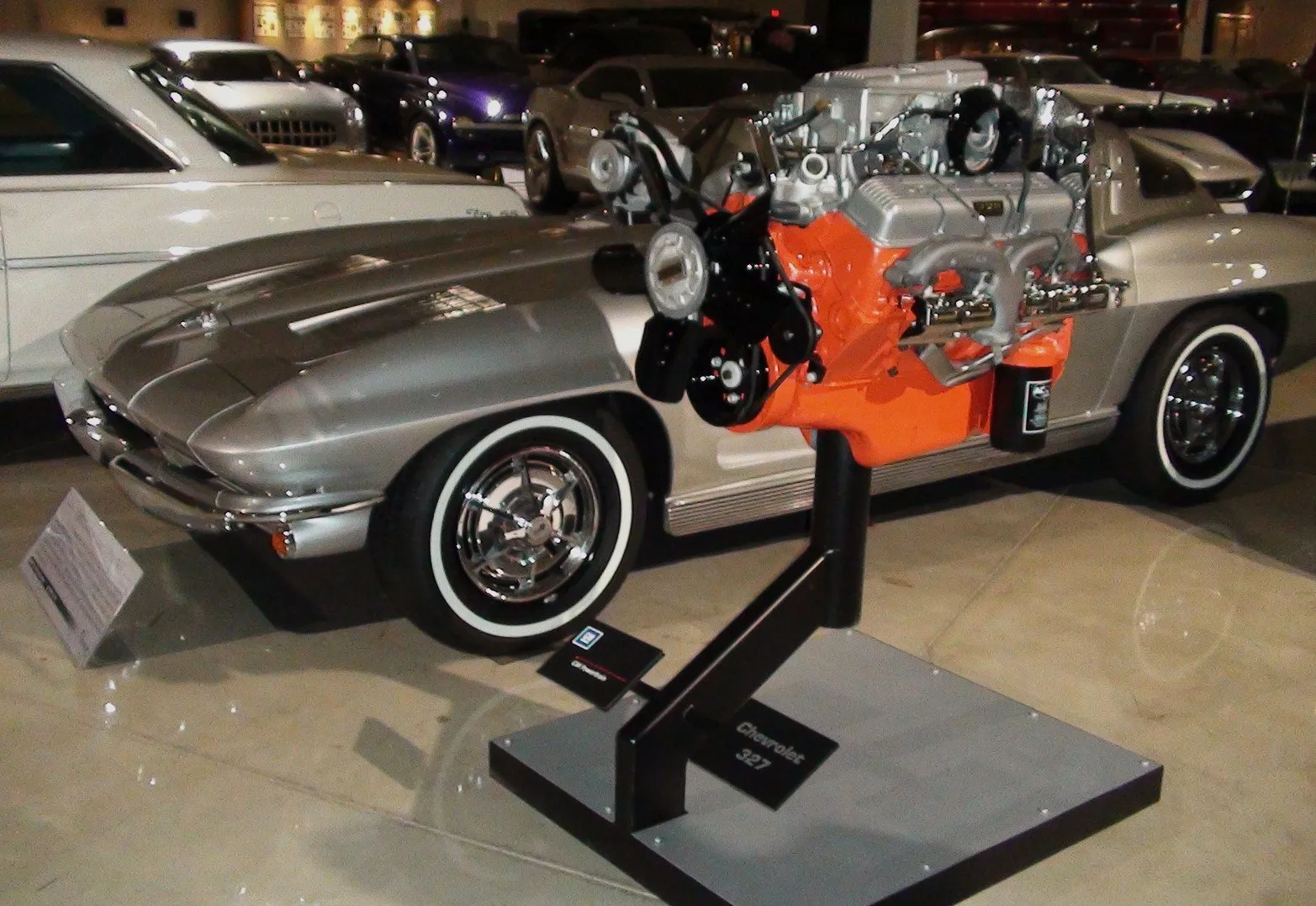
Every 1964 had a 327 cu in V8 (4.00 in bore, 3.25 in stroke). The top two grew: the carbureted L76 went from 340 to 365 hp and the fuel-injected L84 from 360 to 375 hp. Ratings are GM’s gross figures from its January 1964 engine data, prices from its December 2, 1963 list, counts from the Black Book:
| Engine | Induction and lifters | Compression | Gross power | Gross torque | Price | Built |
|---|---|---|---|---|---|---|
| Base 327 | Carter WCFB four-barrel, hydraulic | 10.5:1 | 250 hp at 4,400 rpm | 350 lb-ft at 2,800 rpm | Standard | 3,262 (by subtraction) |
| L75 | Carter AFB four-barrel, hydraulic | 10.5:1 | 300 hp at 5,000 rpm | 360 lb-ft at 3,200 rpm | $53.80 | 10,471 |
| L76 | Holley four-barrel, special camshaft, mechanical | 11.0:1 | 365 hp at 6,200 rpm | 350 lb-ft at 4,000 rpm | $107.60 | 7,171 |
| L84 | Rochester fuel injection, special camshaft, mechanical | 11.0:1 | 375 hp at 6,200 rpm | 350 lb-ft at 4,400–4,800 rpm | $538.00 | 1,325 |
GM also rates the base engine at 210 hp net. One early GM page prints 11.25:1 compression for the top two; three later ones say 11.0:1. Fuel injection cost $107.60 more than in 1963 and went into about half as many cars (2,610 in 1963). GM recommends premium fuel for all four.
Gearboxes and axles
GM calls the 1964 three- and four-speeds “new, improved,” with new ratios: 2.58:1 first for the standard three-speed. The M20 four-speed ($188.30, 19,034 cars) was a wide-ratio box (2.56:1 first) behind the 250 and 300 hp engines on 10,538 cars, and a close-ratio box (2.20:1) behind the 365 and 375 on 8,496. The M35 Powerglide ($199.10) went into 2,480: 904 base engines, 1,576 L75s. That leaves 715 three-speeds, by subtraction.
The rules, from GM’s power teams and price list:
- 250 and 300 hp: three-speed, wide-ratio four-speed or Powerglide, on a 3.36:1 axle. A four-speed car could take the G91 3.08:1 highway axle for $2.20 (2,310 cars).
- 365 and 375 hp: close-ratio four-speed only (1963’s top two could still take the three-speed), on a 3.70:1 axle; 3.08, 3.36, 3.55, 4.11 and 4.56 came only with Positraction.
- Positraction (G81, GM’s limited-slip differential, $43.05) went into 18,279 cars, more than four in five.
- Power steering with 250 or 300 hp only. Air conditioning with 250, 300 or, new for 1964, 365 hp; never the fuelie.
Road & Track’s March 1964 L75 Powerglide coupe, as reproduced by Corvette Action Center, ran 0–60 mph in 8.0 seconds and the quarter mile in 15.2 seconds at 85 mph. That’s the mild end of the list; the L76 and L84 made 65 and 75 hp more than its 300.
Section 03
The Z06 split up, and the order form around it
GM’s December 2, 1963 price list has no Z06. The two options that replaced it are written in by hand at the foot of the page, and GM’s January 1964 dealer data spells out what each one held:
- J56 special brakes, $629.50, 29 cars: finned 11.2 in composite drums with a cooling fan inside each, vented backing plates, an air scoop at each front brake, sintered iron linings and power assist with a dual-circuit master cylinder.
- F40 special suspension, $37.70, 82 cars: a 0.940 in front anti-roll bar, 550 lb/in front springs, a seven-leaf rear spring at 305 lb/in and rear shocks with 1.375 in pistons.
The zone letter says both were “Available late January, 1964.” Both needed the four-speed, Positraction and a high-performance engine, but GM’s papers disagree on which: the letter ties J56 to the 365 hp engine and F40 to the 375, while a handwritten note on the price list says both require the L84. This guide won’t pick between them.
The N03 big tank wasn’t part of the split. It was already its own option in 1963 (63 cars, per the 1963 guide) and simply carried on: 36.5 gallons, coupe only, $202.30, on 38 cars, against 20 gallons standard.
The options that matter
Prices are GM’s of December 2, 1963; counts are the Black Book’s.
| Code | Option | Price | Cars |
|---|---|---|---|
| G81 | Positraction | $43.05 | 18,279 |
| C07 | Hardtop for the convertible | $236.75, or no charge in place of the soft top | 7,023 |
| J65 | Sintered metallic brakes, power assist included | $53.80 | 4,780 |
| A31 | Power windows | $59.20 | 3,706 |
| N40 | Power steering (250 and 300 hp only) | $86.10 | 3,126 |
| J50 | Power brakes | $43.05 | 2,270 |
| C60 | Air conditioning (not with the fuelie) | $421.80 | 1,988 |
| N11 | Off-road exhaust (not with Powerglide or the base engine) | $37.70 | 1,953 |
| 898, 899 | Leather seats | $80.70 | 1,334 |
| P48 | Cast aluminum knock-off wheels | $322.80 | 806 |
| K66 | Transistor ignition (365 and 375 hp only) | $75.35 | 552 |
Of the hardtop cars, 1,220 took it in place of the soft top. The Black Book prints power steering at $75.35, the 1963 price, and splits air conditioning 1,069 coupes and 919 convertibles.
Two arrivals: K66 transistor ignition was new for 1964, and the knock-off wheels finally reached customers. No 1963 is confirmed delivered with them; for 1964 the Black Book says delivery “was certain,” with three-bar spinners only.
Seven colors, and the counts
| Paint (code) | Cars |
|---|---|
| Riverside Red (923) | 5,274 |
| Ermine White (936) | 3,909 |
| Daytona Blue (916) | 3,454 |
| Silver Blue (912) | 3,121 |
| Satin Silver (940) | 2,785 |
| Tuxedo Black (900) | 1,897 |
| Saddle Tan (932) | 1,765 |
Another 24 cars had non-standard paint or primer, which brings the total to 22,229 exactly. Satin Silver was new and free, where 1963’s Sebring Silver had cost $80.70. A black, white or beige soft top came with any color.
GM’s color and trim chart pairs Ermine White with all 20 interiors and Saddle Tan with saddle trims only, but the Black Book says other combinations were possible. An odd pairing isn’t wrong by default; the trim tag has to back it.
Section 04
Reading a 1964’s numbers, and the fakes
Nothing in a 1964’s serial or trim tag names its engine, so the premium versions (the fuelie, the L76, a J56 or F40 car, a big tank) live in date codes and paperwork.
Serial and build month
GM’s identification page: 4 for 1964, 0837 for the Sport Coupe or 0867 for the convertible, S for St. Louis, then a unit number from 100001 to 122229. New for 1964, the serial tag had a space for the dealer to stamp the delivery date; in May 1964 a Chevrolet zone bulletin told service departments to add dates dealers had missed (via Corvette Action Center). An original stamped date is a useful piece of a car’s story. The Black Book’s month-end serials date the car:
| Unit numbers | Built |
|---|---|
| 100001–101741 | September 1963 |
| 101742–104045 | October 1963 |
| 104046–106063 | November 1963 |
| 106064–108091 | December 1963 |
| 108092–110297 | January 1964 |
| 110298–112322 | February 1964 |
| 112323–114570 | March 1964 |
| 114571–116865 | April 1964 |
| 116866–118805 | May 1964 |
| 118806–120920 | June 1964 |
| 120921–122229 | July 1964 |
The engine pad and the reused codes
Every engine was assembled in Flint. The pad stamp reads F, month, day and suffix: GM’s example, F1210RF, is a fuelie built December 10. Owners also look for the car’s serial derivative beside it. The Black Book lists 14 suffixes (GM’s dealer page shows the basic six):
- Manual gearbox: RC 250 hp, RD 300, RE 365, RF 375.
- Manual with air conditioning: RP 250, RQ 300, RR 365.
- Transistor ignition: RT 365, RX 375; RU is a 365 with air and transistor ignition.
- Powerglide: SC 250, SD 300; SK and SL are the same two with air.
The trap: RC, RD, SC and SD meant the same in 1963, and RE and RF were 1963’s 340 and 360 hp codes. The block (3782870) and heads (3782461; 3795896 on the base engine) are 1963 castings too. Only the date and serial derivative tie an engine to a 1964; the 1963 guide covers the other side.
The axle’s two letters plus a date give the ratio: CZ 3.08, CA 3.36, CX 3.70 conventional; CJ 3.08, CB 3.36, CC 3.55, CD 3.70, CE 4.11, CF 4.56 Positraction. The four-speed’s code is on the left lower cover flange of the case.
The trim tag and its two calendars
The tag under the dash carries the body style (64 837 or 64 867), body number, trim, paint and a build-date code. Corvette Action Center’s example: G11 (March 11, 1964), 64 867, body S7403 (St. Louis), trim 898FA (red leather), paint 940AA (Satin Silver).
The catch, per Corvette Action Center’s body-code table (opens in new tab): two calendars. On a St. Louis body, A is September 1963 and K is July 1964; on an A. O. Smith body, A is January 1964 and G is July 1964. Establish the body source before calling a tag wrong.
Real fuelie, or a carbureted car dressed up
The L84 carries the year’s biggest premium (classic.com’s 1964–1965 benchmarks put it about $50,000 over the L76), so it’s the 1964 most worth faking. Owners advising a shopper on a “numbers matching” 1964 fuelie coupe gave their checklist (opens in new tab): RF or RX on the pad, a 6,500 rpm tach redline, the right Rochester unit, the injected engine’s own manifolds and distributor, and ownership history (CorvetteForum, 2011). The Black Book lists the units as 7017375 early, 7017375R limited use and 7017380 late, and the fuelie distributors as 1111063, 1111064 and 1111070.
That shopper walked away from a December 1963 car with a late 7017380 unit. An early car with a late unit is a question, not proof of a fake. Air-cleaner holes in the left inner fender prove little: the 1965 guide explains GM’s service parts carried them for every engine.
NCRS, the National Corvette Restorers Society, calls converting a carbureted car to fuel injection with numbers to match counterfeiting. Paperwork decides; the C2 guide lists what helps.
The 1964 split window
A 1964 with a split rear window is a conversion, and they sell openly: on Bring a Trailer, a 1964 turned split window, on a tube-frame chassis with an LS-based engine, made $250,000 on July 14, 2026 and $243,000 on October 6. A factory split window’s serial starts 30837S. One poster says more 1963s went the other way, to one-piece glass (CorvetteForum, 2015).
Section 05
Early-car fixes in GM’s 1964 bulletins
GM’s 1964 dealer paperwork, as transcribed by Corvette Action Center (the originals weren’t seen for this guide), shows most trouble hitting early cars and being fixed in production. Most important first:
- The four-speed shifter (DR #691, September 8, 1964). Early cars stripped knob threads, broke reverse-inhibitor cables and could break the reverse-blocker pin’s weld “and allow undesired reverse engagement” (opens in new tab). Production got a new mechanism and a brass-insert knob; the early all-plastic knob (
GM 3846842, OEM) fits either lever, the late knob only the late one. The lockout was revised again for 1966. - Starting in gear on a Powerglide car (DR #658, March 10, 1964). On some early cars the neutral safety switch could hit the underbody, allowing “the engine being started while the transmission selector is in a drive position” (opens in new tab). Shims fixed it; the plant corrected it from serial S103661, an October 1963 car.
- Vapor lock. Chevrolet’s 1964 Product Data Book warns that 365 and 375 hp cars, and air-conditioned ones, “may experience a fuel vapor lock condition during high ambient temperatures.” Late cars got a bigger pump with vapor bleed holes; early cars take pump
GM 6415325and elbowGM 3855147(OEM). - Heat on air-conditioned cars. A faulty vacuum valve on a few early cars shut off the heat at maximum (TSB #1012, July 1964; valve
GM 3839651, OEM; correct from S104235, early November 1963), and the blower ran slow on MEDIUM on cars built through December 16, 1963 (Service News, March 1964; resistorGM 3843168, OEM). - The hood support. Some early 1964s had its safety hole drilled through one side only (Service News, January 1964).
- Running changes to the clutch (DR #645, February 1964), and a corporate bulletin on gear clash in 1963–1964 three-speeds (TSB #1008, July 1964).
What the federal files hold
NHTSA, the US road safety agency, has one owner complaint (opens in new tab) for the 1964: a left rear wheel came off while driving, filed in August 2000, no cause given, and this guide won’t guess one. There’s no recall at all. The complaint file starts in September 1994, three decades after these cars were new, so its quiet proves nothing.
The bills that decide a 1964’s fate belong to the generation: the rusting steel birdcage inside the body, the frame’s rear kick-ups, old crash repairs and overheating. The C2 guide covers them.
Section 06
A 1964 inspection, paperwork to frame
- The serial. 40837S or 40867S, then a unit number no higher than 122229. Find its build month in the serial table in Reading a 1964’s numbers, and the fakes.
- The trim tag. Read its month letter on the right calendar: St. Louis or A. O. Smith body first, then the month.
- The engine pad. A suffix that fits the car’s equipment (an air-conditioned 365 is RR, or RU with transistor ignition, never RE), an assembly date before the car’s build date, and the serial derivative. RE or RF alone proves nothing.
- Paper for every premium. Fuel injection, the L76, J56, F40 or the big tank. A J56 or F40 car built before late January 1964 is a question mark on GM’s own timing.
- The fuelie details. RF or RX, a 6,500 rpm tach, a Rochester unit that fits the build date, the right distributor. Fender holes count for nothing on their own.
- The shifter. On an early four-speed, reverse should need the lockout, and the knob should be tight.
- A Powerglide car should crank only in Park or Neutral. One that cranks in a drive range has the fault DR #658 describes, and needs fixing before it’s driven.
- A hot-day idle on a 365, 375 or air-conditioned car. Stumbling after a hot soak points at the vapor-lock bulletin.
- The birdcage and the frame, on a lift, by the C2 guide’s list. They cost more to fix than everything else here put together.
Section 07
Bring a Trailer, Hagerty and classic.com on the 1964
On Bring a Trailer (opens in new tab), 44 cars from the 1964 model year were listed between January 1 and October 22, 2026, and 29 sold, at a median of $62,000: this site’s calculation from sold prices, without BaT’s buyer’s fee (5 percent, $250 minimum, $7,500 maximum). “Titled stock” means the title doesn’t call the car modified or a conversion; it can’t show a replacement engine, and one stock-titled coupe’s listing describes a “replacement 327ci V8.”
| 1964s sold on Bring a Trailer, Jan. 1 to Oct. 22, 2026 | Sales | Median | Range |
|---|---|---|---|
| Titled stock, all | 21 | $60,500 | $39,250–$107,000 |
| Stock coupes | 9 | $66,000 | $52,500–$107,000 |
| Stock convertibles | 12 | $57,750 | $39,250–$94,375 |
| Carbureted coupes | 8 | $64,000 | $52,500–$89,000 |
| Carbureted convertibles | 10 | $55,250 | $39,250–$92,000 |
| Fuel-injected (title says so) | 3 | $94,375 | $60,500–$107,000 |
| Modified | 8 | $96,750 | $48,000–$250,000 |
Three fuelies is a tiny sample: a coupe at $107,000 (October 17) and convertibles at $94,375 and $60,500. An L76 coupe brought $89,000 (October 7) and two L75 coupes $66,000 and $68,750; the cheapest stock sale was an L75 convertible at $39,250. Another 15 cars didn’t sell, at a median high bid of $70,000.
The C2 guide and the best Corvette years guide use June 10 to October 6, 2026: 10 titled-stock 1964s at a $60,250 median, the lowest of the five C2 years.
Hagerty’s price guide (opens in new tab), January 2026, condition #3 (Good), as captured by the Internet Archive:
| Engine | Coupe | Convertible |
|---|---|---|
| 250 hp | $54,200 | $50,800 |
| 300 hp L75 | $47,600 | $51,200 |
| 365 hp L76 | $55,500 | $49,500 |
| 375 hp L84 | $62,000 | $70,200 |
Its order is odd in places (an L75 coupe under a base coupe), and it sits below what two of the three fuelies brought on BaT. Read it as a guide value, not a price tag.
classic.com’s (opens in new tab) May 2026 benchmarks cover 1964–1965 together: $82,319 for an L76, $132,533 for an L84. Its L84 record is a 1964 coupe it lists as highly original, 13,000 miles: $770,000 at Mecum Kissimmee on January 16, 2026. One car, not a market. The three sources measure different things, so don’t average them.
Section 08
Buy the L76 coupe, or a convertible on a budget
Buy a coupe with the 365 hp L76 and the close-ratio four-speed, its pad suffix (RE, or RR, RT or RU), date and serial derivative fitting the car. It’s the year’s hottest carbureted engine, mechanical lifters and all, in the body that shows off the one-piece glass. Hagerty values it barely above a base coupe ($55,500 against $54,200), though BaT’s one L76 coupe this year brought $89,000. Without paper for the L76, pay for a milder car.
The budget path is a carbureted convertible, at a $55,250 median on Bring a Trailer this year, the cheapest group of 1964s in the table in Bring a Trailer, Hagerty and classic.com on the 1964.
A fuelie is a documents purchase: pay for the injection only when the Rochester unit, the pad and the build date agree and the papers carry them. Skip any 1964 sold as a split window near a 1963’s price, and any car whose premium the paperwork can’t back.
Against a 1963, the 1964 trades the split window for 25 more horsepower from the L76 (15 more from the fuelie), new gearbox ratios and a clear view out the back, at the lowest median of any C2 year. That’s America’s sports car at its best value: crack the roof-pillar vent, wind the L76 toward its 6,200 rpm peak in second, and spend the money you saved on the birdcage.
The C2 guide covers the rust, the fakes and all five years; the 1963 guide the year before, and the 1965 guide the year after.
Section 09
Sources
- GM Heritage Center: 1964 Corvette vehicle information kit files.zipcorvette.com This site's library. PDF pages 4–5 (production, serials by month, engine codes and castings, options and colors with counts: Corvette Black Book pages reproduced in GM's kit), 8–10 (GM price list, power teams and color chart, December 1963), 14 (serial, engine and axle codes), 18 (weights), 22 (J56 brakes and F40 suspension), 27 (engine ratings), 48 (wheels and tires), 50–52 (GM's 1964 shop manual supplement: what changed, gearbox ratios, the serial tag, body mounts), 104 (fuel recommendation) and 116 (fuel injection unit).
- Chevrolet Zone 49 distribution letter 002CD01, January 2, 1964: new options J56 brakes and F40 suspension (via Corvette Action Center) (opens in new tab) corvetteactioncenter.com Why the Z06 was split up, and what each new option required.
- Chevrolet TSB DR #691, September 8, 1964: 1964 Corvette 4-speed shift lever revision (via Corvette Action Center) (opens in new tab) corvetteactioncenter.com
- Chevrolet TSB DR #658, March 10, 1964: neutral safety switch malfunction, Powerglide cars (via Corvette Action Center) (opens in new tab) corvetteactioncenter.com
- Chevrolet 1964 Product Data Book: increased capacity fuel pump (via Corvette Action Center) (opens in new tab) corvetteactioncenter.com
- Chevrolet TSB #1012, July 6, 1964: lack of heat with controls in full on position, air-conditioned cars (via Corvette Action Center) (opens in new tab) corvetteactioncenter.com
- Chevrolet Service News, March 1964: air conditioning changes (via Corvette Action Center) (opens in new tab) corvetteactioncenter.com
- Chevrolet Service News, January 1964: Corvette hood support safety hole (via Corvette Action Center) (opens in new tab) corvetteactioncenter.com
- Chevrolet TSB DR #645, February 13, 1964: 1964 clutch interim changes (via Corvette Action Center) (opens in new tab) corvetteactioncenter.com
- Chevrolet TSB #1008, July 16, 1964: 3-speed transmission problems, 1963–1964 passenger cars (via Corvette Action Center) (opens in new tab) corvetteactioncenter.com
- Chevrolet Louisville Zone bulletin 22-59, May 20, 1964: delivery date stamped on the serial plate (via Corvette Action Center) (opens in new tab) corvetteactioncenter.com
- NHTSA owner complaints, 1964 Chevrolet Corvette (opens in new tab) api.nhtsa.gov Pulled October 22, 2026: one complaint, filed in 2000. NHTSA's complaint file begins in September 1994.
- NHTSA recalls, 1964 Chevrolet Corvette (opens in new tab) api.nhtsa.gov Pulled October 22, 2026: none.
- Corvette Action Center: 1964 Corvette production and performance numbers (opens in new tab) corvetteactioncenter.com Production, options, bodies by source, the year's changes and a reproduced Road & Track test (March 1964). Fetched October 22, 2026.
- Corvette Action Center: 1964 Corvette identification numbers (opens in new tab) corvetteactioncenter.com Serial decoding and a worked trim-tag example.
- Corvette Action Center: C2 body build date codes (opens in new tab) corvetteactioncenter.com The 1964 month letters for St. Louis and A. O. Smith bodies.
- Hagerty: 1963–67 Corvette (C2) buyers guide (opens in new tab) hagerty.com Sajeev Mehta, April 15, 2020. Read via the Internet Archive's August 2024 copy (opens in new tab).
- Hagerty Valuation Tools: Chevrolet Corvette 1963–1967 (opens in new tab) web.archive.org Condition #3 US values, January 2026 publication, from the Internet Archive's March 2026 copy.
- classic.com: Chevrolet Corvette C2 market (opens in new tab) web.archive.org May 2026 benchmarks for the L76 and L84, both covering 1964–1965.
- classic.com: Chevrolet Corvette L84 (327/375) market (opens in new tab) web.archive.org Archived March 2026. The record $770,000 sale of a 1964 L84 coupe.
- Bring a Trailer: Chevrolet Corvette C2 results (opens in new tab) bringatrailer.com 1964 model-year results from January 1 to October 22, 2026, read October 22, 2026. Medians are this site's calculation from each listing's sold price, which excludes BaT's buyer's fee.
- NCRS: judging awards (opens in new tab) ncrs.org NCRS's definitions of restoration and counterfeiting.
- CorvetteForum thread: how can I tell if it's a real fuelie (opens in new tab) corvetteforum.com September 2011, about a 1964 coupe.
- CorvetteForum thread: 1964 coupe rear window fan (opens in new tab) corvetteforum.com January 2022.
- CorvetteForum thread: how to tell midyears apart at a glance (opens in new tab) corvetteforum.com June 2013.
- CorvetteForum thread: counterfeit 1963 coupes (opens in new tab) corvetteforum.com June 2015.