C2 · Buying guide
The 1967 Corvette Sting Ray: the last C2, its five 427s, the L88, the fakes and 2026 prices
Published
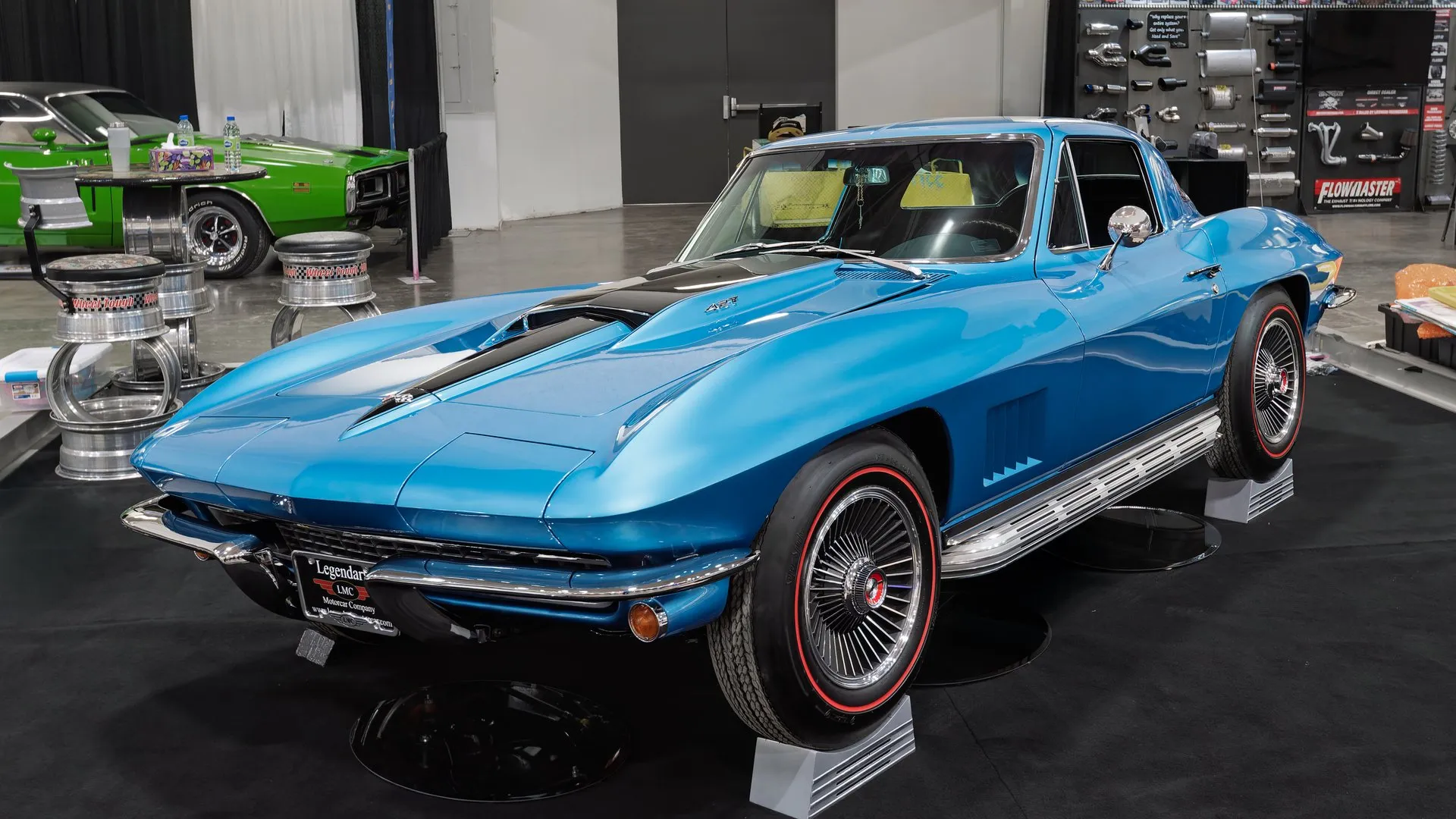
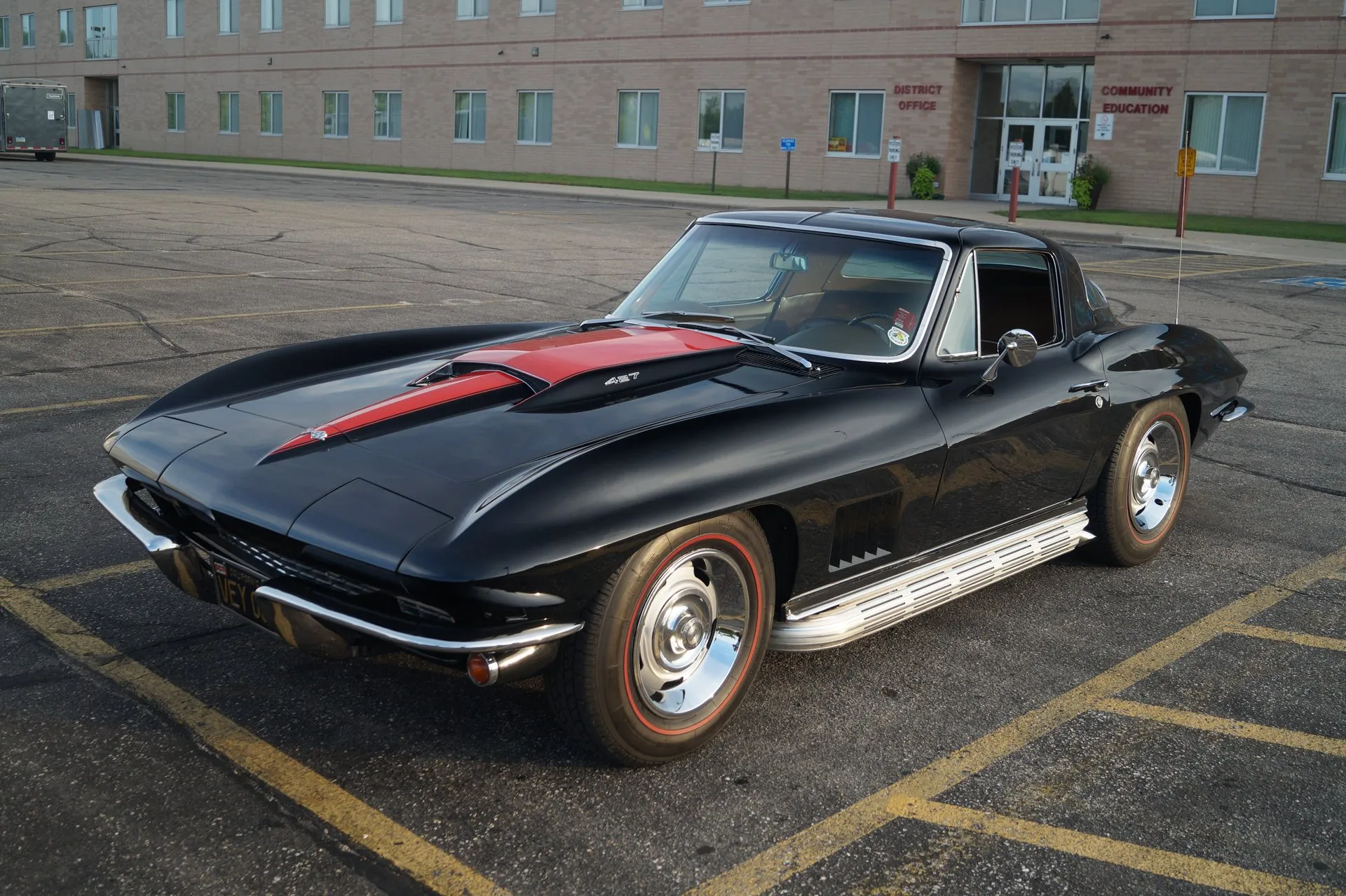
On a 1967 big-block Corvette in seven of the year’s ten colors, the seats picked the color of the stripe on the hood. Chevrolet’s chart, as the Corvette Black Book prints it from the factory’s files, gave a Tuxedo Black car a red stripe over a black or red interior, a white one over saddle, green or white-and-black, and a blue one in a matching shade over a blue interior. Yellow, silver and maroon cars got black whatever the seats. Green is where owners still argue: the chart gives a Goodwood Green car a black stripe only with black seats, and white with any other. In a CorvetteForum thread (opens in new tab) started in 2002, the owner of a green car with black seats says the judging manual of the National Corvette Restorers Society (NCRS) allowed only white on green, and a veteran poster answers that the manual’s 1993 edition listed black.
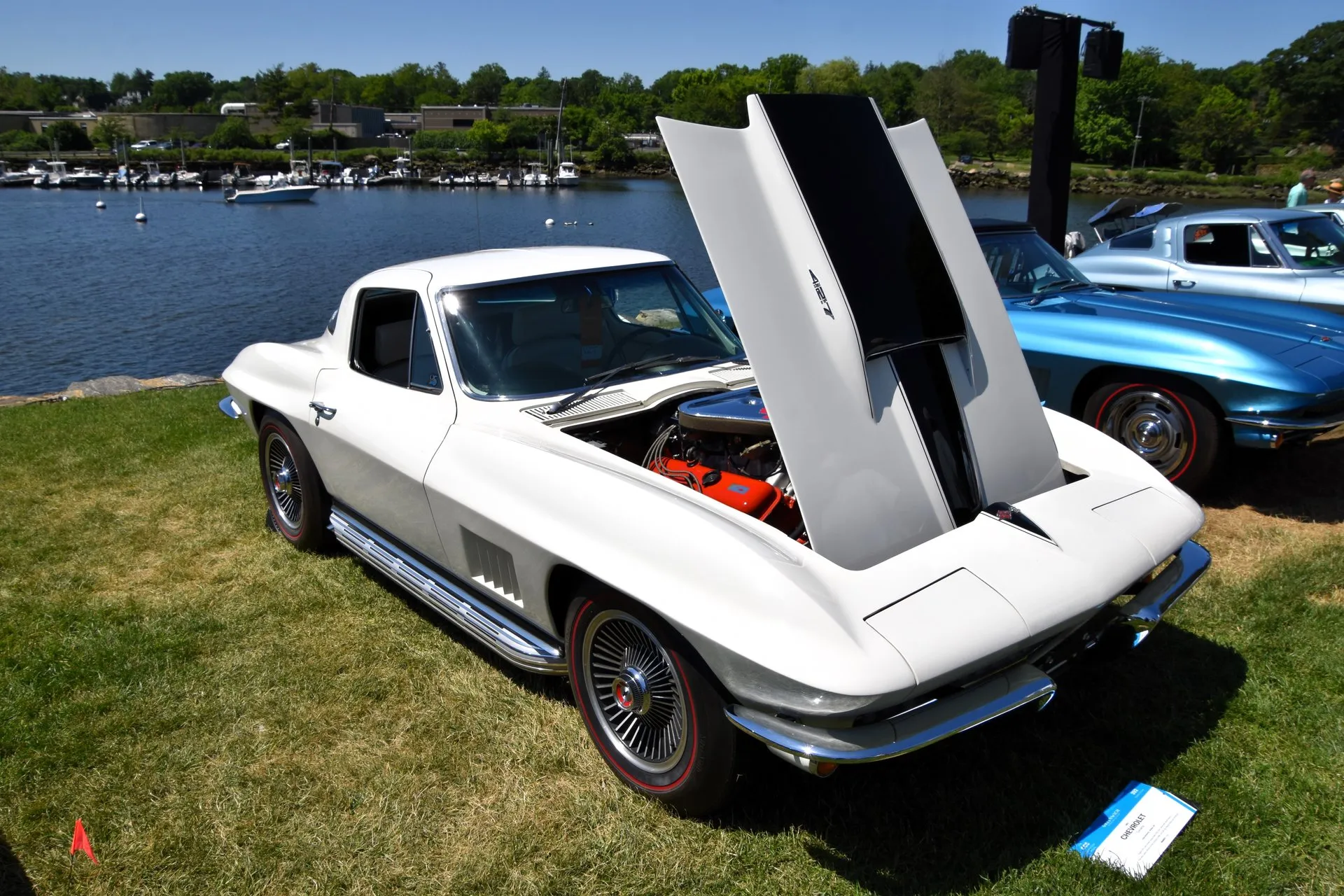
That’s the 1967 Corvette Sting Ray in one detail: the last of the C2 (1963–1967), and a car now judged line by line against factory paper, because the paper sets the price. St. Louis built 22,940 of them. GM took the flags off the fenders and the script off the hood, cut five working vents into each front fender, moved the parking brake between the seats and offered the 427 five ways, three of them on three two-barrel carburetors. On Bring a Trailer in 2026, stock 1967s with a 427 in the listing title sold at about twice the median price of those without.
- Built: 22,940: 8,504 coupes and 14,436 convertibles.
- Engines: two 327s and five 427s, counting the aluminum-head L89 (its own option code on GM’s list) and the L88 (which only the Black Book lists). Top rating: 435 hp at 5,800 rpm, gross, for the L71 and L89. The L88: 20 built, rated 430 hp.
- Price new: $4,353 coupe, $4,141 convertible, on GM’s September 29, 1966 price schedule.
- How to spot one: five fender slots, no fender flags or hood script.
- What one sold for in 2026: a median of $101,500 for 30 cars titled stock on Bring a Trailer between January 1 and October 18, and $152,000 for the nine titled as L71s.
Rust in the steel birdcage and frame, NCRS and Bloomington Gold judging, and the 1963–1966 cars all live in the C2 buyer’s guide. Here, it’s 1967 only.
C2 Key figures
- Built
- 22,940
- Price new, Sept. 1966
- $4,353 coupe, $4,141 convertible
- Engines
- two 327s and five 427s
- Top rating
- 435 hp at 5,800 rpm, gross
- L88
- 20 built, rated 430 hp
- The year's tell
- five fender slots, no fender flags or hood script
- BaT median, 2026
- $101,500 for 30 cars titled stock
Section 01
Five slots, no flags: what changed from 1966
Set GM’s 1966 equipment list beside the 1967 one and the cleanup shows: the crossed flags left the front fenders and wheel covers, the nameplate left the hood (the flags on the nose and fuel door and the rear-deck nameplate stayed), and trim rings and hub caps replaced the wheel covers. The Black Book, a Corvette reference whose 1967 pages GM’s kit reprints, and Corvette Action Center add the rest:
- Five slots. The fender vents became five angled, functional slots, the quickest way to spot a 1967.
- Wheels. Rally wheels with trim rings became no-cost standard equipment. Safety legislation ended the knock-off wheel; in its place came N89, a bolt-on cast aluminum wheel with a clip-on center cap over the lug nuts.
- Inside. Redesigned seats, and the parking brake moved from a “T handle” under the dash (GM’s 1966 wording) to a handle “on center console”. The passenger’s grab handle above the glove box went.
- Rear. The back-up lamp moved above the license plate, per Corvette Action Center and Sports Car Market.
- Colors and tops. Five new colors (Marina Blue, Lynndale Blue, Elkhart Blue, Goodwood Green and Marlboro Maroon) joined five from 1966, and teal blue replaced beige on the soft-top list.
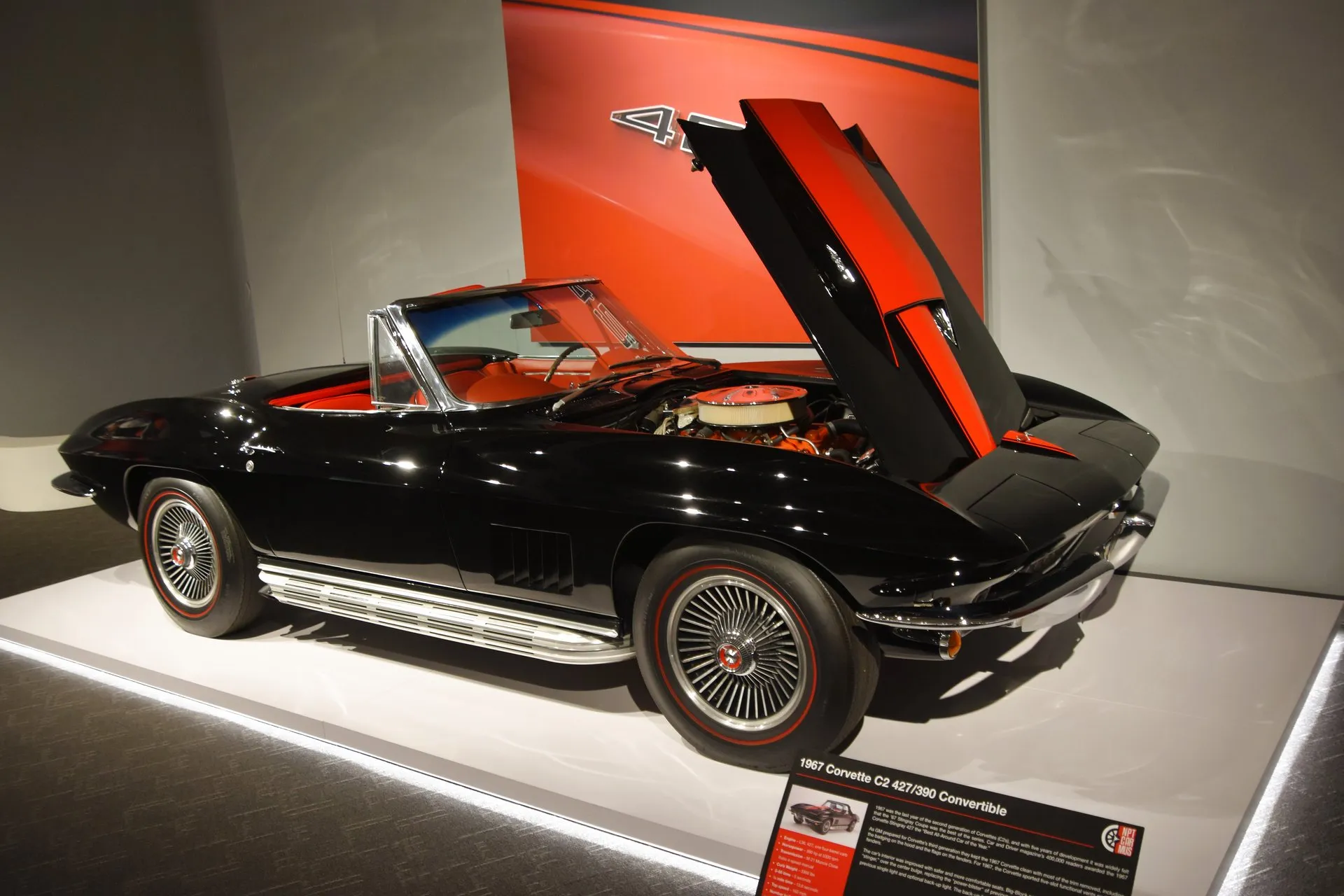
GM’s 1967 pages also make standard two safety items its 1966 pages don’t list: a dual-circuit brake system with a warning lamp (in 1966, a divided master cylinder came only with power brakes) and an energy-absorbing steering column. Big-blocks got a new hood, with what a 1991 Old Cars News article reprinted in the kit calls a large forward-facing air scoop. Underneath, the 1963 Sting Ray carried on: the same frame design, body structure, independent rear suspension and 98.0 in wheelbase, with the four-wheel discs standard since 1965. GM lists curb weights of 3,155 lb coupe, 3,175 lb convertible, with the base engine, fuel and water.
The fifth year wasn’t the plan: Sports Car Market says internal battles over the next Corvette’s roof pushed it from 1967 to 1968, a story a 2016 CorvetteForum article tells too. The C3 (1968–1982) arrived for 1968.
Section 02
Two 327s and five 427s, and what each allowed
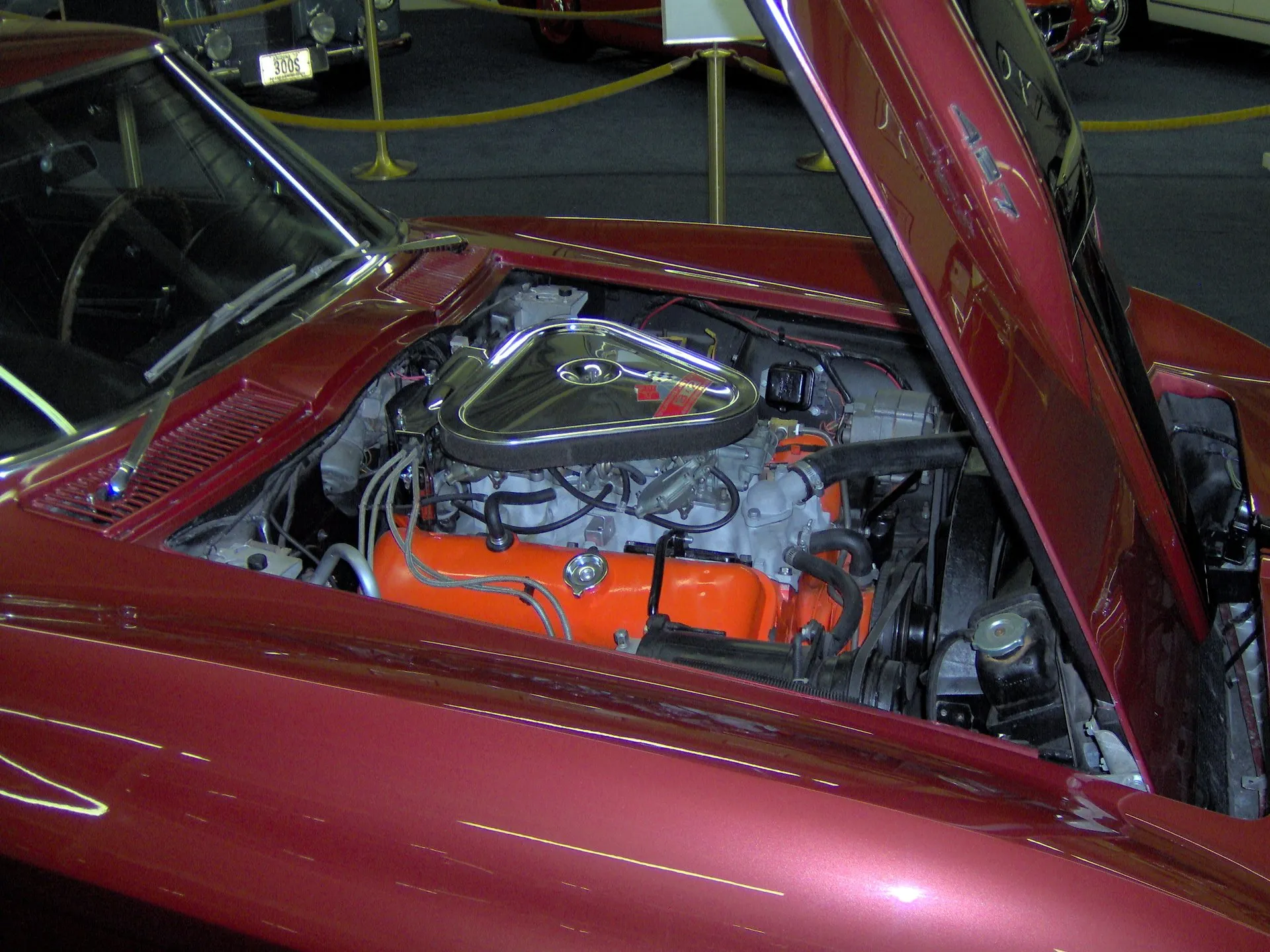
RPO means Regular Production Option, GM’s order code, and the L89 was aluminum heads for the 435 hp engine, sold as an RPO of their own: that’s how 1967 gets to five 427s. Ratings are gross, from GM’s engine data; prices are from its September 29, 1966 schedule, counts from the Black Book.
| RPO | Engine | Carburetion, lifters, compression | Gross hp | Gross torque | Built | GM price |
|---|---|---|---|---|---|---|
| Standard | 327 | Holley four-barrel, hydraulic, 10.0:1 | 300 at 5,000 rpm | 360 lb-ft at 3,400 rpm | 6,858 (by subtraction) | Standard |
| L79 | 327 | Holley four-barrel, hydraulic, 11.0:1 | 350 at 5,800 rpm | 360 lb-ft at 3,600 rpm | 6,375 | $105.35 |
| L36 | 427 | Holley four-barrel, hydraulic, 10.25:1 | 390 at 5,400 rpm | 460 lb-ft at 3,600 rpm | 3,832 | $200.15 |
| L68 | 427 | Three Holley two-barrels, hydraulic, 10.25:1 | 400 at 5,400 rpm | 460 lb-ft at 3,600 rpm | 2,101 | $305.50 |
| L71 | 427 | Three Holley two-barrels, mechanical, 11.0:1 | 435 at 5,800 rpm | 460 lb-ft at 4,000 rpm | 3,754 | $437.10 |
| L89 | 427 | The L71 with aluminum heads | 435 at 5,800 rpm | 460 lb-ft at 4,000 rpm | 16, inside the L71’s 3,754 | $368.65 on top of the L71 |
| L88 | 427 | Holley R3418A carburetor, aluminum heads (Black Book) | 430 (Black Book) | Not listed | 20 | $947.90 (Black Book) |
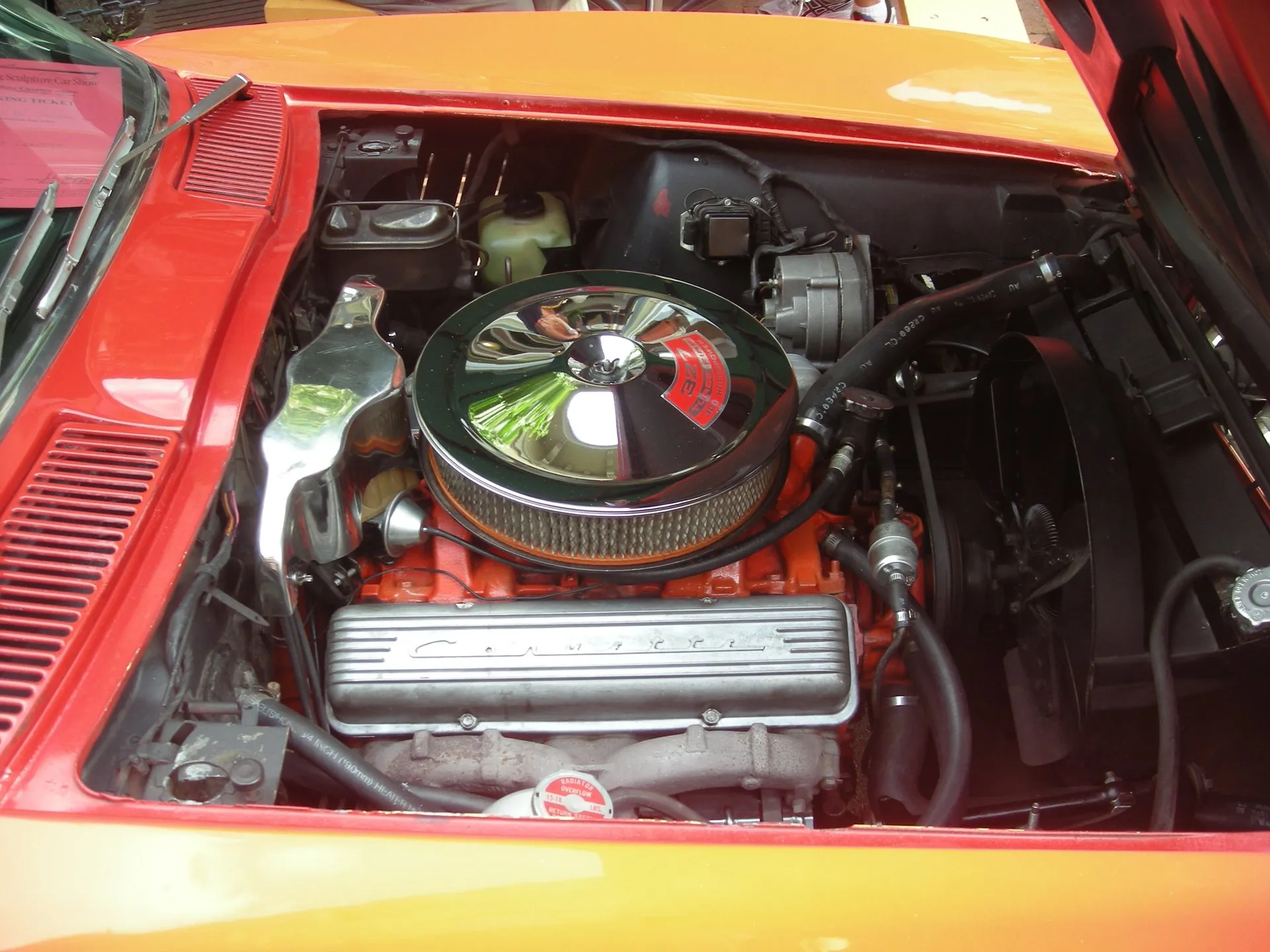
Owners call the three-carburetor setup tri-power; GM’s spec sheet says the two outer carburetors open by linkage once the center one is about half open. Big-blocks went into 9,707 cars, 42 percent of the year, as the Old Cars article in GM’s kit says, and the Black Book’s counts add up to it (3,832 + 2,101 + 3,754 + 20). GM recommended premium fuel for every engine on its sheets.
What GM’s power teams allowed:
- L71 and L89: close-ratio four-speed only, with transistor ignition (K66) and Positraction (GM’s limited-slip axle) required, a 3.55:1 axle standard (3.36, 3.70 or 4.11 optional) and no air conditioning, which GM’s options page says was “not available” with the 435 hp engine. An L71 with air had it added later, which, as it sits, rules out NCRS’s Top Flight award, given for how closely a car matches the factory (CorvetteForum, 2026).
- L36 and L68: a wide- or close-ratio four-speed or the two-speed Powerglide automatic, on a 3.08:1 or 3.36:1 axle as standard, with 3.55 and 3.70 optional behind the close-ratio box or Powerglide. Air conditioning was allowed, with Powerglide on a 3.08 only. Powerglide went into 392 of the 390 hp cars and 207 of the 400s.
- L79: four-speed only: a 3.36:1 axle with the wide-ratio box (3.55 optional), 3.70:1 with the close-ratio (4.11 optional).
- The base 300 hp: the only engine offered with the standard three-speed (about 424 cars, by subtraction); Powerglide went into 1,725.
- Gearboxes: the wide-ratio four-speed (M20) had a 2.52:1 first gear and the close-ratio (M21) 2.20:1, both $184.35. Every 427 was Positraction only.
GM’s performance factors do the bragging in arithmetic: 11.50 lb of car (curb weight plus 300 lb) per gross horsepower with the 300 hp engine, 8.34 lb with the L71, even though the 427s weighed 149 to 215 lb more than the base engine. No period road test of a 1967 turned up for this guide, but Sports Car Market says tests of the day had the 1966 L72, rated 425 hp, equal to or slightly quicker than the 1967 L71.
Section 03
The L88 and the L89, the rarest 1967s
GM’s own pages in the kit, from the dealer specifications to the price schedule, leave the L88 out. The Black Book lists it as a $947.90 option on 20 cars, rated 430 hp, with aluminum heads and engine code IT, and its option page counts 20 M22 heavy-duty close-ratio four-speeds at $237.00 to go with them. Per Corvette Action Center, every 1967 L88 also carried the heater delete (C48), F41 suspension, Positraction, power brakes, the $342.30 heavy-duty brakes (J56) and transistor ignition. No heater, no air, 20 cars.
Few took the 430 at face value. Hagerty’s C2 buyer’s guide says most outside estimates run “well over 500” and the Old Cars article says “nearly 600”, neither with a dyno sheet. Owners joke about the count instead: one asked in 2006 whether all 38 of the “original” 20 had been authenticated (CorvetteForum).
The L89 came by letter. GM’s distribution letter C.O. 67-246, undated on the page the kit reproduces, added a 435 hp 427 that “Includes aluminum cylinder heads and chrome plated rocker covers” at $805.75: the L71’s $437.10 plus the L89’s $368.65. GM’s weight page credits the heads with 73 lb less. Sixteen were built, and Sports Car Market says only three still have their original engines, without saying how it knows.
The money matches the rarity. Hagerty’s price guide put a condition #3 (Good) L89 convertible at $330,000 in January 2025 and an L88 coupe at $1,500,000 in April 2025. classic.com’s highest recorded C2 sale, as of May 2026, was $3,200,000 for a 1967 L88 coupe on January 13, 2024; its L88 benchmark fell from $2,216,967 in January 2025 (on four recorded sales) to $1,546,263 by May 2026, a handful of cars rather than a trend. Bring a Trailer sold nothing titled L88 or L89 in 2026.
Section 04
The price list, the paint and the hood stripe
GM’s September 29, 1966 price schedule listed the Sport Coupe at $4,353.00 and the convertible, with its manual soft top, at $4,141.00: suggested retail with the 300 hp 327, before taxes and options. The Black Book adds the three-speed and vinyl trim to the base car and prints a later $4,388.75 and $4,240.75. The options that matter, at GM’s September 1966 prices as the Black Book reprints them, with the Black Book’s counts:
| Code | Option | Price | Cars |
|---|---|---|---|
| U69 | AM-FM radio | $172.75 | 22,193 |
| G81 | Positraction (required on every 427) | $42.15 | 20,308 |
| P92 | Whitewall tires | $31.35 | 13,445 |
| C07 | Hardtop | $231.75, or no charge in place of the soft top | 6,880 (895 in place of the soft top) |
| K66 | Transistor ignition | $73.75 | 5,759 |
| N40 | Power steering | $94.80 | 5,747 |
| J50 | Power brakes | $42.15 | 4,766 |
| QB1 | Red-stripe nylon tires | $46.65 | 4,230 |
| N14 | Side-mounted exhaust | $131.65 | 4,209 |
| A31 | Power windows | $57.95 | 4,036 |
| C60 | Air conditioning (not with the L71) | $412.90 | 3,788 |
| K19 | Air injection reactor, for California registration | $44.75 | 2,573 |
| N36 | Telescopic steering column | $42.15 | 2,415 |
| F41 | Special suspension | $36.90 | 2,198 |
| C08 | Black vinyl cover for the hardtop | $52.70 | 1,966 |
| No code | Leather seats | $79.00 | 1,601 |
| N89 | Bolt-on cast aluminum wheels | $263.30 | 720 |
| J56 | Heavy-duty brakes (427 and power brakes only) | $342.30 | 267 |
| C48 | Heater delete | $97.85 credit | 35 |
| N03 | 36-gallon fuel tank, coupe only | $198.05 | 2 |
The big tank barely existed. On November 22, 1966, a GM letter cancelled N03 “due to low volume usage,” and two cars got one. Hagerty’s October 2025 guide adds 150 percent for it, so a claimed tank car needs papers before anything else.
Colors. Ten, all at no extra charge, with the Black Book’s counts: Goodwood Green 4,293, Marina Blue 3,840, Marlboro Maroon 3,464, Rally Red 2,341, Sunfire Yellow 2,325, Silver Pearl 1,952, Ermine White 1,423, Lynndale Blue 1,381, Elkhart Blue 1,096 and Tuxedo Black 815, the rarest. Ten more cars left in non-standard paint or primer. GM’s color chart pairs each paint with certain interiors, and the Black Book agrees but adds that other combinations were possible: an off-chart car isn’t wrong by default, but it needs paperwork.
The hood stripe. The Black Book’s researchers first suspected the tires decided it, until Chevrolet’s chart showed that paint and interior did. Here it is, as the Black Book prints it, with the interiors each stripe went with:
| Paint | Stripe, by interior |
|---|---|
| Tuxedo Black | Red (black, red); white (saddle, green, white-and-black); dark teal blue (dark blue); medium bright blue (bright blue, white-and-bright-blue) |
| Ermine White | Black (black, saddle, green, white-and-black); red (red); dark teal blue (dark blue); medium bright blue (bright blue, white-and-bright-blue) |
| Rally Red | Black (black, red); white (white-and-black) |
| Marina Blue | Black (black, bright blue); white (white-and-bright-blue) |
| Lynndale Blue | Black (black, dark blue); white (white-and-black) |
| Elkhart Blue | Black (black); dark teal blue (dark blue) |
| Goodwood Green | Black (black); white (saddle, green, white-and-black) |
| Sunfire Yellow, Silver Pearl, Marlboro Maroon | Black |
Judging guides have read it differently on green cars over the years, so an off-chart stripe proves nothing either way.
Section 05
Serial plate, engine pad, trim tag
Nothing in a 1967’s serial number names its engine. GM’s identification page decodes the rest: the model (19437 for the coupe, 19467 for the convertible), 7 for 1967, S for St. Louis, then a unit number from 100001 (“The 25th model built at St. Louis would be serial number 194377S100025”). The plate sits on the hinge-pillar cross brace under the glove box. The Black Book’s last serial for each month dates the build:
| Built in | Last serial |
|---|---|
| September 1966 | 102110 |
| October 1966 | 102685 |
| November 1966 | 104981 |
| December 1966 | 107110 |
| January 1967 | 109465 |
| February 1967 | 112264 |
| March 1967 | 115316 |
| April 1967 | 117395 |
| May 1967 | 119747 |
| June 1967 | 122214 |
| July 1967 | 122940 |
Engine, gearbox and axle
The engine is stamped at the front of the right cylinder bank, along with the car’s serial: F for Flint, the month and day, and a suffix. GM’s example, F 1210 HE, is a December 10 engine with the 300 hp suffix. GM lists only “basic designations”: HE (300 hp), HT (L79), IL (L36), JC (L68) and JE (L71). The Black Book adds variants, among them IU and JH for the aluminum-head 435 and IT for the L88; those are its codes, not GM’s, and the 1991 article in the same kit prints different ones, so treat them as a guide. Owners add that a pad should never meet an abrasive, and that a suffix or casting number says what the block is, not what the car left with (CorvetteForum, 2002 and 2026).
The gearbox carries a plant letter (S or R for Saginaw, P for Muncie, C or T for Powerglide) and a date that GM’s own page writes two ways, so leave decoding it to the judging guides. The axle code, on the bottom edge of the carrier flange, gives the ratio: AK 3.36 or AS 3.70 for an open axle; AL 3.08, AM 3.36, AN 3.55, AO 3.70 or AP 4.11 for Positraction. An open axle under a car sold as a 427, or a 3.08 under an L71, is a combination GM never offered.
The trim tag, the tank sticker and the Protect-O-Plate
As owners read it, the trim tag beside the serial plate gives the body’s build date (a month letter and a day), the style (67 437 or 67 467), a body number with S or A for St. Louis or A. O. Smith (an outside body maker), the paint code (900AA for Tuxedo Black through 988AA for Marlboro Maroon) and the trim code (Corvette Action Center forum, 2005). The date should fit the serial’s month, allowing about a week for an A. O. Smith body to reach St. Louis. Body numbers are only a rough check: coupes and convertibles were numbered apart, and bodies weren’t always finished in order (CorvetteForum, 2026).
Tags get questioned for the shape of their stamped figures and for body numbers that don’t fit the serial. One 2026 verdict on a black-on-black 427/435 coupe was “suspect trim tag, suspect tank sticker” (opens in new tab); another poster noted such a car would be very rare.
Owners say 1967s left the factory with a sticker listing the options glued to the top of the fuel tank (CorvetteForum, 2026), and on a 1968 L88, one owner said in 2006 that without a complete sticker or other documents, originality can’t be verified (Corvette Action Center forum). The Protect-O-Plate, an embossed metal plate issued with the warranty booklet from 1965 on, can help show original equipment, per the Black Book, though one 2026 poster warns that most you’ll see are fake. NCRS shipping data and judging awards are in the C2 buyer’s guide.
Section 06
L71 clones, L88 tributes and restamps
The fakes follow the money. One 2026 poster calls the L71 “one of the most faked cars Chevy ever made” (opens in new tab), in a thread started by the new owner of a “67 L71 tri power convertible” asking which plate names the engine. None does, and the thread’s last word to him was a pointed question about due diligence.
By GM’s 1967 pages, a real big-block car had a 0.875 in front stabilizer bar (0.750 on a 327), a 0.562 in rear bar (427s only), its own front springs and Positraction, plus K66 and a close-ratio four-speed on an L71. Owners add the oil gauge, clutch, flywheel and tach redline (CorvetteForum, 2007–2008). All of it can be added later, and nothing on the frame of a midyear, as owners call the 1963–1967 cars, proves a big-block (Corvette Action Center forum, 2005). One poster’s rule: if the gearbox, axle and tach dates don’t fit the build date, value it as a base-engine car (CorvetteForum, 2002).
Not every changed car is a con. Owners build L88 clones and tributes openly (CorvetteForum, 2014), and Bring a Trailer listed an “L88-Style” convertible in May 2026, bid to $90,500 without selling. Disclosed, that’s an honest car. Restamping a small-block car’s pad to pass as an original big-block is what NCRS calls counterfeiting. Before money moves on a 1967 big-block, hire at least a master-level NCRS judge, a Bloomington Gold judge or a C2 specialist, as one poster advises (CorvetteForum, 2020).
Section 07
What GM told its dealers about the 1967
NHTSA, the US road safety agency, can’t help much. Its complaint file begins in September 1994 and holds nothing for the 1967 Corvette (opens in new tab) (checked October 18, 2026), which says nothing either way, and GM has no recall on file for the car. The one recall listed is for Cardone’s remanufactured rear calipers 18-7019, 18-7020, 16-7019 and 16-7020 (aftermarket), made from February 2002 to April 2003 for 1965–1982 Corvettes, whose piston seals can leak.
The year’s real record is GM’s dealer paperwork. This guide works from Corvette Action Center’s transcriptions, not GM’s originals:
- The lifter oil feed (Tonawanda engine plant notes, January 1968, for Chevrolet’s 396 and 427 engines). For 1967 the lifters’ oil came through a passage under the rear cam bearing instead of a groove on the camshaft. A 1966 camshaft works in a 1967 engine, but a 1967 camshaft starves an earlier block’s lifters, and a 1966 bare block can’t stand in for a 1967 one. Early 1967 engines got either camshaft.
- The tri-power gasket (Service News, August 1967). Sticking outer-carburetor throttle shafts came from overtightened nuts crushing the thick base gasket (
GM 3902372, OEM); a thinner gasket (opens in new tab) (GM 3921922, OEM) replaced it in production and service. - The water pump belt (bulletin 67-T-26, September 26, 1967). On 1966–1967 427s with air conditioning, a compressor stalling after a hot soak could stall the water pump and burn through its belt; the 1968 cars’ idler pulley, with a longer belt, could be fitted to earlier ones.
- The tri-power linkage (Service News, December 1967). The closing-rod adjustment that shuts the outer carburetors positively “does not appear in either the 1967 or 1968 Service Manual.”
- Disc pads (Engineering Service Letter, February 1968). Tapered wear on the 1967’s organic pads “is inherent in the design”: swap them inner to outer and burnish.
- Idle heat (May 1968). GM said the anti-dieseling solenoid it added to some 1968 427s could go on 1967 tri-power cars too.
Owners fill in the rest. On an L68 that dies when it stops hot, 2026 posters suspect idle speed, the transistor-ignition amplifier, a leaking needle and seat or low floats, and call 190–195 degrees on the gauge normal. Set up right, the tri-power “runs just fine,” says a 1969 L68 owner (CorvetteForum, 2026).
The bills that sink a C2 aren’t 1967 bills: the birdcage and the frame’s rear kick-ups rust on every year, and the C2 guide has the inspection list.
Section 08
A 1967 on the lift: what to look at
- The serial: 194377S (coupe) or 194677S (convertible), then 100001 to 122940.
- The build month, from the serial table (see Serial plate, engine pad, trim tag), against every dated part.
- The engine pad: a suffix that fits the equipment, a date ahead of the car’s build, the serial digits beside it and no grinding marks. An IT, IU, JH or JE pad gets the hardest look.
- The axle: Positraction (AL to AP) under any 427, at a ratio GM offered with that engine.
- The trim tag, tank sticker and Protect-O-Plate, each fitting the serial and each other.
- On a 427: the 0.875 in front and 0.562 in rear bars and the big-block hood; on an L71, K66, a close-ratio four-speed and no factory air. All of it bolts on, so it supports papers but never replaces them.
- On a tri-power car: a warm idle that holds at a stop and outer carburetors that snap shut.
- On an air-conditioned 427: the water pump belt, and whether the 1968-style idler is fitted.
- The brakes: tapered pads, weeping calipers, and rear calipers from Cardone’s recalled run.
- The birdcage and frame, by the C2 guide’s list, then an inspector who knows 1967 big-blocks before you sign.
Section 09
The 2026 market, engine by engine
On Bring a Trailer (opens in new tab), 44 Corvettes from the 1967 model year sold between January 1 and October 18, 2026, at a median of $92,000, from a $16,500 project to $212,000. That’s this site’s calculation from sold prices, without BaT’s buyer’s fee (5 percent, minimum $250, maximum $7,500, as of October 2026). “Titled stock” means the listing title doesn’t call the car modified or a project; a title can’t show a restamp, so it’s an honest label, not a guarantee.
| 1967s sold on Bring a Trailer, Jan. 1 to Oct. 18, 2026 | Sales | Median | Range |
|---|---|---|---|
| Titled stock | 30 | $101,500 | $48,000–$212,000 |
| Stock, titled with a 427 | 14 | $140,500 | $92,000–$212,000 |
| Of those, titled L71 | 9 | $152,000 | $92,000–$212,000 |
| Stock, titled without a 427 | 16 | $71,500 | $48,000–$150,000 |
| Of those, titled L79 | 9 | $77,000 | $65,000–$150,000 |
| Stock coupes | 7 | $70,501 | $60,500–$131,000 |
| Stock convertibles | 23 | $111,000 | $48,000–$212,000 |
| Modified | 11 | $69,000 | $50,000–$113,000 |
| Projects | 3 | $20,250 | $16,500–$26,500 |
The convertible premium is mostly an engine premium: eight of the nine L71s were convertibles, and the one L71 coupe brought $92,000. The two L68s made $131,000 and $168,000, the two L36s $92,000 and $107,000, and 24 more cars didn’t sell, bid to a median of $81,250. The C2 guide uses a shorter window, June 10 to October 6, when 16 stock 1967s sold at a median of $107,500. Both are small samples.
Hagerty’s price guide (opens in new tab), as captured by the Internet Archive, valued a condition #3 (Good) coupe at $61,200 with the 300 hp engine (October 2025) and $71,200 with the L79 (April 2025); no 2026 values were captured. Its October 2025 adjustments take 10 percent off for an automatic and add $5,000 for air conditioning. classic.com’s May 2026 benchmarks were $170,498 for an L71, $143,757 for an L68, $113,862 for an L36 (1966–1967) and $89,189 for an L79 (1965–1967).
Why a 1967 costs more than a 1966. Sports Car Market (opens in new tab), profiling a 1966 L72 sold at the same April 2010 auction as a 1967 L71, called the L71 basically the L72 with three carburetors and put the premium down to the 1967 being the last of the line: $20,000 to $50,000 more for equal quality, it said then. The gap held: classic.com’s May 2026 benchmark was $109,821 for the 1966 L72, against $170,498 for the 1967 L71.
Sold prices, a guide value for a good car and a benchmark built from listings and sales measure different things: read each on its own date.
Section 10
The 1967 to buy, and the one to skip
For most buyers, the 1967 to buy is a small-block car whose paperwork agrees with it. It has the last C2 body, four-wheel discs and every 1967 detail for about half what a big-block costs: cars titled without a 427 sold for a median of $71,500 on Bring a Trailer in 2026 (16 sales). Make it an L79 if the budget stretches, 350 hp from a 327 on 11.0:1 compression, at a $77,000 median (9 sales). Run one through the gears on an empty back road and the 327 makes its own case; it’s why this site ranks a 1965–1967 small-block as the C2 to drive.
If the money runs to a big-block, an L36 or L68 brings the 427’s 460 lb-ft for less than an L71 on classic.com’s benchmarks, and unlike the L71 either could leave St. Louis with Powerglide or air conditioning. The L71, L89 and L88 are documents purchases first: buy the paper, have it checked, then buy the car. For 1967, America’s sports car got its longest 427 menu yet, and the fakers know it.
Skip any big-block whose stamps, tag and tank sticker disagree while its price says they don’t, and any “L88-style” car priced above a tribute. The frame and birdcage come before all of it: an L71 with a rotten frame is a worse buy than a solid 300 hp coupe.
The C2 buyer’s guide covers the generation, the 1963 Corvette guide its first year, the C3 guide what came next, and the best Corvette years guide where the 1967 sits among every generation.
Section 11
Sources
- GM Heritage Center: 1967 Corvette vehicle information kit files.zipcorvette.com This site's library. PDF pages 6 (serial, engine, transmission and axle numbers), 7–9 (regular equipment and options), 14–15 (dimensions and weights), 18 (colors and interiors), 21–24 (frame, steering, axles, stabilizer bars and brakes), 29–31 (power teams, ratings and performance factors), 38 (carburetors and air cleaners), 44 (Old Cars News and Marketplace, June 6, 1991, reprinted), 46–47 (Protect-O-Plate, paint codes and the hood stripe chart, reproduced Corvette Black Book pages), 48–51 (GM's September 29, 1966 price schedule), 52–53 (GM's letters cancelling the 36-gallon tank and adding the L89), 56 and 58 (production, serial numbers by month, engine codes and options with counts, reproduced Corvette Black Book pages), 63 and 75–84 (GM's specification forms of October 7, 1966).
- GM Heritage Center: 1966 Corvette vehicle information kit files.zipcorvette.com This site's library. PDF pages 4 (1966 colors and tops, a reproduced Corvette Black Book page), 41 (exterior equipment: wheel discs and emblems), 51 (steering) and 55 (brakes and parking brake), compared with the 1967 pages.
- NHTSA owner complaints, 1967 Chevrolet Corvette (opens in new tab) api.nhtsa.gov Pulled October 18, 2026: none on file. NHTSA's complaint file begins in September 1994.
- NHTSA recalls, 1967 Chevrolet Corvette (opens in new tab) api.nhtsa.gov Pulled October 18, 2026: no GM recall; the only listing is aftermarket campaign 03E032000 (opens in new tab) (Cardone remanufactured calipers for 1965–1982 Corvettes).
- Chevrolet Service Technical Bulletin 67-T-26: crankshaft to water pump drive belt failure, 1966–1967 427 with air conditioning (via Corvette Action Center) (opens in new tab) corvetteactioncenter.com September 26, 1967. This and the GM bulletins that follow are Corvette Action Center's transcriptions of GM documents, not GM originals.
- Chevrolet Service News: 3x2 carburetor-to-manifold gasket, 1967 Corvette (via Corvette Action Center) (opens in new tab) corvetteactioncenter.com August 1967. Also the December 1967 secondary carburetor closing rod adjustment (opens in new tab).
- Chevrolet Engineering Service Letter: disc brake shoe organic lining wear, 1967 Corvette (via Corvette Action Center) (opens in new tab) corvetteactioncenter.com February 1968. Also the May 1968 letter on idle cooling and dieseling on 427s (opens in new tab).
- Tonawanda engine service notes: valve springs, rocker arms, camshafts, 396 and 427 (via Corvette Action Center) (opens in new tab) corvetteactioncenter.com January 1968. Covers Chevrolet's 396 and 427 engines generally.
- Corvette Action Center: 1967 Corvette production and performance numbers (opens in new tab) corvetteactioncenter.com Changes for 1967, options and colors. Also the 1967 identification page (opens in new tab) and the L88 production page (opens in new tab). Fetched October 18, 2026.
- Sports Car Market: 1966 Chevrolet Corvette 427/425 convertible profile (opens in new tab) sportscarmarket.com Compares the 1967 L71 with the 1966 L72, both sold at a Barrett-Jackson auction on April 3, 2010. Read October 18, 2026.
- CorvetteForum: Did You Know the '67 Corvette Almost Didn't Happen? (opens in new tab) corvetteforum.com 2016. Relays Classic Cars' account of the debate over the next Corvette's roof.
- Hagerty: 1963–67 Corvette (C2) buyers guide (opens in new tab) hagerty.com Sajeev Mehta, April 15, 2020. Read via the Internet Archive's August 2024 copy (opens in new tab).
- Hagerty Price Guide: 1967 Chevrolet Corvette (opens in new tab) web.archive.org Condition #3 values from Internet Archive captures: this link is the 300 hp coupe, October 2025 values (captured November 14, 2025); also the L79 coupe (opens in new tab) (April 2025), the L89 convertible (opens in new tab) (January 2025) and the L88 coupe (opens in new tab) (April 2025). No 2026 values were captured.
- classic.com: Chevrolet Corvette C2 market (opens in new tab) web.archive.org Archived May 17, 2026: the 1967 engine benchmarks, the 1966 L72 benchmark and the record L88 sale. Also the archived L88 market page (opens in new tab), January 8, 2025.
- Bring a Trailer: Chevrolet Corvette C2 results (opens in new tab) bringatrailer.com 1967 model-year results from January 1 to October 18, 2026: 44 cars sold. Groups and medians are this site's calculation from each listing's title and sold price, which excludes BaT's buyer's fee (5%, minimum $250, maximum $7,500 on car auctions, per How BaT works (opens in new tab)).
- NCRS: judging awards (opens in new tab) ncrs.org The Top Flight award and NCRS's definitions of counterfeit versus restoration.
- CorvetteForum thread: '67 big block hood stripe color options, NCRS and Noland Adams (opens in new tab) corvetteforum.com March 2002, with a September 2026 reply.
- CorvetteForum thread: L71 issues, help me (opens in new tab) corvetteforum.com August 2026.
- CorvetteForum thread: 1967 trim tags, opinions wanted (opens in new tab) corvetteforum.com July 2026.
- CorvetteForum thread: '67 black/black trim tag, see any issues? (opens in new tab) corvetteforum.com August 2026.
- CorvetteForum thread: 427/435 (opens in new tab) corvetteforum.com August 2026. Aftermarket air conditioning on an L71.
- CorvetteForum thread: '67 L68 tri power question (opens in new tab) corvetteforum.com October 2026.
- CorvetteForum thread: 1967 427 tri power (opens in new tab) corvetteforum.com August 2026.
- Corvette Action Center thread: looking for advice from L88 experts (opens in new tab) forums.corvetteactioncenter.com March 2006. About a 1968 L88.
- Corvette Action Center thread: quick decipher on trim tag (opens in new tab) forums.corvetteactioncenter.com August 2005. About a 1965 convertible.
- CorvetteForum thread: researching the features of a 1967 L88 (opens in new tab) corvetteforum.com May 2006.
- CorvetteForum thread: L88 tributes and clones (opens in new tab) corvetteforum.com August 2014.
- Corvette Action Center thread: big-block or other (opens in new tab) forums.corvetteactioncenter.com July 2005.
- CorvetteForum thread: correct engine determination (opens in new tab) corvetteforum.com November 2002.
- CorvetteForum thread: inspection advice (opens in new tab) corvetteforum.com March 2020.
- CorvetteForum thread: how to identify a 1966 original big-block car (opens in new tab) corvetteforum.com December 2007 to January 2008.