C3 · Buying guide
1969 Corvette Stingray guide: the 350, the 427s, side pipes, the L88 and ZL1, and 2026 prices
Published
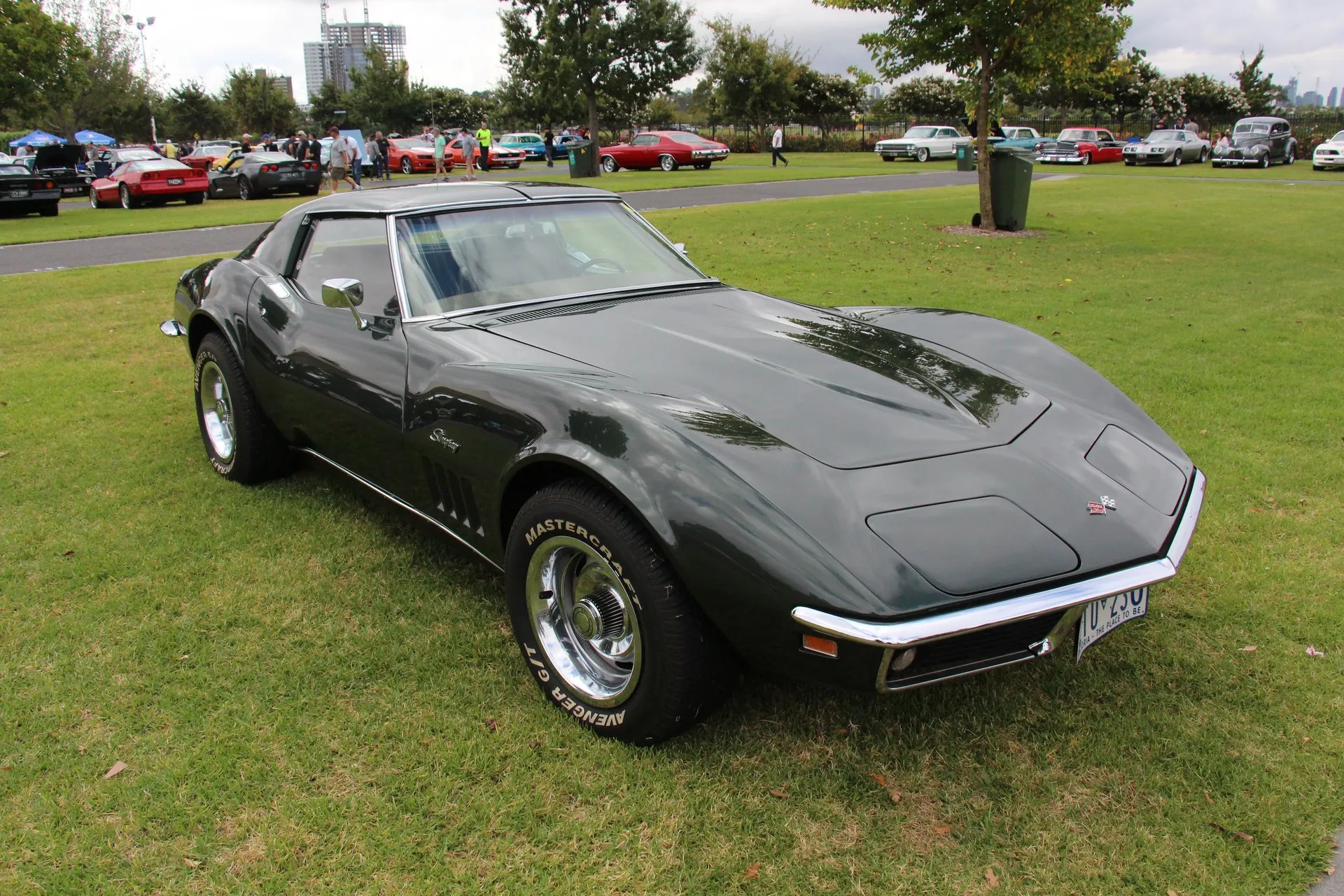
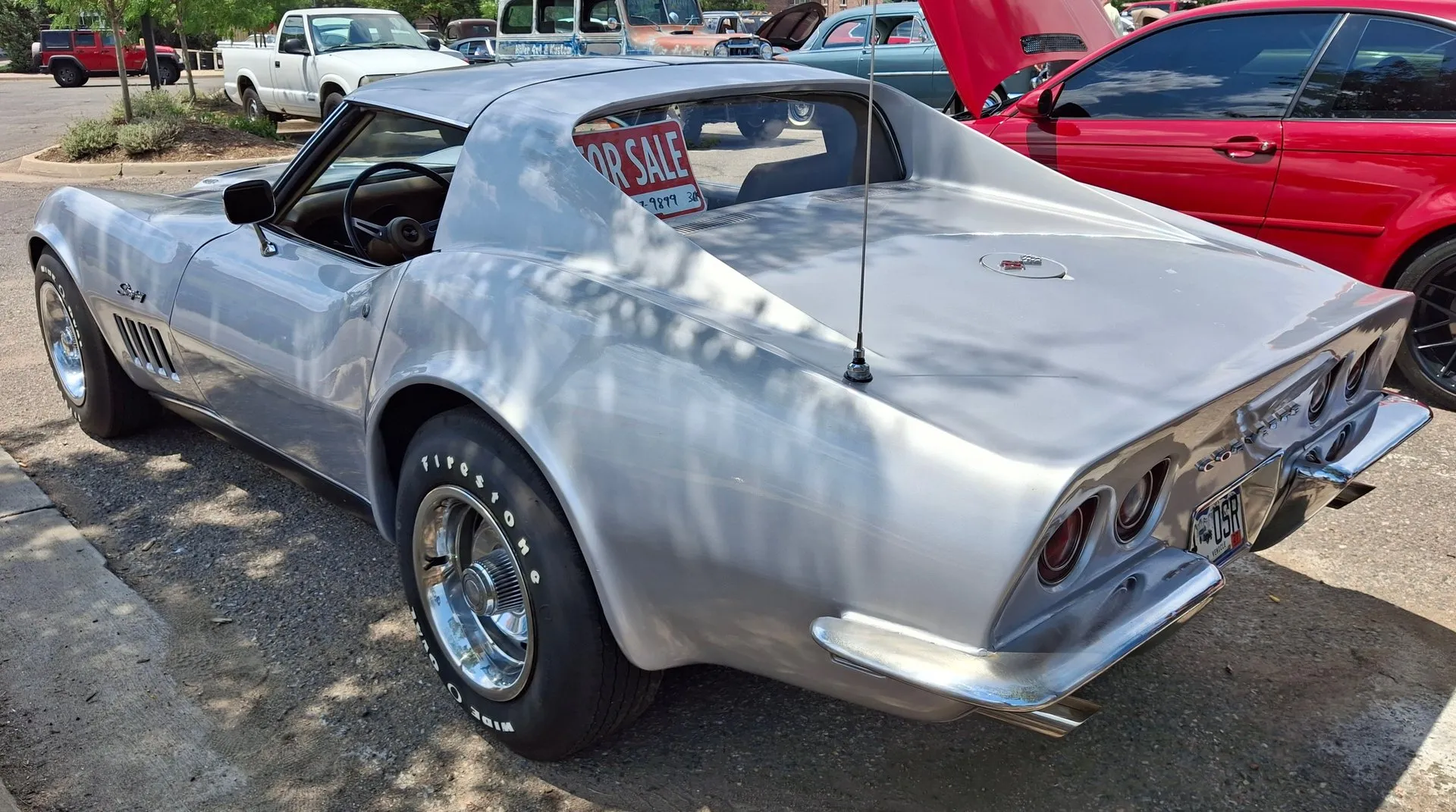
A Stingray script set above four vertical slots, just behind the front wheel: no other Corvette model year wears that pair. The 1968 had the slots but no name, and the 1970 kept the name but traded the slots for a new, bright-outlined louver. Chevrolet put the pair on all 38,762 cars it built for 1969, the second year of the C3 (1968–1982), and no Corvette model year topped that total until 1976.
Underneath sat the 1968’s body and frame, with a new small-block and a long list of small fixes. Every 1969 had a 350 or 427 V8, 300 to 435 hp gross on GM’s price list, and it started at $4,781 for a coupe, $4,438 for a convertible. The Corvette Black Book (a collector’s reference whose 1969 pages GM’s Heritage Center kit reproduces) counts 116 L88s and 2 ZL1s among them, two 427s that never made GM’s dealer price list.
The 38,762 were 22,129 coupes and 16,633 convertibles. On Bring a Trailer between January 1 and October 19, 2026, 1969s sold at a median $62,500 from 27 titled-stock sales, with big-blocks at $64,250 and small-blocks at about half that over twelve months.
Frame rust, birdcage rust (the birdcage is the steel cage around the cabin, inside the fiberglass) and vacuum headlights belong to the whole generation, and the C3 buyer’s guide covers them. This page stays on 1969, and its links into GM’s 1969 kit, in this site’s manual library, open at the page behind the figure.
C3 Key figures
- Built
- 38,762
- Coupes, convertibles
- 22,129 coupes and 16,633 convertibles
- Engines
- 350 or 427 V8, 300 to 435 hp gross
- L88 and ZL1
- 116 L88s and 2 ZL1s
- Price new
- $4,781 for a coupe, $4,438 for a convertible
- Last 1969 built
- December 1969
- Factory side exhaust
- 4,355 cars at $147.45
- Bring a Trailer, 2026
- median $62,500 from 27 titled-stock sales
Section 01
What GM changed for the second C3
GM’s 1969 standard equipment list, read against the 1968 kit’s own list, shows what changed:
- A 350 for the 327, in both small-block versions (4.00 in bore, 3.48 in stroke).
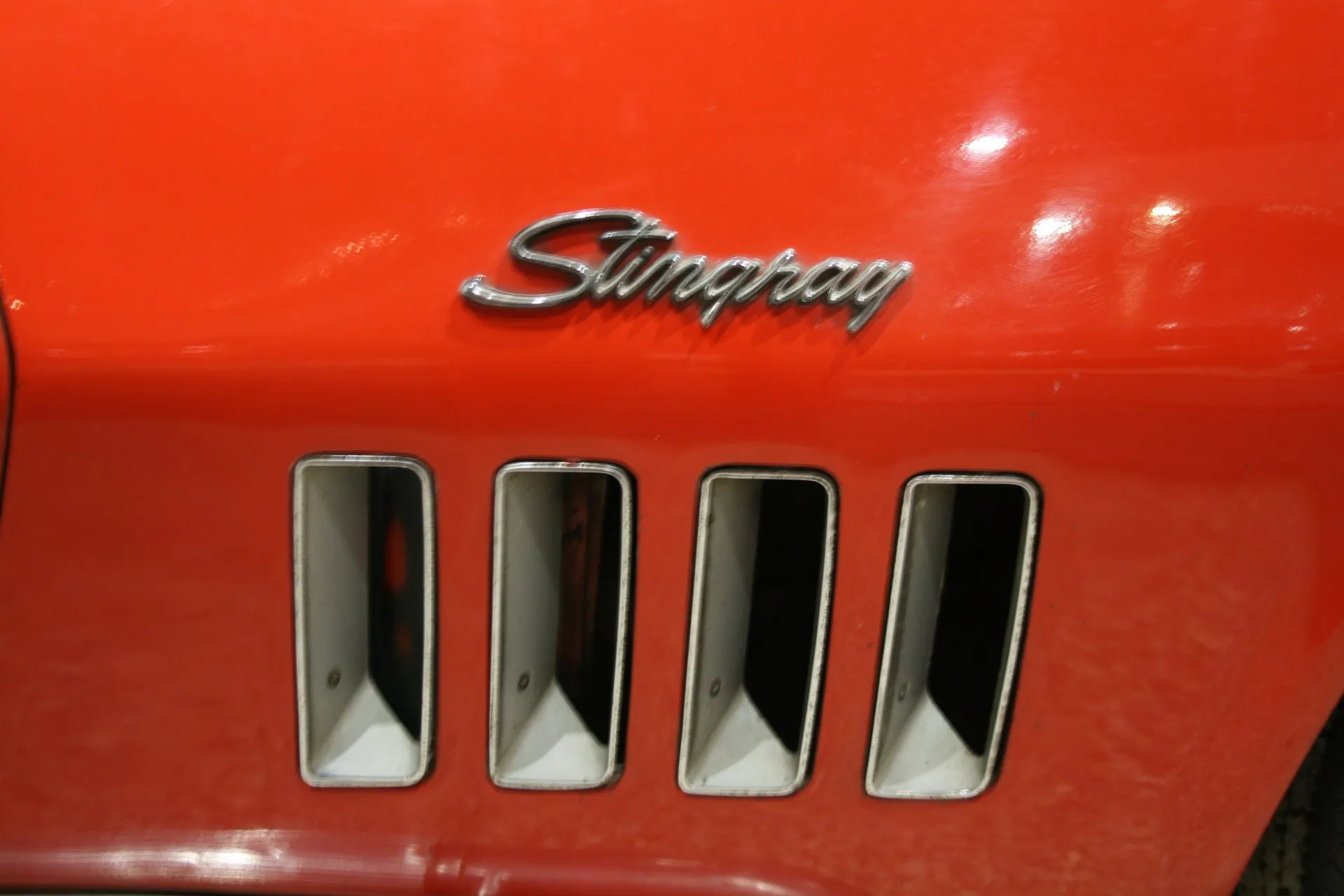
- A name on the fenders. The C2 (1963–1967) was a Sting Ray, the 1968’s list has no fender nameplate, and the one-word Stingray script ran from 1969 through 1976, as the generations guide explains.
- One-motion door handles. The 1968 paired its press-flap handle with a push-button key lock; on the 1969, Hagerty says, the flap released the latch itself and the button was gone.
- Headlamp washers for the hidden headlights, and 15 x 8 in wheels on F70 x 15 tires (GM’s exterior features page). Hagerty says the 1968’s wheels were 7 in wide.
- Back-up lamps moved into the inboard taillights, out of the 1968’s lower body panel.
- A locking steering column, on every 1969 Chevrolet: one key locked the ignition, steering and shifter, a buzzer warned of a key left in, and a new switch let an automatic start only in Park or Neutral and a manual only with the clutch pedal down (GM, page 73).
- Head restraints, a required option early in the year and then standard: all 38,762 had them, by the Black Book’s count.
- Side exhaust, RPO N14 (RPO is GM’s regular production option code), back as a factory option after a year’s absence.
Hagerty’s C3 buyer’s guide adds a frame stiffened to reduce chassis flex. Road & Track’s 1969 test, as summarized by Curbside Classic, also found a stiffer frame, but judged the assembly worse than on the 1968 it had tested.
Section 02
The record year that ran to December
Is a 1969 Corvette rare? Not as a model year. Chevrolet built 38,762, up from 28,566 for 1968, and the record stood until 1976’s 46,558 (see the production table in the C3 guide). Coupe output more than doubled: the 1968 run was 9,936 coupes and 18,630 convertibles (1968 kit). What’s rare on a 1969 is its options: 390 L89s, 116 L88s, 101 heavy-duty M22 four-speeds, 2 ZL1s.
Part of the record is time. The Black Book’s table in GM’s 1969 kit gives the last serial built each month, from September 1968 to December 1969, and skips May 1969 entirely. Its page in the 1971 kit explains: “A labor dispute in May 1969 caused 1969 production to run long,” cutting normal 1970 production by more than four months. Chevrolet’s own dealer bulletin 70-T-2 (opens in new tab), dated November 19, 1969, was still dealing with “late production 1969 Corvettes”.
| Built in | Serial numbers | Cars |
|---|---|---|
| By the end of September 1968 | 700001–703041 | 3,041 |
| October 1968 | 703042–706272 | 3,231 |
| November 1968 | 706273–709159 | 2,887 |
| December 1968 | 709160–711742 | 2,583 |
| January 1969 | 711743–714695 | 2,953 |
| February 1969 | 714696–717571 | 2,876 |
| March 1969 | 717572–720543 | 2,972 |
| April 1969 | 720544–721315 | 772 |
| May and June 1969 | 721316–723374 | 2,059 |
| July 1969 | 723375–725875 | 2,501 |
| August 1969 | 725876–728107 | 2,232 |
| September 1969 | 728108–730963 | 2,856 |
| October 1969 | 730964–734067 | 3,104 |
| November 1969 | 734068–736798 | 2,731 |
| December 1969 | 736799–738762 | 1,964 |
The serials are the Black Book’s; the counts are this site’s arithmetic from them. April 1969 added 772 cars and May and June together 2,059, against about 2,000 to 3,200 in every other month. Then the line kept going: 12,887 cars, a third of the year, came from August through December 1969, though the 1968 model’s run had ended in August 1968. The table gives no start month, only that the last 1969 was built in December 1969.
Section 03
Seven engines, from 300 hp to the ZL1
What engines did the 1969 Corvette have? Five on GM’s engine page and price list, two 350 small-blocks and three 427 big-blocks, plus the L88 and ZL1 from the Black Book. All are gross ratings, GM’s yardstick through 1971 (the C3 guide explains the switch to net).
| Engine | Build | Gross hp | Torque | Compression | Price | Built |
|---|---|---|---|---|---|---|
| Base 350 (no RPO code) | Four-barrel, hydraulic lifters | 300 at 4,800 rpm | 380 lb-ft at 3,200 rpm | 10.25:1 | Standard | About 10,470 (by subtraction) |
| L46 350 | Four-barrel, hydraulic lifters | 350 at 5,600 rpm | 380 lb-ft at 3,600 rpm | 11.0:1 | $131.65 | 12,846 |
| L36 427 | Four-barrel, hydraulic lifters | 390 at 5,400 rpm | 460 lb-ft at 3,600 rpm | 10.25:1 | $221.20 | 10,531 |
| L68 427 | Three two-barrels, hydraulic lifters | 400 at 5,400 rpm | 460 lb-ft at 3,600 rpm | 10.25:1 | $326.55 | 2,072 |
| L71 427 | Three two-barrels, mechanical lifters | 435 at 5,800 rpm | 460 lb-ft at 4,000 rpm | 11.0:1 | $437.10 | 2,722 |
| L89 | The L71 with aluminum heads | 435 | As L71 | As L71 | $832.05 | 390, among the L71s |
| L88 427 | Holley four-barrel, aluminum heads | 430 | Not given | See The L88 | $1,032.15 | 116 |
| ZL1 427 | The L88 with an aluminum block | 430 | Not given | Not given | $4,718.35 | 2 |
The five listed engines carry GM’s prices; the L89, L88 and ZL1 prices and every count are the Black Book’s. GM lists premium fuel for all five.
- The three-speed came only with the base 350, and the L46 only with a four-speed: GM offered the automatic with every other engine.
- Every 427 had Positraction, Chevrolet’s limited-slip differential (only a 350 could have an open one), and the high-domed hood GM lists for the 427 only. The 390, 400 and 435 hp engines also brought heavier front springs, a heavier front stabilizer bar, a rear one and a bigger radiator (GM, page 89).
- The L71 needed transistor ignition (RPO K66), took the close-ratio four-speed or the automatic, and couldn’t have air conditioning (GM’s power teams).
The big-blocks total 15,443, about 40 percent of the year (this site’s arithmetic). A 427 added 157 lb (L36) to 177 lb (L71) to a 3,245 lb base coupe, and the L89’s aluminum heads took 73 lb back off (GM, page 111). Road & Track’s 1969 test of a 435 hp coupe with aluminum heads, as summarized by Curbside Classic, ran 0–60 mph in 6.1 seconds and the quarter mile in 14.3 seconds at 98 mph, at about 10 mpg.
The L88: 116 cars
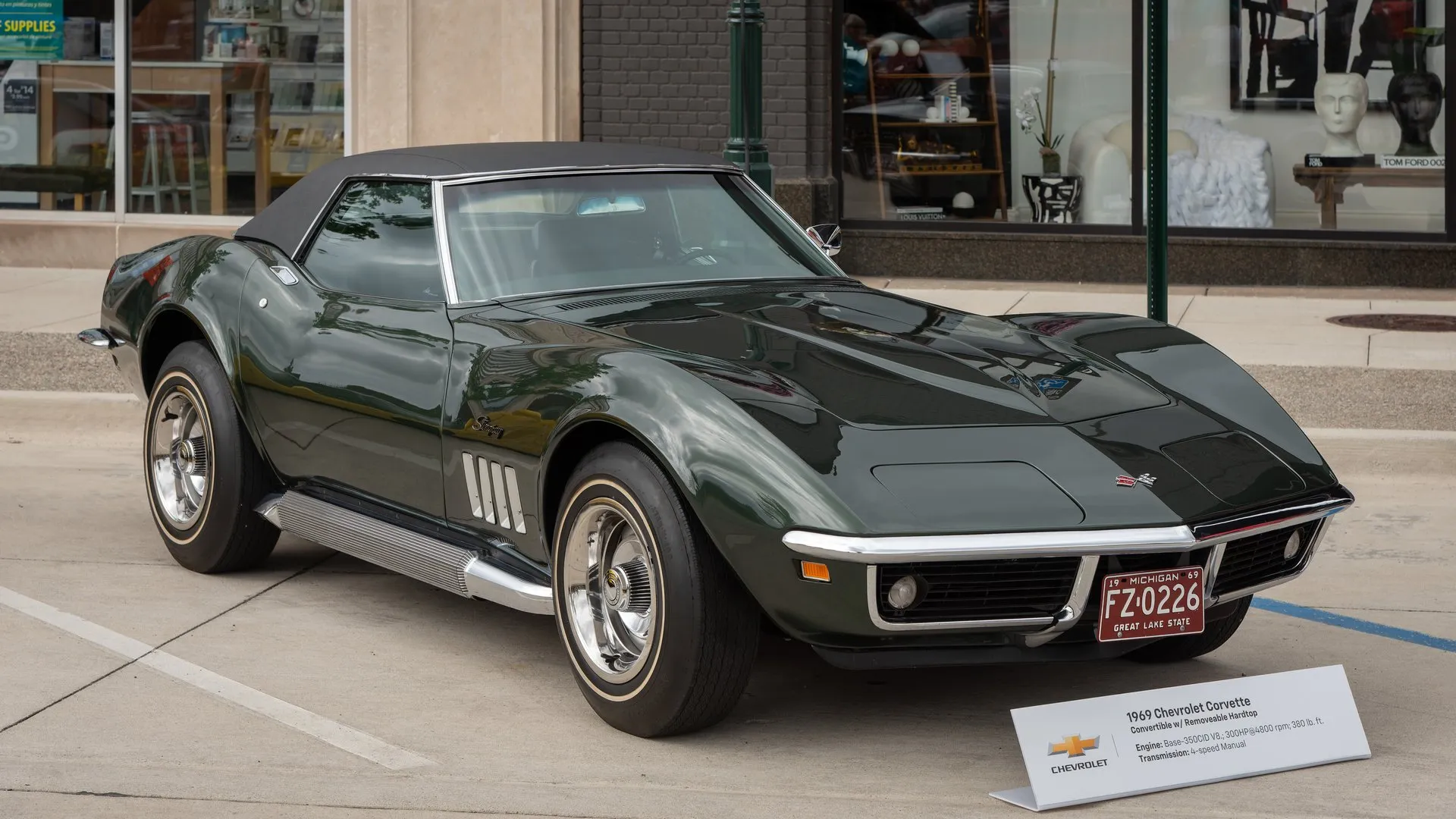
The L88 was a 427 with aluminum heads and one Holley four-barrel, rated 430 hp by the Black Book, which counts 116 for 1969 at $1,032.15, after 80 for 1968. Its compression depends on the source. GM, launching its 2027 LS6 V8, put the 1967–1969 L88 at 12.5:1 (the Grand Sport guide quotes it); Corvette Action Center agrees for the earlier cars but says open-chamber heads (casting 3946074) arrived around the middle of 1969, at 12.0:1. The two L88s Bring a Trailer sold in 2026 were listed at 12.0:1 and, for the one completed in April 1969, 12.5:1.
The ZL1: two cars and the C3 record
RPO ZL1 bought a “Special L88” with an aluminum block for $4,718.35, nearly the price of a whole coupe, and the Black Book counts 2, with engine suffixes ME (manual) and MG (automatic). Hagerty calls the ZL1 likely underrated and says the engine and its required options cost more than $5,000. A ZL1 convertible holds classic.com’s record for any C3: $3,140,000, on January 26, 2023. No source read for this guide says whether the two are also counted among the 116 L88s. A listing title proves nothing: in 2026, Bring a Trailer sold a “ZL1-Style” six-speed convertible for $93,000, and a “ZL1-Powered” coupe was bid to $115,000 without selling.
Section 04
Gearboxes, axles and the option sheet
GM’s transmission page gives the ratios; the counts are the Black Book’s:
| Gearbox | Ratios | Engines | Price | Built |
|---|---|---|---|---|
| Three-speed manual | 2.54, 1.50, 1.00 | Base 300 hp only | Standard | 252 (by subtraction) |
| M20 wide-ratio four-speed | 2.52, 1.88, 1.46, 1.00 | 300, 350, 390, 400 hp | $184.80 | 16,507 |
| M21 close-ratio four-speed | 2.20, 1.64, 1.27, 1.00 | 350, 390, 400, 435 hp | $184.80 | 13,741 |
| M22 heavy-duty close-ratio four-speed | Not in GM’s pages | 99 L88s, per Corvette Action Center | $290.40 | 101 |
| M40 Turbo Hydra-Matic three-speed automatic | Not in GM’s pages | All but the L46 | $221.80, or $290.40 with 435 hp | 8,161 |
Nearly four in five 1969s had a four-speed. A heavy-duty dual-disc clutch, RPO MA6 ($79.00, 102 cars), was required with the 435 hp engine and a four-speed on a 3.36 axle. Axle ratios ran from 2.73 to 4.56, and Positraction (G81, $46.35) went on 36,965 cars, 95 percent.
The options that matter, at GM’s prices with the Black Book’s counts:
| RPO | Option | Price | Built |
|---|---|---|---|
| U69 | AM-FM radio | $172.75 | 33,871 |
| A01 | Tinted glass | $16.90 | 31,270 |
| N40 | Power steering | $105.35 | 22,866 |
| J50 | Power brakes | $42.15 | 16,876 |
| UA6 | Alarm | $26.35 | 12,436 |
| TJ2 | Front fender louver trim | $21.10 | 11,962 |
| C60 | Air conditioning | $428.70 | 11,859 |
| N37 | Tilt-telescopic steering column | $84.30 | 10,325 |
| A31 | Power windows | $63.20 | 9,816 |
| P02 | Full wheel covers | $57.95 | 8,073 |
| C07 | Hardtop for the convertible | $252.80, or no charge in place of the soft top | 7,878 |
| K66 | Transistor ignition | $81.10 | 5,702 |
| N14 | Side-mount exhaust | $147.45 | 4,355 |
| U79 | AM-FM stereo | $278.10 | 4,114 |
| Genuine leather seats | $79.00 | 3,729 | |
| F41 | Special front and rear suspension | $36.90 | 1,661 |
| J56 | Special heavy-duty brakes | $384.45 | 115 |
Side pipes, the only C3 year with them
The factory side exhaust, RPO N14, went on 4,355 cars at $147.45, about one in nine. The 1968 list offered only an N11 off-road exhaust, and N14 is gone from the 1970 list, so 1969 is the only C3 year with side pipes from the factory, though the C2 offered N14 for 1965–1967. Pipes bolt on, so only a car’s paperwork proves it left St. Louis with them.
Ten colors and six interiors
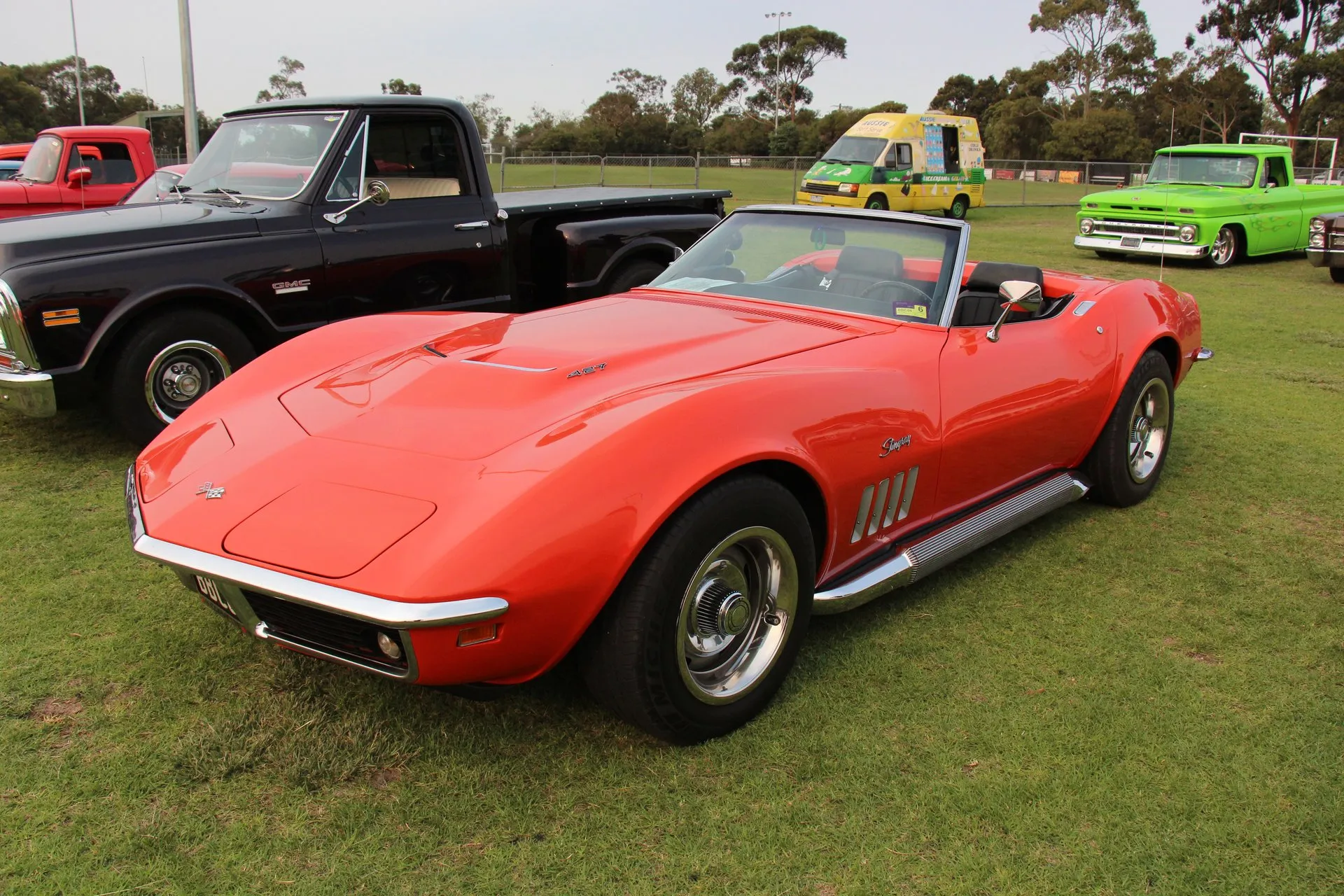
Every paint cost nothing extra: Tuxedo Black (900), Can-Am White (972), Monza Red (974), LeMans Blue (976), Riverside Gold (980), Fathom Green (983), Daytona Yellow (984), Cortez Silver (986), Burgundy (988) and Monaco Orange (990), with a black, white or beige soft top on any of them. The Black Book gives no color counts, so the kit can’t name the rarest 1969 color, and it calls 990 Monaco Orange, whatever one owner-built decoder says. Black left the list for 1970.
Inside, vinyl was standard and genuine leather cost $79.00, in black, bright blue, green, gunmetal, red or saddle. GM’s interior features page lists a 7,000 rpm tachometer, an ammeter and temperature, fuel and oil pressure gauges, warning lights for the seat belts, a door ajar and the headlights, and the parking brake on the console.
Size and weight. GM’s dealer specifications give a 98.0 in wheelbase, 182.5 in length, 69.0 in width, 47.8 in coupe height, a 20-gallon tank and curb weights of 3,245 lb for the coupe and 3,250 lb for the convertible with the base engine. Two more GM pages agree; the service manual’s 3,210 and 3,220 lb are the odd ones out.
Section 05
The 1969 VIN, trim tag and engine pad
The serial number is 194379S for a coupe or 194679S for a convertible, then a unit number from 700001 to 738762: 1 for Chevrolet, 94 for Corvette, 37 or 67 for the body, 9 for 1969 and S for St. Louis (the Black Book page; Corvette Action Center). One owner-built decoder on CorvetteForum prints 100001 to 138762, with its author’s own warning about accuracy. Trust the kit. The unit number dates the car, by the table in The record year that ran to December, but it never names the engine: owners say GM keeps no serial-to-engine records for these cars (CorvetteForum, 2017).
Where GM put the numbers (GM’s service manual page): the serial plate on top of the instrument panel at the left front; the body, trim and paint plate (the trim tag) on the upper left door hinge pillar; the serial derivative, a short form of the serial, on a pad at the front right of the block, on a Muncie four-speed’s case and on a Turbo Hydra-Matic’s converter flange; and the axle code on the bottom of the carrier.
The engine pad also carries an engine-plant letter (owners read V for Flint and T for Tonawanda), the assembly month and day and a two-letter suffix (CorvetteForum, 2006). The Black Book’s 1969 suffixes:
| Engine | Suffixes |
|---|---|
| Base 350, 300 hp | HY (manual), HZ (automatic) |
| L46 350, 350 hp | HW; HX with air conditioning; GC with transistor ignition; GD with both (all manual) |
| L36 427, 390 hp | LM, MH (manual); LL, MI (automatic) |
| L68 427, 400 hp | LQ, MK (manual); LN, MJ (automatic) |
| L71 427, 435 hp | LR, LT (manual); LX (automatic) |
| L89, aluminum heads | LP, LU (manual); LW (automatic) |
| L88 | MR, LO (manual); LV (automatic) |
| ZL1 | ME (manual), MG (automatic) |
The page labels only MR and LV as L88s; LO is listed as a 430 hp manual, which makes it an L88 code by inference. And a documented L88 convertible completed in April 1969, sold on Bring a Trailer in 2026, carries IT, the 1968 L88 code. Treat the list as a guide, not a pass-or-fail test.
The trim tag’s build date is a month letter, A for August 1968 through Q for December 1969, by owners’ reading (CorvetteForum, 2014 and 2016). Posters in a 2016 CorvetteForum thread (opens in new tab) say the G on February 1969 tags lost its crossbar and reads as a C, and one says a crisp February G points to a reproduction tag.
Repainted cars often got new tags (CorvetteForum, 2013). The National Corvette Restorers Society (NCRS) counts changing a tag to make a repaint look original as counterfeiting (opens in new tab), as it does numbers stamped on a big-block swapped into a small-block car.
Signs a 1969 has been changed
- A domed hood on a 350, since GM lists it for the 427 only, or door panels from another year (CorvetteForum, 2011).
- A tach redline that doesn’t fit: 5,600 rpm on the 390 and 400 hp 427s, 6,000 on the L46, per a poster checking a 2023 listing whose console tag and tach disagreed (CorvetteForum).
- An automatic behind an L46, which GM never offered (AMA specification page).
- Flared wheel openings or rectangular exhaust outlets. Flares came with the 1970 body (1970 kit), and posters spotted a later rear clip on one black 1969 coupe by its rectangular exhaust cutouts, a sign of accident repair (CorvetteForum, 2013).
- A later engine. A first-time buyer’s $18,000 1969 turned out to have a 1970 350, and posters said a car without its original engine shouldn’t be priced as a collector car (CorvetteForum, 2011).
L88 and ZL1 claims
An L88 sells for more than ten times an L71, and the claims outnumber the cars. “For every real L88, there’s at least few dozen fakes (opens in new tab),” one poster wrote in 2003. The parts on owners’ L88 lists (the M22, transistor ignition, J56 calipers, a single fuel line, a radio delete plate, a 6,500 rpm tach) came with other options too, and the console plate and octane sticker are cheap reproductions (CorvetteForum, 2006 and 2017).
Paper decides. The tank sticker, the build sheet usually glued to the top of the fuel tank (Corvette Action Center forum, 2003), is “the only real way to verify” by one poster’s account (CorvetteForum, 2017), and since documents get reproduced too, owners point to NCRS’s document checks and shipping records (CorvetteForum, 2013). Bring a Trailer’s two 2026 L88s had files to match: the $860,000 coupe a tank sticker, a Protect-O-Plate (GM’s warranty identification plate), NCRS and Bloomington Gold awards and over 250 pages; the $850,000 convertible its window sticker, an NCRS Shipping Data Report and an engine-pad certificate. BaT withdrew another L88-titled convertible in May, and one more was bid to $430,000 in October without selling.
Section 06
What went wrong in 1969, by Chevrolet’s bulletins
Chevrolet’s 1969 service paper, read from Corvette Action Center’s transcriptions (the originals weren’t seen for this guide), names the year’s own faults:
- Headlamp doors stuck shut at speed (bulletin 69-T-31 (opens in new tab), May 6, 1969). Wind could bend the plastic headlamp shield until it caught the bezel, leaving the warning lamp lit; slowing down and cycling the switch opened them. The fix was revised shields,
3966559left and3966560right (OEM). - Four-speed speedometer cables kinked at the transmission end; a cable 5 in longer, with a set routing, went into production (engineering letter #1106).
- The alternator’s battery terminal could touch the left rocker cover and short on early 427s with power steering; dealers turned the end frame 90 degrees (Service News, January 1969).
- Dead batteries. The 1969 alternator, with its regulator built in, drew 5 to 10 milliamperes all the time, which fooled the usual drain test, and a January 3, 1969 zone letter admits that “doesn’t explain all of the dead batteries”. Regulator
1116387(OEM) later serviced 1969 units, with its locating pin filed off. - Chokes on late 350s (70-T-2, November 1969): hard starts or stalling from a choke that didn’t close. A new coil went into production in September 1969, and coils marked BI or BJ were replaced with
3973497(OEM). - Water in the fuel tank, past the gas cap, when the filler seal’s drain hose kinked; check it along the right-hand bumperette brace (engineering letter #1092, 1968–1969).
- Telltale odometers (Service News, April 1969). Chevrolet’s 1969 odometers don’t run backward, and on vehicles built after January 1, 1969 (Corvette serials above 711742, by this site’s reading of the build table), forcing the first or second figure wheel breaks a plastic strip and shows white. Dust-clogged odometers were later replaced under bulletin 70-T-27, so an intact strip is a clue, not proof.
- Wipers that wouldn’t park after a load of snow or ice, when the motor shaft’s retaining ring popped out; the 1971 shaft and ring,
4960192(OEM), fixed 1968–1970 cars (70-T-59, May 1971).
NHTSA, the US road safety agency, has no owner complaint on file for the 1969, but its complaint file only starts in September 1994. Its one GM recall, 69V001000 (opens in new tab), reported July 8, 1969 for 4,420 vehicles, covered front seat belts that could seem latched with the tongue in upside down or let go in a severe side impact, and seat-back lock forks that could break; the remedy was new belts and, where needed, new forks. A 2003 campaign covers Cardone remanufactured rear calipers (aftermarket) sold for 1965–1982 Corvettes.
The rest is the generation’s: frame and birdcage rust, leaks, vacuum headlights, calipers and rear bearings, all in the C3 buyer’s guide.
Section 07
Checking a 1969 before money changes hands
- Rust first: frame, birdcage and body mounts, checked as the C3 guide explains. A CorvetteForum administrator who had bought several 1969 roadsters said most have some windshield-frame rot, fixable but a reason to look harder at the cage, and that rotted rear frame kick-ups make a car “not really repairable” (2010). On coupes, leaking roof panels send water down the windshield pillars to the front body mounts, so pull the kick panels, the trim by your feet (CorvetteForum, 2019).
- Serial, trim tag and pad agree: the build month from the serial, the tag’s month letter and an engine assembly date ahead of the car’s.
- The suffix fits the hardware: hood, tach redline, console tag, gearbox and, on a 427, a Positraction axle.
- A 1969 body: four fender slots, round exhaust outlets, no flares.
- Headlamp doors after a highway run: they open, and the warning lamp goes out (69-T-31).
- Speedometer and odometer: the cable routing on a four-speed, and the telltale strip on a car built from January 1969.
- On a 427 with power steering, clearance between the alternator’s battery terminal and the left rocker cover, and the battery’s history.
- A cold start on a late 350, for the choke.
- The fuel filler, for a kinked drain hose and water in the tank.
- Paper for every premium: an L88, ZL1, L89 or L71, or factory side exhaust, needs a tank sticker, window sticker or NCRS shipping report. Price the car as what the paper proves.
- An inspection on a lift, by someone who knows 1969s.
Section 08
2026 money, small-block to L88
How much is a 1969 Corvette worth? From the mid-$20,000s for a small-block to $860,000 for a documented L88, before anyone gets to a ZL1. On Bring a Trailer (opens in new tab), 32 of the 45 1969s listed between January 1 and October 19, 2026 sold, at a median of $58,000; 12 didn’t sell and BaT withdrew one. Leave out the five titled as modified and it’s a median $62,500 from 27 titled-stock sales. These are this site’s figures from each sold price, without BaT’s 5 percent buyer’s fee. “Titled stock” means the title doesn’t call the car modified or a project; no title shows a restamped pad.
| 1969s sold on Bring a Trailer, Jan. 1 to Oct. 19, 2026 | Sales | Median | Range |
|---|---|---|---|
| Titled stock | 27 | $62,500 | $26,000–$860,000 |
| Titled-stock coupes | 14 | $68,250 | $36,500–$860,000 |
| Titled-stock convertibles | 13 | $60,000 | $26,000–$850,000 |
| Big-blocks | 24 | $64,250 | $36,500–$860,000 |
| L36 427/390 | 7 | $45,500 | $43,930–$56,000 |
| L68 427/400 | 2 | $63,500 and $65,000 | |
| L71 427/435 | 6 | $78,500 | $73,000–$116,000 |
| L89 | 1 | $139,000 | |
| L88 | 2 | $850,000 and $860,000 | |
| Small-blocks, Oct. 19, 2025 to Oct. 19, 2026 | 7 | $33,000 | $24,251–$44,500 |
| Modified | 5 | $38,375 | $26,500–$93,000 |
Only three small-blocks sold in 2026 (convertibles at $26,000, $33,000 and $41,000), so their row covers twelve months. The L89 was an LP-suffix coupe with NCRS Top Flight awards. In 2025, titled-stock 1969s brought a median $41,500 (28 sales), big-blocks $72,000 (11) and small-blocks $32,900 (17). Samples of six or seven are market color, not a valuation.
Can you buy a 1969 Corvette for under $10,000? Not on Bring a Trailer lately. Nothing from 1969 sold there for less than $26,000 in 2026, and five cars bid to between $17,000 and $21,750 didn’t sell. The cheapest sale since August 2024 was a $4,000 project coupe in primer, with a replacement 350 and an automatic, in September 2024.
Hagerty’s price guide (opens in new tab), as captured by the Internet Archive, put a condition #3 (Good) L46 coupe at $32,100 in January 2026, up from $29,500 a year earlier, and in October 2025 a base 300 hp coupe at $24,100, an L36 convertible at $40,300 and an L89 coupe at $86,000.
classic.com’s February 2026 benchmark for 1968–1969 L88s was $345,143, but its L88 sales go as low as $39,500, for a 1969 convertible in June 2025, so the figure mixes documented cars with claimed ones. Its L89 benchmark was $131,134. Bring a Trailer, Hagerty and classic.com each measure something different, over different dates, so don’t average them.
Section 09
What the 1970 dropped
The 1970 was built only from January to July 1970, 17,316 cars, and it took away much of what set the 1969 apart (the Black Book pages in GM’s 1970 kit, page 4 and page 5):
- No side exhaust, L88, ZL1 or black paint on the lists, and the big-block grew from 427 to 454 cubic inches.
- Flared wheel openings, which the Black Book says were meant to cut the damage debris thrown by the wheels did to 1968–1969 bodies, and a new louver in place of the four slots.
- A higher price, $5,192 for the coupe and $4,849 for the convertible, with a four-speed, Positraction and tinted glass now in the base price.
The 1970 did add the 370 hp LT1 small-block. The C3 guide has the rest of the run, and the best Corvette years guide picks 1968–1972 as the C3s for looks.
Section 10
Which 1969 to buy: the 390 hp 427
Buy an L36 427/390 with a four-speed. The 1969 is a big-block year, with a 427 in four cars of every ten, and the L36 is the easy one to live with: hydraulic lifters, one Rochester four-barrel, 460 lb-ft at 3,600 rpm and the domed hood. In 2026 it sold for a median $45,500 on Bring a Trailer (7 sales), $33,000 under the L71 and about $12,500 over the small-blocks’ twelve-month median, and Hagerty’s #3 L36 convertible stood at $40,300 in October 2025. Look for an LM or MH suffix, a Positraction axle and a tach and hood that match. Coupe or convertible is taste: the coupe’s roof panels and rear window both come out.
For the full 435 hp, an L71 or an L89: a $78,500 median (6 sales), with the one 2026 L89 at $139,000. Mechanical lifters, three two-barrels and no air conditioning; the strongest 1969 that doesn’t need an L88’s file.
On a budget, a base 350 or an L46 four-speed. Small-blocks brought a median $33,000 over the last twelve months (7 sales), and Hagerty’s #3 coupes run $24,100 to $32,100. A car with a replacement engine is the one to build up: its numbers are already gone, so nothing original is lost when it gets the cam, gears and brakes it wants.
Leave the L88 and the ZL1 to the paper. With the documents, they’re another market; without them, pay for what the car can prove.
Whichever it is, the frame and birdcage come first, then the numbers. Get both right and you’re driving the year America’s sports car outsold every Corvette before it: Stingray on the fenders, slots behind the wheels and, in an L36, 460 lb-ft waiting at the bottom of a long on-ramp. The 1980 Corvette guide covers the other end of the C3 run.
Section 11
Sources
- GM Heritage Center: 1969 Corvette vehicle information kit files.zipcorvette.com This site's library. Corvette Black Book pages GM reproduced in the kit: production, serial range, engine suffixes, castings, carburetors and the last serial built each month (PDF page 4); options with prices and counts, colors and interiors (page 5). GM's own pages: Chassis Service Manual identification and dimensions (10), the anti-theft column lock (73), the dealer price list (77), exterior and interior features (78, 79), exterior features and identification, with the fender script over the four slots (80), engine specifications (88), transmissions and engine equipment (89), specifications (96), standard exterior equipment (103), dimensions and weights, September 1968 (111), and the AMA specification forms issued October 15, 1968: power teams (144), transmissions (157).
- GM Heritage Center: 1970 Corvette vehicle information kit files.zipcorvette.com This site's library. Black Book pages: what changed for 1970 and its January to July production (PDF page 4); 1970 prices, the base car, options and colors, with no side exhaust, L88, ZL1 or black paint (page 5). GM's pages: new features for 1970, including bright-outlined front fender louvers (79), and the exterior features album, with the Stingray script on its drawings of the 1970 cars (84).
- GM Heritage Center: 1971 Corvette vehicle information kit files.zipcorvette.com This site's library. Black Book page on the May 1969 labor dispute that ran 1969 production long (PDF page 4).
- GM Heritage Center: 1968 Corvette vehicle information kit files.zipcorvette.com This site's library. GM's exterior equipment list of September 1967, with no fender nameplate and the back-up lamps in the lower body panel (PDF page 5). Black Book page: 1968 production by body, the last 1968 serials (August 1968) and an option list with no side exhaust (page 136).
- GM: Deep dive, the 2027 Corvette's next-generation V8 (opens in new tab) web.archive.org March 26, 2026, Internet Archive copy. Puts the 1967–1969 L88's compression at 12.5:1.
- Chevrolet Dealer Service Technical Bulletin 69-T-31: headlamp opening interference, May 6, 1969 (via Corvette Action Center) (opens in new tab) corvetteactioncenter.com Transcriptions of Chevrolet's dealer paper on Corvette Action Center are not GM originals.
- Chevrolet Engineering Service Letter #1106: speedometer shaft failure, 1969 Corvette with four-speed (via Corvette Action Center) (opens in new tab) corvetteactioncenter.com
- Chevrolet Service News, January 1969: alternator battery terminal contacting the rocker cover (via Corvette Action Center) (opens in new tab) corvetteactioncenter.com
- Chevrolet zone letter, January 3, 1969: the 1969 alternator with integrated voltage regulator (via Corvette Action Center) (opens in new tab) corvetteactioncenter.com Also Chevrolet Engineering Center letter 70-9 26 on integrated regulator failures (opens in new tab), regulator 1116387.
- Chevrolet Dealer Service Technical Bulletin 70-T-2: choke problems, November 19, 1969 (via Corvette Action Center) (opens in new tab) corvetteactioncenter.com Covers late production 1969 Corvettes with the 300 and 350 hp engines.
- Chevrolet Engineering Service Letter #1092: water entry into the fuel tank, 1968–1969 Corvette (via Corvette Action Center) (opens in new tab) corvetteactioncenter.com
- Chevrolet Service News, April 1969: anti-reversing and telltale odometers (via Corvette Action Center) (opens in new tab) corvetteactioncenter.com Covers 1969 Chevrolets in general. Also 70-T-27, odometer failures (opens in new tab), April 30, 1970.
- Chevrolet Dealer Service Technical Bulletin 70-T-59: wipers unable to park, May 5, 1971 (via Corvette Action Center) (opens in new tab) corvetteactioncenter.com 1968–1970 Corvettes.
- NHTSA owner complaints, 1969 Chevrolet Corvette (opens in new tab) api.nhtsa.gov Pulled October 19, 2026: none on file. NHTSA's complaint file begins in September 1994.
- NHTSA recalls, 1969 Chevrolet Corvette (opens in new tab) api.nhtsa.gov Pulled October 19, 2026: GM campaign 69V001000 (opens in new tab) (seat belts and seat-back lock forks, 4,420 vehicles) and aftermarket campaign 03E032000 (opens in new tab) (Cardone calipers).
- Corvette Action Center: 1969 Corvette production and options (opens in new tab) corvetteactioncenter.com Fetched October 18, 2026. Also its 1969 identification page (opens in new tab) (serial digits, ZL1 block casting) and its L88 production (opens in new tab) and engine (opens in new tab) pages.
- Hagerty: 1968–82 Chevrolet Corvette (C3) buyers guide (opens in new tab) hagerty.com Sajeev Mehta, May 13, 2020, updated June 24, 2022. Read via the Internet Archive's June 2025 copy (opens in new tab).
- Hagerty valuation tool: 1969 Chevrolet Corvette L46 coupe (opens in new tab) web.archive.org Internet Archive copy of February 16, 2026: #3 (Good) value $32,100 on the graph dated January 2026, and the series before it. October 2025 #3 values from other captures: base coupe (opens in new tab), L36 convertible (opens in new tab), L89 coupe (opens in new tab).
- classic.com: Chevrolet Corvette L88 (C3) market (opens in new tab) web.archive.org Internet Archive copy of February 13, 2026. Also the L89 market (opens in new tab) (February 9, 2026) and the C3 market (opens in new tab) with its record sale (February 8, 2026).
- Bring a Trailer: Chevrolet Corvette C3 results (opens in new tab) bringatrailer.com 1969 listings from August 2024 to October 19, 2026. Counts and medians are this site's, from each listing's sold price without the buyer's fee. Listings cited: the L88 coupe (opens in new tab), the L88 convertible (opens in new tab), the L89 coupe (opens in new tab), the withdrawn L88-titled convertible (opens in new tab) and the $4,000 project coupe (opens in new tab).
- Curbside Classic: Vintage R&T road test, 1969 Corvette 427/435 (opens in new tab) curbsideclassic.com Paul Niedermeyer, December 15, 2022, summarizing Road & Track's 1969 test. The original issue wasn't seen for this guide.
- NCRS: judging awards (opens in new tab) ncrs.org Flight judging and NCRS's examples of counterfeiting. Fetched October 18, 2026.
- CorvetteForum thread: what to look out for when buying a 1969 (opens in new tab) corvetteforum.com February 2010.
- CorvetteForum thread: what to look for in buying a 1969 coupe (opens in new tab) corvetteforum.com May to June 2019.
- CorvetteForum thread: advice on buying a '69 (opens in new tab) corvetteforum.com August 2011.
- CorvetteForum thread: 69 C3 questions (opens in new tab) corvetteforum.com October 2013. A later rear clip on a 1969 coupe.
- CorvetteForum thread: first thoughts on two 1969s for sale (opens in new tab) corvetteforum.com April 2023. Tachometer redlines.
- CorvetteForum thread: 1969 serial number against trim tag date (opens in new tab) corvetteforum.com December 2013.
- CorvetteForum thread: 1969 trim tag and VIN question (opens in new tab) corvetteforum.com June 2016 to January 2020. Trim tag month letters and the February 1969 G.
- CorvetteForum thread: trim tag date codes (opens in new tab) corvetteforum.com February 2014.
- CorvetteForum thread: 1969 VIN codes (opens in new tab) corvetteforum.com May 2006. A member's decoder, with his own accuracy warning.
- CorvetteForum thread: L88 identification (opens in new tab) corvetteforum.com May 2017.
- CorvetteForum thread: how to identify an L88 (opens in new tab) corvetteforum.com July 2006.
- CorvetteForum thread: hard-to-clone L88 parts (opens in new tab) corvetteforum.com September 2003.
- CorvetteForum thread: C3 document authentication (opens in new tab) corvetteforum.com February to March 2013.
- Corvette Action Center thread: factory roll-out for a 1969 (opens in new tab) forums.corvetteactioncenter.com September 2003. Where the build sheet sits.