C3 · Buying guide
1968 Corvette guide: the first shark, its 327s and 427s, the first-year fixes and what to pay
Published
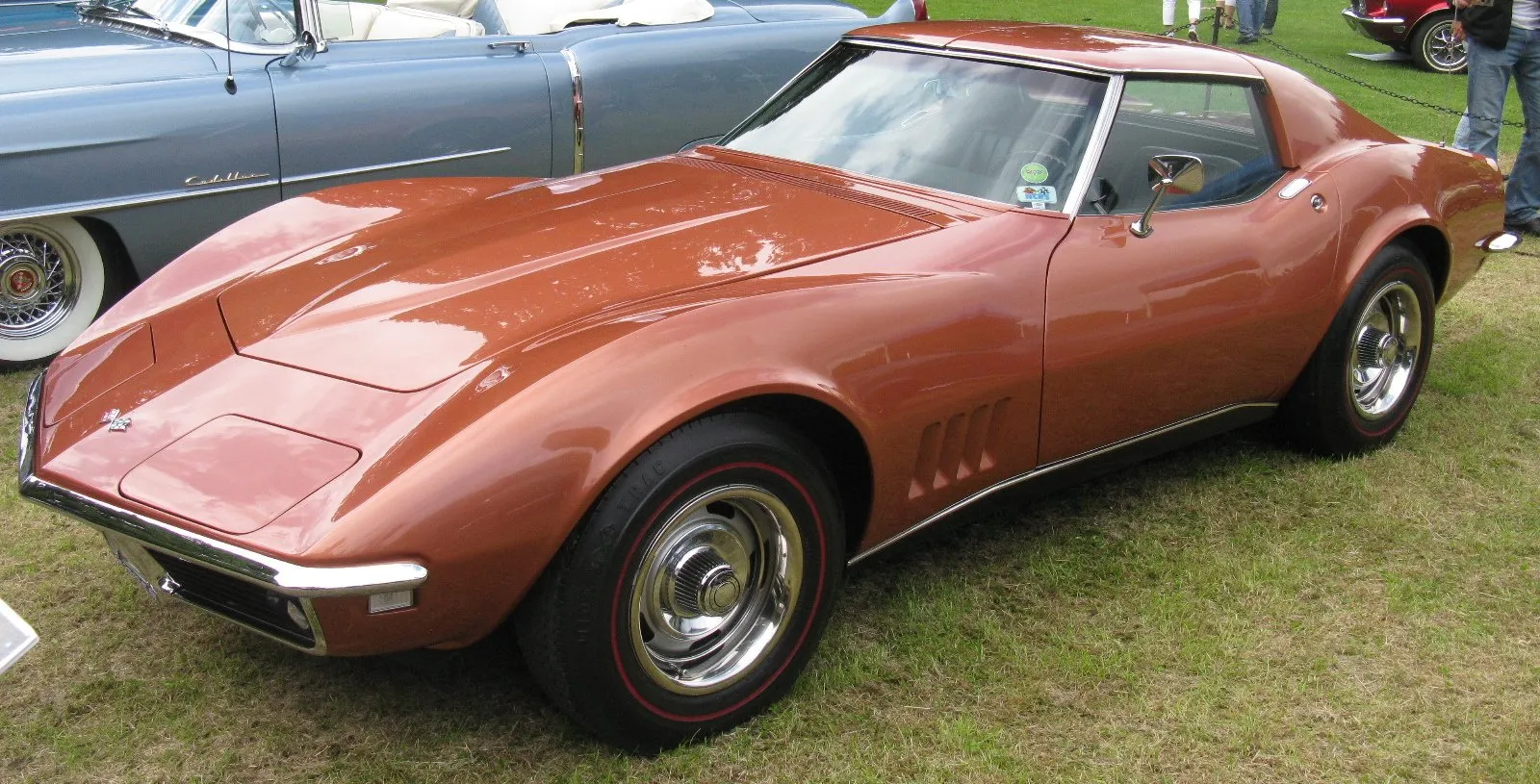
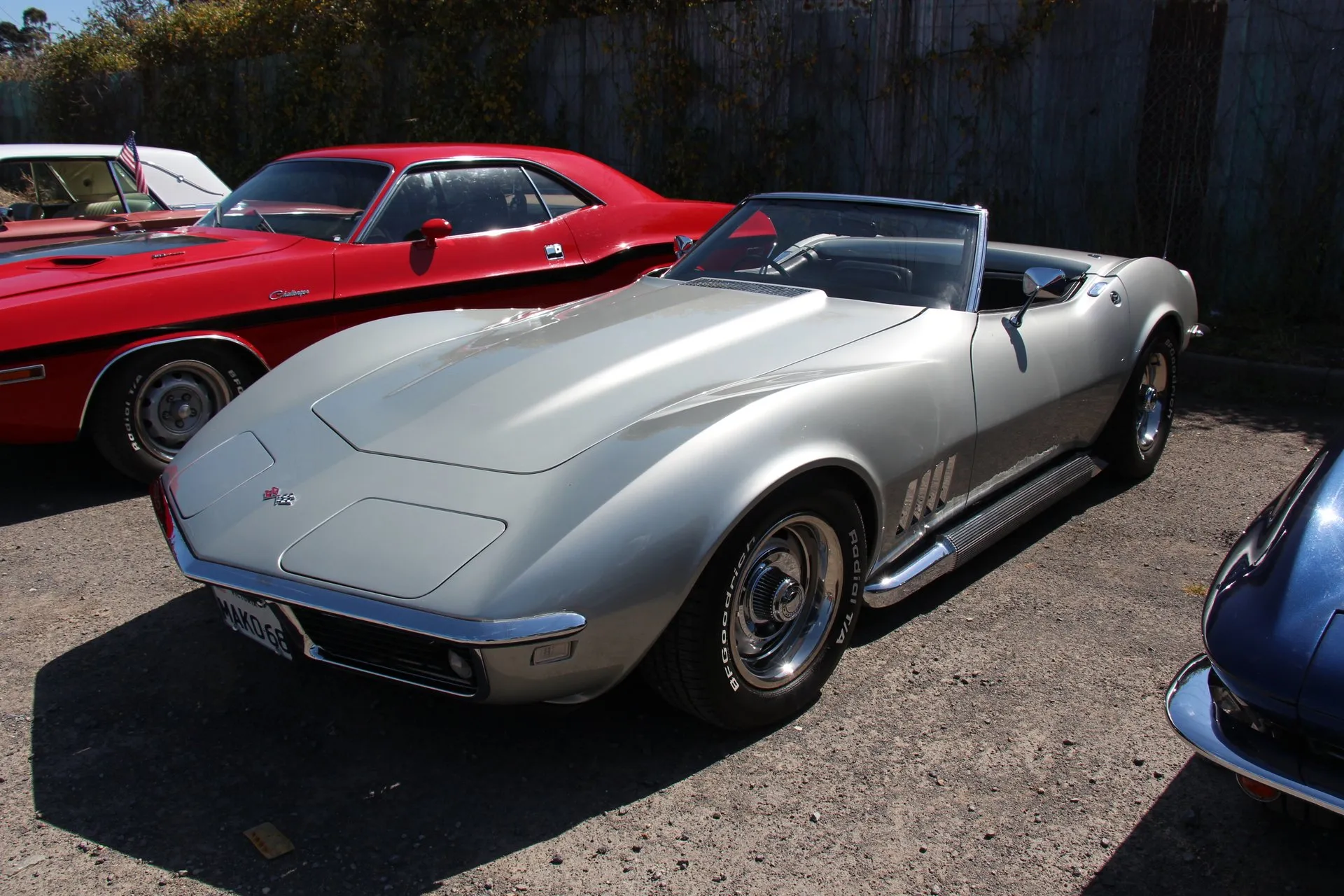
By one insider’s account, the 1968 Corvette coupe was first designed with a one-piece lift-off roof and no T-bar, and the prototypes showed it wouldn’t do. John Hinckley, a GM employee in Chevrolet’s Corvette group at the St. Louis plant as production of the first C3 (1968–1982) began, wrote that the body and frame twisted so much that the panel was nearly impossible to remove or refit unless the car was parked on dead-flat ground. The last-minute fix, he wrote, added the T-bar, split the roof into two panels and took new birdcage members, weatherstrips and tooling, none of it ready until late January 1968. Until then, St. Louis built convertibles and nothing else: the first five months of production, about 10,000 cars. Hinckley was answering a letter in Corvette Enthusiast’s December 2009 issue, and Corvette Action Center publishes his reply (opens in new tab).
The figures in GM’s kit fit his story. The Corvette Black Book (a collector’s reference whose 1968 pages GM reproduced in its Heritage Center kit) counts 28,566 cars: 9,936 coupes and 18,630 convertibles. Its month-by-month serials put the 10,386th car at the end of January 1968. By this site’s count, no Corvette model year through 1975 built more convertibles.
The 1968 put a long-nosed shark body over the running gear of the last C2 (1963–1967), with 327 and 427 V8s, 300 to 435 hp gross. Hagerty says first-year build quality problems plagued it; Chevrolet’s own dealer bulletins say which ones, and when each was fixed.
- How many were made? 28,566, all at St. Louis, 5,626 more than the 1967.
- Price new: $4,663 coupe, $4,320 convertible, before options.
- What engines? A 327 at 300 or 350 hp, a 427 at 390, 400 or 435 hp, and the L88: 80 built, rated 430 hp by the Black Book.
- Is a 1968 a Stingray? Not by its badges: GM’s 1968 equipment list has no fender nameplate, and the script came for 1969. Its brochures did use the name, as the generations guide explains, spellings and all.
- What’s one worth? On Bring a Trailer from January 2025 to October 19, 2026: median $34,500 from 35 titled-stock sales (see What a 1968 brings in 2026).
- Which to buy? A complete small-block convertible with its one-year parts; the last section says why.
The C3 buyer’s guide covers what every C3 shares, from the rusting birdcage to the vacuum headlights. Most figures here come from GM’s 1968 kit, in this site’s owner’s manual library.
C3 Key figures
- Built
- 28,566
- Coupes and convertibles
- 9,936 coupes and 18,630 convertibles
- Engines
- 327 and 427 V8s, 300 to 435 hp gross
- Price new
- $4,663 coupe, $4,320 convertible
- L88
- 80 built, rated 430 hp
- Coupe weight
- 3,210 lb
- Rarest color
- Tuxedo Black (900), 708 cars
- Bring a Trailer, 2025–26
- median $34,500 from 35 titled-stock sales
Section 01
Shark body, carried-over chassis
GM’s September 1967 equipment list reads like a tour of the new car. The coupe’s two roof panels and its rear window both lift out; the convertible kept a manual folding top. The headlamps retract on engine vacuum, and the two-speed electric wipers park under a cowl panel that vacuum raises. The Black Book adds that the headlamps now popped up instead of rotating, worked by vacuum where the 1967’s were electric. The doors got full-glass windows with no vent panes and an “Astro-Ventilation” script. The battery moved behind the seats, and the back-up lamps went into the panel under the rear bumper.
The wheelbase stayed at 98.0 in, inside 182.1 in of length and 69.2 in of width (GM’s dimensions). A coupe weighed 3,210 lb at the curb with the base engine, a convertible 3,220 lb (weights). Every car rode on F70 x 15 bias-ply tires and 15 x 7 in steel wheels, all painted silver, with no optional wheel (page 124). The 1969 went to 15 x 8 in, so a 1968’s wheels are a one-year size.
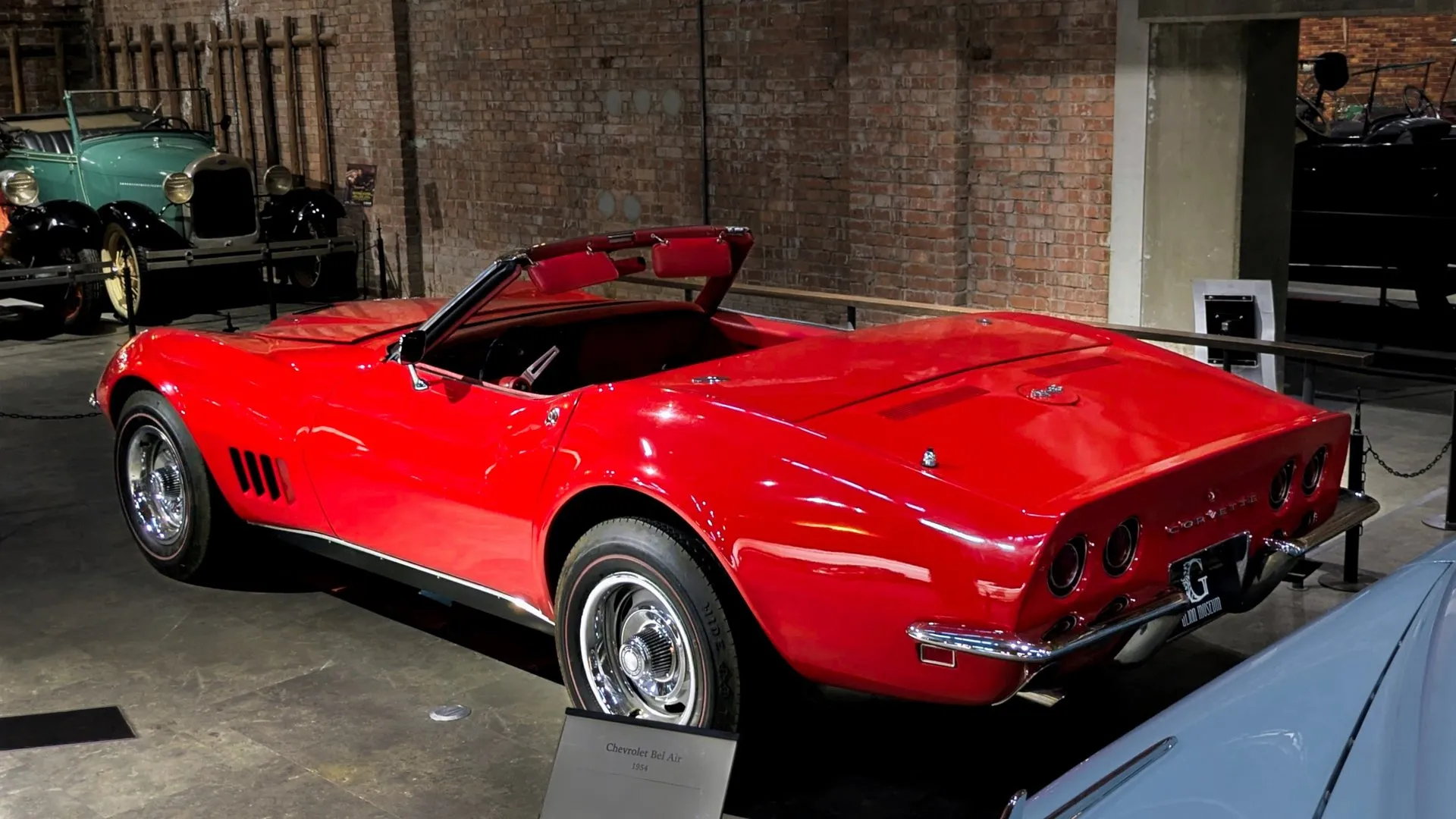
Underneath, Hagerty and Corvette Action Center say, the chassis and mechanical parts carried over: the independent rear suspension, four-wheel disc brakes and the 327 and 427 engines. The automatic changed. A three-speed Turbo Hydra-Matic replaced the two-speed Powerglide, and automatics more than doubled, 5,063 against 1967’s 2,324 Powerglides (1967 kit). The 1967’s side exhaust, aluminum bolt-on wheels and heater-delete credit left the list. The only exhaust option was N11, an off-road system, so side pipes on a 1968 were added later.
Section 02
Small-block or big-block: the 1968 engine list
Every 1968 had a 327 or a 427, rated in gross horsepower, the measure of the day, on GM’s engine data page. Prices and counts are the Black Book’s; the RPO is GM’s Regular Production Option code.
| Engine | Fuel, compression | Gross power | Gross torque | Price | Built |
|---|---|---|---|---|---|
| Base 327 | Rochester Quadrajet four-barrel, 10.0:1 | 300 hp at 5,000 rpm | 360 lb-ft at 3,400 rpm | Standard | About 6,499 (by subtraction) |
| L79 327 | Quadrajet four-barrel, 11.0:1 | 350 hp at 5,800 rpm | 360 lb-ft at 3,600 rpm | $105.35 | 9,440 |
| L36 427 | Quadrajet four-barrel, 10.25:1 | 390 hp at 5,400 rpm | 460 lb-ft at 3,600 rpm | $200.15 | 7,717 |
| L68 427 | Three Holley two-barrels, 10.25:1 | 400 hp at 5,400 rpm | 460 lb-ft at 3,600 rpm | $305.50 | 1,932 |
| L71 427 | Three Holley two-barrels, mechanical lifters, 11.0:1 | 435 hp at 5,800 rpm | 460 lb-ft at 4,000 rpm | $437.10 | 2,898 |
| L89 427 | The L71 with aluminum heads | 435 hp (Black Book) | Not listed | $805.75 | 624, inside the L71 count |
| L88 427 | Aluminum heads, one Holley (Black Book) | 430 hp (Black Book) | Not listed | $947.90 | 80 |
The L89’s $805.75 equals the 1967’s L71 and aluminum-head prices added together, so it looks like the price of both, and Hagerty counts the 624 L89s inside the 2,898 L71s. That makes 12,627 big-blocks, 44 percent of the year (this site’s arithmetic).
GM’s power teams set the gearboxes:
- Three-speed manual: the base 327 only, about 326 cars (by subtraction).
- M20 wide-ratio four-speed, $184.35: base 327, L79, L36 and L68. 10,760 cars.
- M21 close-ratio four-speed, $184.35: L79, L36, L68 and L71, the L71’s only gearbox. 12,337 cars.
- M22 heavy-duty close-ratio four-speed, $263.30: the L88’s. 80 cars.
- M40 Turbo Hydra-Matic, $226.45, or $237.00 with a 427: base 327, L36 and L68. 5,063 cars. GM offered no automatic with the L79 or L71, and no air conditioning with the L71.
Positraction, Chevrolet’s limited-slip axle (RPO G81, $46.35), went on 27,008 cars, about 19 in 20. Car and Driver’s 1968 test of a 400 hp L68 four-speed coupe, as Curbside Classic summarizes it (the magazine wasn’t seen for this guide), ran 0–60 mph in 5.7 seconds and the quarter mile in 14.1 seconds at 102 mph.
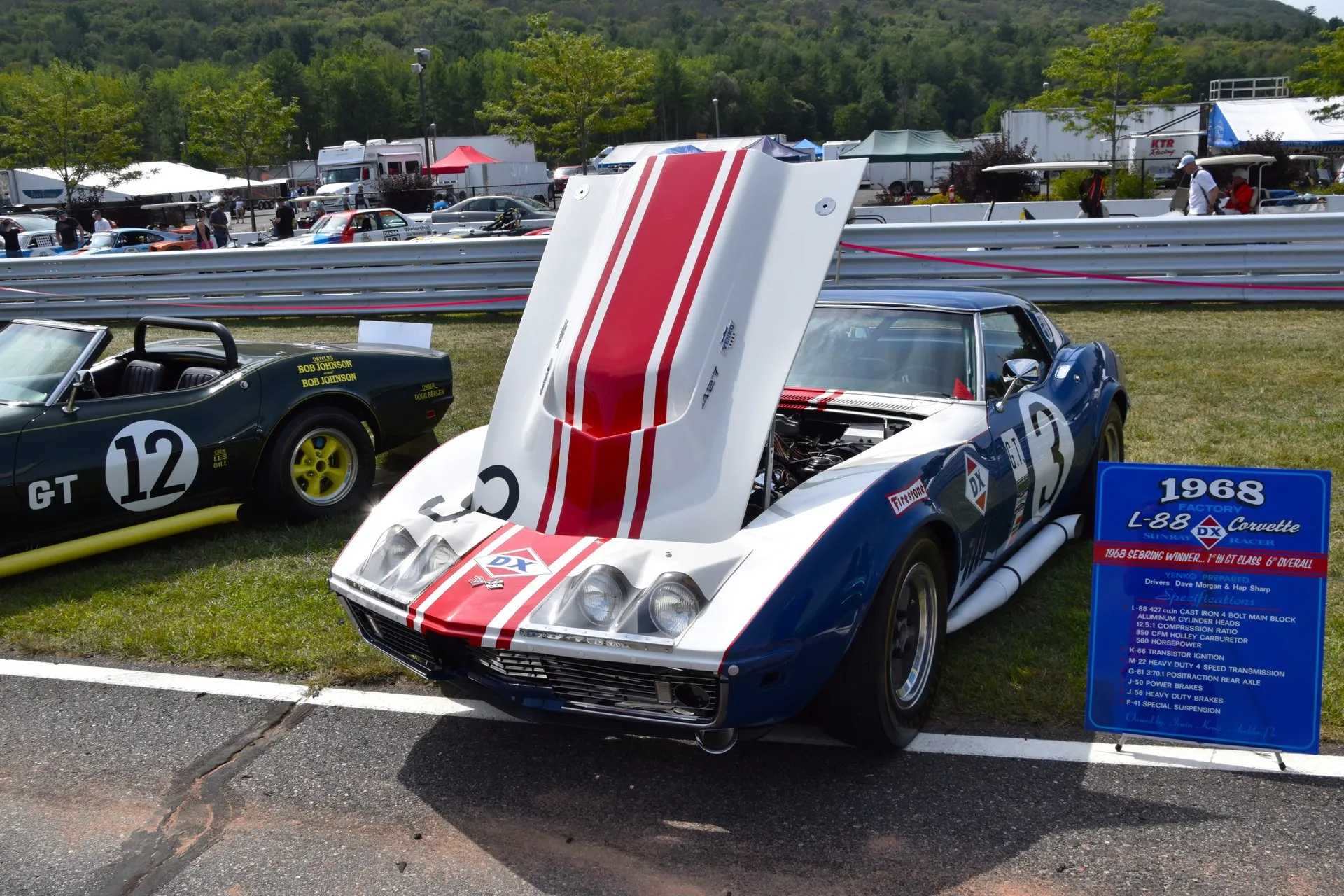
Eighty L88s
The L88 isn’t on GM’s engine pages at all. The Black Book rates it 430 hp and counts 80 at $947.90, after 20 for 1967 and before 116 for 1969, and Corvette Action Center says every 1968 L88 also carried F41 suspension, Positraction, J50 and J56 brakes, K66 transistor ignition and the M22. Chevrolet later warned that some built before May 2, 1968 could have the 327’s 3/4 in front anti-roll bar instead of the 15/16 in one (Engineering Service Letter #963).
Section 03
The order sheet: options, ten colors, seven interiors
The base price bought the 300 hp 327, the three-speed, vinyl trim and, on a convertible, the soft top: $4,663.00 for the coupe, $274.25 more than in 1967, and $4,320.00 for the convertible, $79.25 more (1967 kit). The options that matter, with the Black Book’s prices and counts:
| RPO | Option | Price | Cars |
|---|---|---|---|
| U69 | AM-FM radio | $172.75 | 24,609 |
| N40 | Power steering | $94.80 | 12,364 |
| J50 | Power brakes | $42.15 | 9,559 |
| C07 | Hardtop for the convertible | $231.75 | 8,735 |
| A31 | Power windows | $57.95 | 7,065 |
| N36 | Telescopic steering column | $42.15 | 6,477 |
| C60 | Air conditioning | $412.90 | 5,664 |
| A02 | Tinted windshield only | $10.55 | 5,509 |
| K66 | Transistor ignition | $73.75 | 5,457 |
| N11 | Off-road exhaust | $36.90 | 4,695 |
| None | Leather seats | $79.00 | 2,429 |
| F41 | Special front and rear suspension | $36.90 | 1,758 |
| UA6 | Alarm | $26.35 | 388 |
| J56 | Heavy-duty brakes | $384.45 | 81 |
The hardtop went on nearly half the convertibles. Two lines changed midyear, per Chevrolet’s paper as transcribed by Corvette Action Center: a St. Louis zone letter of March 4, 1968 cancelled A02 for all passenger cars, though orders already in were filled, and the UA6 alarm, switched by a key lock above the rear nameplate, arrived about March 1.
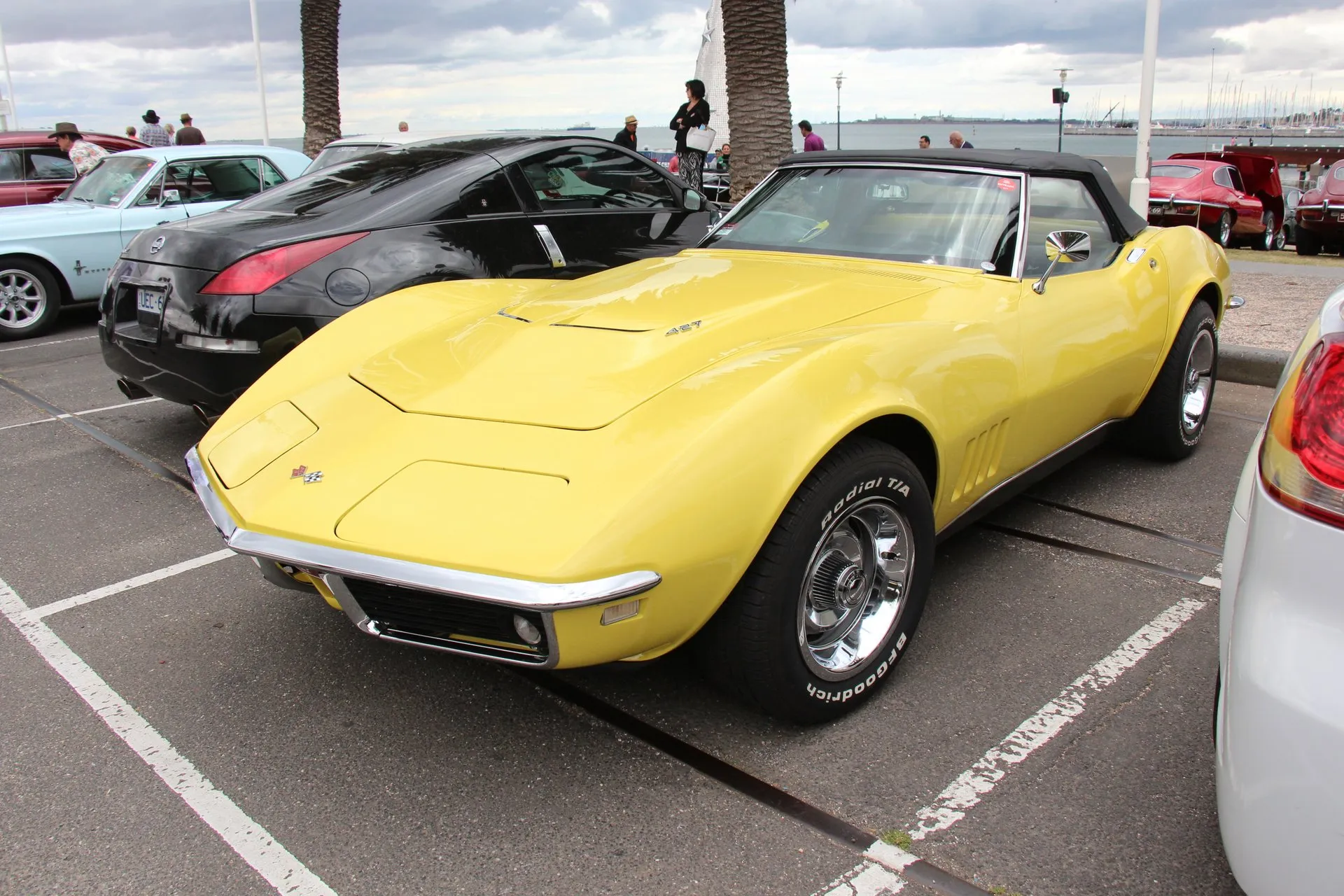
Colors. Ten, in the Black Book’s order of popularity: British Green (983), 4,779 cars; LeMans Blue (976), 4,722; Silverstone Silver (986), 3,435; Corvette Bronze (992), 3,374; Safari Yellow (984), 3,133; Rally Red (974), 2,918; International Blue (978), 2,473; Polar White (972), 1,868; Cordovan Maroon (988), 1,155; and Tuxedo Black (900), 708 cars. They add up to one short of 28,566, and the Black Book accounts for the last: one car in non-standard paint or primer. Corvette Bronze and British Green appear on no 1969 list (1969 kit). Soft tops came in black, white or beige with any color.
Interiors. GM’s color chart lists seven: black (vinyl standard, leather 402), red (407 vinyl, 408 leather), medium blue (414, 415), dark blue vinyl (411), dark orange (425, 426), tobacco (435, 436) and gunmetal vinyl (442). Its paint pairings are suggestions, the Black Book says; other combinations were possible. Saddle is on neither list, yet a 2007 CorvetteForum poster says he documented more than five saddle 1968s (codes 420 and 421), so a saddle car is neither wrong by default nor proven right.
Section 04
What separates a 1968 from a 1969
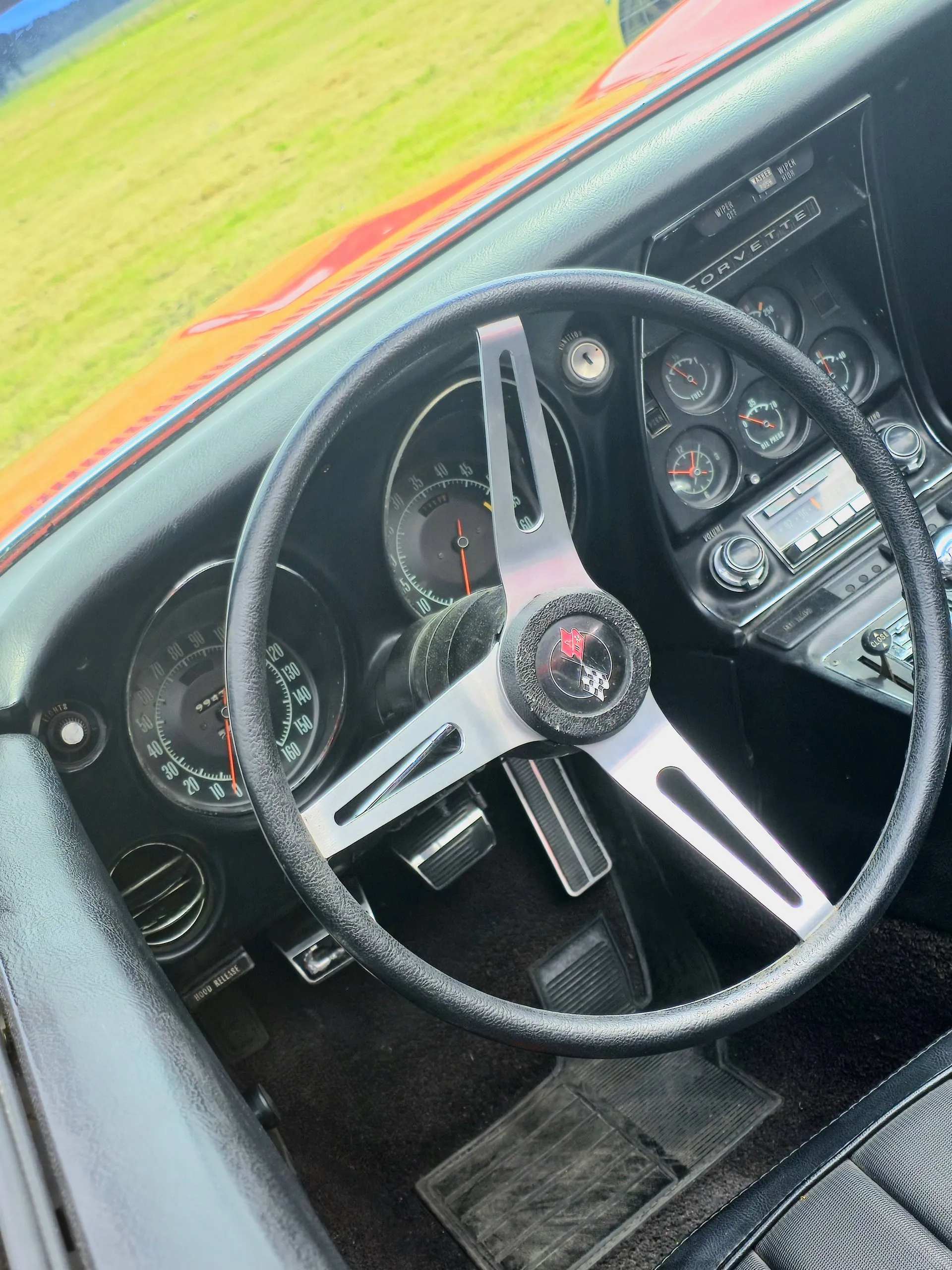
The two years share the body, the four slots behind the front wheels and chrome bumpers at both ends. GM’s equipment lists for 1968 and 1969, its 1969 feature pages and its 1968 bulletins give most of the factory differences; the ignition switch’s place comes from owners.
| 1968 | 1969 | |
|---|---|---|
| Fender script | None | “Stingray” |
| Back-up lamps | In the panel under the rear bumper | In the inboard taillights |
| Grille | Silver-painted bars | Black-painted plastic |
| Doors | Press-flap handle, separate push-button key lock | Press-flap handles and key locks |
| Wheels | 15 x 7 in | 15 x 8 in |
| Base engine | 327, 300 hp | 350, 300 hp |
| Steering wheel | Wood-grain plastic, standard | Black rim, on GM’s feature page |
| Ignition switch | In the dash (owners) | On a locking column, standard on every 1969 Chevrolet |
| Base alternator | 37 amp | 42 amp |
| Headlamp washers | No | Yes |
Original Corvette Bronze or British Green paint also marks a 1968. Two things don’t. GM’s 1968 list gives clear parking-lamp lenses over amber bulbs, but its 1969 pages contradict each other on the lens, so the lens proves nothing. And Chevrolet’s March 1968 bulletin 68-T-34 already describes a manual valve to open the 1968’s wiper door and hold it open, so an override doesn’t make a car a 1969.
Anyone hunting a 1968 with a split rear window is thinking of the 1963 coupe; the 1963 Corvette guide covers it.
Section 05
The numbers that prove a 1968
Nothing in a 1968’s serial names its engine, so proving a car means reading three sets of numbers against each other and against the paper.
What the serial says
It reads 194378S for a coupe or 194678S for a convertible, then a unit number from 400001 to 428566: 1 for Chevrolet, 94 for Corvette, 37 or 67 for the body, 8 for 1968 and S for St. Louis (the Black Book; Corvette Action Center). GM’s September and October 1967 papers place the plate on the left front body hinge pillar (page 4) and on the left windshield garnish molding (page 128); owners find it on the driver’s windshield pillar, with a short form of the serial stamped on top of the driver’s side frame rail (CorvetteForum, 2009 and 2010). Two traps:
- GM’s own example is wrong. The dealer book gives 194378S100025 and says unit numbers start at 100001, but real 1968s start at 400001. A 1xxxxx serial is the 1967’s pattern (1967 kit), and at least one owner-compiled 1968 decoder repeats GM’s number (CorvetteForum, 2006).
- The body digits must match. A convertible whose serial reads 194378S started as a coupe. Bring a Trailer sold one such conversion, disclosed in its title, for $29,750 in August 2026.
The Black Book’s last serial for each month dates the car (cars per month are this site’s arithmetic; it has no July entry):
| Built in | Last serial | Cars |
|---|---|---|
| September 1967 | 400905 | 905 |
| October 1967 | 403410 | 2,505 |
| November 1967 | 405682 | 2,272 |
| December 1967 | 407922 | 2,240 |
| January 1968 | 410386 | 2,464 |
| February 1968 | 412647 | 2,261 |
| March 1968 | 415000 | 2,353 |
| April 1968 | 417676 | 2,676 |
| May 1968 | 420928 | 3,252 |
| June 1968 | 423978 | 3,050 |
| July and August 1968 | 428566 | 4,588 |
The L79 coupe Bring a Trailer sold in March 2026, 194378S409591, was built in January 1968, which fits Hinckley’s account of coupes starting late that month.
The trim tag’s date and codes
Corvette Action Center puts the tag on the driver’s door hinge pillar. Its paint and trim codes should match the car, and owners read its body build date as a month letter and a day, from A for August 1967 to M for August 1968: D09 is November 9, 1967 (CorvetteForum, 2005 and 2014). One owner says the tags on his car and its neighbors, from early October 1967, carry no date at all (CorvetteForum, 2007). NCRS, the National Corvette Restorers Society, counts changing a trim tag (opens in new tab) to make a repaint look original as counterfeiting.
Suffixes and castings on the pad
GM stamps the engine number on the top front of the right-hand cylinder bank (page 4): a plant letter, the month and day, and a two-letter suffix. GM’s example, F1210HE, is a Flint engine built December 10, a base 327 for a manual gearbox. The Black Book’s 1968 suffixes:
- 327: HE (300 hp, manual), HO (300 hp, automatic), HP (350 hp, manual, with air conditioning and power steering), HT (350 hp, manual).
- 427: IL (390 hp, manual), IQ (390 hp, automatic), IM (400 hp, manual), IO (400 hp, automatic), IR (L71), IU (L89), IT (L88).
The trap: eight of those eleven suffixes mean the same engine on the 1967 list, and on a 1967, IM and IR were 390 hp engines. The 427 block casting 3916321 appears on both years’ lists too. A suffix or casting number alone proves nothing; the stamped date, the serial on the pad and the castings’ dates must fit a 1968 build. One detail Chevrolet said affected only the 1968 Corvette 327: the distributor was turned clockwise to clear the tachometer drive, moving every cap tower one position (Service News, December 1967). NCRS deducts 38 points when a 1953–1976 car’s pad is painted or obscured.
Paperwork, and the usual fakes
Documents carry the money: the Protect-O-Plate, the plate GM issued so dealers could track warranty work; the option sticker on the fuel tank; a copy of the order; and NCRS or Bloomington Gold awards. Both of 2026’s highest 1968 sales on Bring a Trailer came with a tank sticker. What gets faked: big-block claims, L71, L89 and L88 above all (NCRS also names stamping numbers on a big-block swapped into a small-block car), repaints passed off as factory colors with a changed tag, coupes turned into convertibles, and 1969 parts on 1968s.
Section 06
The first-year problems, and when Chevrolet fixed each
Chevrolet’s dealer paper, as transcribed by Corvette Action Center (the originals weren’t seen for this guide), shows what Hagerty’s “first-year build quality issues” were. Most of it hit early cars, and most came with a dated production fix, so the serial is the first thing to read.
The one safety recall was Chevrolet Product Campaign 8005, sent to its zones on November 21, 1967 and listed by NHTSA, the US road safety agency, as 67V117000 (opens in new tab), for 2,781 cars: the left front fender skirt could chafe through the front brake pipe. Dealers reworked the skirt.
- Overheating 327s (68-T-13, May 1968). Three production changes, from serials S400720 (valance slots), S401344 (a fan clutch,
GM 3857531, OEM) and S412213 (a faster fan drive): September 1967, October 1967 and February 1968. - Hard-starting 427s (68-T-23, April 1968), cold or after a hot soak; choke rods revised in early October production.
- Heat at the starter on big-blocks. The harness was rerouted from November 27, 1967 (68-T-25, a Chevrolet-wide bulletin), and a solenoid heat shield (
GM 3943647, OEM) and brown, higher-heat end cap (GM 1966377, OEM) came from March 28, 1968 (68-T-66). - A flat battery (Engineering Service Letter 68-8). The new wipers’ load could outrun the base 37 amp alternator below 40 mph with everything on; the 42 amp unit replaced it for 1969.
- Headlamp doors that stuck (68-T-43, April 1968): actuator shaft seals, new style from serial S410514, February 1968.
- Wipers (68-T-34, March 1968). Early wipers could over-travel and hit the pillar or each other, and an under-dash service switch drained the battery if left on.
- Cracking power steering brackets on 427s (68-T-46), redesigned from late March 1968, and a plenum that could crack at the right hood latch (68-T-68), reinforced for 1969.
Then the water. On August 27, 1968, as the model year closed, Chevrolet’s Service Department sent its regional engineers Inter-Organization Letter A.I. 68-11 (opens in new tab): eight leak areas, mostly on coupes, from the windshield header and T-bar molding to the door glass, rear window and roof panels, plus the convertible’s rear plenum. It shipped weatherstrip kits to every region and passed on “Management’s direction that each unit be thoroughly water tested and completely corrected.”
Car and Driver’s tester, per Curbside Classic, listed cheap knobs, unbound carpet edges, poor paint and badly fitting upholstery, and said of the new car’s handling, “we liked the old ones better.” Owners still argue about the year. One says the reputation grew from magazine reviews of early and pre-production cars (CorvetteForum, 2012); a 31-year owner says panel gaps and one-year parts keep 1968 prices down (CorvetteForum, 2022). Chevrolet had a fix on paper for each problem by the end of 1968. The question is whether the car in front of you got it.
NHTSA’s file (opens in new tab) holds no owner complaint about the 1968 (checked October 19, 2026), but it starts in September 1994, so its silence says nothing about the car new. The C3’s big bills (birdcage and frame rust, vacuum leaks, calipers, rear bearings) are generation-wide: see Known C3 problems in the C3 guide.
Section 07
A 1968 checklist, in the order that saves money
- The serial first. 194378S or 194678S, then 400001 to 428566. A convertible with 37 in its serial is a converted coupe.
- The build month, from the month table in The numbers that prove a 1968, against the trim tag’s date and the dated parts.
- The engine pad, unpainted, with a suffix that fits the car, an assembly date before the car’s build and castings that agree. On a big-block, the papers decide.
- The early-car fixes: brisk headlamp doors (cars before S410514 got the old seals), the temperature gauge in traffic on an early 327, the solenoid shield and steering bracket on a 427.
- Vacuum. Cycle the headlamps and wiper door several times with the engine running, try the wiper door’s manual valve, and check that the wipers park.
- A water test on A.I. 68-11’s leak points: windshield header, T-bar, pillars, door glass, rear window, roof panels.
- Completeness. Owners name the console plates, outside door handles and locks and the original steering wheel as costly one-year parts, and many 1968-only parts aren’t reproduced (CorvetteForum, 2002; Corvette Action Center forum, 2006).
- Birdcage and frame, by the checklist in the C3 guide, on a lift, with an inspector who knows early C3s.
Section 08
What a 1968 brings in 2026
How much is a 1968 Corvette worth? On Bring a Trailer (opens in new tab), 16 of the 26 1968s listed between January 1 and October 19, 2026 sold, at a median of $37,275; nine bid to a median $27,250 without selling. These are this site’s figures, from sold prices without BaT’s 5 percent buyer’s fee. “Titled stock” leaves out cars whose listing titles call them modified, a conversion or a project; a title can’t reveal a replacement engine it doesn’t mention. The 2026 sample is small, so the table adds the 21 months from January 2025:
| 1968s sold on Bring a Trailer, titled stock | Sales | Median |
|---|---|---|
| 2026: all | 12 | $34,250 |
| 2026: small-block | 7 | $27,000 |
| 2026: big-block, all convertibles | 5 | $63,250 |
| Jan. 2025 to Oct. 19, 2026: all | 35 | $34,500 |
| Same window: small-block | 18 | $27,750 |
| Same window: small-block, no replacement or modified engine in the listing | 10 | $29,375 |
| Same window: big-block | 17 | $55,000 |
| Same window: L71 and L89 titles | 7 | $81,250 |
By BaT’s own descriptions, 8 of the 18 small-block sales had a replacement or modified engine. The other 10 make the $29,375 row, though even they show only that no swap was mentioned. Three cars sold twice in the window, so the 35 sales are 32 cars. The top 2026 sales were documented cars: an L71 convertible with an NCRS Duntov award, a Protect-O-Plate and a tank sticker at $105,000 in May, and a Corvette Bronze L89 convertible at $102,000 in June. An L89 coupe bid to $92,500 in May didn’t sell. No L88 sold either; one was bid to $245,000 in June 2025.
Why do 1968s sell for less than 1969s? Mostly the mix. Eleven of 2026’s 12 titled-stock 1968s were convertibles and seven were small-blocks, while 24 of the 27 titled-stock 1969s sold in 2026 were big-blocks (this site’s figures from the same results). Like for like, the gap shrinks: 2026’s big-blocks brought a $63,250 median for five 1968s and $64,250 for 24 1969s, and over the last twelve months small-blocks brought $27,750 (14 1968s) against $33,000 (7 1969s).
Hagerty’s price guide (opens in new tab), as captured by the Internet Archive, put a condition #3 (Good) 327/300 coupe at $21,000 in January 2026, an L79 convertible at $30,400 and an L88 convertible at $366,000; in October 2025, an L71 coupe at $48,500 and convertible at $52,500.
classic.com’s (opens in new tab) February 2026 benchmarks, for 1968 and 1969 together, were $345,143 for an L88 and $131,134 for an L89. The three measure different things over different dates, so don’t average them.
Section 09
A complete small-block convertible, and the alternatives
Buy a small-block convertible with its one-year parts in place, an L79 four-speed if one turns up. Two of every three 1968s were convertibles, so that’s where the choice is. Titled-stock small-blocks sold on Bring a Trailer for a median of $27,750 over 21 months, and $29,375 for the ten whose listings named no replacement or modified engine. The L79 is the one to want: 350 hp at 5,800 rpm from 11.0:1 compression, four-speed only, and the four cars sold with L79 in their titles in 2026 brought $27,000 to $36,500. Drop the top, run it up to 5,800 rpm in second on an empty two-lane, and the first-year reputation won’t cross your mind.
For the 427 sound, an L36. It has one four-barrel, GM offered it with the automatic and air conditioning, and big-blocks other than the L71 and L89 sold for a median of $41,900 over 21 months (10 sales).
L71, L89 and L88: buy the paper first. L71 and L89 titles brought a median $81,250 over 21 months, from $43,000 to $105,000, and the top of that range went to cars with their papers and awards. An L88 is another market; without its file, pay for what the car can prove.
The cheapest way in is a car with a replacement engine: Bring a Trailer sold several in 2025–2026 for $18,000 to $28,500. The factory engine is already gone, so that’s the 1968 to modify, and of course you’ll want more than 300 hp anyway.
Skip any 1968 missing its one-year parts unless the price pays for them, and any big-block whose pad, castings and papers don’t agree. Then judge the frame and birdcage before the year, as the C3 guide says of every C3. Get those right and you own the first shark, the car that put lift-out roof panels on America’s sports car. The best Corvette years guide puts 1968–1972 on top for looks, and the 1980 Corvette guide covers a C3 from the end of the run.
Section 10
Sources
- GM Heritage Center: 1968 Corvette vehicle information kit files.zipcorvette.com This site's library. GM's September 1967 dealer data book and October 1967 AMA specification forms: identification codes and the engine-stamp example (PDF page 4), standard exterior and interior equipment (5 and 6), dimensions and weights (20 and 21), colors and interiors (24), power teams (27), engine ratings (28), carburetors and fuel tank (36), transmissions (40), wheels and tires (124), brakes (125), serial plate location (128). Corvette Black Book pages reproduced in the kit: production, serial range and monthly serials, engine suffixes and castings, options with prices and counts, colors (136).
- GM Heritage Center: 1967 Corvette vehicle information kit files.zipcorvette.com This site's library. Black Book pages: 1967 production, serial range and engine suffixes (PDF page 56), prices and options, including the L71, L89, L88, side exhaust, aluminum wheels and Powerglide counts (58).
- GM Heritage Center: 1969 Corvette vehicle information kit files.zipcorvette.com This site's library. GM's column lock for every 1969 Chevrolet (PDF page 73), Corvette exterior and interior features (78 and 79), standard exterior equipment (103); Black Book page on 1969 colors (5).
- NHTSA owner complaints, 1968 Chevrolet Corvette (opens in new tab) api.nhtsa.gov Pulled October 19, 2026: none on file. NHTSA's complaint file begins in September 1994.
- NHTSA recalls, 1968 Chevrolet Corvette (opens in new tab) api.nhtsa.gov Pulled October 19, 2026: GM campaign 67V117000 (opens in new tab) (front brake pipe, 2,781 cars) and Cardone's aftermarket caliper recall 03E032000 (opens in new tab).
- Chevrolet Product Campaign No. 8005, November 21, 1967: left front fender skirt to brake pipe clearance (via Corvette Action Center) (opens in new tab) corvetteactioncenter.com Transcriptions of Chevrolet's dealer paper, here and below, are Corvette Action Center's, read through Internet Archive copies of 2026; the originals weren't seen.
- Chevrolet dealer bulletin 68-T-13, May 22, 1968: inadequate cooling, 1968 Corvette with 327 (via Corvette Action Center) (opens in new tab) corvetteactioncenter.com Production changes from serials S400720, S401344 and S412213.
- Chevrolet dealer bulletin 68-T-23, April 24, 1968: choke and hot restart problems, 427 (via Corvette Action Center) (opens in new tab) corvetteactioncenter.com
- Chevrolet dealer bulletin 68-T-66, October 30, 1968: heat damage at the starter solenoid (via Corvette Action Center) (opens in new tab) corvetteactioncenter.com Also 68-T-25 (opens in new tab) (February 19, 1968, a Chevrolet-wide bulletin with a Corvette plant change from November 27, 1967) and Engineering Service Letter 68-8 (opens in new tab) (the brown end cap).
- Chevrolet Engineering Service Letter 68-8, Part E, February to March 1968: discharged battery (via Corvette Action Center) (opens in new tab) corvetteactioncenter.com
- Chevrolet dealer bulletin 68-T-34, March 11, 1968: windshield wiper system operation and diagnosis (via Corvette Action Center) (opens in new tab) corvetteactioncenter.com
- Chevrolet dealer bulletin 68-T-43, April 24, 1968: 1968 Corvette general information (via Corvette Action Center) (opens in new tab) corvetteactioncenter.com Headlamp actuator seals from serial S410514, and other running changes.
- Chevrolet Inter-Organization Letter A.I. 68-11, August 27, 1968: water leaks, 1968 Corvette coupe and convertible (via Corvette Action Center) (opens in new tab) corvetteactioncenter.com
- Chevrolet dealer bulletin 68-T-46, April 25, 1968: power steering bracket, 427 (via Corvette Action Center) (opens in new tab) corvetteactioncenter.com
- Chevrolet Engineering Service Letter #963, 1968: L88 front end roll in hard cornering (via Corvette Action Center) (opens in new tab) corvetteactioncenter.com
- Chevrolet dealer bulletin 68-T-68, November 11, 1968: plenum cracking at the right hood latch (via Corvette Action Center) (opens in new tab) corvetteactioncenter.com
- Chevrolet Service News, December 1967: 1968 Corvette 327 distributor alignment (via Corvette Action Center) (opens in new tab) corvetteactioncenter.com
- Chevrolet product bulletin, January 16, 1968: Corvette anti-theft warning system (via Corvette Action Center) (opens in new tab) corvetteactioncenter.com Also the St. Louis zone letter of March 4, 1968 cancelling option A02 (opens in new tab).
- Corvette Action Center: 1968 Corvette coupe structure and availability (opens in new tab) corvetteactioncenter.com John Hinckley's reply to a letter in Corvette Enthusiast's December 2009 issue. Read via the Internet Archive's June 18, 2026 copy (opens in new tab).
- Corvette Action Center: 1968 Corvette production and performance numbers (opens in new tab) corvetteactioncenter.com Read via the Internet Archive's June 18, 2026 copy. Also its 1968 identification page (opens in new tab) (serial digits, trim tag location, the 427 hood) and its L88 production page (opens in new tab) (the equipment every 1968 L88 carried).
- Hagerty: 1968–82 Chevrolet Corvette (C3) buyers guide (opens in new tab) hagerty.com Sajeev Mehta, May 13, 2020, updated June 24, 2022. Read via the Internet Archive's June 2025 copy (opens in new tab).
- Hagerty Valuation Tools: 1968 Chevrolet Corvette (opens in new tab) web.archive.org Condition #3 (Good) values read from Internet Archive copies: the 327/300 coupe here; the L79 convertible (opens in new tab) and L88 convertible (opens in new tab) (January 2026); the L71 coupe (opens in new tab) and L71 convertible (opens in new tab) (October 2025).
- classic.com: Chevrolet Corvette C3 market (opens in new tab) web.archive.org Internet Archive copy of February 12, 2026. L88 and L89 (1968–1969) benchmarks.
- Bring a Trailer: Chevrolet Corvette C3 results (opens in new tab) bringatrailer.com 1968 model-year results from January 1, 2025 to October 19, 2026, read October 19, 2026. Counts and medians are this site's, from each listing's sold price without the buyer's fee. Sales named in the text: the L71 convertible (opens in new tab) (May 27, 2026), the L89 convertible (opens in new tab) (June 24), the L79 coupe (opens in new tab) (March 6), the coupe converted to a convertible (opens in new tab) (August 2) and the unsold L89 coupe (opens in new tab) (May 11). The small-block figure without replacement or modified engines leaves out the 8 sales whose listings describe one. The 1969 figures in the comparison are this site's, from the same results.
- Curbside Classic: Vintage Review: 1968 Corvette 427 (opens in new tab) curbsideclassic.com Paul Niedermeyer, July 30, 2024. A summary of Car and Driver's 1968 test of a 400 hp four-speed coupe; the magazine itself wasn't seen.
- NCRS: judging awards (opens in new tab) ncrs.org Flight judging, the engine-pad deduction for 1953–1976 cars and NCRS's definition of counterfeiting. Fetched October 19, 2026.
- Corvette Action Center thread: 1968 Corvette problems (opens in new tab) forums.corvetteactioncenter.com October to November 2006.
- CorvetteForum thread: what are 68 Vette problems (opens in new tab) corvetteforum.com April 2002.
- CorvetteForum thread: 68 vs 66–67 (opens in new tab) corvetteforum.com November 2012.
- CorvetteForum thread: considering a 68–72 (opens in new tab) corvetteforum.com September 2022.
- CorvetteForum thread: 1968 VIN location (opens in new tab) corvetteforum.com July 2010.
- CorvetteForum thread: 1969 VIN locations (opens in new tab) corvetteforum.com June 2009. The same frame as the 1968.
- CorvetteForum thread: 68 trim tag (opens in new tab) corvetteforum.com June 2007.
- CorvetteForum thread: trim plate decode (opens in new tab) corvetteforum.com December 2005.
- CorvetteForum thread: trim tag date codes (opens in new tab) corvetteforum.com February 2014.
- CorvetteForum thread: 1968 VIN codes (opens in new tab) corvetteforum.com May 2006 to September 2019. An owner-compiled decoder with the wrong serial range, corrected later in the thread.