C3 · Buying guide
1972 Corvette Stingray guide: the last chrome bumpers, the LT1 with air, the 454 and what to pay
Published
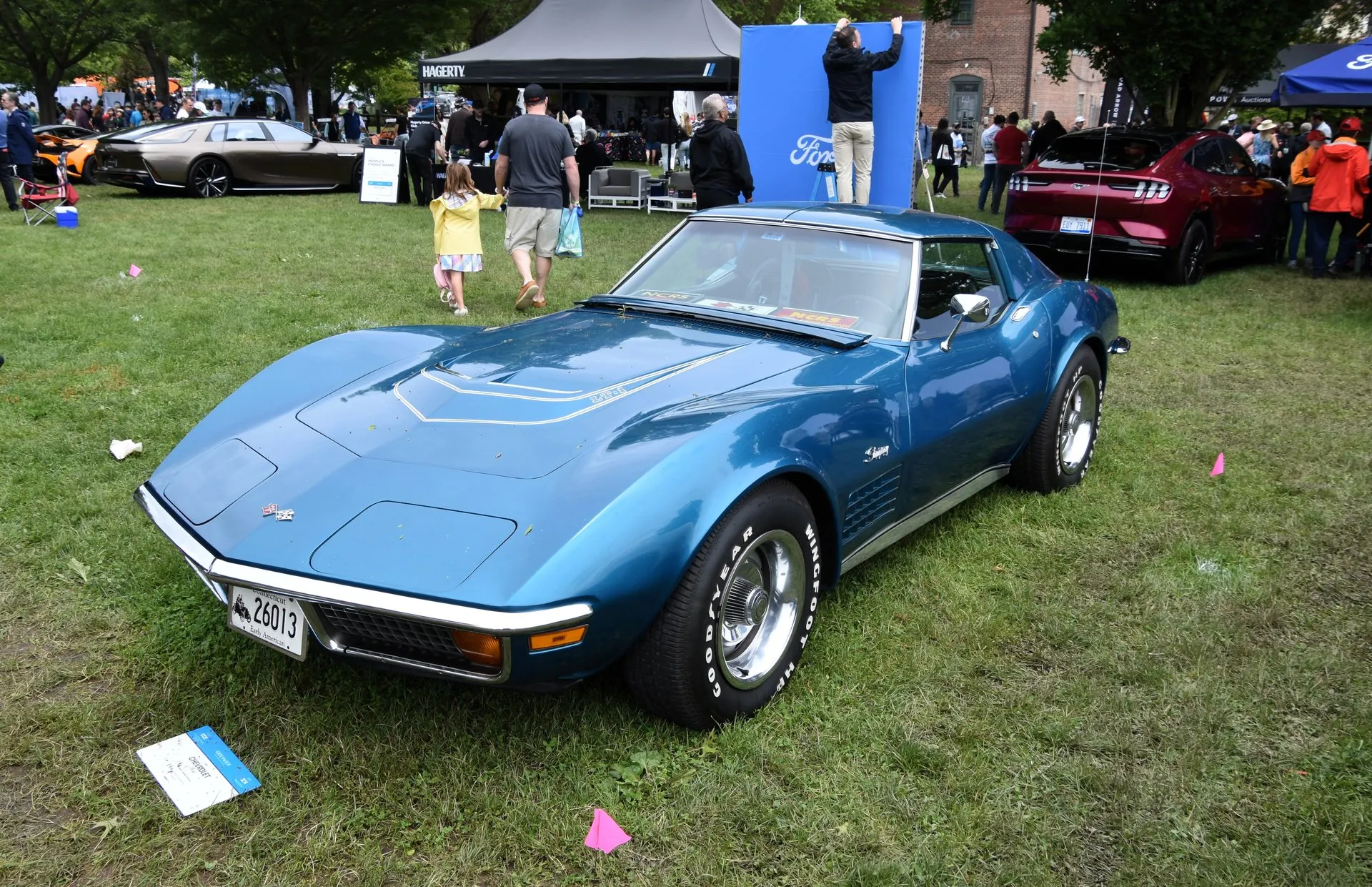
Air conditioning and a solid-lifter LT1 shared an engine bay for one model year, and the tachometer told on them. The Corvette Black Book, a hobby reference whose 1972 pages GM reprints at the front of its Heritage Center kit, says a 1972 LT1 without air got a 6,500 rpm tach and one with air the base engine’s 5,600 rpm unit, to discourage the revs that could spin the compressor belt off. It believes 240 were built that way, out of 1,741 LT1s. No GM count has turned up.
That pairing is the rarest of the 1972’s quirks; most of the others are endings. The fifth year of the C3 (1968–1982) was the last with chrome bumpers at both ends, the last with a rear window that came out, the last LT1 and the last ZR1 package. It was also the first year GM rated its engines net, so a car that barely changed from 1971 reads on paper as if it lost a quarter of its power.
- Built: 27,004, from August 1971 to July 1972: 20,496 coupes and 6,508 convertibles, all at St. Louis.
- Engines: 200 hp base, 255 hp LT1, 270 hp LS5 454 (net).
- Price new: $5,533 (Black Book) or $5,672 (GM suggested retail) for the coupe, from two different sheets (see Price new, options and paint).
- What one costs: on Bring a Trailer in 2026, a median $29,750 from 15 cars. Hagerty’s #3 value is $23,000 (April 2025, base coupe).
What every C3 shares, from birdcage rust to vacuum headlights, is in the C3 buyer’s guide. The figures here come from GM’s 1972 Heritage Center kit in this site’s manual library; where its Black Book pages and GM’s own sheets disagree, both are given.
C3 Key figures
- Built
- 27,004, from August 1971 to July 1972
- Engines
- 200 hp base, 255 hp LT1, 270 hp LS5 454 (net)
- LT1 built
- 1,741, about 240 with air
- ZR1 built
- 20
- Price new, coupe
- $5,533 (Black Book) or $5,672 (GM suggested retail)
- Bring a Trailer, 2026
- median $29,750 from 15 cars
- Hagerty #3 value
- $23,000 (April 2025, base coupe)
Section 01
Net horsepower: the same engines on a stricter scale
Why is the 1972 Corvette rated so low? Because the yardstick changed. Ratings through 1971 were gross; from 1972 GM published only net figures, measured with the engine as installed. GM’s 1971 engine data printed both, which allows a fair comparison with the 1972 ratings:
| Engine | 1971 gross | 1971 net | 1972 net |
|---|---|---|---|
| Base 350 | 270 hp | 210 hp | 200 hp |
| LT1 350 | 330 hp | 275 hp | 255 hp |
| LS5 454 | 365 hp | 285 hp | 270 hp |
Measured the same way, the base engine lost 10 hp, the LT1 20 and the LS5 15. The rest of the fall is the new scale, a point Hagerty makes too. The 1970 LT1 ran 11.0:1 compression; the 1972 one ran 9.0:1, the base 350 and the 454 8.5:1. The 1971’s 425 hp LS6 didn’t return.
What Corvette year to stay away from? Not this one for lack of power: the best Corvette years guide names the 1975 and 1980 California cars as the slowest C3s.
Section 02
Base 350, LT1 or LS5 454: the 1972 engine sheet
What engine came in a 1972 Corvette? A Chevrolet V8, one of three. GM’s December 1, 1971 power-team chart and data book give the ratings; the Black Book gives the prices and counts:
| Base 350 | LT1 350 | LS5 454 | |
|---|---|---|---|
| Power (net) | 200 hp at 4,400 rpm | 255 hp at 5,600 rpm | 270 hp at 4,000 rpm |
| Torque | 300 lb-ft at 2,800 rpm | 280 lb-ft at 4,000 rpm | 390 lb-ft at 3,200 rpm |
| Compression | 8.5:1 | 9.0:1 | 8.5:1 |
| Lifters | Hydraulic | Mechanical (solid) | Hydraulic |
| Carburetor | Rochester four-barrel | Holley four-barrel | Rochester four-barrel |
| Price | Standard | $483.45 | $294.90 |
| Built | The rest | 1,741 | 3,913 |
| VIN letter | K | L | W |
| Gearboxes | Four-speed or automatic | Four-speed only | Four-speed or automatic |
| California | Yes | Yes | No |
Roughly four cars in five got the base engine (this site’s arithmetic). GM’s own sheet prices the LT1 at $470.00 list and $495.05 suggested retail, and the LS5 at $287.00 and $302.30.
Gearboxes and axles. A wide-range four-speed (2.52:1 first gear) was standard. The close-ratio box, RPO M21 (RPO is GM’s regular production option code), cost nothing but came only with the LT1 or the 454: 1,638 cars. The Turbo Hydra-Matic automatic (M40) was free with the base engine, $97 with the 454 and not offered with the LT1; 14,543 buyers took it. Positraction, Chevrolet’s limited-slip axle, was standard, at 3.36:1 for a base four-speed, 3.08 for an automatic or a wide-range LS5, and 3.70 for the LT1 (3.55 with air), by GM’s December chart.
The LS5: 454 cubic inches, not for California
GM’s sheet is blunt: the 270 hp Turbo-Jet 454 was “not available for registration in the State of California.” It came with a heavy-duty battery and added 222 lb with the four-speed, 278 lb with the automatic, by GM’s weight page. The base 350 and the LT1 could be registered there with the $15.80 California emission test, RPO YF5 (1,967 cars), which GM didn’t offer with the 454. Big-blocks with air could also run hot in traffic: see bulletin 73-T-28 in Recalls, complaints and Chevrolet’s service notes.
Section 03
The LT1 gets air: GM’s September and December charts
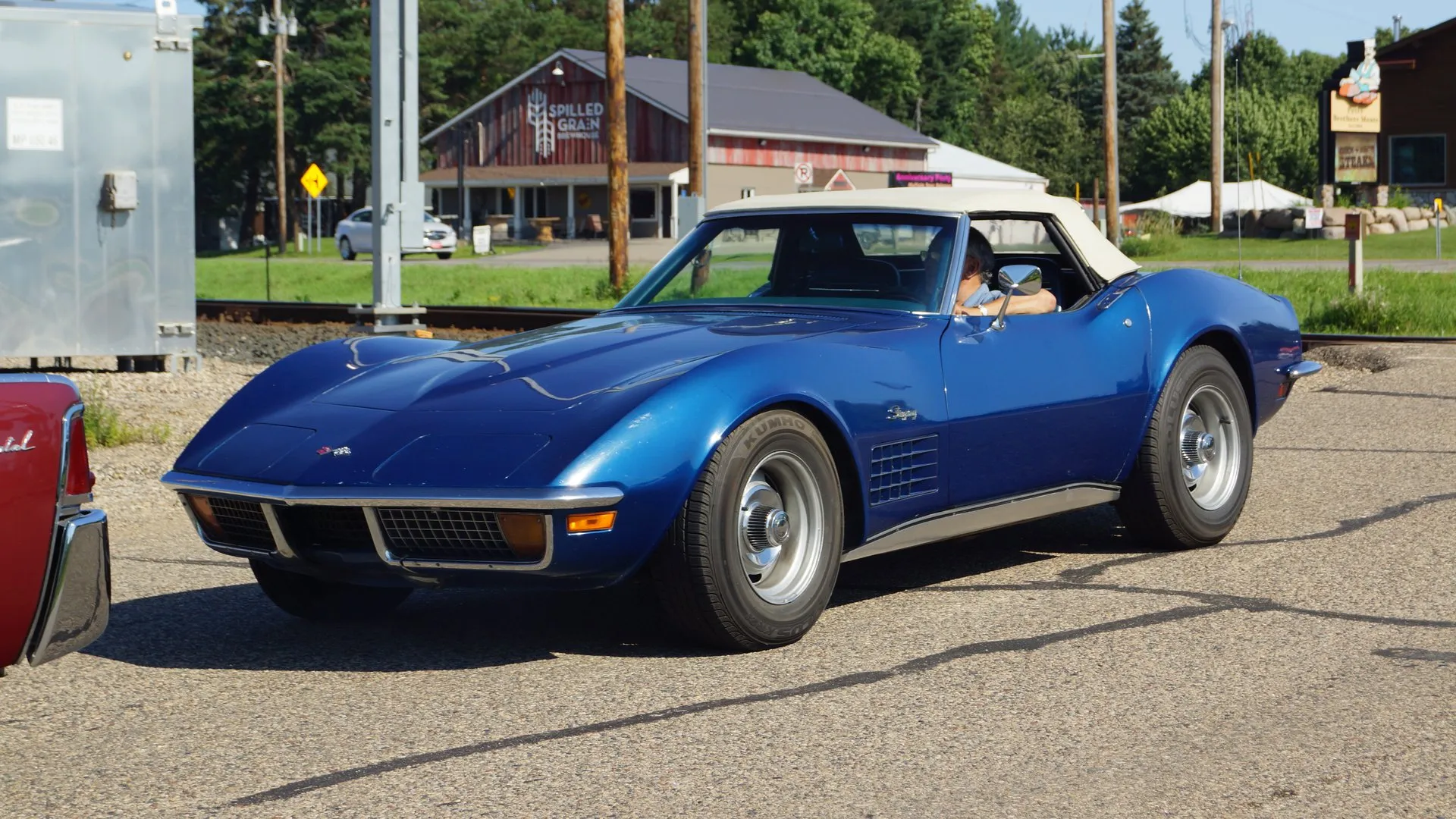
GM’s September 1971 power-team combinations offer air with every base-engine pairing and with no LT1. The December 1, 1971 chart marks the LT1 line as changed and allows air with the LT1 and the wide-range four-speed only, on a 3.55 axle. The same day’s option sheet bars the $452.00 Four-Season air conditioning (C60) from the close-ratio box and the ZR1.
The Black Book’s 1972 page explains the old ban by the belts, and calls 1972 the only year the 1970–1972 LT1 could be had with air. Its LT1 tally: 1,741, about 240 with air, roughly one in seven. The 240 is an estimate.
When did the first one leave the line? No source found for this guide says. GM had it on the order sheet by December 1971. Owners place the cars later: after January 1972 in one 2004 thread, “late in the ‘72 production run” in a 2005 Corvette Action Center thread (opens in new tab). The three air-conditioned LT1s sold on Bring a Trailer in 2025–2026 carry serials 520673, 521910 and 524206, May and June 1972 builds by the Black Book’s monthly serials. Three cars are a sample, not a rule: paper proves an air LT1, not where its serial falls.
Checking an L car’s hardware
The VIN comes first: its fifth character must be L. Then owners in Corvette Action Center threads from 2004 and 2005 check the hardware; a good fake can pass any one check:
- Air injection (A.I.R.) plumbing at the exhaust manifolds, or the provisions for it.
- A Holley; the Black Book lists
R6239A, number3999263(OEM). - A 6,500 rpm tach redline, or 5,600 with air (one owner says 5,800).
- A four-speed: GM sold no automatic LT1.
- A CKY suffix on the engine pad (CKZ on a ZR1).
- Big-block U-joints and half-shafts and a single fuel line, by one 2004 owner’s list.
Hood stripes prove nothing; any hood can be painted. Unlike the 1970’s, the 1972 LT1 could have power steering: GM’s December sheet bars it only from the ZR1. A claimed air car needs a tank sticker (the option list the factory stuck to the fuel tank) or an NCRS shipping data report.
Section 04
RPO ZR1: twenty cars GM warned off the street
GM’s December 1971 sheet called the ZR1 special-purpose engine “not recommended for normal traffic situations,” and 20 buyers took it anyway, at $1,010.05 by the Black Book ($983.00 list by GM). It got the LT1 with a special heavy-duty close-ratio four-speed, heavy-duty power brakes, transistor ignition, an aluminum radiator, special springs, shocks and front stabilizer bar, and rear wheel spindle strut shafts. The Black Book adds that 1972 ZR1s had no fan shrouds and have turned up with and without a rear bar. No power windows, power steering, air, rear defroster, wheel covers or radio; a 3.70:1 or 4.11 axle; California-legal with YF5.
The heavy-duty gearbox had been a separate option on 130 1971s (RPO M22); for 1972 GM’s sheet offers it only inside the ZR1, and the Black Book lists no M22. The 1971 had 8 ZR1s and 12 ZR2s; the 1972 had no ZR2.
Every ZR1 part bolts to an LT1, so only factory paper proves one. Hagerty’s #3 value for a 1972 ZR1 convertible was $76,300 (January 2026). The code came back on the C4 ZR-1 for 1990, as the Black Book notes.
Section 05
The end of the chrome era, and the smaller 1972 changes
From the curb, a 1972 is hard to tell from a 1971: the Black Book calls the appearance changes minimal, Hagerty the car virtually indistinguishable. What changed:
- No fiber-optic light monitors. The 1971 was the last with them.
- A standard alarm. The horn-sounding anti-theft alarm, a $31.60 option on 8,501 1971s, joined the base price.
- Net ratings, the VIN engine letter and air for the LT1, each covered in its own section.
- Three-point belts, RPO AV3, on 17,693 cars.
- Ten colors, three of them what GM’s catalog called “special firemist.”
The Black Book also lists what the 1972 was the last to have: chrome bumpers at both ends, the bright egg-crate grille, the grilles in the front fender vents and the coupe’s removable rear window. The wiper door went too: GM’s 1972 catalog still hides the wipers “beneath power-operated cowl panel,” and the 1973 Black Book says that panel was deleted. That’s the look the C3 guide means by “1968–1972 for looks,” and the 1972 is its final edition.
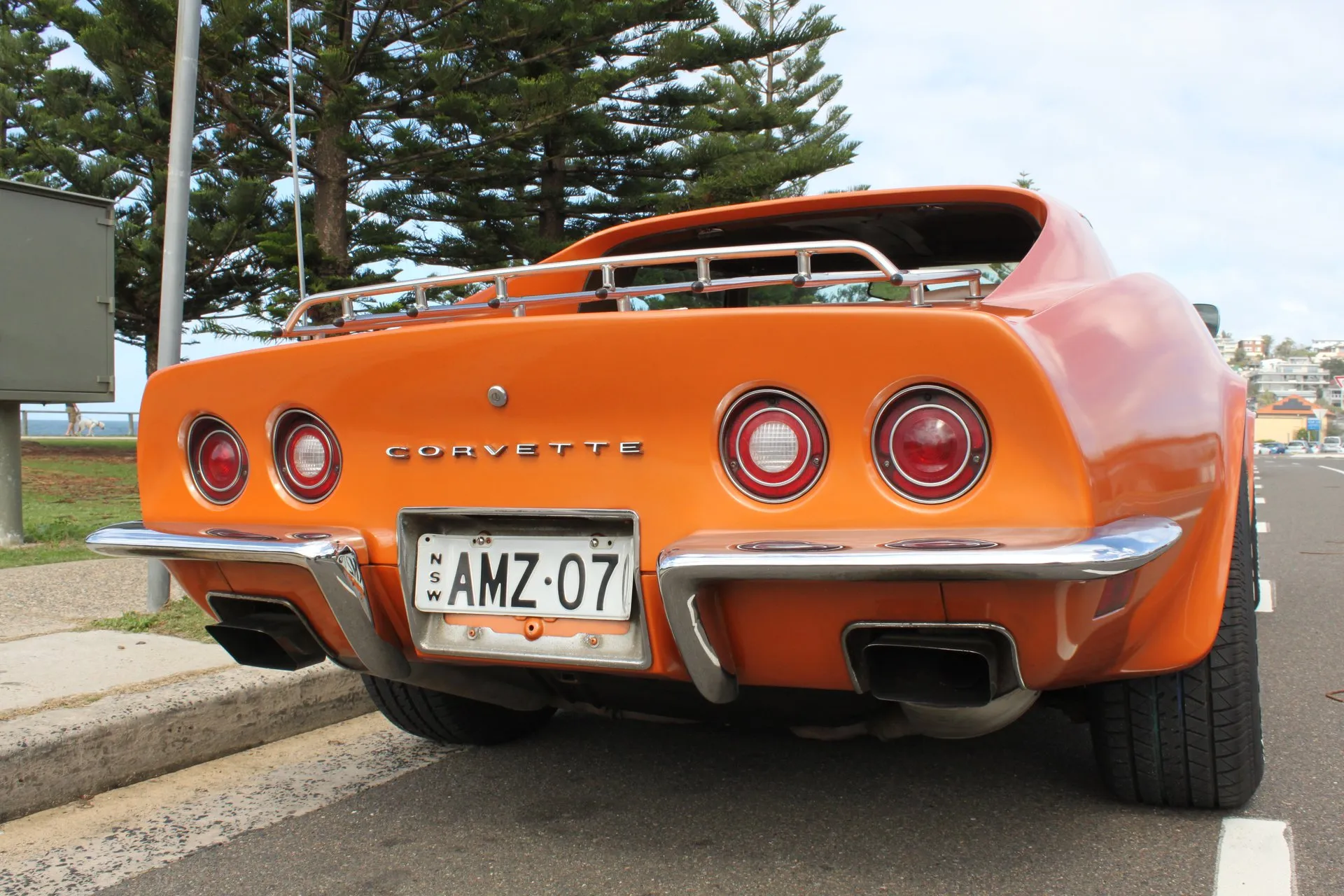
Is a 1972 Corvette a Stingray? Yes: the one-word script on the front fenders arrived for 1969 (the generations guide has the history) and stays on the 1972.
1972 Corvette specs. A 98.0 in wheelbase, 182.5 in long, 69.2 in wide and 47.8 in high as a coupe, by GM’s service manual. GM’s September 1971 data book gives curb weights of 3,305 lb (coupe) and 3,306 lb (convertible) with the base engine; the service manual says 3,292 and 3,320.
Section 06
Price new, options and paint
Price new. The Black Book prices the coupe at $5,533.00 and the convertible at $5,296.00. GM’s price schedule of December 1, 1971 lists them at $5,380.00 and $5,154.00, with manufacturer’s suggested retail prices of $5,672.00 and $5,434.00. On every line checked, the Black Book’s figure sits 2.7 to 3.0 percent above GM’s December list and below its suggested retail; no source found explains why. Compare like with like: the 1971 coupe was $5,496.00 by the same Black Book.
The options that mattered, with the Black Book’s prices and counts:
| RPO | Option | Price | Built |
|---|---|---|---|
| N40 | Power steering | $115.90 | 23,794 |
| U69 | AM-FM radio | $178.00 | 19,480 |
| J50 | Power brakes | $47.40 | 18,770 |
| C60 | Air conditioning | $464.50 | 17,011 |
| PU9 | White-letter F70 x 15 tires | $43.65 | 16,623 |
| N37 | Tilt-telescopic steering column | $84.30 | 12,992 |
| A31 | Power windows | $85.35 | 9,495 |
| Not listed | Custom Interior (leather, cut-pile carpet, wood-grain accents) | $158.00 | 8,709 |
| U79 | AM-FM stereo | $283.35 | 7,189 |
| C07 | Hardtop for the convertible | $273.85 | 2,646 |
| C50 | Rear window defroster | $42.15 | 2,221 |
| C08 | Vinyl cover for the hardtop | $62.00 (GM list) | 811 |
Nearly nine cars in ten had power steering and six in ten had air (this site’s arithmetic). For the vinyl cover the Black Book prints $158.00, the Custom Interior’s price on the line above; GM’s $62.00 fits the 1971 cover’s $63.00, so GM’s figure is given. GM’s 1972 paper lists no side exhaust, so side pipes were added later.
Wheels were painted silver on every car, and soft tops came in black or white. Interior codes: 400 black vinyl, 404 black leather, 407 red vinyl, 412 blue vinyl, 417 saddle vinyl, 421 saddle leather; leather only with the Custom Interior.
Paint codes and how many got each
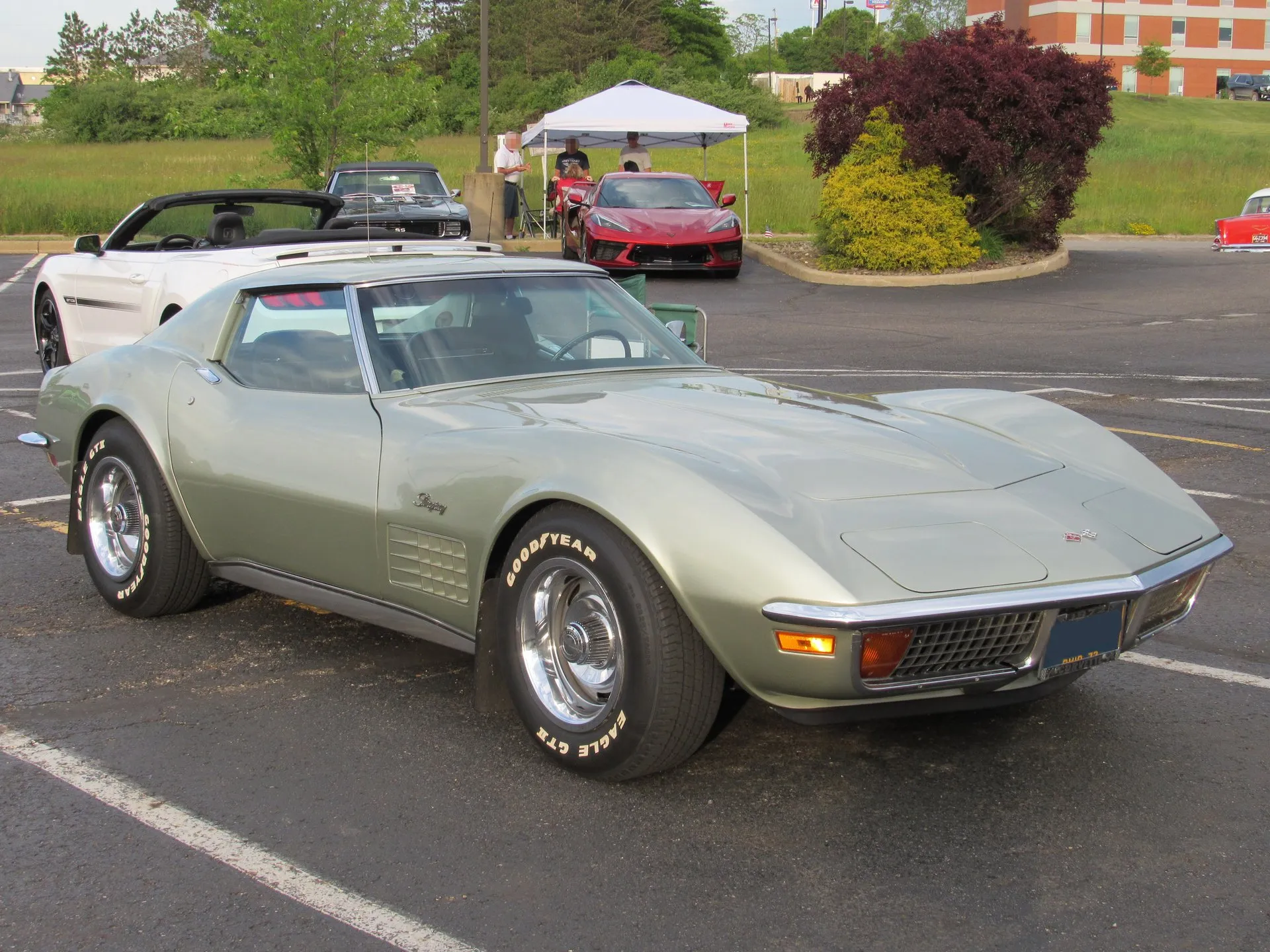
1972 Corvette colors. Unlike the 1970, the 1972 has factory counts by color. The trim tag carries the three-digit code; GM’s color chart uses two digits:
| Color | Trim tag code | GM code | Built |
|---|---|---|---|
| Ontario Orange (firemist) | 987 | 97 | 4,891 |
| Elkhart Green | 946 | 47 | 4,200 |
| Targa Blue | 979 | 27 | 3,198 |
| Classic White | 972 | 10 | 2,763 |
| War Bonnet Yellow (firemist) | 989 | 91 | 2,550 |
| Mille Miglia Red | 973 | 76 | 2,478 |
| Steel Cities Gray (firemist) | 988 | 98 | 2,346 |
| Bryar Blue | 945 | 37 | 1,617 |
| Sunflower Yellow | 912 | 52 | 1,543 |
| Pewter Silver | 924 | 14 | 1,372 |
The counts add to 26,958, 46 short of production (this site’s arithmetic); the Black Book says some cars got non-standard paint or primer only. No black was offered.
Section 07
Proving a 1972 from its numbers
The VIN is on a plate on the left windshield pillar, by GM’s serial number page. GM’s example, 1Z37W2S500025, reads: Chevrolet, Corvette, 37 for a coupe (67 for a convertible), the engine letter, 2 for 1972, S for St. Louis, then the serial, 500001 to 527004. The engine letter is new: K for the base engine, L for the LT1, W for the LS5. No 1968–1971 VIN names the engine; a 1972’s does, though it can’t say whether that engine is still in the car. That makes a 1972 easier to check than a 1970 or 1971, as one owner in a 2004 thread (opens in new tab) puts it, but the tank sticker is still the one sure proof.
The Black Book’s last serial for each month dates any 1972 (counts are this site’s arithmetic):
| Month | Serials | Built |
|---|---|---|
| August 1971 | 500001–501344 | 1,344 |
| September 1971 | 501345–503697 | 2,353 |
| October 1971 | 503698–506050 | 2,353 |
| November 1971 | 506051–508406 | 2,356 |
| December 1971 | 508407–510310 | 1,904 |
| January 1972 | 510311–512661 | 2,351 |
| February 1972 | 512662–515020 | 2,359 |
| March 1972 | 515021–517613 | 2,593 |
| April 1972 | 517614–519993 | 2,380 |
| May 1972 | 519994–522611 | 2,618 |
| June 1972 | 522612–525226 | 2,615 |
| July 1972 | 525227–527004 | 1,778 |
Twelve unbroken months, after a 1969 that ran long and a 1970 that ran short (the 1970 guide has the story). Production rose 24 percent on 1971’s 21,801.
The trim tag. GM’s service manual puts the body number, trim and paint plate on the upper left-hand door hinge pillar; owners describe it as inside the left door frame, below the window pillar (Corvette Action Center forum, 2003).
The engine pad. GM stamps the top front of the right-hand cylinder bank with a plant letter, the month and day, and a suffix, as in its example F1210CKW (Flint, December 10), and puts a VIN derivative on a pad at the front right of the block. The Black Book’s main suffixes: CKW and CKX for the base engine (GM’s own list says CKS for the automatic), CKY for the LT1, CKZ for the ZR1, and CPH, CPJ, CSR and CSS for the LS5. Small-blocks should have block casting 3970010 (3970014 late in the year), the 454 3999289.
Paper and judging. A tank sticker, a Protect-O-Plate (the metal warranty plate) or an NCRS shipping data report outweighs any stamp. The National Corvette Restorers Society (NCRS) judges cars against how they left the factory; a Top Flight award needs 94 percent of 4,500 points.
Claims a 1972 can’t back up
- The domed hood. GM’s catalog says the high-dome hood came with the optional engines, so one on a K car was added. A big-block hood proves nothing (Corvette Action Center forum, 2003).
- The LS5 clone. A 454 in a car whose VIN says K went in later.
- The California 454, which GM’s sheet says couldn’t be registered there: a car sold new in California needs paper to explain one.
- The automatic LT1, or the LT1 with air on a close-ratio box. GM offered neither.
Section 08
Recalls, complaints and Chevrolet’s service notes
NHTSA (opens in new tab), the US road safety agency, holds no owner complaint and no GM recall for the 1972 Corvette (checked October 22, 2026). Its complaint file starts in September 1994, so the silence says nothing about these cars new. The one recall listed covers aftermarket Cardone rear calipers made in 2002–2003 (campaign 03E032000).
Chevrolet’s service paper, as Corvette Action Center transcribes it, says more. Items 2 to 4 are Chevrolet-wide:
- 454 overheating with air. Bulletin 73-T-28 (opens in new tab) (May 1973) covers 1970–1973 Corvettes with the 454 and air that overheat in hot-weather traffic. For a 1972 the fix is flex fan kit
6260480(OEM), in place of the fan and fan clutch, with more fan noise. - Air that quits. From 1972 production, a superheat switch and a thermal fuse shut the compressor off if refrigerant is lost (bulletin 72-I-9, August 1972). A November 1972 Service News item cures leaks at that switch by cleaning its O-ring groove.
- Positraction chatter in slow turns: worn-out additive or mismatched rear tires. Keep the rear tires within 1/2 in of each other’s diameter and refill with GM Positraction lubricant
1051022(OEM) (Service News, November 1972). - New vacuum modulator hoses,
326560(OEM), for 1972–1973 automatics. - Fender skirts. In 1974 Chevrolet replaced the 1972 front fender skirts with the 1973 parts, so a 1972 with a repaired nose may carry 1973 skirts.
No 1972-only fault turned up in the threads or GM paper read for this guide. The risks are the C3’s: frame and birdcage rust (the birdcage is the steel cage around the cabin, inside the fiberglass), leaks, tired vacuum headlights and wiper door, calipers and power steering. The C3 guide covers each.
Section 09
Before you buy a 1972: ten checks
- The frame and birdcage first. Owners weighing a 1972 project in 2018 called rust in either the deal-breaker (Canadian Corvette Forums). Use the C3 checklist.
- The VIN letter against the engine, then the pad’s suffix and VIN derivative.
- The serial against the month table, with engine and gearbox dates before it.
- The trim tag, with a paint code from the ten 1972 colors.
- The hood against the VIN.
- An LT1: the hardware in Checking an L car’s hardware, then the paper.
- An LS5: a W in the VIN, and a temperature gauge that stays put in traffic.
- The wiper door and headlights, cycled with the engine running.
- The air conditioning, if fitted: a compressor that stays engaged.
- An inspection by a shop that knows C3s, before any money moves.
Section 10
1972 Corvette prices in 2026
How much is a 1972 Corvette worth? From January 1 to October 21, 2026, 25 were listed on Bring a Trailer and 16 sales recorded, by this site’s count of sold prices without the buyer’s fee. One Bryar Blue LT1 coupe sold twice, for $60,250 in August and $50,000 in September; counting it once, 15 cars sold at a median of $29,750, from $2,800 to $60,250.
- LT1: $57,000 for a white four-speed coupe with factory air, a tank sticker and a 1991 NCRS Top Flight award (the listing (opens in new tab)), plus the Bryar Blue car. Another air-conditioned LT1 with Top Flight awards was bid to $77,000 and not sold; a bid isn’t a price.
- LS5: $50,000 for an Ontario Orange four-speed convertible.
- Base and unspecified 350s: eight sales from $15,000 to $37,000.
- The rest: a hatchback conversion, a 383 stroker and two projects, from $2,800 to $25,000.
In 2025, 21 of 36 listed sold, at a median of $27,000 and from $11,250 to $94,000; the top figure was a Motion Moray GT, a coachbuilt body on a 1972 LS5, not a stock Corvette. LT1 coupes brought $80,000, $56,720 (with air and a tank sticker) and $26,001, and no stock LS5 sold. Samples this small are market color, not a valuation or a forecast.
Hagerty’s (opens in new tab) #3 (Good) value for a base coupe was $23,000 on its April 2025 graph, the newest public figure this site could read.
classic.com’s (opens in new tab) February 2026 benchmark for 1970–1972 LT1s was $56,207. Its recorded results include two 1972 LT1s sold at Mecum’s Kissimmee auction in January 2026, for $74,800 and $33,000, both with odometers marked true mileage unknown.
For scale, the 1970’s 2026 Bring a Trailer median was $38,249 (nine sales), the C3 guide’s 1968–1972 median $39,000 (45 sales, June 16 to September 26, 2026), and the 1973’s $20,300 (nine). On these small samples, a 1972 sold about $9,000 below the 1970 and the chrome-bumper group as a whole.
Section 11
What 1973 took away
The Black Book page in GM’s 1973 kit lists what changed:
- A body-color front bumper for the new federal 5 mph standard, with the rear essentially as on the 1972.
- A fixed rear window, which bought two inches of luggage height.
- No wiper door, and a hood that draws cold air in at its rear edge.
- Radial tires, a Corvette first, and side-impact beams in the doors.
- No LT1: the engine letters became J (190 hp), T (250 hp) and Z (the 454, 275 hp).
Chevrolet built 30,464. The 1973 guide covers that year in full.
Section 12
Verdict: the LT1, bought on its paper
Buy the LT1, and buy its paperwork with it. The 1970 guide steers buyers to the L46 because that year’s LT1 came without power steering or air. In 1972 there is no L46, the base engine makes 200 hp, and the LT1 could have power steering and, on about 240 cars, air. It’s also the last year of the 1970–1972 solid-lifter LT1 (every 1973 engine had hydraulic lifters), and California-legal with YF5. The VIN makes the first check easy, and 2026’s LT1 sales ran $50,000 to $60,250. The air-conditioned car is the 1972-only collector’s piece: buy it on its tank sticker, never on its tach.
On a budget, a sound base car. Same chrome at both ends, same lift-out rear glass, and a 2026 median under $30,000. A four-speed coupe with air is the one to live with. For torque, an LS5, with a W in its VIN.
Skip any car with a rotten birdcage, an “LS5” or “LT1” whose VIN letter says otherwise, and any car priced on its hood stripes.
What year is the most sought after Corvette? Among C3s, the C3 guide puts the 1969 ZL1 first and the L88 next, and picks the 1968–1972 cars as a group for looks. The 1972 closes that group. Find one whose VIN, pad and paperwork agree, and you have the last of America’s sports cars with chrome at both ends, from the one year the solid-lifter LT1 could be ordered with air.
Section 13
Sources
- GM Heritage Center: 1972 Corvette vehicle information kit files.zipcorvette.com This site's library. Corvette Black Book pages GM reproduced in the kit (a hobby reference, not a GM document): production, VIN range and engine letters, suffixes and castings, monthly ending serials and the year's facts, including the about 240 LT1s with air (PDF page 4); options with prices and counts, the ZR1, colors with counts (page 5). GM's 1972 Chassis Service Manual: dimensions and weights (12), where the VIN, trim tag and unit numbers are (13). GM's December 1, 1971 price schedule: prices, power teams and the LT1 with air (76 to 78), color chart (79). The 1972 catalog's standard equipment and color pages (81, 82, 89). GM's September 1971 data book: serial numbers (94), weights (103), power teams without an LT1 with air (117), net engine ratings (118).
- GM Heritage Center: 1971 Corvette vehicle information kit files.zipcorvette.com This site's library. GM's gross and net ratings for 1971 (PDF page 118) and the Black Book's 1971 options, with the alarm as an option, the LS6, ZR1, ZR2 and M22 (page 6).
- GM Heritage Center: 1973 Corvette vehicle information kit files.zipcorvette.com This site's library. Black Book page: what changed for 1973 and 1973 production.
- NHTSA owner complaints, 1972 Chevrolet Corvette (opens in new tab) api.nhtsa.gov None on file; pulled October 22, 2026. NHTSA's complaint file begins in September 1994.
- NHTSA recalls, 1972 Chevrolet Corvette (opens in new tab) api.nhtsa.gov Pulled October 22, 2026. No GM recall. One aftermarket-part campaign, 03E032000 (opens in new tab) (Cardone calipers).
- Chevrolet dealer bulletin 73-T-28: engine overheat, 1970–1973 Corvette with 454 and air conditioning (via Corvette Action Center) (opens in new tab) corvetteactioncenter.com May 14, 1973. This and the Chevrolet items that follow are Corvette Action Center's transcriptions of Chevrolet documents, not GM originals.
- Chevrolet dealer bulletin 72-I-9: blown thermal fuse diagnosis, 1972 passenger car air conditioning (via Corvette Action Center) (opens in new tab) corvetteactioncenter.com August 14, 1972. A Chevrolet-wide item.
- Chevrolet Service News, November 1972: Positraction chatter (via Corvette Action Center) (opens in new tab) corvetteactioncenter.com A Chevrolet-wide item. The same issue's superheat switch leak (opens in new tab) and vacuum modulator hose (opens in new tab) items, also Chevrolet-wide.
- Chevrolet Service News, September 1974: 1972 Corvette front fender skirts (via Corvette Action Center) (opens in new tab) corvetteactioncenter.com
- Corvette Action Center: 1972 Corvette production numbers (opens in new tab) corvetteactioncenter.com Fetched October 22, 2026. Option counts and dealer list prices; its C50 and Targa Blue counts differ slightly from the Black Book's. Also its 1972 identification page (opens in new tab) (VIN digits, suffixes, castings).
- Hagerty valuation tool: 1972 Chevrolet Corvette base coupe (opens in new tab) web.archive.org Internet Archive copy of June 16, 2025. #3 (Good) value $23,000 on the value graph dated April 2025. Its description says 749 hardtops were vinyl covered; the Black Book's C08 count is 811 (749 is the A85 count). Also the ZR1 convertible page (opens in new tab), copy of February 14, 2026: #3 $76,300 (January 2026).
- Bring a Trailer: Chevrolet Corvette C3 results (opens in new tab) bringatrailer.com 1972 listings only, January 1, 2025 to October 21, 2026. Counts and medians are this site's, from each listing's sold price without the buyer's fee. Cars named in the text include the 2026 LT-1 coupe with air (opens in new tab), the Bryar Blue LT-1 sold in August (opens in new tab) and in September (opens in new tab), the unsold LT-1 with air (opens in new tab) and the LS5 convertible (opens in new tab); and the 2025 LT-1 coupes at $80,000 (opens in new tab), $56,720 (opens in new tab) and $26,001 (opens in new tab), and the Motion Moray GT (opens in new tab).
- classic.com: Chevrolet Corvette C3 LT1 market (opens in new tab) web.archive.org Internet Archive copy of February 12, 2026. The 1970–1972 LT1 benchmark and the two 1972 LT1s sold at Mecum Kissimmee in January 2026.
- NCRS: judging awards (opens in new tab) ncrs.org Flight judging and the Top Flight award. Fetched October 22, 2026.
- Corvette Action Center thread: is this a real LT1? (opens in new tab) forums.corvetteactioncenter.com November to December 2005. A 1972 LT1 convertible's VIN and missing LT1 hardware; air conditioning late in the 1972 run.
- Corvette Action Center thread: LT-1 reference source (opens in new tab) forums.corvetteactioncenter.com August 2004. The 1972 VIN engine letter and the tank sticker as proof.
- Corvette Action Center thread: help please (a claimed 1970 LT1 with air) (opens in new tab) forums.corvetteactioncenter.com October 2004. LT1 tells, and the 1972 air LT1 placed after January 1972.
- Canadian Corvette Forums thread: looking at buying a 1972 (opens in new tab) canadiancorvetteforums.com April 2018. Frame and birdcage rust as the deal-breaker; an inspection first.
- Corvette Action Center thread: purchase question (opens in new tab) forums.corvetteactioncenter.com April 2003. Where to find the trim tag; why a big-block hood proves nothing.