C3 · Buying guide
1973 Corvette Stingray guide: rubber nose, chrome tail, three V8s and what to pay
Published
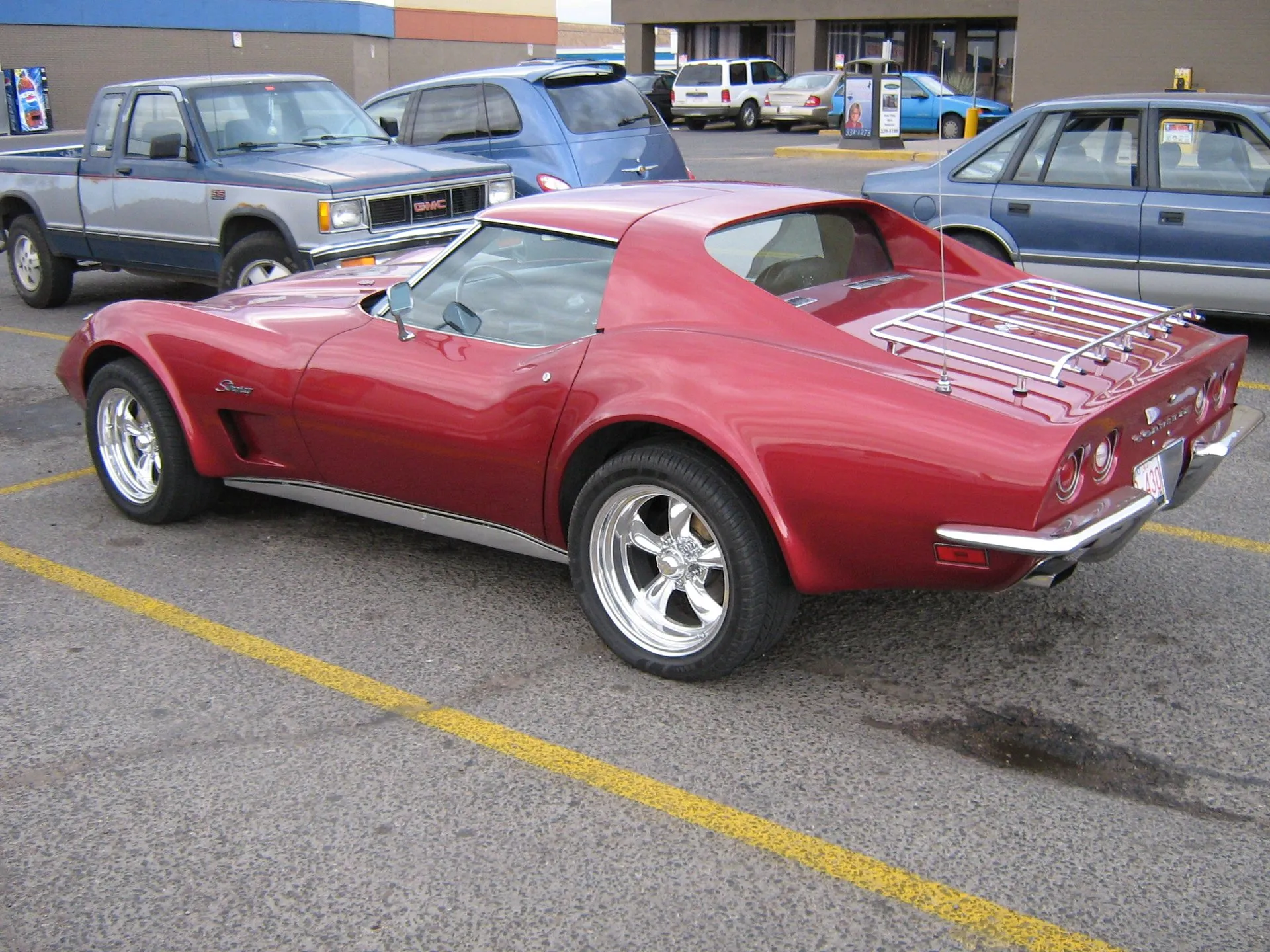
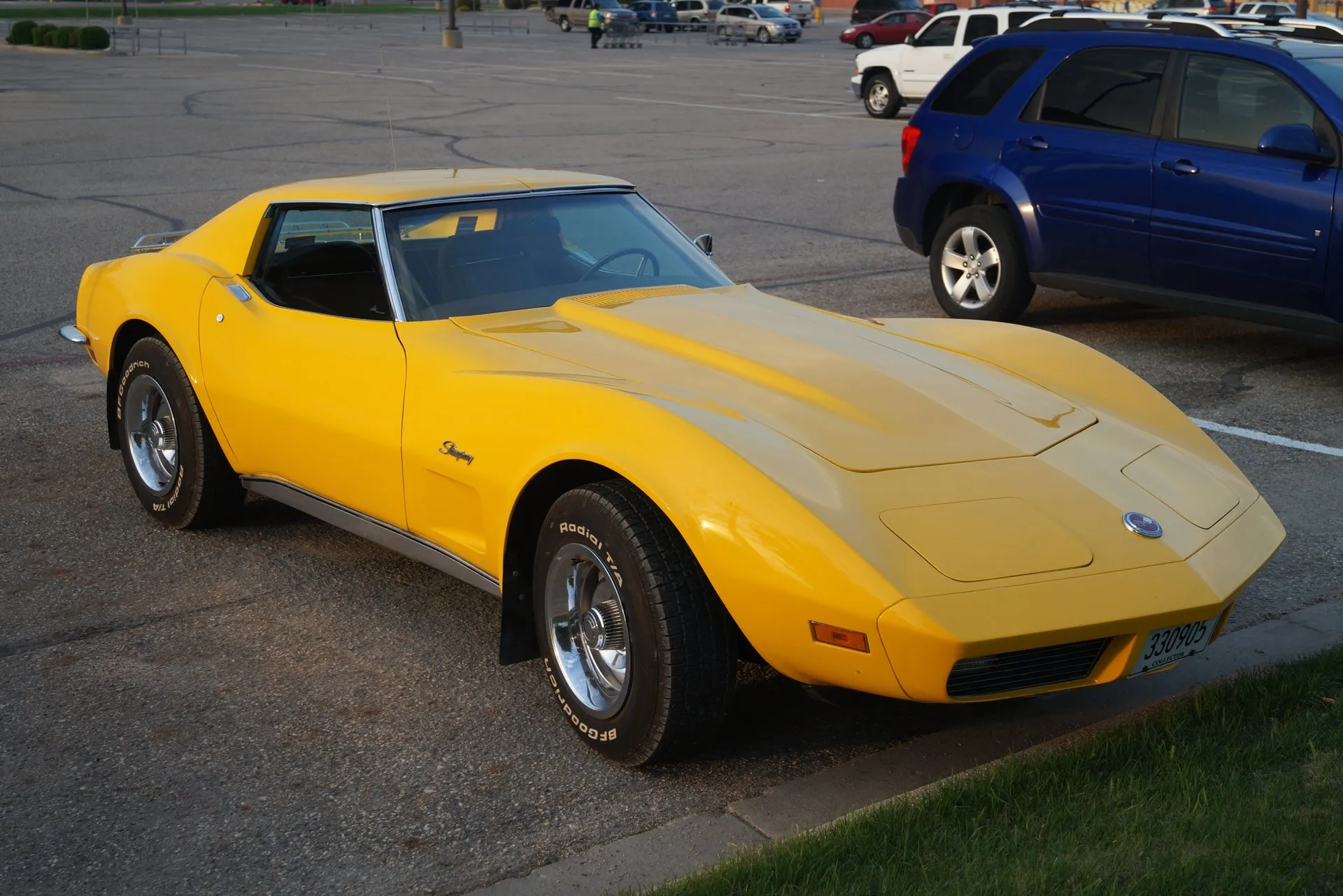
Tap a barrier at 5 mph in a new 1973 Corvette and the nose pops back into shape, lights unharmed. What’s behind it is spent. Car and Driver’s December 1972 test (opens in new tab) laid out the design: a flexible urethane skin over a steel bar on two draw bolts, which soak up the hit by deforming and then have to be replaced. That body-color nose is half of what sets the 1973 apart in the C3 (1968–1982) line. The other half is at the back, where the chrome bumper from 1972 stayed on for one more year.
Chevrolet built 30,464, including 4,943 convertibles, every one at St. Louis. Three V8s were offered, all rated in SAE net horsepower: 190 hp L48, 250 hp L82, 275 hp LS4. GM’s price list dated August 18, 1972 asked $5,561.50 for the coupe and $5,335.50 for the convertible, each including $14.50 for factory delivery and handling. Hagerty and Corvette Action Center give the convertible $5,398.50, a $63 gap no source this site read explains. On Bring a Trailer in 2026, 9 sold, median $20,300, a small sample.
Generation-wide trouble, frame and birdcage rust above all, lives in the C3 buyer’s guide. Most figures here come from GM’s 1973 Heritage Center kit, in this site’s owner’s manual library.
C3 Key figures
- Built
- 30,464, including 4,943 convertibles
- Engines
- 190 hp L48, 250 hp L82, 275 hp LS4
- Price new
- $5,561.50 for the coupe
- One-year look
- body-color nose, chrome rear bumper
- 454s built
- 4,412
- Bring a Trailer, 2026
- 9 sold, median $20,300
- Hagerty #3 value
- $14,100 (April 2025)
Section 01
Rubber in front, chrome behind: the one-year look
The Corvette Black Book page that GM reproduces in its 1973 kit puts it plainly: the front was redesigned to meet federal 5-mph standards, while the rear bumpers were “essentially unchanged from 1972”. The body-color front system added 35 lb and could take a 5-mph impact without damage to lights or safety equipment. GM’s brochure calls it a “resilient body-color bumper” and still lists a “wraparound rear bumper with built-in bumper guards”.
Put that page beside its neighbours. The 1972 Black Book page calls the 1972 the last Corvette with chrome bumpers front and rear. The 1974 page says the change to soft bumpers was completed in 1974, with a body-color urethane rear. Read together, those three pages make the 1973 the only Corvette that pairs the two: body-color nose, chrome rear bumper. That’s this site’s reading, not GM’s wording; owners have long called it the one-year C3 (CorvetteForum, 2006, 2011 and 2025).
Why does a 1973 Corvette have a chrome rear bumper? Because the 5-mph rule was met at the front first. The rear waited a year, and the 1974 got the body-color one.
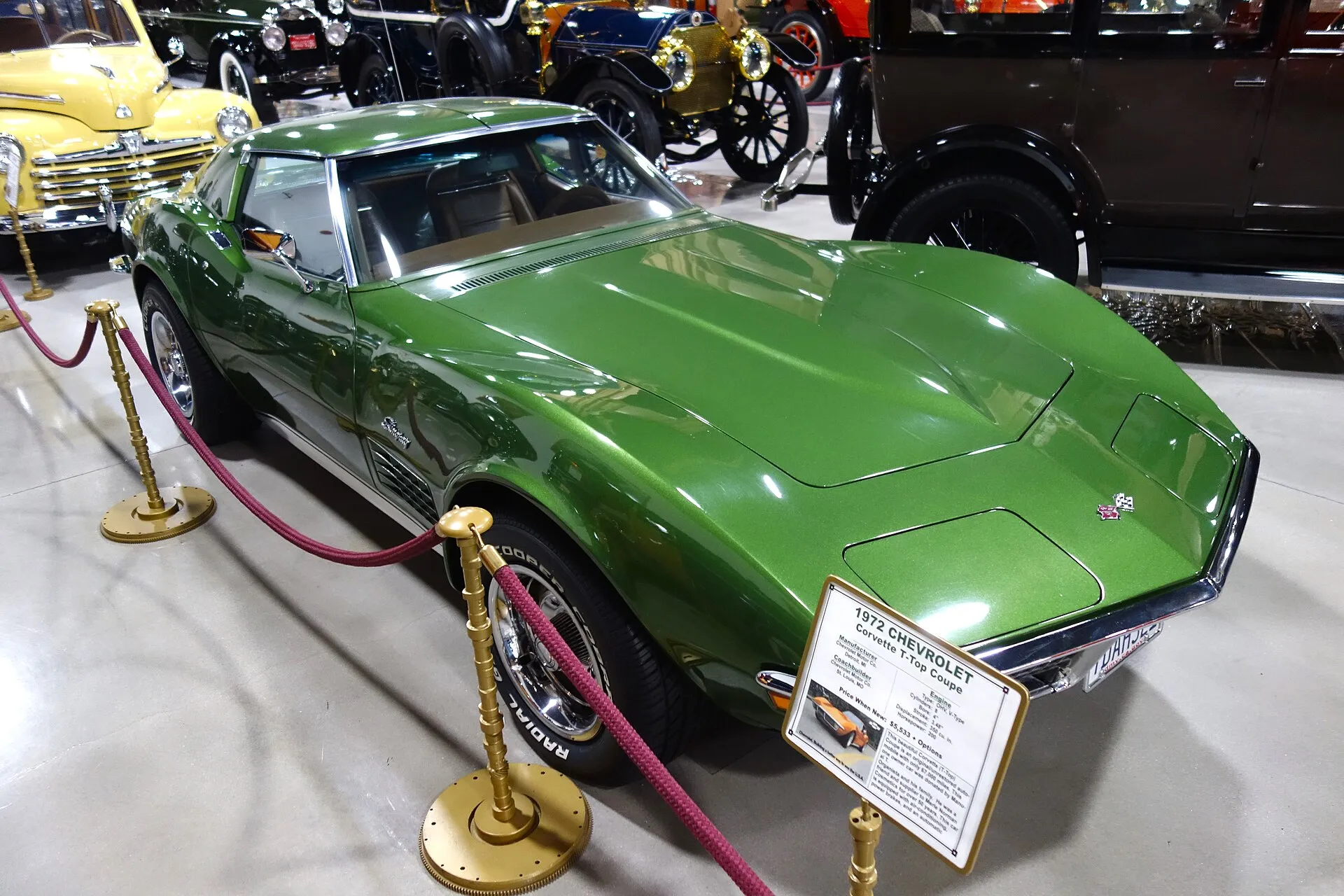
Car and Driver adds that the new bumper sits three inches farther out than the old one. Owners say the 1973–1974 front covers run straight across and fit only those two years, while 1975-on covers dip in the middle and wear bumper pads (CorvetteForum, 2016). From the front, then, a 1973 and a 1974 look the same, and the tail settles it.
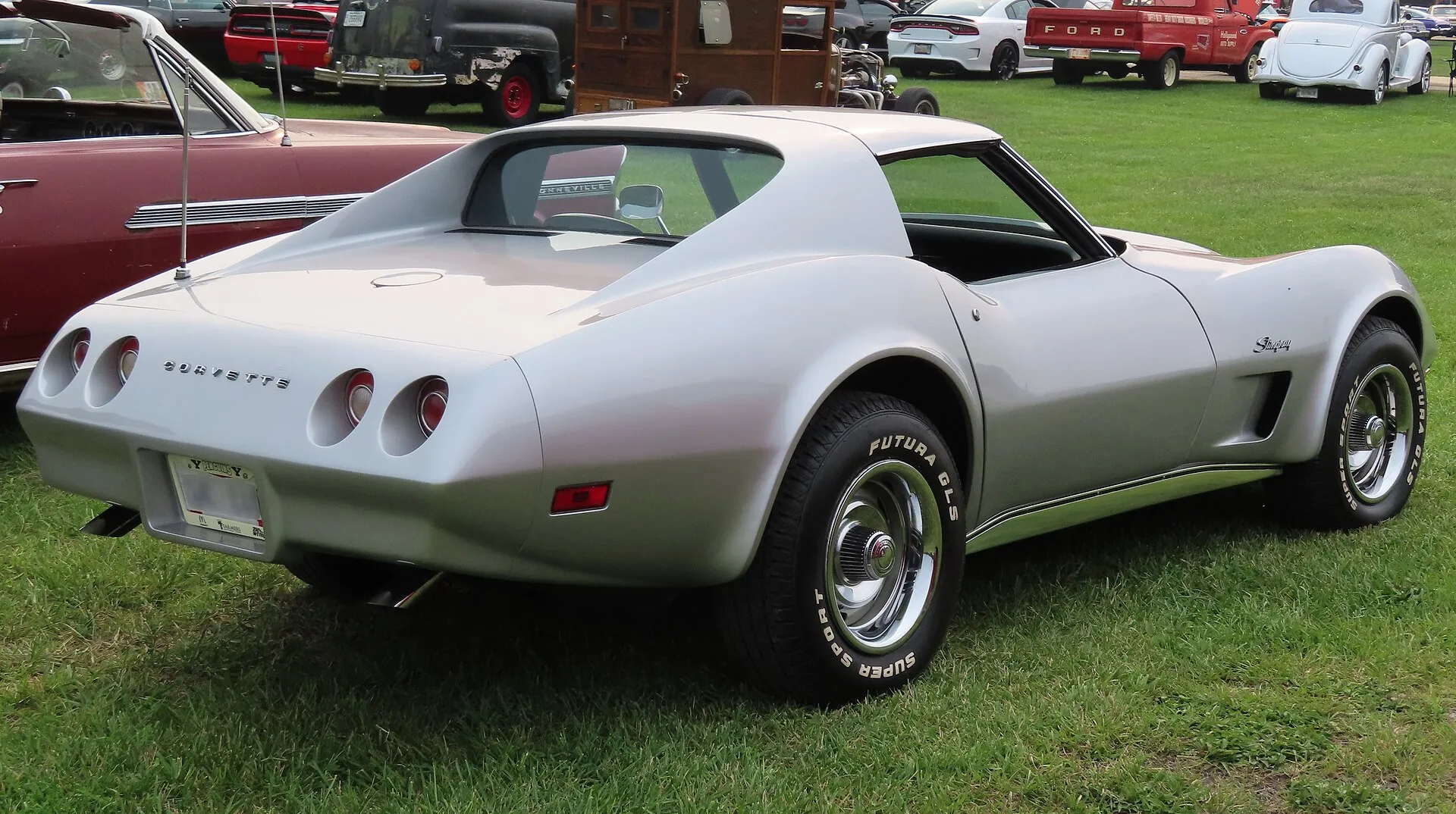
The 1974 finished the job with a urethane rear in two pieces joined at the center, and it was the last year of the 454 and of Corvettes without catalytic converters, per its Black Book page. The 1975 Corvette guide picks up from there. A 1973 wearing a chrome front has been converted, a job owners say takes different brackets, frame extensions and sheet metal (CorvetteForum, 2006).
Section 02
Fixed glass, no wiper door and a hood that breathes at the windshield
The bumper wasn’t the year’s only change. The Black Book lists these too:
- A fixed rear window. The 1968–1972 coupe’s back glass came out; the 1973’s doesn’t, and losing the shelf that stored it added two inches of luggage height. Zora Arkus-Duntov told Car and Driver why: at 140 mph with the roof panels off and the windows up, pulling the rear glass caused a “buffeting backdraft”.
- No wiper door. The vacuum-operated flap over the wipers went, about 10 lb by Car and Driver’s count. The wipers now park under the hood’s rear edge, so GM’s brochure still calls them “Hide-A-Way”.
- A new hood with cold-air induction, “rear cold air induction” in the Black Book’s words. Car and Driver explains it: a solenoid opens an inlet at the base of the windshield at full throttle, and Duntov claimed a full second off the standard engine’s 0–60 mph time (his claim, not a test figure). The carburetor breathed there through 1975, as the 1976 Corvette guide explains.
- An open fender scoop. The 1972 was the last with grilles in the front fender vents; the 1973 has a single recessed scoop. Is a 1973 Corvette a Stingray? Yes: Corvette Action Center puts the Stingray emblems on the front fenders, above the vent.
- Radial tires. “Radial tires were first used with Corvettes in 1973,” the Black Book says: GR70-15 steel-belted radials on 15 × 8 steel wheels with trim rings and center caps. Car and Driver called the radials “an unalloyed improvement”.
- Quieter and stronger. Door beams, rubber body mounts with steel sleeves, sprayed-on sound deadening, an underhood pad and a coolant recovery tank. Car and Driver measured 79 dBA at 70 mph in an L82 four-speed, down from 81.
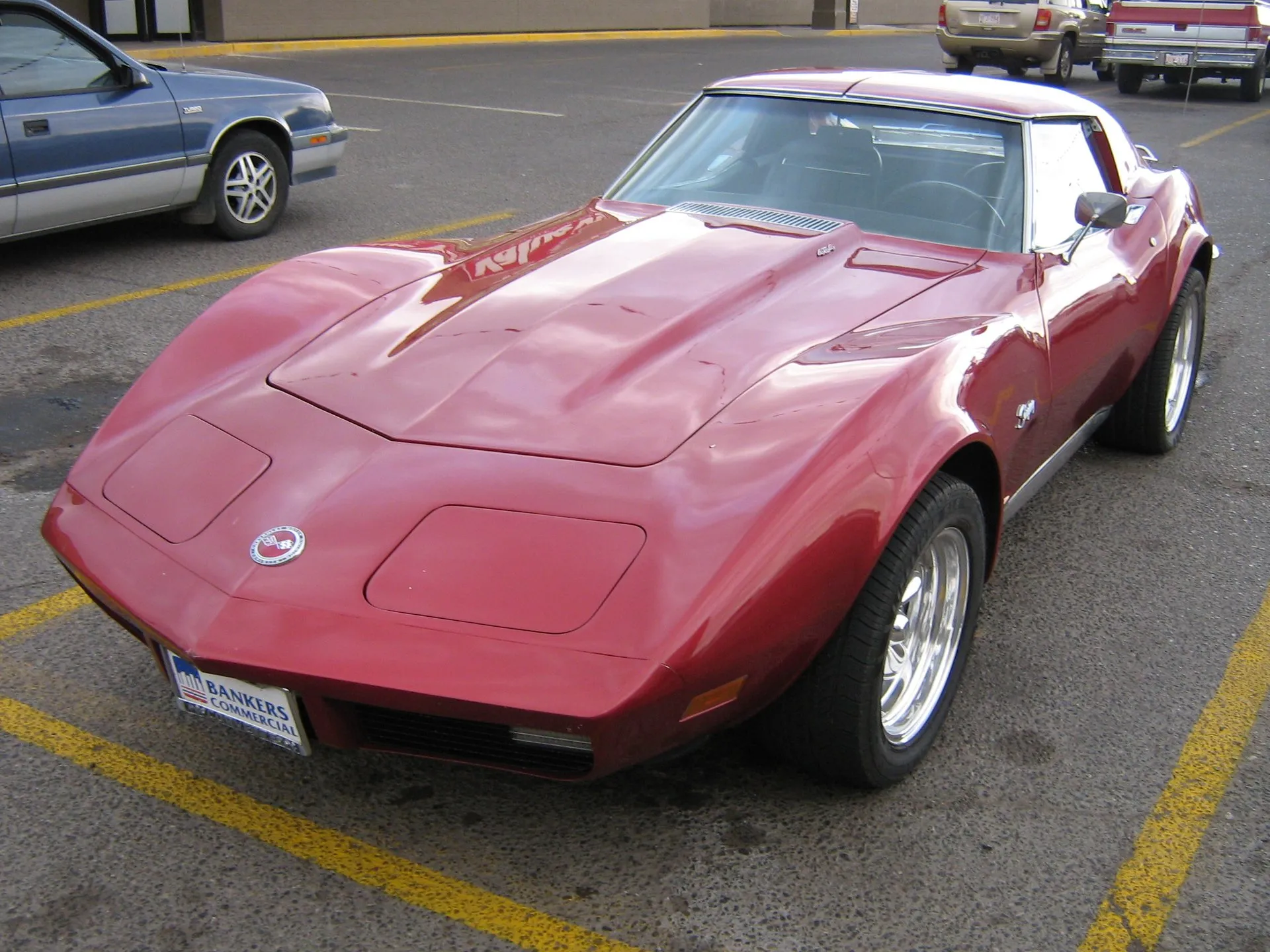
All of it weighed something: Car and Driver put the 1973 roughly 100 lb heavier than the 1972, and GM’s specifications give a base coupe 3,407 lb at the curb, a convertible 3,414 lb.
Section 03
190, 250 or 275 hp: the three 1973 V8s
How much horsepower does a 1973 Corvette have? 190 hp from the standard L48, 250 hp from the L82 and 275 hp from the LS4 454, all SAE net as installed, all with a four-barrel carburetor and dual exhaust (power teams and engine specifications). The C3 guide explains why net ratings from 1972 on look so much lower than the 1960s figures.
| L48 | L82 | LS4 | |
|---|---|---|---|
| Size | 350 cu in | 350 cu in | 454 cu in |
| Compression | 8.5:1 | 9.0:1 | 8.25:1 |
| Power | 190 hp at 4,400 rpm | 250 hp at 5,200 rpm | 275 hp at 4,400 rpm |
| Torque | 270 lb-ft at 2,800 rpm | 285 lb-ft at 4,000 rpm | 395 lb-ft at 2,800 rpm |
| Price | Standard | $299 | $250, heavy-duty battery included |
| Built | 20,342 (by subtraction) | 5,710 | 4,412 |
| VIN fifth digit | J | T | Z |
Prices are from GM’s August 1972 price list; the counts are the Black Book’s as Corvette Action Center reproduces them, the L48’s by this site’s arithmetic. Two cars in three got the base engine, and the 454 cost $49 less than the L82.
The LT1 and the ZR1 package ended with 1972, so every 1973 engine had hydraulic lifters, though solid lifters had been a Corvette trademark “since 1956”, as Car and Driver put it. Hagerty’s buyer’s guide gives the LS4 270 hp (GM’s 1974 figure) and Car and Driver printed 245 hp for the L82; GM’s 1973 papers say 275 and 250 throughout.
Three more things set the 1973 engines apart:
- California got all three. GM’s power teams page marks the L48, L82 and LS4 alike as available for California registration with California emission equipment, and the Black Book lists California suffixes for each. In 1972 the LS5 454 was not available in California.
- Regular fuel. GM’s specification form lists “regular (unleaded or low lead)” for all three.
- Points and a mechanical tach. Breaker-point ignition, gapped at .019 in, and a mechanical tachometer reading to 7,000 rpm. Electronic ignition and an electronic tach came for 1975.
The 454 is heavy: GM’s optional-equipment weights add 211 lb for it, 188 lb on the front axle, against 42 lb for the L82. Car and Driver’s 454s ran the quarter mile in about 14.7 s at 97 mph, and the magazine still preferred the L82 for its balance.
Gearboxes, axles and the 45 Z07 cars
The standard gearbox was the wide-ratio M20 four-speed (2.52, 1.88, 1.46, 1.00). The close-ratio M21 (2.20, 1.64, 1.27, 1.00) cost nothing but came only with the L82 or LS4, and went into 3,704 cars. The M40 Turbo Hydra-matic automatic was free with the L48 and $97 with either optional engine, and 17,927 buyers, nearly three in five, took it. That leaves about 8,833 M20 cars, by subtraction.
Positraction, Chevrolet’s limited-slip differential, was standard. GM’s standard ratios: 3.36 for an L48 four-speed and 3.08 for its automatic; 3.55 for an L82 (3.70 with the M21); 3.08 for an LS4 (3.36 with the M21). Other ratios cost $12, and air conditioning couldn’t be had with the 3.70.
The serious option was Z07, the off-road handling package: heavy-duty suspension and brakes, $369, with an optional engine and the M21 only. With it, the M21 axle went to 4.11 on an L82 and 3.55 on an LS4. Car and Driver reported ride rates up 70 percent at the front and 55 percent at the rear. Only 45 were built.
Section 04
Options, colors and four sets of aluminum wheels
Comfort outsold speed by a mile. Prices for power brakes, steering and windows are GM’s; the rest, and every count, are the Black Book’s as Corvette Action Center reproduces them (opens in new tab), since that page isn’t in GM’s kit:
| RPO | Option | Price | Cars |
|---|---|---|---|
| N40 | Power steering | $113 | 27,872 |
| J50 | Power brakes | $46 | 24,168 |
| C60 | Air conditioning | $452 | 21,578 |
| N37 | Tilt-telescopic steering column | $82 | 17,949 |
| U69 | AM-FM radio | $173 | 17,598 |
| A31 | Power windows | $83 | 14,024 |
| Custom interior trim (leather) | $154 | 13,434 | |
| U58 | AM-FM stereo radio | $276 | 12,482 |
| UF1 | Map light | $5 | 8,186 |
| T60 | Heavy-duty battery (included with the 454) | $15 | 4,912 |
| YF5 | California emission test | $15 | 3,008 |
| P02 | Custom wheel covers | $62 | 1,739 |
| C07 | Auxiliary hardtop (convertible) | $267 | 1,328 |
| A85 | Custom shoulder belts (standard on the coupe) | $41 | 788 |
| C08 | Vinyl roof cover for the hardtop | $62 | 323 |
| Z07 | Off-road handling package | $369 | 45 |
| YJ8 | Cast aluminum wheels | $175 | 4 |
Seven in ten 1973s left with air conditioning; one in seven had an LS4. Corvette Action Center’s rear defroster and white-stripe and white-letter tire counts don’t add up against 1972 and 1974, so they’re left out.
The aluminum wheels that barely happened
GM’s 1973 option list offers YJ8, “special cast aluminum” wheels. Car and Driver reported them made by American Racing Equipment and 35 lb lighter than the steel wheels. Then they vanished. Hagerty’s 1973 notes say 800 sets were made and four sets reported sold before the wheels were withdrawn for porosity; the Black Book, via Corvette Action Center, also counts 4, and its 1974 page says none sold that year. They returned for 1976, the first year with factory aluminum wheels as a regular option (see the 1976 Corvette guide). With four sets sold, a 1973 on aluminum wheels today is almost certainly wearing later ones; owners doubt any surviving set can be proved original (CorvetteForum, 2025).
Ten colors and eight interiors
GM’s color and trim chart lists ten exterior colors, all available with black interiors:
| Code | GM’s name |
|---|---|
| 10 | Classic White |
| 14 | Silver Metallic |
| 22 | Medium Blue Metallic |
| 27 | Dark Blue Metallic |
| 45 | Blue-Green Metallic |
| 47 | Elkhart Green Metallic |
| 52 | Yellow |
| 53 | Yellow Metallic |
| 76 | Mille Miglia Red |
| 80 | Orange Metallic |
On trim tags, owners and Corvette Action Center read the same codes with a 9 in front (927 for Dark Blue). The Black Book, via Corvette Action Center, says no count by color exists and that about 30 cars were painted black at St. Louis, off the chart (Hagerty repeats it).
Inside, the standard seats were vinyl in black, midnight blue, dark red, dark saddle or medium saddle. The custom interior added leather seat trim, cut-pile carpet and wood-grain accents on the doors and console, in black, dark saddle or medium saddle. Convertible tops came in black or white with any color.
Section 05
Reading a 1973: the VIN, the 4,000 missing serials and the stamp
The VIN plate is on the left windshield pillar, by GM’s frame and body page:
| Position | Reads | Means |
|---|---|---|
| 1 | 1 | Chevrolet |
| 2 | Z | Corvette |
| 3–4 | 37 or 67 | Coupe or convertible |
| 5 | J, T or Z | L48, L82 or LS4 |
| 6 | 3 | 1973 |
| 7 | S | St. Louis |
| 8–13 | 400001 to 434464 | Serial number |
How many 1973 Corvettes were made? 30,464: 25,521 coupes and 4,943 convertibles, up 12.8 percent on 1972’s 27,004, while convertibles fell from 6,508 to 4,943, about 16 percent of the total (this site’s arithmetic from the two Black Book pages). Yet the last 1973 is serial 34,464. The Black Book explains: during May 1973, 4,000 numbers, 24,001 through 28,000, were never used. By its account no 1973 left the line with a serial from 424001 to 428000, so a car wearing one deserves hard questions.
The Black Book’s month-end serials date a car to its build month:
| Month | Last serial | Month | Last serial |
|---|---|---|---|
| August 1972 | 01138 | February 1973 | 16301 |
| September 1972 | 03539 | March 1973 | 19253 |
| October 1972 | 06054 | April 1973 | 21933 |
| November 1972 | 08696 | May 1973 | 28892 |
| December 1972 | 10679 | June 1973 | 31731 |
| January 1973 | 13600 | July 1973 | 34464 |
May’s real output was about 2,959 cars, once the skipped numbers come out.
The engine stamp. GM’s service pages say the VIN is stamped on the engine and transmission, and its specification form puts the engine number on the front right of the block, beside a three-letter suffix naming engine and gearbox:
| Engine | Manual | Automatic | California manual | California automatic |
|---|---|---|---|---|
| L48 | CKZ | CLA | CLB | CLC |
| L82 | CLR | CLD | CLS | CLH |
| LS4 | CWM | CWR | CWT | CWS |
The Black Book’s castings: block 3970010 for both 350s and 3999289 for the 454; heads 3998993 on the L48, 330545 on the L82 and 353049 on the LS4. A 350 with 333882 heads is wearing a 1974 casting (the one Chevrolet’s bulletin 74-T-6 covers, not a 1973 part). The C3 guide explains what “numbers matching” can and can’t prove.
The trim tag, with the paint and interior codes, sits on the driver’s door jamb below the windshield pillar, by Corvette Action Center’s account. Check it against the paint: an owner in a 2021 thread spotted a dealer car whose 927 Dark Blue tag didn’t match the body.
What gets faked or fudged:
- Badges. A 454 or L82 emblem proves nothing; the VIN’s fifth digit does (Z or T), and then the suffix. The red car in this page’s photos wears a 454 badge, and nobody can tell from outside whether it’s real.
- The body code. In September 2026, a 1973 listed on Bring a Trailer as a convertible had the coupe’s 37 body code in its VIN: a coupe turned into an open car, or a misdescribed listing. It didn’t sell. Read digits three and four.
- Later parts. Owners comparing a 1973 and a 1974 convertible in 2011 spotted a non-original hood, nose emblem, exhaust tips and engine on the 1973 (CorvetteForum). On a car sold as original, check that the hood has its inlet at the windshield.
Section 06
Known 1973 problems, from the nose to the rear glass
NHTSA’s complaint file (opens in new tab) holds nothing for a 1973 (October 22, 2026), but it starts in September 1994, so its silence says nothing about these cars new. There is no GM recall for the year, only a campaign on Cardone remanufactured rear calipers made in 2002–2003 (aftermarket), listed by part number in the C3 guide.
Chevrolet’s dealer bulletins, transcribed by Corvette Action Center, fill in the year:
- 73-T-75 (January 2, 1974): the rear window. On 1973 coupes, water could get in at the bottom of the new fixed back glass: the plastic frame might let the glass slide and break the butyl seal. The bulletin’s fix (opens in new tab) was to cut the glass out, reset it and fit three rubber spacers (
GM 4871330, OEM), which 1974 production had from the start. The fixed window carried on; the frame without spacers is 1973-only. - 73-T-28 (May 14, 1973): heat. On 1970–1973 cars with the 454 and air conditioning, overheating in hot weather and heavy traffic, from too little airflow at low speed. Chevrolet added a lower grille panel extension (
GM 336176, OEM) to 1973s built after VIN 1Z37Z3S410722, which dealers could fit to earlier cars, and a flex fan kit (opens in new tab) (GM 6260480, OEM) to replace the fan and clutch, with more fan noise. - 77-T-48 (July 1977): torque shake. On 1973–1977 cars, the steering wheel and floor could shake at about 55–60 mph under power. The cause was rear wheel camber, and the cure was resetting it.
The nose. Over fifty years on, the original urethane is the 1973’s own weak spot. When a new owner asked in 2021 about a cracked front, replies said early urethane crumbles and comes apart in chunks (opens in new tab), nothing reliably bonds to it, and tape or a nose bra only buys time; one owner’s aftermarket cover needed a lot of fiberglass work to fit. Owners in 2019 priced replacement covers at $250 to $1,150, and one paid about $900 for a GM cover from a dealer (CorvetteForum).
Everything else is the C3’s: frame and birdcage rust, T-top and windshield leaks, vacuum headlights, calipers, rear wheel bearings and power steering, each covered in Known C3 problems in the C3 buyer’s guide. The 1973 floor is fiberglass; the steel floor that rusts came in 1976.
Section 07
Checking a 1973 before you buy
- The frame and birdcage first, by the C3 checklist: rear kick-ups, crossmembers, the #2 body mounts and the lower windshield corners. A rotten cage outweighs everything else here.
- The nose. Cracks, chunks, filler and tape. If it’s been replaced, ask whose cover and how well it fits.
- The rear window on a coupe. Water stains at the bottom of the glass and in the luggage area point to 73-T-75’s leak.
- Cooling on a 454 with air. Look for the lower grille extension on a car built after VIN 1Z37Z3S410722, and watch the temperature gauge in traffic.
- The VIN. Fifth digit J, T or Z before paying for an engine, 37 or 67 before paying for a convertible, and a serial outside 424001–428000.
- The engine pad. The VIN derivative and a suffix that matches the engine and gearbox, then the castings.
- The trim tag against the paint and the interior.
- The hood with its inlet at the base of the windshield, and the right nose emblem and exhaust tips if the car is sold as original.
- A drive past 55 mph under power, for torque shake, and a look at the calipers for seepage.
- An inspection on a lift by a shop that knows C3s, and the paperwork: a window sticker or shipping data beats any badge.
Section 08
What 1973s sold for in 2026, by engine and body
How much is a 1973 Corvette worth today? On Bring a Trailer (opens in new tab), 15 were listed between January 1 and October 22, 2026, and 9 sold, median $20,300, from $6,400 to $27,000 (this site’s count of sold prices, without the buyer’s fee; engine by VIN fifth digit):
| 1973s on Bring a Trailer, 2026 | Sold | Median or prices | Range |
|---|---|---|---|
| L48 | 7 | $20,300 | $6,400–$27,000 |
| LS4 | 2 (of 4 listed) | $18,250 and $22,000 | |
| L82 | 0 (of 2 listed) | Bid to $14,599 and $6,100 | |
| Coupes | 7 | $20,300 | $6,400–$27,000 |
| Convertibles | 2 | $15,050 and $24,000 | |
| All | 9 (of 15 listed) | $20,300 | $6,400–$27,000 |
The top sale, $27,000 in April, was an L48 coupe with an aftermarket cam and pistons. A Mille Miglia Red L48 automatic with air and 26,000 miles shown brought $26,000 in June, and a yellow LS4 with its tank sticker $22,000 in March. At the bottom, a repainted L48 sold for $6,400 in September. In 2025, Bring a Trailer’s results feed shows 15 of 21 sold, median $17,000. Samples this small are market color, not a valuation or a forecast.
Hagerty’s price guide (opens in new tab), as the Internet Archive captured it, put a #3 (Good) L48 coupe at $14,100 (April 2025), the newest public figure this site could read; a newer one may exist. classic.com offered no figure for the 1973 alone.
For scale, this site’s 2026 Bring a Trailer medians are $14,250 for the 1975 (9 sold) and $10,500 for the 1976 (7 sold): on these small samples, 1973s sold above the full-urethane cars. For the chrome-bumper cars, take the C3 guide’s own window, June 16 to September 26, 2026. In it, 45 sales of 1968–1972 cars made a median of $39,000, and the five 1973s sold in those weeks a median of $20,300 (this site’s count), about half.
What is special about a 1973 Corvette? The body-color nose with the chrome tail, the first fixed rear window and radial tires, and a 454 one year before the big-block’s last.
Section 09
Which 1973 to buy: a sound coupe, then the 454 if the VIN says Z
The pick is a VIN-proved LS4 coupe with a solid birdcage. Its 395 lb-ft at 2,800 rpm is the most torque of any 1973, only one in seven cars got it, and the big-block had a single year left. Bring a Trailer’s 2026 record holds just two LS4 sales, far too few to say what one is worth, so pay for the Z in the VIN and a CW suffix, never the hood badge, and check the cooling (73-T-28). Then the long nose, the chrome tail and a big-block rumble make the case for America’s sports car on their own.
The driver’s alternative is an L82 four-speed, the balance Car and Driver preferred, with 250 hp at 5,200 rpm and, by GM’s optional-equipment weights, 169 lb less than an LS4 car (this site’s arithmetic). None sold on Bring a Trailer in 2026, so expect to hunt, and check for the T.
On a budget, a sound L48 coupe. Two in three 1973s were L48s, and parts for the 350 are everywhere. It’s the 1973 to upgrade without guilt: matching numbers mean the least on the base engine, and a better cam and exhaust undo no rarity.
Skip a rotten birdcage unless the price pays for it, a “convertible” whose VIN says 37, and any car priced on badges. Budget for a nose either way. Get those right, and you have the one year that wears the chrome era and the urethane era at once, selling on this site’s small 2026 sample for about half what 1968–1972 cars brought in the same weeks.
Section 10
Sources
- GM Heritage Center: 1973 Corvette vehicle information kit files.zipcorvette.com This site's library. The reproduced Corvette Black Book page (PDF page 6): production, VINs, engine suffixes, castings, monthly serial numbers, the skipped serials and the year's facts. GM service information (12): dimensions and where the VIN is stamped. GM's price list dated August 18, 1972 (24). Corvette Power Teams, August 18, 1972 (26). The 1973 brochure (28 to 37: features 29, major features 33, selected options 34, power teams and engines 35, specifications 36, color and trim 37). The AMA specification form issued September 1972 (38 to 69: engine 44, power teams 45, instruments 54, distributor 55, frame and body 62, weights 64, optional equipment weights 67).
- GM Heritage Center: 1972 Corvette vehicle information kit files.zipcorvette.com This site's library. Black Book pages: the last chrome bumpers front and rear, the last removable rear window and the last side-fender grilles, 1972 production, prices and the LS5's California status (PDF pages 4 and 5).
- GM Heritage Center: 1974 Corvette vehicle information kit files.zipcorvette.com This site's library. Black Book pages: the body-color rear bumper, 1974 production and prices, the last 454, the last year without catalytic converters and the YJ8 wheels (PDF pages 6 and 7).
- NHTSA owner complaints, 1973 Chevrolet Corvette (opens in new tab) api.nhtsa.gov None on file, pulled October 22, 2026. NHTSA's complaint file begins in September 1994.
- NHTSA recalls, 1973 Chevrolet Corvette (opens in new tab) api.nhtsa.gov No GM recall; one aftermarket-part campaign, 03E032000 (Cardone remanufactured rear calipers). Pulled October 22, 2026.
- Chevrolet dealer bulletin 73-T-75: rear window water leak, 1973 Corvette coupe, January 2, 1974 (via Corvette Action Center) (opens in new tab) web.archive.org Internet Archive copy.
- Chevrolet dealer bulletin 73-T-28: engine overheat, 1970–1973 Corvette with 454 and air conditioning (via Corvette Action Center) (opens in new tab) corvetteactioncenter.com May 14, 1973.
- Chevrolet dealer bulletin 77-T-48: vehicle vibration during acceleration, July 1977 (via Corvette Action Center) (opens in new tab) web.archive.org Internet Archive copy. 1973–1977 models.
- Chevrolet dealer bulletin 74-T-6: blocked coolant passage in 1974 cylinder heads, December 5, 1973 (via Corvette Action Center) (opens in new tab) corvetteactioncenter.com Titled 1973–1974 there, but it covers 1974 head casting 333882, not a 1973 part.
- Car and Driver: 1973 Chevrolet Corvette road test (opens in new tab) caranddriver.com December 1972 issue.
- Corvette Action Center: 1973 Corvette production and options (opens in new tab) web.archive.org Internet Archive copy. Option prices and counts as the Corvette Black Book gives them; the about 30 cars painted black.
- Corvette Action Center: 1973 Corvette identification numbers (opens in new tab) web.archive.org Internet Archive copy. VIN, suffixes, castings, the Stingray emblem and the trim tag's location.
- Corvette Action Center: 1973 Corvette tech center (opens in new tab) web.archive.org Internet Archive copy. The year's changes.
- Hagerty valuation tool: 1973 Chevrolet Corvette L48 coupe (opens in new tab) web.archive.org Internet Archive copy of May 2025: #3 (Good) $14,100, April 2025; $13,300 in October 2024 (the December 2024 copy (opens in new tab)). The live page didn't load on October 22, 2026.
- Hagerty: 1968–82 Chevrolet Corvette (C3) buyers guide (opens in new tab) hagerty.com Sajeev Mehta, May 13, 2020, updated June 24, 2022. Read via the Internet Archive's June 2025 copy (opens in new tab).
- Bring a Trailer: Chevrolet Corvette C3 results (opens in new tab) bringatrailer.com 1973 listings only. 2026: 15 listed and 9 sold from January 1 to October 22 (the last ended October 19), median $20,300; the five sold between June 16 and September 26, 2026 (the C3 guide's window) also had a median of $20,300; 2025 from the results feed. Counts and medians are this site's, from each listing's sold price without the buyer's fee. 2026 sales named in the text: the modified L48 (opens in new tab) (April), the Mille Miglia Red L48 (opens in new tab) (June), the yellow LS4 (opens in new tab) (March), the red LS4 (opens in new tab) (March), the repainted L48 (opens in new tab) (September) and the coupe-coded convertible (opens in new tab) (September).
- CorvetteForum thread: 1973 vs 1974 vs 1975–1979 front bumper (opens in new tab) corvetteforum.com July 2016.
- CorvetteForum thread: best 1973 front bumper replacement (opens in new tab) corvetteforum.com February to March 2019. Owner-reported prices.
- CorvetteForum thread: 1973 front bumper cracks (opens in new tab) corvetteforum.com April 2021.
- CorvetteForum thread: chrome front bumper on a 1973 (opens in new tab) corvetteforum.com November 2006.
- CorvetteForum thread: 1973 C3 values (opens in new tab) corvetteforum.com February 2025.
- CorvetteForum thread: 1973 or 1974 Corvette value (opens in new tab) corvetteforum.com November 2011.
- CorvetteForum thread: a 1973 454 (opens in new tab) corvetteforum.com December 2021.
- CorvetteForum thread: 1973 454, is it an LS4 or LS5 (opens in new tab) corvetteforum.com April 2009.