C3 · Buying guide
1979 Corvette guide: the record year, L48 or L82, the May price change and 2026 prices
Published
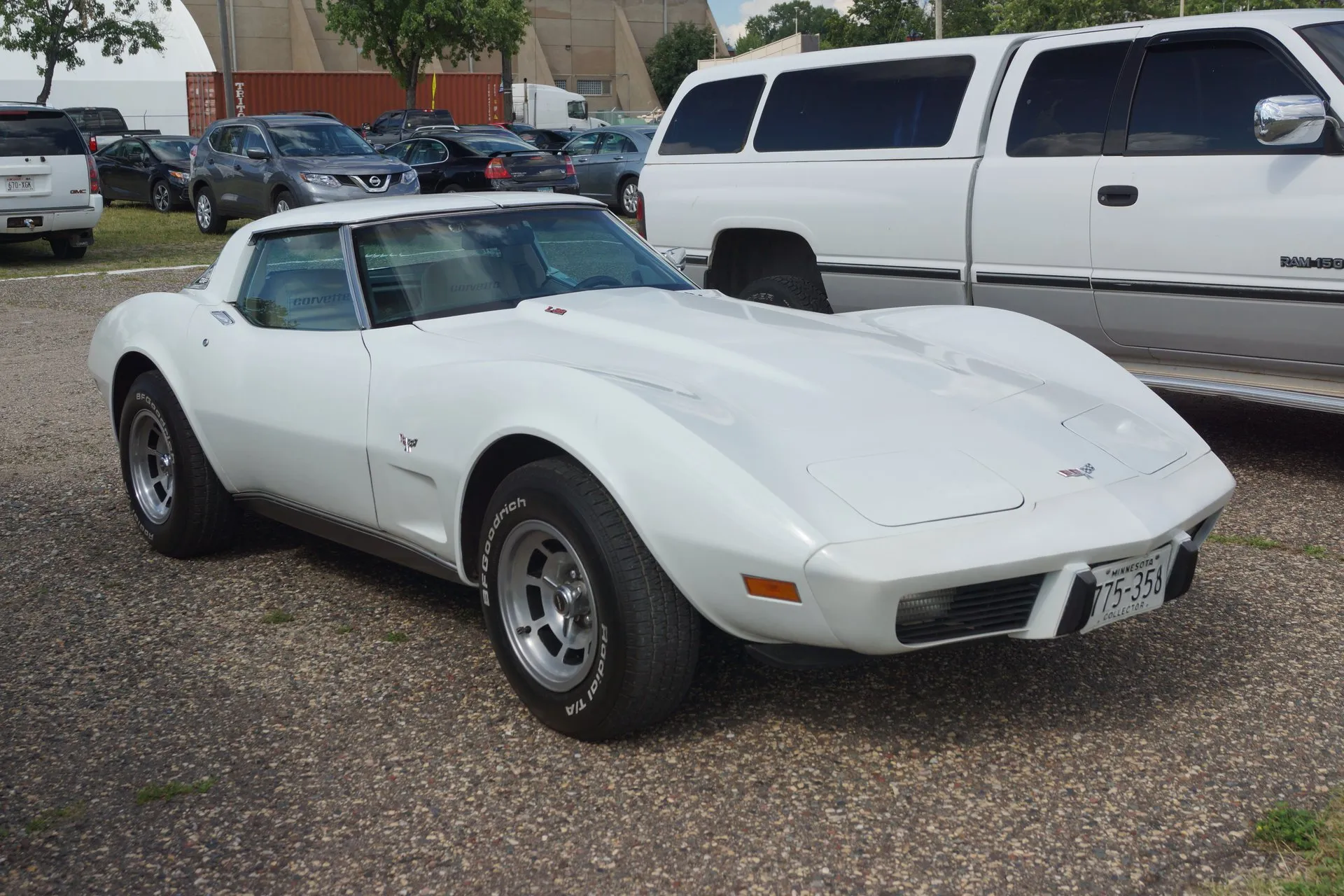
Some 1979 Corvettes have window cranks, and one, a CorvetteForum member wrote in 2009 of a car for sale on eBay, left the factory with a plate over its center air vents instead of air conditioning. Neither has to be a later downgrade. Until a price change on May 7, 1979, air conditioning, power windows and the tilt-telescopic steering column were all options, and owners describe factory cars built without one or more of them. From that date all three were standard, and the base price rose $706, the biggest of the year’s increases.
The 1979 was the twelfth model year of the C3 (1968–1982) and the biggest Corvette model year there has ever been: 53,807, all coupes, all built in St. Louis, up from 46,776 for 1978. The closest any year has come since is the 2023, 22 cars short, per the generations guide. The base price was $10,220.23, rising to $12,313.23 by the end of the year.
What most people ask first:
- Is a 1979 Corvette a Stingray? No. GM fitted no Stingray script that year (see The L82 test).
- What engine does a 1979 Corvette have? A 350 V8, in two versions: 195 hp L48, 225 hp L82.
- How much is a 1979 Corvette worth? On Bring a Trailer in 2026, the median sale was $20,500 from ten cars, and $15,500 for those with their original type of engine (see Sale prices in 2026).
- Is 1979 a good year? For a driver, yes: it’s the C3 with the most cars to choose from, the last with the 1978 body and the last whose L82 came with a four-speed. Which one to buy is in Buy the 4 in the VIN.
GM’s 1979 Heritage Center kit, in this site’s owner’s manual library, is the source of most figures here. The C3 buyer’s guide covers what every C3 shares, starting with frame rust and the birdcage (the steel cage around the cabin, under the fiberglass).
C3 Key figures
- Built
- 53,807, all coupes
- Engines
- 195 hp L48, 225 hp L82
- L82s built
- 14,516
- Price new
- $10,220.23, rising to $12,313.23
- Curb weight, base car
- 3,503 lb
- Bring a Trailer, 2026
- median $20,500 from 10 sales
- Hagerty #3 value
- $13,400 (October 2025)
Section 01
From anniversary car to everyday car: what 1979 changed
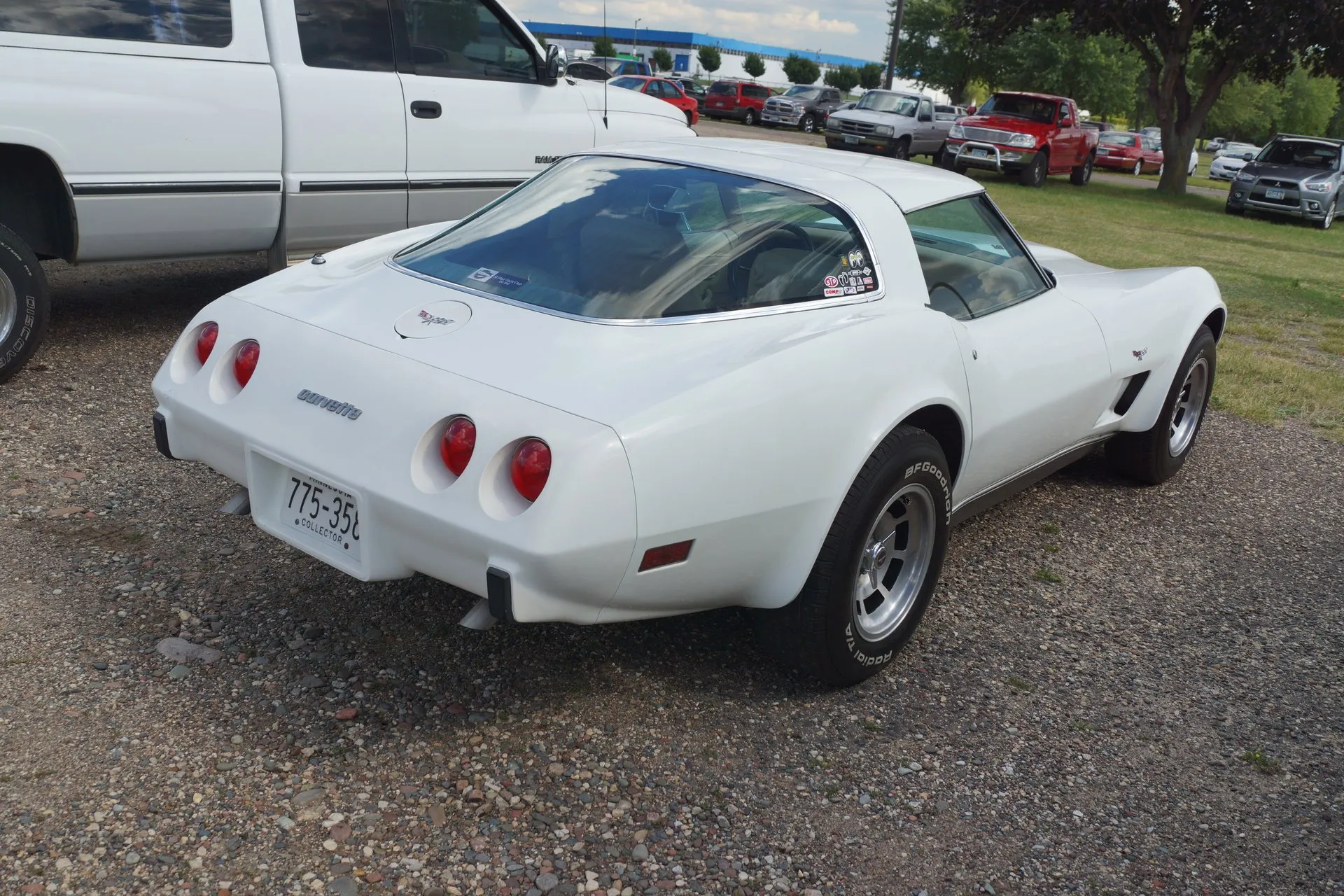
The 1979 kept the fastback rear glass, dash, 24-gallon tank and glass roof panel option that arrived for 1978, and dropped the birthday party. Chevrolet’s press release of September 21, 1978 says the 25th Anniversary emblems front and rear “are replaced by the traditional ‘Cross Flags’”, and GM’s exterior equipment list brings back the 1977 designs on the nose and the fuel filler door. The release also describes the coupe with black moldings on the roof panel and rear window.
The bigger change was inside. The high-back bucket seats introduced on the 1978 Pace Car became standard, and the release lists what they did:
- Lighter: fiberglass-reinforced plastic shells saved about 24 lb per car (the Black Book says about 12 lb per seat).
- More room: the backs pivot higher, so the passenger seat folds flat with the luggage floor and makes it longer, and both seats gained an inch of forward travel “to aid short drivers”.
- Self-locking backs: inertia locks replaced the manual seatback latches.
- New cloth: a new pattern replaced the ribbed cloth in the cloth-and-leather trim.
The Black Book, a hobby reference whose 1979 pages GM reproduces in its kit, adds the rest: the Pace Car’s front and rear spoilers became an option, an AM/FM radio became standard, the high beams turned tungsten-halogen early in the year, and the fuel filler pipe was redesigned to make it harder to modify for leaded-fuel nozzles. GM’s brochure lists an improved anti-theft column lock and two new options, power windows and locks together and an AM/FM stereo with cassette. The release adds a softer ride for manual cars, which now used the automatic’s base shocks.
By GM’s sheets, the base car got lighter: 3,557 lb at the curb for 1978 (MVMA form, February 1978) and 3,503 lb for 1979 (data book weights, October 1978), a 54 lb drop by this site’s arithmetic, nearly half of it in the seats.
One year on. The 1980 got a new nose and tail with the spoilers molded in, about 169 lb less weight, the 85 mph speedometer on every car and air conditioning, power windows and tilt as standard all year; production fell to 40,614.
Section 02
Two 350s, and the places the L82 couldn’t go
Both engines were 350 cu in (5.7 L) V8s with a Rochester Quadrajet four-barrel, built at Flint, rated in SAE net horsepower in GM’s data book:
| L48 | L48, California and high altitude | L82 | |
|---|---|---|---|
| Compression | 8.2:1 | 8.2:1 | 8.9:1 |
| Power | 195 hp at 4,000 rpm | 195 hp at 4,000 rpm | 225 hp at 5,200 rpm |
| Torque | 285 lb-ft at 3,200 rpm | 280 lb-ft at 2,400 rpm | 270 lb-ft at 3,600 rpm |
| Price | Standard | Standard, automatic only | $565 |
| Built | About 39,291, California cars included (this site’s arithmetic) | 14,516 | |
| Gearbox and axle | Four-speed with 3.36, or automatic with 3.55 | Automatic with 3.55 | Four-speeds with 3.70, or automatic with 3.55 |
| VIN, fifth character | 8 | 8 | 4 |
| Engine stamp suffix | ZAA, ZAF manual; ZAB, ZAH automatic | ZAC, ZAJ California; ZAD high altitude | ZBA manual; ZBB automatic |
Against 1978’s 185 and 220 hp, the L48 gained 10 hp and the L82 5. Per the Black Book, new open-flow mufflers gave both engines 5 hp, and the L82’s dual-snorkel air cleaner, now on the L48 too, gave the base engine 5 more; the release adds a larger Y-pipe behind the converter. Some secondary sources say both engines “gained 5 horsepower”; GM’s numbers say otherwise. The L82 went into 27 percent of the year’s cars.
Where the L82 couldn’t be sold. No L82 and no manual gearbox in California or with high-altitude equipment (GM’s power team pages). The 1978 brochure kept the L82 out of other places too, without saying why. For 1979 GM’s paper gives the reason: a Chevrolet letter to every dealer, dated December 1, 1978, says the coupe with the L82 did not meet exterior noise limits in Florida, Maryland, Oregon and Washington, Cook County in Illinois, and the cities of Boston, Chicago, Des Plaines and Grand Rapids, and may not be ordered for a sale there. New cars leased in Boston, Florida or Maryland were covered too; used cars weren’t.
Gearboxes. The three-speed Turbo Hydra-Matic 350 automatic, RPO MX1 (RPO is GM’s regular production option code), cost nothing and went into 41,454 cars, 77 percent, which leaves 12,353 four-speeds. The close-ratio M21 (2.43, 1.61, 1.23, 1.00) was a no-cost, L82-only choice on 4,062 of them (Corvette Action Center’s count; the Black Book prints it against a mislabeled line). GM’s October 1978 data book gives both engines the same wide-ratio box, 2.64, 1.75, 1.34, 1.00, though GM’s September 1978 specification form still shows the 1978 L48’s 2.85 first gear: a 2.85 box in a 1979 L48 is possible, not confirmed. Owners identify the four-speeds as Borg-Warners (opens in new tab) (CorvetteForum, 2019); GM’s identification page uses a Muncie example code.
Axles. Positraction (Chevrolet’s limited-slip differential) came with every ratio, on an 8.375 in ring gear. The automatic L48’s axle went from 3.08 to 3.55, and the brochure lists the new ratio as a 1979 value feature. L82 four-speeds got 3.70, or 3.36 as one of GM’s “economy ratios” (G95, $19, 428 cars) with the wide-ratio box only.
How quick? Corvette Action Center’s table of Road & Track’s December 1978 test of an L82 four-speed gives 0–60 mph in 6.6 s, the quarter mile in 15.3 s at 95.0 mph, 127 mph flat out and 70–0 mph in 198 ft (the magazine itself wasn’t read for this guide).
The suspension boxes. The Gymkhana suspension (FE7, $49, on 12,321 cars) bought, per GM’s extra-cost equipment list, 550 lb/in front and seven-leaf 304 lb/in rear springs, a 1.12 in front bar, a 0.44 in rear bar and its own shock valving. New for 1979, F51 ($33, 2,164 cars) gave heavy-duty shocks without the stiffer springs.
Section 03
Before and after May 7, 1979
The 1979’s base price rose several times during the year, from $10,220.23 to $12,313.23. Per the Black Book’s options page, the largest step, $706.00, took effect on May 7, 1979, when air conditioning, power windows and the tilt-telescopic column became standard. At the Black Book’s listed option prices ($635, $141 and $190), the three had cost $966 together, by this site’s arithmetic.
Before that, all three were extra. GM’s dealer order guide, revised February 5, 1979, still lists C60 air conditioning, A31 power windows and N37 tilt-telescopic column as options, and owners describe factory 1979s with crank windows and without air (CorvetteForum, 2009 (opens in new tab)). How many is unknown. The Black Book counts 47,136 cars with C60, 47,463 with N37 and 49,096 with power windows (A31 plus the ZQ2 package), but doesn’t say whether cars built after the change are in those counts, so subtracting them proves nothing. A crank-window car can be a genuine early 1979; just don’t pay extra for it as a rarity, because nobody knows how rare it is.
Smaller changes during the year mean two correct 1979s can differ:
- Halogen high beams. Chevrolet’s dealer bulletin 79-I-4 says halogen sealed beams went on the high beams only “starting in November, 1978” (opens in new tab), raising the four-lamp system’s candlepower from 75,000 to 150,000. The lamps say “Halogen” on the glass; the part is
GM 5930632(OEM). - The visor mirror. GM’s data book lists a plain passenger visor mirror in the convenience group on “first models” and an illuminated one on “after models”.
- The L82 fan fix. On L82s with air conditioning, the auxiliary electric fan could keep the ignition alive after shut-off, so the engine ran on like dieseling. A Chevrolet Service News item says the plant changed the instrument panel harness from VIN 1Z8749S402690 (opens in new tab).
- Engine suffixes. The Black Book marks ZAA, ZAB and ZAC as “early production” codes.
- Owner-reported changes: two storage compartments behind the seats instead of three on the very last cars, a black headlight switch bezel, a smaller upper radiator hose, a new turn-signal lever pivot on tilt-telescopic columns with cruise, and new intake casting numbers (CorvetteForum, 2011–2022). No GM paper read for this guide confirms them.
The 85 mph speedometer. GM’s data book lists a 140 mph speedometer, and the Black Book says the 85 mph units “associated with 1980 production were used for several late-build 1979s”. The 1980 dial was a federal rule, explained in the 1980 guide. Exactly where the change fell is an owner question. Owners quoting the NCRS judging manual give it as after serial 44598 and before 48940 (the serial’s last five digits), and one owner’s car, serial 446378, built August 3, 1979, still has the 140 mph dial (CorvetteForum, 2024 (opens in new tab)). On a late car either dial can be right; on an early car, an 85 mph dial is a swap.
Section 04
RPO codes, prices and the ten paint colors
The base price included the L48, the four-speed (the automatic cost nothing), the T-top roof panels and leather or cloth-and-leather seats. The options that matter, with the Black Book’s prices and counts:
| RPO | Option | Price | Cars |
|---|---|---|---|
| D35 | Sport mirrors | $45 | 48,211 |
| N37 | Tilt-telescopic column | $190 | 47,463 |
| C60 | Air conditioning | $635 | 47,136 |
| C49 | Rear window defogger | $102 | 41,587 |
| ZX2 | Convenience group | $94 | 41,530 |
| K30 | Cruise control | $113 | 34,445 |
| N90 | Aluminum wheels | $380 | 33,741 |
| ZQ2 | Power windows and door locks | $272 | 28,465 |
| UM2 | AM/FM stereo with 8-track | $228 | 21,435 |
| A31 | Power windows | $141 | 20,631 |
| QBS | P255/60R15 white-letter tires | $226.20 | 17,920 |
| CC1 | Glass roof panels | $365 | 14,480 |
| FE7 | Gymkhana suspension | $49 | 12,321 |
| UN3 | AM/FM stereo with cassette | $234 | 12,110 |
| D80 | Front and rear spoilers | $265 | 6,853 |
| UP6 | AM/FM stereo with CB | $439 | 4,483 |
| ZN1 | Trailer package | $98 | 1,001 |
1979 Corvette spoilers. D80 bought the Pace Car’s front and rear spoilers, functional pieces that the Black Book says cut drag by about 15 percent and added about half a mile per gallon; GM’s data book calls them “interim”, and the 1980 got them molded in. A valuation guide that calls them standard is wrong.
1979 Corvette wheels. Every car came on silver 15 x 8 in wheels, with P225/70R15 blackwalls standard. The N90 cast aluminum wheels, on 33,741 cars, were 33 lb lighter in total by GM’s weight sheet.
The convenience group (ZX2) bundled a delay for the dome and courtesy lights, a headlight warning buzzer, an underhood light, a low-fuel warning light, floor mats, intermittent wipers and the visor mirror.
1979 Corvette colors. Ten, with the Black Book’s counts:
| Code | Color | Cars |
|---|---|---|
| 19 | Black | 10,465 |
| 10 | Classic White | 8,629 |
| 13 | Silver | 7,331 |
| 72 | Corvette Red | 6,707 |
| 83 | Corvette Dark Blue | 5,670 |
| 82 (or 67) | Corvette Dark Brown | 4,053 |
| 28 | Corvette Light Blue | 3,203 |
| 59 | Corvette Light Beige | 2,951 |
| 58 | Corvette Dark Green | 2,426 |
| 52 | Corvette Yellow | 2,357 |
With 15 cars in primer only, the counts add up to exactly 53,807, by this site’s arithmetic, which the 1978 list didn’t manage. Dark Green was new, and Light Blue changed its code from 1978’s 26. Watch code 82: on a 1978 it was Mahogany, on a 1979 it’s Dark Brown.
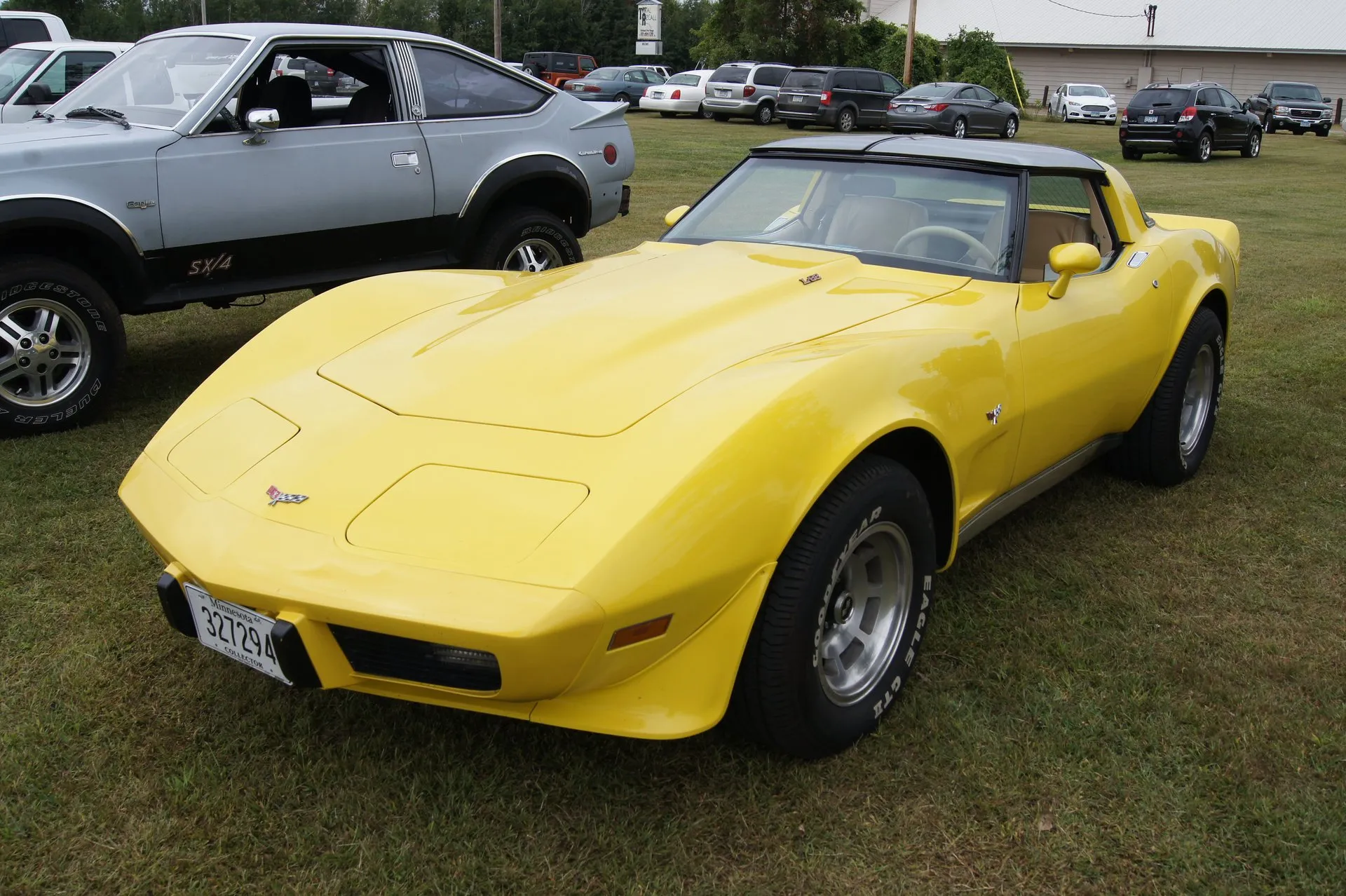
1979 Corvette interior and seats. GM’s color and trim chart offers leather in black, dark blue, light beige, red, dark green and oyster, and cloth-and-leather in dark blue, light beige, dark green and oyster, at no extra cost; oyster came with gray carpet. The chart marks each paint and trim pairing as recommended or acceptable, and a dealer could tick a box (D60) to order others.
Section 05
The L82 test, and the rest of a 1979’s numbers
The VIN is on a plate on the left windshield pillar (GM’s serial number page): 1Z87, the engine (8 for the L48, 4 for the L82), 9 for 1979, S for St. Louis and a serial from 400001 to 453807. GM’s October 1978 data book prints older letter codes there, L and X; the Black Book page, GM’s shop manual (“Engine Code 8 or 4”) and every 1979 VIN read for this guide use 8 and 4.
The engine stamp is on the pad at the top front of the right-hand cylinder bank: a plant letter, the month and day, and the suffix from the table in Two 350s. GM’s example, F1210ZAA, is a Flint engine built December 10 with an L48 four-speed code. The Black Book lists block casting 3970010 for every engine and head casting 462624, plus a block 14016379 of “uncertain usage” (Corvette Action Center calls it late production).
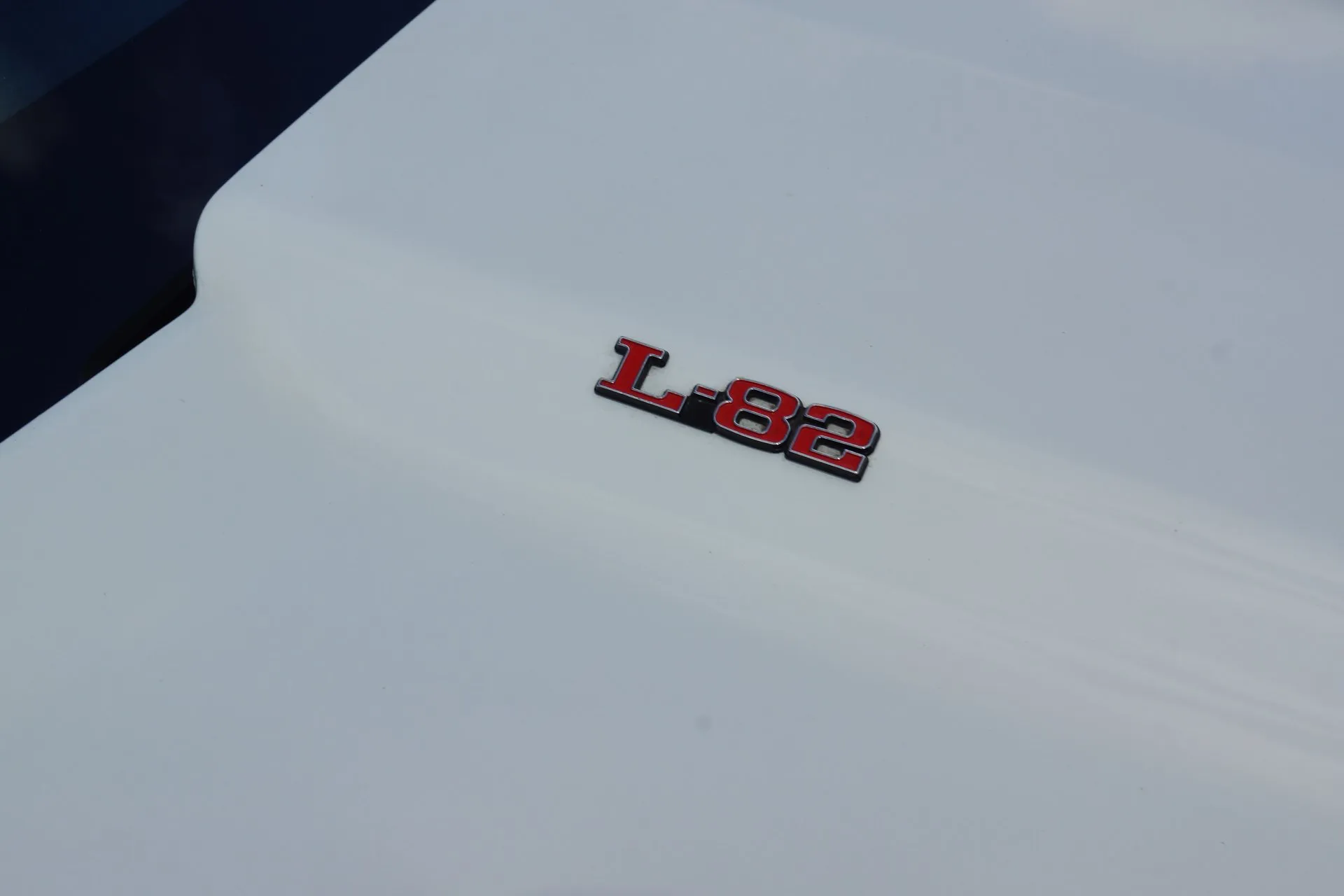
The L82 test. The hood emblem, the aluminum intake and the finned aluminum valve covers are the L82’s, and all three bolt onto an L48. The VIN’s fifth character has to be 4 and the pad has to read ZBA or ZBB (CorvetteForum, 2007 and 2010). Owners add that an L82’s tachometer face reads “L-82” with a higher redline (CorvetteForum, 2024).
The trim tag is an aluminum plate at the top of the cowl inside the driver’s door, owners say (CorvetteForum, 2026), with the paint and trim codes; Bring a Trailer listings print paint codes such as 19L and 83U. The best paper is a copy of the factory invoice from GM, which owners say shows what the car was built with (CorvetteForum, 2019).
Watch for Canadian cars. A Canadian-market L82 four-speed sold on Bring a Trailer in October 2026 with a 240 km/h speedometer and a kilometer odometer. That’s correct for its market, not a swap.
Is a 1979 Corvette a Stingray? No. GM’s exterior equipment list gives the 1979 crossed flags on the nose, fenders and fuel door, a Corvette nameplate at the back and, on L82s, the hood emblem: no Stingray script anywhere (the generations guide explains where the name went). Nor was there a 1979 Pace Car; that’s a 1978.
Section 06
The 1979 file: NHTSA, GM’s bulletins and the C3 list
NHTSA’s complaint file (opens in new tab) holds three complaints about 1979 Corvettes, entered as 13 records. One, filed in 2008, describes an oil hose that broke and sprayed the hot engine; the car burned, with no crash or injury. The other two, filed in 2001, are about one used L82: stalling at idle, an oil leak, a rear wheel that came off after, by the filer’s account, a dealer left the lug nuts loose, and leaking roof panels. The file starts in September 1994, so it says nothing about how 1979s behaved new.
There’s no GM recall for 1979. Two recalls of aftermarket parts are listed against the year: Cardone remanufactured rear brake calipers for 1965–1982 Corvettes, and Fram HP4 and HP8 racing oil filters. NHTSA’s bulletin files, which begin with bulletins received in 1995, hold no GM bulletin for a 1979.
Chevrolet’s own dealer paper, as transcribed by Corvette Action Center, covers the year’s small faults. None was a safety recall:
- The L82 fan run-on and the halogen high beams, both in Before and after May 7, 1979.
- 79-T-7 (April 1979): the vinyl trim molding on 1978–1979 glass roof panels could separate from the glass; dealers bonded it with a two-part epoxy.
- 79-T-8 (April 1979): power antennas sticking in extreme cold or with dirt and corrosion; clean and lubricate. Bulletins from 1983 and 1984 cover replacement masts.
- Service News, 1979: a procedure for reaching the right upper control arm bolt on every 1979.
- Shared with 1980: an instrument cluster squeak (80-T-37), speedometer noise, and refinishing the black moldings around the roof panel and rear glass (80-T-73).
Everything else is the C3’s: rust in the frame and birdcage, 1976–1982 floors, water leaks, vacuum headlights, calipers, rear wheel bearings and power steering. Known C3 problems in the C3 buyer’s guide covers each.
Section 07
Ten checks before buying a 1979
- The frame and birdcage first, by the C3 checklist. On a 1979, owners look under the windshield molding, at the number 2 body mounts behind the sill plates and at the number 4 mounts behind the rear wheels, which one 2026 buyer’s thread says are often badly rusted.
- The VIN against the claim. An L82 needs a 4 in fifth place and ZBA or ZBB on the pad; an 8 means an L48, whatever the hood says.
- The equipment against the date. Crank windows or no air can be original on an early car. If it has air, make sure it blows cold: owners treat working A/C as something a well-kept car should already have (CorvetteForum, 2020).
- The speedometer against the serial. An 85 mph dial belongs only on a late car.
- An early L82 with air (serial below 402690): with the engine off, listen for it running on.
- The roof panels: leaks, fit, and on glass panels the trim molding at the edges.
- The power antenna, if fitted: does it go all the way up and down?
- The usual late-C3 wear, as owners list it: door mechanisms, hoses, the parking brake, headlight doors that hold vacuum, and the suspension (CorvetteForum, 2020).
- Spoilers and options against paper. A car sold as a factory D80 or FE7 car should show it on an invoice or window sticker.
- An inspection on a lift, by a shop that knows C3s.
Section 08
Sale prices in 2026, stock and modified
From January 1 to October 20, 2026, Bring a Trailer (opens in new tab) listed 13 Corvettes from the 1979 model year and recorded a median $20,500 from 10 sales, ranging from $5,600 to $25,500, by this site’s count of sold prices without the buyer’s fee. What’s under the hood splits them:
| 1979s sold on Bring a Trailer, 2026 | Sales | Median | Range |
|---|---|---|---|
| Original type of engine | 6 | $15,500 | $5,600–$23,600 |
| Replacement or enlarged engine | 4 | $22,000 | $17,000–$25,500 |
| All | 10 | $20,500 | $5,600–$25,500 |
The top stock car was an original-owner L82 four-speed in Black with about 9,000 miles, air, power windows and locks, FE7 and its dealer invoice: $23,600 in October. A 19,000-mile L82 automatic brought $20,750 the same month, and a repainted Dark Blue L82 automatic $20,250 in a deal after its auction ended short of the reserve. At the bottom, the Canadian L82 four-speed with a dead tachometer brought $5,600, and a yellow L48 with a replacement automatic and a tapping engine $6,600. The four modified cars (a stroker, a 383 with a five-speed, a crate engine and a 383 stroker built from the original L82) sold for as much as the best stock ones. Unmodified cars titled as L82s brought a median $20,500 from four sales; in 2025, 9 of 15 listed 1979s sold, at a median $14,750. Samples this small are market color, not a valuation or a forecast.
Hagerty’s price guide (opens in new tab), in its newest Internet Archive copy, puts a #3 (Good) L48 coupe at $13,400 (October 2025), down 3.6 percent, and adds 10 percent for a four-speed. classic.com’s February 2026 benchmark for L82 cars is $21,135, but it covers every L82 year from 1973 to 1980. For scale, the C3 guide’s 1978–1982 median is $17,625 (18 sales, June 16 to September 26, 2026), and the best-years guide names a 1978–1982 coupe as the C3 for most buyers.
Section 09
Buy the 4 in the VIN, not the badge
The pick is an L82 four-speed with a 4 in its VIN and ZBA on the pad. At 225 hp it’s the strongest 1979, it’s from the last year an L82 came with a clutch pedal (the 1980 L82 was automatic only), and a documented one topped 2026’s stock-car sales. Take the close-ratio M21 if one turns up: 4,062 were built. And when 225 hp stops being enough, as it will, 2026’s small sample says the market doesn’t mark a car down for a bigger engine: four modified 1979s brought a median $22,000.
For comfort, check the equipment, not the calendar. Most 1979s have air, power windows and the tilt column, and every car from the May 7, 1979 price change on came with all three. An early car without them is honest, and should be priced like it.
On a budget, a solid L48 automatic. It’s the commonest version of the commonest year, Hagerty’s #3 is $13,400, and the stock 1979s on Bring a Trailer in 2026 brought a median $15,500. Check the frame and birdcage by the C3 guide before anything else.
Skip the badge-only “L82”, spoilers or options sold as factory without paper, and anything with a rotten cage. Chevrolet built 53,807 of them, more Corvettes than in any other year, so walking away from a bad one costs nothing but time. The right one is out there: America’s sports car in the year it was most plentiful.
Section 10
Sources
- GM Heritage Center: 1979 Corvette vehicle information kit files.zipcorvette.com This site's library. Corvette Black Book pages GM reproduced in the kit: production, VIN range, engine codes and the year's facts (PDF page 6), options with prices and counts, colors and the May 7, 1979 price change (7). Shop manual VIN page (11); Chevrolet press release, September 21, 1978 (26, 28); Chevrolet letter to dealers on L82 noise limits, December 1, 1978 (30); dealer order guide, revised February 5, 1979 (32 to 34); brochure (39, 45, 46, 49); GM dealer data book, October 1978: serial numbers (54), exterior and interior equipment (55, 57), extra-cost equipment (58), weights (64), power teams (79), engine ratings (80), four-speeds (92); MVMA specification form, September 1978 (97, 111, 120).
- GM Heritage Center: 1978 Corvette vehicle information kit files.zipcorvette.com This site's library. 1978 production (Black Book page, PDF page 110), engine ratings (96), curb weight (MVMA form revised February 1978, 62) and colors (116).
- GM Heritage Center: 1980 Corvette vehicle information kit files.zipcorvette.com This site's library. Black Book page: 1980 production and the 85 mph speedometer phased in during 1979 production.
- NHTSA owner complaints, 1979 Chevrolet Corvette (opens in new tab) api.nhtsa.gov Pulled October 20, 2026: 13 records, three complaints, filed 2001 and 2008. NHTSA's complaint file begins in September 1994.
- NHTSA recalls, 1979 Chevrolet Corvette (opens in new tab) api.nhtsa.gov Pulled October 20, 2026. No GM recall. Aftermarket-part campaigns 03E032000 (opens in new tab) (Cardone calipers) and 07E088000 (opens in new tab) (Fram oil filters).
- NHTSA manufacturer communications (TSB) file, received 1995–1999 (opens in new tab) static.nhtsa.gov No GM bulletin for a 1979 Corvette; the earliest Corvette model year in the file is 1984.
- Chevrolet dealer bulletin 79-I-4: halogen sealed beams, January 1979 (via Corvette Action Center) (opens in new tab) web.archive.org Internet Archive copies of Corvette Action Center's transcriptions, not GM or NHTSA originals. Also 79-T-7, glass roof panel trim (opens in new tab) (April 1979), 79-T-8, power antenna (opens in new tab) (April 1979), the right upper control arm bolt (opens in new tab) (Service News, 1979), 80-T-37, instrument cluster squeak (opens in new tab) (May 1980), speedometer noise (opens in new tab) (Service News, 1980), 80-T-73, black painted moldings (opens in new tab) (January 1981), 82-T-145 (opens in new tab) (July 1983) and 84-84 (opens in new tab) (March 1984), both on antenna masts.
- Chevrolet Service News, Volume 51, Number 1: Corvette auxiliary cooling fan wiring revision (via Corvette Action Center) (opens in new tab) web.archive.org Internet Archive copy. 1979 L82 cars with air conditioning; the harness change from VIN 1Z8749S402690.
- Corvette Action Center: 1979 Corvette production and options (opens in new tab) web.archive.org Internet Archive copy of January 15, 2026. Option counts for M21, YF5 and NA6, and a table of Road & Track's 1979 test figures (the magazines themselves were not read). Also its 1979 identification page (opens in new tab) (VIN, engine and casting codes).
- Hagerty valuation tool: 1979 Chevrolet Corvette L48 coupe (opens in new tab) web.archive.org Internet Archive copy of October 6, 2025, the newest available. #3 (Good) $13,400 on the value graph dated October 2025, and its four-speed adjustment.
- classic.com: Chevrolet Corvette C3 market (opens in new tab) web.archive.org Internet Archive copy of February 12, 2026. Benchmark for 1973–1980 L82 cars.
- Bring a Trailer: Chevrolet Corvette C3 results (opens in new tab) bringatrailer.com 1979 listings only, January 1, 2025 to October 20, 2026. Counts and medians are this site's, from each listing's sold price without the buyer's fee. Sales named: $23,600 (opens in new tab), $20,750 (opens in new tab), $20,250 (opens in new tab) (a sale after the auction ended at $19,000), $6,600 (opens in new tab) and $5,600 (opens in new tab).
- CorvetteForum thread: early and late 1979 identification (opens in new tab) corvetteforum.com July 2011 to November 2022. Owners on mid-year changes, quoting the NCRS judging manual.
- CorvetteForum thread: 1979 C3 speedometer (opens in new tab) corvetteforum.com January to February 2024. The 85 mph dial on late cars; the L82 tachometer.
- CorvetteForum thread: 1979 with no A/C (opens in new tab) corvetteforum.com February 2009. Also could you order a 1979 without A/C (opens in new tab) (March 2009) and crank windows on a 1979 (opens in new tab) (November 2004).
- CorvetteForum thread: 1979 L82 questions (opens in new tab) corvetteforum.com July to November 2019. The four-speeds and their maker; GM invoice copies.
- CorvetteForum thread: what's the code for an L82 in 1979 (opens in new tab) corvetteforum.com February 2007. VIN digit and engine suffixes. Also 1979 L82, is it worth it (opens in new tab) (October to November 2010).
- CorvetteForum thread: 1979 Corvette buyer (opens in new tab) corvetteforum.com May 2026. Body mounts, the VIN plate and the trim tag.
- CorvetteForum thread: pricing for a 1979 (opens in new tab) corvetteforum.com June 2020. What a well-kept car should already have had done.