C4 · Buying guide
1994 Corvette guide: a leather-only cabin, two airbags, the sequential LT1, 116 Copper cars and 2026 prices
Published
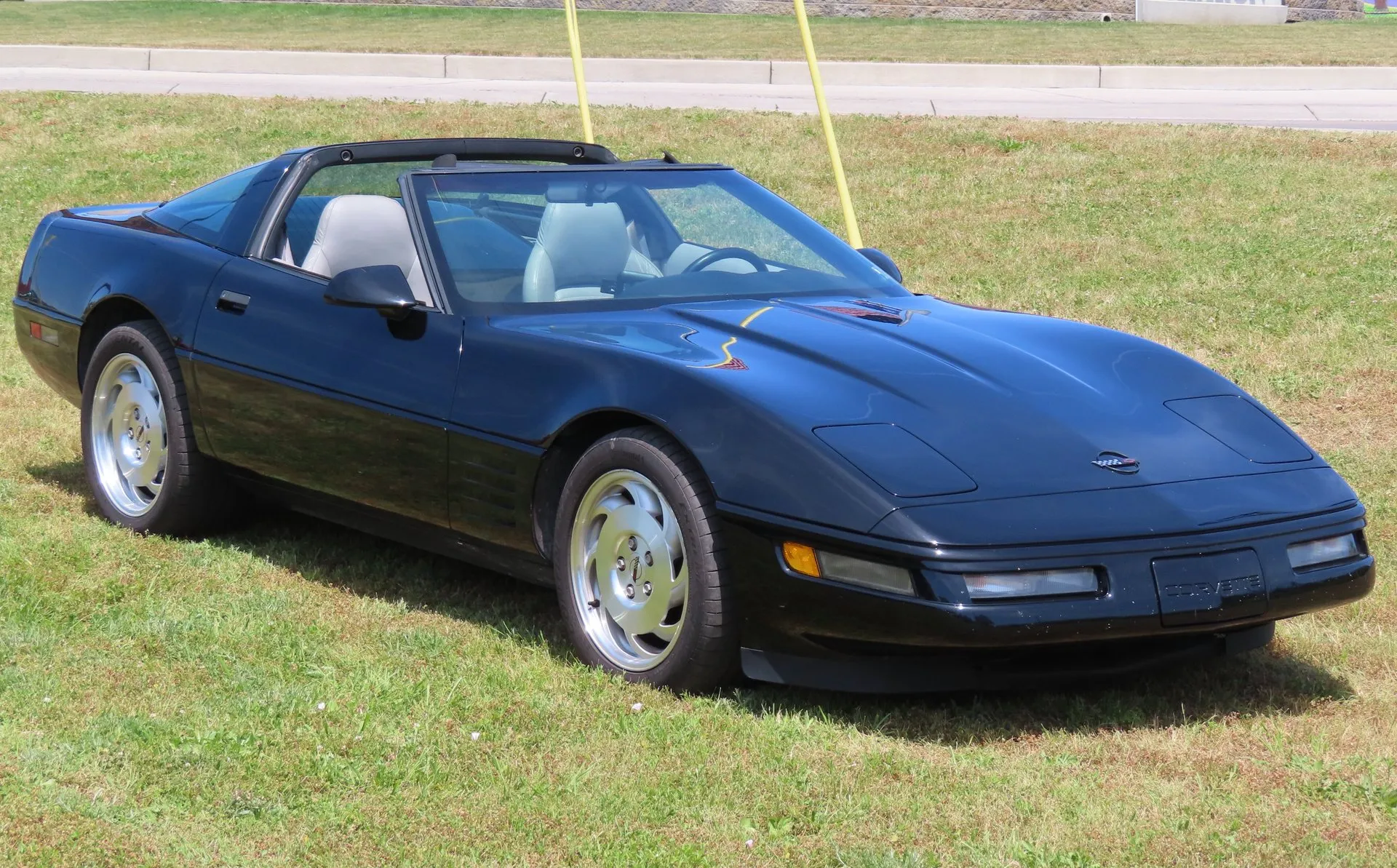
Leather was the only choice in a 1994 Corvette. GM’s dealer feature sheet gave the reason in one sentence: “Due to popular demand, leather seating is now standard” (1994 kit, page 16). A year earlier, by the Corvette Black Book page GM reprints in its 1993 kit, cloth came standard and leather cost $475 more. That swap led off a cabin Chevrolet’s press kit called “completely redesigned”: new seats, a two-spoke steering wheel, new door panels, gauges whose white markings turn tangerine at night, and an airbag for the passenger to go with the driver’s.
The changes went deeper than the trim. The 300 hp LT1 got sequential fuel injection, the automatic became the electronically controlled 4L60-E, and run-flat tires joined the option list. The catch sits at the front of the engine: by Engine Builder’s account and owners’, 1994 was the last year of the unvented Opti-Spark distributor. It’s a C4 (1984–1996), the third-to-last year of it; the C5 began with the 1997 model.
- Built: 23,330 (17,984 coupes, 5,346 convertibles), by Corvette Action Center’s count, with 448 ZR-1s among the coupes.
- Power: the LT1 makes 300 hp and 340 lb-ft; the ZR-1’s LT5 makes 405 hp, 448 built.
- Price new: $36,735 coupe, $43,510 convertible with destination, in Chevrolet’s August 1993 order guide.
- Rarest color: Copper Metallic, 116 cars, a one-year paint.
- GM safety recalls: none.
- Price now: on Bring a Trailer in 2026, a median $12,500 for LT1 cars (7 sales) and $43,000 for ZR-1s (3 sales).
The generation-wide records (the Opti-Spark and water pump, weatherstrips, headlight motors) live in the C4 buyer’s guide. Most figures here come from GM’s 1994 Heritage Center kit and owner’s manual in this site’s manual library.
C4 Key figures
- Built
- 23,330 (17,984 coupes, 5,346 convertibles)
- LT1
- 300 hp and 340 lb-ft
- ZR-1
- 405 hp, 448 built
- Price new
- $36,735 coupe, $43,510 convertible with destination
- Rarest color
- Copper Metallic, 116 cars
- GM safety recalls
- none
- Bring a Trailer, 2026
- median $12,500 for LT1 cars (7 sales)
Section 01
The new cabin: leather only, two airbags
Chevrolet announced the 1994 Corvette on September 1, 1993, with a press kit that marked the car’s 40th birthday and then got down to what was new inside (page 86). GM’s “New for 1994” sheet (page 6) and the press kit list the cabin work:
- A passenger airbag and knee bolster, standard, so every 1994 has two airbags. The driver’s airbag dates from the 1990.
- Leather seats on every car, in a new seat design. The adjustable sport seat (AQ9) stayed an option.
- A two-spoke steering wheel, new door trim panels with storage in the armrests, and new carpet.
- A new look for the instrument panel, with white graphics that turn tangerine at night.
- An Express-Down driver’s window, and the jack moved to a storage compartment behind the passenger seat.
- Four interior colors: black, torch red, light beige and light gray. “Arctic white has been discontinued,” the press kit says (page 105).
Is a 1994 Corvette a good year? For a buyer who wants the later cabin and two airbags with the 300 hp LT1, yes, with one condition: the distributor’s history (see Twelve checks for a 1994). The best Corvette years guide and the C4 guide both flag 1992–1994 for the unvented Opti-Spark, and the C4 guide names the 1995 and 1996 as the C4 years for most buyers, the 1995 with big brakes standard. A 32-year-old car is still only as good as its upkeep.
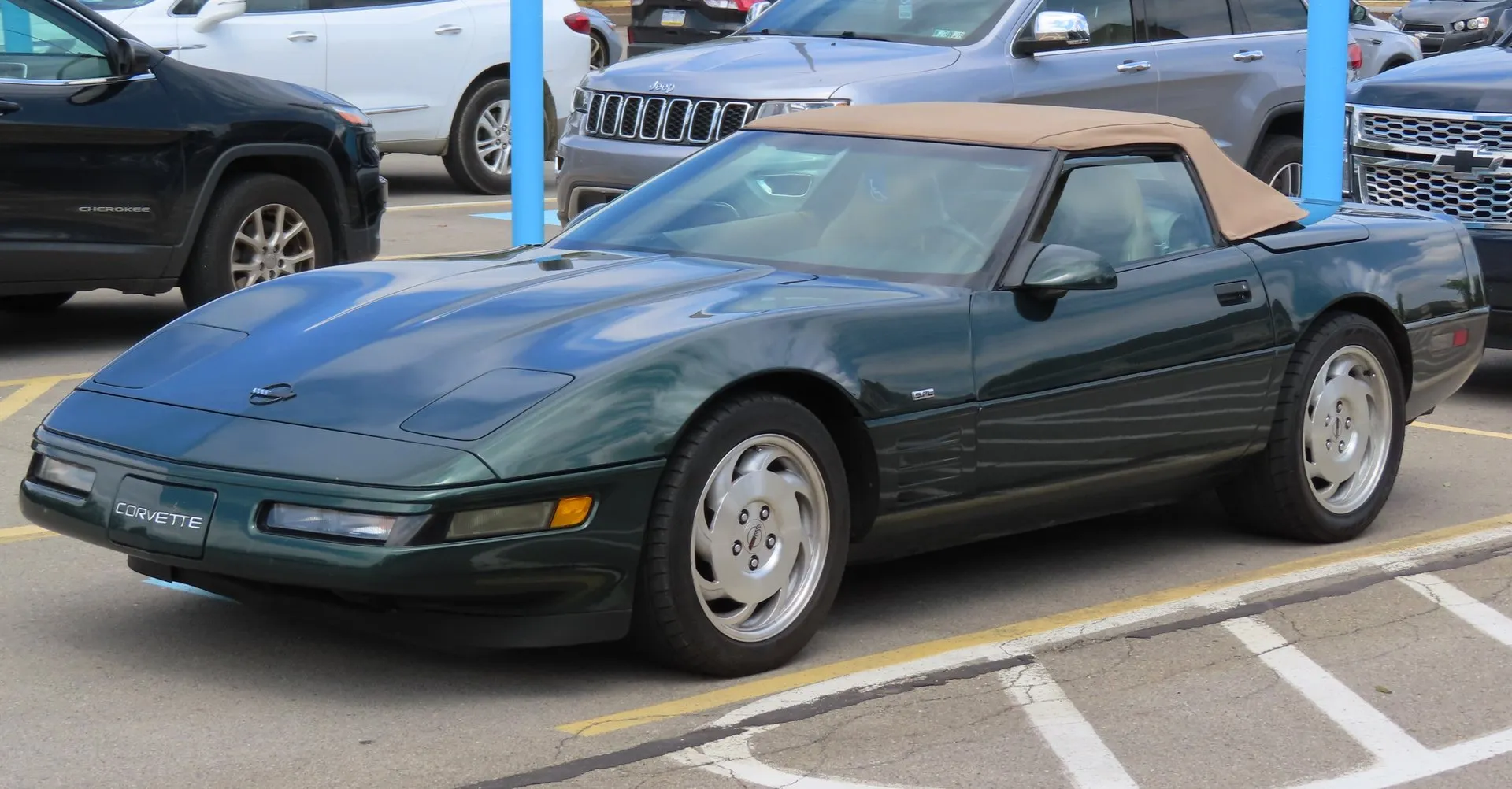
The rest of the 1994 list. The convertible’s top got a heated glass rear window; Hagerty’s description says the earlier window was plastic. Selective Ride (FX3) cars got lower-rate springs and recalibrated shocks, and GM dropped the coupe’s recommended tire pressure to 30 psi. The 3.07 axle became a “free-flow” option on automatics, where before it had been restricted, and the 2.79 was dropped (page 98). GM also added a brake-transmission shift interlock: the automatic stays in park until the brake pedal is down.
What 1994 dropped. Cloth seats, the 40th Anniversary package’s Ruby Red and Medium Quasar Blue, by GM’s deletions list, and the Arctic White interior, by the press kit. On the 1993 Black Book page, the 40th Anniversary package was a $1,455 option on 6,749 cars.
What 1995 changed next. Heavy-duty brakes became standard, with 13 x 1.1 in front rotors in place of the 1994 base car’s 12 x 0.79 in; softer base springs and de Carbon shocks; angled gill panels behind the front wheels; and Dark Purple in place of Copper Metallic and Black Rose Metallic (1995 kit, page 30).
Section 02
Sequential injection, the 4L60-E and the 1994 specs
How much horsepower does a 1994 Corvette have? The LT1, a 5.7-liter (350 cu in) pushrod V8 with an iron block and aluminum heads, makes 300 hp at 5,000 rpm and 340 lb-ft at 3,600 rpm, SAE net, in Chevrolet’s 1994 engine table. Three more 1994 GM pages agree; GM’s 1995 chart moves the same 340 lb-ft to 4,000 rpm. GM Powertrain built the LT1 in Flint, Michigan.
What sequential injection changed. The 1992–1993 LT1s used what Chevrolet’s press kit calls a speed-density system, which works out the air coming in rather than measuring it. For 1994 a mass airflow sensor measured the air, and each injector fired in step with its own cylinder’s intake stroke, in the 1-8-4-3-6-5-7-2 firing order. Chevrolet promised a smoother idle, better driveability and lower emissions, with a new Powertrain Control Module (PCM) running the injectors, the ignition and the automatic.
The 4L60-E. “The electronically controlled 4L60-E replaces the 4L60 4-speed used previously,” the press kit says (page 96), with four shift solenoids run by the PCM. It was standard on LT1 cars (order code MX0; the option label calls it M30). The ZF six-speed manual (MN6, ML9 on the label) was a no-cost option and standard on the ZR-1, with Computer-Aided Gear Selection: under light throttle it skips from first to fourth. Corvette Action Center (CAC) counts 6,012 six-speeds (4,779 coupes, 1,233 convertibles), without saying whether that includes the 448 ZR-1s.
| 1994 Corvette | Coupe and convertible (ZR-1 where it differs) |
|---|---|
| Engine | LT1, 4.00 x 3.48 in bore and stroke, 10.5:1, 5,700 rpm redline (LT5: 405 hp at 5,800, 385 lb-ft at 5,200, 11.0:1) |
| Gear ratios | Automatic 3.06, 1.63, 1.00, 0.70; six-speed 2.68, 1.80, 1.31, 1.00, 0.75, 0.50 |
| Axles | Automatic 2.59, or 3.07 with G92; six-speed 3.45 |
| Wheels and tires | 17 x 8.5 in front, 17 x 9.5 in rear, Goodyear GS-C P255/45ZR17 and P285/40ZR17; Z07: four 17 x 9.5 in on P275/40ZR17 (ZR-1: 17 x 9.5 and 17 x 11 in, P275/40ZR17 and P315/35ZR17) |
| Brakes | Four-wheel discs with ABS and traction control (ASR); 12 x 0.79 in rotors front and rear; 13 in front with Z07 (ZR-1: 13 x 1.1 in front) |
| Curb weight, GM estimate | 3,317 lb coupe, 3,358 lb convertible (ZR-1: 3,503 lb) |
| Size | 96.2 in wheelbase, 178.5 in long, 70.7 in wide (ZR-1: 73.1 in), 46.3 in high (convertible 47.3 in) |
| Fuel tank | 20.0 gallons |
| EPA mileage, GM | 17 city, 24 highway automatic; 17 and 27 six-speed (ZR-1: 17 and 25) |
Weights, rotors and sizes are from GM’s dealer specification page (page 33); GM’s separate ZR-1 sheet gives that car 3,507 lb, the figure the ZR-1 guide uses. The six-speed mileage is from GM’s 1995 chart, which lists it as “1994 Mileage Data.”
How fast is a 1994 Corvette? GM’s 1994 kit and owner’s manual give no 0–60 time or top speed, so this guide gives none either.
Fuel and oil. The owner’s manual asks for premium “rated at 91 octane or higher” and allows middle or regular grade, though the car “may not accelerate as well” (page 174). Both engines want oil meeting GM’s standard GM4718M; the cars left the factory on Mobil 1 synthetic, but the manual warns that not every synthetic meets the standard. The LT1 takes 4.5 qt with a filter change, the LT5 8.6 qt (page 227). The manual’s parts list gives the LT1 a PF51 oil filter (OEM) and 0.050 in spark plug gaps, and 100 lb-ft for the wheel nuts.
The Opti-Spark, unvented. The LT1’s distributor sits at the front of the engine, behind the water pump. Engine Builder reports that early Opti-Spark units on 1992–1994 Corvettes had an unvented cap that trapped moisture (opens in new tab), that later ones were vented, and that caps and the pump’s shaft seal typically go at about 60,000 miles. GM’s own 1994 papers don’t say it; its feature chart even calls the system “distributorless,” which it isn’t.
Owners in a 2013 CorvetteForum thread (opens in new tab) date the vented unit to the 1995 model, which makes the 1994 the last year of the old one; one warns that a remanufactured unit can carry over the old optical sensor. In a 2014 thread on a 1994, owners advised buying on condition and records, and one said the part takes blame for faults nobody diagnosed. The C4 guide’s Known C4 problems covers the failure and the bill.
Section 03
Prices, options and ten colors, Copper Metallic included
What did a 1994 Corvette cost new? $36,735 for the coupe (model 1YY07) and $43,510 for the convertible (1YY67), “Includes Destination & Handling Charges,” in Chevrolet’s order guide revised August 23, 1993 (page 25; convertible on page 27). Without the $550 destination charge that’s $36,185 and $42,960. PASS-Key II was standard: a resistor pellet in the key, and a wrong key shuts off fuel and the starter for a while. Counts are CAC’s (opens in new tab); GM’s kit was printed before production ended.
| Option (RPO) | Price | Built |
|---|---|---|
| Preferred Equipment Group 1: electronic climate control, Delco-Bose cassette, power driver seat | $1,333 | not listed |
| Z07 Performance Handling Package, coupe only | $2,045 | 887 |
| FX3 Selective Ride and Handling | $1,695 | 4,570 |
| Six-speed manual (MN6) | No charge | 6,012 |
| Performance axle, automatics (G92, 3.07) | $50 | 9,019 |
| Adjustable sport leather seats (AQ9) | $625 | 9,023 |
| Driver and passenger power seats (AC3, AC1) | $305 each | 21,592 and 17,863 |
| Delco-Bose with CD (U1F) | $1,219 | 17,579 |
| Low tire pressure warning (UJ6) | $325 | 5,097 |
| Extended Mobility Tires (WY5) | $70 | 2,781 |
| Dual roof package, coupe (C2L) | $950 | 3,875 |
| Blue or bronze transparent roof (24S, 64S) | $650 | 7,064 and 3,979 |
| Convertible hardtop (CC2) | $1,995 | 682 |
CAC prints the same 4,570 FX3 count for 1995, so one of the two may be a copying slip.
Z07, the one to look for. GM’s order guide pitched Z07 at “the Gymkhana/Autocross Enthusiast”: FX3’s driver-adjustable Bilsteins plus stiffer springs, stabilizer bars and bushings, four 17 x 9.5 in wheels on P275/40ZR17 tires, and heavy-duty brakes. In 1994 that was the only way to get 13 in front rotors on an LT1 car. It required both power seats, and G92 on an automatic. With 887 built, it’s the 1994 a hard driver hunts for, and the one to take to an autocross.
Run-flats. Chevrolet’s press kit called the Extended Mobility Tires “the world’s first run-flat tires to be fitted on conventional wheels” (page 108). They came in the regular sizes, required the UJ6 pressure warning, and weren’t offered with Z07 or on the ZR-1. The owner’s manual says a flat EMT can go up to 200 miles at up to 55 mph, that 50 miles or less at that speed gives a good chance it can be repaired, and that the LOW/FLAT TIRE light comes on below 25 psi (page 206). When it does, GM says, check the tire pressures as soon as you can, and replacements must be EMTs too.
What colors did the 1994 Corvette come in? Ten, with codes from GM’s color chart and CAC’s counts:
| Color (code) | Built |
|---|---|
| Torch Red (70) | 5,073 |
| Black (41) | 4,136 |
| Arctic White (10) | 4,066 |
| Polo Green II Metallic (45) | 3,534 |
| Admiral Blue Metallic (28), new for 1994 | 1,584 |
| Dark Red Metallic (75) | 1,511 |
| Black Rose Metallic (73) | 1,267 |
| Bright Aqua Metallic (43) | 1,209 |
| Competition Yellow (53) | 834 |
| Copper Metallic (66), new for 1994 | 116 |
GM recommended the Torch Red interior only with Black, Torch Red or Arctic White paint. Convertible tops came in white, black and beige; CAC’s top counts add up to 26 fewer than its convertible count, so they’re left out here.
Copper Metallic. New for 1994 and deleted for 1995, GM’s papers show: 116 cars, by CAC’s count and Hagerty’s. GM’s service list calls code 66U “Light Melon.” GM’s kits don’t say why it went. Owners in a CorvetteForum thread on the Copper cars (opens in new tab) blame panels that wouldn’t match, and one says the cars were built in three days; others in the thread doubt it. Treat both as owner talk. A real one shows 66U on its option label.
Section 04
The 1994 ZR-1: new wheels, same 405 hp
The ZR1 package cost $31,258 on top of a coupe, and GM’s ZR-1 sheet gives $67,993 with destination (page 8). The four-cam LT5 made 405 hp at 5,800 rpm and 385 lb-ft at 5,200, with the six-speed only. New for 1994: non-directional five-spoke wheels, 17 x 9.5 in front and 17 x 11 in rear, and brake rotors, now on show through the spokes, that Chevrolet said were “protected against corrosion.” CAC counts 448, the same as 1993 and 1995.
A real one has Z as its fifth VIN character and J as its eighth, with a serial from 800001 to 800448 by CAC’s ranges. Three 1994 ZR-1s sold on Bring a Trailer in 2026, for $22,750, $43,000 and $53,000 (the last with a Haibeck-modified LT5), a median of $43,000; a 4,300-mile Polo Green car failed to sell at $43,000 in August. The LT5’s weak points, the power key and the rest are in the C4 ZR-1 buyer’s guide.
Section 05
What NHTSA’s files hold on the 1994
Recalls. No GM safety recall covers a 1994 Corvette. NHTSA’s recall search (opens in new tab) returns one item, 06E043000: a Honeywell recall of certain aftermarket FRAM G3727 fuel filters made from October 2005 to March 2006. It matters only if one was fitted. The C4’s seat belt recall ends with the 1991 model.
Bulletins. NHTSA’s index of GM’s service bulletins begins with those received in 1995, so whatever GM sent dealers while the 1994 was new may be missing. Of the 10 later ones that list a 1994 Corvette, none is for 1994 alone:
- 87-65-27 (December 1998): engine miss or poor driveability on 1992–1996 cars, which Engine Builder ties to a distributor upgrade kit.
- 97-09-01-32-02B (September 1997): a snap or click from the steering column when turning, 1994–1996.
- 72-05-08B (2001): information on the 1989–1996 ZF six-speed.
- 05-03-10-019 (December 2005): the special servicing run-flat tires need, 1994–2006.
No GM campaign or extended-coverage program for a 1994 appears in any NHTSA file. The 1995’s two campaigns don’t apply.
Is a 1994 Corvette reliable? NHTSA holds 35 owner complaints (opens in new tab) against the 1994, filed from October 11, 1994 to April 2023. The file opened in September 1994, early in this car’s life, so 13 of the 35 came in by the end of 1996, while the cars were two years old or less. That’s 1.5 per 1,000 built, close to the 1995’s rate, and not comparable with 1984–1992 cars, whose complaints all came when they were used. By this site’s reading of the text:
- Brakes, 5: erratic front brakes at 30,000 miles, a rear caliper’s bolts sheared, a hard pedal and long stops (the dealer replaced the booster), rusted brake lines, and shaking under braking at 77,000 miles.
- Roof, top and glass, 4: body shake with the roof off, a roof panel separating from its frame, a convertible rear window that fell out, and a hatch glass that shattered.
- Opti-Spark and water pump, 3: two owners describe a leaking pump soaking the distributor and the car dying, once in busy traffic; one of them says it was fixed for 1995. A third had the distributor module replaced three times. One more stall went undiagnosed.
- The automatic, 3: two near-identical reports of a car stuck in second at about 19,000 miles, and one transmission replaced at 134,000 miles after smoke and no drive.
- Airbags, 3: a faulty sensor, bags that didn’t deploy in a crash (GM found no fault), and a steering wheel module with two screws missing.
- Cruise and surging, 3: a broken cruise return spring, a car lunging at idle, and cruise that wouldn’t let go.
- Wheels, 2: four wheels cracked in the same place, and an owner who blamed the run-flats for cracked wheels.
- Water and fire, 2: water from the hood latch housing onto the fuse box, and a fire the fire marshal traced to battery acid eating the fuse box cover and wiring.
The rest are one-offs, the alternator bracket bolts and a seat latch among them, plus one filed against the 1994 that’s really about a 1984’s seat belts. These are owner reports, not findings; no recall or GM bulletin covers the brake, airbag or cruise claims.
Section 06
Is it really a 1994? R, P and the console door
The VIN. From GM’s VIN chart, with serial ranges from CAC:
| Position | On a 1994 |
|---|---|
| 1–3 | 1G1: USA, General Motors, Chevrolet |
| 4–5 | YY Corvette, YZ ZR-1 |
| 6 | 2 coupe, 3 convertible |
| 7 | 2: manual belts with driver and passenger airbags |
| 8 | P for the LT1, J for the LT5 |
| 9 | Check digit |
| 10 | R: 1994 |
| 11 | 5: Bowling Green |
| 12–17 | 100001 to 122882 on LT1 cars, 800001 to 800448 on the ZR-1 |
GM’s sample VIN prints a 3 in the seventh place against its own key; real 1994 VINs in NHTSA’s file start 1G1YY22P or 1G1YY32P. The model year, not the build date, is what the R records: the generations guide gives the example of a car built in September 1993 that is a 1994.
The engine. The LT1 carries a partial VIN stamp: 1 for Chevrolet, R for 1994, 5 for Bowling Green, then the car’s serial (page 56). CAC lists the suffix codes ZWA (LT1, automatic), ZWB (LT1, manual) and ZWC (LT5), and block casting 10125327 for the LT1.
The option label. GM’s Service Parts Identification label lists every RPO code on the car, and for 1994 the service manual puts it on the floor console door (page 65). It moved behind the passenger seat for 1995. It’s the proof for Z07, FX3, G92, MN6, WY5 and the paint: Copper shows as 66U, Admiral Blue as 28U.
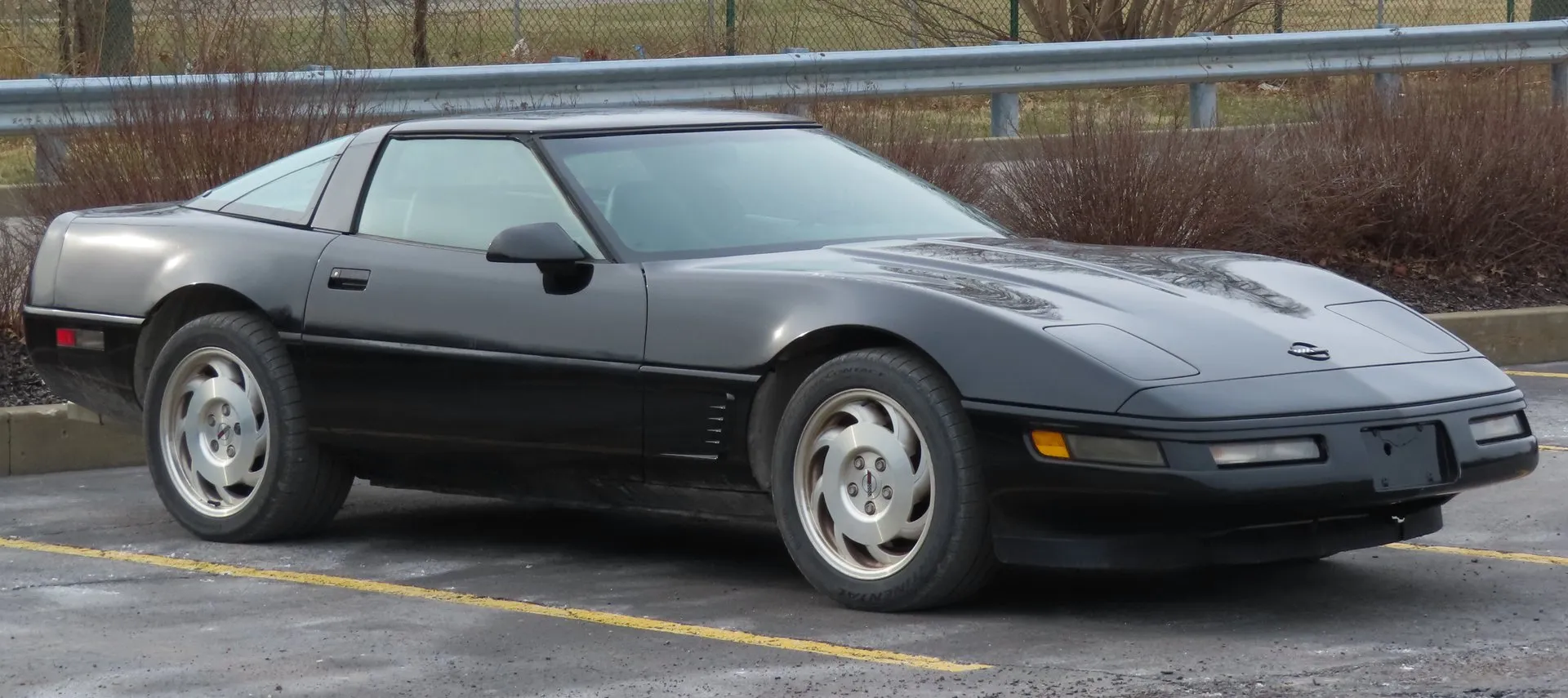
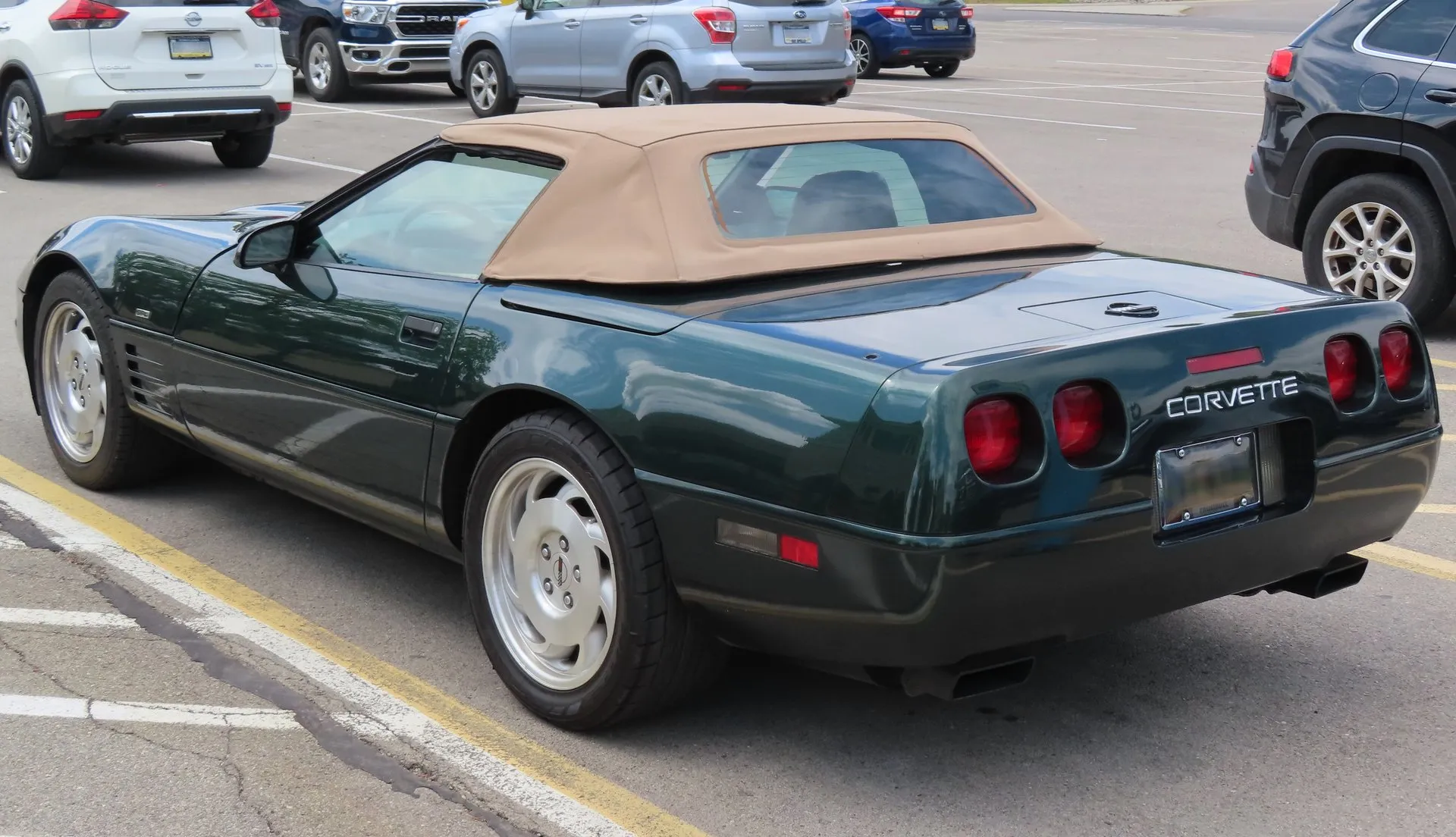
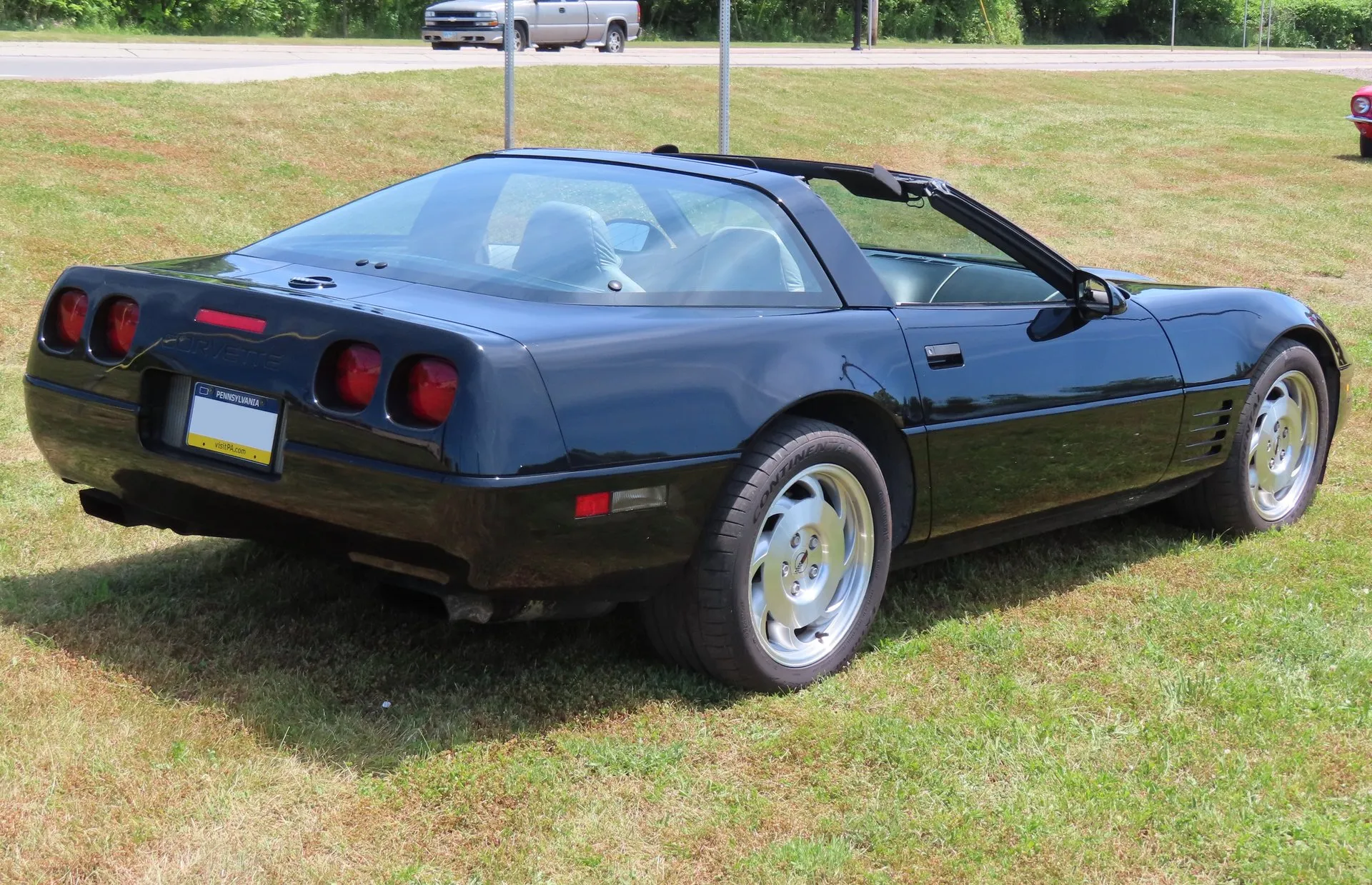
From the outside and inside. Straight, horizontal strakes behind the front wheels mark a 1991–1994; the angled gill panels GM said “identify 1995 models” mean a 1995 or 1996, or a rebodied car. Inside, the two-spoke steering wheel and the passenger airbag set a 1994 apart from a 1993, and on a convertible, so does the glass rear window. Leather on every seat is right; cloth means a 1993 or a swap.
Section 07
Twelve checks for a 1994, distributor first
- Opti-Spark and water pump records. When each was replaced, and with what. Coolant weeping at the pump is a red flag, because it drains onto the distributor. Misfires or stalls point there too; a vented unit fitted later is a plus.
- A cold start and a long drive. Restart it hot as well. Owners in a 2014 thread on a 1994 (opens in new tab) say the cars run near 200°F on the road with the fans coming on at about 228–229°F, and that the needle isn’t linear, so read the digital temperature.
- The automatic. Every upshift and downshift, no hang in second (two complaints), clean fluid, and park released only with the brake down.
- The six-speed. Every gear including reverse, and the first-to-fourth skip at light throttle, which is normal.
- Brakes. A firm pedal, no pulsing, an ABS light that goes out, and the brake lines and caliper bolts on a lift.
- Wheels and tires. Cracks at the wheels, tire date codes, and on an EMT car, a working LOW/FLAT TIRE light. Run-flats need the special servicing in bulletin 05-03-10-019.
- The airbag light. It should go out after start.
- Roof and glass. The roof panel’s bond to its frame and body shake with it off; on a convertible, the rear glass bond, the top latches and the defogger.
- The battery and fuse box. Acid damage, corrosion and water. The battery guide shows where a C4’s battery sits, and a 1994 that sits for weeks belongs on a battery maintainer.
- Cruise control. It should set, resume and let go.
- The label against the ad. Z07, six-speed, Copper or anything else a seller charges extra for should be on the console-door label.
- An inspection by a shop that knows C4s, plus the rest of the C4 checklist.
Section 08
What a 1994 brings in 2026
How much is a 1994 Corvette worth? For an LT1 car, about $12,500 at auction in 2026. From January 1 to October 22, Bring a Trailer (opens in new tab) recorded seven sales of 1994 LT1 cars, $10,251–$16,250, a median of $12,500 by this site’s count of sold prices without the buyer’s fee. The three coupes made $11,000, $12,500 (a six-speed) and $16,250, a 21,000-mile Z07 six-speed. The four convertibles brought $10,251–$15,100, a median of $12,875, but two of them wore ACI widebody kits and other changes; leave those out and the five stock cars’ median is $14,250. The $11,000 coupe had failed to sell at $12,750 in March 2025.
For context, 16 LT1 cars sold in 2025 for $6,000–$25,000, a median of $12,000: coupes $10,125 (10 sales), convertibles $13,725 (6). The $25,000 car was an 8,000-mile Z07 six-speed. Samples this small are market color, not a valuation.
Hagerty, October 2026 (coupe and convertible page (opens in new tab), with the ZR-1 page in Sources). Hagerty’s values are for manual cars and take 10% off for the automatic.
| 1994 | #3 good | #2 excellent | #3 change on the quarter |
|---|---|---|---|
| Coupe | $10,400 | $24,000 | down 6.3% |
| Convertible | $12,300 | $29,100 | down 6.1% |
| ZR-1 | $21,500 | $48,500 | down 11.9% |
Those are dated values, not a forecast. On Bring a Trailer in 2026, a 1994 LT1 car brought a bit more than a 1995 ($10,000 median), though the samples are seven cars each.
Section 09
Buy the six-speed coupe, budget for the Opti-Spark
Buy a 1994 coupe with the six-speed and a folder that shows the water pump and Opti-Spark were done, ideally with a vented unit fitted. Z07 is the prize: 887 coupes with the 13 in front rotors every other LT1 car waited a year for. The rest of the deal is the cabin: two airbags, leather on every seat and a two-spoke wheel no earlier C4 had. Twelve-odd grand on 2026’s auction numbers buys America’s sports car with a 300 hp V8, a six-speed and room in the budget to make it stop and grip like new.
An automatic is the budget path, and most cars were built with one: check the 4L60-E’s shifts and count on Hagerty’s 10% discount. A convertible costs more, about $1,900 to $5,100 on Hagerty’s #3 and #2 values; check its glass and its latches. Copper Metallic is for a buyer who wants the one-year color and can prove it with the label. The ZR-1 follows the ZR-1 guide’s rules.
If the distributor’s history can’t be shown, put the cost of a pump and an Opti-Spark into the offer, or look at a 1995, with the vented distributor and big brakes standard, or the 330 hp LT4 in a 1996.
Section 10
Sources
- GM Heritage Center: 1994 Corvette vehicle information kit files.zipcorvette.com This site's library. Dealer pages: what's new for 1994 (PDF pages 6 and 12), deletions and features, cloth seats dropped (16), specifications, weights and rotors (33); the ZR-1 sheet (8); Chevrolet's 1994 order guide, revised August 23, 1993: prices, options, colors, tops and power teams (pages 25, 27, 30, 32); Chevrolet's September 1, 1993 press kit: overview (86 to 88), engines (90), transmissions and axles (96, 98), suspension and brakes (99, 100), wheels, tires and interior (104, 105), run-flat tires (108); GM Powertrain's LT1 sheet (113); GM service manual pages: VIN chart and engine stamps (55, 56), RPO list and the Service Parts Identification label (64, 65).
- GM 1994 Corvette owner's manual files.zipcorvette.com This site's library. Fuel (PDF page 174), oil (180, 181), Extended Mobility Tires (206), parts (226), capacities (227), dimensions (228).
- GM Heritage Center: 1993 Corvette vehicle information kit files.zipcorvette.com This site's library. A Corvette Black Book page GM included: 1993 prices and options (cloth base seats, leather at $475, the 40th Anniversary package) and colors (PDF page 4).
- GM Heritage Center: 1995 Corvette vehicle information kit files.zipcorvette.com This site's library. What 1995 changed (PDF page 30), Copper Metallic and Black Rose Metallic deleted (49), the 1995 LT1 rating and the 1994 mileage data (16).
- NHTSA owner complaints, 1994 Chevrolet Corvette (opens in new tab) api.nhtsa.gov 35 distinct complaints (40 records) on October 22, 2026, filed from October 1994 to April 2023. Theme counts are this site's reading of the complaint text.
- NHTSA recalls, 1994 Chevrolet Corvette (opens in new tab) api.nhtsa.gov Pulled October 22, 2026. The one result, 06E043000, is a recall of certain aftermarket FRAM fuel filters, not a GM recall on the car.
- NHTSA manufacturer communications (TSB) files, received 1995 to 2026 (opens in new tab) static.nhtsa.gov This link is the 1995–1999 file; the later files were searched too. Every communication listing a 1994 Corvette: 10, none for 1994 alone, including bulletins 87-65-27, 97-09-01-32-02B, 72-05-08B and 05-03-10-019. Summaries only. No GM campaign or special coverage.
- Corvette Action Center: 1994 Corvette production numbers (opens in new tab) corvetteactioncenter.com Prices without destination; option, color and top counts. Also the 1994 identification (opens in new tab) page (VIN ranges, engine suffixes, casting numbers). Copies dated October 17, 2026.
- Hagerty Valuation Tools: 1994 Chevrolet Corvette (opens in new tab) hagerty.com October 2026 price guide: coupe and convertible (values for manual cars; Hagerty takes 10% off for the automatic); also the ZR-1 (opens in new tab) page. Read October 22, 2026.
- Bring a Trailer: C4 Corvette auction results (opens in new tab) bringatrailer.com Listings titled as a 1994, January 1 to October 22, 2026, with 2025 for comparison, read October 22, 2026. LT1 cars counted apart from ZR-1s. Medians are this site's, from sold prices without the buyer's fee.
- Engine Builder: GM's LT1 engine and reverse-flow technology (opens in new tab) enginebuildermag.com Larry Carley, September 11, 2009. The unvented Opti-Spark on 1992–1994 Corvettes, the water pump seal and bulletin 87-65-27.
- CorvetteForum thread: 1994 Opti-Spark, vented or non-vented (opens in new tab) corvetteforum.com February 2013. Owners date the vented unit to the 1995 model.
- CorvetteForum thread: 1994 Corvette LT1 and the Opti-Spark (opens in new tab) corvetteforum.com January 2014. Buying a 1994 on condition and records.
- CorvetteForum thread: is there an overheating problem on the 1994 LT1 (opens in new tab) corvetteforum.com January 2014. Normal running temperature, fan points and the gauges.
- CorvetteForum thread: 1994 Copper confusion (opens in new tab) corvetteforum.com October 2014 to October 2016. Owners on the Copper Metallic cars: build dates, VINs and why the color went.