C1 · Buying guide
1957 Corvette guide: the first fuelie, the late four-speed, the airbox cars and what to pay
Published
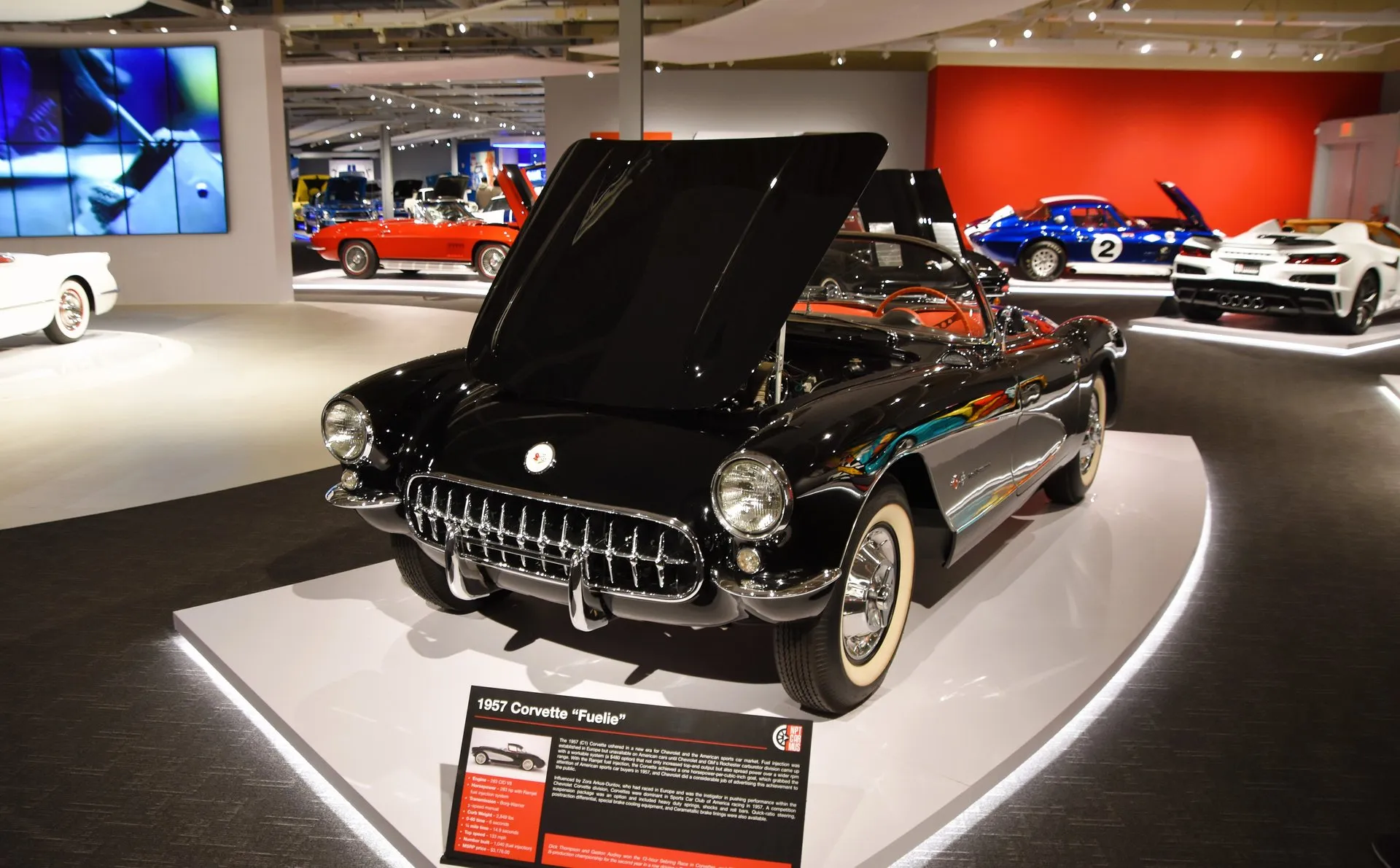
Fifty-three of the 93 Bring a Trailer listings for 1957 Corvettes since 2016 put “4-Speed” in the title. Chevrolet built 664 four-speed cars out of 6,339, about one in ten. GM’s specification form listed the gearbox in December 1956, but by owners’ accounts it reached production only in April 1957, with more than half the year’s cars already built. From October 1957 Chevrolet offered dealers a kit to fit one to a three-speed car, and the fitting hasn’t stopped: five of the nine four-speed 1957s offered on Bring a Trailer in the 12 months to October 19, 2026 came with listings saying the gearbox went in later. In the fifth year of the C1 (1953–1962), how a car left St. Louis and what it carries now can be two different stories.
The year also brought the 283 V8, Rochester fuel injection, a top engine GM’s own sheet rated at 283 hp from 283 cubic inches, and Positraction (Chevrolet’s limited-slip differential). All of it can be fitted later, and no tag on a C1 records how a car was built, so a 1957 is bought on its paperwork first.
- Built: 6,339, all convertibles, 83 percent more than 1956; 4,055 with the optional removable hardtop.
- Engines: the 283 V8, 220 to 283 hp gross, in five versions. 1,040 had fuel injection: the fuelies.
- Four-speeds: 664, from about April 1957, by owners’ accounts.
- Price new: $3,176.32, by Corvette Action Center’s figure.
- What one costs: Hagerty’s #3 (Good) average was $77,980 (January 2026), from $63,300 to $83,100 by engine. Bring a Trailer’s 2026 median, through October 19, was $70,500 (14 sales).
- A 1957 Stingray? No such car: the Sting Ray name arrived with the C2 (1963–1967), for 1963.
Frames, rust and the fake-fuelie debate are in the C1 buyer’s guide. Specifications here are from GM’s 1957 kit, in this site’s manual library; it has no production page, so counts, option codes and prices are Corvette Action Center’s, with Sports Car Market agreeing on the headline figures.
C1 Key figures
- Built
- 6,339, all convertibles
- Engines
- 283 V8, 220 to 283 hp gross
- Fuel-injected cars
- 1,040
- Four-speeds
- 664, from about April 1957
- Price new
- $3,176.32
- Hagerty #3 average
- $77,980 (January 2026)
- Bring a Trailer, 2026
- $70,500 (14 sales)
Section 01
What 1957 added to a carried-over body
GM’s 1957 and 1956 pages give the same two-seat convertible body: a 102 in wheelbase, 168.01 in long, 70.46 in wide and 51.09 in high with the top up (1957 kit; 1956 kit). What changed:
- The 283, up from 265 cu in (3.875 in bore, 3.00 in stroke), with the base rating up from 210 to 220 hp (1957 kit).
- Fuel injection, $484.20 or more, on 1,040 cars (16.4 percent).
- A four-speed manual, listed from December 1956, in cars from about April (see The four-speed).
- Positraction, for manual cars only; 1956’s option list had none (1956 kit).
- Heavy-duty brakes and suspension, regular production option (RPO) 684, $780.10, on 51 cars.
- Inca Silver, a seventh color, on 65 cars, though GM’s chart lists only the six 1956 names.
- A base price of $3,176.32, $56.32 more than 1956’s $3,120.00, and 6,339 cars against 3,467.
What does a 1957 weigh? GM’s supplement gives 2,849 lb at the curb with the three-speed and 2,941 lb with the Powerglide automatic, plus 55 lb for the hardtop (1957 kit). Seat belts were dealer-fitted; the factory installed only the anchors (1958 kit).
How many are left? Nobody has a reliable count. One poster says an owner survey in the early 1990s gathered reports of 1,523 surviving 1956s and 1957s together (CorvetteForum, 2024).
Section 02
One 283, five ratings, two ways to feed it
GM’s specification form, revised in December 1956, rates the 283 five ways, gross (1957 kit), and Chevrolet’s Corvette supplement adds net figures, comparable with GM’s ratings from 1972 on (1957 kit). Two engines ran two four-barrel carburetors, the dual quads. Suffix codes are from GM’s engine list; option codes, prices and counts are Corvette Action Center’s.
| Engine | Option and price | Fuel and lifters | Gross power and torque | Net | Suffix | Built |
|---|---|---|---|---|---|---|
| 220 hp | Standard | One four-barrel, hydraulic | 220 hp at 4,800 rpm, 300 lb-ft at 3,000 | 190 hp, 270 lb-ft | EF manual, FH Powerglide | About 1,633 |
| 245 hp | 469A, $150.65 | Two four-barrels, hydraulic | 245 hp at 5,000 rpm, 300 lb-ft at 3,800 | 215 hp, 270 lb-ft | EH manual, FG Powerglide | 2,045 |
| 270 hp | 469C, $182.95 | Two four-barrels, competition camshaft, mechanical | 270 hp at 6,000 rpm, 285 lb-ft at 4,200 | 230 hp, 255 lb-ft | EG, manual only | 1,621 |
| 250 hp fuel injection | 579A or 579C, $484.20 | Rochester injection, hydraulic | 250 hp at 5,000 rpm, 305 lb-ft at 3,800 | 225 hp, 280 lb-ft | EM manual, FK Powerglide | 284 |
| 283 hp fuel injection | 579B, $484.20, or 579E, $726.30 | Rochester injection, competition camshaft, mechanical | 283 hp at 6,200 rpm, 290 lb-ft at 4,400 | 240 hp, 265 lb-ft | EL, manual only | 756 |
The 220 hp count is this site’s subtraction; each fuelie count adds two of Corvette Action Center’s codes, and no source found says what separated 579A from 579C. The base engine’s 4,800 rpm is from GM’s December form; its supplement says 4,600.
Compression was 9.5:1, or 10.5:1 on the 283 hp engine (1957 kit). The competition-camshaft engines ran mechanical lifters and came only with a manual: GM lists Powerglide codes for the 220, 245 and 250 hp engines alone, so the only automatic fuelie is a 250 hp car stamped FK. No 1957 distributor had vacuum advance (1957 kit).
One horsepower per cubic inch. GM’s supplement prints 1.0 gross hp per cubic inch for the 283 hp fuelie. Whether it was the first engine to do it is argued. Hagerty’s 1957 page says it really made 290 hp, without a source; 290 was GM’s 1958 rating.
Rochester’s first year, and the units Chevrolet replaced
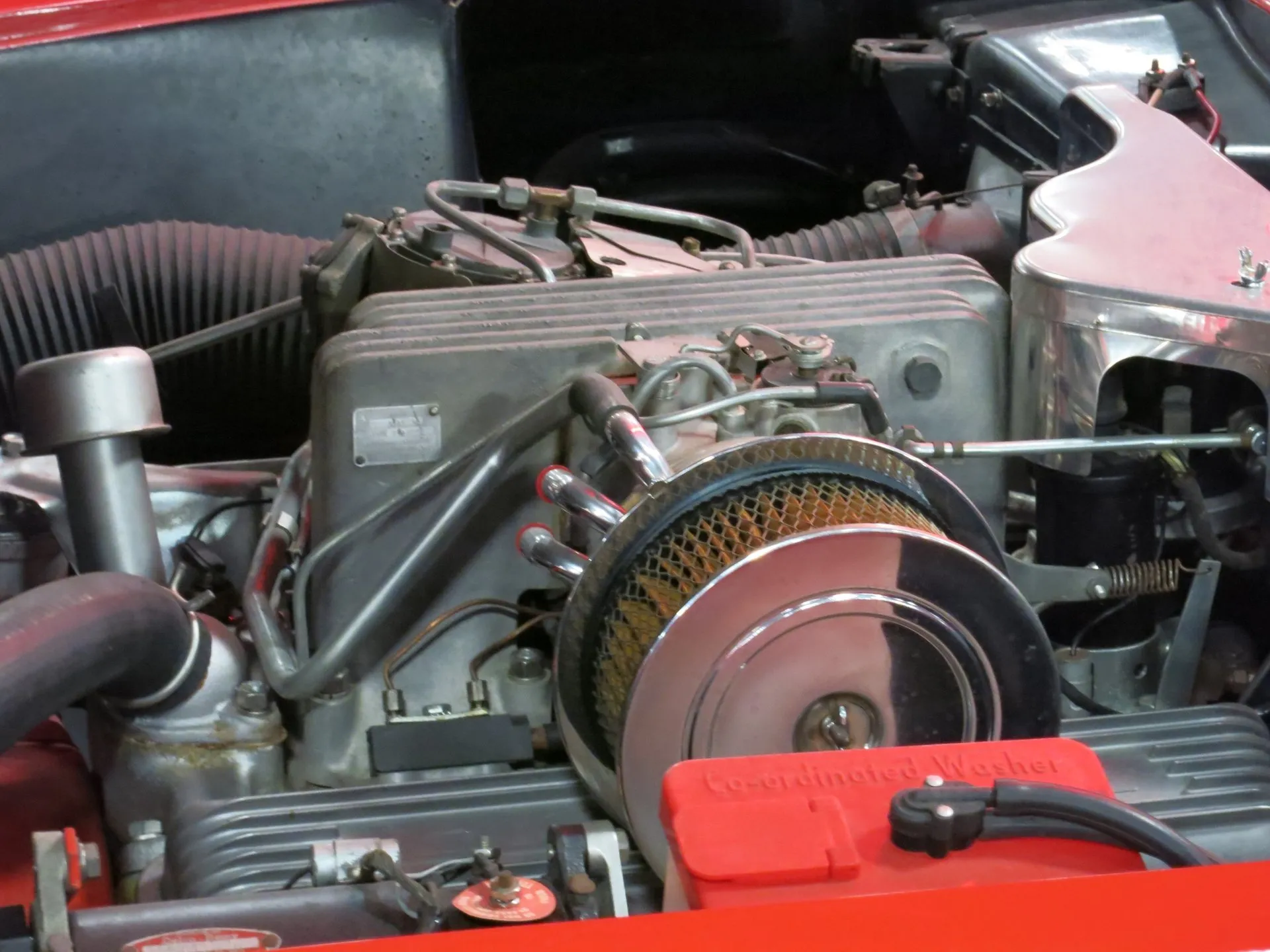
GM’s injection page describes a constant-flow Rochester system: an air meter on the left of the engine, a gear pump driven off the distributor by a flexible shaft at up to 300 psi, eight nozzles and an electric automatic choke (1957 kit). It names two units: 7014520, and 7014360 with the optional camshaft.
By June, Chevrolet was replacing some of them. A Chevrolet letter of June 13, 1957 (opens in new tab), as Corvette Action Center reproduces it, set up a short-term program after a meeting in Detroit on injection problems. Units 7014360 and 7014520 were calibrated for the special racing camshaft and solid lifters, it says, and didn’t perform acceptably in traffic, so cars driven only on the street got a 7014800 unit with the standard camshaft and hydraulic lifters; competition cars kept theirs. Replacements went out in limited quantities, eight per region, adjusted to need, and covered fuel-injected passenger Chevrolets too. The letter never calls it a recall.
GM’s December form pairs 7014520 with the standard camshaft instead. Owners and Corvette Action Center’s parts table list four 1957 unit series, 7014360, 7014520, 7014800 and 7014960, though one owner recalls three (CorvetteForum, 2007–2011); the last two went on 1958s too (1958 kit). So a 1957 on a 7014800 unit, or a 283 hp fuelie now on a hydraulic camshaft, may carry Chevrolet’s own 1957 fix: a reason to ask for documents, not to walk away.
The 43 airbox cars
Corvette Action Center lists RPO 579E, the 283 hp injection at $726.30 instead of $484.20, on 43 cars, with a tachometer on top of the steering column and a fresh-air intake: the airbox cars. GM’s page says only that air intake ducts were available with injection.
The rest comes from collectors and auction writers, and they differ. Corvette Blogger’s posts (2007 and 2010) describe hand-laid fiberglass ducting, heavy-duty brakes, suspension and steering, and no radio or heater, but put the duct on opposite sides, and one relays a historian’s view that the real code was 579D. Rarity and racing hardware make them valuable: one sold for $374,000 in November 2010, Corvette Blogger reported. Clones exist; one owner describes building one from a 1956 (CorvetteForum, 2016–2021).
Section 03
The four-speed: GM’s paper in December, cars in April
GM’s form, revised December 5, 1956, lists the close-ratio three-speed (2.21, 1.32 and 1.00:1) as standard and a four-speed (2.20, 1.66, 1.31 and 1.00) as optional (1957 kit): Borg-Warner’s T-10, by Mac’s Motor City Garage’s account, a Corvette exclusive until 1959. Yet Chevrolet’s supplement page, revised in March 1957, still lists only the three-speed and the Powerglide (1957 kit). Sports Cars Illustrated’s June 1957 test cars were three-speeds too, Curbside Classic notes: by the figures Corvette Action Center reproduces, the 270 hp car reached 60 mph in 6.8 s and the 283 hp fuelie in 6.6 s.
Owners put the first production four-speeds in April: April 9, says one, citing GM documents; another says from approximately car 3,467, built April 17, and available about May 1 (CorvetteForum, 2023 and 2025). The only dated GM anchor, a Chevrolet spark plug bulletin (opens in new tab), has car 3,268 built on April 9. So more than half of all 1957s predate the earliest date anyone gives, and the 664 four-speeds were about one in five of the cars built after it, by this site’s arithmetic.
A Chevrolet zone bulletin of October 8, 1957 (opens in new tab) then announced a kit (GM 3749586, OEM, with selector plate GM 3742510, OEM) to fit a four-speed to a 1956–1957 three-speed car: dealer-fitted with GM parts, but not a factory four-speed. Hagerty supplies a motive: through July 2025, its notes added 10 percent to a 1957’s value for a four-speed and took 10 percent off for an automatic.
On Bring a Trailer, 53 of 93 listings (57 percent) say “4-Speed”, against 10.5 percent from the factory, and counting cars rather than relistings it’s still more than half. Of the past year’s nine four-speed cars, five were later fits (one replaced a Powerglide) and a sixth has an aftermarket Richmond Super T-10. One of the other three, a National Corvette Restorers Society (NCRS) Top Flight 283 hp fuelie bid to $86,500 in November 2025, came with a copy of its original dealer invoice. Most of the past year’s four-speed 1957s weren’t built with one, and only paper says which were.
To check a claimed factory four-speed:
- The serial. E57S103268 was built on April 9, 1957; a four-speed car numbered well below it needs a strong explanation.
- Not the engine code. Every 1957 manual suffix starts with E, three-speed or four (CorvetteForum, 2025).
- Order paper naming RPO 685: a window sticker, invoice or order copy.
- The gearbox’s own date. Owners date cases; one dated a removed close-ratio three-speed to January 1957 (CorvetteForum, 2021).
- The frame. A frame built for a Powerglide has no clutch pedal tower, one owner says (CorvetteForum, 2024).
Some 1957 and 1958 four-speeds left with a 7 degree third-gear cone angle instead of 6, Chevrolet Service News said in December 1957, causing a harsh shift into third. The cure was a new third gear (GM 3743452, OEM) and blocking ring (GM 3709348, OEM).
The Powerglide and the axles
The Powerglide, RPO 313 at $188.30, went into 1,393 cars, selector on the floor. Manual cars got a 3.70:1 axle, Powerglides 3.55:1. Positraction cost $48.45 in 3.70 (RPO 677, 327 cars), 4.11 (678, 1,772) or 4.56 (679, count not recorded), behind manual gearboxes only (1957 kit). Subtraction leaves about 4,280 three-speeds, against Corvette Action Center’s 2,886. Two Powerglide 1957s on Bring a Trailer in 2026 were described with a limited-slip axle, a pairing GM doesn’t list: axles get swapped.
Section 04
1957 options and colors, heater to racing brakes
Corvette Action Center’s 1957 production page (opens in new tab) prices and counts the other options, most popular first:
| Option | RPO | Price | Cars |
|---|---|---|---|
| Heater | 101 | $118.40 | 5,373 |
| Whitewall tires | 290 | $31.60 | 5,019 |
| Removable hardtop | 419 | $215.20 | 4,055 |
| Signal-seeking AM radio | 102 | $199.10 | 3,635 |
| Two-tone paint | 440 | $19.40 | 2,797 |
| Windshield washers | 109 | $11.85 | 2,555 |
| Courtesy lights | 108 | $8.65 | 2,489 |
| Parking brake alarm | 107 | $5.40 | 1,873 |
| Power folding top | 473 | $139.90 | 1,336 |
| Power windows | 426 | $59.20 | 379 |
| 15 x 5.5 in wheels | 276 | $15.10 | 51 |
| Heavy-duty brakes and suspension | 684 | $780.10 | 51 |
GM’s form calls the washer a dealer-installed accessory, so that count is Corvette Action Center’s alone. Hagerty’s 2025 notes added $3,500 for the hardtop, $2,750 for the power top, $1,000 for the signal-seeking Wonderbar radio and $450 for power windows.
Why RPO 684 cost more than fuel injection. GM’s form lists heavy-duty springs, shocks and stabilizer, a quick-steering adapter giving 2.9 turns lock to lock (1957 kit), sintered metal and ceramic linings (1957 kit), and finned drums with optional brake air ducts (1957 kit). Corvette Blogger says it required Positraction. For 1958 the same package, at the same price, went on 144 cars.
Colors. GM’s chart of October 29, 1956 lists six colors with their coves, wheels and interiors (1957 kit). Corvette Action Center counts seven, adding Inca Silver, which Mac’s Motor City Garage calls new for 1957:
| Color | Cars | Cove on GM’s chart | Wheels | Interior |
|---|---|---|---|---|
| Onyx Black | 2,189 | Silver | Black | Red |
| Venetian Red | 1,320 | Beige | Red | Red |
| Polo White | 1,273 | Silver | Red | Red |
| Cascade Green | 550 | Beige | Green | Beige |
| Arctic Blue | 487 | Silver | Blue | Red or beige |
| Aztec Copper | 452 | Beige | Copper | Beige |
| Inca Silver | 65 | Not on GM’s chart | None given | None given |
The counts total 6,336, three short, and black, red and white make up 75 percent. A contrasting cove meant two-tone paint, RPO 440. Interiors were red or beige, with waffle-pattern vinyl seats.
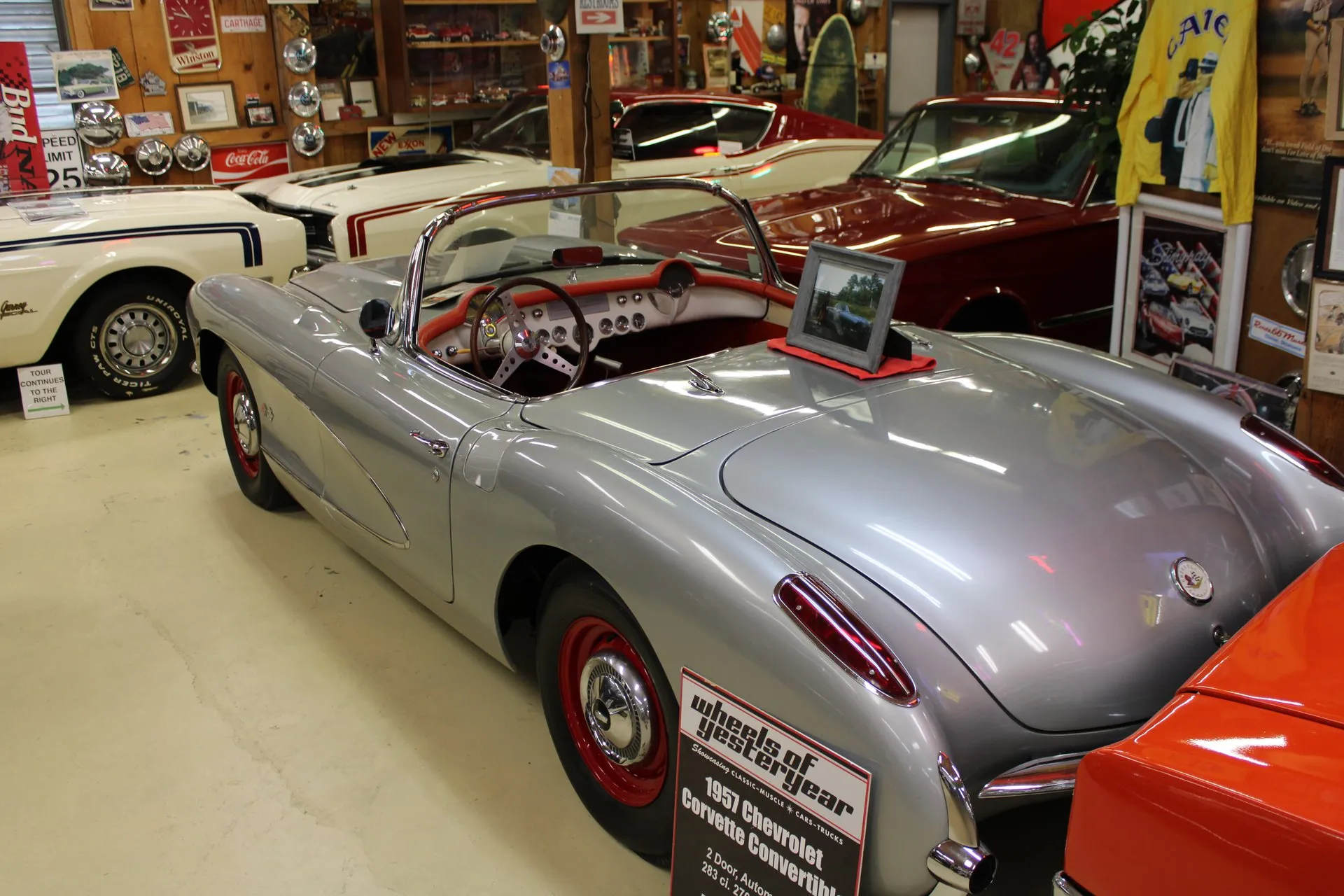
None of it is written on the car. First-generation Corvettes have no trim tag, Sports Car Market notes, so only a window sticker, invoice or ownership history proves a 1957’s original color and options.
Section 05
A 1957 between its neighbors
Against a 1956
Mac’s Motor City Garage calls the 1956 and 1957 nearly indistinguishable. What separates them:
- The serial. 1957s run E57S100001 to E57S106339; 1956 used E56S001001 to E56S004467 (1956 kit).
- The engine. A 283, not a 265. Owners say the 1957 block, casting 3731548, was cast for 1957 only (CorvetteForum, 2010).
- Two codes that changed meaning. In 1956, FG and FK were 265s with a Powerglide; in 1957, FG is a 245 hp 283 and FK the 250 hp fuelie, both automatics. Read the block casting with the code.
- Hardware 1956 never offered: fuel injection, the four-speed, Positraction and RPO 684.
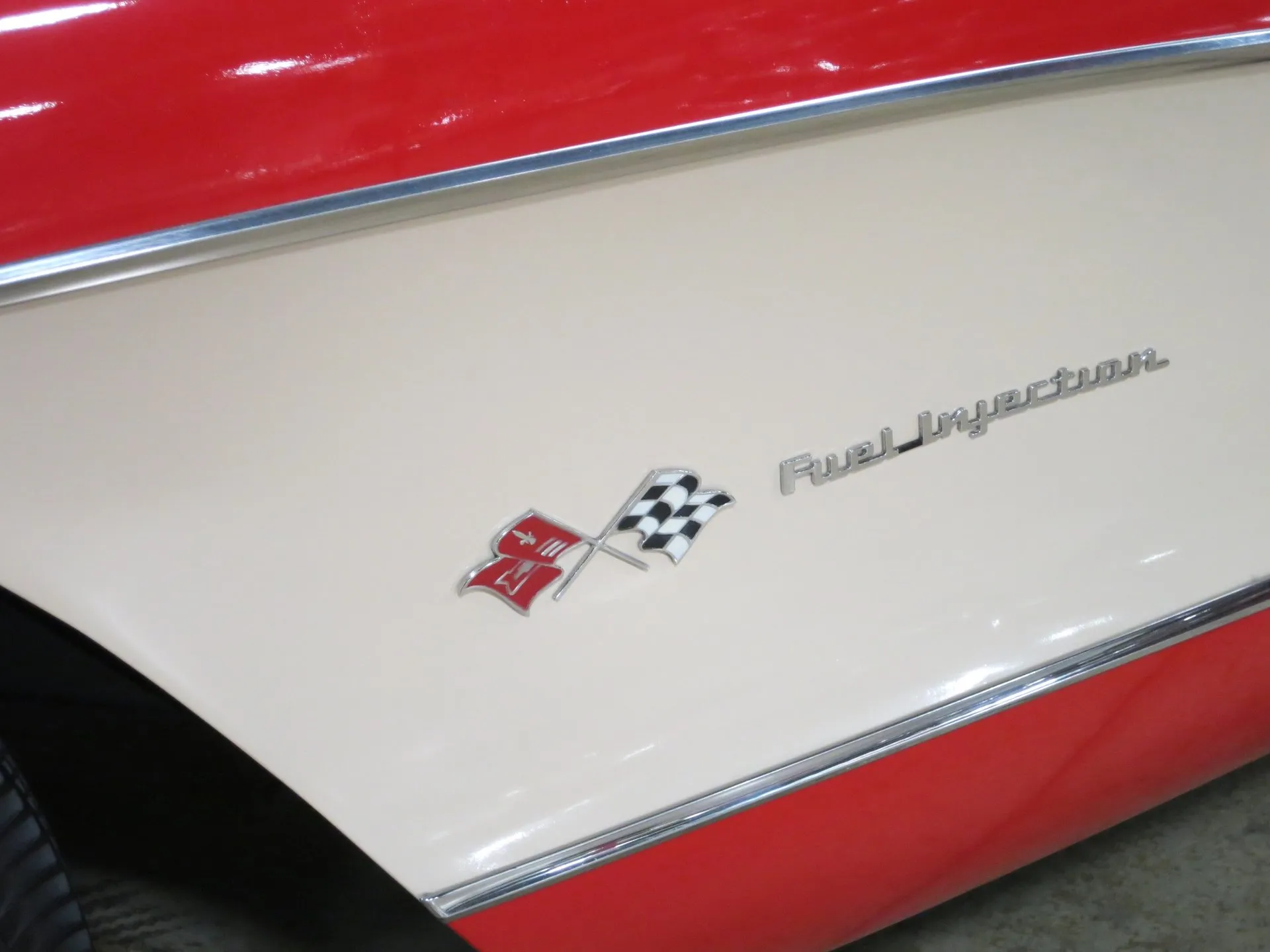
- Fuel Injection script in the coves of injected cars, and Inca Silver paint.
- The dash mirror: a jam nut on the stalk for 1957, a thumb screw for 1956, by Mac’s Motor City Garage’s account.
Badges and mirrors move between cars; the serial and frame stamps settle it.
What 1958 changed
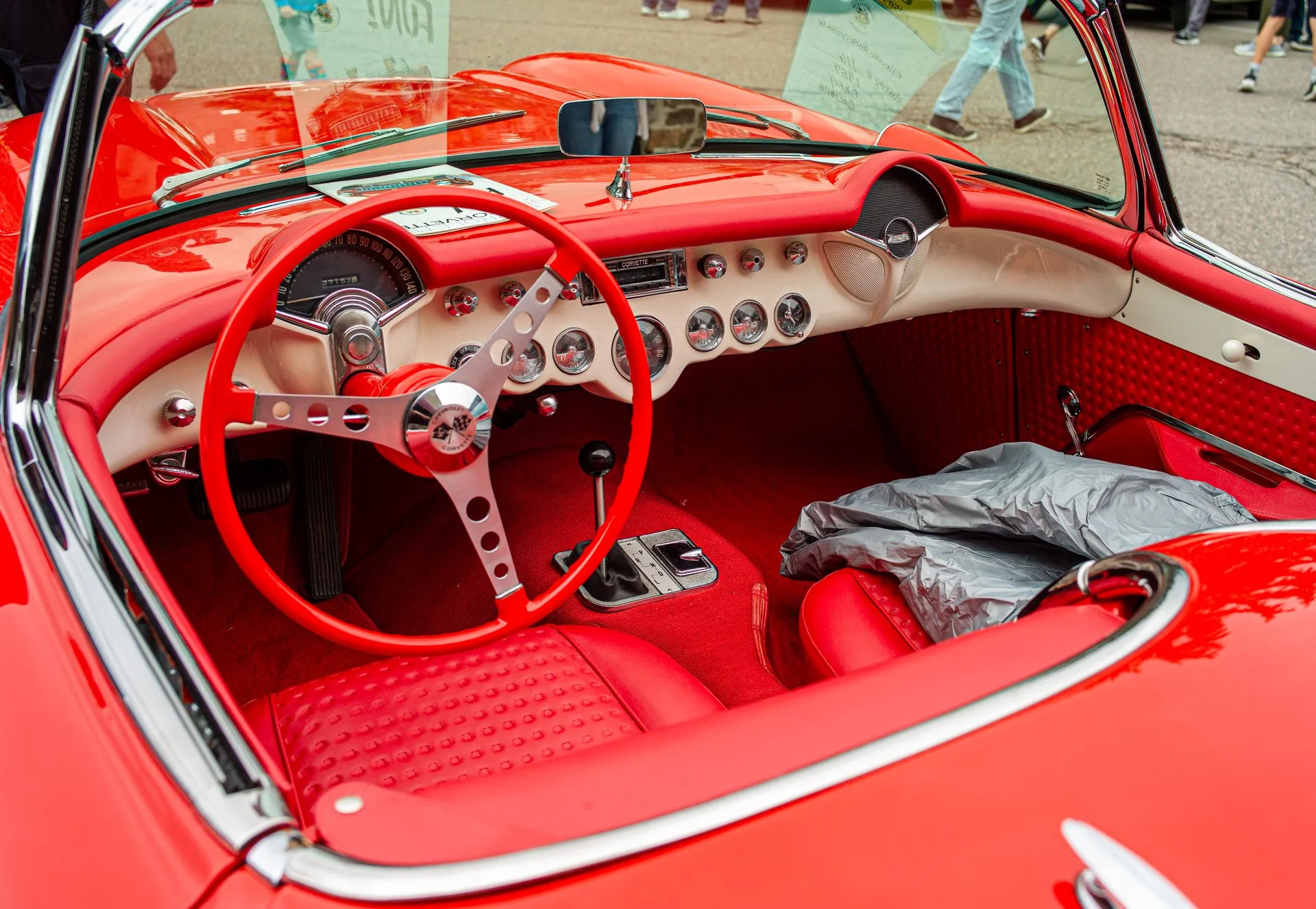
The 1958 kept the frame and changed most of what sat on it: four headlights, simulated hood louvers, trunk spears, factory seat belts and a dash with the tachometer moved from the center to just above the steering column (1958 kit). It grew 9.2 in longer and 2.3 in wider (1958 kit), its engines went to 230 and 290 hp with C and D suffixes, and the base price rose to $3,591.00 (1958 kit). Its blocks also gained side motor-mount bosses, one owner adds (CorvetteForum, 2016).
Section 06
Identifying a 1957: serial, stamps and paper
The serial and the frame
GM decodes the serial’s letters: E for the eight-cylinder engine, S for St. Louis (1957 kit); a 1957 runs from E57S100001 to E57S106339. GM’s 1957 body page doesn’t say where the plate goes, but owners do (opens in new tab): the driver’s door hinge pillar, just below the upper hinge, held by two round-head Phillips screws (CorvetteForum, 2010 and 2017). The serial is also stamped twice on top of the driver-side frame rail, roughly under the seat, readable with the body on by mirror and flashlight or a pencil rubbing (CorvetteForum, 2012).
Plate, both frame stamps and title should agree. A plate on the steering column means a later C1: it moved there during 1960 (see the 1960 guide). Restomod builds have parted many original frames from their bodies, one owner warns (CorvetteForum, 2024). No monthly serial list exists; beyond the bulletin’s April 9 anchor, owners say the last car, number 6,339, was built on September 6, 1957 (CorvetteForum, 2024).
The engine pad and the block
A 1957 engine pad carries a plant letter, a date and the suffix (CorvetteForum, 2010); one owner says Corvette engines carried no part of the car’s serial until 1961 (CorvetteForum, 2008). So no stamp ties a 1957 block to its car, and the question is whether the engine is plausible:
- The suffix, against GM’s list and the gearbox (see the engine table in One 283, five ratings, two ways to feed it).
- The casting, 3731548, which owners say Chevrolet used in every 1957 283, trucks included (CorvetteForum, 2010 and 2016). Passenger-car codes such as GC (a Turboglide 283) or EK (a passenger-car fuel injection engine) mean it didn’t start in a Corvette.
- The casting date. Flint castings carry a one-digit year; a “T” and a two-digit year mark Tonawanda, and in one thread owners judged a Tonawanda block restamped to pass as Flint (CorvetteForum, 2017–2019).
- A clean pad. NCRS judging takes 38 points off for a painted or obscured one; on a claimed fuelie, ask why.
Fuelies, airbox cars and the paper behind them
A fuel-injected 1957 differs from a carbureted one in only a few ways that are easy to fake, one owner warns (CorvetteForum, 2024). Owners check the round throttle rod with a flattened end, which bolts on; the cove emblem holes, from inside the fenders, since emblems slightly out of place usually mean added ones; and a unit series that suits the build date, allowing for Chevrolet’s 1957 replacements (CorvetteForum, 2005–2021). One owner calls a correct conversion almost undetectable, which is why paper settles it: a window sticker, invoice or order copy, an ownership history and a judging record. Without dealer paperwork, another says, original equipment on a car this old is a guessing game (CorvetteForum, 2012).
Section 07
Chevrolet’s 1957 service notes: plugs, springs, leaks
From Chevrolet’s bulletins as Corvette Action Center transcribed them (the originals weren’t seen for this guide):
- Spark plugs (TSB DR #295, May 22, 1957). With most Corvettes driven in congested traffic, AC-46 plugs went into production on April 9 at car 3,268; the 170 cars built from March 29 had plugs whose boots didn’t fit.
- Throttle return spring (Rochester bulletin B-F1-10, March 6, 1957). A kit (
GM 7014754, OEM) for 7014360 units, to fit only when the spring needed replacing. - Sticking choke (TSB DR #278, April 29, 1957), carbureted engines: a more heat-resistant heat tube,
GM 3747292(OEM). - Three-speed leaks (zone bulletin No. 88). The close-ratio box uses a special sealed bearing (
GM 900533, OEM), and some cases were replaced as defective when they weren’t. - Falling fuel economy on 7014800 units (TSB DR #329, November 21, 1957): a dirty bleed hole in the air meter.
NHTSA, the US road-safety agency, lists no owner complaints (opens in new tab) and no recalls for the 1957 Corvette (checked October 19, 2026), and its bulletin files hold no GM bulletin for any Corvette before the 1984 model year. Its complaint records begin in 1994, so the silence says nothing about the car. Frame rust, rocker supports, stress cracks, leaks, heat and injection upkeep are the generation’s problems, in the C1 guide.
Section 08
Checking a 1957, from the paperwork down
- Documents first: window sticker, invoice, ownership history, judging sheets. Nothing else proves colors, options, a fuelie or a factory four-speed.
- Plate, frame and title. E57S10 and four digits on a screwed-on plate at the driver’s hinge pillar, matching both frame stamps and the title.
- The engine pad. A 1957 suffix that suits the gearbox, a 3731548 Flint casting dated before the car was built, and no paint over the stamp.
- Combinations GM built. No Powerglide behind a 270 or 283 hp engine, and no Positraction behind a Powerglide.
- A claimed fuelie or airbox car: the checks in Identifying a 1957, then an NCRS judge or an injection specialist.
- A claimed factory four-speed: a serial past about E57S103268 and paper naming RPO 685, or a price that treats it as added.
- Third gear. A harsh shift may be the cone-angle fault.
- Underneath: the rear crossmember, rails and rocker supports, by the C1 guide’s checklist.
- A car that has sat: fuel system and injection serviced before the engine is cranked.
- An inspection by someone who knows C1s.
Section 09
1957 money: Hagerty, Bring a Trailer and the fuelie premium
How much is a 1957 Corvette worth? Hagerty’s price guide (opens in new tab), as archived on January 23, 2026, values each engine separately. Beside its #3 (Good) figures are the #2 (Excellent) values Hagerty Media published in June 2025:
| Engine | #3 (Good), January 2026 | #2 (Excellent), June 2025 |
|---|---|---|
| 220 hp | $63,300 | $86,000 |
| 245 hp | $79,000 | $102,000 |
| 250 hp fuel injection | $83,100 | $114,000 |
| 270 hp | $82,400 | $108,000 |
| 283 hp fuel injection | $82,100 | $125,000 |
The plain average, $77,980, is the C1 guide’s 1957 figure, above a 1956 ($66,200) and below a 1958 ($90,540). In Good condition the dual-quad cars sit within $4,100 of the fuelies; in Excellent, the 283 hp fuelie leads by $11,000 or more. Hagerty’s 1957 page had the base car at $60,300 in July 2025, and values may have moved since.
Bring a Trailer. From January 1 to October 19, 2026, Bring a Trailer (opens in new tab) listed 19 cars titled as 1957 Corvettes and sold 14, at a median of $70,500, the middle half between about $57,250 and $77,000, by this site’s calculation from each sold price.
- Titled as stock: 11 sold, median $70,000, from $32,000 (a 283/270 four-speed project, April 11) to $83,500.
- Fuel injection in the title: $83,500 for a restored fuelie with a four-speed in place of its Powerglide (July 20), $61,000 for a Powerglide car (July 2), and $50,000, then $42,000 relisted, for a car with a replacement fuel-injected 283. Since January 2024: eight sales, $85,500 median.
- Two four-barrels in the title: five sold since January 2024, $70,000 median. An NCRS Duntov award 283/245 three-speed with its window sticker ($3,973.90 delivered) was bid to $83,000 in July 2026 and didn’t sell.
- Neither: stock-titled cars without injection or dual quads, 11 sold since 2024 at a $64,000 median.
- Restomods are another market: a Ramjet 350 car brought $100,000 (April 22).
Over the 12 months to October 19, 2026, 15 of 21 sold at a $71,000 median, close to the C1 guide’s $70,000 for 1956–1957 together. classic.com shows no 1957-only figure this guide could read. Titles are a crude screen and auctions favor presentable cars: a snapshot, not a forecast.
Section 10
Buy a fuelie with papers, and keep its three-speed
The 1957 to own is a documented 283 hp fuelie on its close-ratio three-speed: GM’s horsepower-per-cubic-inch engine, in the Corvette’s first fuel-injected year. Hagerty’s Good-condition values price it like a dual-quad 1957, $82,100 against $82,400 for the 270 hp car (January 2026). Bring a Trailer buyers paid more, an $85,500 median for 1957s titled as fuel-injected since 2024 against $70,000 for dual-quad titles, and much of that gap rides on paperwork. Ask which unit and camshaft it runs now: after Chevrolet’s June 1957 letter, either answer can be right with paper behind it. That’s this site’s call, from GM’s pages and 2026 prices.
The three-speed matters too. Manual 1957s built before April had one, by owners’ accounts, as did most manual cars that year, and a three-speed leaves the paper one claim to prove instead of two. Want four gears? Of course you do. Fit a T-10 as Chevrolet’s dealers could from October 1957, keep the original box with the car, and never pay a factory four-speed price for a car that can’t prove one.
Without a fuelie whose paper matches, a documented 270 or 245 hp dual-quad car is the fallback. On a budget, buy the 220 hp base car; a Powerglide only lowers the price. Hagerty’s cheapest 1957 is $63,300, its 2025 notes took 10 percent off for an automatic, and comparable cars have sold on Bring a Trailer at a $64,000 median since 2024.
Skip any 1957 priced as a factory four-speed, fuelie or airbox car without the documents to carry it, and any car whose plate, frame stamps and title disagree. An airbox car is a provenance file with a car attached.
The best Corvette years guide names a documented 1957 fuelie as the C1 for the history. Get the paper right and you own America’s sports car in its first fuel-injected year; the 1960 guide picks up the injection story three years on.
Section 11
Sources
- GM Heritage Center: 1957 Corvette vehicle information kit files.zipcorvette.com This site's library. GM's AMA specification questionnaire, issued September 1, 1956 and revised in December 1956: PDF pages 4–29 (axles on page 13, gearboxes on page 16, ignition on page 19, fuel injection on page 22, engine ratings on pages 27–28). Chevrolet's 1957 Corvette supplement, October 1956 with 1957 revisions: pages 30–33 (gross and net ratings, serial and engine codes, weights, colors). The kit has no production page.
- GM Heritage Center: 1956 Corvette vehicle information kit files.zipcorvette.com PDF pages 2 and 4 (reproduced Corvette Black Book pages: 1956 serials, engine codes, options, prices) and 8 (GM's 1956 specifications).
- GM Heritage Center: 1958 Corvette vehicle information kit files.zipcorvette.com PDF pages 4 and 6 (Black Book: what changed for 1958, seat belts, injection units, prices) and 13 (dimensions and weights).
- Corvette Action Center: 1957 Corvette production and options (opens in new tab) corvetteactioncenter.com Option codes, prices and counts, colors, the base price and the Sports Cars Illustrated test figures it reproduces. Read via the Internet Archive's March 2026 copy (opens in new tab).
- Sports Car Market: 1957 283/283 Fuel-Injected Convertible (opens in new tab) sportscarmarket.com Tom Glatch, January 1, 2010. 6,339 built, 1,040 fuel-injected, 664 four-speeds, 327 with the 3.70 Positraction axle; no trim tag on C1s.
- Corvette Action Center: Chevrolet letters on fuel injection, June 1957 (opens in new tab) corvetteactioncenter.com Chevrolet Central Office to regional service managers, June 7 and June 13, 1957, as scanned and reproduced by Corvette Action Center.
- Corvette Action Center: 1957 spark plug recommendations (opens in new tab) corvetteactioncenter.com Chevrolet TSB DR #295, May 22, 1957, as transcribed. Build dates for cars 3,098 and 3,268.
- Corvette Action Center: conversion from three-speed to four-speed (opens in new tab) corvetteactioncenter.com Chevrolet zone bulletin No. 108, October 8, 1957, as transcribed.
- Corvette Action Center: four-speed harsh shift into third (opens in new tab) corvetteactioncenter.com Chevrolet Service News, December 1957, 1957–1958 four-speeds, as transcribed.
- Corvette Action Center: throttle return spring kit (opens in new tab) corvetteactioncenter.com Rochester Products field bulletin B-F1-10, March 6, 1957, as transcribed.
- Corvette Action Center: automatic choke piston and carbon deposits (opens in new tab) corvetteactioncenter.com Chevrolet TSB DR #278, April 29, 1957, as transcribed.
- Corvette Action Center: close-ratio three-speed lubricant leakage (opens in new tab) corvetteactioncenter.com Chevrolet zone bulletin No. 88, 1956–1957 Corvettes, as transcribed.
- Corvette Action Center: fuel economy drop, unit 7014800 (opens in new tab) corvetteactioncenter.com Chevrolet TSB DR #329, November 21, 1957, as transcribed.
- Corvette Action Center: Rochester fuel injection part numbers (opens in new tab) corvetteactioncenter.com Corvette Action Center's own table of unit numbers by year: four series for 1957.
- NHTSA owner complaints, 1957 Chevrolet Corvette (opens in new tab) api.nhtsa.gov Pulled October 19, 2026. None on file. NHTSA's complaint file begins in 1994.
- NHTSA recalls, 1957 Chevrolet Corvette (opens in new tab) api.nhtsa.gov Pulled October 19, 2026. None listed.
- NHTSA manufacturer communications (TSB) file, received 1995–1999 (opens in new tab) static.nhtsa.gov This and NHTSA's later files hold no GM bulletin for any Corvette before the 1984 model year.
- NCRS: judging awards (opens in new tab) ncrs.org The 38-point engine pad deduction and Top Flight judging. Fetched October 2026.
- Mac's Motor City Garage: car spotter's guide to the 1953–1957 Corvette (opens in new tab) macsmotorcitygarage.com Telling a 1957 from a 1956: the mirror mount, Inca Silver, the Fuel Injection cove badges.
- Mac's Motor City Garage: a history of the Borg-Warner T-10 four-speed (opens in new tab) macsmotorcitygarage.com The T-10's arrival on the 1957 Corvette.
- Curbside Classic: Sports Cars Illustrated's 1957 dual-quad and fuel injection test (opens in new tab) curbsideclassic.com A summary of the period test. Both test cars were three-speeds.
- Corvette Blogger: rare 1957 airbox Corvette sells for $374,000 (opens in new tab) corvetteblogger.com November 17, 2010. What the airbox cars carried, as the auction writer describes it. Also the December 2007 post (opens in new tab) relaying a forum expert's account.
- Hagerty Price Guide: 1957 Chevrolet Corvette (220 hp) (opens in new tab) hagerty.com Read via the Internet Archive's September 2025 copy (opens in new tab). The July 2025 #3 value, Hagerty's adjustments for options and gearboxes, and its 290 hp claim.
- Hagerty Price Guide: 1953–1962 Chevrolet Corvette (opens in new tab) web.archive.org Internet Archive copy of January 23, 2026; #3 (Good) values for each 1957 engine.
- Hagerty Media: the best Corvettes per dollar, C1 to C7 (opens in new tab) hagerty.com Andrew Newton, June 4, 2025; #2 (Excellent) values for each 1957 engine. Read via the Internet Archive's June 2026 copy (opens in new tab).
- Bring a Trailer: Chevrolet Corvette C1 results (opens in new tab) bringatrailer.com Every listing titled as a 1957 Corvette, read October 19, 2026. Counts, medians and the four-speed share are this site's calculation from each listing's sold price and title.
- CorvetteForum thread: 1957 info (opens in new tab) corvetteforum.com January 2023. When the first four-speeds were built.
- CorvetteForum thread: 1957 production numbers (opens in new tab) corvetteforum.com February to March 2024. The last car built, survivors, and how easily a fuelie is faked.
- CorvetteForum thread: 1957 Corvette VIN location (opens in new tab) corvetteforum.com September 2017.
- CorvetteForum thread: VIN location on a 1957 (opens in new tab) corvetteforum.com April 2010.
- CorvetteForum thread: matching VIN and frame numbers (opens in new tab) corvetteforum.com January 2012.
- CorvetteForum thread: a 1958 VIN number (opens in new tab) corvetteforum.com July 2008. One owner: no Corvette engine carried the car's serial until 1961.
- CorvetteForum thread: 1957 engine stamp (opens in new tab) corvetteforum.com July 2025. Manual-car suffixes and the first four-speeds.
- CorvetteForum thread: a genuine 1957 fuelie, how to tell (opens in new tab) corvetteforum.com April to May 2005.
- CorvetteForum thread: is a 1957 a real fuelie or not (opens in new tab) corvetteforum.com 2007–2011.
- CorvetteForum thread: 1957 fuel injection emblems (opens in new tab) corvetteforum.com 2016–2021.
- CorvetteForum thread: 1957–1958 fuel injection casting numbers (opens in new tab) corvetteforum.com 2017–2019.
- CorvetteForum thread: the 3731548 block (opens in new tab) corvetteforum.com December 2010.
- CorvetteForum thread: 1957 283 identification (opens in new tab) corvetteforum.com May 2016.
- CorvetteForum thread: three-speed identification help (opens in new tab) corvetteforum.com January to November 2021.