C1 · Buying guide
1958 Corvette guide: the louvered hood, five 283s, how to verify one, and 2026 prices
Published
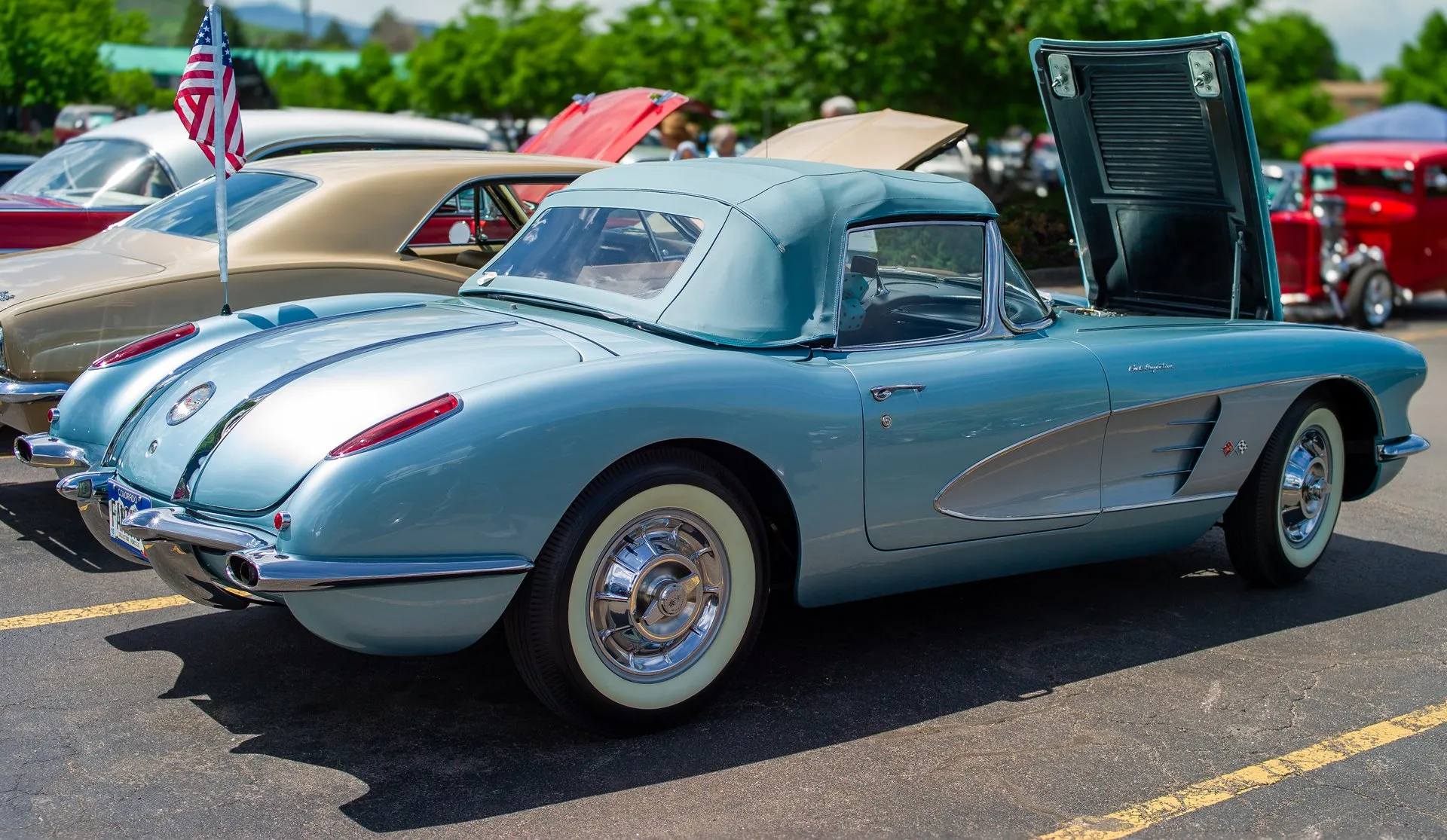
Two styling details that do no work at all make the 1958 the C1 (1953–1962) you can name from across a parking lot. The ribs across the hood are louvers that pass no air, and the twin chrome spears down the trunk lid are there for the look. Owners call it the washboard hood. Neither detail outlived the model year: the 1959 dropped both. Yet in January 2026, Hagerty’s price guide put a base 1958 $18,000 above a base 1959.
The rest of the 1958 changed in ways that mattered more: the Corvette’s first four headlights, a body nine inches longer, a tachometer moved to just above the steering column, the first factory-installed seat belts and a 290 hp fuel-injected 283. Chevrolet built 45 percent more cars than for 1957, and Car and Driver’s December 1957 road test rated it a “Best Buy”. The buyer’s job now is proving a 1958 is all 1958, and the hood and spears can’t do that. The numbers on the car can.
- Built: 9,168, all convertibles. 5,607 also got the removable hardtop, 2,215 of them in place of the soft top at no charge.
- Engines: five 283s, 230 to 290 hp gross. 1,511 cars, about one in six, had fuel injection.
- Price new: $3,591 with the 230 hp engine, a three-speed and a soft top. A heater cost extra.
- One year only: the louvered hood and the twin trunk spears.
- Money in 2026: Hagerty’s #3 (Good) average was $90,540 (January 2026), from $76,500 for a base car to $117,000 for the 290 hp fuel-injected car, the fuelie. Bring a Trailer’s 2026 median, through October 19, was $81,000 (6 sales).
- Stingray? Not for five more years: the Sting Ray name reached a production Corvette for 1963.
Frame rust, fakes and the other nine years are in the C1 buyer’s guide. This page is 1958 only.
C1 Key figures
- Built
- 9,168, all convertibles
- Engines
- five 283s, 230 to 290 hp gross
- Fuel-injected cars
- 1,511
- Price new
- $3,591
- One year only
- the louvered hood and the twin trunk spears
- Hagerty #3 average
- $90,540 (January 2026)
- Bring a Trailer, 2026
- $81,000 (6 sales)
Section 01
Nine inches longer, on the 1957’s frame
Chevrolet’s 1958 data describes the 1957’s frame, a welded box girder with an I-beam X-member, unchanged in size and on the same 102 in wheelbase (1958 kit; 1957 kit). What sat on it was new: the Corvette Black Book, a reference whose 1958 pages are reproduced in GM’s 1958 kit (in this site’s manual library), lists new body panels, a new instrument panel and new upholstery.
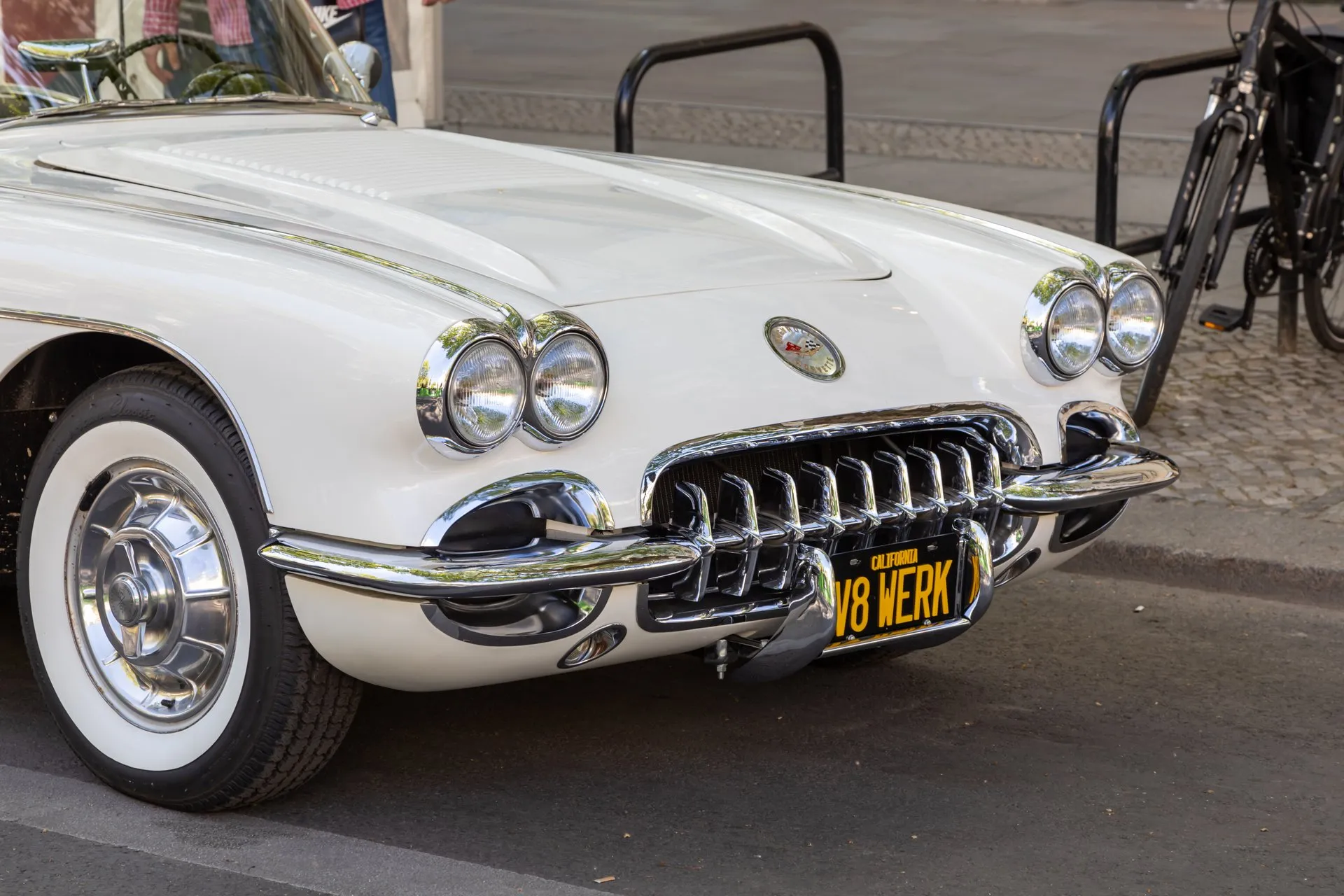
- Four headlights, a Corvette first, with large openings below them. Car and Driver’s test says the openings were there to blast fresh air onto the brakes; on its test car they were painted black.
- A bigger, heavier car. Length grew from 168.0 to 177.2 in and width from 70.5 to 72.8 in. GM’s curb weight rose 77 lb with the three-speed, to 2,926 lb, and 93 lb with the Powerglide automatic, to 3,034 lb (2,912 lb for the three-speed on GM’s specification form). Car and Driver noted that the bumpers were now bracketed to the frame rather than the body.
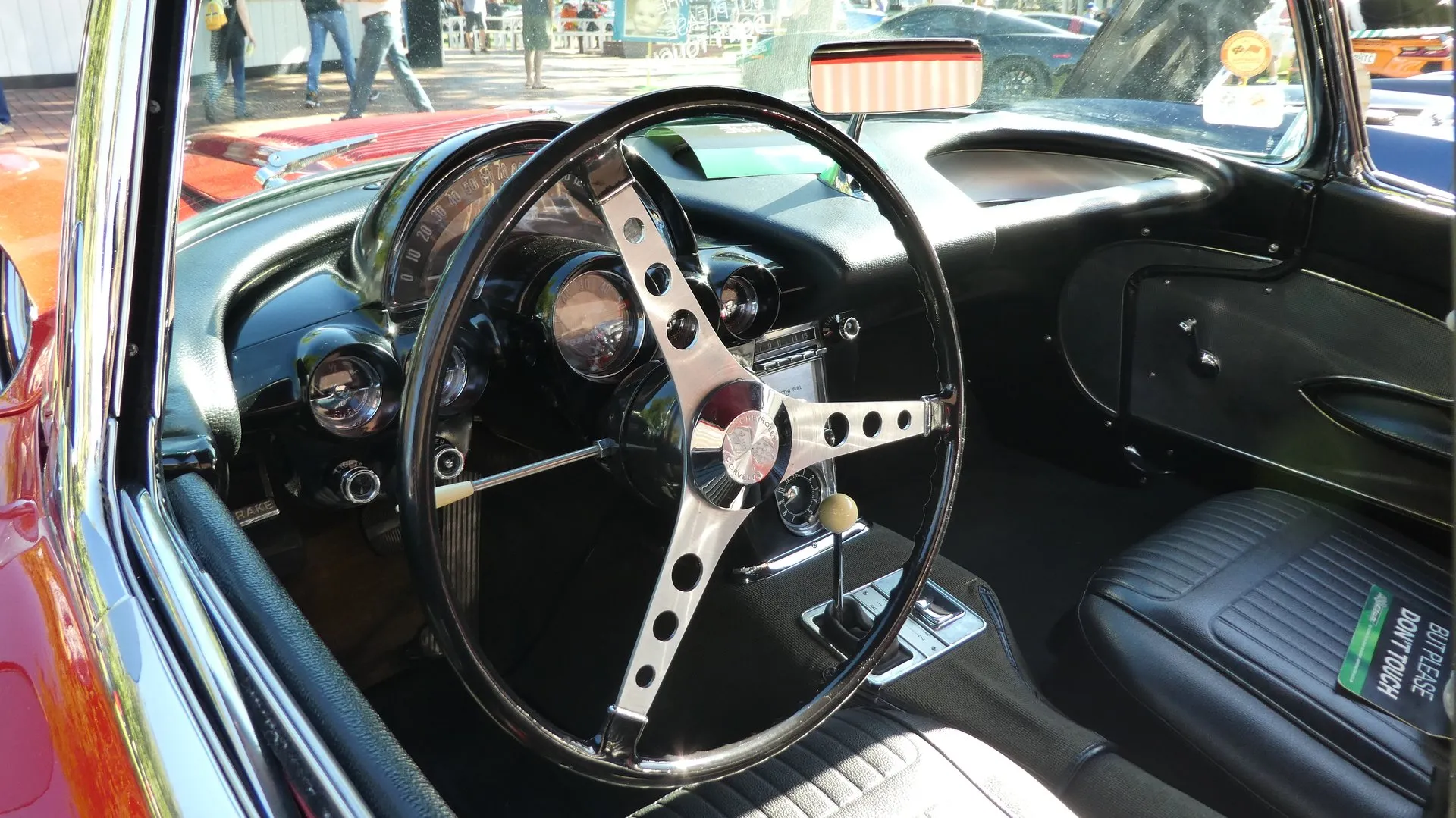
- A new cockpit: a 160 mph speedometer, the tachometer moved from the middle of the dash to just above the steering column, a center console, a grab bar built into the passenger side and two-piece door panels.
- Seat belts from the factory, for the first time. On 1956–1957 cars the factory fitted only the anchors, and dealers installed the belts.
- More power at both ends. The base 283 went from 220 to 230 hp and the top fuel-injected engine from 283 to 290 hp; the 245, 250 and 270 hp ratings carried over (1957 kit; 1958 kit).
- New colors. Every color on GM’s 1958 chart had a new name, and interiors came in Charcoal, Blue-Gray or Red: red carried over from 1957, and beige was dropped (1957 kit; 1958 kit).
The base price rose to $3,591.00, from $3,176.32 by Corvette Action Center’s 1957 figure, and buyers came anyway: 9,168 cars against 1957’s 6,339, with four-speeds in 3,764 of them against 664.
Section 02
Five 283s, and which ones came with a Powerglide
The 1958 engine list is one V8, the 283 cu in (3.875 in bore, 3.00 in stroke), in five tunes. GM’s advertised performance page gives each a gross rating, as advertised, and a net one, the fairer match for a Corvette from 1972 on, when GM switched to net. Options carried regular production option (RPO) codes.
| Engine | RPO and price | Fuel system and lifters | Gross (net) power | Gross (net) torque | Suffix codes | Built |
|---|---|---|---|---|---|---|
| 230 hp | Standard | One Carter four-barrel, hydraulic | 230 hp at 4,800 rpm (195 net) | 300 lb-ft at 3,000 (270 net) | CQ manual, DG Powerglide | 4,243 |
| 245 hp | 469, $150.65 | Two four-barrels, hydraulic | 245 hp at 5,000 rpm (215 net) | 300 lb-ft at 3,800 (270 net) | CT manual, DJ Powerglide | 2,436 |
| 270 hp | 469C, $182.95 | Two four-barrels, special camshaft, mechanical | 270 hp at 6,000 rpm (230 net) | 285 lb-ft at 4,200 (255 net) | CU, manual only | 978 |
| 250 hp fuel injection | 579, $484.20 | Rochester fuel injection, hydraulic | 250 hp at 5,000 rpm (225 net) | 305 lb-ft at 3,800 (280 net) | CR manual, DH Powerglide | 504 |
| 290 hp fuel injection | 579D, $484.20 | Rochester fuel injection, special camshaft, mechanical | 290 hp at 6,200 rpm (245 net) | 290 lb-ft at 4,400 (265 net) | CS, manual only | 1,007 |
Counts are the Black Book’s (1958 kit), the 230 hp figure by this site’s subtraction; suffix codes are from GM’s engine list. Compression was 9.5:1, except the 290 hp engine’s 10.5:1, which called for 96–100 octane premium.
Automatic or not. The Powerglide went behind three engines: 1,414 of the 230 hp cars (this site’s arithmetic), 539 of the 245s and 104 of the 250 hp fuelies. The two special-camshaft engines, the 270 and 290, were manual only. So a fuel-injected 1958 with an automatic can be right, where a 1960 can’t (see the 1960 guide).
One price, two fuelies. Both fuel-injected engines cost $484.20, so the 290’s extra 40 hp over the 250 came at no extra charge, and twice as many buyers took it: 1,007 against 504. Even the 270, $301.25 cheaper, sold fewer (978). With the four-speed and a 4.11 Positraction axle (Chevrolet’s limited-slip differential), a 290 hp car listed at $4,338.85 before a heater or radio, by this site’s arithmetic: about a fifth more than the base car.
The fuel injection. GM describes a constant-flow Rochester system with eight nozzles at the intake ports, and outside-air ducts only with the special camshaft, so only on the 290 (1958 kit). The Black Book lists six unit numbers on 1958s: 7014800, 7014900 and 7017200 (marked late production) on the 250 hp engine, and 7014800R (marked early production), 7014900R and 7014960 on the 290. Three of them, 7014900, 7014900R and 7017200, are on the 1959 list too (1959 kit), so a unit number fits the year without proving it.
How quick. Motor Trend’s March 1958 test of a 290 hp car on 4.11 gears ran 0–60 mph in 6.9 s and the quarter mile in 15.6 s at 95.0 mph, as Corvette Action Center reproduces it (the magazine wasn’t seen for this guide).
Three-speed, four-speed or Powerglide
A close-ratio three-speed manual was standard, synchronized in second and third. The four-speed, RPO 685 at $215.20, went into 3,764 cars (41.1 percent), with all four forward gears synchronized (2.20, 1.66, 1.31 and 1.00, GM’s figures). The Powerglide, RPO 313 at $188.30, went into 2,057, with its selector on the floor, which leaves 3,347 three-speeds. Axles were 3.70:1 behind a manual and 3.55:1 behind the Powerglide. Positraction cost $48.45 in any of three ratios, 3.70 (RPO 677, 1,123 cars), 4.11 (678, 2,518) or 4.56 (679, 370), and came only with a manual.
RPO 684: 144 cars with a sign on the windshield
RPO 684, heavy-duty brakes and suspension, cost $780.10, more than the fuel injection it required, and 144 cars got it. GM’s specification form gives the hardware: front springs at 340 lb/in against 300, a 13/16 in front bar against 11/16 and steering quickened from 21.0:1 to 16.3:1 (1958 kit), rear springs at 125 lb/in against 115 (1958 kit), and sintered metal and ceramic linings in finned drums (1958 kit), plus, the Black Book says, air ducting for the brakes on all but very early cars.
It was all or nothing, Car and Driver’s December 1957 test (opens in new tab) explains: the package required the 290 hp engine and Positraction, and cars so equipped were delivered with a placard on the windshield reading “This car is not for street use.” It wasn’t new for 1958: GM’s 1957 chassis data already lists axle codes for a heavy-duty suspension and brake car (1957 kit). For 1959 its price fell to $425.05, the 270 hp engine qualified too, and 142 were built (1959 kit).
Section 03
Heaters, hardtops and other 1958 options
The $3,591.00 base car came with vinyl seats and no heater: that was option 101, and 1,154 buyers did without. The Black Book counts each option; engines, gearboxes, axles and RPO 684 are in Five 283s.
| Option | RPO | Price | Cars | Share of 9,168 |
|---|---|---|---|---|
| Heater | 101 | $96.85 | 8,014 | 87.4% |
| Whitewall tires | 290 | $31.55 | 7,428 | 81.0% |
| Signal-seeking AM radio | 102 | $144.45 | 6,142 | 67.0% |
| Auxiliary hardtop | 419 | $215.20 | 5,607 | 61.2% |
| Courtesy light | 108 | $6.50 | 4,600 | 50.2% |
| Windshield washers | 109 | $16.15 | 3,834 | 41.8% |
| Two-tone paint | 440 | $16.15 | 3,422 | 37.3% |
| Parking brake alarm | 107 | $5.40 | 2,883 | 31.4% |
| Power folding top | 473 | $139.90 | 1,090 | 11.9% |
| Power windows | 426 | $59.20 | 649 | 7.1% |
| 15 x 5.5 in wheels, small hubcaps | 276 | No charge | 404 | 4.4% |
The hardtop. It weighed 55 lb, and GM’s color chart has it painted to match the body (1958 kit). Hardtops move between cars, though: one 1960 owner found by its glass date codes that his was a 1958 top (CorvetteForum, 2023). A hardtop doesn’t date a car.
The scarcest, by the Black Book’s counts: 144 RPO 684 cars, 193 painted Silver, 370 with the 4.56 axle and 404 on the wider wheels. This guide found no count of survivors.
Eight colors on a six-color chart
Chevrolet’s color chart, dated November 29, 1957, lists six body colors (1958 kit). The Black Book’s production record counts eight, adding Black and Silver, and says Charcoal “is believed to have been replaced by Black” somewhere past the middle of the run:
| Color | Cars | On GM’s chart | Two-tone cars, cove color |
|---|---|---|---|
| Snowcrest White | 2,477 | Yes | 499, silver |
| Silver Blue | 2,006 | Yes | 757, silver |
| Charcoal | 1,631 | Yes | 729, silver |
| Signet Red | 1,399 | Yes | 756, white |
| Regal Turquoise | 510 | Yes | 252, white |
| Black | 493 | No | 199, silver |
| Panama Yellow | 455 | Yes | 190, white |
| Silver | 193 | No | 36, black |
Four more cars got a non-standard color, combination or primer. Panama Yellow was the rarest of the six chart colors. Interiors were Charcoal, Blue-Gray or Red grained vinyl, and GM’s chart pairs Charcoal with any color, Blue-Gray only with Charcoal, Snowcrest White or Silver Blue, and Red only with Charcoal, Snowcrest White or Signet Red, though the Black Book says other combinations were possible.
Don’t look for a paint code. The Black Book says colors and interiors weren’t coded to individual cars, and there’s no trim tag, so only paperwork proves a 1958’s original color.
Section 04
The 1959 differences: louvers, spears and radius rods
A 1959 shares the 1958’s body dimensions, its 102 in wheelbase and its eight engine suffix codes. GM’s 1959 pages list what changed (1959 kit):
- Trim: no louvers on the hood and no spears on the trunk.
- Rear suspension: radius rods. GM’s 1958 form has drive and torque going through the rear springs alone, with no track bar (1958 kit); its 1959 form says “rear springs and radius rods” (1959 kit).
- Cockpit: instruments redesigned with concave lenses and a new tachometer face, armrests and door releases moved, a storage bin under a more heavily padded grab bar, smoother seat upholstery and the Corvette’s first black interior.
- Shifter: a T-handle with a reverse lockout on four-speeds.
- Paint and wheels: new color names for all but Snowcrest White, and black wheels on every color.
- Price list: a $3,875.00 base price, $284 more, a cheaper four-speed, one Positraction code in place of three, and new options including metallic brakes and a 24-gallon tank (1959 kit).
- Weight: 3,033 lb with the three-speed, 107 lb more than a 1958 (1959 kit).
- Production: 9,670.
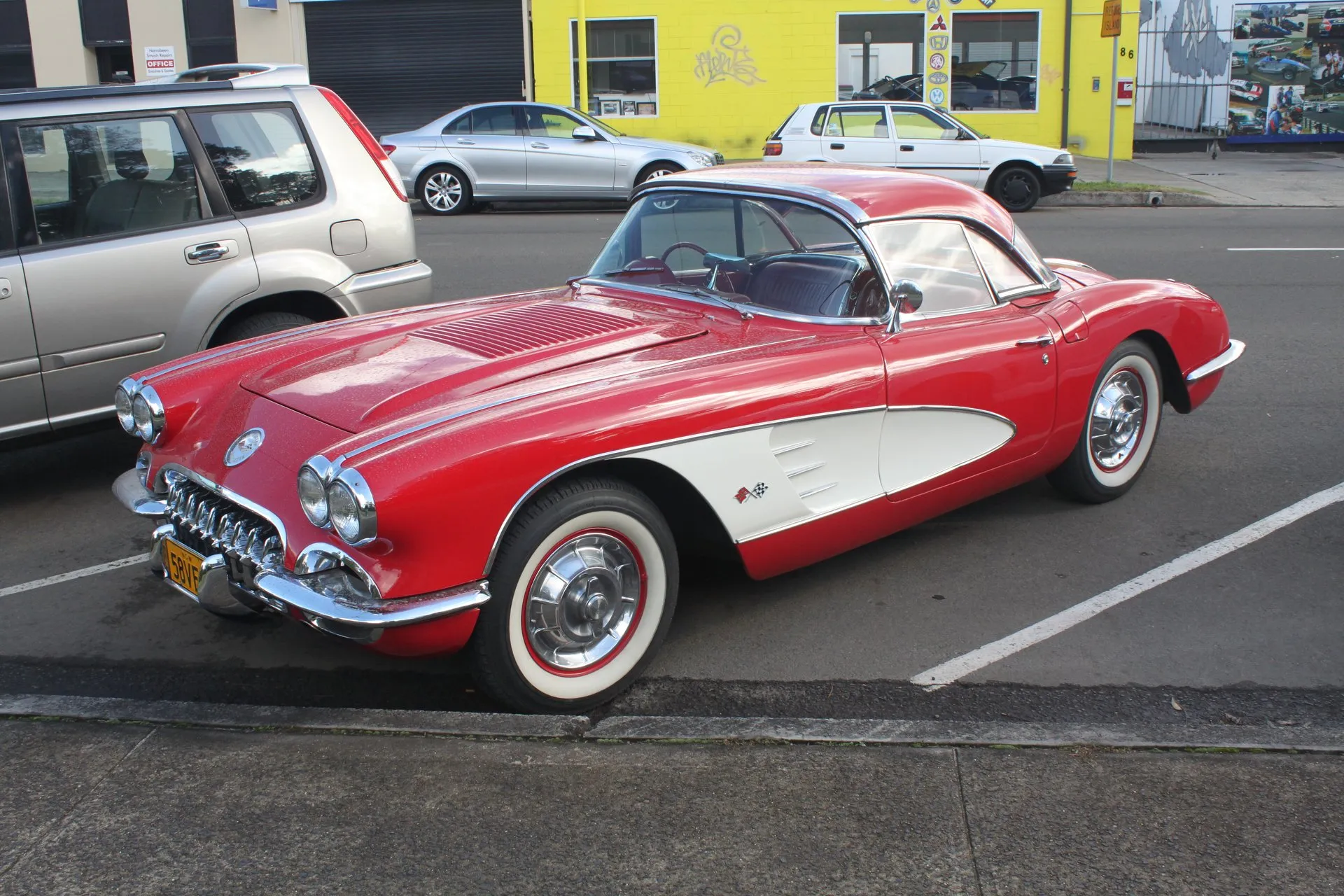
Hagerty values every 1958 engine above the same engine in a 1959 (see the table in What 1958s fetch in 2026), so check that a 1958 really is one. Hoods move between cars, and owners disagree about whether a later trunk lid can take the spears (CorvetteForum, 2008). The serial and the frame stamp settle it.
Section 05
Matching a 1958 to its numbers
The serial plate and the frame stamp
1958 serials run from J58S100001 to J58S109168, with S for the St. Louis plant (1958 kit). GM’s specification form puts the plate on the left front body hinge pillar, at the front of the driver’s door opening (1958 kit). Owners in three CorvetteForum threads add two Phillips screws, not rivets, and numbers stamped in from the front (2008, 2014 and 2020). In the 2020 thread (opens in new tab), posters called one plate a reproduction because its unit number began with 2 and the C and V of its “Chevrolet” were the wrong shape. A state-issued replacement number “significantly lowers” a car’s value, one owner says (2014).
The frame carries the serial too, on top of the driver-side rail under the seat, sometimes stamped twice and sometimes hidden under a rubber body spacer; owners find it with a mirror and a light, or with modeling clay pressed into it (CorvetteForum, 2020; Corvette Action Center forum, 2010–2013). Plate, frame stamp and title should all agree.
The build month, from the serial
The Black Book’s monthly figures date a car by its unit number (1958 kit). Production ran from October 1957 to August 1958; the 1959s started in September.
| Built in | Unit numbers |
|---|---|
| October 1957 | 100001–100486 |
| November 1957 | 100487–101443 |
| December 1957 | 101444–102511 |
| January 1958 | 102512–103677 |
| February 1958 | 103678–104789 |
| March 1958 | 104790–105779 |
| April 1958 | 105780–106544 |
| May 1958 | 106545–107489 |
| June 1958 | 107490–108192 |
| July 1958 | 108193–108840 |
| August 1958 | 108841–109168 |
An engine can be correct, never matching
The engine stamp sits on a pad on the front of the block’s right side, below the cylinder head (CorvetteForum, 2008): an assembly date and a suffix code. What a 1958 pad doesn’t carry, two owners in separate threads say, is any part of the car’s serial; one says Corvette engines didn’t get it until 1961. So a 1958 engine can be correct, meaning the right casting, date and code for the car, but never provably the one it left the factory with (CorvetteForum, 2014 (opens in new tab)).
The suffix should fit the engine and gearbox (see the table in Five 283s). 1957’s codes began with E or F (1957 kit), but 1959 used the same eight as 1958 and 1960 kept most of them, so a code fits the year without proving it. So do the castings: the Black Book lists blocks 3737739 and 3756519 and head 3748770 for 1958, and all three again for early 1959s (1959 kit). Correct 1958 valve covers have staggered hold-down holes: painted steel on the base engine, seven-fin cast alloy on the others.
Checking a fuel-injection claim
The C1 guide covers how conversions are built and argued over. For a 1958, GM’s pages allow these checks:
- The code and the gearbox: CR or CS with a manual, or DH with a Powerglide (only the 250 hp fuelie came with one).
- A 290 hp car’s parts: the outside-air duct, distributor 1110914 with no vacuum advance (1958 kit; the Black Book lists 1110908 on early cars), generator 1102059 and domed pistons for 10.5:1 (1958 kit). Car and Driver says the 290’s tachometer read to 8,000 rpm; Hagerty says the 270’s did too.
- A 250 hp car’s parts: distributor 1110915 with vacuum advance, and, an owner adds, a block-off plate where the 290’s air duct would be (CorvetteForum, 2026).
- The injection unit: a number from the Black Book’s list for that rating, in Five 283s.
Experienced owners in a 2026 CorvetteForum thread (opens in new tab) add tells GM’s pages don’t: a bonded plate of captured nuts for the air-cleaner bolts in the left inner fender, a bracket riveted to the fenderwell for the air-cleaner housing, and a vertical accelerator lever at the firewall that one says nobody reproduces. Clues, not proof: that takes paperwork and a judging history.
Section 06
The siphon problem, and Chevrolet’s other 1958 fixes
These come from Chevrolet’s technical service bulletins (TSBs) and zone bulletins as Corvette Action Center transcribed them; the originals weren’t available to this guide.
- Fuel siphoning into a cylinder (TSB #565, October 14, 1958). On fuel injection unit 7014900, a spill plunger that didn’t seat, or leaked, could let fuel siphon from the fuel bowl into a cylinder with its inlet valve open. Restart the engine after several hours and that cylinder is full of fuel, which won’t compress: the bulletin warns of bent and eventually broken connecting rods, and says a stalling starter may be the sign. The fix was siphon breaker kit
GM 7017143(OEM), built into later 7014900 units (Chevrolet’s bulletin (opens in new tab)). On a car with that unit, ask which it has. - A harsh shift into third. Some 1957 and 1958 four-speeds were built with the wrong cone angle on third gear, 7 degrees instead of 6. The cure was a new third gear (
GM 3743452, OEM) and blocking ring (GM 3709348, OEM). - Positraction chatter (TSB DR #356, April 29, 1958). Usually the wrong lubricant: Chevrolet called for its Positraction special lubricant (
GM 3758791, OEM). - Oil pulled out at speed (zone bulletin, April 25, 1958). Special-camshaft engines with fuel injection or two four-barrels take filler cap
GM 1552719(OEM), which has no breather. - A slipping Powerglide (TSB DR #411, July 22, 1959). Collapsed or restricted hoses to the 1958–1959 Powerglide’s vacuum modulator cause slipping and repeat clutch failures.
Smaller items covered falling fuel economy on 7014800 injection units, wipers, a headlamp bracket, a speedometer gear and a fuel pump diaphragm. One owner adds: don’t crank a long-stored injected engine to see if it runs, because a seized gear pump can break its drive cable (CorvetteForum, 2026).
NHTSA, the US road-safety agency, lists no owner complaints (opens in new tab) and no recalls for the 1958 Corvette (both checked October 19, 2026), and its bulletin files hold nothing from GM for any Corvette before the 1984 model year. An empty file isn’t a clean record: NHTSA’s complaint records begin in September 1994, when the newest 1958 was 36 years old.
Frame rust, stress cracks, leaks and heat are C1-wide, covered in the C1 guide; one owner’s ex-New York 1958 rusted out where the frame kicks up over the rear suspension (Corvette Action Center forum, 2003). In a 1958’s favor, Car and Driver’s period test describes aluminum reinforcement in the rocker panels, and owners report aluminum rocker supports on 1958s where later cars used steel (CorvetteForum, 2012). They disagree about when steel took over, and bodies get repaired, so look anyway.
Section 07
A 1958 checklist: plate, pad, spears, frame
- The plate. J58S10 and four more digits, stamped from the front, held by two Phillips screws on the driver’s door hinge pillar.
- Plate, frame stamp and title agree, and the build month (see Matching a 1958 to its numbers) comes after the engine’s assembly date.
- The hood and spears, original, complete and straight. Replacing one-year parts costs a lot (“breathtaking”, one owner says; CorvetteForum, 2014), and one owner’s reproduction spears wouldn’t follow his lid’s curve (2008).
- The engine pad. A suffix that fits the engine and gearbox, block 3737739 or 3756519, heads 3748770, and no paint hiding the stamp.
- The drivetrain against GM’s rules. No 270 or 290 with a Powerglide, no Positraction behind a Powerglide, no 4.11 or 4.56 axle without Positraction, and no RPO 684 except on a 290 with Positraction.
- Any fuel-injection claim. Documents, then GM’s checks, then a judge from the National Corvette Restorers Society (NCRS) or an injection specialist. With a 7014900 unit, ask about the siphon breaker.
- The shift into third. On a four-speed, a harsh one may be the gear Chevrolet’s bulletin describes.
- The frame, the sills and the panel fit. The rear crossmember, the kick-up, the rear spring front hangers and the rocker supports. One 1958 owner ranks panel fit ahead even of frame rust (CorvetteForum, 2014).
- An outside eye. Pay a C1 specialist to look before paying the seller.
Section 08
What 1958s fetch in 2026
On Bring a Trailer since January 2024, the middle half of 1958s with no modification or fuel injection in the listing title sold between about $69,500 and $92,750, at a median of $83,375 (16 sales). Fuelies brought more.
Hagerty. The archived copy of Hagerty’s price guide (opens in new tab) from January 23, 2026 prices each 1958 engine on its own; its #3 (Good) figures hadn’t moved since October 2025. Beside them, the same engines in a 1959:
| Engine | 1958 | 1959 | 1958’s premium |
|---|---|---|---|
| 230 hp | $76,500 | $58,500 | $18,000 |
| 245 hp | $84,300 | $74,300 | $10,000 |
| 250 hp fuel injection | $88,000 | $79,700 | $8,300 |
| 270 hp | $86,900 | $83,800 | $3,100 |
| 290 hp fuel injection | $117,000 | $103,000 | $14,000 |
Averaged, the five come to $90,540, the C1 guide’s 1958 figure and the highest of any C1 year but 1953. With 46 percent of 1958s built with the 230 hp engine, that average flatters the typical car. Hagerty’s own 1958 page had the base car at $80,500 in July 2025, and values may have moved since January.
Bring a Trailer. Twelve 1958s crossed Bring a Trailer (opens in new tab) between January 1 and October 19, 2026, and half sold, at an $81,000 median (this site’s, from each sold price), from $29,000 for a project with a 350 (May 14) to $145,000 (April 17).
- Titled as stock: five sold, at an $84,500 median. A title isn’t a spec sheet: the $145,000 car, titled a 283/245 four-speed, had a single Edelbrock four-barrel where two belong, front disc brakes and a Hurst shifter.
- A documented car: a Signet Red 283/270 four-speed with Snowcrest White coves, a 3.70 Positraction axle and NCRS scoring sheets from a previous owner sold for $90,000 on September 2.
- Fuelies: four sold since January 2024, at a $108,000 median, from $84,500 for a restored 290 hp car (January 30, 2026) to $140,356 for a 250 hp car (March 2024).
Over the 12 months to October 19, 2026, 9 of 16 sold, at a $77,500 median, against $73,500 for 1958–1960 as a group in the C1 guide. LS3-powered restomods, such as a $225,000 1958 in November 2025, are a market of their own. classic.com showed no 1958-only figure this guide could read.
Section 09
Verdict: a 270 four-speed, spears intact
Buy a documented 270 hp four-speed that still wears its own hood and spears. Only the 250 hp fuelie is scarcer: 978 270s were built, fewer even than the 1,007 290s. It has the fuelie’s special camshaft and mechanical lifters without the Rochester unit, so there’s no siphon bulletin to ask about and no injection claim to prove. And it’s where a 1958 costs least over a 1959: Hagerty puts a 1958 270 just $3,100 above a 1959 270, where the base cars sit $18,000 apart. The documented Signet Red car brought $90,000 in September. The pick is this site’s, from GM’s counts and 2026 prices.
On a tighter budget, buy the 1958 there are most of: the 230 hp base car, 4,243 built and $76,500 in Hagerty’s guide, with the same hood, spears and cockpit as the 270. Spend what’s saved on the frame.
A fuelie, or one of the 144 RPO 684 cars, is a paper chase first and a car second: documents and a judging history, or no deal. Walk away from a 1958 missing its spears unless the price allows for them, from a “stock” title with one carburetor where two belong, and from any car whose numbers disagree.
That’s the 1958 to own: America’s sports car in the one year it wore a washboard hood, with a mechanical-lifter small-block under it and paperwork behind every claim. The 1960 guide picks up the same body two years on, and the best Corvette years guide names 1958–1960 as the C1 years for the quad-headlight look.
Section 10
Sources
- GM Heritage Center: 1958 Corvette vehicle information kit files.zipcorvette.com This site's library. Reproduced Corvette Black Book pages (production, serials, suffix codes, castings, injection units, monthly build numbers, options, prices, colors): PDF pages 4 and 6. Chevrolet's 1958 Corvette supplement, November 1957: pages 12–15, 23 and 26. GM's AMA specification questionnaire, issued August 27, 1957: pages 29, 34, 38, 41, 44, 46, 47, 54 and 56.
- GM Heritage Center: 1957 Corvette vehicle information kit files.zipcorvette.com This site's library. PDF pages 30, 32 and 33: 1957 ratings, dimensions, weights, engine codes, axle codes, colors and interiors.
- GM Heritage Center: 1959 Corvette vehicle information kit files.zipcorvette.com This site's library. PDF pages 4–5 (Black Book: what changed for 1959, production, suffixes, castings, injection units, options, prices, colors), 11 (weights) and 41 (rear radius rods).
- GM Heritage: 1963 Chevy Corvette Sting Ray (opens in new tab) gm.com Read via the Internet Archive's May 2026 copy. The production Sting Ray arrived for 1963.
- Car and Driver: 1958 Chevrolet Corvette road test (opens in new tab) caranddriver.com Stephen Wilder, December 1957 issue, published under the magazine's earlier name. The new body's reinforcements, the brake-air openings, the 290 hp engine and its tachometer, the heavy-duty package and its windshield placard.
- NHTSA owner complaints, 1958 Chevrolet Corvette (opens in new tab) api.nhtsa.gov Pulled October 19, 2026. None on file. NHTSA's complaint file begins in September 1994.
- NHTSA recalls, 1958 Chevrolet Corvette (opens in new tab) api.nhtsa.gov Pulled October 19, 2026. None listed.
- NHTSA manufacturer communications (TSB) file, received 1995–1999 (opens in new tab) static.nhtsa.gov This and NHTSA's later files, through 2025–2026, hold no GM bulletin for any Corvette before the 1984 model year.
- Corvette Action Center: siphon breaker plate, unit 7014900 fuel injection (opens in new tab) corvetteactioncenter.com Chevrolet TSB #565, October 14, 1958, as transcribed by Corvette Action Center. Read via the Internet Archive's February 2025 copy.
- Corvette Action Center: fuel economy drop, unit 7014800 (opens in new tab) corvetteactioncenter.com Chevrolet TSB DR #329, November 21, 1957, as transcribed.
- Corvette Action Center: four-speed harsh shift into third (opens in new tab) corvetteactioncenter.com Chevrolet Service News, 1957–1958 four-speeds, as transcribed.
- Corvette Action Center: Positraction operation and service (opens in new tab) corvetteactioncenter.com Chevrolet TSB DR #356, April 29, 1958, as transcribed.
- Corvette Action Center: oil filler cap and crankcase breather (opens in new tab) corvetteactioncenter.com Chevrolet zone bulletin, April 25, 1958, as transcribed.
- Corvette Action Center: Powerglide vacuum modulation (opens in new tab) corvetteactioncenter.com Chevrolet TSB DR #411, July 22, 1959, as transcribed. The smaller 1958 items (wipers, headlamp bracket, speedometer gear, fuel pump) are on the same site's 1958 bulletin pages.
- Corvette Action Center: 1958 Corvette production and options (opens in new tab) corvetteactioncenter.com Read via the Internet Archive's May 2026 copy. The period test figures it reproduces (the magazines themselves were not seen).
- Corvette Action Center: 1957 Corvette production (opens in new tab) corvetteactioncenter.com The 1957 base price and production, as used by this site's C1 guide.
- Sports Car Market: 1957 283/283 Fuel-Injected Convertible (opens in new tab) sportscarmarket.com Tom Glatch, January 1, 2010. 1957 production and four-speed count; no trim tag on C1s.
- Hagerty Price Guide: 1953–1962 Chevrolet Corvette (opens in new tab) web.archive.org Internet Archive copy of January 23, 2026. #3 (Good) values for each 1958 and 1959 engine, January 2026 and October 2025, from the page's US-dollar price data.
- Hagerty Price Guide: 1958 Chevrolet Corvette (opens in new tab) hagerty.com Read via the Internet Archive's July 2025 copy (opens in new tab). The base car's July 2025 value and the tachometer note.
- Bring a Trailer: Chevrolet Corvette C1 results (opens in new tab) bringatrailer.com Every listing titled as a 1958 Corvette, read October 19, 2026. Counts and medians are this site's calculation from each listing's sold price.
- CorvetteForum thread: 1958 VIN number (opens in new tab) corvetteforum.com July 2008. How 1958 plates were stamped; the engine stamp's location.
- CorvetteForum thread: 1958 Corvette VIN tag pictures (opens in new tab) corvetteforum.com December 2014.
- CorvetteForum thread: is a C1 1958 VIN number correct (opens in new tab) corvetteforum.com May 2020. A reproduction plate, and where the frame stamp hides.
- CorvetteForum thread: 1958 vs 1957 (opens in new tab) corvetteforum.com December 2009.
- CorvetteForum thread: 1958 Corvette buying tips (opens in new tab) corvetteforum.com July 2014.
- CorvetteForum thread: 1958 trunk spears (opens in new tab) corvetteforum.com March to August 2008.
- CorvetteForum thread: 1958 hood question (opens in new tab) corvetteforum.com October 2013. The hood louvers are styling only.
- CorvetteForum thread: help with a 1958 Corvette (opens in new tab) corvetteforum.com July 2026. Factory fuel injection tells on a 1958.
- CorvetteForum thread: hardtop differences, 1958 vs 1959–1960 (opens in new tab) corvetteforum.com March 2023.
- CorvetteForum thread: C1 rusted rocker panel support (opens in new tab) corvetteforum.com April to May 2012. Aluminum rocker supports on 1958s.
- Corvette Action Center thread: known bad spots on C1 frames (opens in new tab) forums.corvetteactioncenter.com August 2003. A 1958 frame.
- Corvette Action Center thread: looking for advice on a 1958 frame (opens in new tab) forums.corvetteactioncenter.com 2010–2013. Where the frame stamp is.