C1 · Buying guide
1955 Corvette guide: the first V8, the 700 cars, the rare three-speed and 2026 prices
Published
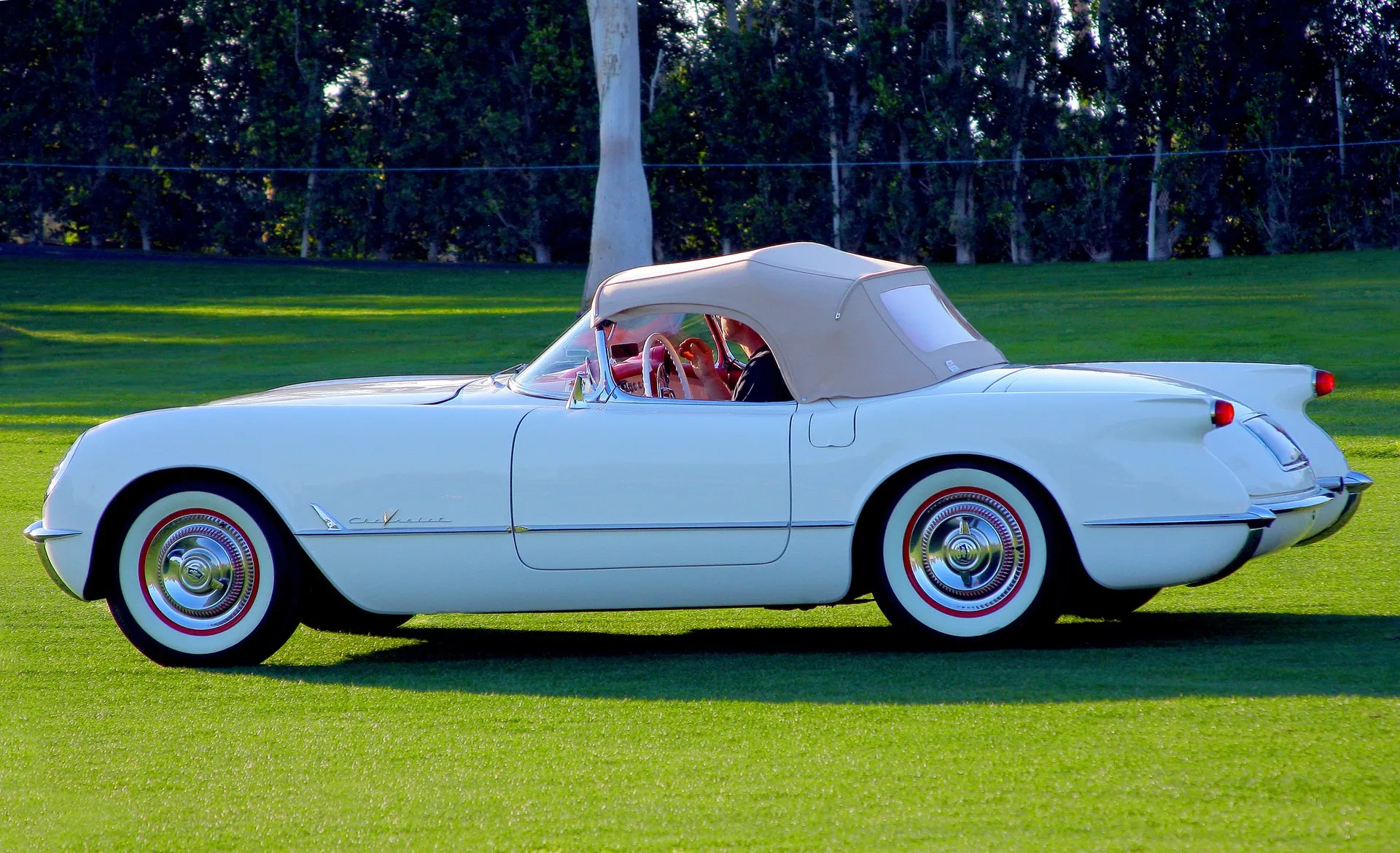
More than half the new Corvettes sold in 1955 were leftovers. An owners’ registry gave the generally accepted calendar-year figures in 1974: 1,639 Corvettes sold in 1955 and 700 built. Those 700 were the whole run of 1955 models, built January to December by the monthly serials in the Corvette Black Book, a hobby reference whose pages GM reprints in its Heritage Center kit. So at least 939 of the cars sold that year had been built before it. The Black Book counts more than 1,100 unsold 1954s on hand when 1955 production began.
That’s why the year that gave the C1 (1953–1962) its V8 is also one of the rarest Corvettes built. The 265 V8 came with 12-volt electrics and a gold V on each front fender, a handful of cars kept the six, and about 75 late V8s got a clutch pedal, by the Black Book’s estimate. Small as the run was, the Black Book counts it among the most mysterious Corvettes to document, so buying one is mostly a job of proving which of those cars you’re looking at.
- Built: 700, all roadsters, St. Louis, January to December 1955 (1955 kit, page 2).
- Engines: the V8 at 265 cu in, 195 hp gross, or the 235 six at 155 hp. Gross is the bare-engine rating GM gave every C1; its 1955 papers also give lower net figures, with accessories fitted.
- Price new: $2,774.00 six, $2,909.00 V8, sold as two models, plus $178.35 for the Powerglide automatic.
- Transmission: the Powerglide on nearly every car; a three-speed manual on about 75 (Black Book estimate), all V8s, all late.
- What one costs: Hagerty’s #3 (Good) value for the V8 was $99,900 (January 2026); three Bring a Trailer sales in the last year had a median of $81,500.
- A 1955 Stingray, convertible or hardtop? No Stingray: the name came with the C2 (1963–1967). Every 1955 is an open roadster, and no hardtop came from the factory.
Frames, rocker supports and fiberglass cracks are common to every early car: see the C1 buyer’s guide. The specs here come from GM’s 1955 kit in this site’s manual library, which holds Chevrolet’s own questionnaire and supplement beside the Black Book’s pages. Where a figure is the Black Book’s, this page says so.
C1 Key figures
- Built
- 700, all roadsters
- Price new
- $2,774.00 six, $2,909.00 V8
- V8
- 265 cu in, 195 hp gross
- Electrics
- 12 volts on V8 cars, 6 on sixes
- Three-speed cars
- about 75 (Black Book estimate)
- Hagerty #3, V8
- $99,900 (January 2026)
- Bring a Trailer median
- $81,500 (3 sales, 12 months to October 2026)
Section 01
Why only 700: leftover 1954s and a slow first half
St. Louis had built 3,640 Corvettes for 1954, all sixes with the Powerglide. With many still unsold, the base price fell to $2,774.00 on October 28, 1954 (1954 kit, page 4). The 1955 six kept exactly that price, and the V8 cost $135 more.
Outside, the 1955 “nearly duplicated” the previous two years, by the Black Book’s account, and with a lot full of 1954s the plant built it at a trickle. The Black Book lists the last serial built each month, and the gaps show the pace (1955 kit, page 2):
| Month, 1955 | Last serial | Cars that month (this site’s subtraction) |
|---|---|---|
| January | 001027 | 27 |
| February | 001110 | 83 |
| March | 001150 | 40 |
| April | 001200 | 50 |
| May | 001300 | 100 |
| June | 001389 | 89 |
| July | 001489 | 100 |
| August | 001555 | 66 |
| September | 001599 | 44 |
| October | 001634 | 35 |
| November | 001688 | 54 |
| December | 001700 | 12 |
Serials ran from 001001 to 001700, so car number 350, the midpoint, was built in June. The table dates any car from its serial, and it decides whether a claimed three-speed was built late enough to be one.
Only 1953’s 300 made a smaller Corvette year. No current survivor count exists, and the best one is old: by April 1, 1974, the International Registry of Early Corvettes had 177 1955s on its books, about a quarter of the build.
Section 02
Two models, two electrical systems
Chevrolet didn’t sell one car with an engine option. It sold model 2934-6, the six, and 2934-8, the V8, each with its own price (1955 kit, page 3). GM’s questionnaire of May 31, 1955 sets them side by side (page 6):
| Six | V8 | |
|---|---|---|
| Displacement | 235.5 cu in | 265 cu in |
| Bore and stroke | 3-9/16 x 3-15/16 in | 3-3/4 x 3 in |
| Compression | 8.0:1 | 8.0:1 |
| Gross power | 155 hp at 4,200 rpm | 195 hp at 5,000 rpm |
| Gross torque | 225 lb-ft at 2,800 | 260 lb-ft at 3,000 |
| Net power and torque | 140 hp, 212 lb-ft | 180 hp, 250 lb-ft |
| Fuel | Three side-draft carburetors | One Carter four-barrel |
| Electrics | 6-volt, 100 amp-hr battery | 12-volt, 50 amp-hr battery |
| Shipping weight, Powerglide | 2,695 lb | 2,665 lb |
The net figures, with the engine’s accessories fitted, come from Chevrolet’s Corvette supplement (page 35). It calls the V8 “basically the same as the Turbo-Fire-180 passenger car engine,” mechanical tappets and all, with the four-barrel from the passenger cars’ power package. The six was the Blue Flame engine of 1953 and 1954 (page 34).
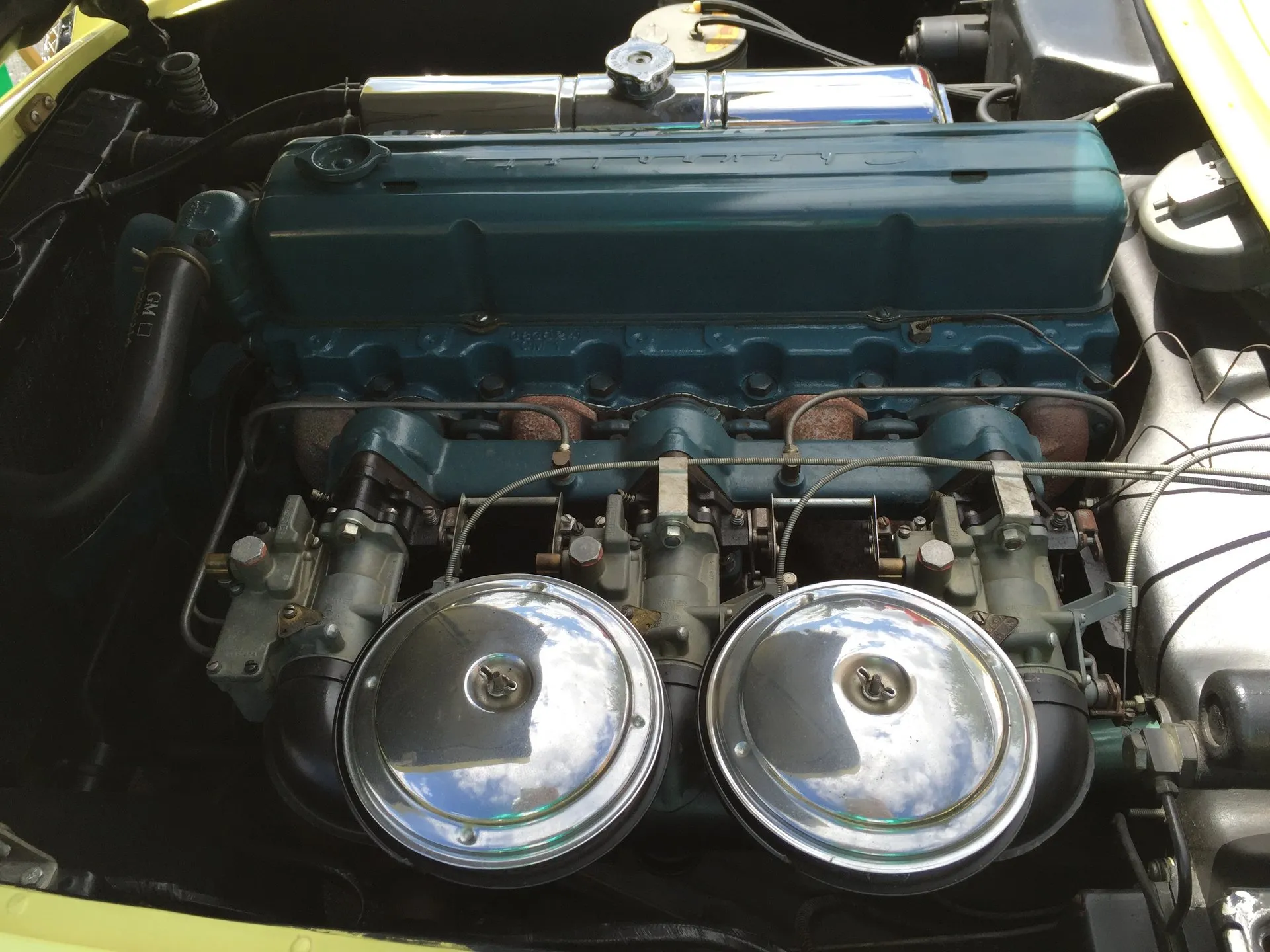
By GM’s own scales the V8 car was 30 lb lighter than the six, and 35 lb lighter at the curb (2,805 against 2,840 lb). Add 40 horsepower and the supplement’s figure drops from 20 lb per gross horsepower to 16. Road & Track’s July 1955 test, as Corvette Action Center reproduces it, got a V8 to 60 mph in 8.7 seconds and to 119.1 mph flat out.
The electrics split: 12 volts on V8 cars, 6 on sixes. Every 1954 ran six volts, so a 1955 V8 has its own generator (1102025, per the Black Book), starter and battery.
The rest of the chassis, per GM’s questionnaire: 102 in wheelbase, 167.00 in long, 72.24 in wide, 11 in drums at all four wheels with no booster, 6.70-15 tubeless tires and a 3.55:1 axle (page 20). The fuel tank held 17.25 gallons, by the supplement.
The gold V, and the other V8 differences
The Black Book describes the badge plainly: “an enlarged gold ‘V’” fixed over the small “v” in the Chevrolet script on both front fenders. Six-cylinder cars kept the plain script. The V8 got chrome valve covers with Chevrolet script, held by Phillips-head screws; the six kept the 1954 covers.
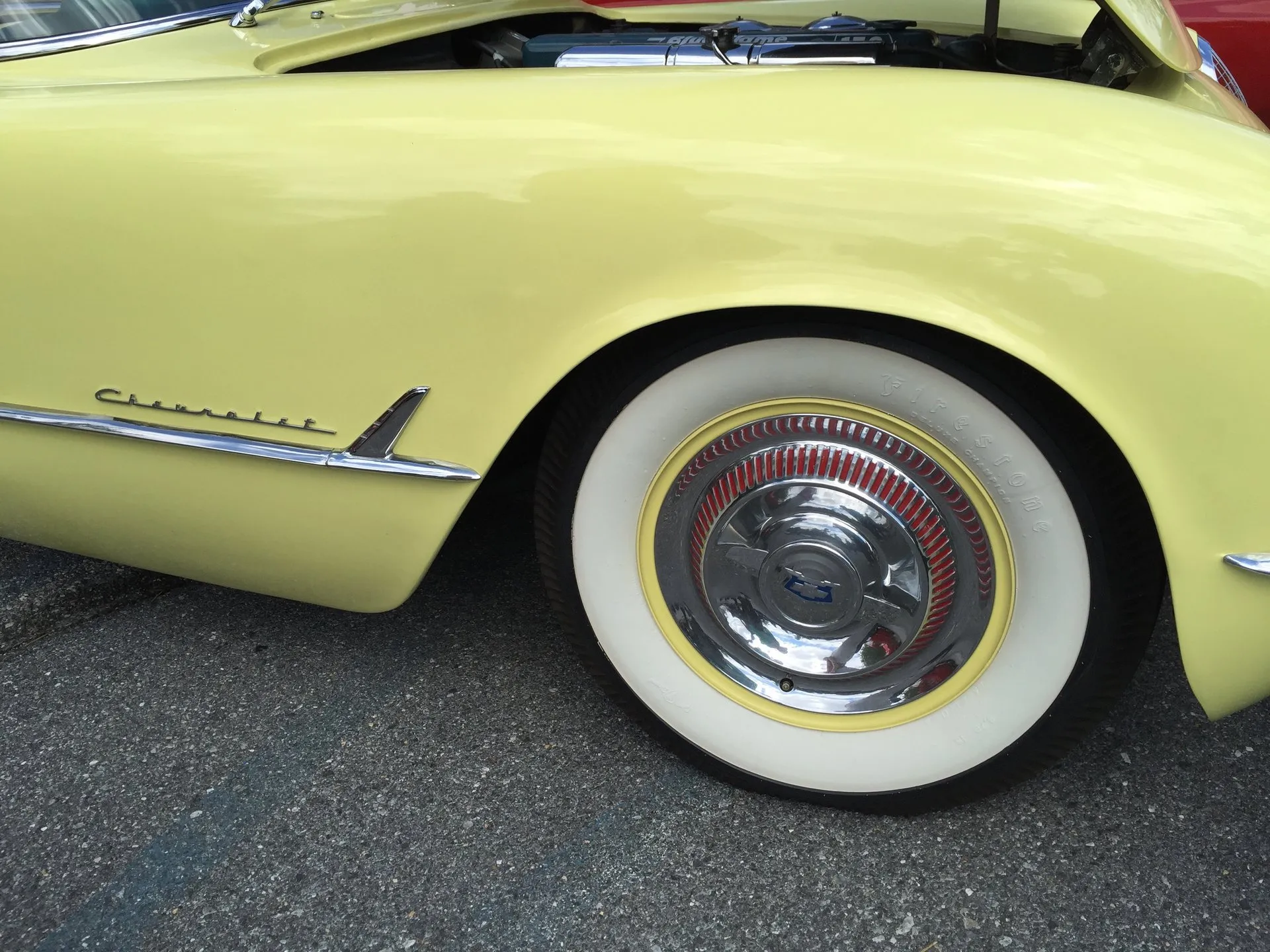
V8 serials start VE55S, with S for St. Louis. The supplement makes VE55S001001 the first unit (page 33). A six’s prefix is less settled: the Black Book says the V is omitted, while Chevrolet’s supplement prints “‘V’ for 6-Cyl”. Either way, a six never wore VE.
The Black Book gives the sixes only as “a small number,” and owners who have tried to count them have come up with a handful (CorvetteForum, 2010–2021). Every one had the Powerglide: the Black Book says no 1955 six with a manual transmission has ever been documented.
Section 03
Powerglide on paper, a three-speed by summer
Chevrolet’s own spring 1955 paperwork has no stick-shift Corvette in it. GM’s questionnaire dated May 31, 1955 lists the conventional transmission as “N.A.”, overdrive as “N.A.” and the automatic as “Standard,” and it says so twice (pages 6 and 17). Its clutch section is blank. Its only axle ratio is the automatic’s 3.55:1, and its only transmission is the Powerglide, GM’s two-speed automatic, with a 1.82:1 low (page 18). The supplement revised June 10 still gives engine codes for Powerglide cars only, and puts the selector on the floor to the right of the driver.
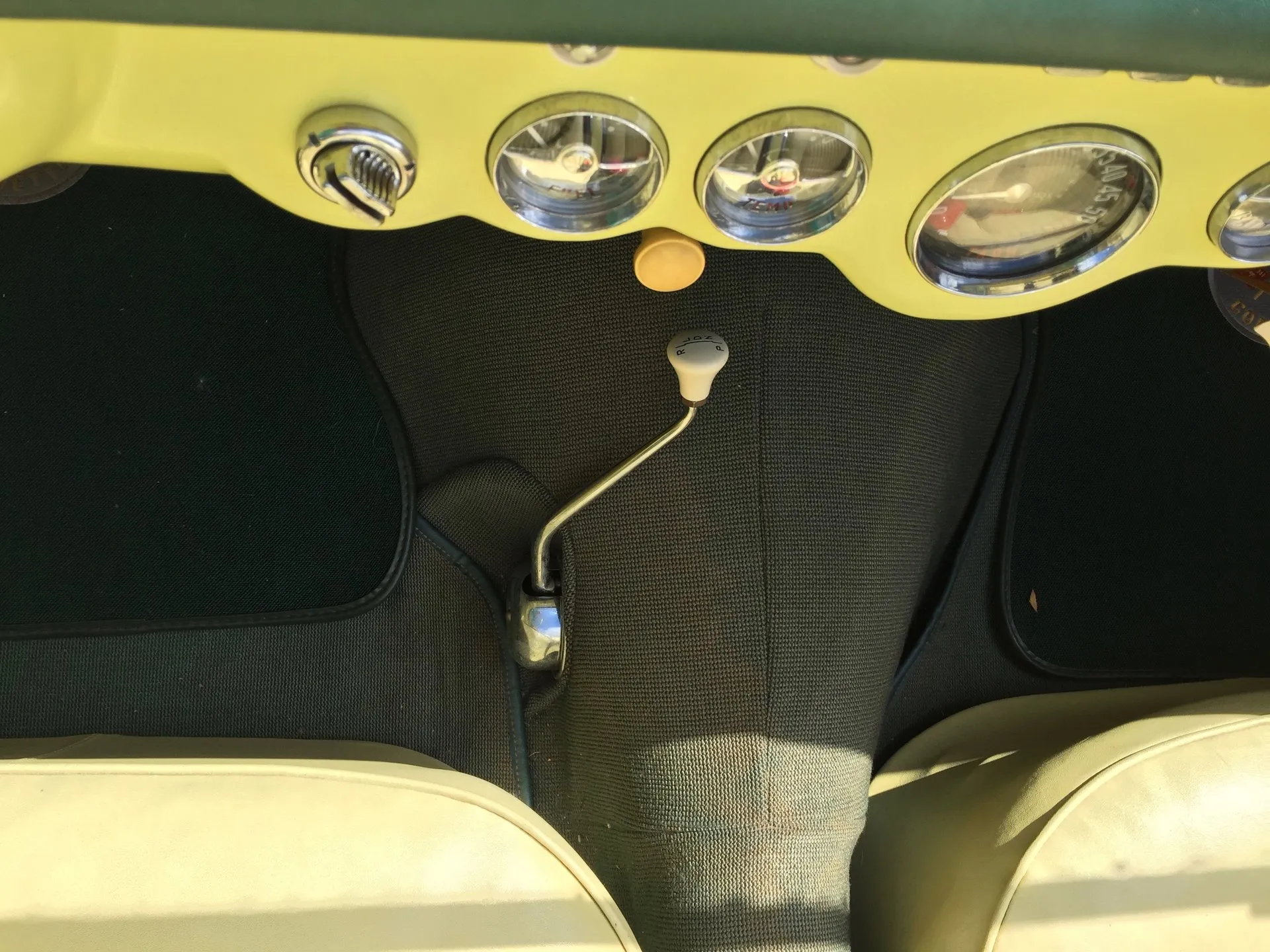
The Black Book fills in what came after. The base price “included” a three-speed manual on paper, but Powerglide was a required option with the V8 “until somewhere past the midpoint of 1955 production when the manual transmission started to be used” (page 3). It estimates about 75 manual cars, says records “support a total in the range of 70 to 80,” and gives the manual V8 its own engine suffix, GR.
The two accounts don’t clash. GM’s papers are dated May and June, and the midpoint, by the Black Book’s own monthly serials, falls in June. On the Black Book’s account, a real three-speed 1955 is a V8 with a serial from about 001350 up. But no GM document seen for this guide shows a manual 1955, so the 75 stays an estimate, and other counts run lower. Hagerty says “a few dozen.” One CorvetteForum poster who says he judged the 1953–1955 class at Bloomington Gold for 14 years guessed 20 to 30 at most, and he “never saw an original 55 3 speed car” (CorvetteForum, 2007 (opens in new tab)).
Owners have their own tells for a car converted later, none of them proof:
- The pedals. The same judge says a factory three-speed had brake and clutch pedals the same size, where an automatic car had the wider brake pedal. A wide brake pedal beside a clutch suggests a conversion; a second poster found one on a converted 1956.
- The gearbox. One poster says late 1955 and early 1956 Corvettes used a passenger-car three-speed with tailhousing #3722946, which had bosses for the floor shifter; another says the common passenger-car housing 3707195 lacks them (CorvetteForum, 2011).
- The engine pad. A GR suffix fits a factory manual V8. Stamps can be made, though, and the C1 guide explains how the National Corvette Restorers Society (NCRS) treats counterfeits.
Nothing moves the money on a 1955 like a three-speed: see the table in 1955 prices.
Section 04
What every 1955 had, and what none did
The order form carried six accessories, and the Black Book believes all 700 cars got every one (1955 kit, page 3). RPO, regular production option, is GM’s order code:
| Option | RPO | Price | Black Book count |
|---|---|---|---|
| Directional signals | 100 | $16.75 | 700 |
| Heater | 101 | $91.40 | 700 |
| Signal-seeking AM radio | 102A | $145.15 | 700 |
| Parking brake alarm | 420A | $5.65 | 700 |
| Courtesy lights | 421A | $4.05 | 700 |
| Windshield washers | 422A | $11.85 | 700 |
| Powerglide | 313 | $178.35 | Not recorded |
| Whitewall tires, 6.70x15 | 290B | $26.90 | Not recorded |
Add it up and a V8 with the Powerglide and the six accessories listed at $3,362.20, a six at $3,227.20, before whitewalls (this site’s arithmetic). The heater only recirculated cabin air, and the washer worked by a floor pedal.
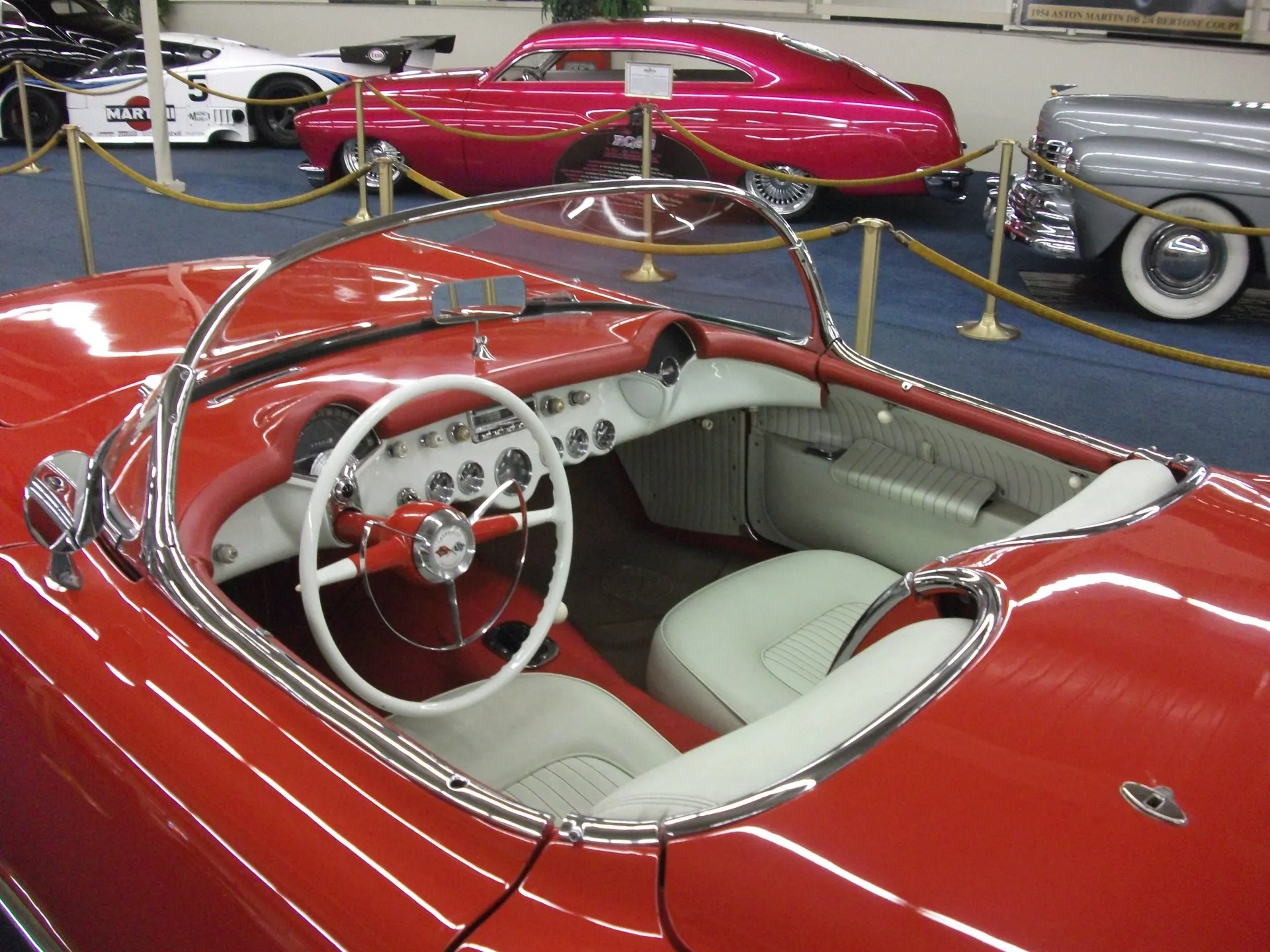
What no 1955 had:
- Roll-up windows or outside door handles. GM’s supplement describes side windows in chrome frames that snapped into slots in the doors and rode in the luggage compartment when not in use.
- A factory hardtop. The Black Book says Chevrolet offered none for 1955, though some dealers sold aftermarket hardtops for 1953–1955. Hagerty’s 1955 page lists an “Auxiliary Hard Top” as optional equipment; GM’s pages don’t.
- A power top. GM lists a manually folding top. Early tops were canvas, then a vinyl-coated fabric arrived and both were used; white tops were all vinyl.
Section 05
Five colors, four on GM’s June list
Chevrolet didn’t keep color counts for 1955, and it didn’t code colors to individual cars. The Black Book’s figures are estimates, and it says they “should not be relied upon as precise” (1955 kit, page 3):
| Color | Black Book estimate | Top | Wheels | Interior |
|---|---|---|---|---|
| Polo White | 325 | White or beige | Red | Red |
| Gypsy Red | 180 | White or beige | Red | Light beige |
| Harvest Gold | 120 | Dark green | Yellow | Yellow |
| Pennant Blue | 45 | Beige | Red | Dark beige |
| Corvette Copper | 15 | White | Bronze | Dark beige |
Those estimates add up to 685, not 700. Pennant Blue was dropped in April 1955, the Black Book says, and Chevrolet’s color list revised June 10 names only the other four (page 33). The Black Book thinks Gypsy Red and Copper came after Pennant Blue left; owners point to Copper claims among much earlier serials, so treat its timing as a belief, not a record.
The early-1970s registry’s sample ranks them the same way: Polo White 47.2 percent, Gypsy Red about 26 percent and Harvest Gold about 21 percent across their interior choices, Pennant Blue sixth of seven combinations and Copper 1.9 percent, “the rarest.” One CorvetteForum poster has listed 26 cars painted Copper or claimed to have been, against the Black Book’s 15 (2018–2026). Another expects more claims, “just like all the three speed 55 out there that never was a three speed.” A Copper 1955 needs the same paper a three-speed does.
Section 06
Reading a 1955: serial, badge, engine pad and paper
Telling it from a 1953 or 1954. A V8 with the gold V and a VE55S serial can’t be either; neither year had a V8 or 12 volts. A six is harder, because it wears the same plain script and six-volt system as a 1954. The serial settles it: 1954s run E54S001001 to E54S004640 (1954 kit, page 2), and a 1955 carries 55 in the same place. Neither Harvest Gold nor Gypsy Red is on a 1954 color list in GM’s kit.
The engine. The Black Book lists the suffix codes: FG for the V8 with Powerglide, GR for the V8 with the manual, YG for the six. The 265 block casting is 3703524 with heads 3703523; the six’s block is 3835911 with heads 3836241. A 1956 used FG and GR too, on its 225 hp 265 with a different block casting (see the 1956 guide), so read the code with the casting. Ten V8 stamps sampled by the registry all ended in F55FG, and it found the 1955 engine numbers the least consistent with the car serials of any early year.
The swaps. The International Registry of Early Corvettes (opens in new tab), surveying owners in 1973, found only 41 percent of the 163 registered 1955s still had their original engine. Another 41 percent had a replacement V8, 2 percent a replacement six, 6 percent no engine at all and 10 percent didn’t know. That was the lowest original-engine share of the three early years (64 percent for 1953, 56 for 1954). It’s an owners’ survey, not GM’s records, but the point is plain: on a 1955, the original engine was already the exception by 1973.
Sixes turned V8s, and paper. Some 1955s were converted to V8s later, one Corvette Action Center forum poster said in 2003: a six-cylinder serial under a V8 and a gold V is a converted six, the rarer car. Another poster in that thread calls 1955 the year with “the least documentation.” No 1955 has a trim tag, so the proof is a dealer invoice, a registry history, NCRS judging sheets or a documented line of owners. Price the car on the paper that exists.
Section 07
Service bulletins for 1955, and an empty NHTSA file
Most of what Chevrolet wrote about 1955 problems went to every Chevrolet dealer, because the Corvette V8 was a passenger-car engine. Corvette Action Center files these bulletins under the 1955 Corvette and transcribes them; the originals weren’t seen for this guide.
- Oil use and smoke on early V8s. Bulletin 55-4 (opens in new tab), November 23, 1954, reported “excessive oil consumption and smoking on early 1955 Chevrolet V8’s.” The fix was valve stem oil shields (
GM 3836755, OEM), plus a revised oil ring (GM 3719631, OEM) if the rings came out. - Radio interference on V8 Corvettes. Chevrolet’s Wichita zone told its dealers on May 20, 1955 (opens in new tab) to fit two braided ground straps from the front engine mount to the frame, two more from the tail pipe U-bolt to the frame, and a condenser at the headlight switch. Whether 1955 V8 ignitions were shielded is unsettled: the Black Book describes chrome distributor and coil covers, while Chevrolet’s June 10 supplement calls them “Unshielded.”
- A fuel gauge that read three-quarters on a full tank. DR-195, February 8, 1955: a new gauge unit (
GM 1518407, OEM) went into production about January 14, 1955. - A temperature gauge that read cool, then hot. DR-222, October 13, 1955: after “running cool” complaints on early V8s, the gauge was recalibrated, which brought complaints of overheating on later cars with no water loss. The new gauge was
GM 1513145(OEM). - A six-cylinder Powerglide that held first too long. DR-192, January 31, 1955: a new throttle valve lever and rod brought the part-throttle upshift down from 25–28 mph to 12–18 mph.
- A flasher socket that could short. DR-180, November 3, 1954: “All early 1955 Cars should be checked.”
NHTSA, the US road safety agency, lists no owner complaints (opens in new tab) and no recalls for the 1955 Corvette (checked October 22, 2026). Its complaint file starts in 1994, so the empty result says nothing about the car. Frame rust and body cracks are in the C1 guide.
Section 08
Checking a 1955 before money changes hands
- The serial, against the month. Find it in the monthly table in Why only 700: it dates the build and tests any three-speed claim.
- Badge, serial, pad and block agree. A gold V goes with a VE55S serial, 12 volts, an FG or GR pad and block 3703524; a plain script with six volts, YG and block 3835911. Ask about any painted-over or decked pad.
- The original engine. With the registry’s 41 percent in mind, ask for proof. A replacement 265 isn’t a dealbreaker; it’s a price point.
- A claimed three-speed. A V8, a serial from about the midpoint on, matching pedal widths, the right tailhousing and paper. Without paper, price it as a Powerglide car with a conversion.
- A claimed color. Copper especially. The counts are estimates, and nothing on the car records its color.
- Gauges and electrics. Sensible fuel and temperature readings, a radio that stays quiet with the engine running, charging matched to the engine’s voltage.
- Side curtains, top and hardtop. Curtains present and fitting, a top color that suits the paint, and any hardtop priced as aftermarket.
- The frame and body, by the C1 guide’s checklist, then an inspection by someone who knows early Corvettes, ideally an NCRS judge.
Section 09
1955 prices: Hagerty, Bring a Trailer and the three-speed premium
Hagerty’s price guide (opens in new tab), as archived on January 23, 2026, values a 1955 by engine in #3 (Good) condition: $72,200 for the six and $99,900 for the V8. The plain average, $86,050, is the figure the C1 guide gives for 1955.
On Bring a Trailer, three 1955s sold in the 12 months to October 22, 2026, all in 2026, all Powerglide V8s, and none went unsold. The median: $81,500 (3 sales, 12 months to October 2026), by this site’s calculation, and a sample that small needs reading car by car:
- $90,500 (September 8): car 553, refurbished in Gypsy Red over light beige around 1990, engine and transmission overhauled then.
- $81,500 (February 2): car 462, refinished white over red, its 265 and Powerglide rebuilt between 2016 and 2019.
- $77,605 (March 29): car 519, a former race car by a previous owner’s notes, with a replacement 265 per the listing.
Over the longer run, Bring a Trailer (opens in new tab) has listed 22 production 1955s since November 2016, and 12 sold at a median of $94,750, from $62,500 to $243,000. No six-cylinder 1955 has been listed there.
The three-speed premium. Five listings put “3-Speed” in the title. Top Flight, in the table, is the NCRS award for a car that scores at least 94 percent in judging against how it left the factory:
| Date | Result | What the listing claimed |
|---|---|---|
| February 2021 | Sold, $76,000 | Repainted in the 1960s, stored for nearly five decades; no claim the gearbox was factory |
| September 2021 | Sold, $209,000 | Built in June 1955, believed by the seller to be a factory test car for the three-speed; NCRS Top Flight |
| October 2021 | Sold, $243,000 | Gypsy Red, a regional NCRS Top Flight award, a GR-stamped engine pad |
| November 2022 | Bid to $201,955, unsold | Harvest Gold, described by the seller as one of 75 factory three-speeds; NCRS Top Flight and other awards |
| October 2024 | Bid to $70,000, unsold | Car 244, built in May by the monthly table; no claim the gearbox was factory |
The two six-figure sales came with NCRS awards and sellers’ claims, not a GM document, and buyers paid more than twice the $90,500 median of the other 1955s sold there. Car 244 shows the other side: a serial from before the midpoint, no factory claim, and bidding stopped at $70,000. The money follows the proof.
Section 10
From 1954 to 1956: the year in between
The year before, every Corvette was a six with six volts and a Powerglide, in Polo White or Pennant Blue on GM’s list (1954 kit, page 8); the 1953 guide covers the first 300.
The year after, the body changed. The 1956 got roll-up windows, outside door handles, exposed headlights, side coves and Chevrolet’s first factory hardtop, on 2,076 cars. The six was gone, the 265 made 210 or 225 hp, a three-speed manual became standard and the Powerglide optional, and production rose to 3,467 at $3,120.00 (1956 kit, page 4). So the 1955 is the only Corvette with the first body and a V8, and the last with a six.
Section 11
The verdict: a Powerglide V8, bought on its serial
The 1955 to buy is a V8 with the Powerglide, the car almost every buyer got: gold V, VE55S serial, 12 volts and a 265 that’s either original or honestly described. That’s the year as it really was, the first body with the first V8, and recent sales put a good one near Bring a Trailer’s $81,500 median, below Hagerty’s $99,900. Pay extra for a documented original engine; fewer than half had one even by 1973.
A six is for the collector who wants the rarest drivetrain and can prove it, with a serial, an engine pad and paper that agree. Hagerty values the six below the V8, so the rarity doesn’t buy a premium on paper.
Buy a three-speed only with documents, and price it on them. Six figures went to three-speeds with NCRS awards and strong stories; without paper, a 1955 with a clutch pedal is a Powerglide car somebody improved. Skip any car whose badge, serial and engine tell three different stories.
Get it right and you own the first V8 in the history of America’s sports car, one of 700 built in a year when most buyers still went home in a leftover.
Section 12
Sources
- GM Heritage Center: 1955 Corvette vehicle information kit files.zipcorvette.com This site's library. Corvette Black Book pages reproduced by GM: PDF pages 2 (serials, codes, monthly production, facts) and 3 (prices, options, color estimates). GM's AMA specification questionnaire, May 31, 1955: PDF pages 6–30. Chevrolet's 1955 Corvette supplement, revised June 10, 1955: PDF pages 32–37.
- GM Heritage Center: 1954 Corvette vehicle information kit files.zipcorvette.com PDF pages 2 and 4 (Black Book: 1954 production and the October 28, 1954 price) and 8 (GM's 1954 supplement).
- GM Heritage Center: 1956 Corvette vehicle information kit files.zipcorvette.com What changed for 1956: PDF pages 2 and 4.
- Corvette Action Center: International Registry of Early Corvettes reports (opens in new tab) corvetteactioncenter.com Owners' registry, Reports 1 to 3 (data to September 1, 1973, January 1, 1974 and April 1, 1974): registered 1955s, original engines, engine stamps, calendar-year sales and colors.
- Corvette Action Center: 1955 Corvette production and options (opens in new tab) corvetteactioncenter.com Cross-check of codes and prices; reproduces Road & Track's July 1955 test figures.
- Corvette Action Center: Chevrolet bulletin 55-4, 1955 V8 engines, November 23, 1954 (opens in new tab) corvetteactioncenter.com As transcribed. Passenger-car bulletin.
- Corvette Action Center: Chevrolet zone bulletin, V-8 Corvette radio interference, May 20, 1955 (opens in new tab) corvetteactioncenter.com Wichita zone. As transcribed.
- Corvette Action Center: Chevrolet bulletin DR-195, new gasoline gauge, February 8, 1955 (opens in new tab) corvetteactioncenter.com
- Corvette Action Center: Chevrolet bulletin DR-222, new temperature gauge, October 13, 1955 (opens in new tab) corvetteactioncenter.com
- Corvette Action Center: Chevrolet bulletin DR-192, upshift at part throttle, January 31, 1955 (opens in new tab) corvetteactioncenter.com
- Corvette Action Center: Chevrolet bulletin DR-180, directional signal flasher socket, November 3, 1954 (opens in new tab) corvetteactioncenter.com
- NHTSA owner complaints, 1955 Chevrolet Corvette (opens in new tab) api.nhtsa.gov Pulled 2026-10-22: none. NHTSA's complaint file begins in 1994.
- NHTSA recalls, 1955 Chevrolet Corvette (opens in new tab) api.nhtsa.gov Pulled 2026-10-22: none.
- NCRS: judging awards (opens in new tab) ncrs.org Top Flight (94 percent of the judging points) and NCRS's definition of counterfeiting, as cited on this site's C1 guide.
- Hagerty Price Guide: 1953–1962 Chevrolet Corvette (opens in new tab) web.archive.org Internet Archive copy of January 23, 2026; #3 (Good) values by engine.
- Hagerty: 1955 Chevrolet Corvette (opens in new tab) web.archive.org Internet Archive copy of August 12, 2025. Its equipment list includes a hardtop; none came from the factory.
- Bring a Trailer: Chevrolet Corvette C1 results (opens in new tab) bringatrailer.com 1955 listings since November 2016; sales from October 23, 2025 to October 22, 2026. Medians are this site's calculation from each listing's sold price.
- CorvetteForum thread: 1955 Corvette original manual transmission (opens in new tab) corvetteforum.com January–February 2007.
- CorvetteForum thread: 3-speed transmissions (opens in new tab) corvetteforum.com 2011.
- CorvetteForum thread: 1955 Corvette Copper cars (opens in new tab) corvetteforum.com 2018–2026.
- CorvetteForum thread: 1955 six-cylinder serial numbers (opens in new tab) corvetteforum.com 2010–2021.
- Corvette Action Center forum thread: the first V8 Corvette (opens in new tab) forums.corvetteactioncenter.com December 2003.