C1 · Buying guide
1960 Corvette guide: engines, options, the serial plate that moved, and 2026 prices
Published
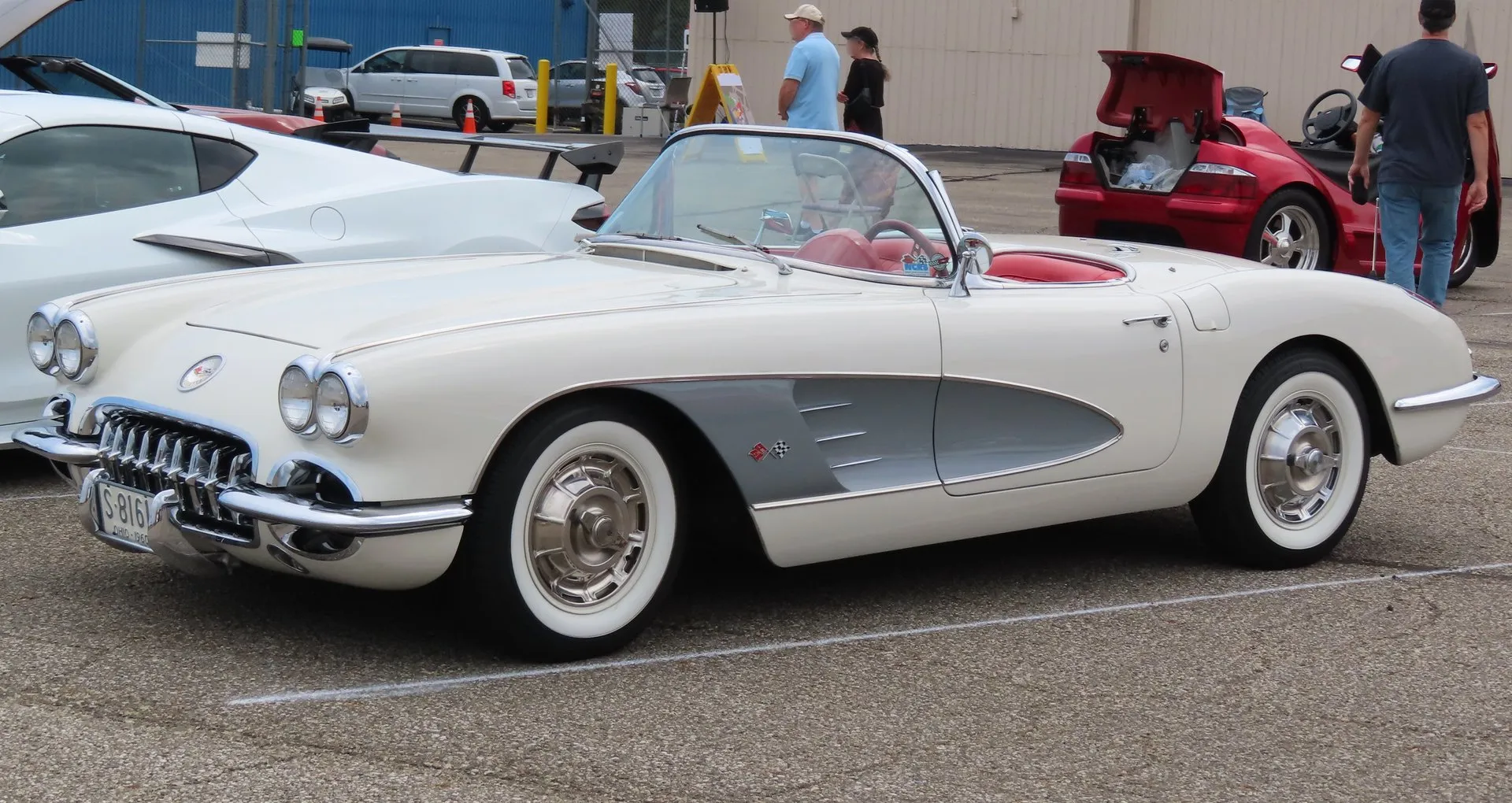
A 1960 Corvette’s serial plate can turn up in two places, and either one can be right. GM’s specification page for the 1960 body, issued in July 1959, puts the serial number on the driver’s door hinge pillar, where owners of early cars report plates held on with screws. Around the 1,400th to 1,650th car, by owners’ reckoning, the plate moved under the hood and was spot-welded to the steering column. Know only one of those spots and you can walk away from a good car, or pay up for a bad one.
It’s a car of small differences. A 1960 looks almost exactly like a 1959; what changed is underneath and in the paperwork, and in places GM’s own pages don’t agree with each other. GM’s spec sheets even advertised two fuel-injected engines that no record shows reaching a customer. It was the first Corvette year past 10,000 cars and the last C1 (1953–1962) with taillights set into rounded rear fenders and a grille full of chrome teeth. Know where to look and you can buy the last round-tailed version of America’s sports car on facts, not on a seller’s word.
- Built: 10,261, all convertibles. 5,147 left with the optional hardtop, 1,641 of them in place of the soft top.
- Engines: a 283 V8, 230 to 290 hp in five versions, two of them fuel-injected (859 cars). GM also advertised 275 and 315 hp fuel injection with aluminum heads; no delivery of either to a customer has been confirmed.
- Price new: $3,872, three dollars less than a 1959.
- What one costs: Hagerty’s #3 (Good) average was $81,460 (January 2026), from $63,100 for the base 230 hp car to $113,000 for the 290 hp fuel-injected car, or fuelie. 1960s sold on Bring a Trailer from January 1 to October 17, 2026 brought a median of $72,000 (10 sales).
- A 1960 Sting Ray? There wasn’t one. The name reached a production Corvette with the C2 (1963–1967). In 1960 it belonged to Bill Mitchell’s Stingray racer, which won an SCCA national championship (opens in new tab) that year with Dick Thompson driving.
The C1 buyer’s guide has the generation-wide story: frames, rocker supports, fiberglass, how fake fuelies get made, and the other nine years. Everything from here on is 1960 only.
C1 Key figures
- Built
- 10,261, all convertibles
- Engines delivered
- 230 to 290 hp in five versions
- Advertised only
- 275 and 315 hp fuel injection with aluminum heads
- Fuel-injected cars
- 859
- Price new
- $3,872
- Hagerty #3 average
- $81,460 (January 2026)
- Bring a Trailer, 2026
- $72,000 (10 sales)
Section 01
What changed for 1960, and what didn’t
Chevrolet built 10,261 Corvettes for 1960 in St. Louis, every one a two-seat convertible. The count comes from the production page in GM’s 1960 kit, part of this site’s manual library: a page from the Corvette Black Book, a Corvette reference whose pages GM reproduced in the kit beside its own specifications. GM’s heritage collection calls it the most Corvettes built in any year to that point. That June, Corvettes ran at Le Mans for the first time, and the car John Fitch and Bob Grossman shared finished eighth overall and won its class, the race’s organizer records (opens in new tab).
Lay GM’s 1960 pages beside its 1959 ones and this is what moved:
- A rear stabilizer bar. GM’s 1960 chassis data lists a .625 in rear bar; its 1959 page lists the rear stabilizer as “None” (1959 kit). That’s GM’s specification, not proof that every car has one: look underneath.
- A heavier front bar, by most accounts. Hagerty (opens in new tab) and owners describe a stronger front bar, and two owners say it runs straight across where 1959’s was notched or offset (CorvetteForum, 2010; Corvette Action Center forum, 2002). GM’s own 1960 pages disagree on its size: the Corvette supplement lists .8125 in, the size of 1959’s heavy-duty bar, while the specification form repeats 1959’s regular .67–.70 in (1960 kit; 1959 kit). This guide can’t settle it.
- Aluminum radiators, the first on a Corvette, on the two special-camshaft engines, the 270 and 290 hp (GM’s data).
- Fuel injection with a manual only. 1959 sold a 250 hp fuelie with a Powerglide. Every 1960 fuelie was a manual, and the Powerglide came only with the 230 and 245 hp engines (1960 kit).
- RPO 687 in place of RPO 684. 1959’s heavy-duty package, regular production option (RPO) 684 at $425.05 on 142 cars, had stiffer springs and the heavier front bar. 1960’s heavy-duty brakes and steering, RPO 687 at $333.60 on 119 cars, dropped the springs and kept special shocks, sintered linings, finned and fan-cooled drums with air scoops, and quick steering: 3.25 turns lock to lock instead of 3.7. It required the 270 or 290 hp engine, Positraction (Chevrolet’s limited-slip axle) and a manual.
- Body-color wheels. GM’s 1960 color chart lists the wheels with the body color (1960 kit), where the Black Book’s 1959 table gives black wheels for every color (1959 kit). Full wheel covers usually hide them.
- Six new color names, all but Tuxedo Black and Roman Red.
- A little cheaper, a little lighter. $3,872.00 against $3,875.00, and GM’s curb weights fell to 2,985 lb with the three-speed and 3,090 lb with the Powerglide, from 3,033 lb and 3,135 lb (1960 kit; 1959 kit).
What didn’t change: the body, the quad headlights, the toothed grille and the rounded tail, the 102 in wheelbase, the drum brakes, the three carbureted ratings and the 16.4 gallon tank. Hagerty calls the 1960 visually unchanged.
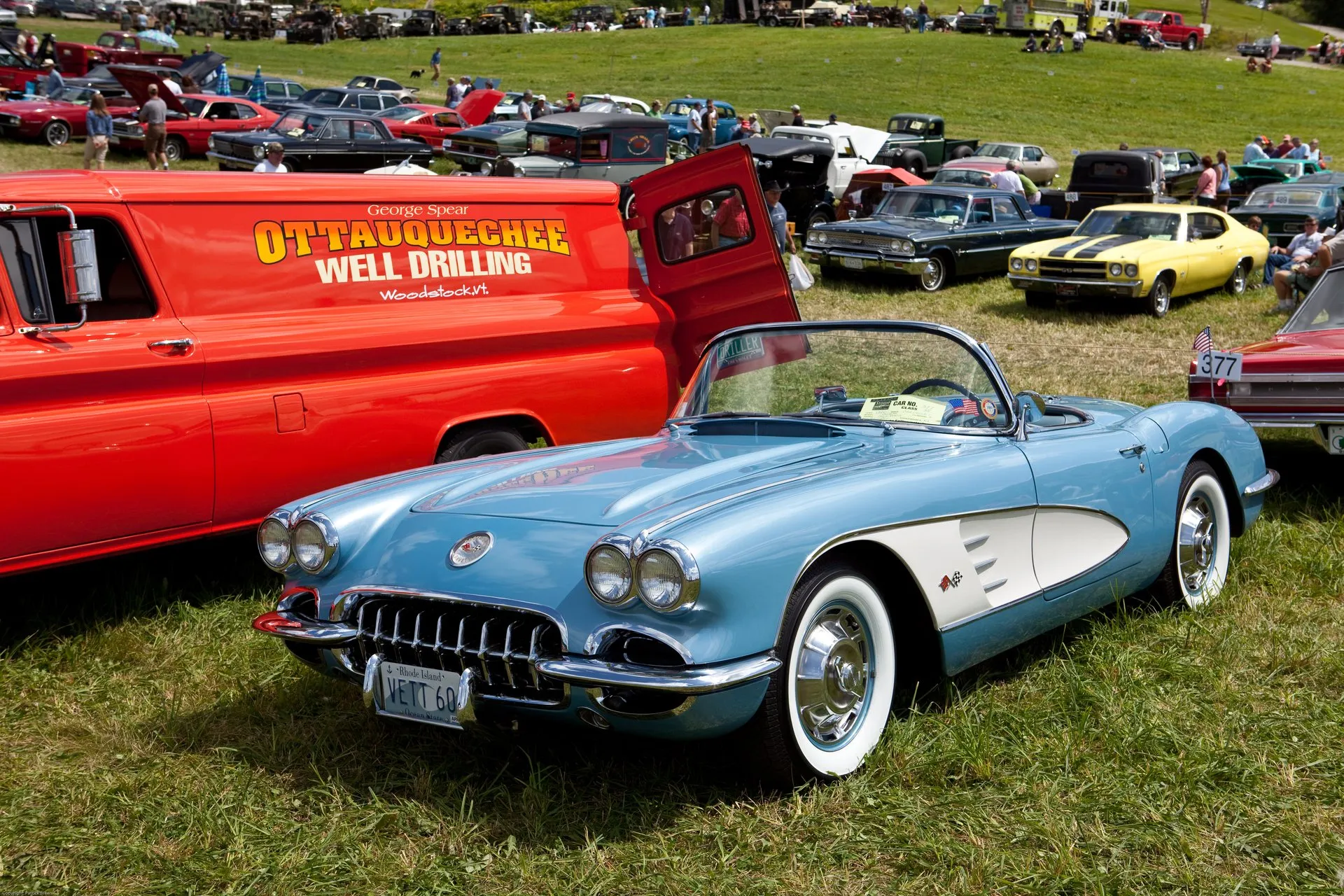
Owners point to (opens in new tab) small interior tells: seat pleats sewn front to back (side to side on a 1959), a raised lip on the door end caps, and small red and blue bars above and below the Corvette script by the passenger grab bar (CorvetteForum, 2010–2017). Interiors get swapped and restored, so the serial number is what settles it.
Section 02
The last rounded tail, and what 1961 changed
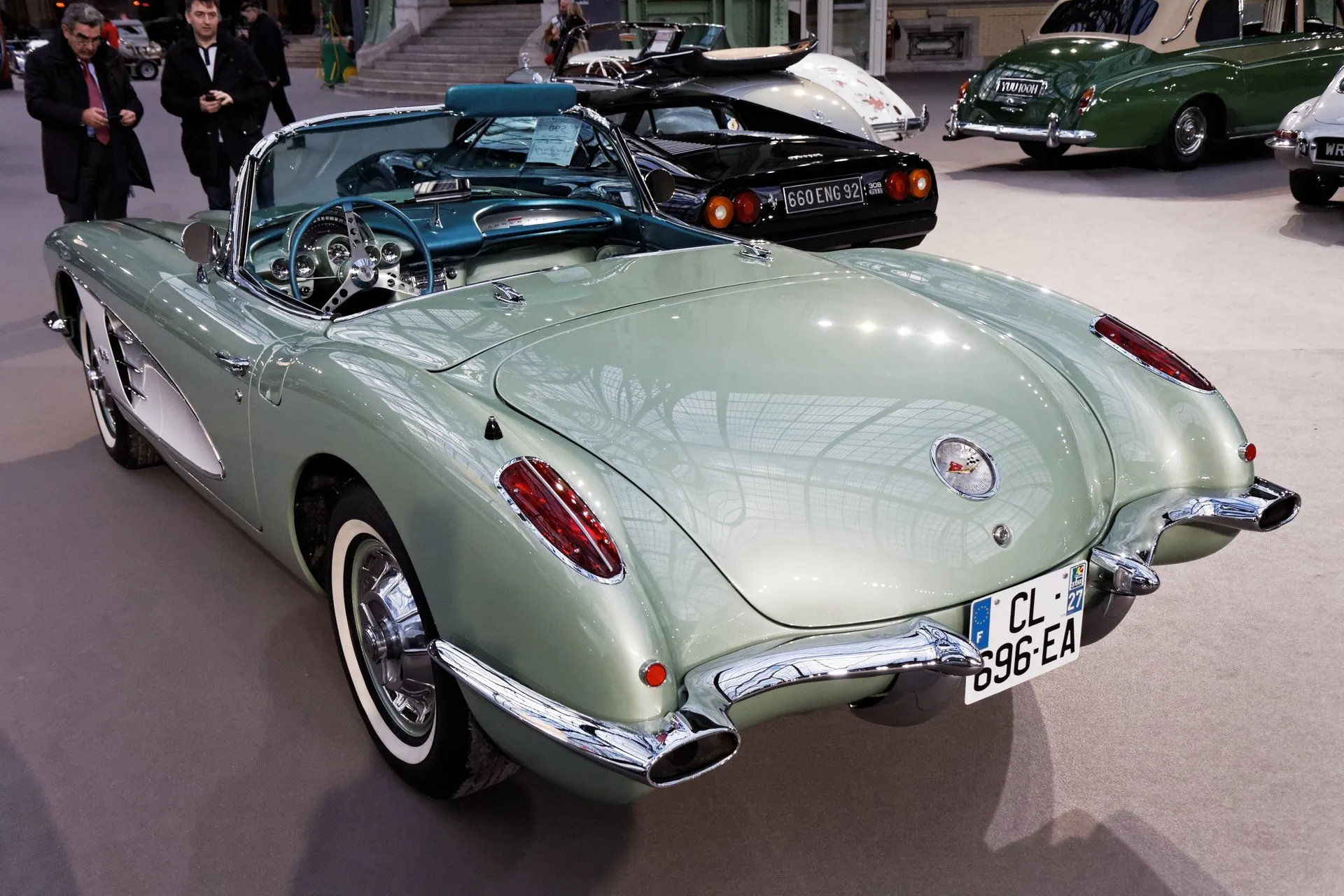
The Black Book page in GM’s kit calls 1960 the last year for taillights formed into the rounded rear fenders, and the last with the heavy grille teeth. The 1958–1960 look ended here.
For 1961, Chevrolet restyled the rear with four taillights and dropped the grille teeth. The exhaust moved under the body, the transmission tunnel got 20 percent narrower, and washers, sunshades, a courtesy light and a temperature-controlled fan became standard. Fuel injection finally made 275 and 315 hp, on iron heads. A 1961 cost $3,934 (1961 kit).
Between the two, it comes down to the tail and the fuelie. A 1960 is the newest Corvette with the rounded tail and the exhaust through the bumper; a 1961 has the narrower tunnel, more standard equipment and a 315 hp fuelie you could actually buy, and the C1 guide rates 1961–1962 as the drivers’ pick.
Section 03
The 1960 engines: five delivered, two only on paper
Every 1960 has a 283 cu in V8, and the Black Book lists one block casting, 3756519, and one head casting, 3774692, for all of them. Ratings are gross, not the net figures GM used from 1972.
| Engine | RPO and price | Fuel and cam | Rating, gross | Suffix code | Built |
|---|---|---|---|---|---|
| 230 hp | Standard | One four-barrel, hydraulic lifters | 230 hp at 4,800 rpm, 300 lb-ft at 3,000 | CQ manual, DG Powerglide | About 5,827 |
| 245 hp | 469, $150.65 | Two four-barrels, hydraulic lifters | 245 hp at 5,000 rpm, 300 lb-ft at 3,800 | CT manual, DJ Powerglide | 1,211 |
| 270 hp | 469C, $182.95 | Two four-barrels, special cam, mechanical lifters | 270 hp at 6,000 rpm, 285 lb-ft at 4,200 | CU, manual only | 2,364 |
| 250 hp fuel injection | 579, $484.20 | Rochester fuel injection | 250 hp | CR, manual only | 100 |
| 290 hp fuel injection | 579D, $484.20 | Rochester fuel injection, special cam | 290 hp | CS, manual only | 759 |
| 275 hp fuel injection, aluminum heads | Advertised under 579 | Rochester fuel injection, 11.0:1 compression | 275 hp at 5,200 rpm, 305 lb-ft at 4,400 | CY, assigned | None confirmed |
| 315 hp fuel injection, aluminum heads | Advertised under 579 | Rochester fuel injection, special cam, 11.0:1 compression | 315 hp at 6,200 rpm, 295 lb-ft at 4,700–5,100 | CZ, assigned | None confirmed |
The carbureted ratings and the two advertised fuelies’ figures come from GM’s advertised performance page. The delivered fuelies’ 250 and 290 hp come from the Black Book, which gives no rpm for them. Suffixes are from GM’s engine identification list and the Black Book. The 230 hp count is this site’s subtraction.
The fuelies GM advertised
GM’s October 1959 specification pages list two fuel-injected engines, 275 and 315 hp, both at 11.0:1 compression with cast aluminum heads, and a power-team page revised in February 1960 still names them (1960 kit). The Black Book page in the same kit lists 100 cars at 250 hp and 759 at 290 hp, 1959’s ratings. It says the codes CY and CZ were assigned to aluminum-head versions, and that delivery of a factory aluminum-head 1960 to a retail customer has not been confirmed.
GM’s kit doesn’t say why. Hagerty’s 1960 page says the heads tended to crack and warp in testing. A long-time Corvette Action Center member (opens in new tab), writing in 2001 and citing a 1961 Chevrolet letter this guide couldn’t check, says they cracked between the valve seats, that a few engines went to GM’s Warren Tech Center, and that none left St. Louis in a car.
For 1961, 275 and 315 hp became real on iron heads, though GM’s 1961 data still listed CY and CZ as aluminum-head codes (1961 kit). So a 1960 sold as “315 hp” is being sold off a spec sheet, and CY or CZ on a 1960’s engine pad calls for hard questions, not a premium. No 1960 GM page gives the delivered fuelies’ torque or compression.
Carburetors, gearboxes and axles
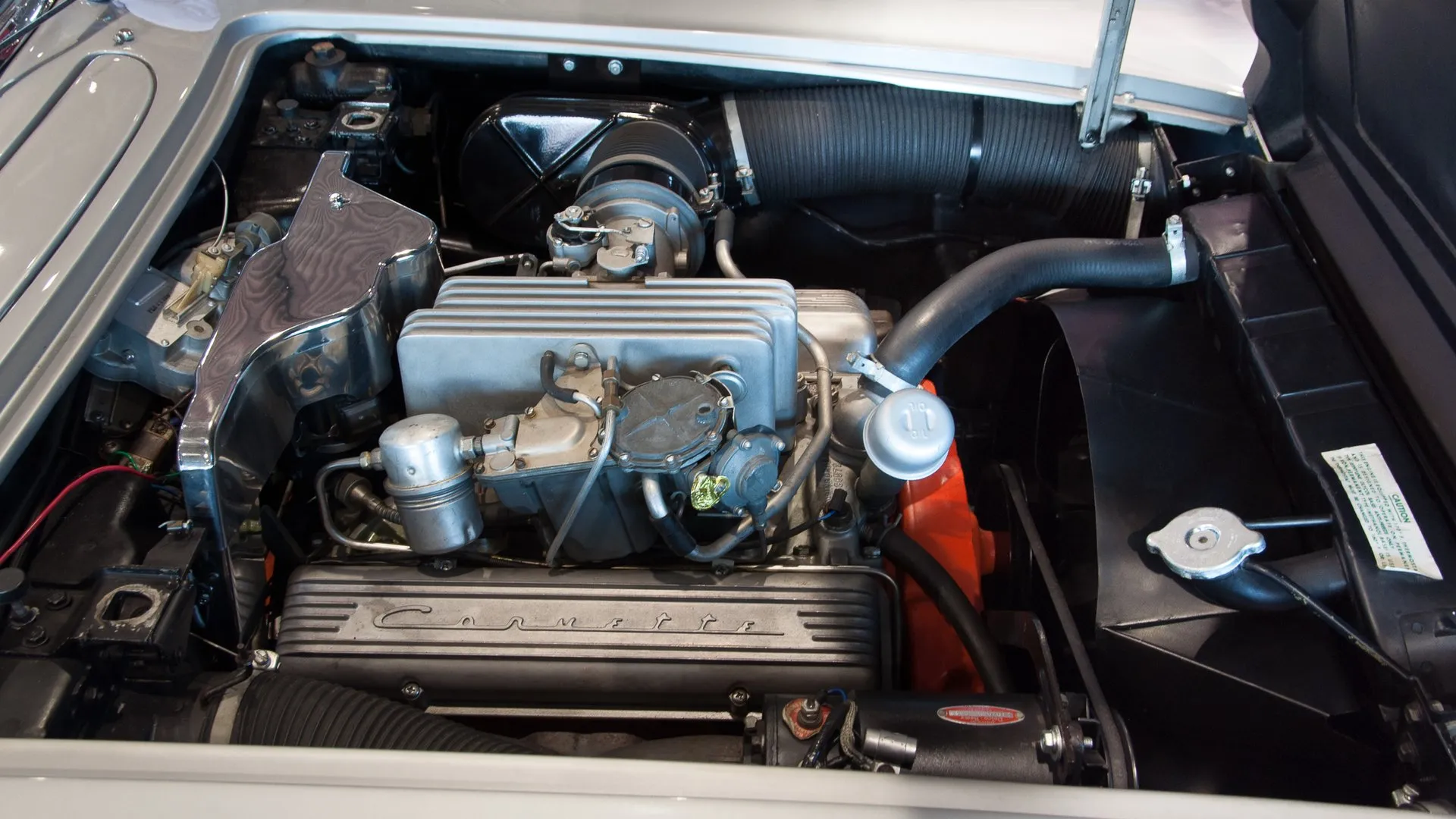
The 230 hp base engine ran one four-barrel under painted steel valve covers; every optional engine got seven-fin cast alloy covers. Both dual-quad engines (two four-barrels) had an aluminum intake and a dual-point distributor, and the 270 hp version added the special camshaft with mechanical lifters, premium aluminum bearings, the aluminum radiator and straight-through mufflers (GM’s data). That’s 40 more horsepower than the base engine for $182.95: performance per dollar, 1960 style.
A three-speed manual was standard. The four-speed (RPO 685, $188.30) went into 5,328 cars, more than half, with a T-handle reverse lockout, and the Powerglide (RPO 313, $199.10) into 1,766. Manual cars got a 3.70 axle and Powerglides a 3.55. The 4.11 and 4.56 ratios came only with Positraction (RPO 675, $43.05, 5,231 cars), and Positraction only with a manual (1960 kit).
How quick
GM’s performance page gives 14.28 lb per gross horsepower for a 230 hp three-speed car and 12.09 for a 270 (1960 kit). Motor Trend’s July 1960 test of a 270 hp car, as reproduced by Corvette Action Center (the magazine wasn’t seen for this guide), ran 0–60 mph in 8.4 s and the quarter mile in 16.1 s at 89.0 mph.
Section 04
Options and colors, with the production counts
The Black Book page in GM’s kit prices and counts nearly every option (1960 kit). Engines and gearboxes are in The 1960 engines; these are the rest that matter, most popular first:
| Option | Code | Price | Cars |
|---|---|---|---|
| Heater | 101 | $102.25 | 9,808 |
| Whitewall tires | 290 | $31.55 | 9,104 |
| Signal-seeking AM radio | 102 | $137.75 | 8,166 |
| Auxiliary hardtop | 419 | $236.75 | 5,147 |
| Two-tone paint | 440 | $16.15 | 3,309 |
| Sintered metallic brakes | 686 | $26.90 | 920 |
| Power windows | 426 | $59.20 | 544 |
| Power folding top | 473 | $139.90 | 512 |
| 15 x 5.5 in wheels | 276 | No charge | 246 |
| Heavy-duty brakes and steering | 687 | $333.60 | 119 |
| 24-gallon fuel tank | 1625A | $161.40 | Not recorded |
The 24-gallon fiberglass tank came only on cars that took the hardtop in place of the soft top, because it filled the well the soft top folded into (1960 kit).
| Color | Built | With contrasting coves |
|---|---|---|
| Ermine White | 3,717 | 488, Sateen Silver coves |
| Roman Red | 1,529 | 779, Ermine White coves |
| Tuxedo Black | 1,268 | 368, Sateen Silver coves |
| Honduras Maroon | 1,202 | 572, Ermine White coves |
| Sateen Silver | 989 | 280, Ermine White coves |
| Horizon Blue | 766 | 359, Ermine White coves |
| Tasco Turquoise | 635 | 383, Ermine White coves |
| Cascade Green | 140 | 65, Ermine White coves |
Cascade Green, the rarest, was a metallic, not the same shade as 1956–1957’s Cascade Green, and fifteen cars got a non-standard color, combination or primer. Interiors came in red (4,920), black (3,231), turquoise (1,078) and blue (1,032), and soft tops in black, white or light blue with any color (GM’s color chart). GM’s chart pairs Cascade Green and Honduras Maroon with black interiors only, though the Black Book says other combinations were possible.
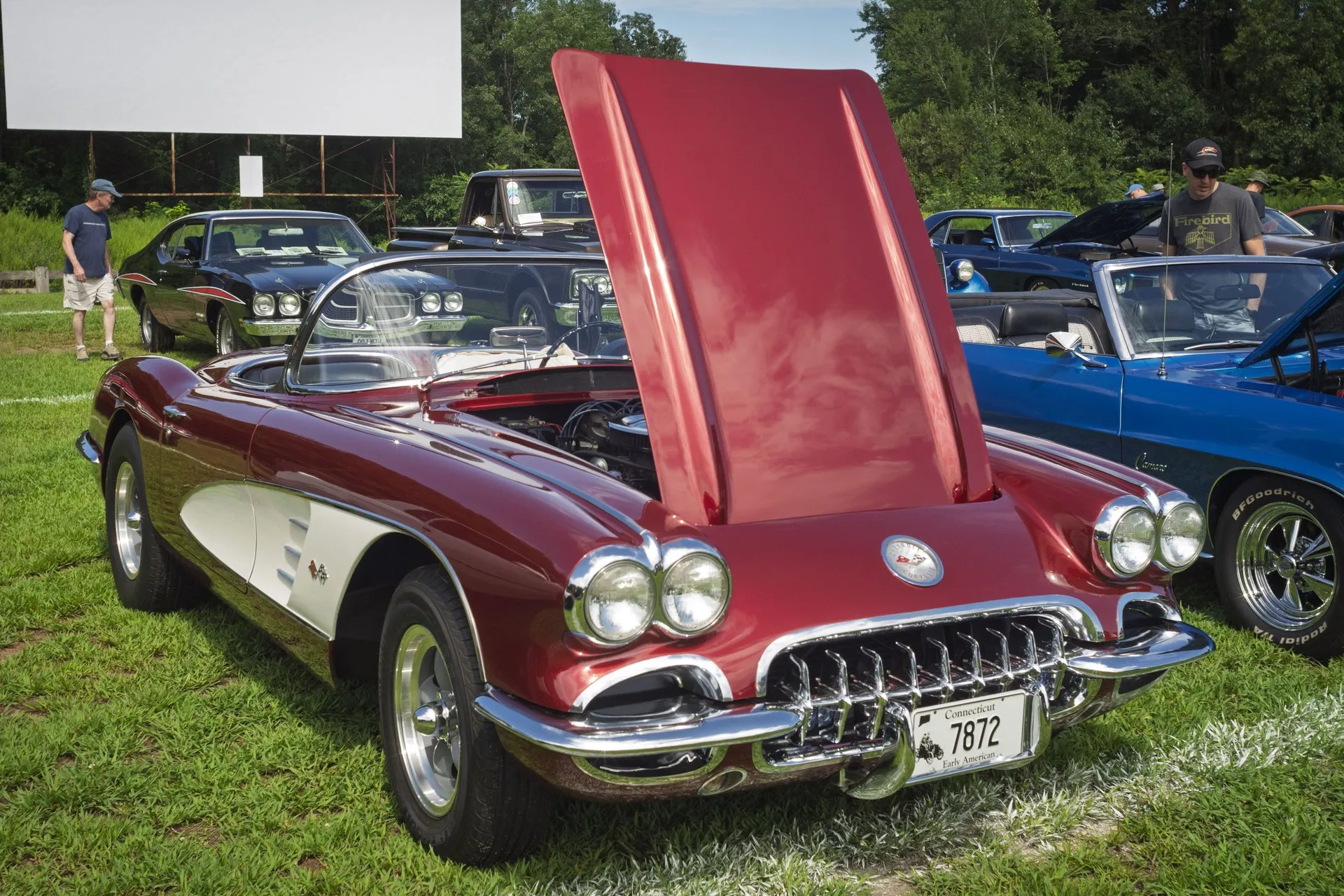
Chevrolet didn’t code colors to individual cars, and a 1960 carries no trim tag, so nothing on the car proves its original paint.
Section 05
How to verify a 1960: plate, pad and fuel injection
The serial number and where the plate is
GM’s own example serial, 00867S100003, reads: 0 for 1960, 0867 for the model, S for St. Louis, then the unit number (1960 kit). The 1960s ran from unit 100001 to 110261, and the Black Book gives the last unit built each month, which dates a car:
| Built by the end of | Last unit number |
|---|---|
| October 1959 | 101168 |
| November 1959 | 101454 |
| December 1959 | 102059 |
| January 1960 | 103158 |
| February 1960 | 104360 |
| March 1960 | 105711 |
| April 1960 | 107011 |
| May 1960 | 108167 |
| June 1960 | 109149 |
| July 1960 | 109846 |
| August 1960 | 110261 |
GM’s body specification page of July 15, 1959, puts the serial on the “LF body hinge pillar”, at the front of the driver’s door opening (1960 kit). Owners agree, with one dissenter in a 2012 CorvetteForum thread, that early plates sat there, screwed on, and that during the year the plate moved under the hood to the top of the steering column and was spot-welded in place. They put the change at about the 1,400th to 1,650th car, late November to mid-December 1959, citing the 1960 assembly instruction manual and Noland Adams’s restoration guide, which this guide couldn’t check (CorvetteForum, 2012 (opens in new tab)). The Black Book’s monthly numbers fit: 101454 ended November, 102059 December.
So either spot can be right. A door-post plate on a car built deep into 1960, or a column plate on an October 1959 car, needs explaining. Owners add that column welds fail, loose plates get refitted elsewhere, and reproductions exist (CorvetteForum, 2013 and 2014).
The frame stamp is the arbiter: on top of the driver-side frame rail near the X-member, often faint enough to need a mirror and a flashlight (CorvetteForum, 2012; Corvette Action Center forum, 2009). Plate, stamp and title should all agree.
The engine pad
GM puts the engine number on the front right of the block (1960 kit): a Flint assembly date and a suffix code. The seven 1960 suffixes are in the table in The 1960 engines, and none of them dates an engine. The Black Book gives 1959 the same seven, plus DH for its Powerglide fuelie, and 1961 kept all seven, with CR and CS moved to its 275 and 315 hp fuelies (1959 kit; 1961 kit). Block 3756519 spans all three years.
The heads narrow it. The Black Book lists casting 3774692 on every 1960 engine. 1959’s heads carry other numbers, and 1961 kept 3774692 only for its carbureted engines, giving its fuelies 3782461. So a “1960 fuelie” on 3782461 heads isn’t wearing 1960 heads, and 3774692 fits a 1960 without proving one, since heads get swapped. What has to line up is the pad’s assembly date against the car’s build month. And a “fuel-injected 327” in a 1960 isn’t original: the 327 arrived for 1962 (Corvette Action Center forum, 2007).
A fuelie’s hardware and paper
Fuel injection adds money, so it gets added to cars; the C1 guide covers how fakes are made and judged. GM’s 1960 pages and the Black Book give these checks:
- Suffix CR or CS, and a manual. No 1960 fuelie had a Powerglide. The codes alone prove nothing, since 1959 and 1961 used them too.
- The 290 hp parts. Distributor 1110914 and generator 1102173 (1960 kit), and a tachometer driven off the distributor, not the generator (1960 kit).
- The plumbing. An air cleaner on the radiator bulkhead, ducted to the air meter (1960 kit), and on the 290 hp car the aluminum radiator.
- The injection unit. The Black Book lists five Rochester unit numbers on 1960s: 7017200, 7017250, 7017300, 7017310 and 7017320. Matching one to a car is specialist work.
- The washer bottle. On the right behind heat shields, not the left. 1959 and 1961 fuelies did the same, so it marks a fuelie, not a year.
- Badges. Fuel Injection script proves nothing.
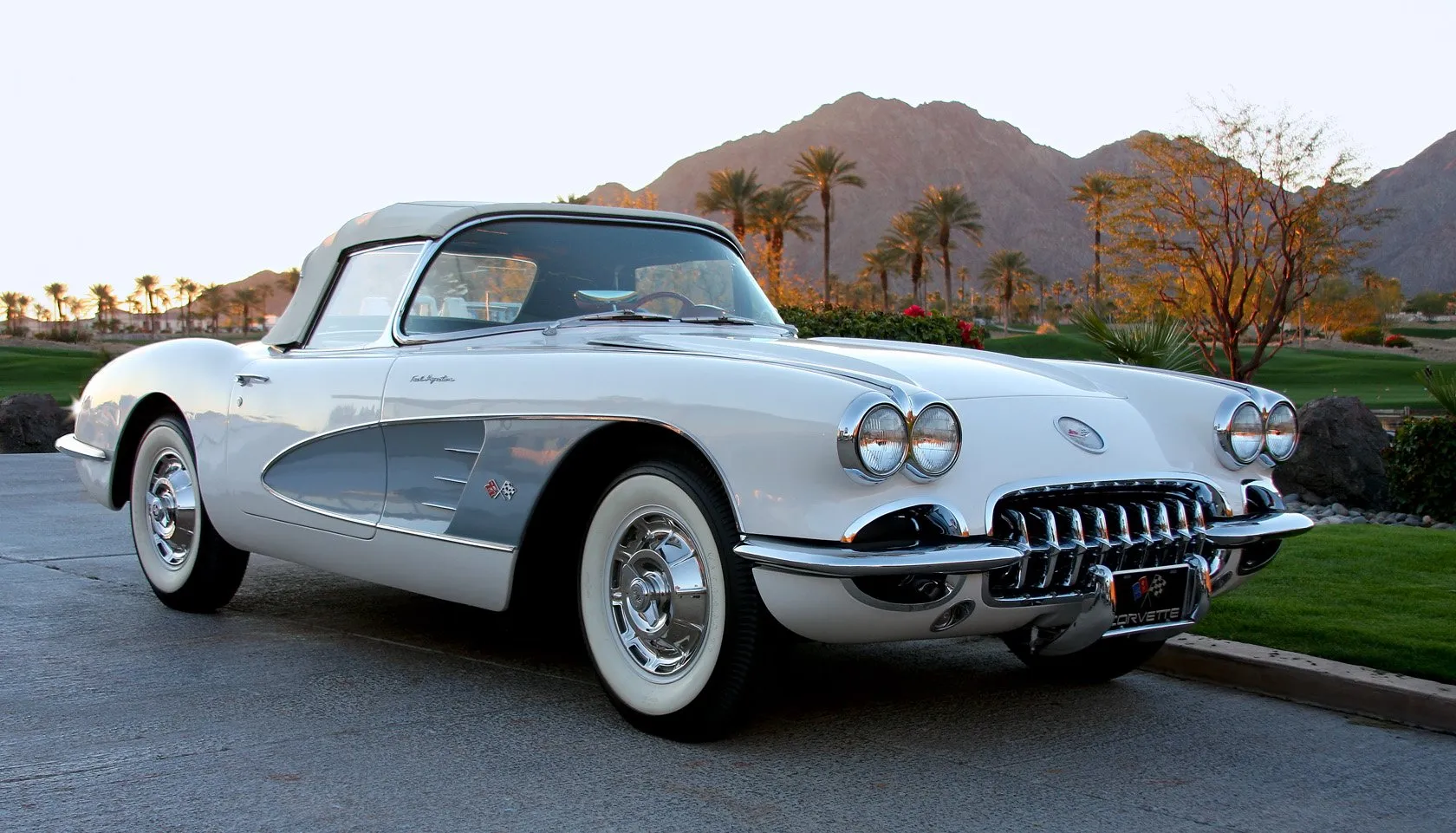
Paperwork first, then judging. The 290 hp fuelie that sold on Bring a Trailer in January 2026 came, by its listing, with a 1997 Bloomington Gold Survivor certificate and National Corvette Restorers Society (NCRS) Top Flight and other awards from 2025.
Section 06
Recalls, complaints and known problems
NHTSA lists no recalls for the 1960 Corvette and one owner complaint (opens in new tab), filed in 2017: fuel dripped below the filler door after a top-off, with no crash, fire or injury (both checked October 18, 2026). That near-silence says nothing about how these cars behaved: NHTSA’s complaint file starts in September 1994, more than three decades after they were new, and its bulletin files hold no GM bulletin for any Corvette before the 1984 model year.
The problems that matter are the generation’s: frame rust, rocker supports, stress cracks, leaks and heat. The C1 guide covers each. Three owner notes come from 1960s:
- Running hot. For a 1960 running 200–220°F, owners said to check the gauge with an infrared thermometer first, then the thermostat, fan clutch, radiator and timing (Corvette Action Center forum, 2007).
- Fuel injection. Ethanol fuel and hot stop-and-go traffic don’t suit a Rochester unit, one owner warns (CorvetteForum, 2011).
- Tires. A restored 1960 that wandered on bias-plies drew two answers: radials, “night and day” by one account, or an alignment check (CorvetteForum, 2012).
Section 07
What to check before buying a 1960
- The plate against the build number, using the monthly numbers in How to verify a 1960.
- Frame stamp, plate and title. All three agree, or stop.
- The engine pad. A suffix from the 1960 list, a Flint assembly date that fits the build month, block 3756519, heads 3774692, and no paint hiding the pad.
- A claimed fuelie. Paperwork, then the checks in How to verify a 1960, then an NCRS judge or a fuel-injection specialist.
- Combinations GM didn’t build: a Powerglide behind a 270 or a fuelie, Positraction with a Powerglide, a 4.11 or 4.56 axle without Positraction, or RPO 687 without a 270 or 290 hp engine. Axle codes are on GM’s list.
- The 24-gallon tank, only on a car that came without a soft top.
- Underneath: the rear stabilizer bar, then the frame, as the C1 guide’s checklist describes.
- An inspection by someone who knows C1s, ideally an NCRS judge.
Section 08
What a 1960 Corvette costs in 2026
Hagerty. Hagerty’s price guide (opens in new tab), as archived on January 23, 2026, values each 1960 engine separately. Its #3 (Good) figures:
| Engine | January 2026 | October 2025 |
|---|---|---|
| 230 hp | $63,100 | $65,000 |
| 245 hp | $73,300 | $75,600 |
| 250 hp fuel injection | $72,700 | $74,900 |
| 270 hp | $85,200 | $87,800 |
| 290 hp fuel injection | $113,000 | $116,000 |
Their plain average, $81,460, is the 1960 figure on the C1 guide. It isn’t weighted by production, so it sits well above the base car, which more than half of all 1960s were. Hagerty values the 250 hp fuelie, of which 100 were built, below both dual-quad cars. Values may have moved since.
Bring a Trailer. From January 1 to October 17, 2026, Bring a Trailer (opens in new tab) listed 19 cars titled as 1960 Corvettes. Ten sold, at a median of $72,000, from $26,250 to $193,000, by this site’s calculation from each sold price.
- No engine swap or five-speed in the title: 6 sold, median $76,250, top $87,500. A body-off restoration with three NCRS Top Flight awards from 1998–2001 brought $82,000 in May.
- Swapped or five-speed: 4 sold, median $66,000, topped by a $193,000 LS3 restomod, a different market.
- Fuelies: the last two sold were a 290 hp four-speed at $87,500 (January 22, 2026) and a 250 hp four-speed at $64,000 (July 12, 2025).
- The bottom: $26,250 for a non-running four-speed project on October 15.
The C1 guide’s 12-month median for 1958–1960 as a group, $73,500, measures the same market more broadly. Listing titles are a crude screen and auctions favor presentable cars, so this is a snapshot, not a forecast.
Under $10,000? Not on this evidence: the cheapest 1960 sold on Bring a Trailer in 2025 or 2026 was that $26,250 non-running project. How rare? 10,261 were built, and this guide found no count of survivors. By the Black Book’s count, 100 had the 250 hp fuel injection, 119 had RPO 687 and 140 were Cascade Green.
Section 09
The verdict: which 1960 to buy
The pick is a documented 270 hp four-speed. It was the most popular optional engine (2,364 cars), and it has the hot parts without the injection: the mechanical-lifter cam, the cast covers and the aluminum radiator. Hagerty values it at $85,200 against $113,000 for the 290 hp fuelie, and less money rides on its paperwork. That’s this site’s call from GM’s kit and 2026 prices; no owner thread read for this guide argues one 1960 engine over another.
The budget path is a 230 hp car, Powerglide included, with plate, frame stamp and title in agreement: Hagerty’s cheapest 1960, at $63,100, with the same rounded tail and chrome teeth.
Buy a fuelie only with paperwork and a judging history, and expect to pay for it: $87,500 for the documented 290 hp car in January 2026. Skip any 1960 whose plate, frame stamp and build number don’t tell the same story, any “315 hp” claim and any fuel-injected 327.
Get it right and you own the last Corvette with its taillights in rounded fenders, from the year Corvettes first raced at Le Mans. Three years later the Sting Ray name arrived with the C2, and the 1963 guide picks up the story there.
Section 10
Sources
- GM Heritage Center: 1960 Corvette vehicle information kit files.zipcorvette.com This site's library. Chevrolet's 1960 Corvette supplement, October 1959 (some pages revised February 1960): PDF pages 6–12 and 15–19 (color combinations, serial and engine codes, weights, chassis, heavy-duty brakes, power teams, advertised engine ratings, performance factors, tank, carburetor, fuel injection and transmission data). GM's AMA specification questionnaire, issued October 2, 1959: pages 31, 48, 53 and 61 (body page issued July 15, 1959: serial and engine number locations). Reproduced Corvette Black Book pages (production, suffix codes, block and head castings, injection units, monthly serial numbers, options, prices, colors): pages 26 and 28.
- GM Heritage Center: 1959 Corvette vehicle information kit files.zipcorvette.com This site's library. What 1959 had: PDF pages 4–5 (Black Book: production, engine suffixes and castings, the 250 hp Powerglide fuelie, the fuelie washer reservoir, RPO 684, prices, colors and wheel colors), 11 (Chevrolet data: curb weights) and 40–41 (AMA: front and rear stabilizer bars, heavy-duty springs).
- GM Heritage Center: 1961 Corvette vehicle information kit files.zipcorvette.com This site's library. What 1961 changed: PDF pages 4–5 (Black Book: restyled rear, iron-head 275 and 315 hp fuel injection, engine suffixes and castings, standard equipment, price, production) and 13 (Chevrolet data: curb weights and engine codes, CY and CZ still listed).
- NHTSA owner complaints, 1960 Chevrolet Corvette (opens in new tab) api.nhtsa.gov Pulled October 18, 2026. One record, filed in July 2017. NHTSA's complaint file begins in September 1994.
- NHTSA recalls, 1960 Chevrolet Corvette (opens in new tab) api.nhtsa.gov Pulled October 18, 2026. None listed.
- NHTSA manufacturer communications (TSB) file, received 1995–1999 (opens in new tab) static.nhtsa.gov This and NHTSA's later files, through 2025–2026, hold no GM bulletin for any Corvette before the 1984 model year.
- GM Heritage: 1960 Chevy Corvette (opens in new tab) gm.com Read via the Internet Archive's March 2025 copy (opens in new tab). Production the highest to that point.
- GM Heritage: 1963 Chevy Corvette Sting Ray (opens in new tab) gm.com Read via the Internet Archive's May 2026 copy. The production Sting Ray arrived for 1963.
- The Henry Ford: trophy won by William Mitchell's Stingray, SCCA Cumberland National Races, 1960 (opens in new tab) thehenryford.org The racer's April 1959 debut and its 1960 SCCA national championship with Dick Thompson. Also the Road America 500 trophy, September 1960 (opens in new tab).
- Automobile Club de l'Ouest: Corvette's first class win at Le Mans in 1960 (opens in new tab) 24h-lemans.com The race organizer's account of June 26, 1960.
- Corvette Action Center: 1960 Corvette production and performance numbers (opens in new tab) corvetteactioncenter.com Fetched October 18, 2026. Cross-check of GM's production figures, and the Motor Trend July 1960 test figures it reproduces (the magazine itself was not read).
- Hagerty Price Guide: 1960 Chevrolet Corvette (opens in new tab) web.archive.org Internet Archive copy of August 27, 2025. The model description: visually unchanged from 1959, stronger front and new rear sway bars, aluminum heads that cracked and warped in testing.
- Hagerty Price Guide: 1953–1962 Chevrolet Corvette (opens in new tab) web.archive.org Internet Archive copy of January 23, 2026. The 1960 #3 (Good) average and the January 2026 and October 2025 #3 value of each 1960 engine, from the page's US-dollar price data.
- Bring a Trailer: Chevrolet Corvette C1 results (opens in new tab) bringatrailer.com Every listing titled as a 1960 Corvette, read October 18, 2026. Counts and medians are this site's calculation from each listing's sold price.
- CorvetteForum thread: 1960 VIN tag locations (opens in new tab) corvetteforum.com November 2012. Owners date the plate's move to the steering column.
- CorvetteForum thread: differences between 1959 and 1960 C1s (opens in new tab) corvetteforum.com September 2010 to March 2017.
- CorvetteForum thread: a 1960 VIN plate in the wrong location (opens in new tab) corvetteforum.com June 2013.
- CorvetteForum thread: 1960 VIN tag replacement (opens in new tab) corvetteforum.com September 2014.
- CorvetteForum thread: matching VIN and frame numbers (opens in new tab) corvetteforum.com January 2012.
- Corvette Action Center thread: VIN location on the frame (opens in new tab) forums.corvetteactioncenter.com December 2008 to April 2009.
- Corvette Action Center thread: 1960 vs 1959 front end (opens in new tab) forums.corvetteactioncenter.com December 2002 to January 2003.
- Corvette Action Center thread: Corvette cylinder heads and power packs, 1960–1967 (opens in new tab) forums.corvetteactioncenter.com June 2001 to January 2011. One member's 2001 account of the 1960 aluminum heads, citing a 1961 Chevrolet letter.
- Corvette Action Center thread: C1 windshield frame (opens in new tab) forums.corvetteactioncenter.com June 2007. A 1960 offered as a fuel-injected 327.
- Corvette Action Center thread: C1 cooling and heating (opens in new tab) forums.corvetteactioncenter.com September to October 2007. A 1960 running hot.
- CorvetteForum thread: putting the fuel injection back on a 1960 (opens in new tab) corvetteforum.com August 2011.
- CorvetteForum thread: how bias-ply tires affect handling (opens in new tab) corvetteforum.com January 2012. A restored 1960.