C1 · Buying guide
1959 Corvette guide: radius rods, black wheels, five 283s and what one costs in 2026
Published
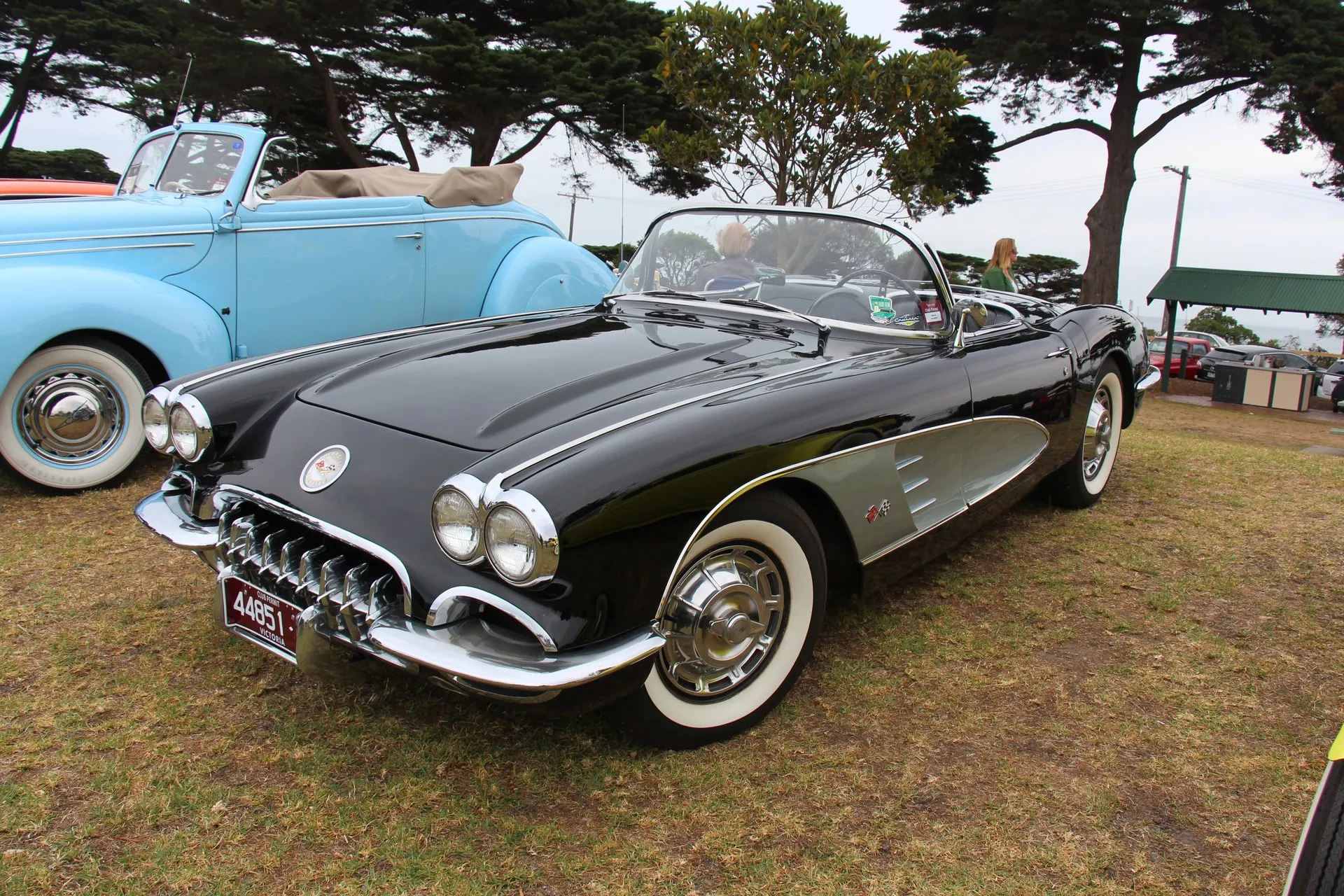
Zora Arkus-Duntov told Sports Cars Illustrated that a borrowed raincoat moved the 1959 Corvette’s door handles. Thousands of proving-ground miles hadn’t done it, he said for the magazine’s March 1959 road test (opens in new tab). A visit to Riverside, California did: the coat he borrowed there had cinch straps on its sleeves, and he kept opening the door when he turned left. The Corvette Black Book, a reference whose 1959 pages GM reprints in its Heritage Center kit, records the result: door releases moved forward.
Much of 1959 was that kind of fix. It’s the middle year of the rounded-tail, quad-headlight C1 (1953–1962), wearing the 1958’s body with the fake hood louvers and trunk spears taken off. Chevrolet added rear radius rods, a T-handle reverse lockout for the four-speed and a bin for the passenger, and painted every car’s wheels black. In January 2026, Hagerty’s price guide valued a base 1959 below a base 1958 or 1960, the cheapest way into that body, if the car is what its seller says.
- Built: 9,670, all convertibles, 502 more than for 1958. 5,481 got the removable hardtop, 1,695 of them in place of the soft top at no charge.
- Engines: five 283s, 230 to 290 hp gross, every rating carried over from 1958. 920 cars had fuel injection, fewer than one in ten.
- Price new: $3,875, with the 230 hp engine, a three-speed, vinyl seats and a soft top.
- New for 1959: rear radius rods, black interior (the Corvette’s first), the T-handle lockout, the passenger bin and black-painted wheels.
- Money in 2026: Hagerty’s #3 (Good) average was $79,860 (January 2026), from $58,500 for the base car to $103,000 for the 290 hp fuel-injected car, the fuelie. Bring a Trailer, 2026: $74,500 (16 sales).
- A 1959 Stingray? No production car. Bill Mitchell’s Stingray racer made its competition debut in April 1959 (opens in new tab); the Sting Ray name reached a showroom for 1963.
Frames, rocker supports, fiberglass cracks, fake fuelies and the other nine years live in the C1 buyer’s guide.
C1 Key figures
- Built
- 9,670, all convertibles
- Engines
- five 283s, 230 to 290 hp gross
- Fuel-injected cars
- 920
- Price new
- $3,875
- New for 1959
- rear radius rods, black interior
- Hagerty #3 average
- $79,860 (January 2026)
- Bring a Trailer, 2026
- $74,500 (16 sales)
Section 01
What 1959 took off, and what it added
The body didn’t move: 177.2 in long on a 102 in wheelbase, as in 1958 (1959 kit, in this site’s manual library). Trim, the cockpit and the rear axle changed.
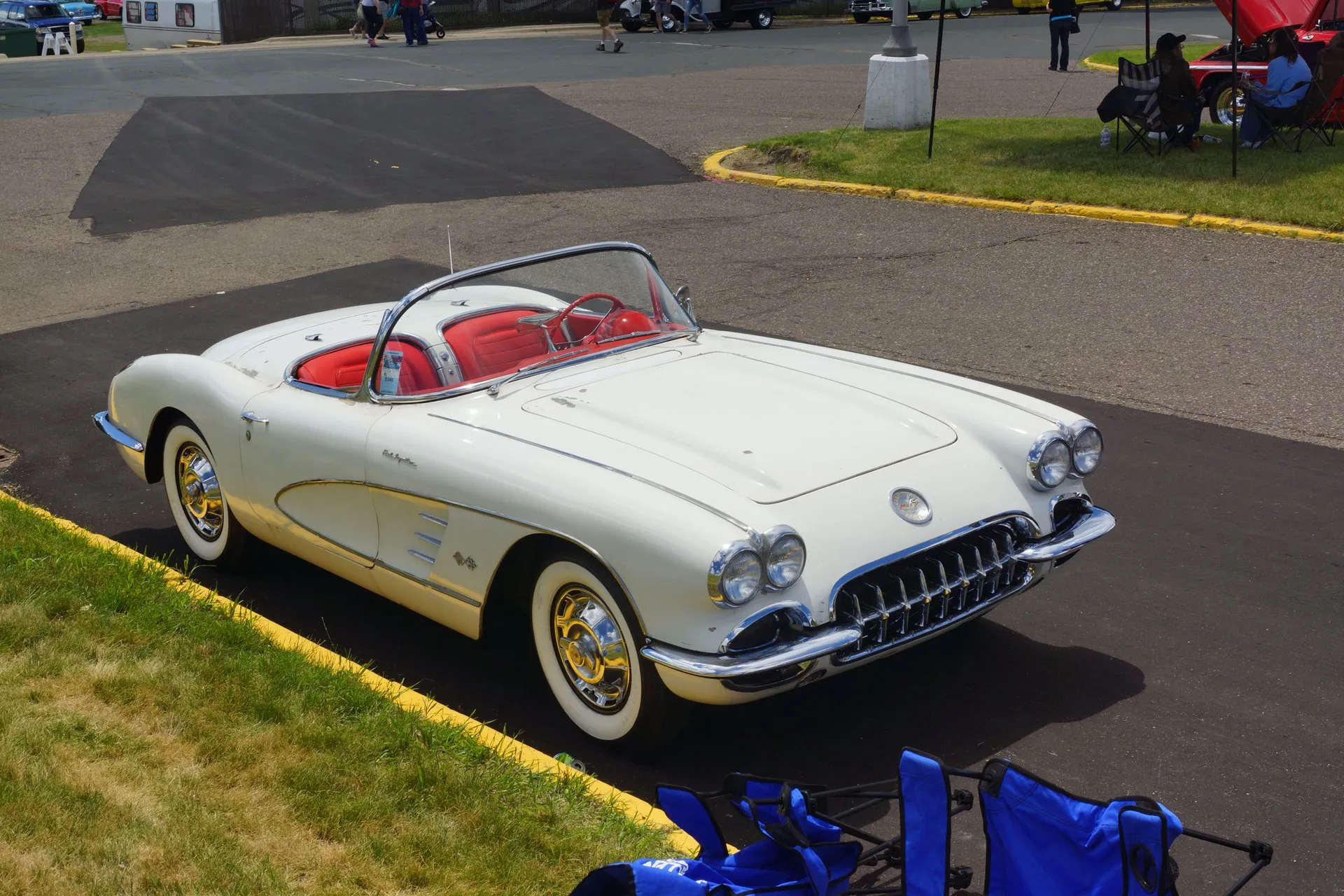
- Trim off. No simulated louvers on the hood and no twin chrome spears on the trunk lid, the Black Book says (1959 kit). The headlights, toothed grille, coves and rounded tail carried over.
- Radius rods on. GM’s 1959 specification form lists “Auxiliary radius rods in rear to control spring wind-up” (1959 kit), and its rear suspension page sends drive and torque through “Rear springs and radius rods” (1959 kit). The 1958 form had springs alone. Wind-up is the leaf springs twisting as the axle tries to turn under power; the rods tie the housing to the frame to resist it. Hagerty’s claim of a softer ride and sharper handling isn’t on GM’s pages.
- No rear bar yet. The same 1959 page lists the rear stabilizer as “None”. The 1960 got one, so 1959 is the only year with radius rods and no rear bar.
- A reworked cockpit. The Black Book lists redesigned instruments with concave lenses, new door panels with the armrests and releases moved, a storage bin under a more heavily padded passenger grab bar, and smoother seat upholstery.
- The T-handle. On four-speeds, reverse sat behind a lockout: lift the “T” handle to let the lever into the reverse gate, GM’s transmission page says (1959 kit).
- Black interior and black wheels. The Black Book calls 1959’s black interior the Corvette’s first. GM’s color chart carries a one-line footnote, “Wheels painted black” (1959 kit), for every body color. 1958’s were silver (1958 kit) and 1960’s matched the body. Full wheel covers hide most of it. Every 1959 color but Snowcrest White also got a new name.
- More money, more weight. The base price rose $284, to $3,875.00 from $3,591.00. The four-speed fell from $215.20 to $188.30; the Powerglide automatic and the hardtop went up. Positraction (Chevrolet’s limited-slip axle) went from three option codes to one, and sintered metallic brakes, a fan clutch, sunshades and a 24-gallon tank joined the list (1959 kit). GM’s curb weight rose to 3,033 lb with the three-speed, 107 lb more than a 1958, and 3,135 lb with the Powerglide.
Section 02
Engines, gearboxes and the last Powerglide fuelie
Every 1959 has a 283 cu in V8 (3.875 in bore, 3.000 in stroke), in the same five tunes and ratings as 1958 (1959 kit). Ratings are gross, as GM advertised them, with GM’s net figures in brackets, closer to how it rated engines from 1972. Options carry regular production option (RPO) codes.
| Engine | RPO and price | Fuel and cam | Gross (net) power | Gross (net) torque | Suffix codes | Built |
|---|---|---|---|---|---|---|
| 230 hp | Standard | One Carter four-barrel, hydraulic lifters | 230 hp at 4,800 rpm (195 net) | 300 lb-ft at 3,000 (270 net) | CQ manual, DG Powerglide | 5,487 |
| 245 hp | 469, $150.65 | Two four-barrels, hydraulic lifters | 245 hp at 5,000 rpm (215 net) | 300 lb-ft at 3,800 (270 net) | CT manual, DJ Powerglide | 1,417 |
| 270 hp | 469C, $182.95 | Two four-barrels, special camshaft, mechanical lifters | 270 hp at 6,000 rpm (230 net) | 285 lb-ft at 4,200 (255 net) | CU, manual only | 1,846 |
| 250 hp fuel injection | 579, $484.20 | Rochester fuel injection, hydraulic lifters | 250 hp at 5,000 rpm (225 net) | 305 lb-ft at 3,800 (280 net) | CR manual, DH Powerglide | 175 |
| 290 hp fuel injection | 579D, $484.20 | Rochester fuel injection, special camshaft | 290 hp at 6,200 rpm (245 net) | 290 lb-ft at 4,400 (265 net) | CS, manual only | 745 |
Counts and suffix codes are the Black Book’s (1959 kit); the 230 hp count, 56.7 percent of the year, is this site’s subtraction. Compression was 9.5:1, or 10.5:1 on the 290, which GM’s performance page works out to 1.025 gross hp per cubic inch (1959 kit).
Against 1958, the 270 nearly doubled, from 978 cars to 1,846, while the fuelies fell from 1,511 to 920 at the same $484.20, the 250 hp car from 504 to 175, the year’s rarest engine.
Powerglide behind fuel injection, one last time
GM’s 1959 performance table fills in the Powerglide columns for only three engines, the 230, the 245 and the 250 hp fuelie (1959 kit), and the Black Book gives the fuelie-and-Powerglide car its own suffix, DH. Every 1960 fuelie was a manual, and none of the mechanical fuel-injected Corvettes that followed, through 1965, offered the Powerglide, so 1959 is the last year a fuel-injected Corvette could be ordered with one. GM’s kit doesn’t say how many of the 175 had it.
They do turn up: a white 1959 with fuel injection and a two-speed Powerglide sold on Bring a Trailer for $98,500 on February 19, 2026, its listing saying the injected 283 “was factory rated at 250 horsepower”, with National Corvette Restorers Society (NCRS) judging awards from 2004, 2010 and 2022. A 290 with a Powerglide is a car GM didn’t build.
Gear ratios and Positraction
A three-speed manual was standard, synchronized in second and third (2.21, 1.32 and 1.00:1). The four-speed, RPO 685 at $188.30, went into 4,175 cars (43.2 percent), with all four forward gears synchronized (2.20, 1.66, 1.31 and 1.00, GM’s figures). The Powerglide, RPO 313 at $199.10, went into 1,878, leaving 3,617 three-speeds. Manuals got a 3.70:1 axle, Powerglides 3.55:1. Positraction, RPO 675 at $48.45, went into 4,170 cars, came only with a manual, and was the only way to get the 4.11 or 4.56 ratios (1959 kit).
Period road tests
Sports Cars Illustrated (SCI) took a $5,127.80 290 hp four-speed on a 3.70 Positraction axle from 0 to 100 mph and back to a standstill in 26.4 s, and found it quite similar at the top end to the 3.0-liter Ferrari 250 GT it had tested the year before. As Corvette Action Center reproduces the figures (the magazines weren’t seen for this guide), the SCI car ran 0–60 mph in 6.6 s and the quarter mile in 14.9 s at 98.0 mph, and Road & Track’s January 1959 270 hp car on 4.11 gears matched its 0–60 time.
Section 03
RPO 684, and the $26.90 brakes SCI wanted standard
For 1958, RPO 684, heavy-duty brakes and suspension, cost $780.10 and required the 290 hp fuelie. For 1959 it cost $425.05 and the 270 qualified too, still with Positraction and a manual, by the Black Book’s account (1959 kit). Only 142 cars got it. (SCI, writing early in the year, said it came only with the 290 and Positraction.)
GM’s 1959 data gives the package 550 lb/in front springs against the regular 300, and five-leaf rear springs at 145 lb/in against 115 (1959 kit). The front bar was 0.81 in against the regular .67–.70 in, and quick steering cut the turns lock to lock to 3.25 from 3.70 (1959 kit). The brakes were Cerametalix linings in finned drums with air scoops, and GM’s own form heads that page “Optional Heavy Duty Brakes (Not recommended for street use)” (1959 kit). SCI agreed: cold, they grabbed violently.
The street answer was RPO 686, sintered metallic linings in the regular drums, a separate option for the first time at $26.90. SCI made repeated stops from 90 mph without fade and called them so good and so cheap they should be standard. Only 333 buyers took them.
Section 04
Colors, options and what buyers ticked
The Black Book prices and counts nearly every 1959 option (1959 kit). Drivetrain aside, most popular first:
| Option | RPO | Price | Cars | Share of 9,670 |
|---|---|---|---|---|
| Heater | 101 | $102.25 | 8,909 | 92.1% |
| Whitewall tires | 290 | $31.55 | 8,173 | 84.5% |
| Windshield washers | 109 | $16.15 | 7,929 | 82.0% |
| Signal-seeking AM radio | 102 | $149.80 | 7,001 | 72.4% |
| Auxiliary hardtop | 419 | $236.75 | 5,481 | 56.7% |
| Sunshades | 261 | $10.80 | 3,722 | 38.5% |
| Parking brake alarm | 107 | $5.40 | 3,601 | 37.2% |
| Courtesy light | 108 | $6.50 | 3,601 | 37.2% |
| Two-tone paint | 440 | $16.15 | 2,931 | 30.3% |
| Power folding top | 473 | $139.90 | 661 | 6.8% |
| Power windows | 426 | $59.20 | 587 | 6.1% |
| Sintered metallic brakes | 686 | $26.90 | 333 | 3.4% |
| 15 x 5.5 in wheels, small hubcaps | 276 | No charge | 214 | 2.2% |
| Heavy-duty brakes and suspension | 684 | $425.05 | 142 | 1.5% |
| Radiator fan clutch | 121 | $21.55 | 67 | 0.7% |
A 24-gallon tank, LPO 1625 (a limited production option), came only with the hardtop and no soft top, because it took part of the soft top’s storage space. The Black Book gives no count.
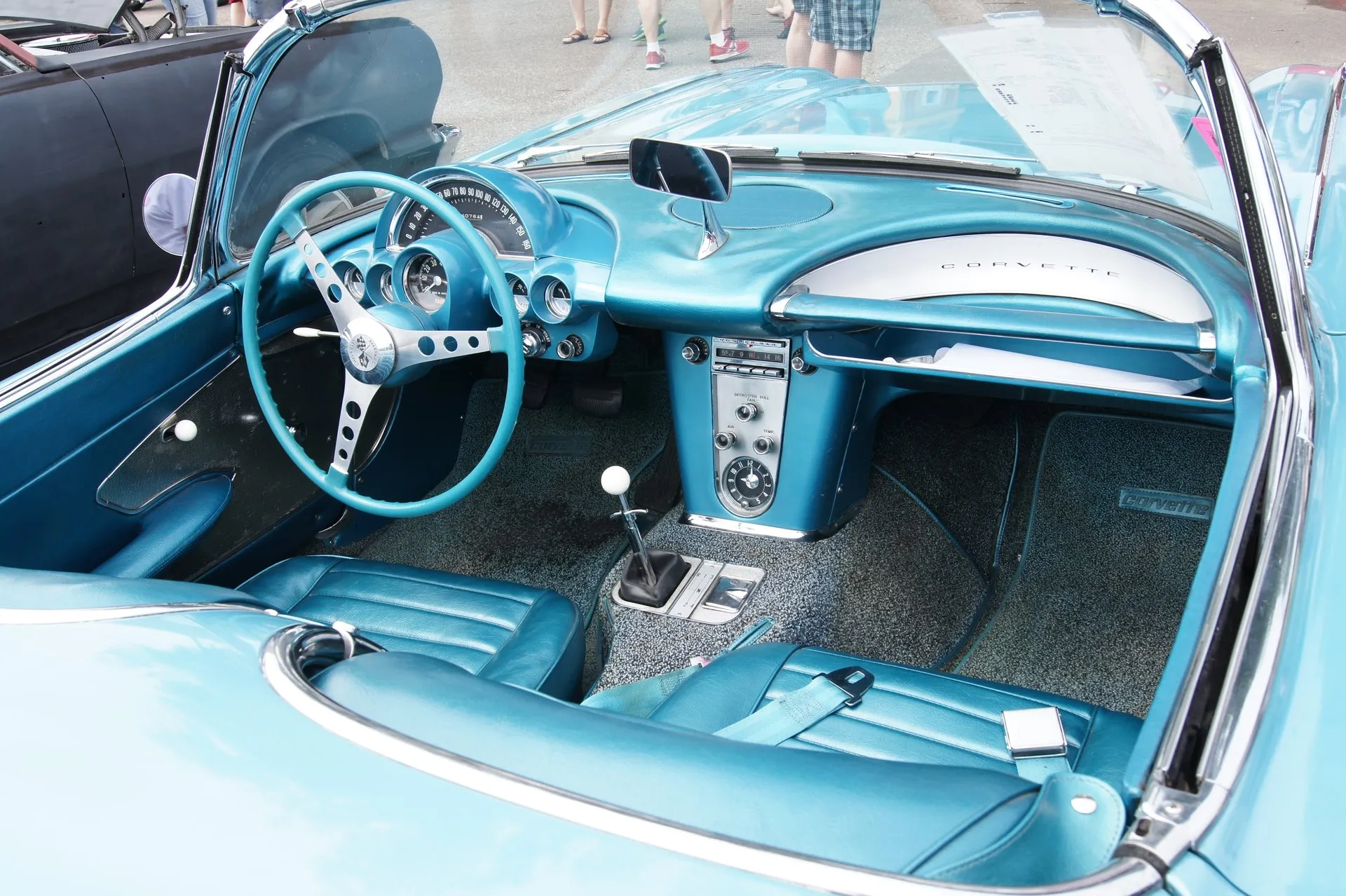
Seven colors, one of them for 1959 only
| Color | Cars | Two-tone cars, cove color |
|---|---|---|
| Snowcrest White | 3,354 | 535, Inca Silver |
| Tuxedo Black | 1,594 | 496, Inca Silver |
| Roman Red | 1,542 | 805, Snowcrest White |
| Frost Blue | 1,024 | 361, Snowcrest White |
| Inca Silver | 957 | 220, Snowcrest White |
| Crown Sapphire | 888 | 420, Snowcrest White |
| Classic Cream | 223 | 89, Snowcrest White |
Counts are the Black Book’s; cove colors are GM’s (1959 kit). Five more cars got a non-standard color or primer, and 83 went for export, colors unrecorded. Classic Cream, the rarest, is on neither the 1958 nor the 1960 chart, so it’s the one color that says 1959 on its own, if it’s original.
Interiors: red (5,124 cars), black (2,062, about one in five, in its first year), blue (1,303) and turquoise (1,181). GM’s chart pairs Classic Cream only with black and Crown Sapphire only with turquoise, though the Black Book says other combinations were possible. Soft tops came in black, white, turquoise or light blue, and turquoise, the Black Book says, only for 1959.
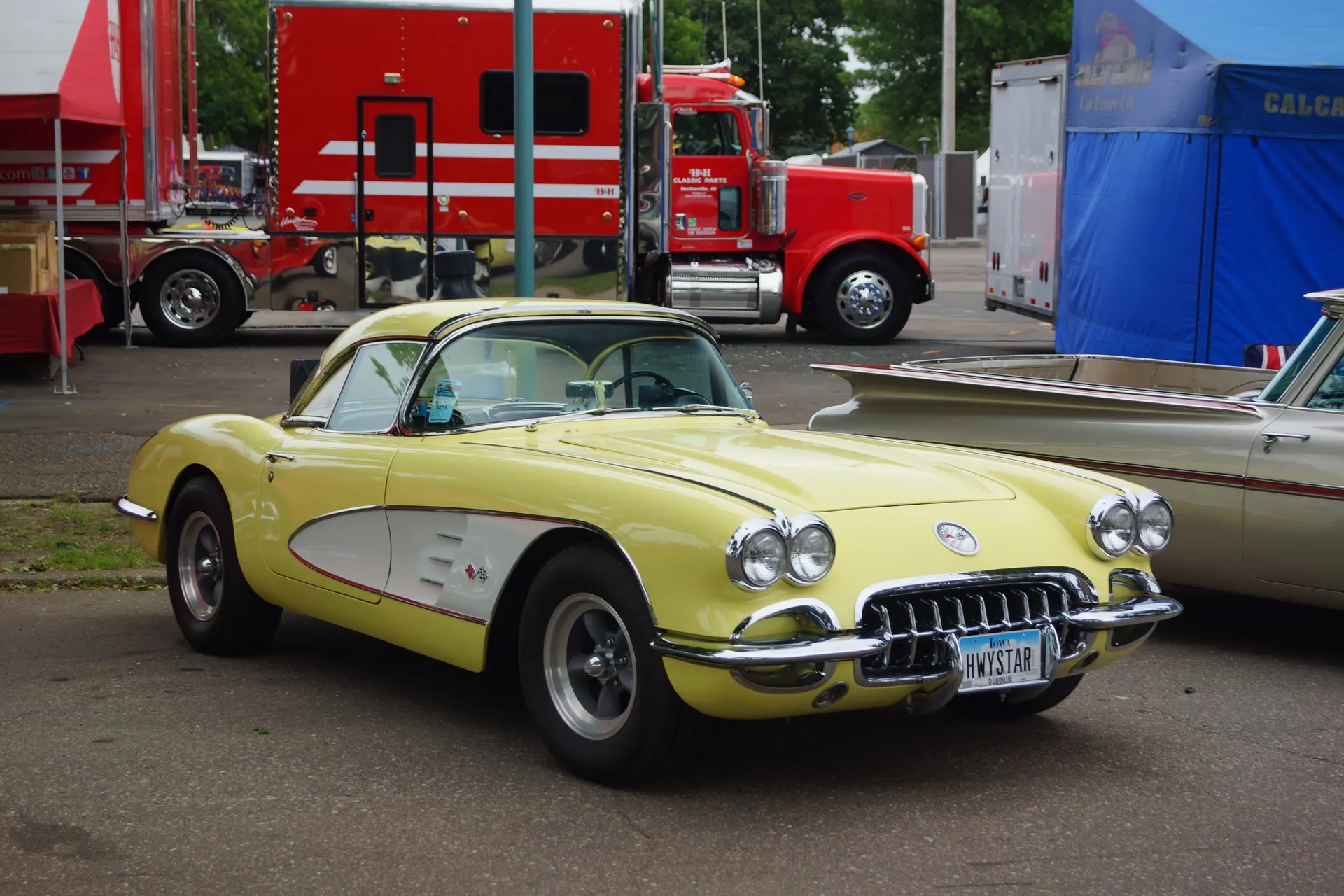
Don’t hunt for a paint code. The Black Book says colors and interiors weren’t coded to individual cars, and a 1959 has no trim tag: only paperwork proves original paint.
Section 05
Spotting a 1959 next to a 1960
With wheel covers on, a 1959 and a 1960 look the same. GM’s pages separate them underneath:
- The rear bar. None on a 1959; GM’s 1960 data lists a .625 in rear stabilizer bar (1960 kit).
- The wheels. Black on a 1959, body color on a 1960, under the covers.
- The fuelie’s gearbox. No 1960 fuelie had the Powerglide (1960 kit).
- The radiator. 1960 brought aluminum radiators on the 270 and 290; a 1959 had none from the factory.
- The heads. The Black Book lists 3774692 on every 1960 (1960 kit), not a 1959 number.
- The serial. J59S on a 1959; a 1960 reads 00867S, and its plate moved from the door pillar to the steering column during the 1960 run.
Owners add interior tells (opens in new tab): seat pleats running side to side on a 1959 and front to back on a 1960, no red and blue bars beside the Corvette script on the 1959’s grab-bar panel, and the woven “Daytona” carpet most 1959s carried over from 1958 (CorvetteForum, 2017–2018; Corvette Action Center forum, 2007). One experienced poster adds that 1959’s friction hood latches can let the hood creep open on the road (CorvetteForum, 2022). Interiors get swapped, so these are clues; the serial settles it. Most owners in those threads call the two near twins and say to buy the better car; two point to 1960’s rear bar as the real improvement.
Section 06
Verifying a 1959: plate, frame, pad and build month
The serial and the build month
1959 serials run J59S100001 to J59S109670: J for the V8, 59 for the year, S for St. Louis, then the unit number (1959 kit). GM’s specification form puts the serial on the “Left front body hinge pillar”, at the front of the driver’s door opening, and the engine number on the “Front right side of cylinder block” (1959 kit). A 1959 plate belongs on the door pillar.
The Black Book’s last unit for each month dates the car; cars per month are this site’s arithmetic.
| Month | Last unit | Cars that month |
|---|---|---|
| September 1958 | 100409 | 409 |
| October 1958 | 100623 | 214 |
| November 1958 | 101587 | 964 |
| December 1958 | 102641 | 1,054 |
| January 1959 | 103962 | 1,321 |
| February 1959 | 104921 | 959 |
| March 1959 | 106033 | 1,112 |
| April 1959 | 107144 | 1,111 |
| May 1959 | 107934 | 790 |
| June 1959 | 108702 | 768 |
| July 1959 | 109437 | 735 |
| August 1959 | 109670 | 233 |
The frame carries the serial too, on top of the driver-side rail, often faint (see the C1 guide). Plate, frame stamp and title should agree, and the engine’s assembly date should come before the build month.
The engine pad and the castings
A 1959’s pad carries a Flint assembly date and a suffix code (the table in Engines, gearboxes and the last Powerglide fuelie). The eight codes are 1958’s, and 1960 kept seven, so a code fits the year without proving it. The castings narrow it: the Black Book lists block 3756519 (all 1959s) or 3737739 (early cars), and heads 3748770 or 3755550 (early, with staggered valve-cover holes) or 3767465 (late).
Swaps are common: ten of the 20 1959s listed on Bring a Trailer in 2026 named a 327, 350, 383 or LS3 in the title. Owners have found a 1963 full-size Chevrolet 327 in one 1959 (CorvetteForum, 2014) and, in another (opens in new tab), a 1967 passenger-car 327 under a correct-looking 1959 dual-four manifold and late-1959 heads (CorvetteForum, 2011). The same thread warns that a pad’s stamped characters can hide under paint or be machined away; ask why one can’t be read.
The axle
Every 1959 got radius rods, so its axle housing needs their mounts. A long-time C1 restorer, in a 2019 CorvetteForum thread (opens in new tab), describes a bracket welded to the top of each side of the housing between the spring U-bolts on every 1959–1962 Corvette; in the same thread, a 1959’s cracked center section turned out to be from a 1956 Powerglide car. Center sections interchange, so the ratio code proves less than the housing.
Proving a 1959 fuelie
The C1 guide covers how conversions are built. For a 1959, GM’s pages allow these checks:
- Code and gearbox: CR or CS with a manual, DH with a Powerglide. A 290 (CS) with a Powerglide, or Positraction behind any Powerglide, isn’t a car GM built.
- The air duct: GM’s 1959 form says outside-air intake ducts “are furnished with Fuel Injection” (1959 kit), on both fuelies.
- The unit: the Black Book lists 7014900, 7017200 and 7017300R on the 250 hp car and 7014900R, 7017250 and 7017300 on the 290. Owners say the numbers are stamped on the air meter’s rear flange and the outboard side of the fuel bowl, and that parts have always moved between units, so a unit can be a mix (CorvetteForum, 2025).
- The distributor: 1110915 on the 250, 1110914 on the 290, by the Black Book.
- The washer bottle: on the right, behind heat shields, on a fuelie; on the left on carbureted cars. 1960 and 1961 fuelies did the same, so it marks a fuelie, not a year.
Section 07
Chevrolet’s 1959 fixes, and the empty federal file
Chevrolet’s 1959 dealer papers are known here as Corvette Action Center transcribed them; the originals weren’t seen.
- Driveline vibration, from the new rods. Chevrolet’s July–August 1959 Service News blamed excessive driveline vibration on a 1959 Corvette (opens in new tab) on too much rear U-joint angle. The cure was a 2 or 3 degree shim between each spring and axle pad, thick edge forward (
GM 3722797andGM 3744488, OEM), with the radius control rods disconnected first and, if needed, the rod’s frame mounting hole elongated ¼ in rearward, keeping at least 7½ degrees of U-joint angle. - Fuel at the back of the injection unit (Service News, March 1959). A worn drive-shaft seal on the high-pressure fuel pump; seal kit
GM 7017174(OEM), with a new shaft. - A slipping Powerglide (TSB DR #411, July 22, 1959). Collapsed or restricted hoses to the 1958–1959 Powerglide’s vacuum modulator cause slipping and repeat band and clutch failures.
- Flickering headlights (TSB #586, January 27, 1959). For all 1959 Chevrolets: voltage regulators date-coded 8J, 8K or 8L could oxidize their points; the fix was a new regulator.
NHTSA, the US road safety agency, lists no owner complaints (opens in new tab) and no recalls for the 1959 Corvette (both checked October 22, 2026), and its bulletin files hold nothing from GM for any Corvette before 1984. That isn’t a clean record: the complaint file begins in September 1994, when the newest 1959 was 35 years old. The problems that matter are the generation’s (frame rust, rocker supports, cracks, leaks and heat), all in the C1 guide.
Section 08
A 1959 checklist
- The plate on the driver’s door pillar, J59S10 and four more digits, matching the frame stamp and the title.
- The build month from the serial (the table in Verifying a 1959), with the engine assembled before it.
- The pad: a suffix that fits the engine and gearbox, block 3756519 or 3737739, heads 3748770, 3755550 or 3767465, and no paint or grinding over the stamp.
- GM’s combinations: no 270 or 290 with a Powerglide, no Positraction with a Powerglide, no 4.11 or 4.56 without Positraction, and RPO 684 only on a 270 or 290 with Positraction and a manual.
- Underneath: the radius rods and their axle brackets, no factory rear bar, and the frame, crossmember and rocker supports as the C1 guide describes.
- A claimed fuelie: paperwork, the checks in Verifying a 1959, then an NCRS judge or an injection specialist.
- A shake at speed: the U-joint angle and the shims from Chevrolet’s 1959 fix.
- A Powerglide that slips: the modulator hoses first.
- An outside eye from a C1 specialist, paid for before the seller is.
Section 09
What 1959s sell for in 2026
Hagerty. The archived copy of Hagerty’s price guide (opens in new tab) from January 23, 2026, prices each engine on its own; its #3 (Good) figures for 1959 hadn’t moved since October 2025. Beside them, the same engines a year either side:
| Engine | 1958 | 1959 | 1960 |
|---|---|---|---|
| 230 hp | $76,500 | $58,500 | $63,100 |
| 245 hp | $84,300 | $74,300 | $73,300 |
| 250 hp fuel injection | $88,000 | $79,700 | $72,700 |
| 270 hp | $86,900 | $83,800 | $85,200 |
| 290 hp fuel injection | $117,000 | $103,000 | $113,000 |
The five 1959 figures average $79,860, the C1 guide’s 1959 number, but that average isn’t weighted by production, and 56.7 percent of 1959s had the 230. The base 1959 is the cheapest of the three base cars, $18,000 under a 1958 and $4,600 under a 1960, while the three years’ 270s sit within $3,100 of each other. Values may have moved since January.
Bring a Trailer. From January 1 to October 21, 2026, 20 cars titled as 1959 Corvettes crossed Bring a Trailer (opens in new tab), and 16 sold, at a median of $74,500, from $55,000 to $111,000 (this site’s calculation from each sold price).
- Titled as stock: 7 sold, median $68,000. Without the two fuelies, 5 sold at a $61,111 median, a small sample. The low sale, $55,000 in September, was a car bought from a Nevada Chevrolet dealer in 1968 and kept 58 years.
- Titled as modified: 9 sold, median $81,959. In 2026 the swapped cars brought more than the stock ones.
- Fuelies: 7 of 8 listed since January 2024 sold, at a $90,000 median, from $75,500 (a black four-speed with Positraction, January 2026) to $113,000. The Powerglide fuelie brought $98,500 in February.
Over the 12 months to October 21, 2026, 19 of 24 sold, at a $73,500 median, the same as the C1 guide’s figure for 1958–1960 as a group. An archived classic.com page put the 1959 average at $89,739 across 124 sales in July 2025, over an unstated window. Listing titles are a crude screen: treat all of it as a snapshot.
How rare? No survivor count was found. The Black Book counts 142 RPO 684 cars, 175 250 hp fuelies and 223 in Classic Cream. Hagerty adds three Scaglietti-bodied cars built on 1959 chassis with Gary Laughlin, Jim Hall and Carroll Shelby; no dealer sold those.
Section 10
Verdict: the base car, bought on its numbers
Buy a 230 hp 1959 with the four-speed, on its numbers: plate, frame stamp, pad and title in agreement. The 270 four-speed is the pick in the 1958 and 1960 guides, and a good 1959 too, but Hagerty prices it about the same in all three years. The 1959’s discount sits in the base car: $58,500, the lowest of the three, and stock-titled carbureted 1959s sold for a $61,111 median on Bring a Trailer in 2026 (five sales). The base car has every 1959 change but one, the T-handle lockout, and the four-speed brings that. With 56.7 percent of the year’s cars, it’s also the easiest 1959 to find. Spend the difference on the frame. That’s the site’s call from GM’s counts and 2026 prices; owners mostly say to buy the best 1959 or 1960 going.
For the special camshaft and mechanical lifters, step up to a documented 270 hp four-speed (1,846 built): no Rochester unit to authenticate, and $83,800 in Hagerty’s guide against $103,000 for the 290.
A fuelie is a paper chase first: documents and a judging history, or no deal. A Powerglide fuelie must be the 250 hp car with a DH code, the combination that ended with this year. Walk away from numbers that disagree, a “283” whose pad can’t be read, or a 290 with a Powerglide.
Get it right and you own America’s sports car in its tidiest quad-headlight form: the 1958’s look without the fake louvers, the axle tied down, and door handles that leave a raincoat alone. The 1958 guide and the 1960 guide cover the years either side.
Section 11
Sources
- GM Heritage Center: 1959 Corvette vehicle information kit files.zipcorvette.com This site's library. The Corvette Black Book pages (PDF pages 4–5: production, serials, suffix codes, castings, injection units, monthly build numbers, options, prices, colors); Chevrolet's 1959 Corvette supplement, October 1958 (pages 9–20: equipment, color chart, weights, chassis, RPO 684, engine ratings, transmissions); GM's specification form, July 1958 (pages 22–49: rear radius rods, brakes, suspension, serial and engine number locations, weights).
- GM Heritage Center: 1958 Corvette vehicle information kit files.zipcorvette.com PDF page 6 (Black Book: 1958 prices, options and wheel colors) for the comparison.
- GM Heritage Center: 1960 Corvette vehicle information kit files.zipcorvette.com PDF pages 8, 19, 26 and 28: what changed for 1960.
- Car and Driver: 1959 Chevrolet Corvette Reviewed (Sports Cars Illustrated, March 1959) (opens in new tab) caranddriver.com Duntov's door handles, the radius rods, RPO 684's spring rates, the brake linings, the test car's price and 0–100–0 mph.
- NHTSA: complaints, 1959 Chevrolet Corvette (opens in new tab) api.nhtsa.gov None on file (checked October 22, 2026); the file begins in 1994. Recalls: none (recall query (opens in new tab)).
- Corvette Action Center: Chevrolet Service News, driveline vibration, 1959 Corvette (July–August 1959, as transcribed) (opens in new tab) corvetteactioncenter.com
- Corvette Action Center: Chevrolet Service News, fuel injection pump leakage (March 1959, as transcribed) (opens in new tab) corvetteactioncenter.com
- Corvette Action Center: TSB DR #411, Powerglide vacuum modulation system inspection (July 22, 1959, as transcribed) (opens in new tab) corvetteactioncenter.com
- Corvette Action Center: TSB #586, headlamp flicker (January 27, 1959, as transcribed) (opens in new tab) corvetteactioncenter.com
- Corvette Action Center: 1959 Corvette production and performance numbers (opens in new tab) corvetteactioncenter.com Period magazine figures, as reproduced there.
- Hagerty Price Guide (Internet Archive, January 23, 2026): 1953–1962 Corvette (opens in new tab) web.archive.org #3 (Good) values for each 1958, 1959 and 1960 engine, January 2026 and October 2025, from the page's US-dollar price data.
- Hagerty (Internet Archive, December 8, 2025): 1959 Chevrolet Corvette (opens in new tab) web.archive.org The radius rods, the black interior and the three Scaglietti-bodied cars.
- Bring a Trailer: Chevrolet Corvette C1 results (opens in new tab) bringatrailer.com 1959 sales computed by this site from each listing's sold price, to October 21, 2026.
- classic.com (Internet Archive, July 8, 2025): 1959 Corvette market (opens in new tab) web.archive.org
- The Henry Ford: trophy won by Bill Mitchell's Stingray racer, 1960 (opens in new tab) thehenryford.org
- CorvetteForum thread: 59 vs 60 (2017–2018) (opens in new tab) corvetteforum.com
- Corvette Action Center thread: difference between 59 and 60 (2007) (opens in new tab) forums.corvetteactioncenter.com
- CorvetteForum thread: differences between 1959 and 1960 C1s (2010–2017) (opens in new tab) corvetteforum.com
- CorvetteForum thread: 1959 Corvette, hood latches and 1959–1960 changes (2022) (opens in new tab) corvetteforum.com
- CorvetteForum thread: 1959 rear end and the radius rod brackets (2019) (opens in new tab) corvetteforum.com
- CorvetteForum thread: 1959 power train identification (2011) (opens in new tab) corvetteforum.com
- CorvetteForum thread: 327 in a 1959 (2014) (opens in new tab) corvetteforum.com
- CorvetteForum thread: fuel injection unit, 1959 (2025) (opens in new tab) corvetteforum.com