C2 · Buying guide
1966 Corvette Sting Ray: the first 427s, the record year, the fakes and 2026 prices
Published
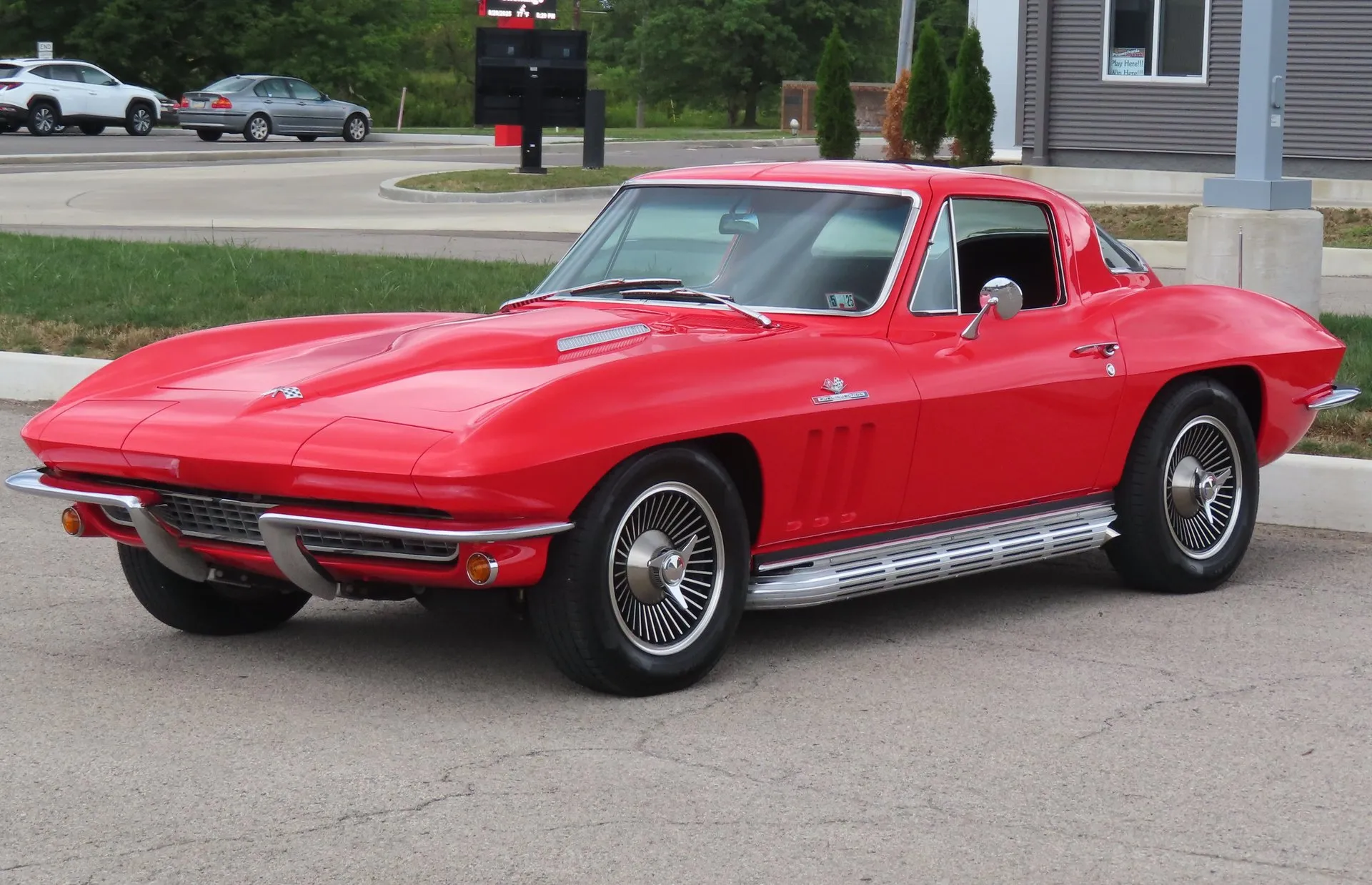
The most powerful 1966 Corvette lost 25 horsepower on paper and none under the hood. The Corvette Black Book, a reference whose 1966 pages GM reprints in its Heritage Center kit, says Chevrolet first listed its new solid-lifter 427, RPO L72 (RPO is GM’s regular production option code), at 450 hp, and that shortly after introduction the rating, “not the actual output,” came down to 425. GM’s own specification sheets, issued October 7, 1965, show the seam: one page heads its column “425HP RPO L72” and still gives valve lash “for 450 HP” in its footnote.
That’s the 1966 Corvette Sting Ray, the fourth year of the C2 (1963–1967): the year the 427 arrived, for $181.20 or $312.85 on top of the car, and more than a third of buyers took one. St. Louis built more Corvettes than in any model year before it, a record that stood until the 1968. Sixty years on, the money in a 1966 follows those two engine codes, and so do the fakes.
- Built: 27,720: 9,958 coupes and 17,762 convertibles.
- Engines: 327s of 300 and 350 hp, 427s of 390 and 425 hp, all gross.
- Price new: $4,295 coupe, $4,084 convertible, on GM’s March 16, 1966 price list.
- 427s built: 5,116 L36, 5,258 L72.
- New for 1966: the 427, no roof vents on the coupe, a hood script and a square-mesh grille.
- What one sold for in 2026: a median of $92,000 for 36 titled-stock sales on Bring a Trailer, January 1 to October 20.
- The generation’s rust, judging and fakes: in the C2 buyer’s guide; this page sticks to 1966.
C2 Key figures
- Built
- 27,720
- Coupes / convertibles
- 9,958 coupes and 17,762 convertibles
- Engines
- 327s of 300 and 350 hp, 427s of 390 and 425 hp, all gross
- Price new, March 1966
- $4,295 coupe, $4,084 convertible
- 427s built
- 5,116 L36, 5,258 L72
- L72 rating
- 425 hp at 5,600 rpm, gross
- Bring a Trailer, 2026
- $92,000 for 36 titled-stock sales
Section 01
1966 against 1965 and 1967: what moved
The Black Book’s 1966 facts page calls the styling similar to the previous model. The changes from the 1965 were under the hood and in the details:
- The 427s replaced the 396, the 1965’s one-year big-block, and fuel injection was gone: the Black Book’s 1966 engine codes are all 327s and 427s.
- Holleys everywhere. GM’s engineering pages give every 1966 engine a Holley four-barrel; in 1965 the two mildest 327s had Carters. GM’s own heritage page (opens in new tab) says the same, and counts 27,720 cars.
- A stronger base engine: the 300 hp 327 (the 1965’s L75 rating) replaced the 250 hp one.
- Outside: the coupe’s roof-pillar vents went, a script went on the hood, a plated square-mesh cast grille replaced the 1965’s black bars, and the knock-off wheels got a dull center cone instead of a bright one.
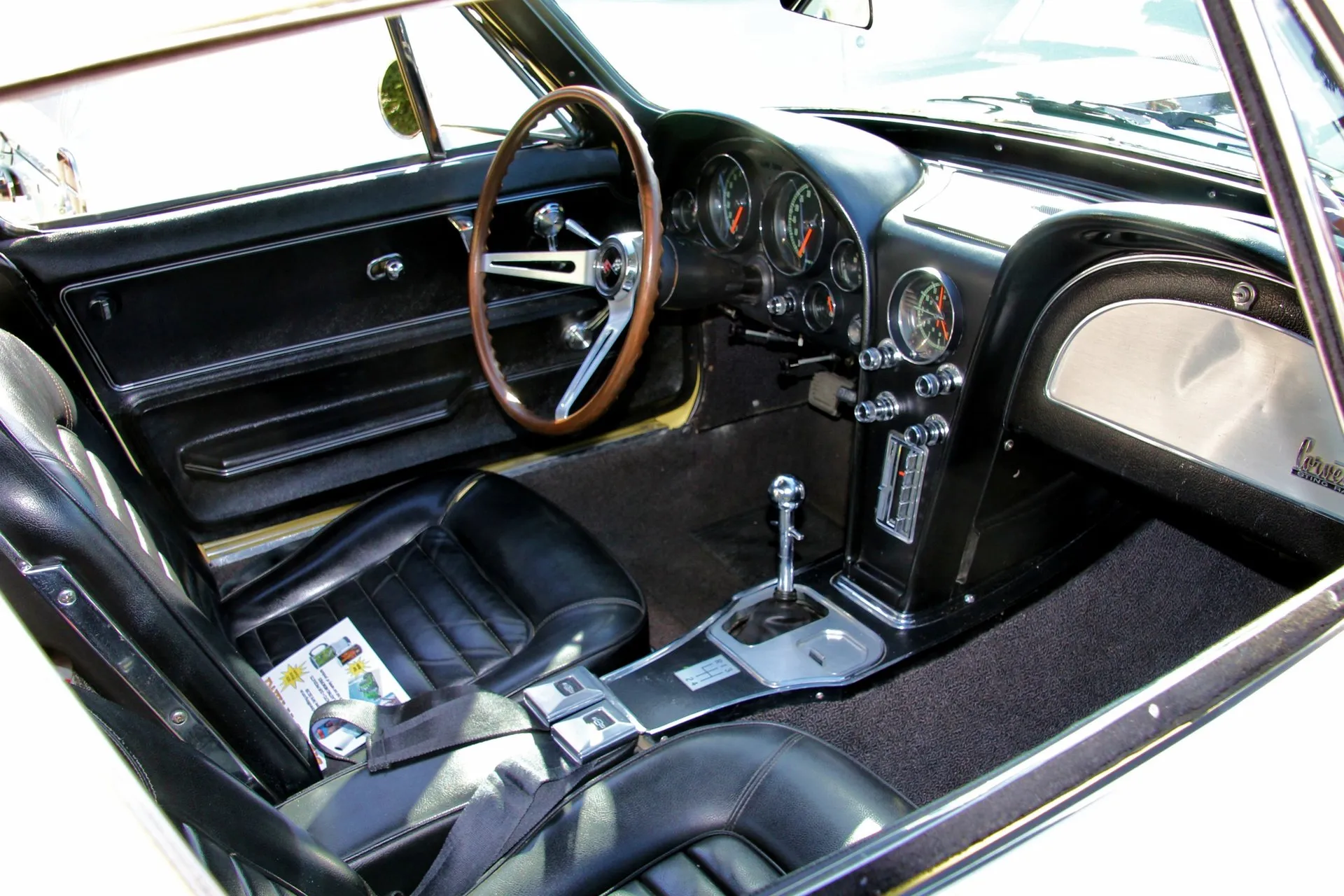
- Inside: seats with extra pleats, vinyl-covered foam headliners in coupes and hardtops (except early cars), bright door pulls, and headrests (A82) and shoulder belts (A85) offered for the first time.
- Lights and paint: backup lights became standard, built into the inner taillights (in 1965 they came in an option group), a hazard-flasher switch (V74) arrived, and GM’s paint codes changed from double letters to three digits.
- Gearboxes: the three-speed became fully synchronized, with a 2.54:1 first gear, and the four-speed split into two option codes, wide-ratio and close-ratio.
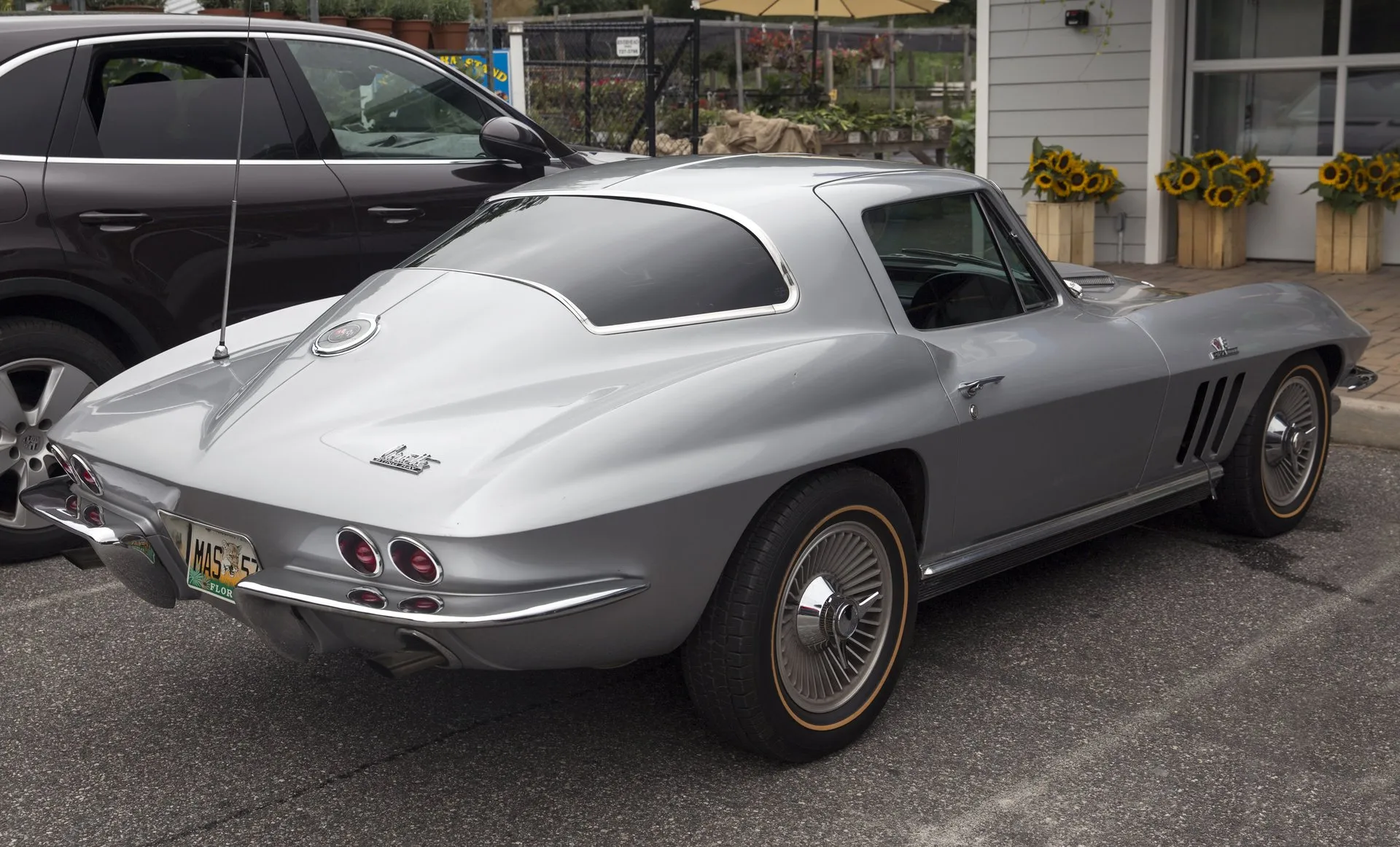
Carried over: the 1963 chassis and body structure (see the 1963 guide), the 98.0 in wheelbase and 175.1 in length, 11.75 in discs at all four wheels, three vertical fender vents, crossed flags on the fenders, the parking brake’s T-handle under the dash and 7.75 x 15 tires. GM’s weight page gives curb weights of 3,140 lb for the coupe and 3,160 lb for the convertible with the base engine and three-speed, plus 200 lb for a 427.
The 1967 then brought five angled fender vents, no fender flags or hood script, standard Rally wheels, a bolt-on aluminum wheel in place of the knock-off (so 1966 was the knock-off’s last year), the parking brake on the console, standard dual-circuit brakes, three-carburetor 427s and the L88.
Section 02
The 427 arrives: four engines and the rules for each
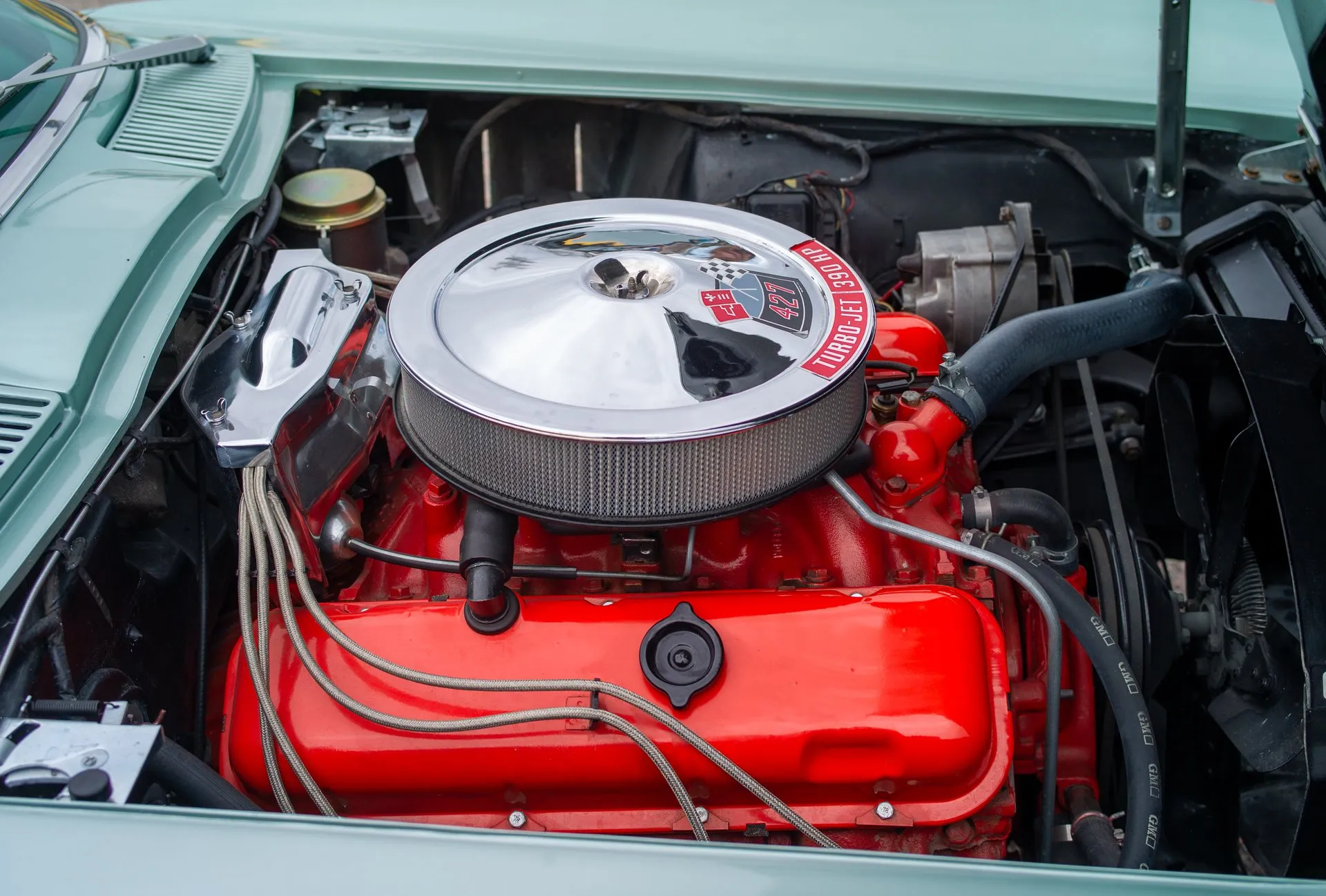
GM’s AMA specification sheet gives the ratings, all gross; prices are from GM’s March 16, 1966 schedule and counts from the Black Book. The 427 measured 4.25 x 3.76 in, bore and stroke, against the 327’s 4.00 x 3.25.
| Engine | Carburetor, lifters, compression | Gross hp | Gross torque | GM price | Built |
|---|---|---|---|---|---|
| Base 327 | Holley four-barrel, hydraulic, 10.5:1 | 300 at 5,000 rpm | 360 lb-ft at 3,400 rpm | Standard | 9,755 (by subtraction) |
| L79 327 | Holley four-barrel, high-performance camshaft, hydraulic, 11.0:1 | 350 at 5,800 rpm | 360 lb-ft at 3,600 rpm | $105.35 | 7,591 |
| L36 427 | Holley four-barrel, special camshaft, hydraulic, 10.25:1 | 390 at 5,200 rpm | 460 lb-ft at 3,600 rpm | $181.20 | 5,116 |
| L72 427 | Large Holley four-barrel, special camshaft, mechanical, 11.0:1 | 425 at 5,600 rpm | 460 lb-ft at 4,000 rpm | $312.85 | 5,258 |
GM’s engineering data also rates the base engine at 235 hp net, the yardstick GM adopted for 1972. The L72’s 425 hp at 5,600 rpm, gross, made it the year’s strongest Corvette, and the two 427s went into 10,374 cars, 37 percent of the year.
The performance-per-dollar math comes straight off GM’s price list: with the Positraction ($42.15) and transistor ignition ($73.75) GM required, an L72 coupe listed at $4,723.75 before taxes. GM’s performance factors put it at 8.50 lb of car per gross horsepower, against 11.45 for the base engine with a four-speed. Period tests, as reported by Corvette Action Center rather than read in the magazines: Car and Driver’s August 1965 427/425 with a 3.36:1 axle ran 0–60 mph in 5.4 seconds and the quarter mile in 12.8 at 112 mph, and Motor Trend’s March 1966 car with 4.11 gears did 5.6 seconds and 13.4 at 105 mph.
What GM’s power teams and price list allowed:
- L72: Positraction and full-transistor ignition (K66) required, the close-ratio four-speed only, a 3.55:1 axle as standard (3.36, 3.70 or 4.11 optional) and no air conditioning: “Not available with 425-hp V8 engine,” says GM’s dealer album. F41 special suspension ($36.90, 2,705 cars: springs, shocks and front and rear bars) came only with the L72.
- M22: the dealer album also lists a heavy-duty close-ratio four-speed for the L72, with axles up to 4.56:1, marked “Not recommended for general use.” The Black Book counts 15 at $237.00.
- L36: Positraction only, on 3.08:1 with the wide-ratio four-speed or 3.36:1 with the close-ratio, and air conditioning allowed with a four-speed. GM’s October and December 1965 pages give it no automatic; its March 1966 power teams add Powerglide, and the Black Book counts 20.
- J56 heavy-duty brakes ($342.30, 382 cars) came with power brakes, for the 425 hp engine on GM’s March list (the dealer album says 390 or 425).
- L79 and base 327: the L79 was four-speed only (3.36:1 wide-ratio, 3.70:1 close-ratio); the 300 hp was the only engine with the three-speed (about 564 cars, by subtraction) and took 2,381 of the Powerglides.
- The four-speeds: M20 wide-ratio (2.52:1 first) on 10,837 cars and M21 close-ratio (2.20:1 first) on 13,903, both $184.35. Positraction went into 24,056 cars, 87 percent of the year.
Section 03
450 hp or 425: the rating that changed on paper
GM’s AMA sheets of October 7, 1965 already rate the big-blocks at 390 and 425 hp, and the valve-system page from the same set heads its columns “390HP RPO L36” and “425HP RPO L72”. Only its footnote is left over, giving valve figures “for 300 HP, 350 HP and 400 HP” and lash “for 450 HP”. In this guide’s reading, that’s a rating changed at the top of the page and missed at the foot, not a different engine. The Black Book says the cut came “for reasons unclear”, that the L36 “was sometimes rated at 400hp”, and still calls the L72 a “450/425hp” engine on its option page.
Owners agree the engines were the same and argue about the rest (CorvetteForum, 2010 and 2014):
- The order behind it. One poster says he holds the engineering change order that cancelled the 450 air cleaner decals in July 1965 and replaced them with 425s. This guide hasn’t seen it.
- How many 450 cars. No source read counts them. Estimates run from the first few thousand cars to a decal “used occasionally throughout the model year”, per a magazine article a poster cites.
- The codes. GM’s December 1965 engine page lists IP for the L72 and no IK; the Black Book gives IP as the 450/425 and IK as a 425, and posters disagree about what IK marked. A pad code doesn’t prove a 450 car.
For a buyer, a 450 decal proves nothing: one poster notes reproductions sell for about $12 (CorvetteForum, 2022). Pay for paperwork, not stickers.
Section 04
Options GM priced in March 1966, and who took them
GM’s price schedule of March 16, 1966 lists the Sport Coupe at $4,295.00 and the convertible at $4,084.00, suggested retail with the 300 hp engine, three-speed, vinyl trim and, on the convertible, the soft top: $62 more than GM’s June 1965 list. The Black Book’s prices match GM’s on every line checked. The options that matter, most-ordered first (engines, F41, J56 and the gearboxes are in The 427 arrives):
| RPO | Option | GM price | Cars |
|---|---|---|---|
| U69 | AM-FM radio with power antenna | $199.10 | 26,363 |
| G81 | Positraction | $42.15 | 24,056 |
| P92 | Whitewall tires | $31.30 | 17,969 |
| A01 | Tinted glass, all windows | $15.80 | 11,859 |
| C07 | Hardtop | $231.75, or no charge in place of the soft top | 8,463 (1,303 in place of the soft top) |
| K66 | Transistor ignition (350 hp and up) | $73.75 | 7,146 |
| V74 | Traffic hazard switch | $11.60 | 5,764 |
| N40 | Power steering | $94.80 | 5,611 |
| T01 | Gold-stripe nylon tires | $46.55 | 5,557 |
| J50 | Power brakes, dual-circuit master cylinder | $42.15 | 5,464 |
| A31 | Power windows | $57.95 | 4,562 |
| N32 | Teakwood steering wheel | $47.40 | 3,941 |
| N36 | Telescopic steering column | $42.15 | 3,670 |
| N14 | Side-mounted exhaust | $131.65 | 3,617 |
| C60 | Air conditioning (not with the L72) | $412.90 | 3,520 |
| N11 | Off-road exhaust | $36.90 | 2,795 |
| K19 | Air injection reactor | $44.75 | 2,380 |
| No code | Leather seats | $79.00 | 2,002 |
| P48 | Cast aluminum knock-off wheels | $316.00 | 1,194 |
| A82 | Headrests | $42.15 | 1,033 |
| N03 | 36-gallon fuel tank, coupe only | $198.05 | 66 |
| C48 | Heater and defroster delete | $97.85 credit | 54 |
| A85 | Shoulder belts | $26.35 | 37 |
Side pipes and wheels. N14 was “For off-road service only” in GM’s words. The standard wheel was a 15 x 5.5 steel wheel under what GM’s dealer album calls ventilated wheel covers “with simulated 3-lug knock-off hub”, so a spinner proves nothing; the $316 P48 option was five cast aluminum 15 x 6 wheels with real knock-off hubs. Both bolt on, and both get added later: 3,617 and 1,194 cars are the ceiling for originals.
The big tank. N03 swapped a coupe’s 20-gallon tank for a 36-gallon one under a color-keyed fiberglass cover in the luggage area. Sixty-six were built.
K19, California’s option. GM’s price list calls the air injection reactor “exclusive to California vehicle registration only” (not required with the 425 hp engine), and its other 1966 pages agree. The Black Book counts 2,380 and says the device “was not limited to California use.” Nothing read for this guide explains the gap, so a K19 car from outside California is a question for the paperwork, not a verdict.
Ten colors, and the four new ones
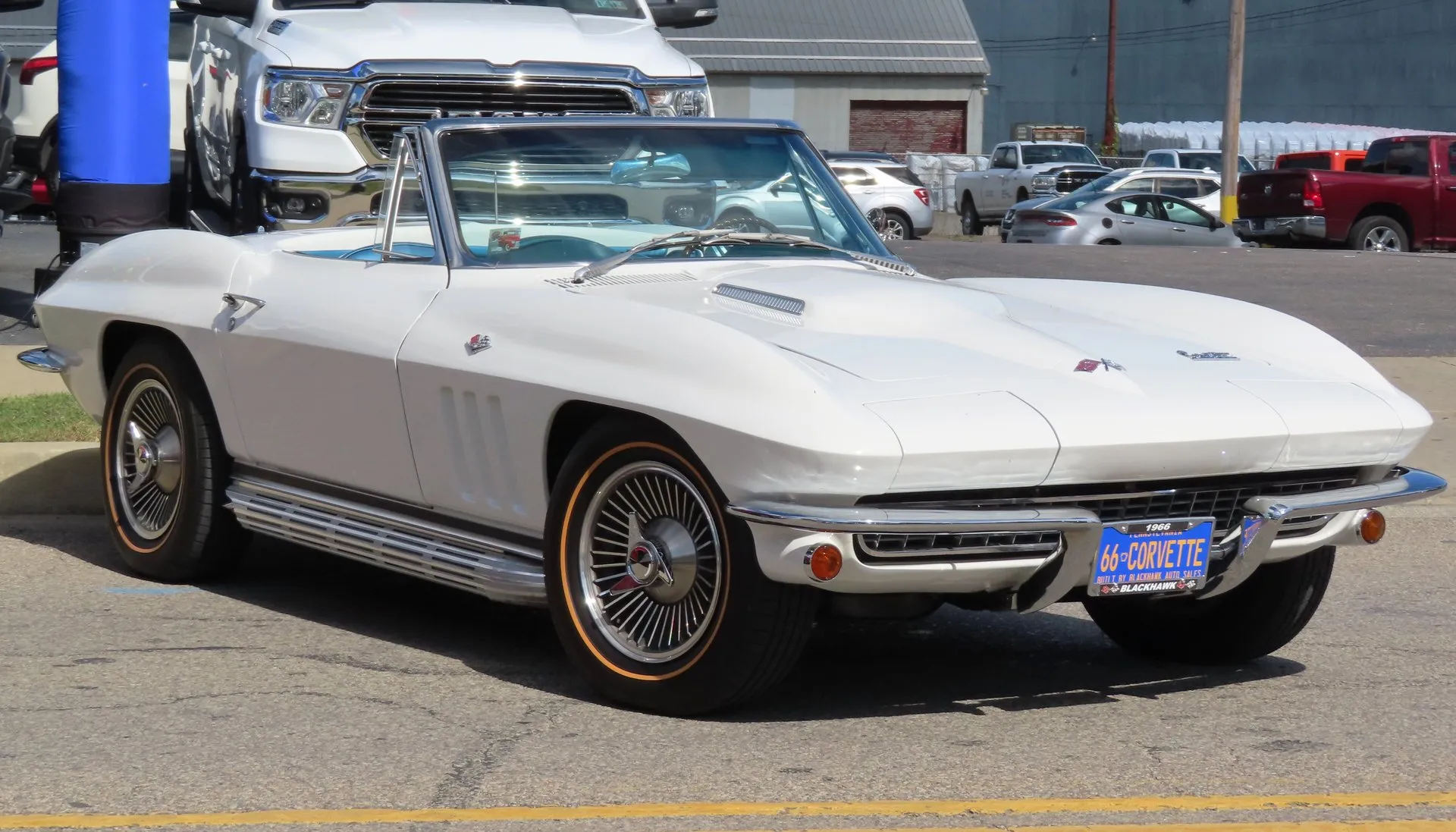
Every color was solid and cost nothing extra; GM’s ordering page rules out two-tones. Laguna Blue, Trophy Blue, Mosport Green and Sunfire Yellow were new, and the 1965’s Goldwood Yellow and Glen Green were gone. The Black Book’s counts:
| Code | Color | Cars |
|---|---|---|
| 976 | Nassau Blue | 6,100 |
| 988 | Milano Maroon | 3,799 |
| 974 | Rally Red | 3,366 |
| 986 | Silver Pearl | 2,967 |
| 984 | Sunfire Yellow | 2,339 |
| 982 | Mosport Green | 2,311 |
| 972 | Ermine White | 2,120 |
| 978 | Laguna Blue | 2,054 |
| 980 | Trophy Blue | 1,463 |
| 900 | Tuxedo Black | 1,190 |
Eleven more cars left in non-standard paint or primer, which brings the total to exactly 27,720. Soft tops came in black, white or beige with any color. Black vinyl was standard; red, bright blue, dark blue, saddle and silver came in vinyl or leather (seats only), and green and white-and-blue in vinyl only, per GM’s color chart. The Black Book says combinations off the chart were possible, so an odd one calls for paper, not a verdict of repaint.
Section 05
Plates and stamps: dating and decoding a 1966
Neither the serial nor the trim tag names a 1966’s engine. They date the car and name the body; the engine pad has to agree with both.
Serial number, plant and month
GM’s identification page puts the serial plate on the right side of the hinge-pillar cross brace under the glove box. A coupe runs 194376S100001 upward and a convertible 194676S: 1 for Chevrolet, 94 for Corvette, 37 for the coupe or 67 for the convertible, 6 for 1966, S for St. Louis, then the unit number. The last was 127720. The Black Book’s last serial for each month:
| Built in | Last serial |
|---|---|
| September 1965 | 102031 |
| October 1965 | 104384 |
| November 1965 | 107186 |
| December 1965 | 109892 |
| January 1966 | 112587 |
| February 1966 | 115283 |
| March 1966 | 118091 |
| April 1966 | 120664 |
| May 1966 | 123016 |
| June 1966 | 125469 |
| July 1966 | 127720 |
The body plate under the dash
The trim tag on the crossbrace under the dash gives the build date as a month letter and a day (A for September 1965 to K for July 1966 on St. Louis bodies; A for August 1965 to L for July 1966 on bodies from A. O. Smith, an outside body maker), the style (66 437 or 66 467), the body maker and number, the trim code and the paint code. The identification guide reproduced in GM’s kit decodes its example, H12 / 66 467 / S 1234 / STD / 974, as an April 12 convertible with a St. Louis body, black vinyl and Rally Red paint. A three-digit paint code is a quick check against a 1965, whose tags carry double letters.
The stamp on the right bank
GM puts the engine number on the top front of the right cylinder bank. Its example, F 1210 HE, is a Flint engine built December 10, with the base 300 hp suffix, and GM lists four “basic” codes: HE (300 hp), HT (L79), IL (L36) and IP (L72). The Black Book lists 14, adding versions for air injection, Powerglide, power steering and air conditioning, among them IM, IQ and IR for the L36 and IK for the L72. The pad also carries the year digit and the car’s last six serial digits, per the identification guide. Owners add that early pads read 6S before the number, and that 427s were assembled at Tonawanda, with pads starting T (CorvetteForum, 2017 and 2019).
The Black Book’s casting and part numbers, for checking what’s there:
- Blocks: 3858174 for the 327 (3892657 late in the year) and 3869942 for both 427s, with a few early 427s on 3855961 or 3855962.
- Heads: 3782461 on both 327s, 3872702 on the L36, 3873858 on the L72.
- Carburetors: Holley 3884505 on the 327s, 3882835 on the L36, 3886101 on the L72, and 3890499 or 3892341 on air-injection cars.
- Axles: the code on the carrier gives the ratio and the date; Positraction big-block axles carry AT, AU, AZ, FA, FB or FC, a series the reproduced guide labels “396”.
Section 06
Real 427 or converted: the tells, and why paper wins
On Bring a Trailer in 2026, 1966s titled with an L36 or L72 sold at a median of $112,000, against $64,500 for those titled with a small-block. That gap is why the fakes exist.
GM’s own pages give the big-block hardware: a special high-domed hood on every 427 and a “427 Turbo-Jet” fender emblem. On an L72, add transistor ignition, Positraction, a close-ratio box and no factory air; a points distributor or an open axle under a claimed L72 is a combination GM never offered. Owners add these clues, and say each one can be copied (CorvetteForum, 2007 to 2022):
- The fuel line bends about 90 degrees at the pump on a big-block, against about 45 on a small-block, one of the details owners rank hardest to fake (opens in new tab) (CorvetteForum, 2015).
- The firewall carries a big-block throttle arm and a J-shaped cable hook, and the copper radiator has its expansion tank built in, with no small-block overflow tank.
- The battery sits on the passenger side unless the car had air conditioning.
- The hood prop is on the driver’s side, though very early 1966 big-blocks may have the 1965’s passenger-side prop.
- Anti-roll bars front and rear, on every big-block by posters’ account.
- Gauges: an “LB” mark on the back of an L72’s cluster (one poster), plus the tach and oil gauge, where owners disagree about the L36.
Clues cut both ways: in a 2022 thread, a small-block car’s owner found big-block details on his, from the fuel line to the J-hooks, and wondered whether it started as a 427. Details suggest; only paper proves. On the pad, posters look for crisp stamping that matches a known original from the same day, and treat a fresh-looking pad as a red flag (CorvetteForum, 2017 and 2020).
Disclosed changes are honest: Bring a Trailer sold a 1966 titled “Convertible Conversion L72”, a former coupe, for $85,000 on September 23, 2026. Restamping a small-block car’s pad to pass as a big-block is what NCRS, the National Corvette Restorers Society, calls counterfeiting; the C2 guide covers judging, shipping data and the papers that help.
Section 07
Reverse lockout to water pumps: GM’s 1966 bulletins
NHTSA, the US road safety agency, holds one owner complaint (opens in new tab) for the 1966: a rear wheel came off, filed in 1996 with no cause given. One record in a file that only begins in September 1994 is no pattern. NHTSA lists no GM recall; its one recall covers Cardone’s remanufactured rear calipers 18-7019, 18-7020, 16-7019 and 16-7020 (aftermarket), made from February 2002 to April 2003 for 1965–1982 Corvettes, whose piston seals can leak.
GM’s own service paper says more (from Corvette Action Center’s transcriptions, not GM’s originals):
- Reverse lockout (TSB #66-10, November 29, 1965). On early four-speeds a loose set screw in the T-handle could leave the reverse release cable up, so accidental selection of reverse (opens in new tab) “would be possible”; a release rod (
GM 3889461, OEM) replaced the cable in interim 1966 production. The one safety item of the year. - Early air-conditioned cars (November and December 1965). 327 heater hoses ran over the compressor until serial 6S103533, and L36s could overheat at idle until a smaller pulley (5.39 in, from 5.90) arrived.
- 427 surge (January and February 1966). Some early 427 Holleys had lean #63 main jets that surged at 40–60 mph; carburetors dated 594 or later have #65s.
- Brake pads (Product Data Book, February 15, 1966). Riveted pads replaced bonded ones in December 1965 production, front from serial S109343, front and rear from S109688.
- Grille supports (March 22, 1966). The new grille’s outer supports could break on rough roads; improved ones came from serial S115499.
- Mid-year changes: a 327 clutch ball stud too short until April 4, 1966; a parking-brake lever revised April 1; a shifter moved to the crossmember after March 21, ending a buzz; a fix from February 15 for the top hose rubbing on early 427s with power steering; and L79 water pump pulleys that could crack, reinforced for 1967.
- The temperature gauge was recalibrated for 1966 to read around center or left of it; check the real temperature with an infrared thermometer anyway, as the C2 guide advises.
- 427s with air (September 1967 bulletin, 1966–1967). After a hot soak, a stalled compressor could stall the water pump and burn its belt; the 1968’s idler pulley fits.
- Big-block valve springs. Tonawanda’s notes date a more durable spring of the same part number to January 18, 1967, so every 1966 427 left with the earlier one (this guide’s reading of the dates). A 1967 camshaft also starves a 1966 block’s lifters.
The expensive problems are generation-wide: the birdcage, the frame kick-ups and the caliper bores, in Known C2 problems on the C2 guide.
Section 08
The 1966 inspection list, paper first
- The documents, before anything else, if the price depends on a 427, an L72, a “450” story, side pipes, knock-offs or the big tank.
- The serial: 194376S or 194676S and a unit number no higher than 127720, dated by the table in Plates and stamps, with every dated part built before the car.
- The trim tag: a build code that fits the serial’s month, the right style and a three-digit paint code.
- The pad: a suffix that fits the equipment, a date ahead of the car, the serial digits and no grinding marks.
- On a 427: the domed hood, both anti-roll bars and the castings; on an L72, transistor ignition, Positraction, a close-ratio four-speed and no factory air.
- On a car numbered under 115499 (built before early March 1966), the grille supports.
- The shifter and parking brake, and reverse lockout on an early four-speed.
- The brakes: weeping calipers and Cardone’s recalled numbers.
- The real temperature, read with an infrared thermometer.
- The birdcage and frame, by the C2 guide’s list, then an inspector who knows C2 big-blocks.
Section 09
What 1966s brought in 2026, by engine
How much is a 1966 Corvette worth? On Bring a Trailer (opens in new tab), 44 Corvettes from the 1966 model year sold between January 1 and October 20, 2026, and 20 more were bid to a median of $58,250 without selling. Medians are this site’s arithmetic on sold prices, without BaT’s buyer’s fee. “Titled stock” means the title doesn’t call the car modified or a project; no title reveals a restamp.
| 1966s on Bring a Trailer, Jan. 1 to Oct. 20, 2026 | Sold | Median | Range |
|---|---|---|---|
| Titled stock | 36 | $92,000 | $52,000–$173,500 |
| Stock coupes | 8 | $87,750 | $59,500–$152,000 |
| Stock convertibles | 28 | $96,500 | $52,000–$173,500 |
| Titled L36 or L72 | 19 | $112,000 | $76,000–$173,500 |
| Of those, L72 | 8 | $109,250 | $91,000–$173,500 |
| Of those, L36 | 11 | $112,000 | $76,000–$165,000 |
| Titled with a small-block | 12 | $64,500 | $52,000–$107,000 |
| Of those, L79 | 7 | $87,500 | $52,000–$107,000 |
| Of those, 300 hp | 3 | $59,500 | $53,000–$68,000 |
| Modified | 6 | $77,500 | $44,000–$190,000 |
The top stock sales were an L72 convertible at $173,500 (March 18), an L36 convertible its listing believes is one of the 11 primer or non-standard cars at $165,000 (July 29) and an L72 coupe at $152,000 (July 21). Don’t read the L36’s edge over the L72 as a trend: the samples are small, and since April 2025, 14 L72s sold at a median of $117,500 against $95,000 for 17 L36s. The C2 guide’s shorter window, June 10 to October 6, has 16 stock 1966s at a $90,500 median.
Hagerty’s price guide (opens in new tab) (an Internet Archive capture) valued condition #3 (Good) 1966s like this in January 2026, small-blocks up about 4 percent on October 2025 and 427s unchanged.
| Engine | Coupe | Convertible |
|---|---|---|
| 300 hp | $61,300 | $57,900 |
| L79 350 hp | $60,600 | $61,300 |
| L36 390 hp | $70,600 | $75,300 |
| L72 425 hp | $78,600 | $86,200 |
classic.com’s (opens in new tab) benchmark for the 1966 L72, a one-year engine, was $109,821 in April and May 2026; its L36 benchmark, $113,862, takes in 1967 cars too. Sold prices, a guide value and a benchmark built from listings measure different things: compare each with itself over time, not with the others.
Section 10
Buy the L79 convertible, or a 427 the papers carry
For most buyers, the 1966 to buy is an L79 convertible whose pad and papers agree: 350 hp on hydraulic lifters, with power steering and air conditioning on the order form. Seven L79s sold on Bring a Trailer in 2026 at a median of $87,500, a small sample. On a budget, a 300 hp car has the same discs and body: three 2026 sales at a $59,500 median, and $61,300 from Hagerty for a good coupe in January 2026.
For a big-block, choose by how you drive. The L36 is the easier-living 427: 460 lb-ft on hydraulic lifters, and air conditioning with a four-speed. The L72 is the one the year is remembered for: solid lifters, a close-ratio box and no air. Wind one past 4,000 rpm, where its torque peaks, and you’ll see how one period test, as Corvette Action Center reports it, got a 12.8-second quarter mile out of it. Both sold around $110,000 on BaT in 2026, and both are paperwork purchases first.
Walk away from a 427 priced as original when its pad, tag and papers don’t back it up, unless it’s priced as the small-block car it can prove to be. And judge the birdcage and frame first: a solid 300 hp convertible beats an L72 with rot in its birdcage. For 1966, America’s sports car sold more copies than ever and put 425 hp on the price list for $312.85. The job now is finding one that’s still telling the truth.
Next stops: the C2 buyer’s guide for the generation’s rust and judging, the 1965 and 1967 guides for the years either side, and the best Corvette years guide for where a 1966–1967 427 ranks across every generation.
Section 11
Sources
- GM Heritage Center: 1966 Corvette vehicle information kit files.zipcorvette.com This site's library. PDF pages 4 and 6 (options, colors, codes and production; reproduced Corvette Black Book pages), 10–12 (VIN, trim tag, engine and axle numbers; a reproduced identification guide), 16–20 (GM price schedule, power teams and color chart, March 16, 1966), 23–35 (GM dealer sales album), 39 (serial and engine numbers), 45 (weights), 56–61 (wheels, power teams, engine ratings, performance factors), 68 (fuel system), 80, 86 and 103 (AMA specifications issued October 7, 1965).
- GM Heritage Center: 1965 Corvette vehicle information kit files.zipcorvette.com PDF pages 4 and 9: the 1965 options, colors and double-letter color codes, for comparison.
- General Motors: 1966 Chevy Corvette Sting Ray (GM Heritage collection) (opens in new tab) gm.com Read via the Internet Archive's April 2026 copy (opens in new tab).
- GM Engineering Service Letter TNP #66-1: overheating at idle (1966 L36 with air conditioning) (opens in new tab) corvetteactioncenter.com November 16, 1965, as transcribed by Corvette Action Center.
- GM bulletin TSB #66-10: reverse lockout mechanism revised (opens in new tab) corvetteactioncenter.com November 29, 1965, as transcribed by Corvette Action Center.
- GM bulletin DR #774: temperature gauge reading too high (opens in new tab) corvetteactioncenter.com November 23, 1965: the recalibrated 1966 gauge. As transcribed by Corvette Action Center.
- GM bulletin DR #66-10: heater hose routing change (opens in new tab) corvetteactioncenter.com December 16, 1965, as transcribed by Corvette Action Center.
- GM Engineering Service Letter TNP #66-2: 427 engine surge (opens in new tab) corvetteactioncenter.com January 24, 1966; also the February 15, 1966 field note (opens in new tab). As transcribed by Corvette Action Center.
- GM Product Data Book: riveted brake pads (opens in new tab) corvetteactioncenter.com February 15, 1966, as transcribed by Corvette Action Center.
- GM Product Data Book: radiator grille supports (opens in new tab) corvetteactioncenter.com March 22, 1966, as transcribed by Corvette Action Center.
- GM Reliability Data Center letter: poor clutch release, 1966 327 engines (opens in new tab) corvetteactioncenter.com Undated on the transcription; the short ball stud was used until April 4, 1966. As transcribed by Corvette Action Center.
- GM bulletin TSB #66-59: high parking brake application effort (opens in new tab) corvetteactioncenter.com May 4, 1966, as transcribed by Corvette Action Center.
- GM bulletin TSB #66-62: air pump noise (opens in new tab) corvetteactioncenter.com May 20, 1966, as transcribed by Corvette Action Center.
- GM bulletin TSB #66-65: gear shift control buzz (opens in new tab) corvetteactioncenter.com June 13, 1966, as transcribed by Corvette Action Center.
- GM Engineering Service Letter TNP #66-4: top radiator hose interference (opens in new tab) corvetteactioncenter.com July 11, 1966 (Corvette Action Center's header says 1967; the serial it gives is a 1966 coupe's).
- GM bulletin DR #66-40: water pump pulley failures (opens in new tab) corvetteactioncenter.com July 26, 1966, as transcribed by Corvette Action Center.
- GM bulletin 67-T-26: water pump drive belt failure (opens in new tab) corvetteactioncenter.com September 26, 1967, for 1966–1967 427s with air conditioning. As transcribed by Corvette Action Center.
- Tonawanda engine service notes: valve springs, rocker arms, camshafts (opens in new tab) corvetteactioncenter.com January 1968, for 1965–1967 396 and 427 engines. As transcribed by Corvette Action Center.
- Corvette Action Center: 1966 Corvette production and performance numbers (opens in new tab) corvetteactioncenter.com Its table of period road tests. Read via the Internet Archive's July 2026 copy.
- NHTSA owner complaints, 1966 Chevrolet Corvette (opens in new tab) api.nhtsa.gov Pulled October 20, 2026: one complaint (ODI 506699, 1996). NHTSA's complaint file begins in September 1994.
- NHTSA recalls, 1966 Chevrolet Corvette (opens in new tab) api.nhtsa.gov Pulled October 20, 2026: no GM recall; the only listing is aftermarket campaign 03E032000 (opens in new tab) (Cardone remanufactured rear calipers for 1965–1982 Corvettes).
- Bring a Trailer: Chevrolet Corvette C2 results (opens in new tab) bringatrailer.com 1966 model-year results from January 1 to October 20, 2026, and back to April 2025 for the 427s, read October 20, 2026. Medians are this site's calculation from each listing's sold price, which excludes BaT's buyer's fee.
- Hagerty Valuation Tools: 1963–1967 Corvette (opens in new tab) web.archive.org Condition #3 values for every 1966 engine and body, January 2026, from the Internet Archive's March 2026 copy.
- classic.com: Chevrolet Corvette C2 market (opens in new tab) web.archive.org Archived May 17, 2026: the L72 and L36 benchmarks.
- classic.com: 1966 Chevrolet Corvette L72 (427/425) (opens in new tab) web.archive.org Archived April 15, 2026.
- CorvetteForum thread: how to identify a 1966 original big-block car (opens in new tab) corvetteforum.com December 2007 to January 2008.
- CorvetteForum thread: how to tell a 425 hp 427 (opens in new tab) corvetteforum.com January 2019.
- CorvetteForum thread: 1966 427/390 identifiers (opens in new tab) corvetteforum.com January 2008.
- CorvetteForum thread: verifying a 1966 big-block wasn't a small-block car (opens in new tab) corvetteforum.com March 2015.
- CorvetteForum thread: is the VIN tag authentic on this 1966 L72 (opens in new tab) corvetteforum.com January 2020.
- CorvetteForum thread: 450 hp L72 historian question (opens in new tab) corvetteforum.com February 2010.
- CorvetteForum thread: fact or fiction, 1966 427/450 (opens in new tab) corvetteforum.com July to October 2014.
- CorvetteForum thread: 1966 early-production 427/450 car (opens in new tab) corvetteforum.com December 2022.
- CorvetteForum thread: 1966 early 427 engine stamp (opens in new tab) corvetteforum.com June 2017 to August 2026.
- CorvetteForum thread: did my 1966 have a big-block (opens in new tab) corvetteforum.com July 2011 to July 2013.
- CorvetteForum thread: maybe a big-block car originally (opens in new tab) corvetteforum.com November 2022.
- CorvetteForum thread: 1965 396 L78 (hood details) (opens in new tab) corvetteforum.com August 2024.