C3 · Buying guide
1981 Corvette buyer's guide: St. Louis or Bowling Green, the L81 and the last manual
Published
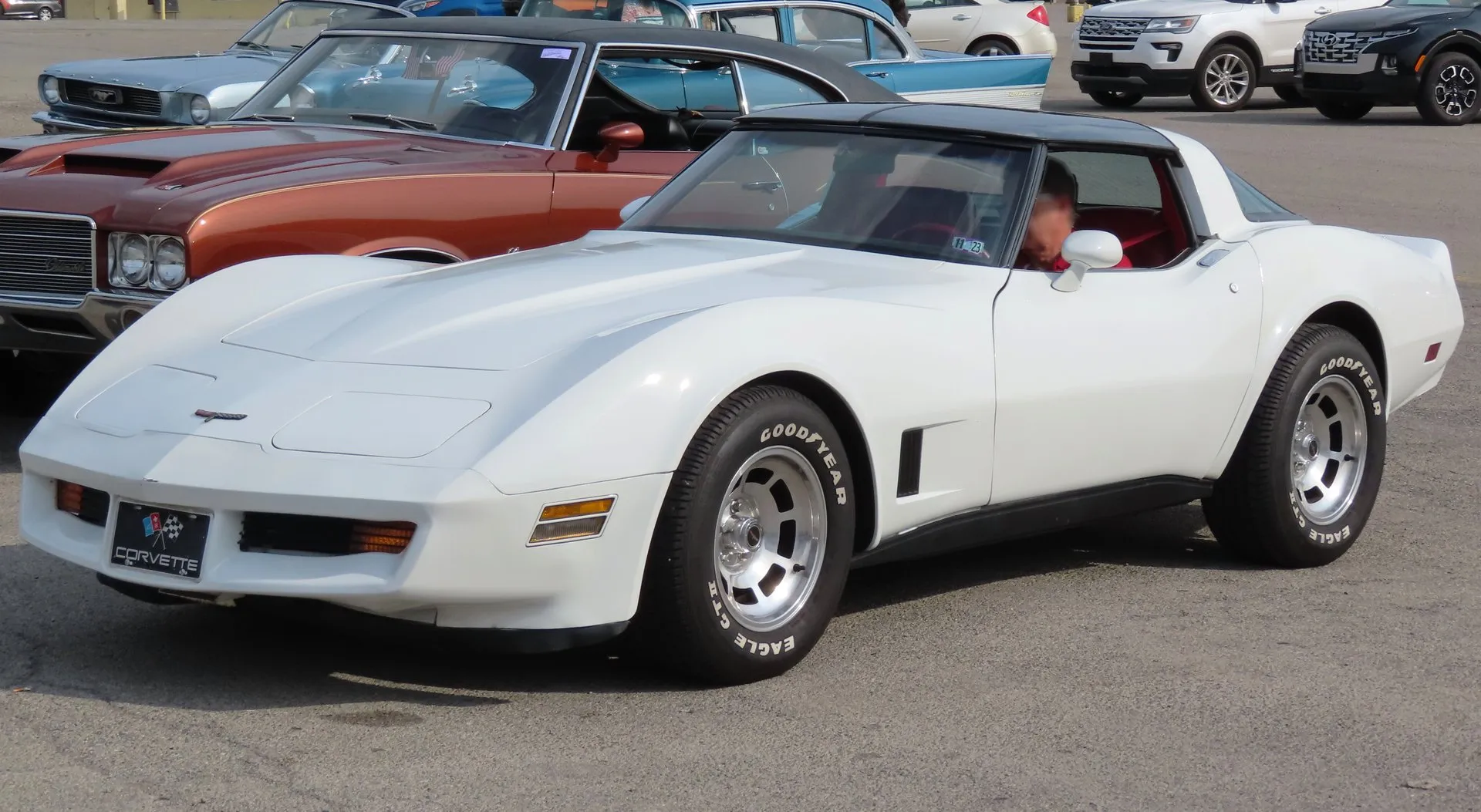
Eleven characters into a 1981 Corvette’s VIN sits the answer to where it was built: S for St. Louis, Missouri, or 5 for Bowling Green, Kentucky. No Corvette model year before it came from two plants at once, and in 1981 the plant decided the paint. St. Louis sprayed lacquer until its last car was finished on August 1, 1981. Bowling Green, whose first car was finished on June 1, used enamel with clear coat and, by the account of the Corvette Black Book, a hobby reference, painted every one of the year’s two-tones.
Under the paint, every 1981 is the same car: the 190 hp L81 350 with an engine computer, sold in all 50 states with a four-speed manual or an automatic, the first Corvette with a computer-run engine everywhere it was sold and the last with a clutch pedal until the 1984 C4. GM built 40,606 coupes, the 14th of the 15 model years of the C3 (1968–1982), at a base price of $16,258.52.
- What’s it worth? On Bring a Trailer in 2026, a median $15,300 from 11 sales; Hagerty’s #3 (Good) value is $16,300 (October 2025). Details in 1981 prices in 2026, original and swapped.
- Is 1981 a good year? For a driver, yes. It’s the only C3 with both a manual gearbox and an engine computer. The verdict is in the last section.
- Is it a Stingray? No: see Proving a 1981 is what it claims.
Figures here come from GM’s 1981 Heritage Center kit in this site’s owner’s manual library unless another source is named: GM’s order guide, brochure, press release and specification form, plus the Black Book pages GM reproduces in the kit. What every C3 shares, from frame rust to the birdcage, is in the C3 buyer’s guide.
C3 Key figures
- Built
- 40,606 coupes
- Plants
- St. Louis and Bowling Green
- Engine
- 190 hp L81 350
- Four-speeds built
- 5,757
- Price new
- $16,258.52
- Curb weight, GM figure
- 3,307 lb
- Bring a Trailer, 2026
- median $15,300 from 11 sales
- Hagerty #3 value
- $16,300 (October 2025)
Section 01
Two plants, one model year
The Black Book page in GM’s 1981 kit gives the dates for St. Louis and Bowling Green: the first Bowling Green car was completed June 1, 1981, and the last St. Louis car August 1, two months of overlap. Its VIN ranges, 400001 to 431611 for St. Louis and 100001 to 108995 for Bowling Green, make 31,611 St. Louis cars and 8,995 from Kentucky (this site’s arithmetic; the two add up to the 40,606 total, and the 1982 kit’s Black Book page gives the same 8,995). Roughly one 1981 in five came from Bowling Green.
A Chevrolet bulletin puts Bowling Green’s start in May, and owners have posted July 31 and September 1 for St. Louis’s last day; this page, like the C3 guide, uses the Black Book’s dates.
Every 1982 came from Bowling Green, so 1981 is the only year with two plants to choose between. Does a low St. Louis serial carry a premium? “Not really,” a long-time poster answered in 2017.
Owners argue about build quality. An original 1981 owner in a 2009 CorvetteForum thread (opens in new tab) tells buyers to find a Bowling Green car, for its base coat and clear coat paint and better assembly. Another Bowling Green owner rates its fit and finish far better and blames part of the gap on St. Louis workers who knew their jobs were ending (CorvetteForum, 2017). Those are owners’ views of cars now 45 years old; the car in front of you matters more.
Section 02
Lacquer, enamel and the 1981 colors
St. Louis kept lacquer to the end of its run; Bowling Green used enamel color coats under clear topcoats (the Black Book). Chevrolet’s bulletin 82-I-23 (opens in new tab) told dealers to repair Bowling Green’s acrylic enamel over a whole panel or to a feature line, because “Spot repair is not acceptable.”
The plants didn’t offer the same colors. The Black Book counts the St. Louis colors (its total runs 21 short of production, it warns); for Bowling Green, it says, the records aren’t available. GM’s order guide, revised June 15, 1981, lists Bowling Green’s seven single colors and four two-tones.
| St. Louis color (code) | Built |
|---|---|
| White (10) | 6,387 |
| Black (19) | 4,712 |
| Red (75) | 4,310 |
| Beige (59) | 3,842 |
| Charcoal Metallic (84) | 3,485 |
| Silver Metallic (13) | 2,590 |
| Dark Blue Metallic (28) | 2,522 |
| Maroon Metallic (79) | 1,618 |
| Mahogany Metallic (06) | 1,092 |
| Yellow (52) | 1,031 |
| Bright Blue Metallic (24) | 1 |
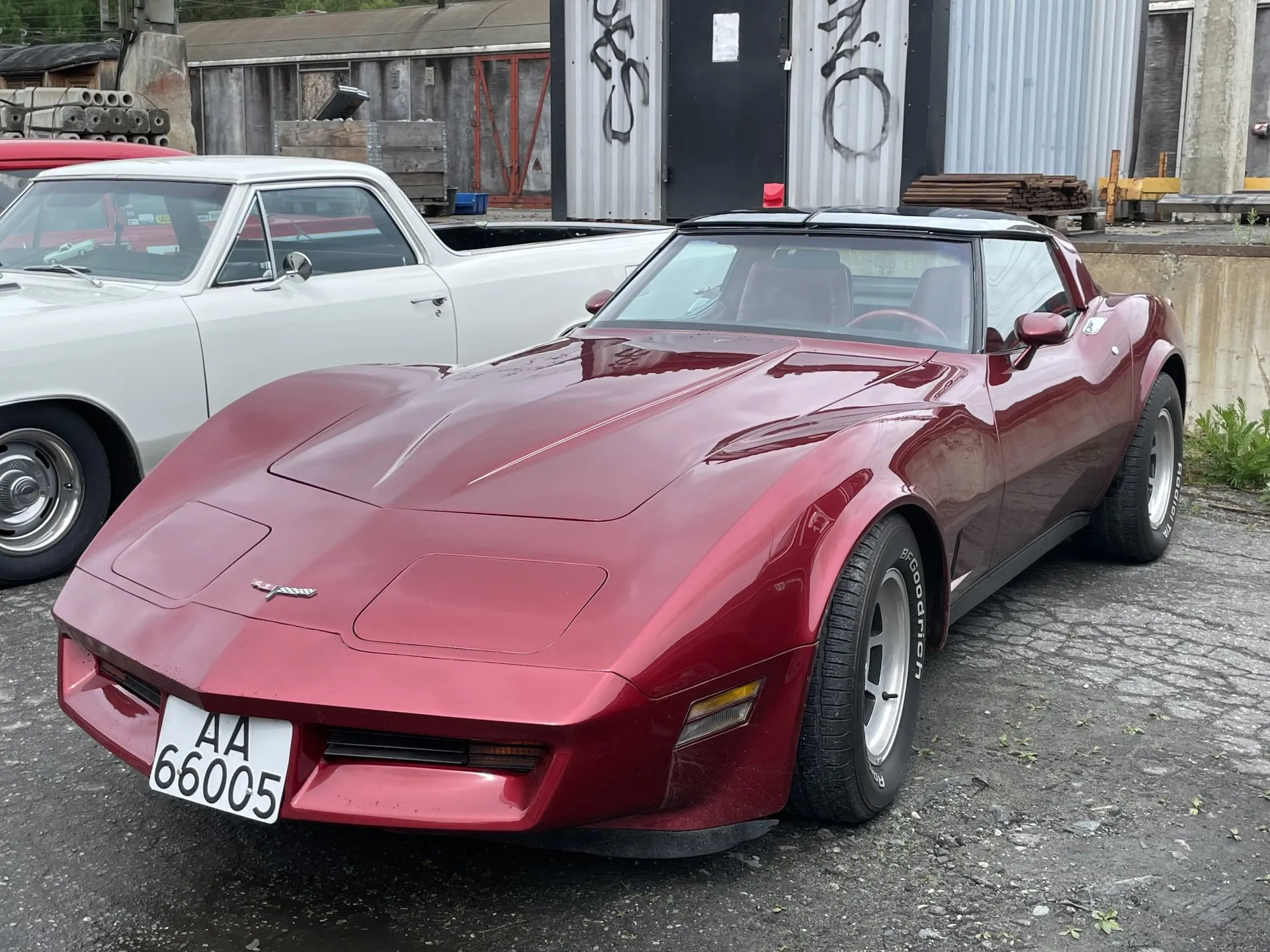
Bowling Green’s seven, under their own codes: Silver Metallic (33), Dark Blue Metallic (38), Charcoal Metallic (39), Beige (50), Dark Bronze Metallic (74), Autumn Red Metallic (80) and Dark Claret Metallic (98). (The order guide calls code 80 Claret; the bulletin and the Black Book, Autumn Red.) So a 1981 in white, black, red, yellow, mahogany or maroon left St. Louis.
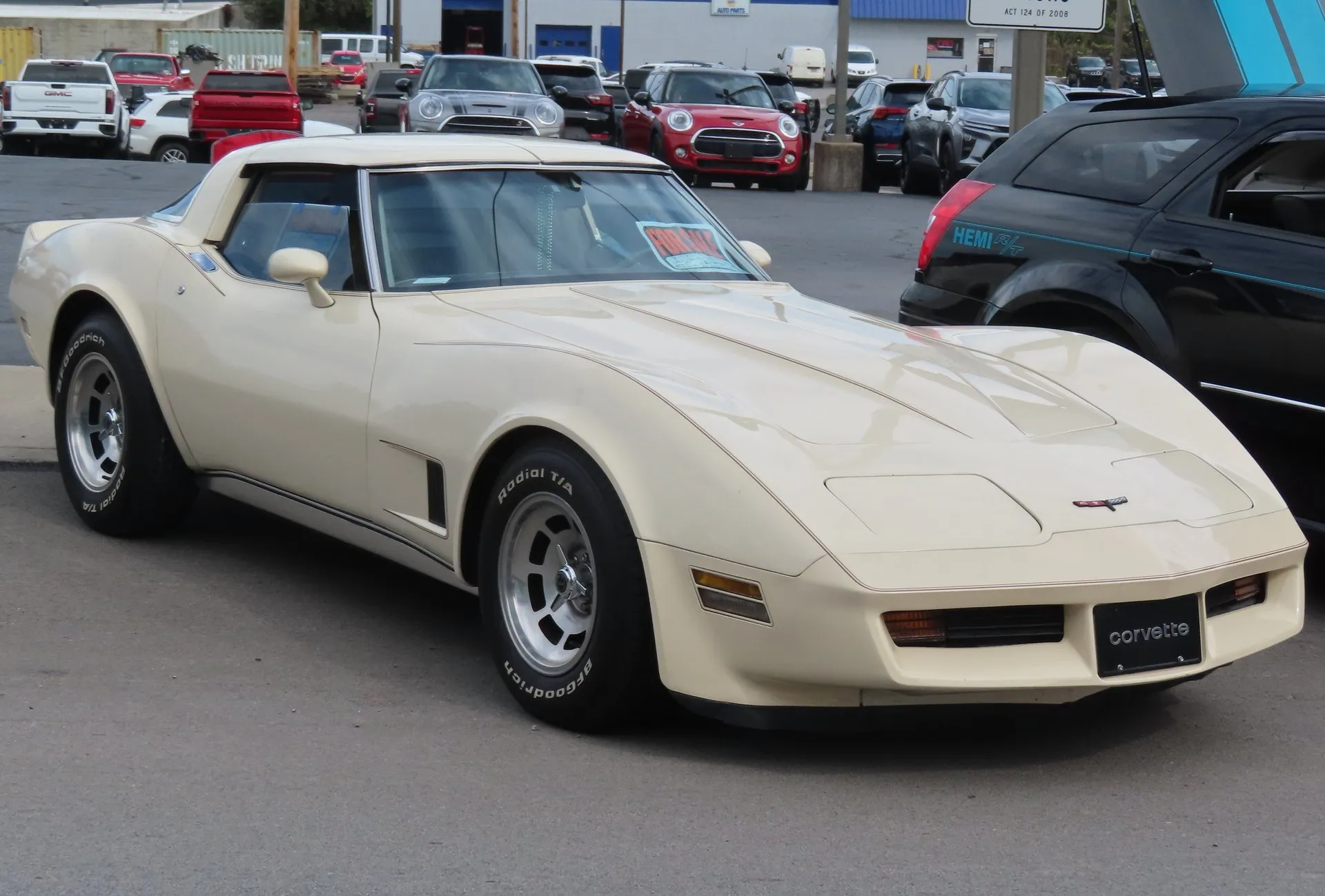
The two-tones. RPO D84 (RPO is GM’s regular production option code), $399 with pinstriping, went on 5,352 cars in four schemes, each with its own pinstripe color in the order guide: Beige and Dark Bronze with gold, Autumn Red and Dark Claret with red, Silver and Dark Blue with blue, Silver and Charcoal with gray. “All two-tone combinations were painted at the new Bowling Green facility,” the Black Book says. If that holds, more than half of Bowling Green’s 8,995 cars were two-tones (this site’s arithmetic). Nobody has a count by scheme.
The St. Louis exceptions. In July 1980, Chevrolet’s bulletin 80-I-68 (opens in new tab) told dealers that about 80 St. Louis pilot cars had been painted in two-tone acrylic enamel ahead of Bowling Green’s start-up, in the same four combinations, with “E” paint codes on the body plate. It doesn’t say which model year they were. Posters in a 2019 thread suspect a silver and dark blue St. Louis 1981, its trim tag dated November 1980, is one of them.
Section 03
The L81: one engine, a computer, and a clutch for California
GM’s September 1980 press release opened its powertrain news plainly: “Corvette for ‘81 offers a single engine for all 50 states.” Here is that engine, from GM’s specification form (power teams, manual gearbox, automatic and axle):
| 1981 L81 | GM’s figures |
|---|---|
| Displacement | 350 cu in (5.7 L), 4.00 x 3.48 in bore and stroke |
| Compression | 8.2:1 |
| Fuel | Rochester Quadrajet four-barrel, aluminum intake |
| Power, SAE net | 190 hp at 4,200 rpm |
| Torque, SAE net | 280 lb-ft at 1,600 rpm |
| Four-speed manual | 2.88, 1.91, 1.33, 1.00; reverse 2.78 |
| Automatic (Turbo Hydra-matic 350C) | 2.52, 1.52, 1.00, converter clutch in second and third |
| Axle | Limited slip standard; 2.72 with the manual, 2.87 with the automatic |
Against the 1980 L48, the power figure is the same and peak torque arrives 800 rpm sooner (280 lb-ft at 2,400 rpm in GM’s 1980 data). GM’s brochure prints 180 hp and its engine chart 9.0:1; the specification form, the engineering document, says 190 hp and 8.2:1, and so does this page.
Computer Command Control. Every 1981 had it: an engine computer (the ECM) that reads an oxygen sensor, sets the carburetor’s mixture and the ignition timing, and locks the automatic’s torque converter in second and third. California 1980s had GM’s one-year C-4 system on the 305; the 1980 guide tells that story. The 1981 also got the 305’s stainless steel exhaust manifolds.
A manual for California. In 1980, California buyers got a 305 and an automatic, nothing else. For 1981, the press release says, California buyers got a manual choice “for the first time in several years.” California cars still needed emissions option YF5 ($46, on 4,951 cars), and there the automatic came with a 2.72 axle, or 2.87 as RPO G92, a $20 performance axle 2,400 buyers took, per GM’s order guide. (GM’s brochure prints 2.87 for every automatic; the order guide and specification form agree with each other.) Every 1980 had a 3.07, so a 1981 turns fewer revs at a given speed.
The four-speed’s last stand. GM’s M18 four-speed (RPO MM4, no charge) went into 5,757 cars, about one in seven, the last manual Corvettes, the Black Book says, until well into the 1984 production year. The 1982 was automatic only; the manual came back as the 1984’s “4+3”.
1981 Corvette top speed. GM’s kit gives none. Corvette Action Center’s table of period tests credits Car and Driver’s December 1981 issue with 0–60 mph in 7.2 s and 130 mph, and Road & Track with 7.7 s; this site hasn’t checked either magazine. The dial couldn’t show it anyway: GM lists an “85-mph speedometer”, the federal rule the 1980 guide explains.
Section 04
Lighter underneath: the fiberglass spring and the rest
GM’s press release called it “the industry’s first fiberglass reinforced plastic monoleaf rear spring,” and it was the 1981’s headline engineering: one composite leaf in place of the steel multi-leaf spring across the back of the car, 8 lb against 44 lb by the Black Book, or 33 lb lighter by the press release.
Not every 1981 has one. GM’s value-features sheet puts it on automatics with the standard suspension and keeps the steel spring on manual cars and on cars with the Gymkhana suspension (RPO FE7, $57, 7,803 built), and GM’s specification form gives the FE7 spring eight steel leaves. The trailer package, ZN1, included Gymkhana, so owners say automatics with it got steel as well (CorvetteForum, 2010 and 2015). For 1982 the composite went under every car without FE7.
Owners say composites don’t sag the way steel does, but they can crack or break, and they hate heat, so keep the factory heat shields (Corvette Action Center forum, 2009). One owner’s original spring broke with only one mounting bolt left in place; check the bolts (CorvetteForum, 2003).
GM’s other weight savings, from the value-features sheet and press release:
- Stainless steel exhaust manifolds, about 14 lb lighter than cast iron.
- Magnesium valve covers, black with bright ribs.
- Thinner side glass.
- An auxiliary electric fan, which let GM fit a smaller, quieter engine-driven fan.
The scales barely moved: GM’s form gives the 1981 coupe a curb weight of 3,307 lb, against 3,334 lb for a 1980 (1980 kit), with slightly different equipment on the two sheets.
Section 05
The 1981 options: a power seat, new radios and the prices
The base price, $16,258.52, covered the engine, either gearbox, T-tops, and leather-and-vinyl or cloth-and-vinyl seats (the Black Book). GM’s equipment list adds air conditioning, power windows, a tilt-telescopic leather-wrapped steering wheel, an AM/FM radio and a 7,000-rpm tachometer. The options, with the Black Book’s prices and counts (PDF page 21):
| RPO | Option | Price | Built |
|---|---|---|---|
| C49 | Rear window defogger | $119 | 36,893 |
| N90 | Aluminum wheels | $428 | 36,485 |
| AU3 | Power door locks | $145 | 36,322 |
| U75 | Power antenna | $55 | 32,903 |
| K35 | Cruise control with resume (automatic only) | $155 | 32,522 |
| A42 | Six-way power driver’s seat | $183 | 29,200 |
| CC1 | Glass roof panels | $414 | 29,095 |
| UM6 | AM/FM stereo with cassette | $423 | 22,892 |
| QGR | P225/70R15 white-letter tires | $72 | 21,939 |
| QXH | P255/60R15 white-letter tires | $491.92 | 18,004 |
| DG7 | Electric sport mirrors | $117 | 13,567 |
| UM4 | AM/FM stereo with 8-track | $386 | 8,262 |
| FE7 | Gymkhana suspension | $57 | 7,803 |
| D84 | Two-tone paint | $399 | 5,352 |
| U58 | AM/FM stereo | $95 | 5,145 |
| V54 | Roof panel carrier | $135 | 3,303 |
| G92 | Performance axle | $20 | 2,400 |
| UN5 | AM/FM stereo with cassette and CB | $750 | 2,349 |
| F51 | Heavy-duty shocks | $37 | 1,128 |
| ZN1 | Trailer package | $110 | 916 |
| UM5 | AM/FM stereo with 8-track and CB | $712 | 792 |
| UL5 | Radio delete | $118 credit | 315 |
New for 1981: the power seat, the first on a Corvette and for the driver only; cruise with resume; the electric mirrors; and four electronically tuned stereos with built-in clocks. With one of those, the Black Book says, an oil temperature gauge took the dash clock’s place.
1981 Corvette interior. Leather came in silver gray (code 152), charcoal (192), dark blue (292), camel (642), dark red (672) and medium red (752); cloth in charcoal (19C), dark blue (29C), camel (64C) and dark red (67C), by the Black Book’s list. For the first time the headlamp and wiper switch bezels were molded in the interior color; on a 1980 they’re black whatever the trim. The standard anti-theft alarm gained a starter interrupt: it arms from the door lock switch with the driver’s door open and disarms with a key in either door lock (GM’s specification form).
Section 06
Proving a 1981 is what it claims
The VIN sits on the left windshield pillar, and 1981 was the first year of the 17-character format (the generations guide explains the switch). A 1981 reads 1G1 (a US-built Chevrolet), A (manual belts), Y (Corvette), 87 (coupe), 6 (the L81), a check digit, B (1981), S or 5 for the plant, then the serial: 400001 to 431611 from St. Louis, 100001 to 108995 from Bowling Green, per the Black Book and Corvette Action Center’s identification page (opens in new tab). A serial outside its plant’s range is wrong.
The engine stamp. GM’s engine pages put it on the pad just forward of the right-hand cylinder head: a source plant letter, the month and day, and a suffix, with a partial VIN nearby. The 1981 suffixes, from GM’s identification chart: ZDA (manual, federal), ZDB (automatic, California), ZDC (manual, California) and ZDD (automatic, federal). The block (14010207) and head (462624) castings carried on into 1982, 1984 and 1985, so a casting number can’t date the engine; the stamp and partial VIN have to.
The rest of the drivetrain. GM’s chart gives the four-speed the code CC and the automatic 8JD, and the axle OK for the 2.72 with the manual or OJ for the 2.87 with the automatic. It lists no code for a California automatic on its standard 2.72, so a car that fits neither code isn’t automatically wrong. Carburetors, by Corvette Action Center: 17081217 on manuals, 17081228 on automatics and 17081218 on California automatics; the distributor is 1103443.
Paint against plant. The color lists in Lacquer, enamel and the 1981 colors make a quick test: a St. Louis VIN wearing a factory two-tone needs to be one of the pilot cars, or it’s been repainted. A Bowling Green VIN in white, black, red or yellow wears a color GM didn’t list for Bowling Green that year, so expect a repaint unless paperwork says otherwise. Owners read the trim tag’s paint codes; one Bowling Green Autumn Red and Dark Claret car’s tag reads “80L 80U 98” (CorvetteForum, 2019).
The computer. The original Computer Command Control distributor has an extra multi-pin connector; a single pink wire means an aftermarket HEI, owners say (CorvetteForum, 2009).
Paper. A window sticker and build sheet settle most arguments, and two of 2026’s Bring a Trailer cars had both. National Corvette Restorers Society (NCRS) judging deducts from 4,500 points, and a Top Flight award needs 94 percent; one 2026 sale carried one.
Is a 1981 Corvette a Stingray? No. Hagerty’s Brandan Gillogly writes that the Stingray name was gone from car and brochures for 1977, not to return until the 2014 C7, and GM’s 1981 brochure drawing shows crossed flags and a “Corvette” nameplate.
Section 07
Fuel tanks, a speed sensor and GM’s 1981 bulletins
NHTSA’s complaint file (opens in new tab) holds six complaints about the 1981 Corvette, the most of any C3 year, which still isn’t much. Four describe the fuel tank’s plastic liner cracking at its front lower corners and fuel rusting through the steel shell; three of those are identical and were filed the same day in 1998. One, from 2018, tells of an upper control arm bolt that kept coming out; the sixth describes no defect. NHTSA lists no GM recall and holds no GM bulletin for the year, and its complaint file starts in September 1994, so none of this says how the cars fared new. Its two recalls cover replacement parts: Cardone rear calipers made in 2002–2003 (18-7019, 18-7020, 16-7019 and 16-7020, aftermarket) and Fram HP4 and HP8 oil filters.
Chevrolet’s dealer bulletins for the 1981, as transcribed by Corvette Action Center:
- 81-I-17, January 1981. The speedometer carries an optical speed sensor that feeds the computer for converter-clutch and idle control; a fault shows as trouble code 24.
- 81-I-19, January 1981. Light glows around the wiper switch bezel at night on some early cars with silver, red or rust trim; the fix is a black bezel,
GM 14016216(OEM), painted to match. - 81-T-20, July 1981. A whistle or whine in reverse or first at idle from the 350C automatic: dealers enlarged one hole in the valve-body spacer plate with a No. 41 drill.
- 82-T-144. A GM repair program for plugged or damaged dual-bed converters on 1981 5.7-liter cars: the 1981 Corvette’s
GM 8999338was replaced byGM 25056672(both OEM). It was a dealer program, not a safety recall.
The computer, by the owners who live with it. Owners say the 1981’s ECM, mixture-control Quadrajet, oxygen sensor, distributor and speed sensor work only as a set, and that the carburetor, distributor, ECM and harness were one-year parts (CorvetteForum, 2012). Plenty of 1981s have had the lot swapped for an earlier Quadrajet and HEI or aftermarket injection, as some posters in a 2020 thread (opens in new tab) urge. An experienced poster there says the system mainly gives trouble when neglected or tampered with, and others warn that the converter clutch needs a substitute switch once the ECM goes. Check local emissions rules before pulling anything. Owner-reported prices: about $500 for a replacement 1981 carburetor (2020), just over $100 for a CCC distributor (2009).
Everything else is the C3’s: frame and birdcage rust, 1976–1982 floors, water leaks, vacuum headlights, calipers, rear wheel bearings and power steering, each covered in Known C3 problems in the C3 buyer’s guide.
Section 08
Frame to fuel tank: inspecting a 1981
- Frame and birdcage first, by the C3 checklist. Owners tap the frame ahead of the rear wheels and look hard at the windshield pillars (CorvetteForum, 2009).
- VIN against title: S with 400001–431611, or 5 with 100001–108995.
- Paint against plant, by the color lists. A mismatch means a repaint until proven otherwise.
- The engine pad: ZDA, ZDB, ZDC or ZDD, a date that fits and a matching partial VIN.
- The computer system: multi-pin distributor, original carburetor and ECM in place. If it’s gone, price the car as modified.
- The rear spring: on an automatic, cracks in the composite leaf, its heat shields and bolts. A manual or FE7 car should have steel.
- The fuel tank, for seepage at the front lower corners.
- The automatic: listen for a whine in reverse and first at idle (bulletin 81-T-20).
- The lower front air dam, which owners say tears (CorvetteForum, 2009).
- An inspection on a lift, by a shop that knows C3s.
Section 09
1981 prices in 2026, original and swapped
How much is a 1981 Corvette worth? On Bring a Trailer (opens in new tab), 13 1981s were listed between January 1 and October 22, 2026, and 11 sold, at a median of $15,300, from $5,500 to $22,500 (this site’s count of sold prices without the buyer’s fee). That sample mixes two kinds of car:
| 1981s on Bring a Trailer, 2026 | Sold | Median | Prices |
|---|---|---|---|
| Original L81 drivetrain | 7 | $19,000 | $5,500 to $22,500 |
| Engine swapped or heavily modified | 4 | $11,425 | $9,000, $9,100, $13,750, $18,500 |
The top sale was a 6,000-mile Bowling Green automatic in silver with red leather, window sticker, build sheet and an NCRS Top Flight award: $22,500 in April, after bidding stalled at $28,000 in February. A Bowling Green Claret two-tone with Gymkhana suspension brought $19,250; the two four-speeds, a black St. Louis car and a lowered Bowling Green car, $19,000 and $15,300; a running project, $5,500. Four Bowling Green cars brought a median $18,875 against $9,100 for seven from St. Louis, but the St. Louis group held the project and three of the four swapped cars: condition, not plant.
In 2025, 7 of 10 listed 1981s sold, at a median of $19,500 ($7,500 to $25,281). Samples this small are market color, not a valuation or a forecast.
Other measures. Hagerty’s #3 (Good) value (opens in new tab) for a 1981 coupe was $16,300 (October 2025), up 8.7 percent on the year; a newer reading couldn’t be checked. Hagerty had a 1980 L48 at $16,200 and a 1982 coupe at $17,200 (both January 2026), and the C3 guide’s 1978–1982 median on Bring a Trailer was $17,625 (18 sales, June 16 to September 26, 2026).
Section 10
Between the 1980 and the 1982
1981 or 1980? Same body, same 190 hp base rating, nearly the same weight. The 1980 offers the 230 hp L82 and, outside California, no engine computer; the 1981 offers a manual in every state, the fiberglass spring and the power seat.
1981 or 1982? The 1982 brings Cross-Fire Injection, 200 hp and a four-speed overdrive automatic, and no other gearbox. Owners in a 2009 thread split: some find the 1981’s carburetor and three-speed simpler to fix and modify, others want the 1982’s injection and overdrive. Only the 1981 offers a clutch pedal.
Which year to stay away from? Not this one. The slow C3s, by the C3 guide, are the 1975 and the 1980 California car, and the best-years guide picks 1978–1982 as the C3 years for driving.
Section 11
Which 1981 to buy: a four-speed, from Kentucky if you can
The pick is a four-speed with its numbers and computer intact. It’s what only a 1981 offers: a clutch pedal and an engine computer in one C3, and the last manual Corvette before the 1984’s 4+3. Look for ZDA or ZDC on the pad and steel under the back.
Given two good ones, take the Bowling Green car. That’s this site’s reading, not a rule: the Black Book gives it enamel under clear coat, owners rate its assembly better, and with only one 1981 in five built there, a Bowling Green four-speed should be the scarcer of the two (an inference: GM’s paper doesn’t say how many four-speeds each plant built). The market hasn’t priced that in: 2026’s one Bowling Green four-speed brought $15,300 on aftermarket suspension, below the black St. Louis car’s $19,000. A 5 in the VIN’s 11th place and a color from the Bowling Green list prove it; condition still comes first.
For a factory two-tone, a Bowling Green automatic. The best-kept 2026 sales, the Top Flight car and the Claret two-tone with its window sticker, both came from Kentucky.
On a budget, a complete St. Louis automatic, the commonest 1981 by far and the only one in white, red, yellow or black. 2026’s original St. Louis cars ran from $5,500 for a project to $20,000, by condition.
Price a swapped car as a modified car. It can be a fine driver, but 2026’s four brought a median $11,425: don’t pay original-car money.
Whichever plant built it, the birdcage gets checked before the VIN. Then find a clear stretch of two-lane, drop it into second and let the L81 pull through third. America’s sports car wouldn’t offer a clutch pedal again until well into 1984 production.
Section 12
Sources
- GM Heritage Center: 1981 Corvette vehicle information kit files.zipcorvette.com This site's library. GM's dealer order guide, revised June 15, 1981 (PDF pages 4 to 6); engine, transmission and axle identification (8); engine stamp location (10 to 13); VIN chart (14); spec card (16); the Corvette Black Book pages GM reproduces: production, VIN ranges, codes and the year's facts (20), options, prices, counts and colors (21); dealer brochure and value features (22 to 33); Chevrolet press release of September 11, 1980 (34, 36); MVMA specification form, September 1980 (38 to 75).
- GM Heritage Center: 1980 Corvette vehicle information kit files.zipcorvette.com This site's library. The 1980 coupe's curb weight (PDF page 46), ratings (28) and axle (27), for comparison.
- GM Heritage Center: 1982 Corvette vehicle information kit files.zipcorvette.com This site's library. The Black Book page: Bowling Green's 1981 output of 8,995 cars.
- NHTSA owner complaints, 1981 Chevrolet Corvette (opens in new tab) api.nhtsa.gov Six complaints (ODI 529765, 529766, 529786, 821063, 753118 and 11162151), pulled October 22, 2026. NHTSA's complaint file begins in September 1994.
- NHTSA recalls, 1981 Chevrolet Corvette (opens in new tab) api.nhtsa.gov Pulled October 22, 2026. No GM recall. Aftermarket-part campaigns 03E032000 (opens in new tab) (Cardone calipers) and 07E088000 (opens in new tab) (Fram oil filters).
- NHTSA manufacturer communications (TSB) files, received 1995–1999 and 2000–2004 (opens in new tab) static.nhtsa.gov With the 2000–2004 file (opens in new tab), downloaded October 22, 2026: no GM bulletin for a 1980, 1981 or 1982 Corvette.
- Chevrolet dealer bulletin 80-I-68: enamel paint pilot program, July 1980 (via Corvette Action Center) (opens in new tab) corvetteactioncenter.com About 80 St. Louis pilot cars in two-tone acrylic enamel. Corvette Action Center's transcriptions are not GM originals.
- Chevrolet dealer bulletin 82-I-23: enamel paint usage and repair, 1981–1982 (via Corvette Action Center) (opens in new tab) corvetteactioncenter.com Bowling Green's 1981 colors, enamel and base coat/clear coat, and the repair rule.
- Chevrolet dealer bulletin 81-I-17: vehicle speed sensor servicing, January 1981 (via Corvette Action Center) (opens in new tab) corvetteactioncenter.com Also 81-I-19, glow around the wiper switch (opens in new tab) (January 1981), 81-T-20, whine in reverse or first (opens in new tab) (July 1981) and 82-T-144, catalytic converter repair (opens in new tab).
- Corvette Action Center: 1981 Corvette production and options (opens in new tab) corvetteactioncenter.com Fetched October 22, 2026. Its table of period road tests (Car and Driver, December 1981; Road & Track), not read in the magazines. Also its 1981 identification page (opens in new tab): VIN digits, castings, carburetors.
- Hagerty valuation tool: 1981 Chevrolet Corvette coupe (opens in new tab) web.archive.org Internet Archive copy of November 10, 2025. #3 (Good) value $16,300 on the graph dated October 2025.
- Hagerty: 1968–82 Chevrolet Corvette (C3) buyers guide (opens in new tab) hagerty.com Sajeev Mehta, May 13, 2020, updated June 24, 2022. Read via the Internet Archive's June 2025 copy (opens in new tab).
- Hagerty (via IMSA): When is a Corvette a Sting Ray and not a Stingray? (opens in new tab) web.archive.org Brandan Gillogly, Hagerty, September 6, 2022, as syndicated by IMSA. Internet Archive copy of May 4, 2023.
- Bring a Trailer: Chevrolet Corvette C3 results (opens in new tab) bringatrailer.com 1981 listings only, January 1, 2025 to October 22, 2026. Counts and medians are this site's, from each listing's sold price without the buyer's fee; plants read from each listing's VIN. Cars named in the text: the Top Flight car (opens in new tab) (April), the black four-speed (opens in new tab) (February), the Claret two-tone (opens in new tab) (June) and the Bowling Green four-speed (opens in new tab) (October).
- NCRS: judging awards (opens in new tab) ncrs.org Flight judging and the Top Flight award.
- CorvetteForum thread: which year to purchase, 1981 or 1982 (opens in new tab) corvetteforum.com April 2009. An original owner on the plants; the 1981 and 1982 drivetrains compared.
- CorvetteForum thread: 1981 VIN question (opens in new tab) corvetteforum.com March 2010. Plant codes, serial ranges, lacquer and enamel, two-tones.
- CorvetteForum thread: 1981 St. Louis two-tone (opens in new tab) corvetteforum.com August 2019. A St. Louis-VIN two-tone and the pilot cars; a Bowling Green trim tag. Owner claims.
- Corvette Action Center thread: 1981 two-tone paint (opens in new tab) forums.corvetteactioncenter.com November 2014. No two-tone breakdown exists.
- CorvetteForum thread: 1981 early production C3 (opens in new tab) corvetteforum.com February 2017. Early serials and collectibility; owners on Bowling Green fit and finish.
- CorvetteForum thread: looking at a 1981, things to look for (opens in new tab) corvetteforum.com October 2009.
- CorvetteForum thread: considering buying an 81 (opens in new tab) corvetteforum.com August 2012. One-year engine-control parts; the Stingray badge question.
- CorvetteForum thread: 81 ECM and carb problems (opens in new tab) corvetteforum.com September 2020. Keep or replace Computer Command Control. Owner-reported price.
- CorvetteForum thread: 1981 Computer Command Control ignition and carb replacement (opens in new tab) corvetteforum.com April 2009. Telling a CCC distributor from an aftermarket HEI. Owner-reported price.
- Corvette Action Center thread: fiberglass monoleaf spring (opens in new tab) forums.corvetteactioncenter.com March to April 2009.
- CorvetteForum thread: when your mono-leaf spring breaks (opens in new tab) corvetteforum.com July 2003.
- CorvetteForum thread: composite or steel rear spring on a 1981 (opens in new tab) corvetteforum.com September 2015.
- CorvetteForum thread: how many 1980 and 1981 four-speeds (opens in new tab) corvetteforum.com 2009. The Black Book's four-speed counts, as posted by owners.