C4 · Buying guide
1987 Corvette guide: roller lifters, the Z52 and the Callaway twin-turbo
Published
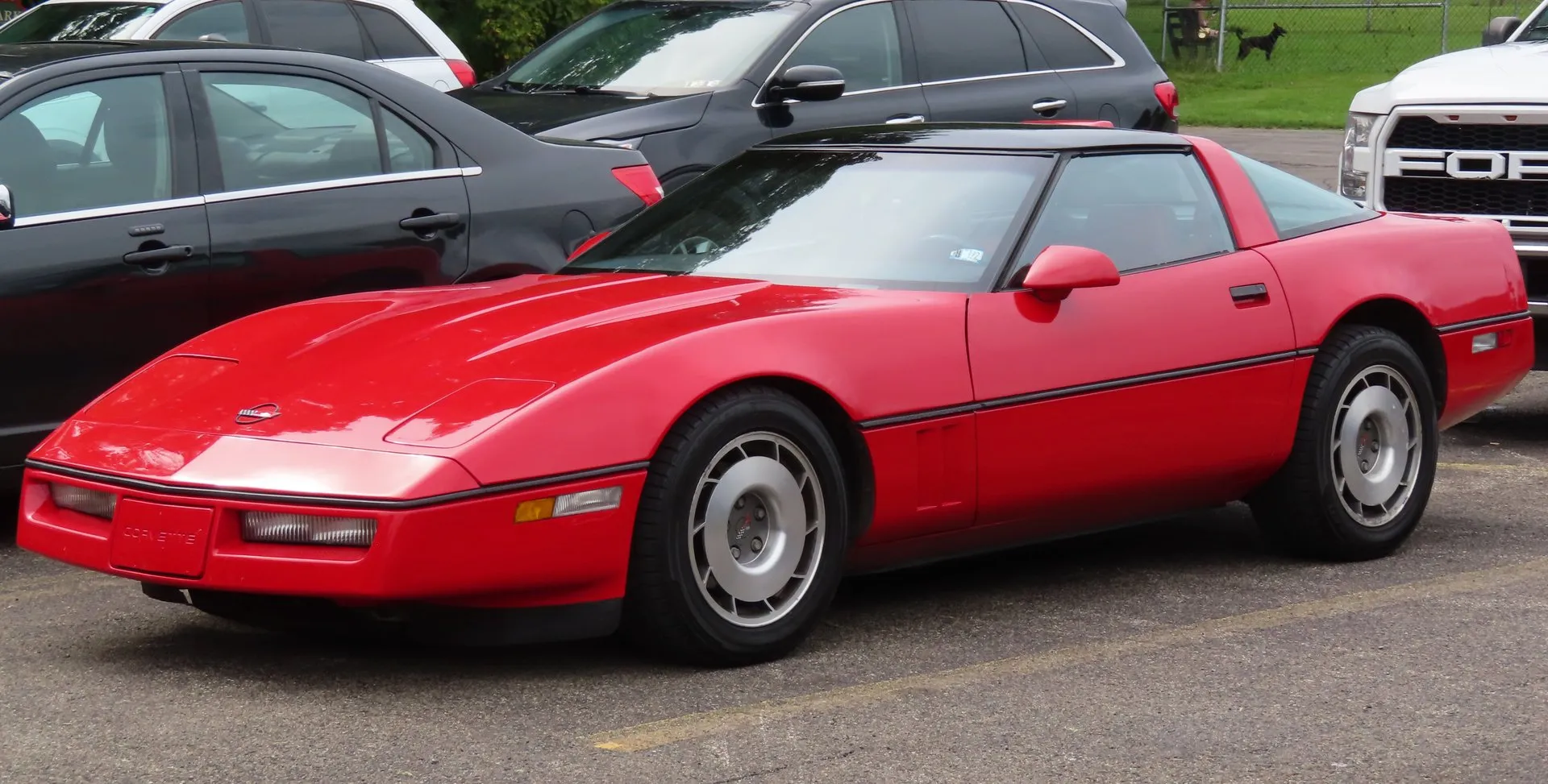
Forty-six 1987 Corvettes were sold with an option that has a line drawn through it in Chevrolet’s dealer order guide. It was RPO UJ6 (RPO is GM’s regular production option code), a $325 low tire pressure warning, struck out by hand on both the coupe’s and the convertible’s pages of the guide in GM’s Heritage Center kit. The Corvette Black Book, a hobby reference whose 1987 pages sit in the same kit, gives the reason: the option “was on constraint during 1987 due to false signalling problems. However, Chevrolet records show forty-six units sold.”
A warning light that cried wolf makes a fitting footnote, because the real changes for 1987 were quiet ones. The fourth model year of the C4 (1984–1996) got roller lifters and 5 more horsepower, a softer handling package called Z52 that more than four in ten buyers took, and a twin-turbo engine that a Chevrolet dealer could order but GM didn’t install. Bowling Green built 20,007 coupes and 10,625 convertibles, 30,632 in all.
Four decades on, a 1987 sells for a median of $11,000 from seven sales on Bring a Trailer in 2026. The C4 buyer’s guide covers what every C4 shares; this page works from GM’s 1987 kit, in the site’s manual library.
- Engine: the L98 5.7-liter V8 with Tuned-Port Injection, 240 hp at 4,000 rpm, 345 lb-ft at 3,200 rpm.
- Bodies: coupe or convertible; $27,999 coupe, $33,172 convertible.
- New: roller lifters, the Z52 package and the Callaway option, plus a 91-octane fuel rating.
- 2026 money: Hagerty’s February values for a #3 (good) car are $10,100 coupe, $13,000 convertible.
C4 Key figures
- Built
- 20,007 coupes and 10,625 convertibles, 30,632 in all
- L98 V8
- 240 hp at 4,000 rpm, 345 lb-ft at 3,200 rpm
- Price new
- $27,999 coupe, $33,172 convertible
- New for 1987
- roller lifters, the Z52 package and the Callaway option
- Fuel
- 91-octane unleaded
- Callaway B2K
- 184 cars, $19,995 on top of the Corvette
- Bring a Trailer, 2026
- a median of $11,000 from seven sales
- Hagerty #3, Feb 2026
- $10,100 coupe, $13,000 convertible
Section 01
Roller lifters, 240 hp and a premium-fuel label
The big change for 1987 is invisible. The L98 got roller valve lifters, which follow the camshaft on a small wheel instead of sliding across it. Chevrolet’s ordering information says they “reduce friction and improve drivability” (page 16). The Black Book credits the friction cut with 240 hp, “up 5hp” from the 1986’s aluminum-head engine (page 4).
GM’s power-team sheet gives 240 bhp at 4,000 rpm and 345 lb-ft at 3,200 rpm, SAE net, on 9.5:1 compression (page 43). The 1986 made 330 lb-ft at the same engine speed, so torque rose 15 lb-ft. Every 1987 has the same castings: block 14093638 and aluminum heads 14101128, the heads that only convertibles and late coupes got in 1986.
The fuel rating changed with it. Chevrolet’s 1987 sales book calls for “91-Octane Rating Unleaded Gasoline” (page 34), and GM’s engine sheet lists an antiknock index of 91. The 1986 sheet said 87 (1986 kit, page 26). A footnote allows 85 octane in certain high-altitude areas, as the owner’s manual specifies. Budget for 91-octane unleaded, and ask a seller what the car has been running on.
Gearboxes and axles. The 700-R4 four-speed automatic was standard. The Doug Nash 4+3 manual, a four-speed with overdrive in the top three gears (“in effect, a 7-speed transmission,” the sales book says), cost nothing extra and went on 4,229 cars: 13.8 percent, down from 19.5 percent in 1986 (this site’s arithmetic). That leaves about 26,400 automatics.
Every manual car required the boost fan, the engine oil cooler and the heavy-duty radiator (order guide, page 10). GM’s power-team sheet gives automatic coupes a 2.59 axle and automatic convertibles a 2.73. Manuals got a 3.07 on the larger 8.5-inch ring gear, either body. The $22 G92 performance axle put a 3.07 behind the automatic and went on 7,285 cars; on the convertible it couldn’t be had with the Bose stereo.
The rest of the numbers. GM’s curb weight sheet gives 3,229 lb for the coupe and 3,299 lb for the convertible (page 66). Wheelbase 96.2 in, length 176.5 in, width 71.0 in, height 46.7 in for the coupe and 46.4 in for the convertible, and a 20-gallon tank. EPA’s current ratings for the automatic are 15 mpg city, 23 highway and 17 combined; EPA lists no 1987 manual.
Tire size and bolt pattern. Standard tires were Goodyear Eagle VR50s, P255/50VR-16, at 35 psi front and rear, on 16 x 8.5-inch alloy wheels. The studs sit on a 4.75-inch (120.7 mm) circle, five of them, with M12 x 1.5 nuts, one an anti-theft nut (page 54). The spare is a compact P155/80D-16 under the fuel tank.
GM’s kit gives no 0–60 time or top speed for a base 1987, and no period road test of one turned up, so this guide gives none.
Section 02
Z51 or Z52: the 1987 handling split
For 1986, the Z51 cost $470, went on 12,821 coupes and came with either gearbox (only 6,835 1986s had the manual). For 1987, Chevrolet split it in two.
| Z51 Performance Handling | Z52 Sport Handling | |
|---|---|---|
| Price | $795 | $470 |
| Built | 1,596 | 12,662 |
| Bodies | coupe only | coupe and convertible (Black Book) |
| Gearbox | 4+3 manual only | either |
| Springs and bars | heavy-duty suspension | base springs; larger front bar except early cars |
| Common to both | Bilstein shocks, oil cooler, boost fan, heavy-duty radiator, 9.5-inch-wide wheels, faster steering |
The Black Book option page says the Z51 was for “Coupes and manual transmissions only,” and the coupe’s order guide adds that it required the manual and ruled out the G92 axle (the 3.07 came with it anyway). The Z52 paired most of the Z51’s hardware and a quicker 13:1 steering ratio “with the softer suspension of base models.” Both packages also got structural reinforcements developed for the convertible, and the Z51 gained a finned power steering fluid cooler. Hagerty’s history of the generation says the Z52 “covered the middle ground.”
The Z52 went on 41.3 percent of all 1987s and the Z51 on 8.0 percent of coupes. Owners in a 2016 CorvetteForum thread on the 1987 Z51 (opens in new tab) call the Z52 the better road car and the Z51 the stiff one; that’s owner opinion, not a test.
GM’s paper disagrees with itself on convertibles. The ordering sheet says the Z52 was “available for Coupe,” and the convertible’s order guide page lists neither package in type, then adds the Z52 and the Bilsteins by hand (page 12). The Black Book says the Z52 “was available with coupes or convertibles,” and owners report Z52 convertibles. No count splits the 12,662 by body.
A convertible doesn’t need the package for the wide wheels: Chevrolet’s ordering information lists 16 x 9.5-inch wheels as standard on the convertible.
Section 03
The Callaway B2K, finished in Connecticut
The fastest 1987 Corvette left Bowling Green as an ordinary L98 car. The Callaway Twin-Turbo “was not a factory-installed option, but could be ordered through participating Chevrolet dealers as RPO B2K,” the Black Book says. The plant built the car to a set equipment list and shipped it to Callaway Engineering in Old Lyme, Connecticut, which installed its twin-turbo engine.
The Black Book’s record of the 1987 cars:
- 184 cars, $19,995 on top of the Corvette: 121 coupes and 63 convertibles.
- 345 hp and 465 lb-ft, and a top speed of 177.9 mph “with .60 overdrive gearing,” with no test named.
- All manual, and none certified for sale in California.
- The first four used replacement LF5 truck short blocks; later cars reworked production engines.
- Their own engine numbers: Chevrolet’s coding was replaced by two digits for the year, three for the Callaway sequence and four matching the last four of the VIN.
Corvette Action Center publishes figures it credits to Car and Driver’s test of a Callaway coupe in the November 1986 issue: 0–60 mph in 4.7 seconds, the quarter mile in 13.2 seconds at 108 mph and a 161 mph top speed, at $52,585 as tested. Those numbers come only through that transcription; this guide couldn’t find the original article.
The B2K stayed on the order sheet through 1991, by Hagerty’s account; the 1990 guide covers that year’s 58 cars. A 1987 Callaway is worth roughly double a stock car: Hagerty’s February 2026 #3 values are $20,100 for a coupe and $24,600 for a convertible. Bring a Trailer has sold two since December 2024: a Medium Blue convertible with the four-speed for $22,250 in December 2025 and a Dark Red Z51 coupe with 14,000 miles for $32,250 in August 2026. The coupe came with Callaway’s certificate of authenticity and a console plaque reading 60 of 184. That’s the paperwork to expect. A Callaway without it is a Corvette with turbochargers until proven otherwise.
Section 04
Smaller 1987 changes, inside and out
From GM’s pages in the kit, the rest of what changed from 1986:
- Electronic air conditioning (RPO C68, $150) spread from coupes to convertibles too, and went on 20,875 cars.
- Two new comfort options: a power passenger seat (AC1, $240, 17,124 cars) and a lighted driver’s vanity mirror (D74, $58, 14,992).
- Mirrors: heated ones for the convertible (DL8, $35, 6,840; on coupes they came with the Z6A defogger), and air deflectors on convertibles and early coupes only.
- The dash: the 4+3’s overdrive light moved from the center of the dash into the tachometer display, and the generator warning moved to the console’s driver information module. Otherwise the digital cluster carried over.
- Wheel centers painted argent gray. The 1986’s were left unpainted, and 1984–1985 centers were black.
- Theft-deterrent part labels: “Key components carry identification,” the ordering sheet says.
- The convertible top’s number 5 bow weatherstrip, which pulled loose on some 1986s, was glued “from the start of 1987 production,” GM’s bulletin 87-148 says.
The pelleted VATS key (Vehicle Anti-Theft System) and the Bosch ABS II anti-lock brakes carried over from 1986 as standard.
Section 05
Bose in nine cars of ten: 1987 options and colors
The base price bought the L98, the automatic, cloth seats and a body-color roof panel or a soft top. Most buyers added the comfort options on top, and the $905 Delco-Bose stereo went on 90.5 percent of cars. Counts and prices from the Black Book’s option page (page 6):
| RPO | Option | Price | Built |
|---|---|---|---|
| AU3 | Power door locks | $190 | 29,748 |
| K34 | Cruise control | $185 | 29,594 |
| AC3 | Power driver’s seat | $240 | 29,561 |
| UU8 | Delco-Bose stereo | $905 | 27,721 |
| C68 | Electronic air conditioning control | $150 | 20,875 |
| Z6A | Rear window and mirror defoggers (coupe) | $165 | 19,043 |
| AC1 | Power passenger seat | $240 | 17,124 |
| AR9 | Base seats, leather | $400 | 14,579 |
| AQ9 | Sport seats, leather | $1,025 | 14,119 |
| Z52 | Sport handling package | $470 | 12,662 |
| 24S | Blue-tint roof panel (coupe) | $615 | 8,883 |
| 64S | Bronze-tint roof panel (coupe) | $615 | 5,766 |
| C2L | Dual removable roof panels (coupe) | $915 | 5,017 |
| NN5 | California emissions | $99 | 5,423 |
| MM4 | 4+3 manual | No charge | 4,229 |
| FG3 | Delco-Bilstein shocks | $189 | 1,957 |
| Z51 | Performance handling package (coupe) | $795 | 1,596 |
| D84 | Two-tone paint (coupe) | $428 | 1,361 |
| B2K | Callaway Twin Turbo (not GM installed) | $19,995 | 184 |
The 24S count’s first digit is faint on GM’s scan; Corvette Action Center also prints 8,883. Interiors came in graphite, medium gray, blue, saddle, bronze or red, in cloth or leather. Soft tops were black, saddle or white.
Prices rose $972 for the coupe and $1,140 for the convertible over 1986. Production fell by 4,477 cars: coupes dropped 7,787 while convertibles rose 3,310. Convertibles made up 34.7 percent of 1987 production, against 20.8 percent in 1986 (this site’s arithmetic).
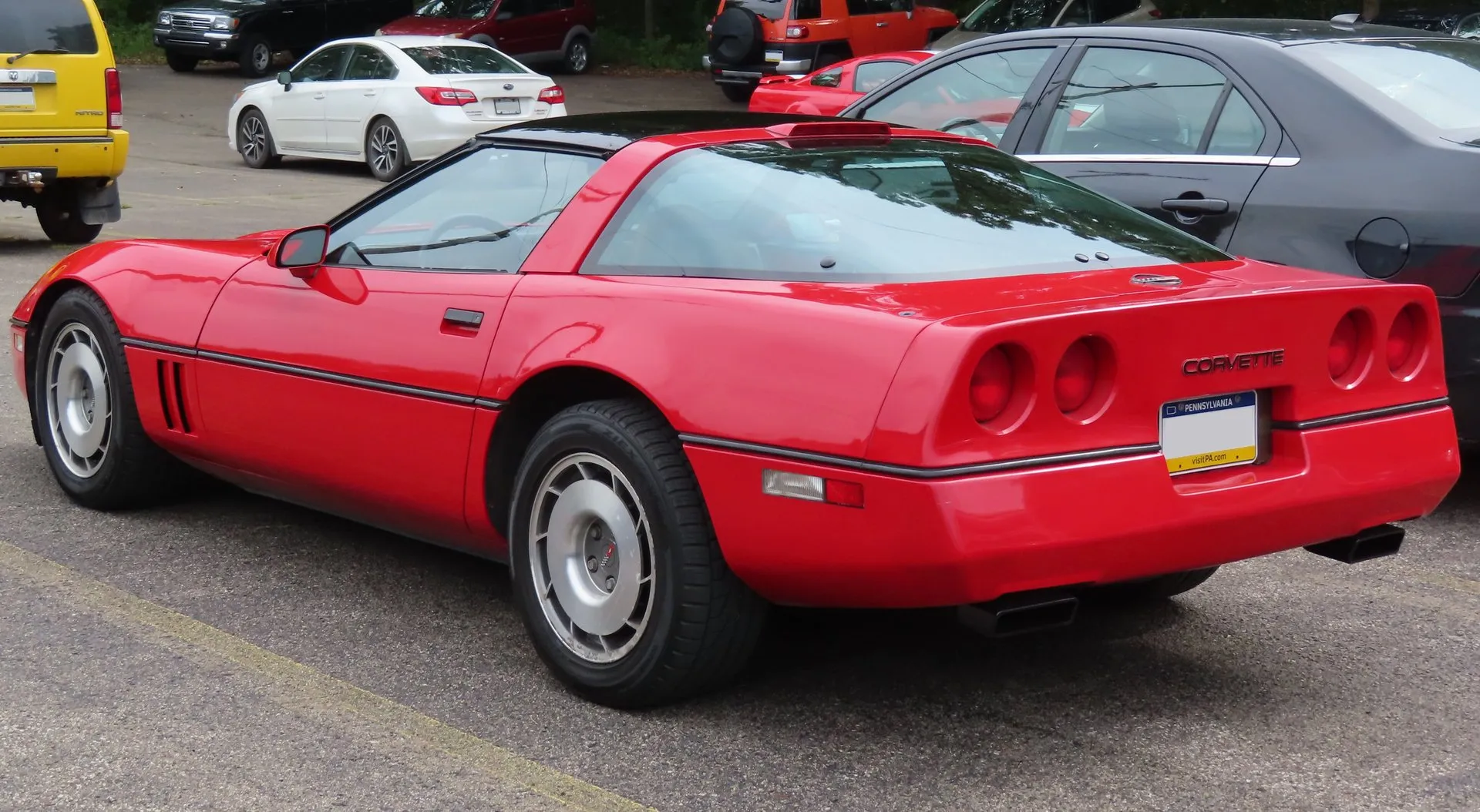
Colors. Twelve solid colors and four two-tones (coupes only), with the Black Book’s counts: Bright Red 8,285, Dark Red Metallic 5,578, Black 5,101, White 3,097, Medium Blue Metallic 2,677, Yellow 1,051, Medium Gray Metallic 1,035, Silver Beige Metallic 950, Silver Metallic 767, Gold Metallic 397, Medium Brown Metallic 245 and Copper Metallic 87. The two-tones: Silver Beige over Medium Brown 447, Silver over Gray 403, Gray over Black 316 and White over Silver 195, the rarest paint of the year. Medium Blue jumped from 128 cars in 1986. Copper Metallic isn’t on GM’s early 1987 color sheet at all (page 17), which lists eleven colors. As printed, the counts add up to 30,631, one short of production.
Section 06
The H in the VIN and the 14093638 block
The VIN changed layout for 1987. GM’s range in the Black Book runs from 1G1YY2182H5100001 to 1G1YY2182H5130632, and “For convertibles, sixth digit is a 3”:
| Position | On a 1987 |
|---|---|
| 1–3 | 1G1: Chevrolet, made in the USA |
| 4–5 | YY: Corvette |
| 6 | 2 coupe, 3 convertible |
| 7 | 1: manual seat belts |
| 8 | 8: the L98 |
| 9 | Check digit |
| 10 | H: 1987 |
| 11 | 5: Bowling Green |
| 12–17 | 100001 to 130632, coupes and convertibles in one sequence |
A 1986 carried 07 or 67 in places 6 and 7, with convertibles numbered from 900001, so a 1987 VIN laid out like a 1986’s is wrong. The digit decodes come from Corvette Action Center’s 1987 page and match the Black Book’s range.
The engine. The engine code suffix should be ZJN (automatic), ZLA (automatic with oil cooler), ZLC (manual with oil cooler) or ZLB (export). The block casting is 14093638 on every 1987; a 1986’s is 14088548. The heads, 14101128, prove less, since aluminum-head 1986s share them. A replacement block breaks the rule, so read the casting with the suffix. A Callaway’s engine number follows Callaway’s scheme instead.
The parts label. GM’s Service Parts Identification label, on the underside of the center console lid, lists every RPO code the car was built with. It’s where a claimed Z51, Z52, G92 or B2K shows up, or doesn’t. A manual Z51 coupe should show Z51 and MM4; a Z52 automatic, Z52 and no MM4.
By eye, the argent gray wheel centers point to a 1987, but wheels get swapped. Trust the VIN and the block.
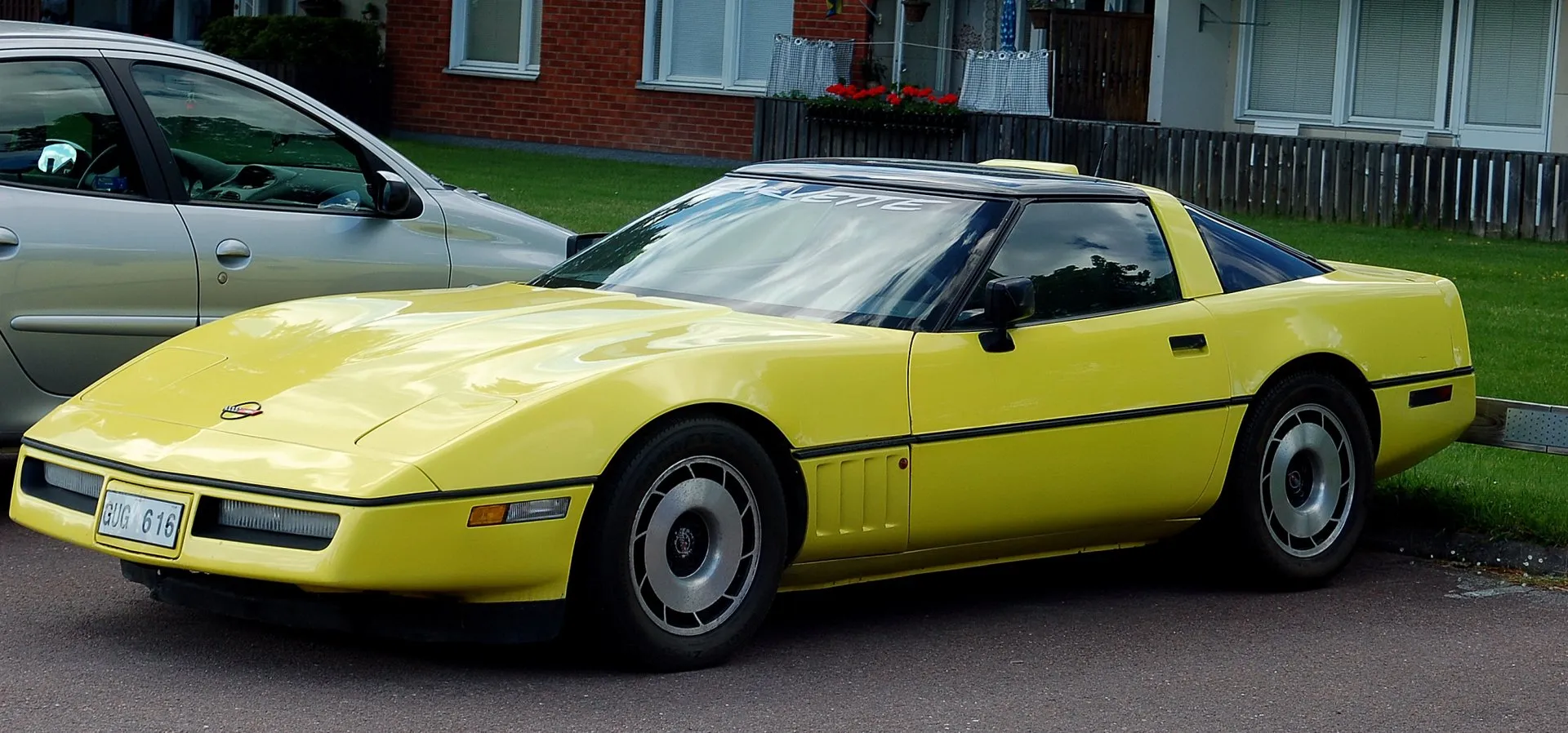
No 1987 Stingray, no 1987 ZR-1. Searches ask for both. No C4 wears the Stingray name (the generations guide traces where it went), and the ZR-1 arrived for 1990 (the ZR-1 guide). A seller offering either has a badge, not a model.
Section 07
Jammed belts, a chafed harness and NHTSA’s file
Was the 1987 Corvette recalled? Once. NHTSA lists one GM recall for the 1987 (opens in new tab), 91V143000 of September 1991: front seat belts on 1984–1991 Corvettes that can lock up or jam in the retractor. GM ran it as campaigns 91C25 (left) and 91C26 (right), and its bulletin says “only those safety belts which are experiencing a locked-up or jammed belt will require replacement.” None of the 1986’s other recalls and campaigns reaches a 1987.
GM’s dealer bulletins add the year’s own weak spots:
- 87-207 (September 1987), 1987 only. “Some 1987 Corvettes” can show “a variety of engine type electrical problems” because sharp casting flash on top of the transmission case, right behind the distributor, cuts into the main engine harness. Symptoms include an erratic speedometer, torque converter clutch shudder at low speed and blown gauge fuses. The fix: file the flash, tape it and repair the harness (GM’s bulletin, via Corvette Action Center (opens in new tab)).
- 87-140 (May 1987), 1986–1987. Intermittent no-starts from a damaged ignition lock cylinder or key pellet; the module shuts the system down for about two minutes. GM’s fix was an improved lock cylinder (
GM 26008775, OEM) with a narrower keyway and longer keys. - 88-43 (September 1987), 1986–1988. A low coolant light with plenty of coolant may be air in the system; 1987s built before serial H5101986 may need new coolant recovery hose clamps (
GM 22527587, OEM). - 87-114 (April 1987), manual cars. The clutch master cylinder push rod attachment may not hold; a new bushing, washer and retainer fix it.
- 87-206 (September 1987). A moan or vibration with the air conditioning on, fixed with a power steering pump bracket and brace kit (
GM 10077573, OEM). - 87-263-10 (January 1988). A front air dam torn up by bumps, curbs and snow; brace kit
GM 10107824(OEM) for a 1987 with the Z51,GM 10107825(OEM) without. - 91-449-6A (November 1991), 1987–1991. A puff of blue smoke at start-up, oil past the valve stem seals; new seals (
GM 12511890, OEM).
What goes wrong with a 1987 Corvette? NHTSA’s file (opens in new tab) holds 21 owner complaints, filed between July 1996 and October 2019, more than for any other C4 year through 1989. Thirteen are about seat belts: belts that won’t retract, owners told the car was too old or the VIN didn’t qualify, and one driver who pried a retractor apart with a screwdriver to get out. Two describe cold-steering trouble; three are electrical (a VATS key cutting the car off in traffic, a no-start, and smoke from under the hood, NHTSA’s only fire flag); one each report a cracked front leaf spring, an ABS failure and sudden acceleration. These are raw counts in this site’s reading, not rates, and NHTSA’s file starts in 1994, after these cars were new.
The C4 guide covers the generation’s shared problems: jamming belts, failing digital dashes, headlight motor bushings, tired weatherstrips and cold-steering “morning sickness.”
Section 08
Ten checks before buying a 1987
- Both front belts. Pull each all the way out and let it go. A belt that jams is a safety repair, not a quirk. Completed recall work leaves 91C25 and 91C26 stickers on top of the radiator, one CorvetteForum owner notes (opens in new tab).
- The harness behind the distributor. A jumpy speedometer, low-speed shudder or blown gauge fuses point to bulletin 87-207. Look where the harness crosses the transmission.
- The key. Start the car several times. A no-start that clears after a couple of minutes is VATS reacting to a worn pellet or lock cylinder (87-140). Diagnose it; don’t bypass it.
- The VIN’s sixth digit and tenth letter. 2 or 3, then H. Anything else isn’t a 1987.
- Block and suffix. 14093638, with a ZJN, ZLA, ZLC or ZLB suffix. A different block can drive fine but isn’t worth original-car money.
- The parts label. Match any Z51, Z52, G92 or B2K claim to the codes under the console lid.
- A cold start. Feel the steering before the rack warms up, and watch for blue smoke at start-up (91-449-6A).
- The fuel. Ask what it has been fed, and fill it with premium for the test drive.
- The dash and lights. Every display readable by day and night, the low coolant light out with the coolant full, and each headlight motor stopping when its lamp does.
- On a convertible, the top’s fit, seals and plastic rear window; on a coupe, the roof panel’s rear corners, which a 1988 Chevrolet letter to owners of 1984 to early 1987 cars warned could crack if forced from their stowage brackets (the 1984 guide has the story).
Then pay a shop that knows Tuned-Port cars to look it over.
Section 09
1987 prices in 2026, coupe against convertible
How much is a 1987 Corvette worth? About $7,000 to $15,000 at auction for a stock car in 2026, with low-mileage cars above that. Bring a Trailer (opens in new tab) sold seven stock 1987s between February 14 and September 24, 2026 (results read through October 20), for $7,250 to $19,750, a median of $11,000 by this site’s arithmetic on sold prices before the buyer’s fee:
- Coupes, 6: $19,750 for a 29,000-mile Z51 four-speed in February, $11,000 for an 18,000-mile Z52 in April, $14,000 for an 18,000-mile Z51 four-speed with revised engine management in July, $14,500 for an 11,000-mile Z52 automatic in July, $8,000 for a four-speed with an aftermarket exhaust and stereo in August, and $7,250 for a 51,000-mile Z51 four-speed in September. Median $12,500.
- Convertible, 1: $8,700 for a Yellow four-speed in July.
Calendar 2025 brought seven stock sales at a median of $12,000. From January 2025 to October 2026, five convertibles sold at a median of $8,700 against nine coupes at $13,000. Samples this small give a feel, not a price list. A 383 stroker car is left out, and the two Callaways are counted on their own.
Hagerty ranks the bodies the other way round. Its February 2026 #3 values (archived copy (opens in new tab)) are $10,100 for a coupe and $13,000 for a convertible, against $9,300 and $11,100 for a 1986 and $9,700 and $11,700 for a 1988. Hagerty puts the 1987 above both neighbours, and Bring a Trailer’s 2026 median of $11,000 is above the 1986’s $9,800. classic.com’s 1987 page couldn’t be read, and the best-years guide’s $12,750 median covers stock 1984–1989 cars, not the 1987 alone. None of this predicts where values go next.
Is the 1987 a good year? For an early C4, yes: the first L98 with roller lifters, aluminum heads on every car, one recall, and known faults (the harness chafe, the key) that are cheap to check. The C4 guide’s picks for most buyers remain 1995–1996, or a 1990 or 1991 for an L98 with the later dashboard.
Section 10
What waited for 1988
The 1988 brought what the 1987 lacked, by Chevrolet’s 1988 ordering information (1988 kit, page 8): two-piston front calipers with thicker rotors, zero-scrub front suspension geometry, a parking brake handle moved down and back out of the way of the door opening, new 16-inch wheels on ZR-rated tires, and optional 17 x 9.5-inch wheels on P275/40ZR-17s, included with the Z51 and Z52. The ZF six-speed replaced the 4+3 a year later, for 1989.
Section 11
Verdict: start with a Z52 coupe
Buy a Z52 coupe. More than four in ten 1987 buyers chose it: the Bilsteins, the cooling, the wide wheels and the quick steering on the base car’s softer springs, with either gearbox. Roller-lifter torque, aluminum heads and a removable roof for about $11,000 to $14,500 on 2026’s coupe sales. Look for the Z52 code on the console label, belts that retract, a key that starts it every time, the 14093638 block and a seller who bought premium.
The firm alternative is a Z51 4+3 coupe, one of 1,596, for someone who wants the stiffest 1987 and three pedals. Expect a harder ride, and check the clutch push rod (87-114).
The open-air bargain is the convertible: 9.5-inch wheels on every one, and in Bring a Trailer’s small sample it sold for less than the coupe, though Hagerty values it higher. Check the top and the belts first.
The collector’s 1987 is a Callaway, and only with Callaway’s paperwork and a matching engine number.
Skip a car with a jamming belt priced as if it didn’t, an electrical gremlin no one has traced to the harness, or a “Stingray” badge sold as a model. Then lift the roof panel off and drive it: America’s sports car, roller lifters and all, for well under half its 1987 sticker.
Section 12
Sources
- GM Heritage Center: 1987 Corvette vehicle information kit files.zipcorvette.com This site's library. Corvette Black Book pages GM included in the kit: production, VINs, engine codes, castings, the year's facts and the Callaway (PDF page 4); options with prices and counts, colors and interiors (6). Chevrolet's 1987 dealer order guide (8 to 12), sales book (14, 34), ordering information (16) and colors sheet (17). GM's MVMA specification sheets: power teams (43), engine (44), tires and wheels (54), anti-theft (60), curb weight (66).
- GM Heritage Center: 1986 Corvette vehicle information kit files.zipcorvette.com This site's library. The 1986's castings and facts (PDF page 18), prices and counts (19), fuel rating (26).
- GM Heritage Center: 1988 Corvette vehicle information kit files.zipcorvette.com This site's library. What 1988 changed (PDF page 8) and the 35th Anniversary release (5).
- NHTSA owner complaints, 1987 Chevrolet Corvette (opens in new tab) api.nhtsa.gov 21 complaints on October 22, 2026, filed July 1996 to October 2019; NHTSA's file starts in 1994. Theme counts are this site's reading of the complaint text.
- NHTSA recalls, 1987 Chevrolet Corvette (opens in new tab) api.nhtsa.gov One GM recall (91V143000), pulled October 22, 2026. Two aftermarket filter recalls in the same results are not about the car.
- GM product safety campaign 91C25 and 91C26: safety belt retractors, 1984–1991 Corvette (via Corvette Action Center) (opens in new tab) corvetteactioncenter.com GM's campaign bulletin for NHTSA recall 91V143000, as transcribed by Corvette Action Center. Transcriptions of GM's bulletins here and below are not GM or NHTSA originals.
- GM dealer service bulletin 87-207: engine harness cut by transmission casting flash, 1987 Corvette (via Corvette Action Center) (opens in new tab) corvetteactioncenter.com September 1987. Also 87-140 (opens in new tab) VATS no-starts (May 1987), 87-148 (opens in new tab) convertible top weatherstrip (May 1987), 88-43 (opens in new tab) low coolant light (September 1987), 87-114 (opens in new tab) clutch push rod (April 1987), 87-206 (opens in new tab) A/C moan (September 1987), 87-263-10 (opens in new tab) front air dam (January 1988) and 91-449-6A (opens in new tab) start-up smoke (November 1991).
- Corvette Action Center: 1987 Corvette identification (opens in new tab) corvetteactioncenter.com A secondary source for the VIN digits and the parts label location; GM's kit wins where they differ. Also its 1987 production (opens in new tab) page and its 1987 Callaway (opens in new tab) page, with its transcription of Car and Driver's November 1986 test.
- EPA fuel economy ratings (fueleconomy.gov): 1987 Corvette (opens in new tab) fueleconomy.gov Current method, automatic; no 1987 manual is listed. Pulled October 22, 2026.
- Bring a Trailer: C4 Corvette auction results (opens in new tab) bringatrailer.com Listings titled as a 1987, December 2024 to October 20, 2026, read October 22, 2026; an engine-swapped stroker car left out and Callaways counted apart. Medians are this site's, from the sold prices without the buyer's fee.
- Hagerty valuation tool: 1984–1996 Corvette generation page (archived February 8, 2026) (opens in new tab) web.archive.org #3 (Good) values: 1987 coupe $10,100, convertible $13,000; 1987 Callaway coupe $20,100, convertible $24,600; 1986 and 1988 for comparison. Its history text on the Z52 and on 1991 as the Callaway's last year.
- CorvetteForum thread: Z51 in 1987 (opens in new tab) corvetteforum.com June 2016. Owner reports on the Z51 and Z52 and where the option codes are listed.
- CorvetteForum thread: what was the difference between Z51 and Z52 (opens in new tab) corvetteforum.com September 2004. Owners on the 1987 packages' springs, shocks and bars.
- CorvetteForum thread: seat belt locked up, GM won't honor safety recall (opens in new tab) corvetteforum.com 2019–2023. The 91C25 and 91C26 recall stickers on top of the radiator.