C4 · Buying guide
1986 Corvette guide: the convertible returns, ABS arrives and the heads change mid-year
Published
To steal a new 1986 Corvette with a key, a thief had to match one of fifteen resistor pellets, and every wrong guess cut off part of the fuel system for about two minutes. Car and Driver laid it out in its February 1986 road test: a small black pellet set in the key blade, read by the ignition switch along with the cuts. A thief might have to shuffle pellets “for as much as a half-hour,” the magazine figured, and Chevrolet told it the ordinary thief considers anything past ten minutes overtime.
That key, which GM called VATS (Vehicle Anti-Theft System), was one of three firsts for the third model year of the C4 (1984–1996). Anti-lock brakes became standard. And the convertible came back after ten years away, the first Chevrolet-built Corvette convertible since the 1975 model, with every one designated a replica of the car that paced that year’s Indianapolis 500.
Under the hood, the 1986 is two engines that look like one. The L98 started the year with the iron heads of the 1985 and finished it with aluminum ones, rated 230 hp with iron heads, 235 hp with aluminum heads, by the Corvette Black Book. Bowling Green built 35,109: 27,794 coupes and 7,315 convertibles. Four decades on, a 1986 coupe is one of the cheapest V8 Corvettes going, and Hagerty’s February 2026 values make the convertible the cheapest C4 with a folding top.
The C4 buyer’s guide covers what every C4 shares; this page works mostly from GM’s 1986 kit, in the site’s manual library.
C4 Key figures
- Built
- 35,109: 27,794 coupes and 7,315 convertibles
- L98 V8
- 230 hp with iron heads, 235 hp with aluminum heads
- Price new
- $27,027 coupe, $32,032 convertible
- New for 1986
- the convertible, ABS and the VATS key
- 0–60 mph, Car and Driver
- 6.0 s
- NHTSA recalls
- three
- Bring a Trailer, 2026
- a median of $9,800
- Hagerty #3, Feb 2026
- $9,300 coupe, $11,100 convertible
Section 01
The convertible’s return after ten years
The convertible had been gone since the 1975 model (the C3 guide and the 1976 guide tell that side). The Corvette Black Book page that GM bound into its 1986 kit (the Black Book is a hobby reference, not a GM publication) dates its arrival to “interim 1986” (page 18).
Chevrolet built it with ASC, and Car and Driver reported (opens in new tab) a considerably revised frame with an X-brace under the cockpit floor: less rigid than a coupe with its roof panel in, the engineers said, stiffer than one with it out. The top stows under a panel in the rear deck, and the rear window is plastic. The convertible got its own springs, bars and shocks (a 310 lb/in front spring against the coupe’s 295) and a 30 psi tire placard against the coupe’s 35. Car and Driver adds that it wore the Z51’s 9.5-inch-wide wheels as standard; no GM sheet in the kit confirms that width for the convertible.
The Z51 package itself was “Limited to coupes,” the Black Book’s option page says, and the convertible’s page in GM’s December 1985 dealer order guide lists neither the Z51 nor the Bilstein shocks (page 114). Tops came in white, black or saddle.
List prices: $27,027 coupe, $32,032 convertible, a $5,005 gap. Car and Driver’s automatic test convertible weighed 3,266 lb and ran:
- 0–60 mph in 6.0 s and 0–100 in 16.4 s
- the quarter mile in 14.5 s at 95 mph
- a 144 mph top speed
- 70–0 mph in 164 ft, the second-shortest stop the magazine had measured for a production car
- 0.85 g on the skidpad
Those are one magazine’s figures for one car (the kit gives no GM 0–60 time or top speed), and the testers noted some fade in hard braking from high speed. EPA’s current ratings put the 1986 at 15 mpg city and 22 highway, automatic or manual.
Section 02
Pace car lettering, some assembly required
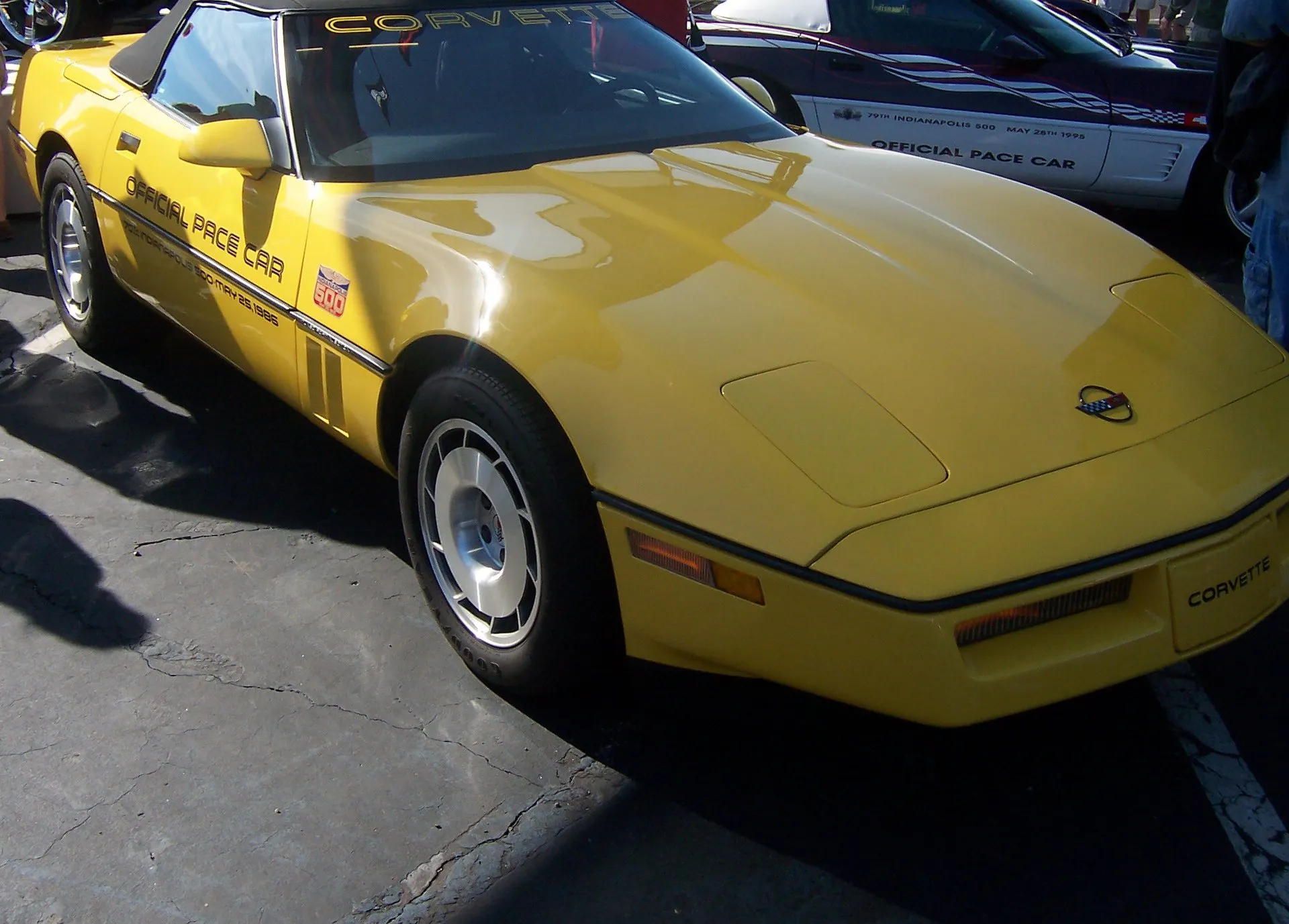
A Corvette convertible paced the 70th Indianapolis 500 on May 25, 1986. GM’s flyer, printed before the race, said the track car differed from the showroom model only in its “specially fabricated light bar and strobed driving, brake and cornering lamps” (page 96), and offered the convertible in 12 exterior colors and three top colors.
“All 1986 Corvette convertibles sold were designated as pace car replicas,” the Black Book says, “and all included decal packages for dealer or customer installation.” GM’s installation sheet lists the package: left and right winged-wheel logos, upper and lower door lettering and a squeegee. So a 1986 convertible with “Official Pace Car” on its doors and one without are the same car. Neither is rarer or more “real.”
The market agrees. Bring a Trailer’s listings mention pace car graphics on three 1986 convertibles sold in 2025, at $6,600, $8,600 and $11,750, with no visible premium, and Hagerty gives the pace car no separate value.
Section 03
ABS, VATS and the rest of the 1986 changes
What the 1986 gained over the 1985, from GM’s pages in the kit:
- ABS, standard. The Black Book calls it “an adaptation of Bosch’s system”; Chevrolet’s sales book called it Bosch ABS II, “that lets you steer during a full panic stop.” GM’s brake sheet lists it as electronic, four-wheel and three-channel, behind 11.5-inch vented discs at all four corners (page 35).
- VATS. The pellet has one of fifteen resistances, read by contacts in the lock cylinder and checked by a decoder module, with a built-in delay after a wrong key (page 42). Chevrolet’s sales book promised “15-20 minutes”; Car and Driver and GM’s bulletin 87-140 say about two minutes per lockout.
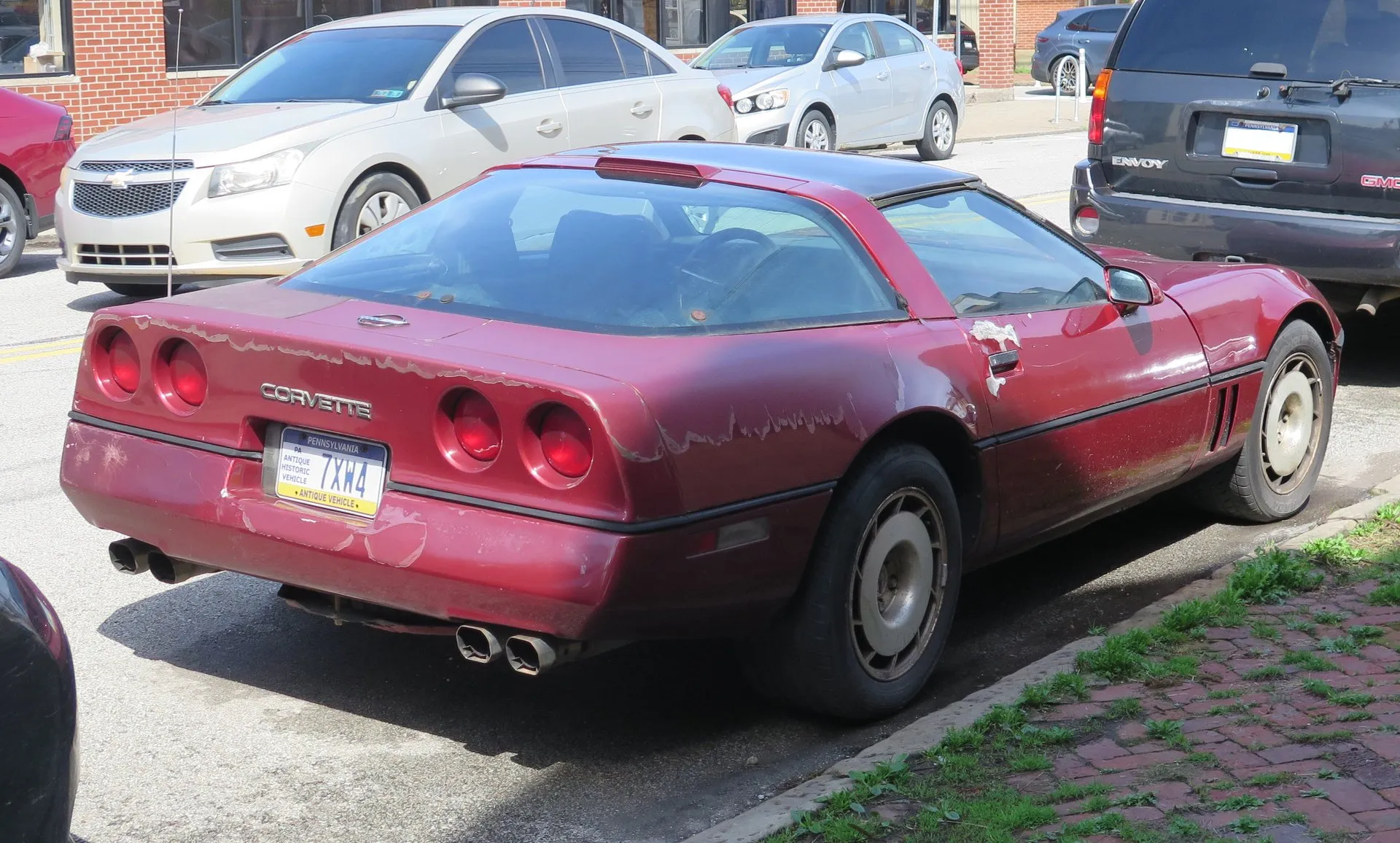
- A third brake light, to meet federal requirements: above the rear window on the coupe, in the rear fascia on the convertible.
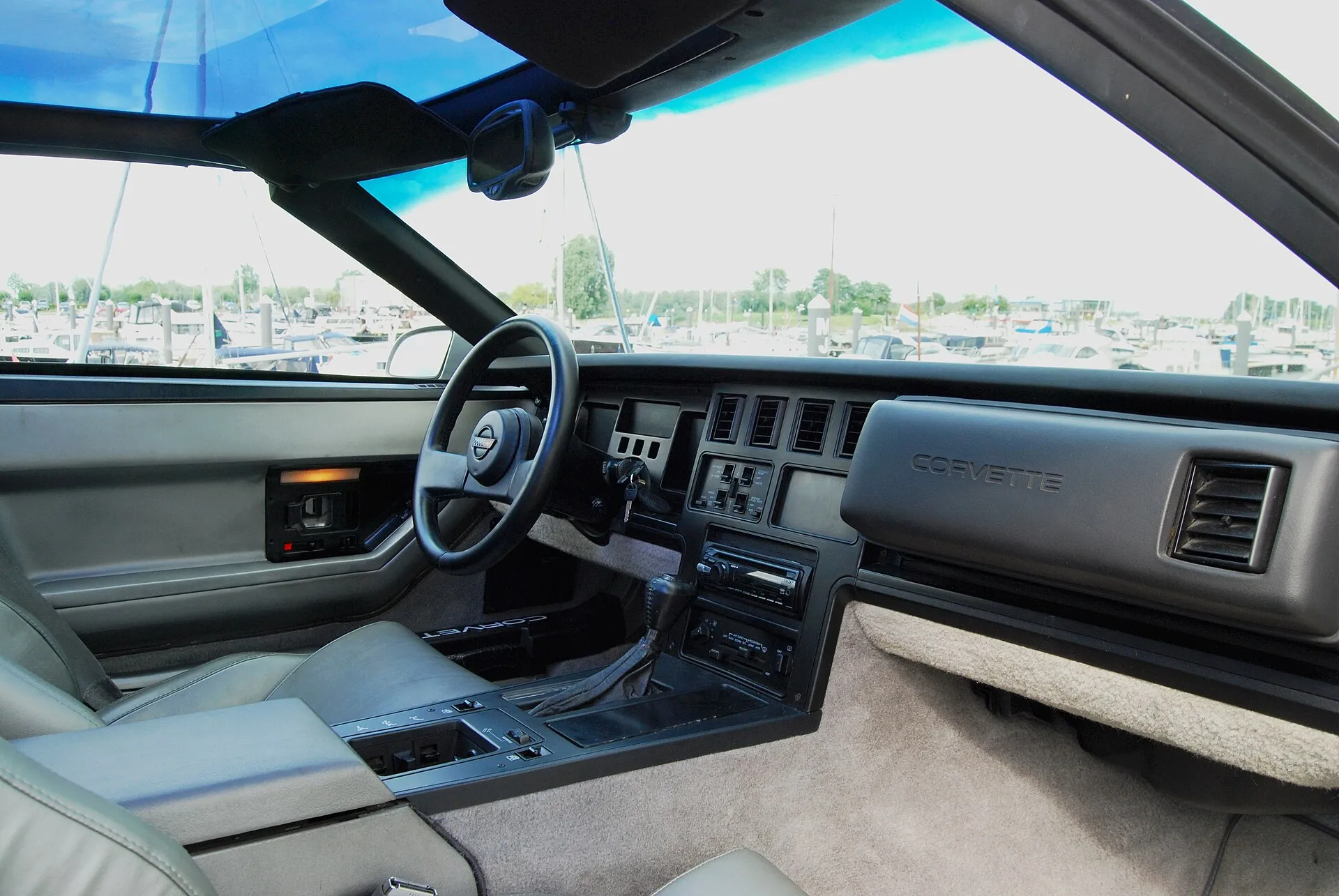
- The cluster, re-angled to cut daytime glare, with a new upshift light and “Low coolant” and “anti-lock” displays.
- Steering feel: caster went from four degrees to six, the Black Book says, “to improve on-center road feel and to decrease wander.” GM’s alignment sheet gives 6.0 degrees (page 38).
- Electronic air conditioning (RPO C68; RPO is GM’s regular production option code), the item that slipped from 1985 into 1986: $150, coupes only, on 16,646 cars.
- Three catalytic converters, two up front and one in the underbody tunnel, where GM’s 1985 emissions sheet lists one (1986, 1985).
- Paint and wheels: three new colors (Silver Beige, Medium Brown and Dark Red Metallic), and wheel centers left in their natural finish instead of the black of 1984–1985, per two Black Book pages. (One GM product sheet says “blackout treatment new for ‘86”; the Black Book’s 1987 page repeats its own version.)
Section 04
Iron heads or aluminum: which 1986 has which
GM meant the 1986 to have aluminum cylinder heads from the start, and its early ordering sheet said so. They were late. Cracking around the head attachment bosses “required an introduction delay for design revisions,” the Black Book says, and the revised heads “were ready in time for convertible production and all 1986 convertibles and late production coupes had aluminum heads,” rated 5 hp higher. Torque stayed at 330 lb-ft at 3,200 rpm, by GM’s specification sheet (page 25) and Car and Driver’s aluminum-head test car.
The 235 hp figure is the Black Book’s, and the C4 guide’s spec table uses it. GM’s own paper is less tidy: the pace car flyer calls the aluminum-head engine 230 hp, and GM’s specification sheet, revised in September 1985, lists only 230. Car and Driver said the heads came “Starting in February or March” on both bodies, saved 40 lb per car and raised compression half a point, to 9.5:1. GM’s sheet gives 9.5:1 and its sales book 9.0:1.
Where the coupes switched, no GM page gives a serial number or date, and this guide found none elsewhere. Owners report a December 1985 coupe with iron heads and a May 1986 coupe said to have aluminum. Don’t trust a seller’s word or a build date: check the engine.
| Check | Iron heads, 230 hp | Aluminum heads, 235 hp |
|---|---|---|
| Engine suffix (Black Book) | D: DKF, DKC, DKH, DKD, DKB | Z: ZJS, ZJH, ZKD, ZJW, ZKA |
| Head casting (Black Book) | 462624, as on the 1984–1985 | 14101128, as on every 1987 |
| A magnet on the head (owners) | sticks | doesn’t |
| Valve cover bolts (owners) | around the edge | down the center |
The suffix is stamped with the VIN derivative on the pad at the front of the block. The magnet and the bolt pattern are quick checks owners swear by (one Corvette Action Center thread runs from 2004 to 2025 (opens in new tab)), not GM’s. A Z-suffix engine with iron heads, or the reverse, has had its heads changed, and a convertible with a D suffix isn’t wearing its original engine.
Aluminum heads ask one courtesy. GM’s bulletin 86-82 (May 1986) says to pull spark plugs from an aluminum-head L98 only with the engine cool, or they may seize, and to fit a new gasket on any plug that goes back in. The 5 hp is a footnote, not a reason to pick one car over another.
Section 05
The 1986 order sheet: options, colors and the Konner cars
The base price bought the L98, the 700-R4 four-speed automatic, cloth seats and a body-color roof panel or a soft top. The 4+3 manual (a four-speed with overdrive in its top three gears) cost nothing extra, and nearly everyone added the comfort options. Counts and prices from the Black Book’s option page (page 19):
| RPO | Option | Price | Built |
|---|---|---|---|
| AU3 | Power door locks | $175 | 34,215 |
| K34 | Cruise control | $185 | 34,197 |
| AG9 | Power driver’s seat | $225 | 33,983 |
| UU8 | Delco-Bose stereo | $895 | 32,478 |
| Z6A | Rear window and mirror defoggers (coupe) | $165 | 21,837 |
| C68 | Electronic air conditioning control (coupe) | $150 | 16,646 |
| AQ9 | Sport seats, leather | $1,025 | 13,372 |
| Z51 | Performance handling package (coupe) | $470 | 12,821 |
| 24S | Blue-tint roof panel (coupe) | $595 | 12,021 |
| 64S | Bronze-tint roof panel (coupe) | $595 | 7,819 |
| MM4 | 4+3 manual | No charge | 6,835 |
| C2L | Dual removable roof panels (coupe) | $895 | 6,242 |
| NN5 | California emissions | $99 | 5,697 |
| FG3 | Delco-Bilstein shocks | $189 | 5,521 |
| G92 | Performance axle, 3.07:1 | $22 | 4,879 |
| D84 | Two-tone paint (coupe) | $428 | 3,897 |
| 4001ZA | Malcolm Konner special edition paint | $500 | 50 |
The Z51 bundled the Bilstein shocks, the heavy-duty radiator, a boost fan, an engine oil cooler, heavier suspension, faster steering and 16 x 9.5-inch wheels. It went on 46 percent of coupes, against 37 percent of 1985s. The 4+3 went on 19 percent of all 1986s, so about 28,274 were automatics (this site’s arithmetic). Automatic coupes got a 2.59 axle and automatic convertibles a 2.73, by GM’s sheet; manuals, Z51 cars and the G92 option got 3.07.
Colors. Twelve solid colors and four two-tones, with the Black Book’s counts: Bright Red 9,466, Black 5,464, Dark Red Metallic 5,002, White 4,176, Medium Gray Metallic 1,603, Yellow 1,464, Silver Beige Metallic 1,383, Silver Metallic 1,209, Gold Metallic 777, Medium Brown Metallic 488, Medium Blue Metallic 128 and Copper Metallic just 4. The two-tones: Gray over Black 1,138, Silver over Gray 1,049, Silver Beige over Medium Brown 1,014 and White over Silver 693. GM’s early color sheet already had Medium Blue and Copper struck through by hand. As printed, the counts add up to 35,108, one short of production.
The Malcolm Konner cars. Fifty coupes honoring the founder of a New Jersey Chevrolet dealership, in Silver Beige over Black, coded “spec” on the paint list and 4001ZA on the window sticker. All had graphite leather; 20 were manuals and 30 automatics. Hagerty valued one in #3 (good) condition at $10,900 in February 2026, $1,600 over a standard coupe. See the window sticker before believing one.
Section 06
Telling a real 1986 from a 1985 or a 1987
The VIN sits on a plate at the top left of the instrument panel, read through the windshield. GM’s chart (page 5) decodes it:
| Position | On a 1986 |
|---|---|
| 1–3 | 1G1: Chevrolet, made in the USA |
| 4–5 | YY: Corvette |
| 6–7 | 07 coupe, 67 convertible |
| 8 | 8: the L98 with Tuned-Port Injection |
| 9 | Check digit |
| 10 | G: 1986 (F is 1985, H is 1987) |
| 11 | 5: Bowling Green |
| 12–17 | 100001 to 127794 coupes; 900001 to 907315 convertibles |
The block is the strongest single tell. The Black Book pages list casting 14088548 for every 1986 L98, against 14010207 for 1985 and 14093638 for 1987 (1987 kit), so an original 1986 block separates the car from both neighbours. A replacement block breaks the rule, so read it with the suffix and the VIN derivative. The heads can’t settle it alone: 462624 is also the 1984–1985 casting, and 14101128 is on every 1987.
The Service Parts Identification label lists the RPO codes the car was built with, so it’s where a claimed Z51 or G92 shows up, or doesn’t. Corvette Action Center puts it in the rear storage area behind the driver’s seat on early coupes and on the underside of the console lid on later coupes and every convertible.
By eye, a 1986 coupe has the third brake light a 1984 or 1985 lacks, plus the anti-lock display and the pelleted key. A 1987 is harder: its wheel centers were painted argent gray, the Black Book says, but wheels get swapped. Trust the VIN and the block.
Two claims to doubt on sight: a 1984 or 1985 convertible (the 1986 was the first factory C4 convertible, so an earlier one is an aftermarket conversion) and a “1986 Stingray” (no C4 wears the name; the generations guide shows it returning with the C7).
Section 07
Recalls, GM campaigns and 16 owner complaints
Was the 1986 Corvette recalled? NHTSA lists three GM recalls (opens in new tab), the count the C4 guide gives:
- 86V056000 (April 1986): a headlight switch whose contacts could make the lights flicker or go out. A GM-wide recall: 21 model lines, 93,317 vehicles.
- 86V120000 (August 1986): “severe and unusual braking conditions” could damage the ABS master cylinder’s center valve, enough to lose the front brakes, with longer pedal travel. NHTSA counts 18,223 Corvettes. GM’s dealer bulletin, campaign 86C12 of September 1986, covers “all 1986 Chevrolet Corvette Models” from G5100001 through G5118892 with a master cylinder piston kit (GM’s scanned bulletin, via Corvette Action Center (opens in new tab)). Convertible serials start at G5900001, so by this site’s reading of the serial ranges the campaign reached coupes only, and only the first 18,892 of them.
- 91V143000 (1991): the 1984–1991 front seat belts that can lock up or jam in the retractor.
Two more GM campaigns reach 1986s by serial number and aren’t in NHTSA’s recall database:
- 86C02(a), the VATS module (March 1986, reissuing February’s 86C02). “Some early 1986 Chevrolet Corvette models” could fail to start, lose fuel delivery on start-up or lose their anti-theft protection, from a fault in the anti-theft module. Dealers fitted a new module (
GM 1227760, OEM) and new keys on certain cars from G5100001 through G5103700, the first 3,700 coupe serials (GM’s scanned bulletin (opens in new tab)). - 86C26, the fuel tank pressure control valve (April 1990). California emission cars only, between G5101039 and G5907270, so convertibles too: an inoperative valve raised evaporative emissions. The fix was a new valve (
GM 17087240, OEM) ahead of the left front wheel well.
Each bulletin promised the work free “regardless of mileage, age of vehicle, or ownership.” Years later, NHTSA complaints show owners being told their cars weren’t covered, so ask the seller for the paperwork rather than counting on a dealer.
GM’s service bulletins name the year’s other weak spots: 87-140 (May 1987), no-starts from a damaged lock cylinder or key pellet, fixed with an improved cylinder (GM 26008775, OEM) and longer keys; 87-148 (May 1987), the convertible top’s number 5 bow weatherstrip pulling loose; 88-43 (September 1987), a false low coolant light, and on convertibles before G5907034 a probe that may need replacing; and 87-114 (April 1987), a clutch master cylinder push rod that may come adrift on manual cars. A 1988 Chevrolet letter sent owners new stowage bracket covers, because forcing the stowed roof panel could crack its corners.
What goes wrong with a 1986 Corvette? NHTSA’s file (opens in new tab) holds 16 owner complaints, filed between September 1994, when the file starts, and July 2017. Seven are about seat belts, one reporting an injury from a belt that failed in a quick stop. Seven are about brakes: five master cylinder leaks or failures (three of those owners asked about recall 86V120000), one car whose brakes locked and skidded, and one with rear brakes locking and a failed ABS module that couldn’t be replaced. The last two: a headlight door that wouldn’t open (filed with cold power steering) and blowing fuses. Raw counts and this site’s reading, not rates.
The C4-wide faults, detailed in the C4 guide: seat belts that jam (1984–1991), a digital cluster that fades or dies, headlight motor bushings, tired weatherstrips and power steering that’s weak until it warms up.
Section 08
Before you buy a 1986: the checklist
- The serial. Coupe serial 118892 or lower: ask for the 86C12 master cylinder paperwork; 103700 or lower, the 86C02(a) VATS module; a California car, the 86C26 valve.
- The brakes. Look for fluid at the master cylinder, then make sure the anti-lock display lights at start and goes out. A low-speed self-test noise after each start is normal (bulletin 91-241-5). One owner told NHTSA a replacement ABS module couldn’t be found; price that risk in.
- The key. Start the car several times. A no-start that clears after a few minutes is the VATS lockout at work, often a worn pellet or lock cylinder (bulletin 87-140). Get it diagnosed, not bypassed.
- The heads. Read the engine suffix, D for iron and Z for aluminum, then put a magnet on a head. “Late car, aluminum heads” proves nothing until the suffix agrees.
- The block casting. 14088548 on an original 1986. Anything else is a replacement: fine to drive, not worth original money.
- The seat belts. Pull each front belt all the way out and let it go. Completed recall work leaves stickers 91C25 and 91C26 on top of the radiator, one CorvetteForum owner points out (opens in new tab).
- On a convertible: the top’s fit and seals, the number 5 bow weatherstrip (87-148), the plastic rear window’s clarity and the low coolant light (88-43).
- On a coupe: the roof panel’s rear corners for cracks, and the parts label for Z51 if the seller claims it.
- The dash and a cold start. Every readout legible by day and night, the low coolant and anti-lock displays included; steering feel before the car warms up; each headlight motor stopping when its lamp does.
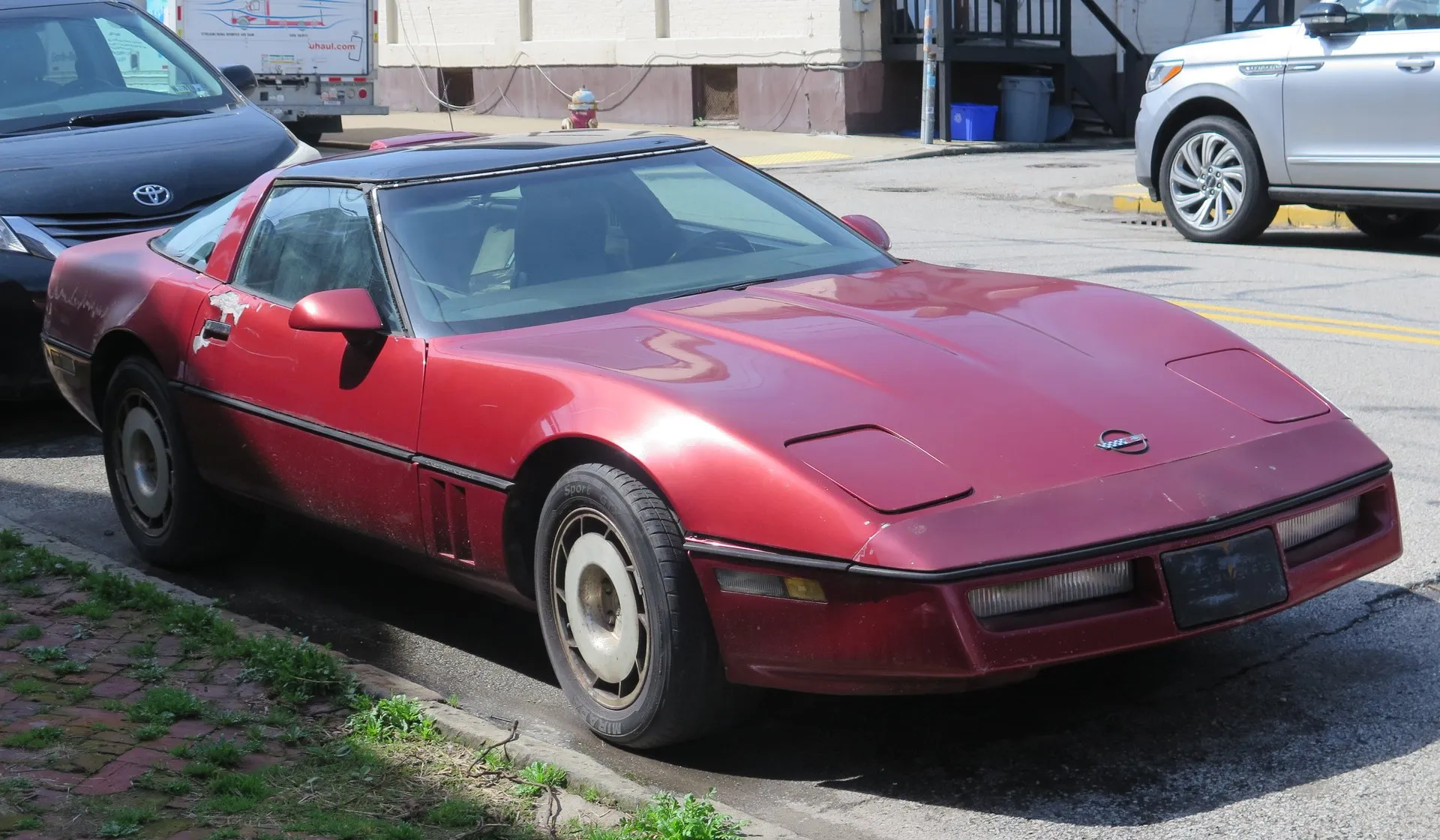
- The paint. Plenty of 1986s wear tired clearcoat, like the coupe pictured here. Judge the car under it, price the paint separately, and pay a shop that knows Tuned-Port cars to look it over.
Section 09
What 1986 Corvettes sold for in 2026
How much is a 1986 Corvette worth? On 2026’s numbers, about $6,500 to $13,000 for a coupe and about $11,000 for a good convertible, with low-mileage cars above that. Bring a Trailer (opens in new tab) sold seven stock 1986s between January 6 and September 7, 2026 (its results read through October 20), for $6,400 to $19,750, a median of $9,800 by this site’s arithmetic on sold prices before the buyer’s fee:
- Coupes, 5: $6,891 in January, $9,800 for a 22,000-mile Z51 in March, $6,500 for a Z51 4+3 in May, $13,000 for an 18,000-mile Z51 in July and $6,400 for a 45,000-mile Z51 in August. Median $6,891.
- Convertibles, 2: $10,750 in April and $19,750 in May for an 11,000-mile car with its original owner. One more was bid to $9,850 in September and didn’t sell.
Over the last 12 months the median is also $9,800, from nine sales, with four convertibles at a median of $11,250; calendar 2025 brought 12 sales at a median of $11,441.50. Samples this small give a feel, not a price guide. A kart, an aftermarket convertible conversion, a supercharged 427 swap and a body-kitted car are left out.
Hagerty valued a 1986 in #3 (good) condition, in February 2026, at $9,300 coupe, $11,100 convertible (archived copy (opens in new tab)), between $9,100 for a 1985 coupe and $10,100 for a 1987 coupe ($13,000 for a 1987 convertible). The 1984 and 1985 guides quote the same capture. classic.com’s 1986 figures couldn’t be read, and the best-years guide’s $12,750 median covers stock 1984–1989 cars, not the 1986 alone. None of this predicts where values go next.
Is the 1986 a good year? It brought the convertible, ABS and the VATS key, and its campaigns are known and finite. Its first-year hardware, the ABS master cylinder and the VATS key, is also what GM revisited by campaign and bulletin. The C4 guide’s picks for most buyers remain 1995–1996, and a 1990 or 1991 for an L98 with the later dashboard.
Section 10
The 1986 to buy: a convertible with paperwork
Buy the convertible. It’s the reason the 1986 exists, every one has the aluminum heads, and the 2026 market puts it only a few thousand dollars over a coupe. By this site’s reading of the serials, the 86C12 master cylinder and 86C02(a) VATS campaign ranges list no convertible; that’s paper, not proof, so check the master cylinder and the key anyway. Pace car lettering or not makes no difference: every one came with the decals. Look for records, a sound top, a working anti-lock display and the 14088548 block.
The budget pick is a late coupe with a Z-suffix engine and the Z51 package, at the low end of 2026’s coupe sales. An early coupe is fine with the campaign paperwork; without it, price in a master cylinder and a VATS diagnosis.
Skip a car with brake fluid at the master cylinder and no records, a key that only starts it on the third try at a full price, and any belt that won’t retract. If 240 hp and roller lifters matter more than being first, the 1987 is the next step up.
Then fold the top under its deck panel and drive it: America’s sports car, open again after ten years, for about a third of its 1986 sticker. Between drives, a battery maintainer and a cover keep it that way.
Section 11
Sources
- GM Heritage Center: 1986 Corvette vehicle information kit files.zipcorvette.com This site's library. Corvette Black Book pages GM included in the kit: production, VINs, engine codes, castings and the year's facts (PDF page 18), options with prices and counts, colors and interiors (19). GM's 1986 service manual identification pages (4 to 7, 16). GM's MVMA specification sheets: power teams (25), engine (26), fuel (29), emissions (30), transmissions (31), brakes (35), tires and wheels (36), alignment (38), anti-theft (42), curb weight (48). Chevrolet's 1986 sales book (62, 88), the pace car flyer (94, 96), ordering information (98, 100), colors sheet (102) and dealer order guide (110 to 114).
- GM Heritage Center: 1985 Corvette vehicle information kit files.zipcorvette.com This site's library. The 1985's castings and facts (PDF page 6), prices and counts (8), emissions sheet (66).
- GM Heritage Center: 1987 Corvette vehicle information kit files.zipcorvette.com This site's library. What 1987 changed, with its castings and the note on 1986 wheel centers (PDF page 4).
- Car and Driver: Tested: 1986 Chevrolet Corvette Convertible Makes a Comeback (February 1986) (opens in new tab) caranddriver.com Patrick Bedard's road test of an automatic convertible; test figures as published.
- NHTSA owner complaints, 1986 Chevrolet Corvette (opens in new tab) api.nhtsa.gov 16 complaints on October 22, 2026, filed September 1994 to July 2017; NHTSA's file starts in 1994. Theme counts are this site's reading of the complaint text.
- NHTSA recalls, 1986 Chevrolet Corvette (opens in new tab) api.nhtsa.gov Three GM recalls (86V056000, 86V120000, 91V143000), pulled October 22, 2026. Two aftermarket oil filter recalls in the same results are not about the car.
- GM product safety campaign 86C12: ABS master cylinder center valve, 1986 Corvette (via Corvette Action Center) (opens in new tab) corvetteactioncenter.com September 1986; VINs G5100001 to G5118892, from GM's scanned bulletin (NHTSA 86V120000). Transcriptions and scans of GM's bulletins here and below are not GM or NHTSA originals.
- GM product campaign 86C02(a): VATS module, 1986 Corvette (via Corvette Action Center) (opens in new tab) corvetteactioncenter.com March 1986, reissuing 86C02 of February 1986; VINs G5100001 to G5103700. Not in NHTSA's recall database.
- GM emission campaign 86C26: fuel tank pressure control valve, 1986 California Corvettes (via Corvette Action Center) (opens in new tab) corvetteactioncenter.com April 1990; VINs G5101039 to G5907270, California emission cars only. Not in NHTSA's recall database.
- GM dealer service bulletins for the 1986 Corvette (via Corvette Action Center) (opens in new tab) corvetteactioncenter.com This link is 87-140, VATS lock cylinder and key no-starts (May 1987). Also 86-82 (opens in new tab) aluminum-head spark plugs (May 1986), 87-148 (opens in new tab) convertible top weatherstrip (May 1987), 88-43 (opens in new tab) low coolant light (September 1987), 87-114 (opens in new tab) clutch master cylinder push rod (April 1987), 91-241-5 (opens in new tab) ABS self-test noise (February 1991), Chevrolet's 1988 roof panel stowage letter (opens in new tab) and GM's pace car decal sheet (opens in new tab).
- Corvette Action Center: 1986 Corvette identification (opens in new tab) corvetteactioncenter.com A secondary source for the parts label location and cross-checks; GM's kit wins where they differ. Also its 1986 specifications (opens in new tab) and production (opens in new tab) pages.
- EPA fuel economy ratings (fueleconomy.gov): 1986 Corvette (opens in new tab) fueleconomy.gov Current method, automatic; the manual (opens in new tab). Pulled October 22, 2026.
- Bring a Trailer: C4 Corvette auction results (opens in new tab) bringatrailer.com Listings titled as a 1986, December 2024 to October 20, 2026, read October 22, 2026; a kart, an aftermarket conversion, an engine swap and a withdrawn body-kitted car left out. Medians are this site's, from the sold prices without the buyer's fee.
- Hagerty valuation tool: 1984–1996 Corvette generation page (archived February 8, 2026) (opens in new tab) web.archive.org #3 (Good) values: 1986 coupe $9,300, convertible $11,100, Malcolm Konner coupe $10,900; 1985 coupe $9,100; 1987 coupe $10,100 and convertible $13,000.
- Corvette Action Center thread: aluminum heads on a 1986 (opens in new tab) forums.corvetteactioncenter.com 2004 to 2025. Owners on which 1986s have aluminum heads, the magnet check and the weight saved.
- CorvetteForum thread: any issues with a 1986 Corvette? (opens in new tab) corvetteforum.com From November 2009. The valve cover bolt check for heads, and the small faults of an aging 1986.
- CorvetteForum thread: how to tell if your 86 has aluminum heads (opens in new tab) corvetteforum.com August 2012. The casting number, a magnet and the build date on the door label.
- CorvetteForum thread: an 86 built 12/85, iron or aluminum heads? (opens in new tab) corvetteforum.com August 2012. A December 1985 coupe with iron heads; the engine suffix as the check.
- CorvetteForum thread: seat belt locked up, GM won't honor safety recall (opens in new tab) corvetteforum.com 2019–2023. The 91C25 and 91C26 recall stickers on top of the radiator.