C4 · Buying guide
1988 Corvette guide: the 35th Anniversary, bigger brakes and the first 17-inch wheels
Published
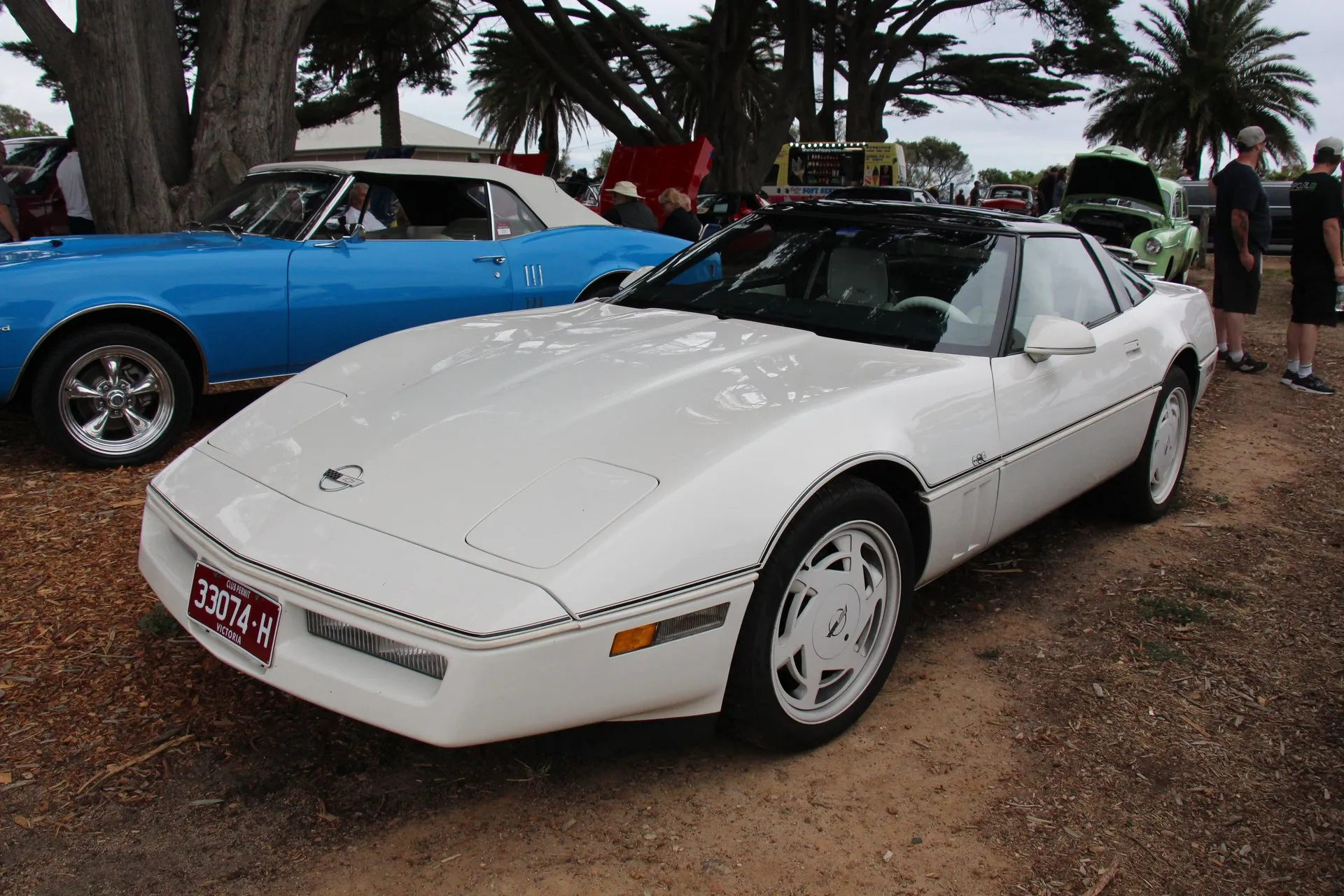
“Just 2,000,” Chevrolet told its employees in March 1988: that was how many 35th Anniversary Corvettes Bowling Green built, each with a build sequence number on its console. The plant’s own figures, as Corvette Action Center publishes them, count 2,050. And the badge itself can’t settle which white coupes are real: reproduction console plaques are sold, and the numbers on genuine ones don’t run in VIN order.
The white coupe is the 1988’s headline. The bigger story is underneath it. For the fifth model year of the C4 (1984–1996), Chevrolet put two-piston calipers on the front brakes, reworked both ends of the suspension, fitted new 16-inch wheels and offered the first 17s, and found five horsepower in new cylinder heads and a longer-lift camshaft. Most 1988 figures here come from GM’s 1988 Heritage Center kit in the site’s manual library; the C4 buyer’s guide covers what every C4 shares.
- Built: 22,789: 15,382 coupes and 7,407 convertibles, by Corvette Action Center’s plant figures.
- Engine: the L98 5.7-liter V8, 245 hp with dual-outlet mufflers, 240 hp with single-outlet ones.
- Price new: $29,955 coupe, $35,295 convertible, with destination, on Chevrolet’s order guide revised December 4, 1987.
- New for 1988: two-piston front brakes, 16- and 17-inch wheels, new heads and cam, and the 35th Anniversary package.
- 2026 money: Bring a Trailer sales give a median of $12,750 from seven base cars; Hagerty’s February #3 values are $9,700 coupe, $11,700 convertible.
C4 Key figures
- Built
- 22,789: 15,382 coupes and 7,407 convertibles
- L98 V8
- 245 hp with dual-outlet mufflers, 240 hp with single-outlet ones
- Price new
- $29,955 coupe, $35,295 convertible, with destination
- New for 1988
- two-piston front brakes, 16- and 17-inch wheels, new heads and cam
- 35th Anniversary
- 2,050 by the plant's count; GM said 2,000
- Bring a Trailer, 2026
- a median of $12,750 from seven base cars
- Hagerty #3, Feb 2026
- $9,700 coupe, $11,700 convertible
Section 01
The 35th Anniversary Edition, white on white
The package was RPO Z01 (RPO is GM’s regular production option code), and Chevrolet’s brochure lists what it bundled (page 27). Outside: white paint with a black roof bow (and, GM’s release adds, a black transparent roof panel), white door handles, side moldings, rear lettering, wheels and center caps, and anniversary badges on both front fenders. Inside: white leather sport seats with an embroidered badge, a white leather steering wheel, and white console lid, door panels, armrests, sill plates and seat belts, plus the numbered console badge.
It also bundled most of the option sheet: power seats on both sides, automatic air conditioning, the lighted vanity mirror, the Delco-Bose stereo, heated rear window and mirrors, and the Z52 Sport Handling package with its 17-inch wheels. Buyers chose only the gearbox (manual or automatic) and whether to add the dual removable roof panels (C2L). It was coupe only. The car made its first public appearance at the New York Auto Show.
How many 35th Anniversary Corvettes were made? 2,050 by the plant’s count; GM said 2,000. Chevrolet’s newsletter of March 24, 1988, its press release dated March 16 and its photo caption all say “just 2,000,” written while the year’s cars were still being built. Corvette Action Center’s figures, which it says came from the Bowling Green plant, count 2,050 Z01 cars, 2,050 painted White/Black and 2,050 white leather interiors, and Bring a Trailer’s listings say “one of 2,050.”
What did it cost? Corvette Action Center lists $4,795. No page in GM’s kit prices the Z01, not even the dealer order guide, so that figure rests on Corvette Action Center alone.
Proving one. GM’s newsletter says the cars were “produced in sequence,” but the plaque number isn’t the VIN’s sequence. One owner’s list of plaques against VINs, posted in a CorvetteForum thread (opens in new tab), puts plaque 784 on the car ending 15181 and plaque 760 on the one ending 15203, 22 serials later. In 2018 the thread’s starter reported that Chevrolet’s customer assistance had traced his car’s number from its VIN. The same thread mentions reproduction console lids and plaque emblems for sale, and one car that arrived with a reproduction lid and no plaque. Check the paint code (40/41, white over black), the white leather down to the seat belts, and the Z01 code on the option label (see Proving a 1988). Don’t count on the label printing the package’s sub-codes, B57 and B18: no source shows it does.
GM wrote one bulletin for this car alone. Bulletin 88-399-10 (opens in new tab) (April 1989) let owners whose white door armrests had turned yellow get new ones that wouldn’t: GM 10149223 left and GM 10149224 right (OEM). A second bulletin covers every white 1988, anniversary cars included (see the recalls section).
Section 02
Bigger brakes, new geometry and the first 17s
Brakes. Every 1988 got twin-piston aluminum front calipers, bigger pads and larger rotors, which GM’s engineering page says bring “increased braking capacity and longer pad life” (page 66). Standard rotors front and rear measure 305 x 20 mm (12.0 x 0.8 in). Car and Driver’s May 1988 test says the 0.8-inch-thick rotors grew from 11.5 to 12.0 inches across: GM’s ordering sheet calls them “thicker,” but on a standard car only the diameter changed.
The Z51 package added the heavy-duty system: 330 x 28 mm front rotors (13.0 x 1.1 in) with matching calipers. That front rotor is the only thicker one of the year. GM’s engineering page ties them to “the 17-inch wheel option,” but the ordering information and specification sheet put them in the Z51 alone.
At the back, single-piston aluminum calipers now worked the parking brake too, replacing the old separate drum and shoes. The handle moved “down and rearward to improve entry/exit,” and carpeted sills went in to cut scuff marks. Wheel bearings front and rear got higher capacity.
Suspension. The front end was redesigned for zero scrub radius, GM says (page 64), to stop the brake pull that uneven braking forces from the ABS could cause at each wheel. That took new knuckles, control arms, shocks and stabilizer, and a front leaf spring wide enough to need a new compressor adapter in the shop (bulletin 88-272-3C). At the rear, GM extended rebound travel and reduced ride camber. The steering carried over, but the turning circle grew to clear the wider 17-inch tires.
Wheels and tires. GM restyled both wheels for 1988 (page 65):
| Standard | Optional (with Z51 or Z52) | |
|---|---|---|
| Wheel | 16 x 8.5 in, six slanted vents | 17 x 9.5 in, twelve slots in pairs |
| Offset | 50 mm | 56 mm |
| Tire | P255/50ZR-16 Goodyear Eagle | P275/40ZR-17 Goodyear Eagle |
| Spare | 16 x 4 in steel, T155/80D16 | 17 x 4 in aluminum, T155/70D17 |
What size tires does a 1988 Corvette take? P255/50ZR-16 on the standard wheel, at 35 psi front and rear, or P275/40ZR-17 on the optional one, GM’s specification sheet says (page 114). The ZR rating was new, GM’s engineering page notes, for tires good for over 149 mph. Five studs on a 4.75-inch circle, M12 x 1.5 nuts, one of them anti-theft. The 1987’s 16-inch wheel sat at a 32 mm offset, so the two 16s aren’t the same part.
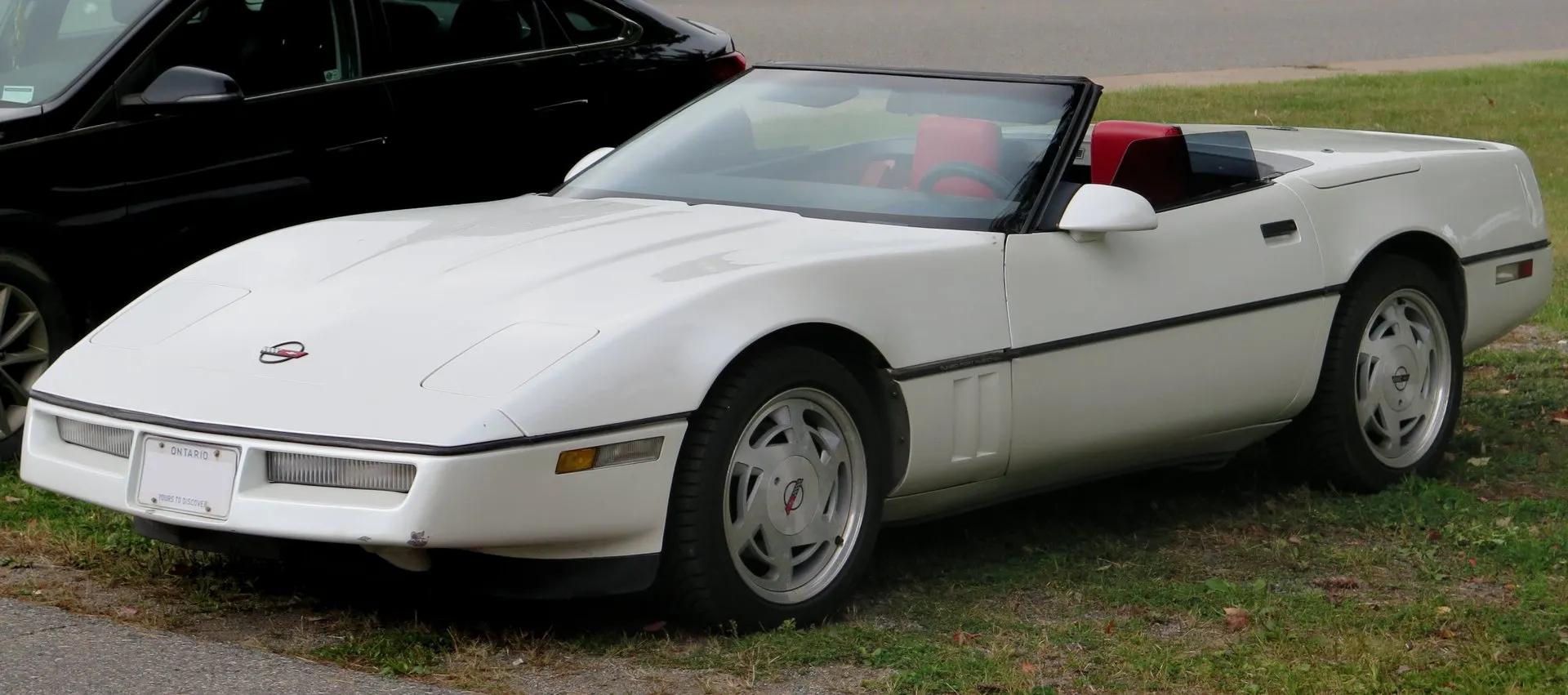
The 16-inch wheel is the 1988 tell. For 1989 the 17s became standard, so the six-vent wheel was standard equipment for this year alone, and owners in a 2010 CorvetteForum thread (opens in new tab) call it seldom seen. One there says it fits 1988–1994 cars with the right offset but won’t clear the big brakes. The 17s, by contrast, carried into 1989, so they prove less.
Did the bigger tires add grip? Not on Car and Driver’s skidpad: its Z52 coupe pulled 0.87 g, the same as the previous car, and the magazine said that wasn’t the point. It called the Z52 “a bargain at $970.”
Section 03
New heads, a longer-lift cam, and 240 or 245 hp
The L98 is a 5.7-liter (350 cu in) pushrod V8 with Tuned-Port Injection, aluminum heads, hydraulic roller lifters and 9.5:1 compression, and Chevrolet’s sales book calls for 91-octane unleaded (85 in some high-altitude areas named in the owner’s manual). For 1988, GM’s power-train pages describe three changes (page 73):
- Heads. Exhaust ports raised for more flow, new valve head and seat angles, and a second angle cut on the back of each exhaust valve. The casting is 10088113, by Corvette Action Center’s identification page, against the 1987’s 14101128.
- Exhaust manifolds. Revised to raise and enlarge the tubes where they meet the head.
- Camshaft. Intake lift up 0.011 in, exhaust lift up 0.015 in and exhaust duration up 4 degrees, “responsible for an increase of five horsepower.”
How much horsepower does a 1988 Corvette have? 240 or 245, and the exhaust decides. Chevrolet’s sales book (page 40):
| 1988 car | Mufflers | Power | Torque |
|---|---|---|---|
| Coupe, 4+3 manual | Dual outlet | 245 hp at 4,300 rpm | 340 lb-ft at 3,200 rpm |
| Coupe, automatic with the 3.07 axle | Dual outlet | 245 hp at 4,300 rpm | 340 lb-ft at 3,200 rpm |
| Coupe, automatic with the 2.59 axle | Single outlet | 240 hp at 4,000 rpm | 335 lb-ft at 3,200 rpm |
| Every convertible | Single outlet | 240 hp at 4,000 rpm | 335 lb-ft at 3,200 rpm |
GM’s specification sheet ties the automatic coupe’s rating to its axle, but it rates the 3.07 manual convertible at 240 hp too; only the muffler rule fits every car. It matches the C4 guide’s “240 or 245 hp” and the 1989 guide. Don’t call the 1988 stronger across the board: every 1987 made 240 hp and 345 lb-ft, so peak torque fell 5 to 10 lb-ft, and only the dual-outlet cars gained the 5 hp.
Gearboxes and axles. The 700-R4 four-speed automatic was standard. The Doug Nash 4+3 manual, a four-speed with overdrive on its top three gears and a 2.88 first, cost nothing but required the boost fan, engine oil cooler and heavy-duty radiator. It went on 4,282 cars against 18,507 automatics, in its last year: the ZF six-speed replaced it for 1989. Manuals got a 3.07 axle. Automatic coupes got a 2.59 and automatic convertibles a 2.73, per GM’s specification sheet, unless the buyer paid $22 for the G92 3.07, which required the Z52 and went on 4,497 cars.
How fast is a 1988 Corvette? Car and Driver’s Z52 automatic coupe with the 3.07 axle ran 0–60 mph in 5.6 seconds and the quarter mile in 14.2 seconds at 95 mph, stopped from 70 mph in 168 ft and reached 154 mph. It weighed 3,313 lb at the curb; GM’s sheet lists 3,229 lb for a coupe and 3,299 lb for a convertible, unchanged from its 1987 figures. EPA’s current-method ratings are 15 mpg city, 23 highway and 18 combined for the automatic, and 15, 22 and 18 for the manual.
Section 04
Z51, Z52 or the plain 16-inch car
Both handling packages cost $500 more than in 1987, and both now brought the 17-inch wheels and tires, which this site reads as the reason. GM’s order guide (page 34) and ordering information give their content:
| Z51 Performance Handling | Z52 Sport Handling | |
|---|---|---|
| Price | $1,295 | $970 |
| Built | 1,309 | 16,017 |
| Bodies and gearbox | coupe only, 4+3 manual only | coupe or convertible, either gearbox |
| Springs and bars | heavy-duty, front and rear | standard |
| Brakes | heavy-duty, 13-inch front rotors | standard |
| Both | Bilstein gas shocks, 13:1 steering, 17-inch wheels and tires, oil cooler, heavy-duty radiator, boost fan |
The Z51 added a power steering cooler and the convertible’s structure ahead of the dash. Seven 1988s in ten had the Z52 (the 2,050 anniversary cars among them), and the Z51 went on 8.5 percent of coupes. Corvette Action Center labels its Z52 count “coupe,” but GM’s order guide lists the package on the convertible’s page too.
Subtract both packages from production and about 5,460 cars were left on the base springs, base shocks and the 16-inch wheels, by this site’s arithmetic. That’s the plain 1988, and the rarer one to find with its original wheels.
Section 05
Who ordered what: colors, options and 22,789 cars
Bowling Green built 22,789 cars, down 7,843 from 1987, by Corvette Action Center’s plant figures. GM’s kit has no 1988 production page, but two GM campaigns cover serials J5100001 to J5122789, a span that agrees with that total. Most buyers loaded up (Corvette Action Center’s counts and prices):
| Option (RPO) | Price | Built |
|---|---|---|
| Delco-Bose stereo (UU8) | $773 | 20,304 |
| Electronic air conditioning control (C68) | $150 | 19,372 |
| Leather sport seats (AQ9) | $1,025 | 12,724 |
| Leather base seats (AR9) | $400 | 9,043 |
| Blue-tint roof panel (24S) | $615 | 8,332 |
| Dual removable roof panels (C2L) | $915 | 5,091 |
| Performance axle (G92) | $22 | 4,497 |
| California emissions (NN5) | $99 | 3,882 |
| Bronze-tint roof panel (64S) | $615 | 3,337 |
| Radio delete (UL5) | minus $297 | 179 |
| Callaway Twin Turbo (B2K) | $25,895 | 124 |
What’s the 1988 interior like? The all-digital dash and a steering wheel without an airbag, as on every 1984–1989. Cloth came in black or saddle only; leather in black, blue, gray, red and saddle, plus the anniversary car’s white. The sport seats required power seats on both sides.
Colors. Ten solid colors, three of them new: Dark Blue Metallic, Charcoal Metallic and Gray Metallic. There was no customer two-tone; the black-over-white scheme came only with the Z01. Counts are Corvette Action Center’s:
| Color (code) | Built |
|---|---|
| Bright Red (81) | 5,340 |
| White (40) | 3,620 |
| Black (41) | 3,420 |
| Dark Red Metallic (74) | 2,878 |
| White/Black, 35th Anniversary (40/41) | 2,050 |
| Dark Blue Metallic (28) | 1,675 |
| Medium Blue Metallic (20) | 1,148 |
| Charcoal Metallic (96) | 1,046 |
| Gray Metallic (90) | 644 |
| Yellow (35) | 578 |
| Silver Metallic (13) | 385 |
The table adds up to 22,784. Corvette Action Center’s other five are Dark Orange (66) coupes it marks “pilot vehicles only,” a color missing from GM’s order guide.
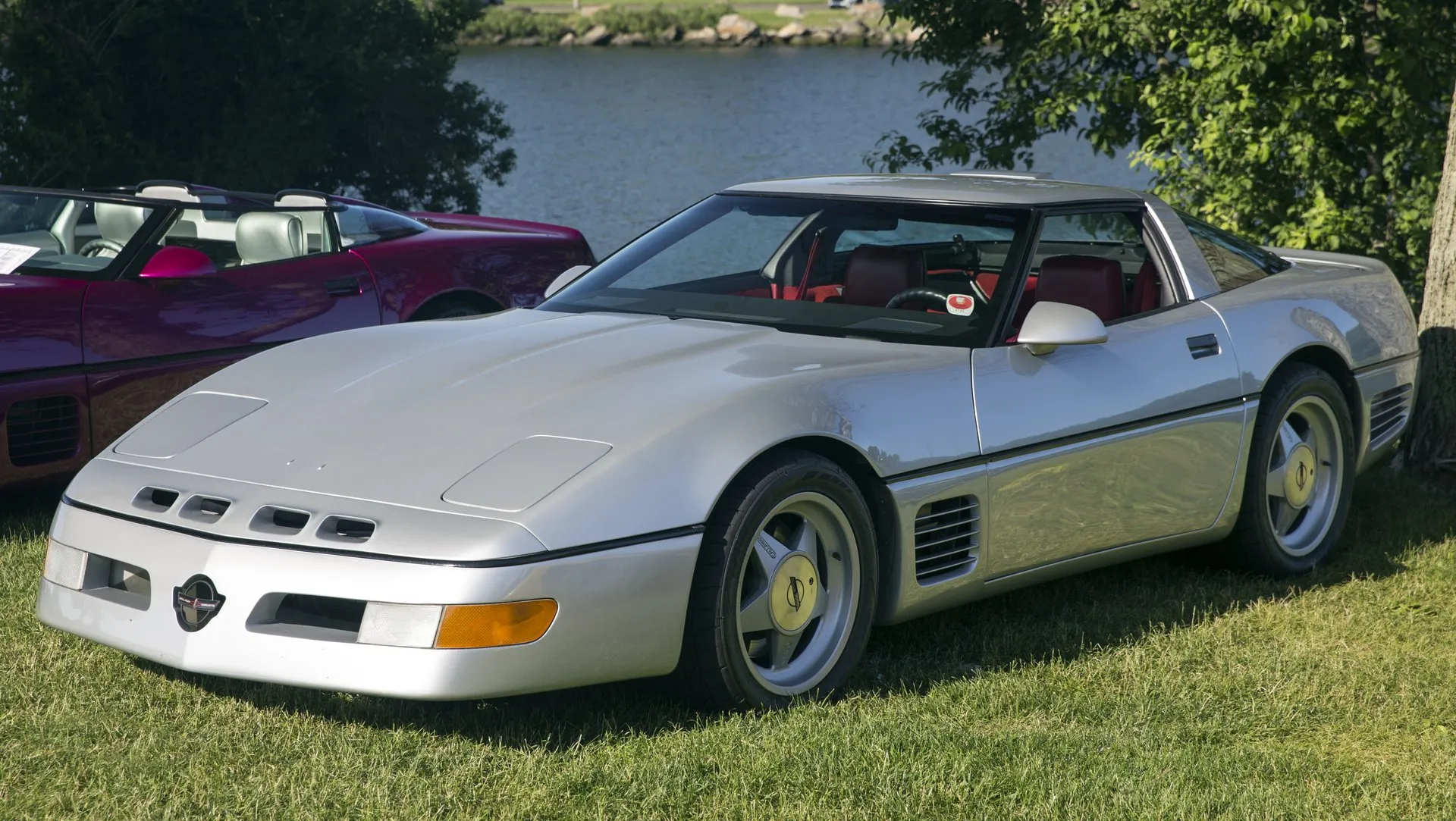
The Callaway. RPO B2K, a twin-turbo conversion ordered through Chevrolet dealers, went on 124 cars at $25,895 on top of the Corvette, by Corvette Action Center’s count. Hagerty and Bring a Trailer give Callaway’s rating as 382 hp and 562 lb-ft; GM’s kit gives none. Not every 1988 Callaway was a manual: a convertible sold on Bring a Trailer in June 2026 has a three-speed automatic. The 1987 guide tells how B2K began and the 1990 guide covers its later cars.
The Corvette Challenge. SCCA’s one-make series ran on specially prepared 1988 coupes, 56 of them by Hagerty’s account. They trade in their own market. So do body-kitted cars: Chevrolet announced in June 1987 an $1,800 GTO fiberglass body kit for 1984 and later Corvettes, sold through GM parts dealers, so a 1988 wearing one is a kit car, not a factory special.
Section 06
Proving a 1988: J, 10088113 and the console label
The VIN of every 1988 reads 1G1YY, then:
| Position | On a 1988 |
|---|---|
| 6 | 2 coupe, 3 convertible |
| 7 | 1: manual seat belts |
| 8 | 8: the L98 |
| 9 | Check digit |
| 10 | J: 1988 |
| 11 | 5: Bowling Green |
| 12–17 | 100001 to 122789 |
A 1987 reads H in the tenth place and a 1989 K. The decodes are Corvette Action Center’s; GM’s campaigns give the same serial range.
The engine. Corvette Action Center lists the suffix codes as ZMA (automatic), ZMC (manual, oil cooler) and ZMD (automatic, oil cooler); no GM list of them turned up. The block, 14093638, runs from 1987 to 1990, so it proves little. The heads, 10088113, rule out a 1987’s originals but are shared with 1989. A Callaway follows Callaway’s numbering instead.
The option label. GM’s Service Parts Identification label, in the console area on GM’s service manual drawing, lists the RPO codes the car was built with. It’s where Z01, Z51, Z52, G92, MM4 (the 4+3) or B2K show up, or don’t. A Z51 should come with MM4; an anniversary car should show Z01.
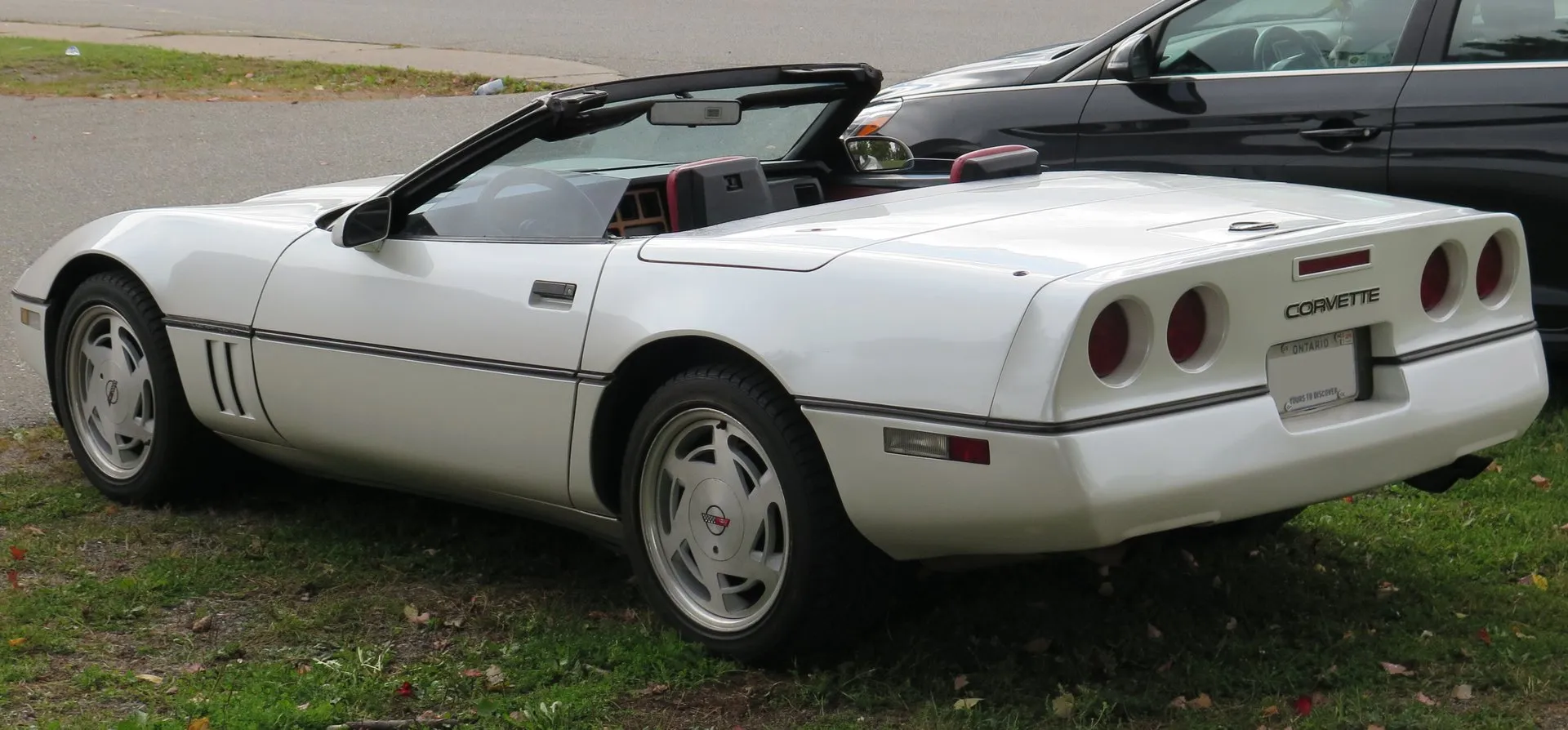
By eye. Two-piston front calipers, a low parking brake handle set back from the door, and either the six-vent 16-inch wheel or the twelve-slot 17 rule out a 1984–1987. An all-digital dash and a steering wheel without an airbag rule out a 1990 or later.
Is there a 1988 Corvette Stingray? No. No C4 carries the name; the generations guide traces where it went. Nor is there a 1988 ZR-1: the ZR-1 went on sale as a 1990.
Section 07
Three recalls, an emissions campaign and the dealer bulletins
Was the 1988 Corvette recalled? Three times. NHTSA’s list (opens in new tab) shows:
- 88V017000 (February 1988), 1988 only. On cars with 17-inch wheels, a “missing weld that attaches wheel center to the rim” could let the center separate from the rim, risking steering and braking control and “crash without prior warning.” GM’s campaign 88C09 replaced wheels with missing welds. Corvette Action Center’s summary puts it on the first 8,432 1988s with the Z51 or Z52; that scope isn’t in NHTSA’s record.
- 90V032000 (February 1990), 1988–1989. Rear wheel tie rods could fatigue and fracture at the inboard bearing, risking loss of control. Campaign 89C17 replaced the tie rod assemblies on every 1988 and 1989.
- 91V143000 (September 1991), 1984–1991. Front belts that can jam in the retractor, replaced only if one locks up. The C4 guide covers the 91C25 and 91C26 stickers and the trouble owners have getting the repair.
GM also ran campaign 89C25, an emissions fix NHTSA’s safety list doesn’t show: two evaporative emission hoses that “may deteriorate, crack and leak,” replaced on every 1988 serial, J5100001 to J5122789, regardless of mileage or ownership.
The dealer bulletins worth knowing, from Corvette Action Center’s transcriptions of GM’s originals:
- 89-327-6D (1988–1989). Intermittent no-starts, long cranking, start-and-stall or surging with no codes: replace both MAF relays with
GM 14089936(OEM). - 91-231-6D (1988–1991). A no-start with no starter click, “similar to a VATS related condition,” from paint on the starter mounting flange breaking the ground. Clean the flange before blaming the key.
- 89-136-10 (white 1988–1989 cars). Yellowing paint on and around the headlamp doors, from the clear coat reacting with rubber under the hood. Every white 1988 is in range; on cars before J5120731 the fix included new headlamp doors. A repaired car carries radiator hose
10135650or a drive belt10105314with a green band (OEM). - 89-183-1B. The A/C hose can rub the underside of the hood on every 1988.
- 90-376-3B (1988–1990). Power steering shudder or groan in low-speed turns.
- 90-412-10 (1984–1990). Power seats dead or blowing fuses because the switch harness shorts on a bracket under the seat.
What goes wrong with a 1988 Corvette? NHTSA’s complaint file (opens in new tab) holds 16, filed September 1996 to November 2023. By this site’s reading: eight about seat belts, several saying GM no longer supplies the parts; two about broken rear tie rods, one from an owner who says he lost control in 2005; two about power seat wiring, one describing a fire under the driver’s seat motor; two electrical; and two others. NHTSA’s file starts in 1994, after these cars were new, so these are raw counts, not rates. The digital dash, headlight motors, weatherstrips and cold steering are generation-wide: see Known C4 problems.
Section 08
A 1988 inspection, in eleven steps
- The tie rods. Paperwork for 89C17, and no clunk or wander from the rear. This is the recall that matters most.
- The 17-inch wheels. On a Z51, Z52 or anniversary car, proof of 88C09, or wheels inspected at each center-to-rim weld.
- Both front belts. Pull each all the way out and let it retract. A jamming belt is a safety repair.
- The 89C25 label on the radiator core support, and the evaporative hoses themselves.
- Starts, hot and cold. Restart it several times. No-starts with no codes point to the MAF relays; no click at all, to the starter ground before VATS.
- The power seats. Run them through every direction and sniff for hot wiring under them.
- White paint around the headlamp doors, and the hood’s underside for A/C hose rub marks.
- The VIN and label. J in the tenth place, and every package the ad claims printed on the option label.
- An anniversary car. Z01 on the label, paint 40/41, white leather down to the belts, and the console lid and plaque inspected for reproduction parts.
- A Callaway. Callaway’s paperwork and an engine number in Callaway’s scheme: the year, the Callaway sequence and the last four of the VIN.
- The fuel. Premium for the test drive. Then a shop that knows Tuned-Port cars.
Section 09
1988 prices in 2026: base, 35th Anniversary and Callaway
How much is a 1988 Corvette worth? For a stock base car, about $10,000 to $15,000 at auction in 2026; 35th Anniversary cars and Callaways bring more. Bring a Trailer (opens in new tab) sold seven base 1988s between March 21 and September 1, 2026 (results read through October 20), for $6,299 to $22,501: a median of $12,750, by this site’s arithmetic on sold prices before the buyer’s fee.
- Coupes, 4, median $14,500: three Z51 four-speeds at $13,500, $15,500 and $22,501 (13,000 miles), and a modified Z52 at $6,299.
- Convertibles, 3, median $9,700: $9,500, $9,700 and $12,750 (a charity auction).
Calendar 2025 brought seven base sales at a median of $10,250.
The 35th Anniversary. Thirteen sold from January 2025 to October 2026, $10,250 to $50,001, a median of $18,444. Driven cars brought $13,583 to $22,750. Two near-new ones set the top in 2026: $50,001 for a four-speed with 146 miles and $35,000 for one with 386 miles.
The Callaway. Five sold, $20,800 to $52,666, a median of $31,382; the top was a one-owner convertible with 6,000 miles in June 2026.
Hagerty’s #3 (good) values of February 8, 2026 (archived copy (opens in new tab)) are $9,700 for a coupe, $11,700 for a convertible and $12,100 for a 35th Anniversary, with a Callaway at $24,300 as a coupe and $29,800 as a convertible. That’s a little under the 1987 and 1989 coupes. classic.com showed no 1988 figure, and the best-years guide prices 1984–1989 cars together. Samples this small give a feel, not a price list, and none of it predicts where values go.
Section 10
The 1988 worth buying
Buy a Z51 coupe. The 1988’s story is brakes, and the Z51 is the only 1988 with the 13-inch front rotors, along with the only heavy-duty springs and bars. Every one also has the 4+3, the 3.07 axle and the 245 hp dual-outlet engine. Just 1,309 were built, yet three of the four base coupes Bring a Trailer sold in 2026 were Z51 four-speeds, at a median of $15,500 among them. Expect a firm ride on those springs, and check that the label shows Z51 and MM4. Brake late into the first tight corner on a back road, and the year’s whole point shows up under your right foot.
The softer choice is a Z52 coupe, ideally an automatic with the G92 axle, the spec Car and Driver timed at 5.6 seconds to 60. The budget path is a convertible: every one is a 240 hp car, and 2026’s sold for a median of $9,700. Buy it for the open sky.
The collector’s 1988 is the 35th Anniversary, and only with Z01 on the label and an original plaque and lid. On Bring a Trailer they sold at a median of $18,444 from January 2025 to October 2026, against $10,250 for the nine base coupes sold in the same months; near-new ones are a different market. Skip a car with no tie-rod paperwork, a jamming belt priced as if it didn’t jam, or a white coupe sold as an anniversary car without the label to prove it.
For the generation’s bigger picture, the C4 guide still steers most buyers to a 1995 or 1996. But a 1988 Z51 is America’s sports car at the moment its brakes caught up with its engine, for about half its 1988 sticker.
Section 11
Sources
- GM Heritage Center: 1988 Corvette vehicle information kit files.zipcorvette.com This site's library. Chevrolet's 1988 ordering information: new features and handling packages (PDF pages 8, 9); the 35th Anniversary newsletter, brochure, photo caption and release (5, 27, 28, 30, 31); the dealer order guide revised December 4, 1987 (33, 34, 36); sales book color and trim, power teams and engine (38, 40); one-page summary (54); the Protofab GTO releases (58 to 63); suspension, wheels and brakes (64 to 66); heads and camshaft (72, 73); GM's MVMA specification sheets: power teams (103), brakes (113), tires and wheels (114), weights (126).
- GM Heritage Center: 1987 and 1989 Corvette vehicle information kits files.zipcorvette.com This site's library. The 1987's castings, ratings, prices and packages (PDF pages 4, 6); also the 1989 kit (pages 4 and 38), for the 1989 castings and the end of the Z52.
- Car and Driver: Tested: 1988 Chevrolet Corvette (May 1988) (opens in new tab) caranddriver.com Csaba Csere. A Z52 coupe, automatic, 3.07 axle: 0–60 mph 5.6 s, 154 mph, 0.87 g, 3,313 lb, $29,955 base and $33,598 as tested; the new brakes and the Z52's price.
- NHTSA recalls, 1988 Chevrolet Corvette (opens in new tab) api.nhtsa.gov Three GM recalls (88V017000, 90V032000, 91V143000), pulled October 22, 2026. Two aftermarket filter recalls in the same results are not about the car.
- NHTSA owner complaints, 1988 Chevrolet Corvette (opens in new tab) api.nhtsa.gov 16 complaints (17 records) on October 22, 2026, filed September 1996 to November 2023; NHTSA's file starts in 1994. Theme counts are this site's reading of the complaint text.
- GM product safety campaign 88C09: possible missing wheel weld, 1988 Corvette with 17-inch wheels (via Corvette Action Center) (opens in new tab) corvetteactioncenter.com February 1988, the campaign for recall 88V017000. Transcriptions of GM's bulletins here and below are not GM or NHTSA originals. Also 89C17 (opens in new tab) rear tie rods (March 1990), 91C25 and 91C26 (opens in new tab) belt retractors and 89C25 (opens in new tab) evaporative hoses, with the 1988 VIN range.
- GM dealer service bulletin 88-399-10: 1988 Anniversary model door armrests turning yellow (via Corvette Action Center) (opens in new tab) corvetteactioncenter.com April 1989. Also 88-272-3C (opens in new tab) the wider 1988 front spring (August 1988), 89-327-6D (opens in new tab) MAF relays (July 1991), 89-136-10 (opens in new tab) white-paint headlamp door yellowing (April 1989), 89-183-1B (opens in new tab) A/C hose rubbing the hood (June 1989), 90-376-3B (opens in new tab) steering groan (October 1990), 90-412-10 (opens in new tab) power seat harness (March 1991), 91-231-6D (opens in new tab) starter ground no-start (February 1991) and 93-169-3E (opens in new tab) tires slipping on wheels.
- Corvette Action Center: 1988 Corvette production (opens in new tab) corvetteactioncenter.com Plant production, option, color and interior counts and prices, and the Callaway count; a secondary source, GM's kit wins where they differ. Also its 1988 identification (opens in new tab) page (VIN, engine suffixes, castings) and its 35th Anniversary (opens in new tab) page.
- EPA fuel economy ratings (fueleconomy.gov): 1988 Corvette (opens in new tab) fueleconomy.gov Current method: automatic 15/23/18, manual (vehicle 4123 (opens in new tab)) 15/22/18. Pulled October 22, 2026.
- Bring a Trailer: C4 Corvette auction results (opens in new tab) bringatrailer.com Listings titled as a 1988, January 2025 to October 20, 2026, read October 22, 2026; a Grand Sport 80 conversion, a Corvette Challenge race car and a five-speed swap left out; 35th Anniversary cars and Callaways counted apart. Medians are this site's, from the sold prices without the buyer's fee.
- Hagerty valuation tool: 1984–1996 Corvette generation page (archived February 8, 2026) (opens in new tab) web.archive.org #3 (Good) values: 1988 coupe $9,700, convertible $11,700, 35th Anniversary $12,100, Callaway coupe $24,300 and convertible $29,800; 1987 and 1989 for comparison. Its history text on the Corvette Challenge cars and the Callaway's 382 hp and 562 lb-ft.
- CorvetteForum thread: 88 35th console serial number (opens in new tab) corvetteforum.com March 2011 to July 2018. Owner reports on plaque numbers against VINs, reproduction lids and plaques, and Chevrolet tracing one car's number.
- CorvetteForum thread: rare 88 wheels? (opens in new tab) corvetteforum.com March 2010. Owner reports on the 1988 base 16-inch wheel.