C4 · Buying guide
1989 Corvette guide: the ZF six-speed, FX3 and the original digital dash's last year
Published
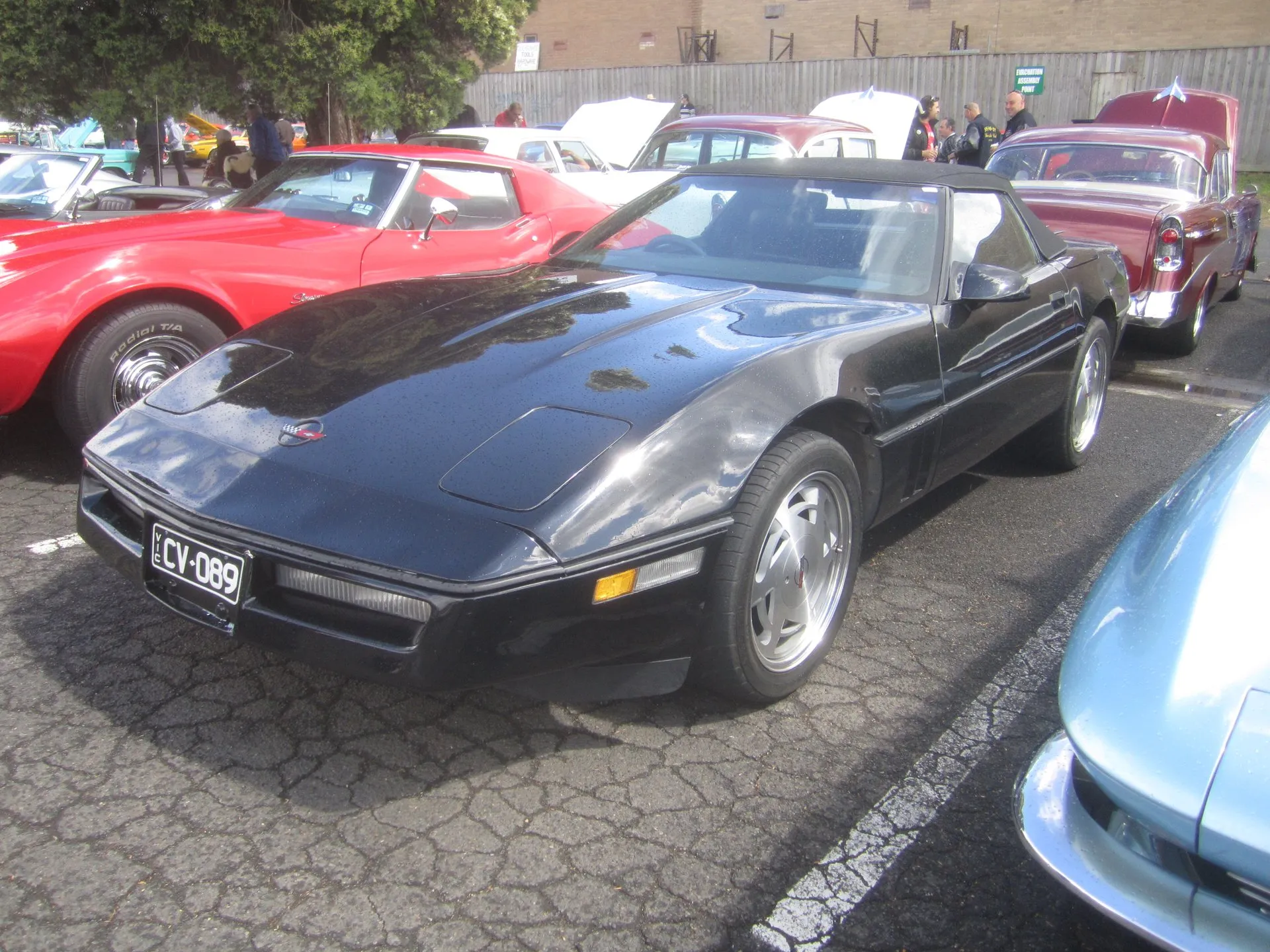
Second gear isn’t always available in a 1989 Corvette six-speed. Pull away gently with the coolant past 122°F (50°C), reach for second between 12 and 19 mph with the throttle at 35 percent or less, and a computer picks fourth instead, “even if the driver intends to shift to second gear,” GM’s engineering page says. GM called it computer-aided gear selection (CAGS), and Car and Driver’s June 1989 road test (opens in new tab) said it helped the Corvette pass the EPA’s fuel-economy tests. Floor it from a stop and the computer stays out of the way.
That skip-shift came with the year’s big news: for 1989, the sixth model year of the C4 (1984–1996), a ZF six-speed replaced the Doug Nash “4+3” as the only manual gearbox. The base car took over almost everything in the old Z52 Sport Handling package, Bilstein shocks and 17-inch wheels included. A new option, FX3, let the driver change the shock settings from a console switch. And the L98 V8 was rated at 240 hp or 245 hp, with the answer in the mufflers.
- Built: 26,412: 16,663 coupes and 9,749 convertibles, up 3,623 from 1988.
- Power: 240 hp or 245 hp, depending on the mufflers (see 240 hp or 245 hp: count the outlets).
- Price new: $31,545 coupe, $36,785 convertible, before destination.
- New: the ZF six-speed, FX3, and Bilsteins and 17-inch wheels on every car.
- Price now: a median of $9,475 from 4 sales on Bring a Trailer in 2026; Hagerty’s February 2026 #3 values are $9,900 coupe, $13,200 convertible.
The 1989 was also the last year of the original all-electronic dash, and the last Corvette without an airbag; the 1990 got a new instrument panel and a driver airbag. Most figures here come from GM’s 1989 Heritage Center kit in this site’s manual library, including pages from the Corvette Black Book, a hobby reference GM bound into it.
C4 Key figures
- Built
- 26,412: 16,663 coupes and 9,749 convertibles
- L98 V8
- 240 hp or 245 hp, depending on the mufflers
- Price new
- $31,545 coupe, $36,785 convertible
- New for 1989
- the ZF six-speed, FX3, and Bilsteins and 17-inch wheels on every car
- Six-speed (MN6)
- 4,113 cars
- Bring a Trailer, 2026
- a median of $9,475 from 4 sales
- Hagerty #3, Feb 2026
- $9,900 coupe, $13,200 convertible
Section 01
Six gears, and a computer that skips two
GM’s engineering page on the gearbox says the ZF “is the only manual transmission available in 1989.” ZF built it in Germany to a design shared with Chevrolet, the Black Book page adds, with every gear synchronized, reverse included. GM rated it for 450 lb-ft, well over the L98’s 340.
| Gear | ZF six-speed (1989) | Doug Nash 4+3 (to 1988) |
|---|---|---|
| 1st | 2.68 | 2.88 |
| 2nd | 1.80 | 1.91 |
| 3rd | 1.31 | 1.33 |
| 4th | 1.00 | 1.10 as GM printed it |
| 5th | 0.75 | none |
| 6th | 0.50 (GM’s engineering page prints 0.49) | none |
The 4+3 had put overdrive on its top three gears instead, as the 1986 and 1987 guides explain. The ZF simply has six gears, two of them overdrives.
The six-speed was RPO MN6 (RPO is GM’s regular production option code), and it cost nothing over the standard four-speed automatic. Chevrolet’s order guide, revised January 30, 1989, says it required the KC4 engine oil cooler, the B4P radiator boost fan and the V01 heavy-duty radiator, about $225 of cooling on the coupe’s price list. The Black Book page counts 4,113 cars with it, 15.6 percent of the year. Corvette Action Center counts 22,299 automatics. No count splits the 4,113 by body, but GM’s order guide and Car and Driver’s test car put the six-speed in the convertible too.
Living with CAGS. The computer watches road speed, coolant temperature, engine speed, transmission speed and throttle position, and it only steps in on the first upshift from a standing start. Owners in a 2001 CorvetteForum thread (opens in new tab) say cheap plug-in eliminators exist and that on pre-1996 cars it can simply be disconnected. Of course you’d rather pick your own gear.
The growl that’s supposed to be there. Chevrolet ran an exchange program for 1989–1991 ZF gearboxes “to gain helpful product feedback on the new ZF 6-speed,” bulletin 91-89-7B says, and its chart calls a low-speed “first gear parking lot growl” and a dual-mass flywheel resonance at shut-down normal. ZF’s own later note says 1989–1992 gearboxes growl by design. A GM engineer’s note traces a cold squeal with the clutch pedal down to the crankshaft pilot bushing. Grinding is something else.
Axles, and a disputed note. Automatics got a 2.59 axle, or the $22 G92 performance ratio (3.07 on the coupe, 2.73 on the convertible) on 10,211 cars; G92 needed the same three cooling options and wasn’t available with Z51. For the six-speed, GM’s MVMA specification sheet (revised September 1988) and its engineering axle page give every car a 3.54. A handwritten, unsigned note bound into GM’s kit, dated January 10, 1989, says six-speeds built after about February 6, 1989 would get a 3.33 instead (page 28). It names no author and records a plan, not cars built. GM’s brochure prints 3.31, a figure from a November 1987 GM plan. On any one car, the axle code on the option label settles it: GM’s code for 3.54 is GHO.
Section 02
240 hp or 245 hp: count the outlets
How much horsepower does a 1989 Corvette have? 240 hp or 245 hp, and the exhaust decides. The L98 is a 5.7-liter (350 cu in) pushrod V8 with Tuned-Port Injection, aluminum heads, hydraulic roller lifters and 9.5:1 compression, and it wants 91-octane unleaded. GM’s engine specifications give it:
| 1989 car | Mufflers | Power | Torque |
|---|---|---|---|
| Coupe, automatic, 2.59 axle | Single outlet | 240 hp at 4,000 rpm | 335 lb-ft at 3,200 rpm |
| Every convertible | Single outlet | 240 hp at 4,000 rpm | 335 lb-ft at 3,200 rpm |
| Coupe, six-speed | Dual outlet | 245 hp at 4,300 rpm | 340 lb-ft at 3,200 rpm |
| Coupe, automatic with G92 | Dual outlet | 245 hp at 4,300 rpm | 340 lb-ft at 3,200 rpm |
That matches the C4 guide’s “240 or 245 hp” for 1988–1989. Car and Driver’s spec line gave its six-speed convertible 245 hp; GM says every convertible is a 240 hp car, and GM’s rating stands. New for 1989 were Multec injectors, designed to resist clogging, and no separate cold-start injector, GM’s brochure says.
How fast is a 1989 Corvette? Car and Driver’s six-speed convertible, which came with the new hardtop and weighed 3,499 lb at the curb, ran 0–60 mph in 5.8 s and the quarter mile in 14.4 s at 94 mph, reached 100 mph in 16.2 s and topped out at 142 mph. It stopped from 70 mph in 157 ft and pulled 0.88 g on the skidpad. GM’s kit gives no 0–60 time of its own.
GM’s MVMA sheet puts an automatic coupe at 3,223 lb and a convertible at 3,263 lb. EPA’s current-method figures are 15 mpg city, 23 highway and 18 combined with either gearbox, on premium.
Section 03
Bilsteins for everyone, FX3 for a few
“Beginning with S.O.P. for 1989, the Z52 Sport Handling Package is cancelled,” GM’s program highlights say. “All RPO’s included in the Z52 package, except for the cooling package, are now part of the base car.” So every 1989 got Bilstein gas-charged shocks with new digressive valving, which GM said brought “much reduced ride harshness,” plus the twelve-slot 17 x 9.5-inch wheels on P275/40ZR-17 Goodyear Eagles. A 1988 buyer had paid $970 for the Z52 package, by Corvette Action Center’s 1988 production page; the 1987 guide tells how it began.
Z51. The Performance Handling Package cost $575 and went on 2,224 cars, 13.3 percent of coupes. It was for coupes with the six-speed only, and it bundled the boost fan, the oil cooler, the heavy-duty radiator, a heavy-duty suspension and a faster steering ratio. No 1989 GM page in the kit gives a Z51 bigger brakes.
FX3. Selective Ride and Handling cost $1,695 and could be ordered only with Z51. GM’s suspension page calls it Bilstein Selective Ride Control: a console switch picks Touring, Sport or Performance, and a microprocessor drives electric motors on each shock through 18 speed-variable valving positions. If something fails, it defaults to the safest setting.
Here’s the quirk. The Black Book page says every 1989 with FX3 was a Z51, yet FX3 cars got Z52 springs and stabilizer bars, not the Z51’s, “for a wider range of suspension control.” Z52 was the base car by then, and the 1987 Black Book describes it as most of the Z51’s hardware “with the softer suspension of base models.” So a Z51 coupe without FX3 is the stiff 1989, and one with FX3 rides on the base springs. The only exceptions were the sixty Corvette Challenge race cars, which had FX3 with Z51 springs and bars.
How many FX3 cars? The Black Book page prints 1,573, the same number it prints for the convertible’s unrelated hardtop, and no independent count confirms either, so treat both as the Black Book’s figures, not settled ones. Owners in a CorvetteForum thread on FX3 (opens in new tab) name the weak points: the small gear on top of each shock and the actuators. Rebuilds exist, and some owners remove the system.
Sport seats. The leather adjustable sport seats (AQ9, $1,025, 1,777 cars) went only to Z51 cars in 1989, the Black Book page says, because of weight and fuel economy. Chevrolet’s January 1989 order guide doesn’t print that requirement, so check the label on a sport-seat car without Z51.
Section 04
The hardtop that stiffened the convertible
The convertible’s big addition came late in the year: CC2, a removable hardtop at $1,995, one of two “new convertible options for late 1989 introduction,” the Black Book page says. GM’s engineering pages describe a 65 lb single-piece shell in body color, with a black headliner and a heated rear window. Car and Driver, which tested one in June 1989, said it was developed by ASC, locked on with nine bolts, met the rollover standards for fixed-roof cars and left the convertible’s body “fifteen percent stiffer than the coupe’s.”
The other late option was V56, a black rear luggage rack for $140, on 616 cars. Two GM bulletins cover the hardtop’s teething trouble: 90-203-10, a rattle from short rivets in the mounting brackets, and 90-183-10, a stowage lid that won’t sit flush.
Section 05
What 26,412 buyers ordered
Base price bought the L98, the automatic, cloth seats, and a body-color removable roof panel on the coupe or a soft top on the convertible. Chevrolet’s order guide, whose prices include destination, lists $32,045 and $37,285, $500 more. Most buyers loaded up. Counts and prices are the Black Book’s option page:
| Option (RPO) | Price | Built |
|---|---|---|
| Delco-Bose stereo (UU8) | $773 | 24,145 |
| Electronic air conditioning control (C68) | $150 | 24,675 |
| Leather seats (AR9) | $400 | 23,364 |
| Heavy-duty radiator (V01) | $40 | 20,888 |
| Radiator boost fan (B4P) | $75 | 20,281 |
| Engine oil cooler (KC4) | $110 | 20,162 |
| Performance axle (G92) | $22 | 10,211 |
| Low tire pressure warning (UJ6) | $325 | 6,976 |
| Dual removable roof panels, coupe (C2L) | $915 | 5,274 |
| California emissions (NN5) | $100 | 4,501 |
| Six-speed manual (MN6) | No charge | 4,113 |
| Z51 Performance Handling, coupe | $575 | 2,224 |
| Leather sport seats (AQ9) | $1,025 | 1,777 |
| FX3 Selective Ride and Handling | $1,695 | 1,573 |
| Removable hardtop, convertible (CC2) | $1,995 | 1,573 |
| Callaway Twin-Turbo (B2K) | $25,895 | 69 |
Colors. Eight on the chart, and Bright Red outsold the rest:
| Color (code) | Built |
|---|---|
| Bright Red (81) | 7,663 |
| White (10) | 5,426 |
| Black (41) | 4,855 |
| Dark Red Metallic (68) | 3,409 |
| Dark Blue Metallic (28) | 1,931 |
| Charcoal Metallic (96) | 1,440 |
| Medium Blue Metallic (20) | 1,428 |
| Gray Metallic (90), cancelled in November 1988 | 225 |
Off the chart, Chevrolet’s records show 27 Arctic Pearl cars (code 31) and a handful of Yellow (code 35): six by the Black Book page, eight by Corvette Action Center. Interiors ran black 9,909, red 7,139, saddle 4,785, gray 3,096 and blue 1,483.
Inside. The all-liquid-crystal instrument cluster, switchable between English and metric, had its last year, and coupes got a heated rear window as standard. The C4 guide covers what an aging digital dash does.
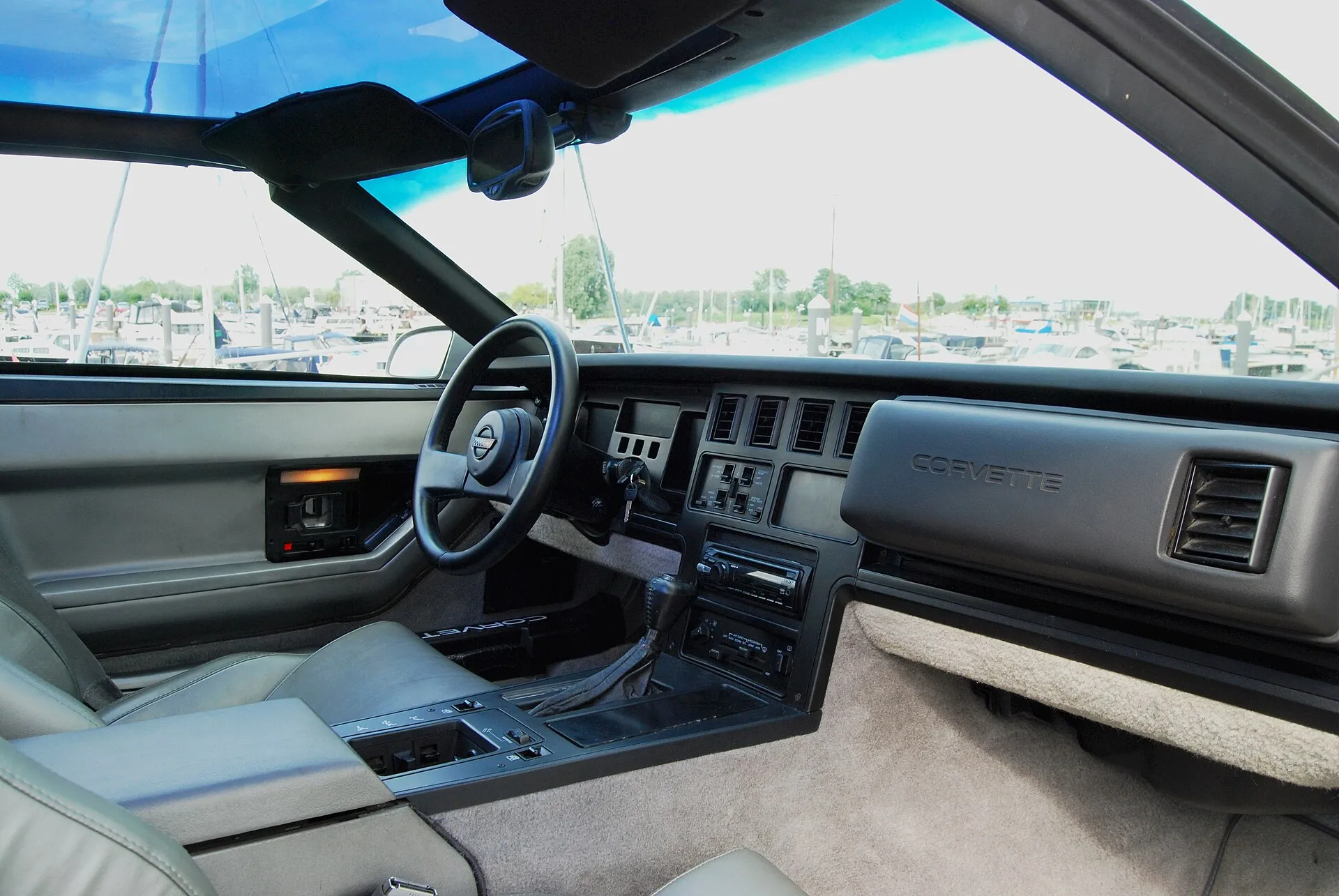
Is a 1989 Corvette a Stingray? No. GM’s 1989 order guide names a Corvette coupe and a Corvette convertible, and nothing else; the generations guide traces where the Stingray name went and when it came back.
Section 06
The rare 1989s: ZR-1, Challenge and Callaway
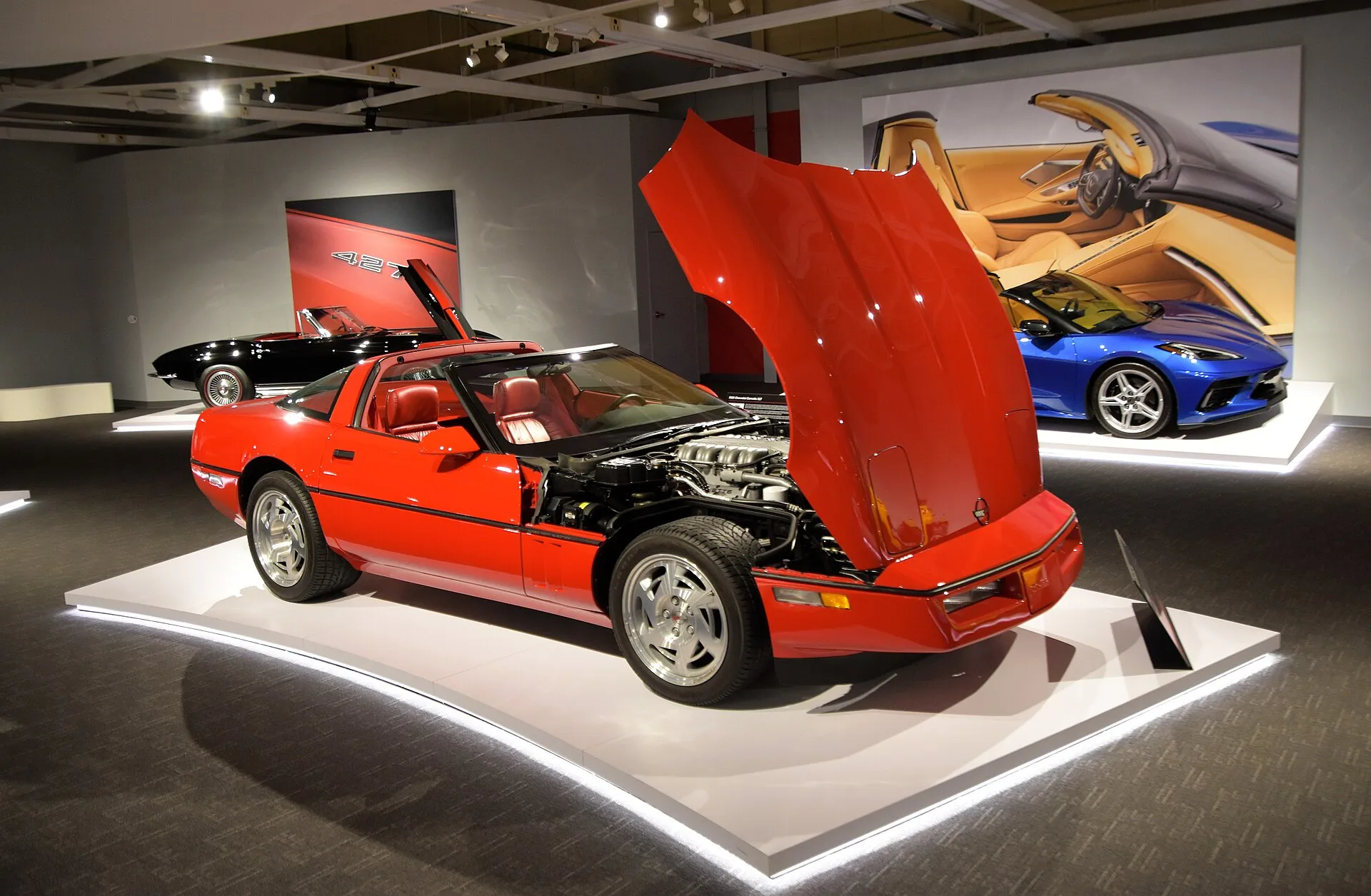
Is there a 1989 ZR-1? Built, yes; sold, no. GM’s engineering pages planned it as a 1989, but on April 19, 1989, Chevrolet told dealers it would be a 1990, citing “insufficient availability of engines caused by additional development.” About 100 1989 ZR-1s were built for evaluation, testing, media previews and photography, and none were released for public sale, the Black Book page says. GM’s evaporative-hose campaign 89C25 lists 84 ZR-1 VINs, K5800001 to K5800084. One was bid to $84,500 on Bring a Trailer in April 2026 without selling. A 1989 wearing ZR-1 badges is either one of those cars, with the papers to prove it, or a clone; the C4 ZR-1 guide covers the real thing.
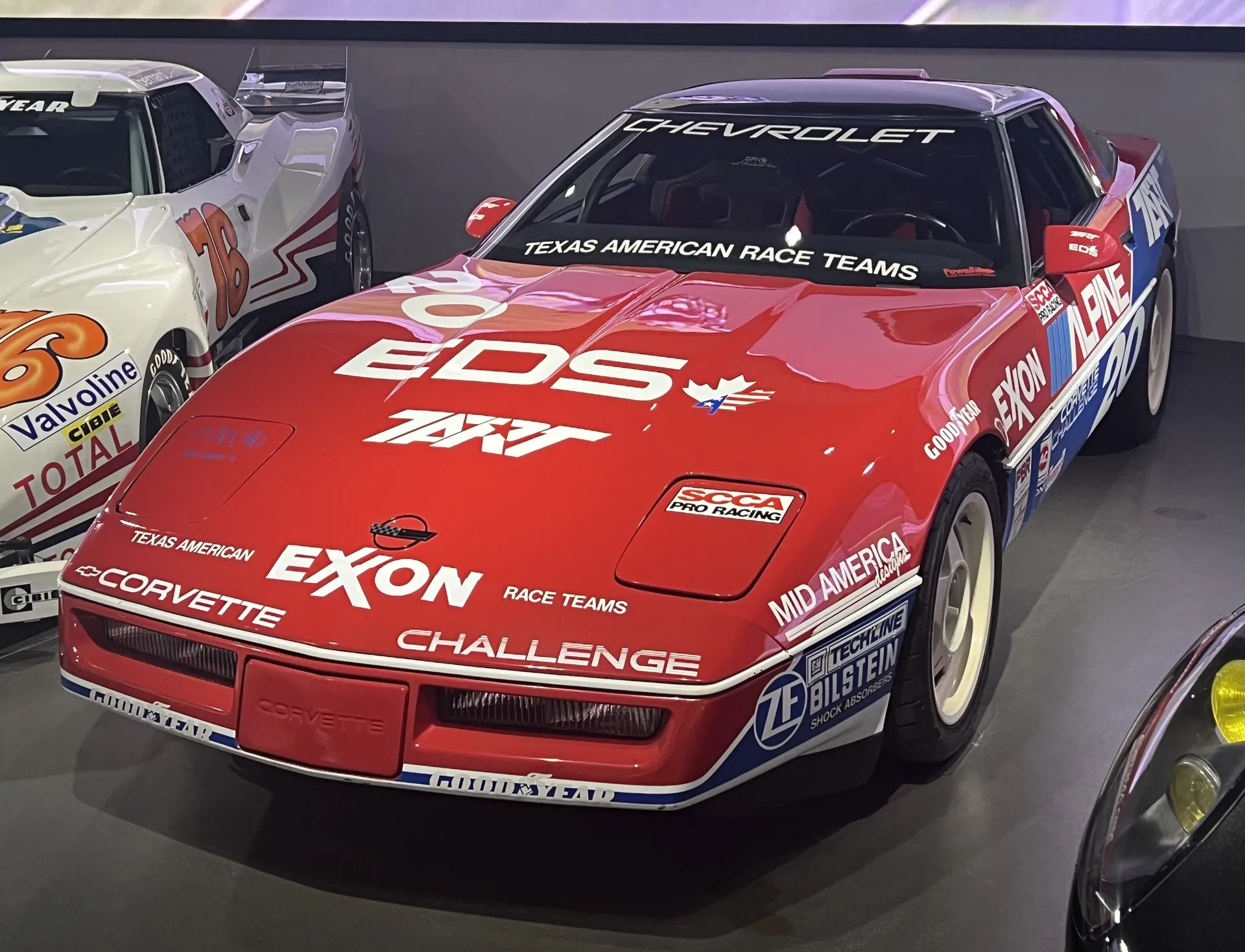
The Corvette Challenge. The one-make race series ended with the 1989 season, and Bowling Green built sixty cars for it with standard engines. Race engines built in Flint were matched for power and sealed, then swapped in when the cars got their roll cages; at season’s end, the Black Book page says, Chevrolet gave each racer back the original, numbers-matching engine. So a Challenge car’s story lives in its paperwork. On Bring a Trailer, one raced in 11 rounds of 1989 sold for $38,500 in November 2025, and the ex-Stu Hayner car, the 1989 champion by its listing, for $55,000 in March 2026.
The Callaway. RPO B2K, the Callaway Twin-Turbo (“not GM installed,” the Black Book page notes), went on 69 cars at $25,895 on top of the Corvette. Bowling Green built the cars with standard engines, and Callaway’s Connecticut shop fitted its twin-turbo engines. Hagerty’s valuation tool lists 382 hp for a 1989 Callaway; neither GM’s kit nor the Black Book page gives a rating. Hagerty’s February 2026 #3 values are $26,700 for a Callaway coupe and $30,100 for a convertible; a 30,000-mile six-speed coupe sold on Bring a Trailer for $35,000 in April 2025.
Section 07
The K in the VIN, and other proof of a 1989
GM’s VIN chart and the Black Book page decode every 1989:
| Position | On a 1989 |
|---|---|
| 1–3 | 1G1: United States, General Motors, Chevrolet |
| 4–5 | YY: Corvette |
| 6 | 2 coupe, 3 convertible |
| 7 | 1: manual belts |
| 8 | 8: L98 5.7-liter V8 |
| 9 | Check digit |
| 10 | K: 1989 |
| 11 | 5: Bowling Green |
| 12–17 | 100001 to 126412 |
A 1988 reads J in the tenth place, and a 1990 reads L, with a 3 in the seventh place for its airbag.
Engine. Part of the VIN is stamped on a pad on the case, with a suffix: ZRA (manual, oil cooler), ZRB (automatic) or ZRC (automatic, oil cooler). Since every six-speed needed the oil cooler, a six-speed car should carry ZRA. The block is cast 14093638 and the heads 10088113, but that block number runs from 1987 to 1990.
The option label. GM’s Service Parts Identification label, in the storage compartment between and behind the seats on GM’s drawing, lists every RPO code the car was built with, plus the paint and trim codes (page 21). It’s the proof for MN6, Z51, FX3, G92, CC2, UJ6, AQ9 and B2K, and for the axle code.
By eye. An all-electronic dash and a wheel with no airbag rule out a 1990 or later. Twelve-slot 17-inch wheels fit a 1989, but also a 1988 that had them as an option. A six-speed shifter rules out every earlier manual C4, and a factory hardtop on a convertible means 1989 or later.
Section 08
The tie-rod recall and what else GM fixed
NHTSA’s recall list (opens in new tab) holds two GM recalls for the 1989:
- 90V032000 (1988–1989). The rear wheel tie rod “may fatigue and could fracture at the inboard bearing,” which could cause “loss of vehicle control and a crash without prior warning.” Dealers replaced the tie rod assemblies under GM campaign 89C17. It’s the one recall a 1989 shares only with the 1988.
- 91V143000 (1984–1991). Front belts that can lock up or jam in the retractor, with a remedy that applies once a belt locks up. The C4 guide covers the campaign stickers and the trouble owners have had getting the repair.
GM ran a third campaign that isn’t on NHTSA’s list because it’s about emissions, not safety. Campaign 89C25 (opens in new tab) replaced two evaporative emission hoses that “may deteriorate, crack and leak” on 1988–1989 cars, 1989 VINs K5100001 to K5126328, with a campaign label on the radiator core support.
Chevrolet’s dealer bulletins for the 1989 predate NHTSA’s bulletin index and survive in Corvette Action Center’s transcriptions. The ones worth knowing:
- 89-327-6D (1988–1989). Intermittent no-starts, long cranking, start-and-stall or surging with no trouble codes, because the production MAF relays (
GM 14103304, OEM) “may not conduct enough current.” The fix is both relays, replaced withGM 14089936(OEM). Corvette Action Center has the bulletin (opens in new tab), and owners still name the MAF and its relays as a common failure. - 89-136-10 (white 1988–1989 cars). Yellowing paint on or around the headlamp doors, from the clear coat reacting with rubber under the hood. Cars with VINs after K5113927 aren’t affected.
- 89-183-1B. The A/C hose can rub the underside of the hood on 1989s built before K5103849.
- 90-376-3B (1988–1990). Power steering shudder or groan at parking speeds; new hoses with internal tuner cables.
- 91-493-7A (1989–1991 automatics). No reverse, or a slow one, below 0°F; a new reverse input clutch seal.
What goes wrong with a 1989 Corvette? NHTSA’s complaint file (opens in new tab) holds 15, filed from November 1995 to September 2016. By this site’s reading: three about brakes, three about the rear suspension (all touching the tie-rod recall), two about seat belts, two recall questions, two electrical and three one-offs. NHTSA’s file starts in 1994, after these cars were new, so these are raw counts, not rates. What a 1989 shares with other C4s (belts, headlight motors, weatherstrips, cold steering, PASS-Key no-starts) is in Known C4 problems. A 1989 has no Opti-Spark: that distributor came with the 1992 LT1.
Section 09
Eleven checks on a 1989 before you pay
- The tie rods. Proof of the 90V032000 work, and no clunk from the rear.
- Both front belts. Pull each one all the way out and let it retract.
- Starts, hot and cold. Restart the car several times. A no-start, a stall or a surge with no codes points at the MAF relays in 89-327-6D.
- The six-speed. A growl in first at parking-lot speed is normal by GM’s chart; grinding isn’t, and neither is a cold squeal with the clutch in. Ask whether CAGS has been disconnected.
- The label against the ad. Any MN6, Z51, FX3, G92, CC2 or AQ9 the ad claims should show on the option label, and a six-speed engine should read ZRA.
- FX3. Turn the switch through all three settings, and ask what’s been rebuilt or removed.
- The dash. Every segment readable in daylight and after dark, in English and metric.
- Under the hood. Rub marks from the A/C hose on the hood’s underside, the 89C25 label on the radiator core support, and the hoses themselves.
- White cars. Yellowed paint around the headlamp doors.
- The hardtop. Rattles, and a stowage lid that sits flush.
- An inspection. Owners in a 2017 CorvetteForum thread (opens in new tab) add heater core and steering rack leaks, rear U-joints, hub play and headlight motors to the list, and suggest compression and leak-down tests.
Section 10
What a 1989 sells for now
How much is a 1989 Corvette worth? Around $10,000 at auction in 2026. From January 20 to October 17, Bring a Trailer (opens in new tab) sold four 1989 road cars (Callaway, Challenge, ZR-1 and engine-swapped cars left out) for $7,000 to $20,650: a median of $9,475, by this site’s count of sold prices without the buyer’s fee, the same figure the 1990 guide gives. All four were automatics. Leave out the cheapest, a $7,000 convertible with an aftermarket throttle body and intake, and the median is $10,750.
Calendar 2025 brought eight sales, four of each body, from $7,250 to $20,250: a median of $13,250. Only two six-speed road cars sold in those 22 months, a Z51 coupe for $16,500 and a convertible for $12,250, too few to price the gearbox. Samples this small are market color, not a valuation.
Hagerty’s #3 (good) values of February 8, 2026 put a 1989 coupe at $9,900 and a convertible at $13,200, between the 1988 and the 1990. classic.com shows no 1989 figure; the best-years guide’s $12,750 median covers stock 1984–1989 cars together. That’s what values did, not a forecast. The Callaway, Challenge and ZR-1 cars trade in their own market (see The rare 1989s).
Section 11
Which 1989 is worth your money
Buy a six-speed coupe. It’s the year’s reason to exist: the first Corvette six-speed, the 245 hp dual-outlet engine, the cooling MN6 required, and Bilsteins and 17s that were options a year earlier. Let the label prove MN6; if CAGS bugs you, owners say it unplugs. One owner in a 2013 CorvetteForum thread prized the 0.50 sixth gear on the highway. Fewer than one 1989 in six was built this way, so be patient.
Z51 or not? A Z51 coupe without FX3 is the stiffest 1989, for the driver who’ll take it to a track day and wants it flat into the first braking zone. With FX3, it rides on base springs and brings electric shocks from 1989 to the inspection: buy that one for the switch, and budget for a rebuild.
The budget path is an automatic coupe, about $10,000 on 2026’s sales; a G92 car gets the 245 hp rating too. The convertible is a 240 hp car whatever the gearbox, but one with the CC2 hardtop is two cars in one, and stiffer than a coupe with the top bolted on, by Car and Driver’s account.
Is 1989 a good year? One CorvetteForum owner calls it the best of the C4s; another calls that subjective. If an airbag and the 1990 dashboard matter more, the 1990 costs a little more, and the C4 guide’s pick for most buyers is still a 1995 or 1996. But for the $12,250 to $16,500 the last two six-speeds brought, you get three pedals and the six-speed Car and Driver used to reach 60 mph in 5.8 seconds. That’s America’s sports car at its most attainable.
Section 12
Sources
- GM Heritage Center: 1989 Corvette vehicle information kit files.zipcorvette.com This site's library. Corvette Black Book pages GM included in the kit: production, VINs, engine codes, castings and the year's facts (PDF page 4); options with prices and counts, colors and interiors (5). GM service manual identification pages: VIN chart (10), engine and transmission codes (11), the Service Parts Identification label (21). Chevrolet's ordering information (24), the handwritten axle note dated January 10, 1989 (28), the 1989 order guide revised January 30, 1989 (30, 32, 34). GM engineering pages: program highlights (38), six-speed and CAGS (39), suspension and FX3 (40), axles (44). Sales brochure: new for 1989 (128), power teams (132), engines and transmissions (137), engine specifications (138). MVMA specification sheets: power teams (142), tires and wheels (154), weights (166).
- GM Heritage Center: 1988 and 1990 Corvette vehicle information kits files.zipcorvette.com This site's library. What 1990 changed (PDF page 4); also the 1988 kit (page 8).
- NHTSA owner complaints, 1989 Chevrolet Corvette (opens in new tab) api.nhtsa.gov 15 complaints on October 22, 2026, filed November 1995 to September 2016; NHTSA's file starts in 1994. Theme counts are this site's reading of the complaint text.
- NHTSA recalls, 1989 Chevrolet Corvette (opens in new tab) api.nhtsa.gov Two GM recalls (90V032000, 91V143000), pulled October 22, 2026. Two aftermarket filter recalls in the same results are not about the car.
- GM product campaign 89C25: evaporative emission hoses, 1988–1989 Corvette (via Corvette Action Center) (opens in new tab) corvetteactioncenter.com Chevrolet's campaign bulletin with the VIN ranges, as transcribed by Corvette Action Center. Transcriptions of GM's bulletins here and below are not GM or NHTSA originals. Also 89C17 (opens in new tab), the campaign number for recall 90V032000, and 91C25 and 91C26 (opens in new tab), the belt campaign.
- GM dealer service bulletin 89-327-6D: intermittent no-start, MAF relays, 1988–1989 Corvette (via Corvette Action Center) (opens in new tab) corvetteactioncenter.com July 1991. Also 89-136-10 (opens in new tab) headlamp door yellowing on white cars (April 1989), 89-183-1B (opens in new tab) A/C hose rubbing the hood (June 1989), 91-89-7B (opens in new tab) six-speed exchange program (October 1990), the GM engineer's pilot bushing note (opens in new tab), ZF's note on 1989–1992 gearboxes (opens in new tab), 90-376-3B (opens in new tab) power steering groan, 90-203-10 (opens in new tab) hardtop bracket rattle, 90-183-10 (opens in new tab) hardtop stowage lid and 91-493-7A (opens in new tab) cold delayed reverse.
- Corvette Action Center: 1989 Corvette production and options (opens in new tab) corvetteactioncenter.com A secondary source for the automatic count and the color counts by body; GM's kit wins where they differ. Also its 1989 identification (opens in new tab) page and its 1988 production page (opens in new tab), for 1988 prices.
- Car and Driver: 1989 Chevrolet Corvette Convertible road test (June 1989) (opens in new tab) caranddriver.com A six-speed convertible with the new hardtop: 0–60 mph in 5.8 s, quarter mile 14.4 s at 94 mph, 142 mph; the hardtop's nine bolts and stiffness; CAGS and the EPA.
- EPA fuel economy ratings (fueleconomy.gov): 1989 Corvette (opens in new tab) fueleconomy.gov Current method. Automatic; the six-speed is vehicle 5244 (opens in new tab). Pulled October 22, 2026.
- Bring a Trailer: C4 Corvette auction results (opens in new tab) bringatrailer.com Listings titled as a 1989, December 2024 to October 20, 2026, read October 22, 2026; Callaway, Corvette Challenge, ZR-1 and engine-swapped cars counted apart. Medians are this site's, from the sold prices without the buyer's fee.
- Hagerty valuation tool: 1984–1996 Corvette generation page (archived February 8, 2026) (opens in new tab) web.archive.org #3 (Good) values: 1989 coupe $9,900, convertible $13,200; 1989 Callaway coupe $26,700, convertible $30,100; 1988 and 1990 for comparison. Its 382 hp rating for 1988–1989 Callaways.
- CorvetteForum thread: 1989 C4 problem areas (opens in new tab) corvetteforum.com May 2017. Owner reports.
- CorvetteForum thread: FX3 suspension questions (opens in new tab) corvetteforum.com November 2009 to August 2016. Owner reports on FX3 actuators, shocks and rebuilds.
- CorvetteForum thread: what is CAGS skip shift in a ZF 6 (opens in new tab) corvetteforum.com December 2001. Owner reports on disconnecting CAGS.
- CorvetteForum thread: choosing between an 87, 88, 89 or 90 (opens in new tab) corvetteforum.com March 2013. Owner opinions on the 1989 against its neighbours.