C1 · Buying guide
1961 Corvette guide: the first ducktail, the 315 hp fuelie, two-tone coves and 2026 prices
Published
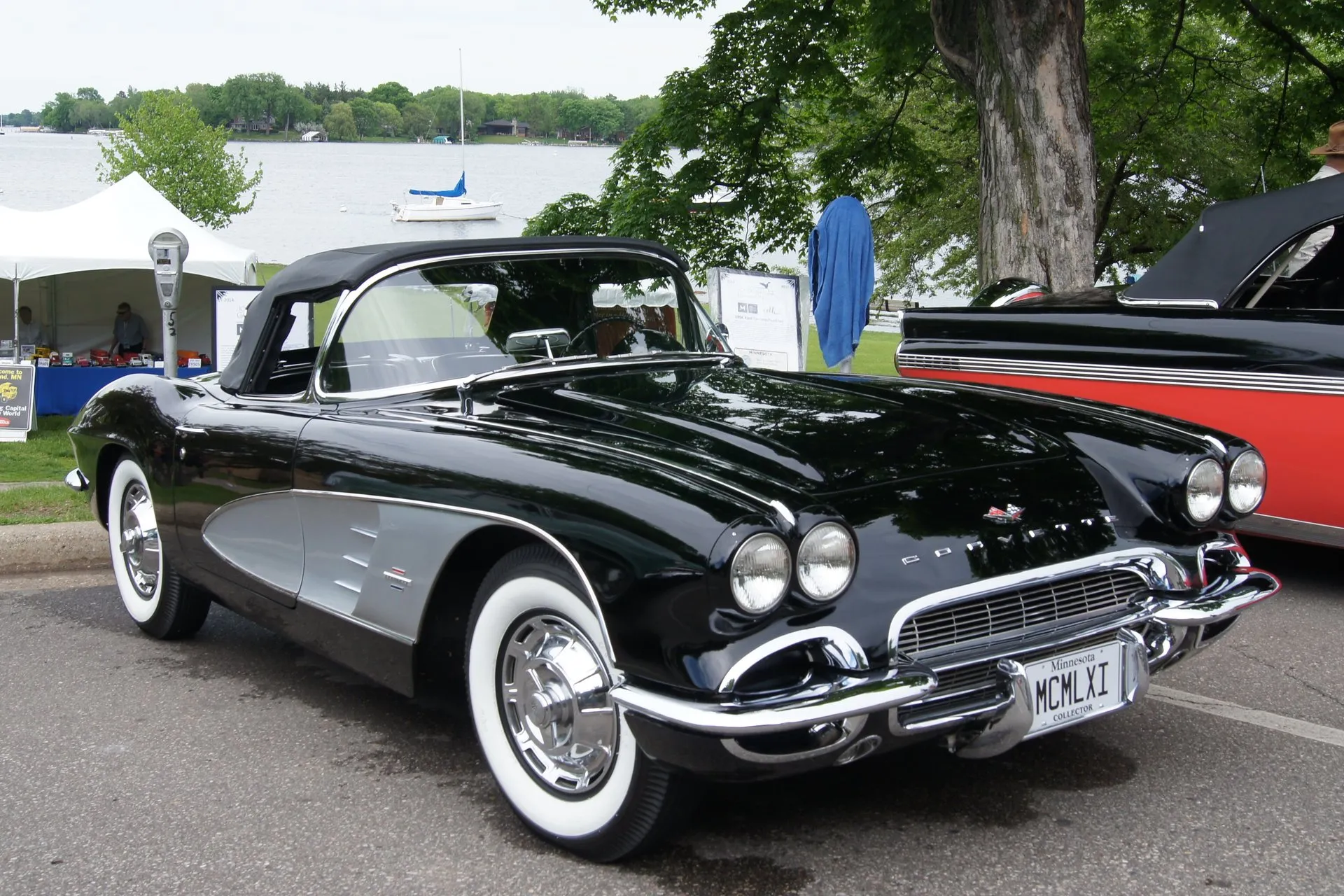
Jewel Blue lasted one model year. The Corvette Black Book, a reference whose 1961 pages GM reprints in its Heritage Center kit, counts 855 cars painted that color and says it was available only in 1961. A good deal of the 1961 C1 (1953–1962) shared that fate. The 275 and 315 hp fuel-injected 283s that GM had printed for 1960 reached buyers’ driveways for 1961 only; a year later the 327 replaced them. It was the last year of the 283, of dual four-barrels, of contrasting paint in the side coves and of wide whitewalls. What it started stayed: the ducktail rear with four round taillights, and exhaust that left under the body instead of through the bumper.
It’s an odd one to price, too. On Bring a Trailer in 2026, buyers paid less for 1961s than for 1962s, a $54,500 median against $63,250, while Hagerty’s guide values them the other way round.
- Built: 10,939, all convertibles, second only to 1962 among C1 years.
- Engines: five versions of the 283 V8, from 230 hp to 315 hp gross. 1,580 cars had fuel injection, the “fuelie”, and 1,462 of those were the 315.
- Price new: $3,934, $62 more than a 1960.
- What one costs: Hagerty’s #3 (Good) values run $61,900 to $96,900 (January 2026), by engine; Bring a Trailer’s 2026 median, to October 21, was $54,500 (10 sales).
- A 1961 Sting Ray? No such car. The Sting Ray name reached production with the 1963.
Frames, rocker supports, fiberglass, heat and how fake fuelies get built are in the C1 buyer’s guide. This guide is the 1961 alone.
C1 Key figures
- Built
- 10,939, all convertibles
- New for 1961
- the ducktail rear with four round taillights
- Strongest engine
- 315 hp fuel injection
- Fuel-injected cars
- 1,580
- Price new
- $3,934
- Hagerty #3, by engine
- $61,900 to $96,900 (January 2026)
- Bring a Trailer, 2026
- $54,500 (10 sales)
Section 01
The ducktail year: what Chevrolet changed for 1961
The front of a 1961 is a 1960 cleaned up; the back is new. The Black Book page in GM’s 1961 kit, part of this site’s manual library, lists the changes:
- A new rear. The rounded fenders with their taillights set into them gave way to a flat, cut-off deck with four round taillights, which the Black Book calls a Corvette trademark that started here.
- Exhaust under the body. Every earlier Corvette ran its pipes out through the rear body panel or the bumper.
- A cleaner nose. A fine mesh grille replaced the heavy chrome teeth, and the headlight bezels were painted the body color.
- A narrower tunnel. The transmission tunnel shrank by 20 percent.
- More standard equipment. Windshield washers, sunshades, a courtesy light, a parking brake warning light and a temperature-controlled radiator fan all became regular equipment (GM’s list). The heater stayed a $102.25 option, though 10,671 buyers took it.
- One-piece door sills, in place of 1960’s two-piece sills.
- An aluminum four-speed case, new for 1961.
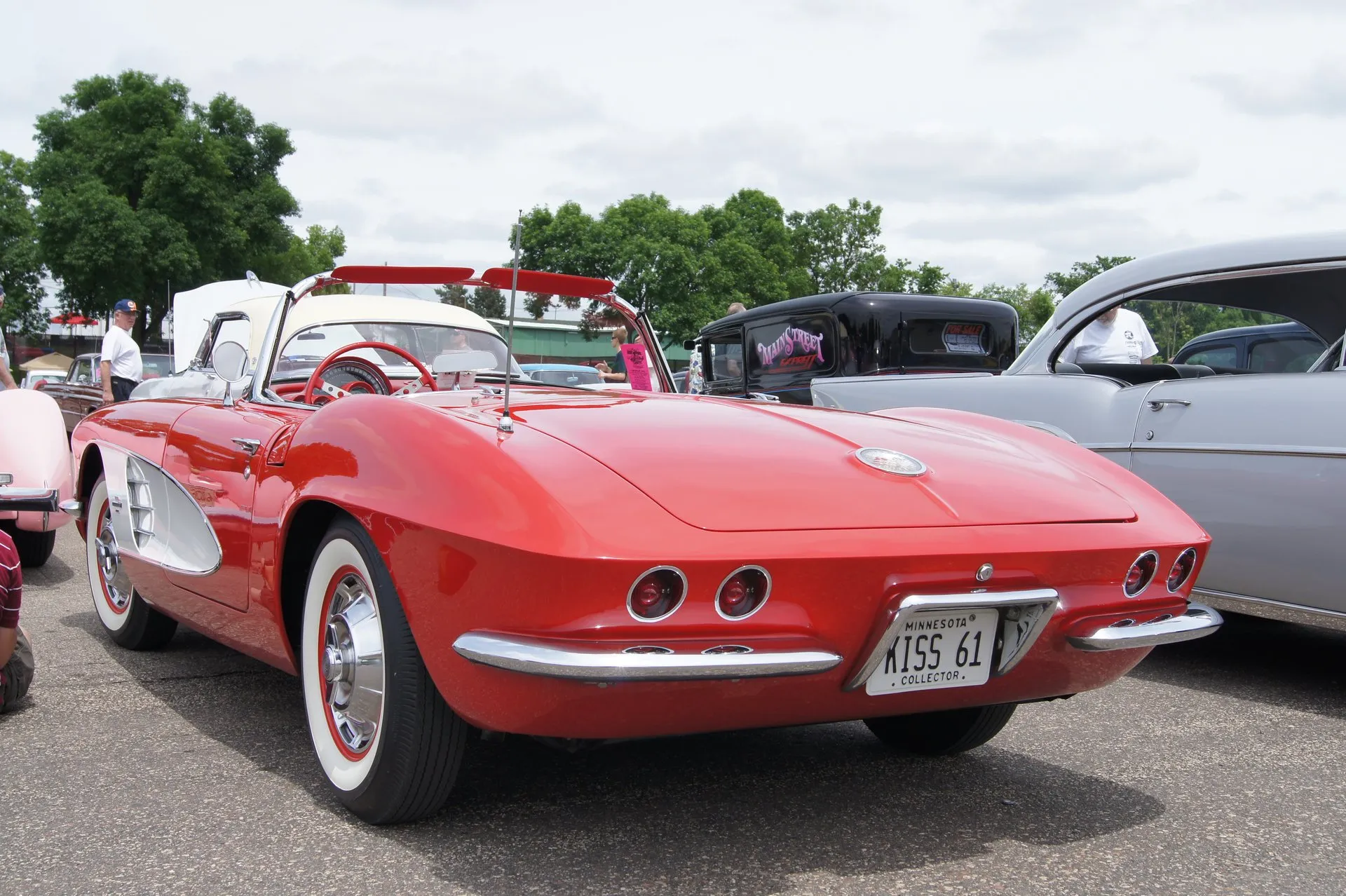
GM’s 1961 specification form gives a car 176.7 in long and 70.4 in wide on the same 102 in wheelbase (1961 kit), against 177.2 in and 72.8 in for 1960, and a three-speed curb weight of 3,035 lb (GM).
Under the hood, GM’s pages give every 1961 a Harrison aluminum cross-flow radiator with a 13 psi cap (GM), where 1960 kept aluminum for its two special-camshaft engines. Whether every car got one is another matter: see Copper or aluminum: the 1961 radiator.
Section 02
The last 283s, from 230 to 315 hp
Every 1961 has a 283 cu in V8 on block casting 3756519 (3789935 late in the year). Ratings are GM’s gross figures, not the net ones it used from 1972: the 230 hp base engine was 195 hp net (GM’s engine page).
| Engine | RPO and price | Induction and lifters | Gross rating | Compression | Pad suffix | Built |
|---|---|---|---|---|---|---|
| 230 hp | Standard | One four-barrel, hydraulic | 230 hp at 4,800 rpm; 300 lb-ft at 3,000 | 9.5:1 | CQ manual, DG Powerglide | 5,357 |
| 245 hp | 469, $150.65 | Two four-barrels, hydraulic | 245 hp at 5,000 rpm; 300 lb-ft at 3,800 | 9.5:1 | CT manual, DJ Powerglide | 1,175 |
| 270 hp | 468, $182.95 | Two four-barrels, special camshaft, mechanical | 270 hp at 6,000 rpm; 285 lb-ft at 4,200 | 9.5:1 | CU, manual only | 2,827 |
| 275 hp fuel injection | 353, $484.20 | Rochester fuel injection, hydraulic | 275 hp at 5,200 rpm; 305 lb-ft at 4,400 | 11.0:1 | CR, manual only | 118 |
| 315 hp fuel injection | 354, $484.20 | Rochester fuel injection, special camshaft, mechanical | 315 hp at 6,200 rpm; 295 lb-ft | 11.0:1 | CS, manual only | 1,462 |
RPO is GM’s regular production option code. Prices, counts and suffixes are the Black Book’s (1961 kit); the 230 hp count is this site’s subtraction. Only the optional engines got seven-fin cast alloy valve covers.
The fuelie that matched its brochure
For 1960, GM’s specification pages advertised fuel injection at 275 and 315 hp with aluminum heads, and no record shows either one reaching a customer; the 1960 guide tells that story. For 1961 the same two ratings went into production on cast iron heads, which GM’s fuel-injection page states outright. The Black Book gives the injected engines head casting 3782461 and the carbureted ones 3774692.
Buyers knew which one they wanted. Both fuelies cost $484.20, and 1,462 of the 1,580 fuel-injection buyers, more than nine in ten, took the 315 with the special camshaft: the strongest engine a Corvette buyer had yet driven home, where the best before was 290 hp (the C1 guide’s production table has every year). Fuel-injected cars came to 14.4 percent of the 1961s, nearly double 1960’s 859.
One trap in GM’s own paper: its 1961 option list and engine codes still carried aluminum-head fuel injection, RPO 579 and 582 with suffixes CY and CZ (1961 kit). The Black Book lists none built. CY or CZ on a “1961” engine pad is a question for the seller, not a find.
Gearboxes, axles and Positraction
The standard three-speed manual was a different box for 1961: 2.47, 1.53 and 1.00 to one, on a 3.36:1 axle (1961 kit), where 1960’s had a 2.21 first and a 1.32 second on a 3.70 (1960 kit). The overall first gear barely moved (8.30 against 8.18, this site’s arithmetic), but the taller axle meant fewer revs on the highway.
- Four-speed, RPO 685 at $188.30: 7,013 cars, 64.1 percent. Ratios 2.20, 1.66, 1.31 and 1.00 on a 3.70 axle, in the new aluminum case.
- Powerglide automatic, RPO 313 at $199.10: 1,458 cars, 1,226 with the 230 hp engine and 232 with the 245. GM offered it only behind those two, on a 3.55 axle.
- Three-speed: the remaining 2,468, this site’s subtraction. Every engine could have it, fuelies included.
Positraction, Chevrolet’s limited-slip axle, was RPO 675 at $43.05 on 6,915 cars: 3.36, 4.11 or 4.56 with the three-speed, 3.70, 4.11 or 4.56 with the four-speed (GM’s power teams), and never with the Powerglide (1961 kit).
Pounds per horsepower, and a stopwatch
GM’s yardstick, pounds per gross horsepower, runs from 14.50 for a three-speed 230 to 10.60 for a three-speed 315 (GM). Motor Trend tested both ends for its September 1961 issue, as Corvette Action Center reproduces it (the magazine wasn’t seen for this guide): 0–60 mph in 8.3 s for a 230 hp single-carburetor car and 7.4 s for a 315 hp fuelie. Nine-tenths of a second, in those two cars, for the price of the injection option.
Section 03
Seven colors, two-tone coves and the option sheet
The colors
The Black Book counts every 1961 by color. Wheels were body color, and the soft top black or white; 1960 had offered light blue too.
| Color | Cars | Contrasting cove, as GM paired it |
|---|---|---|
| Ermine White | 3,178 | Sateen Silver |
| Roman Red | 1,794 | Ermine White |
| Honduras Maroon | 1,645 | Ermine White |
| Fawn Beige | 1,363 | Ermine White |
| Tuxedo Black | 1,340 | Sateen Silver |
| Jewel Blue | 855 | Ermine White |
| Sateen Silver | 747 | Ermine White |
Seventeen more cars got a non-standard color, combination or primer. Fawn Beige and Jewel Blue were new names, and 1960’s Horizon Blue, Tasco Turquoise and Cascade Green were gone (GM’s color chart). Interiors came in red (4,459), black (3,487), fawn (1,662, also new) and blue (1,331).
The two-tone option, RPO 440 at $16.15, painted the coves in the contrasting color on 3,368 cars, and the Black Book says 1961 was the last year for it. Its split is partly smudged in the kit’s scan; the legible figures are 954 Roman Red with white, 429 Tuxedo Black with silver, 385 Ermine White with silver and 358 Fawn Beige with white.
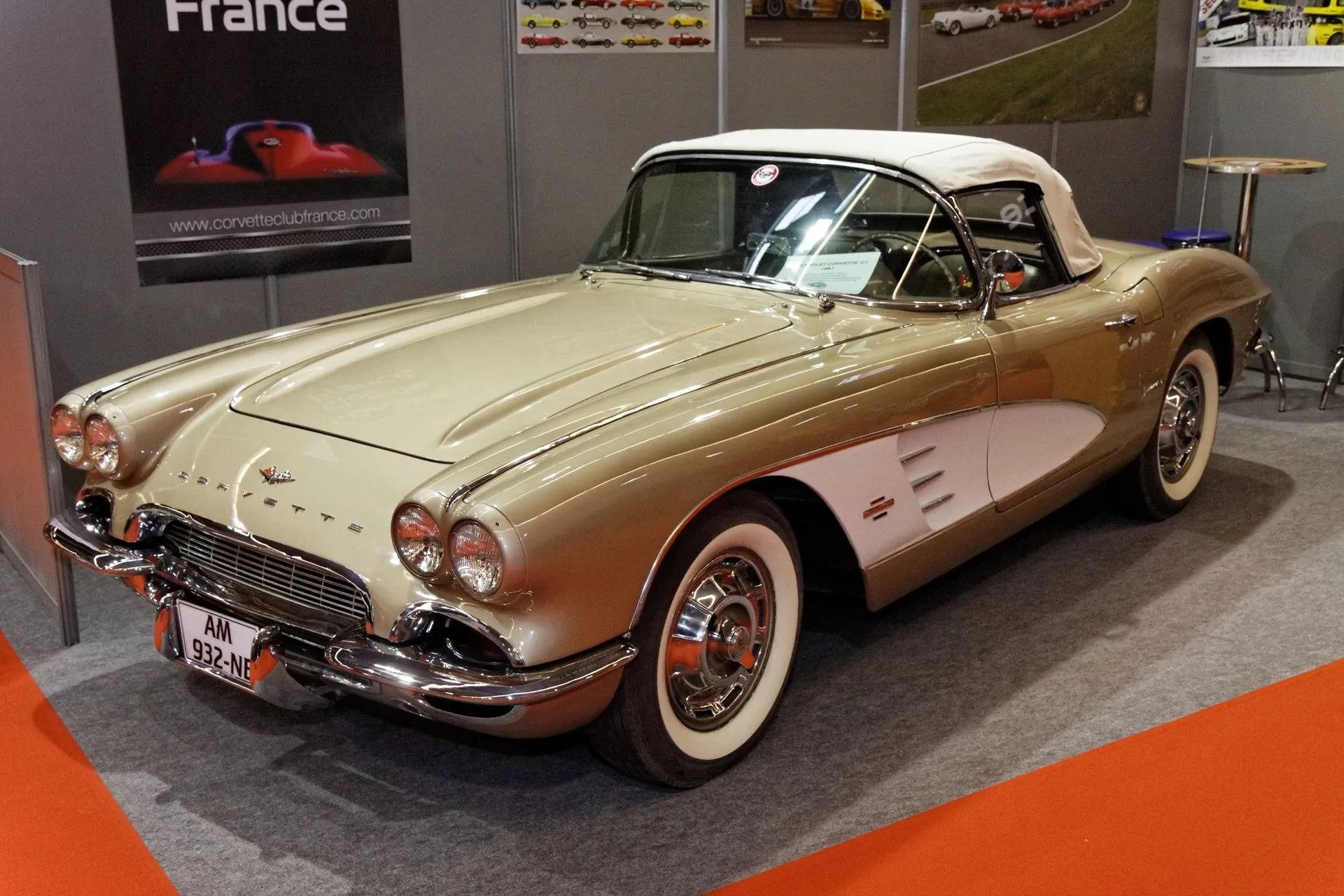
Colors weren’t coded to individual cars, the Black Book says, and a 1961 has no trim tag, so only original paperwork proves a car’s paint.
The options buyers ticked
Engines and gearboxes are in The last 283s; here is the rest that matters, most popular first, from the Black Book page:
| Option | Code | Price | Cars |
|---|---|---|---|
| Heater | 101 | $102.25 | 10,671 |
| Whitewall tires, 6.70 x 15 | 290 | $31.55 | 9,780 |
| Signal-seeking AM radio | 102 | $137.75 | 9,316 |
| Auxiliary hardtop | 419 | $236.75 | 5,680 |
| Two-tone paint | 440 | $16.15 | 3,368 |
| Sintered metallic brakes | 686 | $37.70 | 1,402 |
| Power windows | 426 | $59.20 | 698 |
| Power folding top | 473 | $161.40 | 442 |
| 15 x 5.5 in wheels, small hubcaps | 276 | No charge | 337 |
| Heavy-duty brakes and steering | 687 | $333.60 | 233 |
| 24-gallon fuel tank | 1625 | $161.40 | Not counted |
The hardtop. 2,285 of the 5,680 hardtop cars took it in place of the soft top, at no charge. Only those cars could have the 24-gallon fiberglass tank, which used part of the soft top’s well (GM). The standard tank held 16.4 gallons.
RPO 687, the racer’s package. Sintered metallic linings in finned drums with cooling fans and air scoops, special shocks and a quick-steering adaptor for 3.25 turns lock to lock (GM). It required the 315 fuelie or the 270, plus Positraction, and 233 cars got it, nearly double 1960’s 119. Wide whitewalls were offered for the last time, says the Black Book.
Section 04
A 1961 beside a 1960 and a 1962
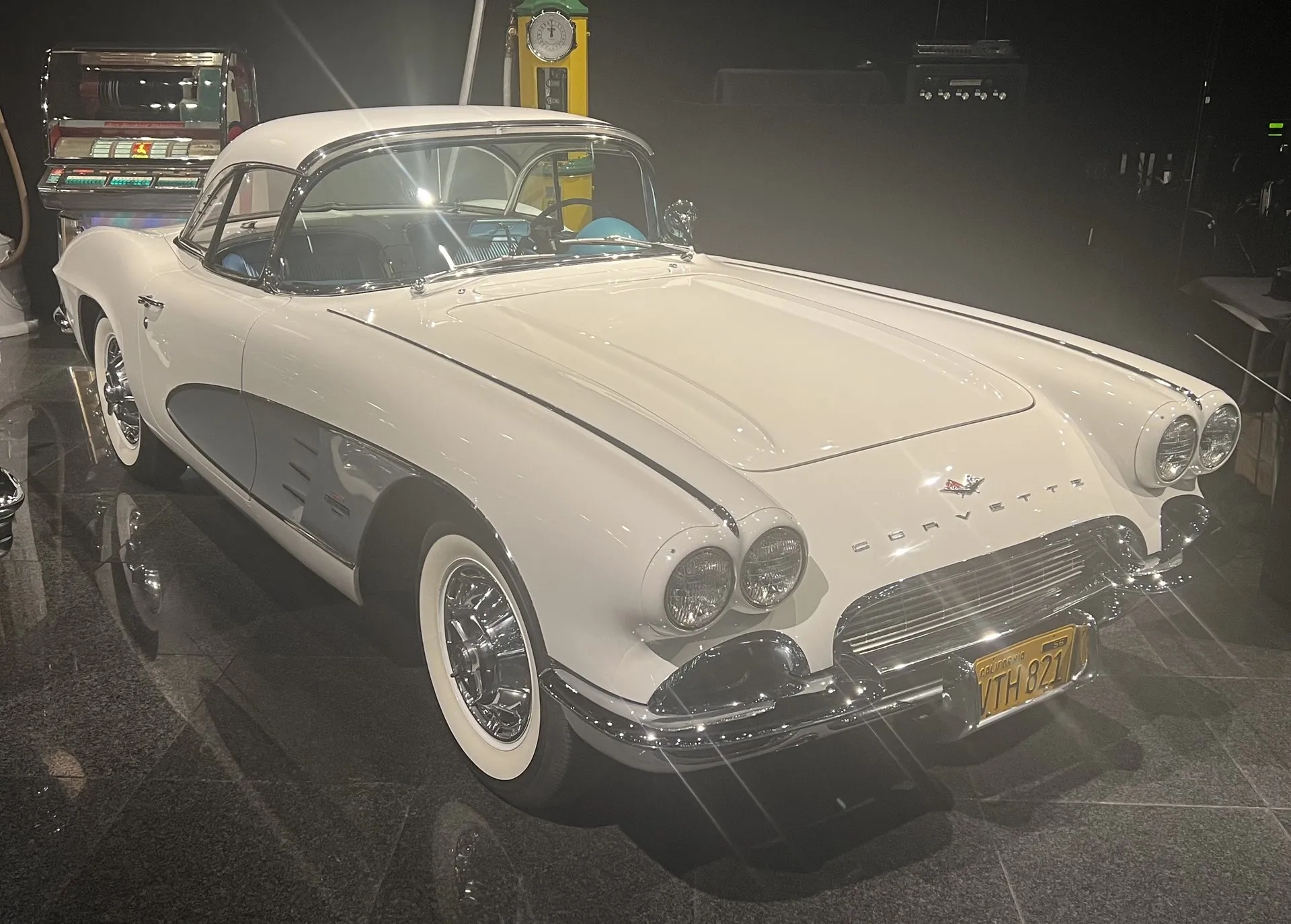
From the front, a 1960 gives itself away with chrome teeth in the grille; a 1961 has the fine mesh. From behind there’s no contest: a 1960 has its taillights in rounded fenders and its exhaust through the bumper (1960 kit). Chrome 1958–1960 headlight bezels sometimes end up on later cars, owners say, so bezels alone decide nothing (CorvetteForum, 2015).
A 1962 wears the same body. The tells, from GM’s equipment lists and the 1962 guide:
- The cove. A 1961 has a bright outline around each cove, three horizontal spears inside and possibly a contrasting color. A 1962 has no outline, a single louver and one color.
- The sill. A 1962 has a ribbed bright molding along each rocker; a 1961 doesn’t.
- The whitewalls. Wide ones on a 1961; narrow ones were new for 1962.
- The engine. A 283 on a 1961, a 327 on a 1962, and dual four-barrels only on a 1961.
- The automatic. 1962 brought the first aluminum Powerglide case, so a 1961’s Powerglide is the older cast-iron one.
- The colors. Jewel Blue is 1961 only; Almond Beige arrived for 1962.
Owners in a 2019 CorvetteForum thread (opens in new tab) add one more: a 1962’s crossed-flags nose emblem sits in a ring and a 1961’s doesn’t. Trim swaps both ways, so the serial number settles it.
Section 05
Proving a 1961: plate, frame stamp, pad and build month
Reading the serial
GM’s example serial, 10867S100003, reads: 1 for 1961, 0867 for the convertible, S for St. Louis, then the unit number (1961 kit). 1961s ran from unit 100001 to 110939. The Black Book gives the last unit finished each month, which dates a car to its month:
| Unit numbers | Built |
|---|---|
| 100001–101052 | September 1960 |
| 101053–102301 | October 1960 |
| 102302–103355 | November 1960 |
| 103356–104306 | December 1960 |
| 104307–105203 | January 1961 |
| 105204–105966 | February 1961 |
| 105967–106889 | March 1961 |
| 106890–107804 | April 1961 |
| 107805–108960 | May 1961 |
| 108961–110160 | June 1961 |
| 110161–110939 | July 1961 |
The ranges are this site’s arithmetic from the Black Book’s monthly figures.
Plate and frame
The kit lacks GM’s 1961 body page, so the plate’s location comes from owners: spot-welded to the steering column under the hood, where it moved during 1960. In a 2010 thread (opens in new tab) comparing 1961 plates, owners noted that weld dimples fill with paint and grime, that stamping alignment varies on genuine plates, and that plates are easy to come by, legitimately or not.
So the frame stamp carries more weight. It’s on top of the driver-side frame rail, roughly under the driver’s hip near the X-member, and hard to see; owners use a mirror, a light and sometimes chalk (CorvetteForum, 2004), and the C1 guide notes one 1961 whose stamp hid under a body-mount rubber block. Plate, stamp and title agree, or the deal stops.
Pad, block and heads
The pad on the front of the block’s right side carries an assembly date and a suffix from the engine table in The last 283s. Owners say a 1961’s original pad also carries a short form of the car’s serial, as a 1961 owner’s posted stamp shows (CorvetteForum, 2010 and 2014). The pad’s date should come before the car was built.
Heads should be 3774692 on a carbureted car and 3782461 on a fuelie. A “fuelie” on 3774692 heads isn’t wearing its originals, and 3782461 fits one without proving it, since heads get swapped.
A fuelie’s hardware
Fuel injection is where the money is, so it’s where the fakes are (C1 guide). The checks, none of them proof alone:
- A CR or CS suffix and a manual gearbox. No 1961 fuelie had a Powerglide.
- The tachometer drive. On the 315, GM drove the tach off the distributor; every other 1961, the 275 fuelie included, drove it off the generator (GM).
- The part numbers. Rochester unit 7017310 and distributor 1110915 on the 275; 7017320 and 1110914 on the 315.
- The plumbing. An air cleaner on the left fender skirt, ducted to the air meter, and the windshield washer bottle moved to the right side behind heat shields (left on carbureted cars).
Paperwork and a judging history from the National Corvette Restorers Society (NCRS) count for more than any of it.
Section 06
Copper or aluminum: the 1961 radiator
GM’s paper is simple. Its 1961 specification form, issued in October 1960, gives an aluminum cross-flow core with no engine condition (GM); the base engine’s page, revised in February 1961, names a Harrison aluminum unit, and the other engines’ pages list no different one. GM’s 1961 pages never mention copper.
Others say some cars got copper anyway. Hagerty’s 1961 description says some early cars did, and tells buyers to “check under the hood”. Corvette Action Center blames delayed aluminum production, without saying which cars. Owners narrow it: in a 2014 thread (opens in new tab), an owner quotes NCRS’s pocket guide and judging guide as giving aluminum radiator 3150916 to every 1961 engine after about the 1,700th car. Posters there describe three radiator versions during the year, and the Black Book confirms side-mounted expansion tanks began partway through it.
So a copper radiator in one of the first 1,700 or so cars, built in September and October 1960, isn’t automatically wrong, and a later car should have aluminum. The figure of about 1,700 is NCRS as an owner quotes it, not GM.
Aluminum wasn’t trouble-free when new: a Chevrolet service letter of October 10, 1960, from its Memphis zone, told dealers to replace failed 1960–1961 aluminum radiators rather than repair them, for 12 months or 12,000 miles. Owners in the 2014 thread prefer a reproduction to a 1961 original, whose core may be corroded inside. A 1961 that ran hot at idle in a 2012 thread had an aftermarket radiator; owners prescribed the correct radiator and fan, a flush through the block drains and sealing the gaps around the shroud.
Section 07
Chevrolet’s 1961 bulletins and the empty federal file
NHTSA, the US road-safety agency, lists no recalls (opens in new tab) and no owner complaints for the 1961 Corvette (both checked October 22, 2026). That proves nothing: the complaint file begins in 1994, and NHTSA’s bulletin files hold nothing from GM for any Corvette before 1984.
Chevrolet’s own 1961 paperwork says more. These bulletins survive as Corvette Action Center’s transcriptions; this guide didn’t see the originals, and none is a recall:
- Fuel spilling from the gas cap, November 21, 1960. Fuel could escape through the vented filler cap in right-hand turns on cars before serial S101750: the first 1,749, built in September and October 1960 by the Black Book’s numbers. The fix was a new cap (opens in new tab) with a pressure and vacuum valve, part 3787292.
- Long-travel lifters, January 20, 1961. The bulletin says 1961 283s went to long-travel hydraulic lifters, set at two turns of preload past zero lash; the old one-turn setting would likely cut the rocker studs. The 270 and 315 ran mechanical lifters, so this site reads it as applying to the 230, 245 and 275.
- A bronze three-speed bushing, December 12, 1960, part 3786292, for service where extension bushings were failing; production kept the babbitt one.
- A leaner cold-enrichment setting for the 315, July 1961: the injection’s thermostatic coil cover moved to 3-1/2 notches lean.
- Clutches on the hot engines, November 28, 1961. Citing the increased frequency of clutch failures (opens in new tab) on 1961 high-performance Corvettes, Chevrolet released a stronger pearlitic malleable iron pressure plate for 1962 and made it the service part for every 1961 with RPO 354 or 468, the 315 and the 270. It has a cast depression in each driving lug.
The expensive problems are the generation’s: the frame’s rear crossmember, rocker supports, cracked fiberglass, leaks and heat. The C1 guide takes each in turn, including a stored 1961 fuelie whose injection pump was “all gummed up”.
Section 08
Eight checks before you buy a 1961
- Frame first, on a lift, with the C1 guide’s checklist. A rotten frame outweighs every number below.
- Plate, frame stamp and title. One number on all three, the plate spot-welded to the steering column.
- The pad. A suffix from 1961’s seven, the serial’s short form, a date before the car was built (see Proving a 1961), heads that fit the engine, and nothing painted over.
- A claimed fuelie. A CR or CS pad, a manual, the hardware in Proving a 1961, then paperwork and an NCRS judge.
- Combinations GM built. No Powerglide behind a 270 or a fuelie; no Positraction with a Powerglide; RPO 687 only with a 270 or 315 and Positraction; the 24-gallon tank only on a car that left without a soft top.
- Cooling. The radiator type against the build month, and the gauge at idle on a warm day.
- The clutch on a 270 or 315: has the stronger 1962-type pressure plate gone in?
- A rebuilt 230, 245 or 275: were the hydraulic lifters set at two turns?
Section 09
1961 values in 2026, engine by engine
What is a 1961 Corvette worth? On Bring a Trailer in 2026, about $54,000 for a stock carbureted car at the median and $81,500 for a fuelie; Hagerty’s January 2026 guide put a #3 car at $61,900 to $96,900, by engine.
Hagerty. Hagerty’s price guide (opens in new tab), archived January 23, 2026, values each 1961 engine in #3 (Good) condition:
| Engine | January 2026 | October 2025 |
|---|---|---|
| 230 hp | $61,900 | $63,800 |
| 245 hp | $76,600 | $79,000 |
| 270 hp | $85,000 | $87,600 |
| 275 hp fuel injection | $82,500 | $85,000 |
| 315 hp fuel injection | $96,900 | $99,900 |
The plain average, $80,580, is the 1961 figure on the C1 guide; unweighted, it sits well above the 230 hp car that half of all 1961s were. Hagerty values the rare 275 fuelie, 118 built, below the carbureted 270.
Bring a Trailer. From January 1 to October 21, 2026, Bring a Trailer (opens in new tab) listed 13 cars titled as 1961 Corvettes. Ten sold, at a median of $54,500, from $27,000 to $84,000, by this site’s calculation from each sold price.
- Stock carbureted: 5 sold, median $54,000, from $43,750 for a partly refinished 230 four-speed (September) to $84,000 for a black car with silver coves and NCRS awards whose 283 had been replaced (March).
- Fuelies: $82,000 (February 6), $81,500 for a Jewel Blue car with a rebuilt injection unit (June 11), and $51,600 for a 315 hp project whose engine hadn’t run since 2021 (August 28).
- The bottom: $27,000 for a non-running project with a fuel-injected 327 fitted, which a 1961 never had from the factory (October 9).
- Over 12 months to October 21, 2026: 12 of 18 sold, at a $60,250 median, topped by a $135,000 LS3 restomod.
The medians have fallen: $81,500 in calendar 2024 (22 sales), $59,000 in 2025 (19). Since January 2024, 12 fuelies titled as stock sold at a $90,000 median. Samples this small move on one or two cars. classic.com’s archived March 2026 average for 1961 and 1962 together was $82,709, and the C1 guide’s 1961–1962 group median is $62,000.
How many survive? This guide found no count. The rare ones are the option cars: 118 with the 275 fuelie, 233 with RPO 687, 442 with the power top, 855 in Jewel Blue.
Section 10
Verdict: buy the 315, with its paper
The 1961 to buy is a documented 315 hp fuelie with a four-speed. That’s not this site’s pick for the years before: the 1958 and 1960 guides choose the 270 four-speed and the 1959 guide the base car, partly because a fuelie cost so much more for the same body (in 1960, Hagerty puts the 290 fuelie $27,800 above the 270). The 1961 changes the sums. The 315 is the year’s own engine, printed for 1960 but built only for 1961, and with 1,462 made it was the year’s second most popular optional engine, so there are cars to choose between. And the premium has shrunk: Hagerty puts the 315 $11,900 above the 270, and the two running 315s sold on Bring a Trailer in 2026 went for $81,500 and $82,000, below Hagerty’s $85,000 for a 270 and below the $95,553 a 270 four-speed brought there in October 2025. The pick is this site’s, from GM’s pages and those sales; no owner thread read for this guide ranks the 1961 engines.
Demand the full set: a CS pad with the serial’s short form, 3782461 heads, a distributor-driven tach, a manual gearbox, documents, a judging history, and the stronger pressure plate.
The budget path is a two-tone 230 hp car with a four-speed and Positraction, the last factory contrasting cove. Two 230 hp four-speeds sold on Bring a Trailer in 2026, at $43,750 and $55,000; the dearer was a red and white two-tone with Positraction. For an easy cruiser, a Powerglide car belongs on the list too.
Skip any “1961” with a 1962’s sill trim or louvered coves, a CY or CZ pad, a fuel-injected 327, or a fuelie with an automatic. Get it right, and you’re driving the first Corvette with four round taillights, the last with two colors down its sides, and America’s sports car at its most powerful yet. The 1962 guide covers the 327 that came next, and the best Corvette years guide sets 1961–1962 against every generation since.
Section 11
Sources
- GM Heritage Center: 1961 Corvette vehicle information kit files.zipcorvette.com This site's library. Reproduced Corvette Black Book pages (production, monthly serial numbers, engine codes, castings, options, prices, colors): PDF pages 4–5. Chevrolet's 1961 Corvette supplement (October 1960, some pages revised February 1961): pages 11–25. GM's AMA specifications (issued October 7, 1960): pages 26–58.
- GM Heritage Center: 1960 Corvette vehicle information kit files.zipcorvette.com What 1960 had: PDF pages 19 (three-speed gears and axles), 26 (Black Book: rounded tail, exhaust through the bumper) and 30 (dimensions).
- NHTSA owner complaints, 1961 Chevrolet Corvette (opens in new tab) api.nhtsa.gov Pulled October 22, 2026. None. NHTSA's complaint file begins in 1994.
- NHTSA recalls, 1961 Chevrolet Corvette (opens in new tab) api.nhtsa.gov Pulled October 22, 2026. None.
- Corvette Action Center: fuel spillage at the gas tank filler cap (opens in new tab) corvetteactioncenter.com Chevrolet bulletin DR #456, November 21, 1960, as transcribed by Corvette Action Center.
- Corvette Action Center: aluminum radiator replacement (opens in new tab) corvetteactioncenter.com Chevrolet Zone 17 (Memphis) service letter S&M60-53, October 10, 1960, as transcribed.
- Corvette Action Center: hydraulic valve lifter adjustments (opens in new tab) corvetteactioncenter.com Chevrolet bulletin DR #462, January 20, 1961, as transcribed.
- Corvette Action Center: three-speed transmission extension bushing (opens in new tab) corvetteactioncenter.com Chevrolet Advance Information 61-1, December 12, 1960, as transcribed.
- Corvette Action Center: fuel injection change (opens in new tab) corvetteactioncenter.com Chevrolet Service News, July 1961, as transcribed.
- Corvette Action Center: new clutch pressure plate for the 1962 Corvette (opens in new tab) corvetteactioncenter.com Chevrolet Advance Information A.I. #62-3, November 28, 1961, as transcribed.
- Corvette Action Center: 1961 Corvette production and performance numbers (opens in new tab) corvetteactioncenter.com Read October 22, 2026. Its radiator note, two-tone total and the Motor Trend September 1961 figures it reproduces (the magazine itself was not read). Its option counts are not used: several repeat 1960's.
- Hagerty Price Guide: 1953–1962 Chevrolet Corvette (opens in new tab) web.archive.org Internet Archive copy of January 23, 2026: the January 2026 and October 2025 #3 (Good) value of each 1961 engine, from the page's US-dollar price data, and their average.
- Hagerty Price Guide: 1961 Chevrolet Corvette (opens in new tab) web.archive.org Internet Archive copy of June 13, 2025: the model description, including copper radiators on some early cars and 1961 as the second most common C1 year. Its value is superseded by the January 2026 figures.
- Bring a Trailer: Chevrolet Corvette C1 results (opens in new tab) bringatrailer.com Every listing titled as a 1961 Corvette, read October 22, 2026. Counts and medians are this site's calculation from each listing's sold price.
- classic.com: 1961–1962 Chevrolet Corvette market (opens in new tab) web.archive.org Internet Archive copy of March 2, 2026; 1961 and 1962 together. The 1961-only page refused access.
- CorvetteForum thread: 1961 radiator question (opens in new tab) corvetteforum.com December 2006.
- CorvetteForum thread: which book is correct on the 1961 radiator (opens in new tab) corvetteforum.com June to August 2014. An owner quoting NCRS's judging guides.
- CorvetteForum thread: 1961 correct radiator (opens in new tab) corvetteforum.com July 2012. A 1961 running hot at idle.
- CorvetteForum thread: comparing VIN plates on a 1961 (opens in new tab) corvetteforum.com November 2010.
- CorvetteForum thread: VIN for a 1961 (opens in new tab) corvetteforum.com June 2004. Finding the frame stamp.
- CorvetteForum thread: 1961–1962 buyer's guide help (opens in new tab) corvetteforum.com September 2019.
- CorvetteForum thread: telling a 1961 from a 1962 (opens in new tab) corvetteforum.com September 2015.