C3 · Buying guide
1977 Corvette guide: no Stingray script, a new cockpit, and how to tell early cars from late
Published
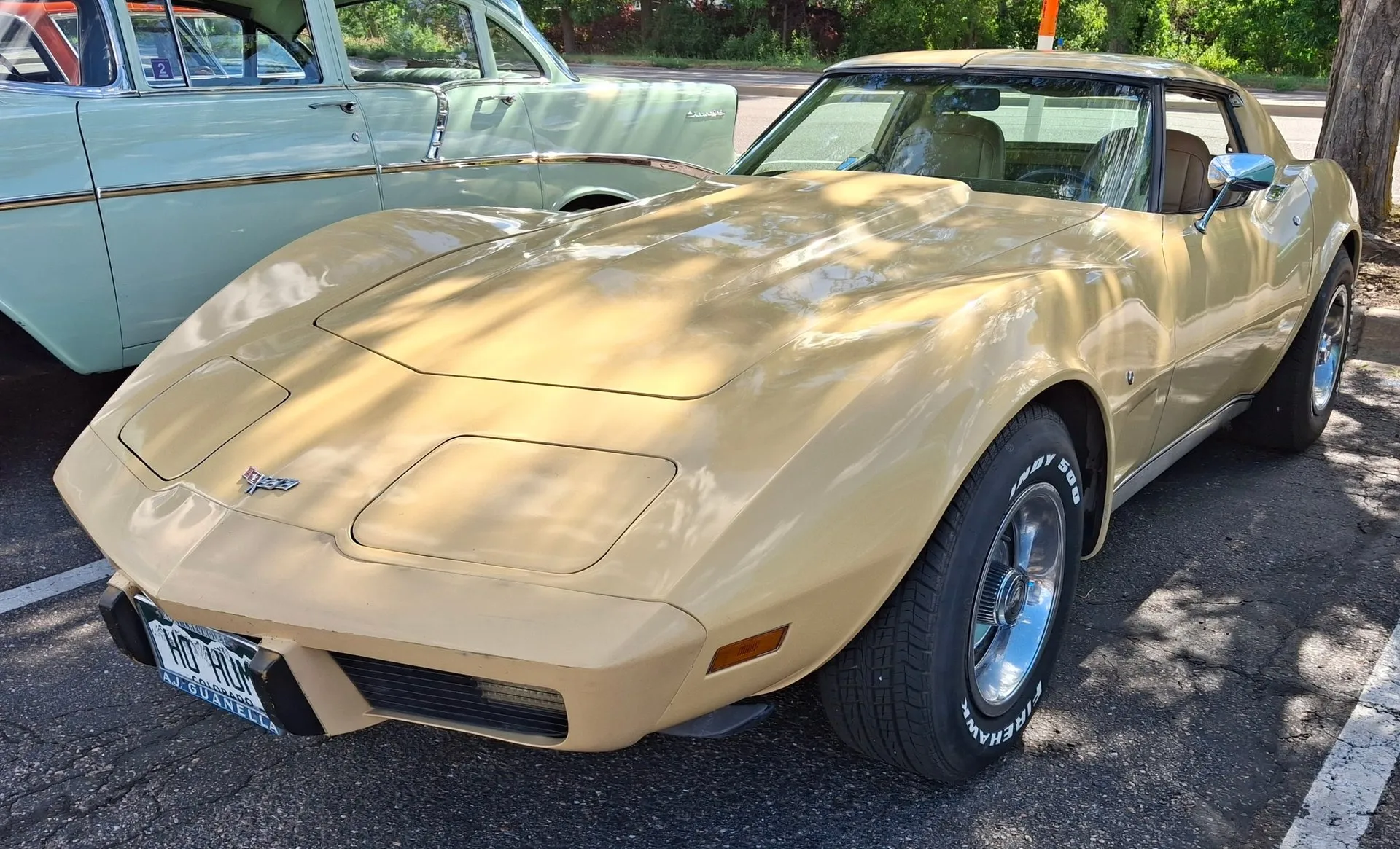
Orange paint went on the engines of some early 1977 Corvettes, and blue on the rest. Corvette Action Center records that Chevrolet’s engine plant in Flint, Michigan, changed the color on Corvette V8s between August 23 and September 7, 1976, and that some early-production 1977s were still built with orange engines; Hagerty gives the same dates. It was the first of several changes made while the 1977s were being built, which is why owners still argue over whether a given car is early, middle or late.
The 1977 is the tenth model year of the C3 (1968–1982), and the year Chevrolet built more Corvettes than ever before: 49,213, all coupes, past 1976’s record of 46,558 (1979 would top both). It is also the first C3 without the Stingray name on its fenders, and the first Corvette with leather seats as standard.
The quick answers. A 1977 is not a Stingray by its badge. It had the same two 350s as 1976, the 180 hp L48 or 210 hp L82. The base price was $8,647.65. What one sells for now is in 1977 sale results and values.
Generation-wide trouble, frame and birdcage rust above all, lives in the C3 buyer’s guide (the birdcage is the steel frame around the cabin, hidden in the fiberglass). This page covers what makes a 1977 a 1977, mostly from the 1977 paper GM reprints in its Heritage Center kit, in this site’s owner’s manual library.
C3 Key figures
- Built
- 49,213, all coupes
- Engines
- 180 hp L48 or 210 hp L82
- Price new
- $8,647.65
- L82s built
- 6,148
- Leather seats
- standard for the first time
- Alarm switch moved
- March 21, 1977, at serial 427373
- BaT 2026, to Oct. 22
- 6 sold, median $12,633
- Hagerty #3 value
- $12,700 (January 2026)
Section 01
Crossed flags where the Stingray script was
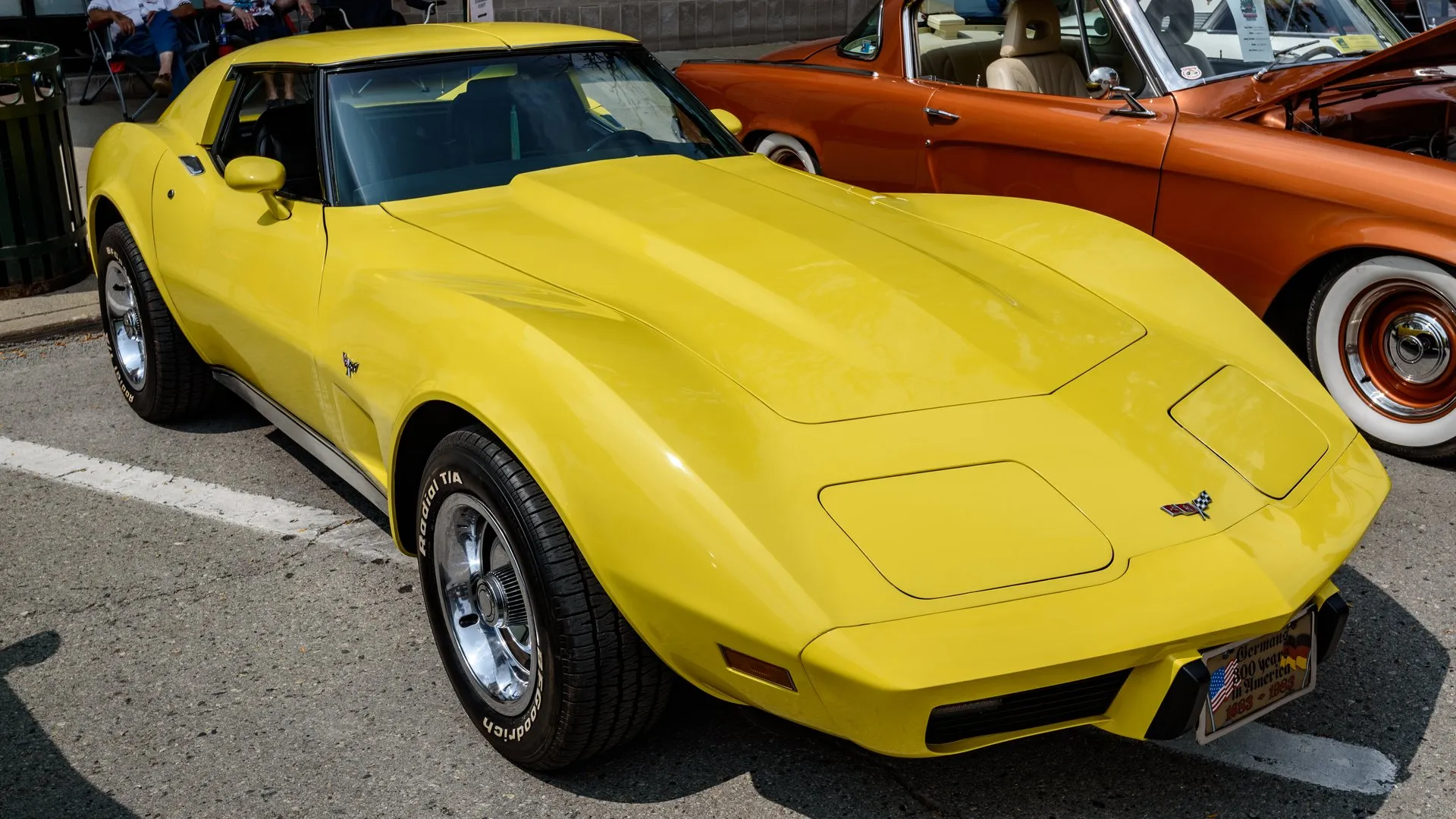
Is a 1977 Corvette a Stingray? Not by its badge. GM’s 1977 list of standard exterior equipment, dated September 1976, names a crossed-flags emblem on the nose and another on the fuel filler door, a “Corvette” nameplate on the tail and a front fender air slot, and nothing else on the fenders (data book). The 1976 list has a “Stingray” script there (1976 kit). Hagerty’s Brandan Gillogly writes that the badge ran through 1976 and the name stayed off the car until the 2014 C7; the generations guide explains the spellings in between. Plenty of 1977s wear Stingray script anyway, and owners say it is always an add-on (CorvetteForum, 2004 and 2012–2018).
The fenders didn’t stay bare. Corvette Action Center says the earliest 1977s had no fender emblems, and owners agree that crossed flags appeared behind the front wheels within the first months. Exactly when is not settled: owners’ break points run from about serial 7500 to about 12607 (mid-November 1976), and one reports flags on serial 6606 (CorvetteForum threads, 2005–2021). The trim tag’s build date answers it better (see Early, middle and late 1977s).
Two more outside changes: the windshield reveal moldings turned black, and GM’s brochure page speaks of new “thin-pillar-style” windshield posts. Owners say the hood lost the grille at its back edge, which did nothing on a 1976, as the 1976 guide reports.
Section 02
A new cockpit for 1977
The interior is where 1977 earns its own page. From GM’s equipment pages and the list of 1977 facts in the Corvette Black Book, a hobby reference whose 1977 pages GM reprints in its Heritage Center kit:
- A deeper console. It carried the heater and air conditioning controls and “accepted standard Delco radios”. An 8-track joined the option list, where 1976’s had offered only AM-FM radios: RPO UM2 (RPO is GM’s regular production option code), $414, on 24,603 cars.
- A new steering column. It put the wheel two inches closer to the instrument panel, so two inches farther from the driver, for a straighter-armed position and easier entry. Car and Driver’s March 1977 short take (opens in new tab) called the column “shorter by two full inches” and noted a shift lever an inch longer, so a hand in second cleared the parking brake.
- One stalk. GM’s data book lists a “Smart” switch lever for the turn signals, headlamp beam, wipers and washer. For 1978 the wiper switch went back to the dash.
- A voltmeter in place of the ammeter, beside a 160 mph speedometer and a 7,000 rpm tachometer (interior list), and the mirror moved to the windshield.
- Leather as standard. “Leather seats were standard for the first time in 1977,” the Black Book says, with cloth-and-leather at no cost. GM’s color chart offers black, red, smoked gray, buckskin, blue and brown interiors, each in either, and white leather seats with some of them.
Which steering wheel is right for a 1977? It depends on the column. Corvette Action Center says the redesigned wheel came only with the N37 tilt-telescopic column, and Hagerty says cars without it got the 1976 wheel, which owners call a Vega look-alike (CorvetteForum, 2010). N37 cost $165 and went on 46,487 cars, so 2,726 got the plain column by the Black Book’s counts (Hagerty says about 2,000).
Out back, the luggage rack became a regular option, V54 at $73, designed by the Black Book’s account to carry the T-top panels and leave the luggage area free. Corvette Action Center and Hagerty count 16,860. Glass roof panels, CC1, appeared in early 1977 option listings and were never sold: the Black Book blames a marketing dispute with the supplier, and Chevrolet released its own for 1978.
Section 03
Early, middle and late 1977s
The 1977 changed more than once mid-run, and only one break point is written in GM’s own paper. Chevrolet’s dealer bulletin 77-I-38, May 1977, moved the anti-theft alarm switch from the left front fender to the left door lock, effective March 21, 1977 (opens in new tab). From then on only the key in the driver’s door lock, from outside, set the alarm, and the alarm horn and flasher moved too. So a keyhole in the left front fender means a car built before March 21, 1977, at serial 427373, the break point the bulletin and the Black Book both give.
The other early signs, roughly in order of build:
- An orange engine, on some early-production cars, by Corvette Action Center’s and Hagerty’s accounts. No page in GM’s kit records it.
- Square 1976 keys. Chevrolet’s bulletin 77-I-4 says 1977 Chevrolet passenger cars of every line built until about October 1, 1976 got 1976 square ignition keys, marked “C” on the shank.
- No fender flags, in the first months.
- A bright horn cap. Early tilt-telescopic wheels had a brushed-chrome horn cap and lock lever, which GM recalled for painted parts (see The horn-cap recall, the alarm bulletins and the floors).
- The fender keyhole, until March 21, 1977.
Owners add smaller ones, as their observations rather than GM’s: T-top weatherstrip with 19 pins on early cars and 18 on late, and a flat A/C compressor late in the run (CorvetteForum threads, 2007–2010). Chevrolet also changed many axle codes across its car lines from February 1, 1977 (bulletin 77-I-21), so the data book’s codes hold for early cars only.
Is my 1977 early or late? The trim tag on the left door hinge pillar carries a build-date code: a letter for the month, A for August 1976 through M for August 1977, then the day (Corvette Action Center; CorvetteForum, 2010 (opens in new tab)). The Black Book prints the last serial built each month, with no entry for October 1976 (shown here with the 4 that starts every 1977 serial):
| Month | Last serial | Month | Last serial |
|---|---|---|---|
| August 1976 | 402287 | February 1977 | 424662 |
| September 1976 | 406337 | March 1977 | 429041 |
| November 1976 | 414216 | April 1977 | 433057 |
| December 1976 | 417551 | May 1977 | 437029 |
| January 1977 | 421118 | June 1977 | 441233 |
| July 1977 | 445179 | ||
| August 1977 | 449213 |
March holds one more date. Corvette Action Center records the 500,000th Corvette leaving the St. Louis line on March 15, 1977. GM’s kit doesn’t mention it, but Chevrolet’s production totals for 1953–1976 put the 500,000th car about 26,600 cars into the 1977 run, between the February and March serials above (this site’s arithmetic).
Section 04
Same 180 and 210 hp, shorter L82 gears
How much horsepower does a 1977 Corvette have? 180 hp from the standard L48 and 210 hp from the optional L82, SAE net, both 350 cu in V8s with a four-barrel carburetor, and both unchanged from 1976. Hagerty points out that much of Chevrolet’s range gained power that year; the Corvette waited until 1978, for 185 and 220 hp. GM’s engine data and specification form:
| L48 | L82 | |
|---|---|---|
| Compression | 8.5:1 | 9.0:1 |
| Power | 180 hp at 4,000 rpm | 210 hp at 5,200 rpm |
| Torque | 270 lb-ft at 2,400 rpm | 255 lb-ft at 3,600 rpm |
| Crankshaft and main caps | Cast nodular iron, two-bolt mains | Forged steel, four-bolt mains |
| Valve lift, intake and exhaust | .390 and .410 in | .450 and .460 in |
| Intake valve | About 1.94 in | About 2.02 in |
| Price | Standard | $495 |
| Built | About 43,065 (this site’s arithmetic) | 6,148 |
| California and above 4,000 ft | The only engine, automatic only | Not sold |
About one 1977 in eight got the L82. California cars took the L48, the automatic and YF5 emissions equipment ($70), and cars for high altitude the same pair with NA6 ($22).
Three gearboxes:
- M20 wide-ratio four-speed (2.64, 1.75, 1.34, 1.00): standard with either engine, about 5,922 cars by subtraction.
- M21 close-ratio four-speed (2.43, 1.61, 1.23, 1.00): no cost, L82 only, 2,060 cars.
- M40 Turbo Hydra-Matic automatic: no cost with the L48 and $146 with the L82 (up from $134), on 41,231 cars, more than four in five. GM’s transmission page again shows two units, the L48’s with a 2.52 first gear and the L82’s with a 2.48 first and a bigger converter; owners call them the Turbo 350 and 400.
The drivetrain news was in the axles. GM’s power team chart: 3.36 for an L48 four-speed (3.08 optional, RPO G95), 3.08 for an L48 automatic, 3.70 for an L82 four-speed (3.55 optional) and 3.55 for an L82 automatic, with air conditioning allowed on every combination. On a 1976 L82, 3.55 was standard with the four-speeds and 3.36 with the automatic, and the 3.70 came only on a close-ratio car without air conditioning (1976 chart). So both 1977 L82 standard ratios were a step shorter, for quicker getaways, and the option, G95, was now a taller highway gear with either engine; only 972 buyers paid $14 for it. Positraction, Chevrolet’s limited-slip differential, came with every axle.
Are 1977 Corvettes fast? Not by modern measures, and GM published no acceleration figures. As Corvette Action Center tabulates them, Motor Trend (December 1976) took 8.8 s to 60 mph in an L82 automatic, and Road & Track (June 1977) 6.8 s in an L82 four-speed. A base L48 coupe weighed 3,534 lb at the curb by GM’s figures, on a 98.0 in wheelbase.
Section 05
Air conditioning on nine in ten: options and colors
Comfort sold. More than nine in ten cars got air conditioning and the tilt-telescopic column, while the L82 and the Gymkhana suspension each went into fewer than one in six. Cruise control, new as K30 at $88, needed the automatic and the tilt-telescopic column and still went into 29,161 cars. The Black Book’s prices and counts:
| RPO | Option | Price | Cars |
|---|---|---|---|
| N37 | Tilt-telescopic column | $165 | 46,487 |
| QRZ | White-letter GR70-15 tires | $57 | 46,227 |
| C60 | Air conditioning | $553 | 45,249 |
| A31 | Power windows | $116 | 44,341 |
| ZX2 | Convenience group | $22 | 40,872 |
| B32 | Floor mats | $22 | 36,763 |
| UA1 | Heavy-duty battery | $17 | 32,882 |
| C49 | Rear window defogger | $84 | 30,411 |
| K30 | Speed control | $88 | 29,161 |
| UM2 | AM-FM stereo with 8-track | $414 | 24,603 |
| D35 | Sport mirrors | $36 | 20,206 |
| U58 | AM-FM stereo | $281 | 18,483 |
| V54 | Luggage and roof panel rack | $73 | 16,860 |
| YJ8 | Aluminum wheels | $321 | 12,646 |
| FE7 | Gymkhana suspension | $38 | 7,269 |
| L82 | 210 hp engine | $495 | 6,148 |
| U69 | AM-FM radio | $187 | 4,700 |
| ZN1 | Trailer package | $83 | 289 |
The V54 count is Corvette Action Center’s and Hagerty’s, and Corvette Action Center shows higher second prices for a few options, so some prices rose during the year. FE7 bought a stiffer front anti-roll bar and springs. The base price covered the L48, the wide-ratio four-speed, the T-tops and the leather, and power brakes and steering were standard. YJ8 aluminum wheels doubled from 1976’s 6,253 cars.
The Black Book lists twelve paint codes, two more than GM’s September 1976 color chart:
| Code | Color | Cars |
|---|---|---|
| 10 | Classic White | 9,408 |
| 19 | Black | 6,070 |
| 26 | Corvette Light Blue | 5,967 |
| 13 | Silver | 5,518 |
| 80 | Corvette Tan | 4,588 |
| 28 | Corvette Dark Blue | 4,065 |
| 72 | Medium Red | 4,057 |
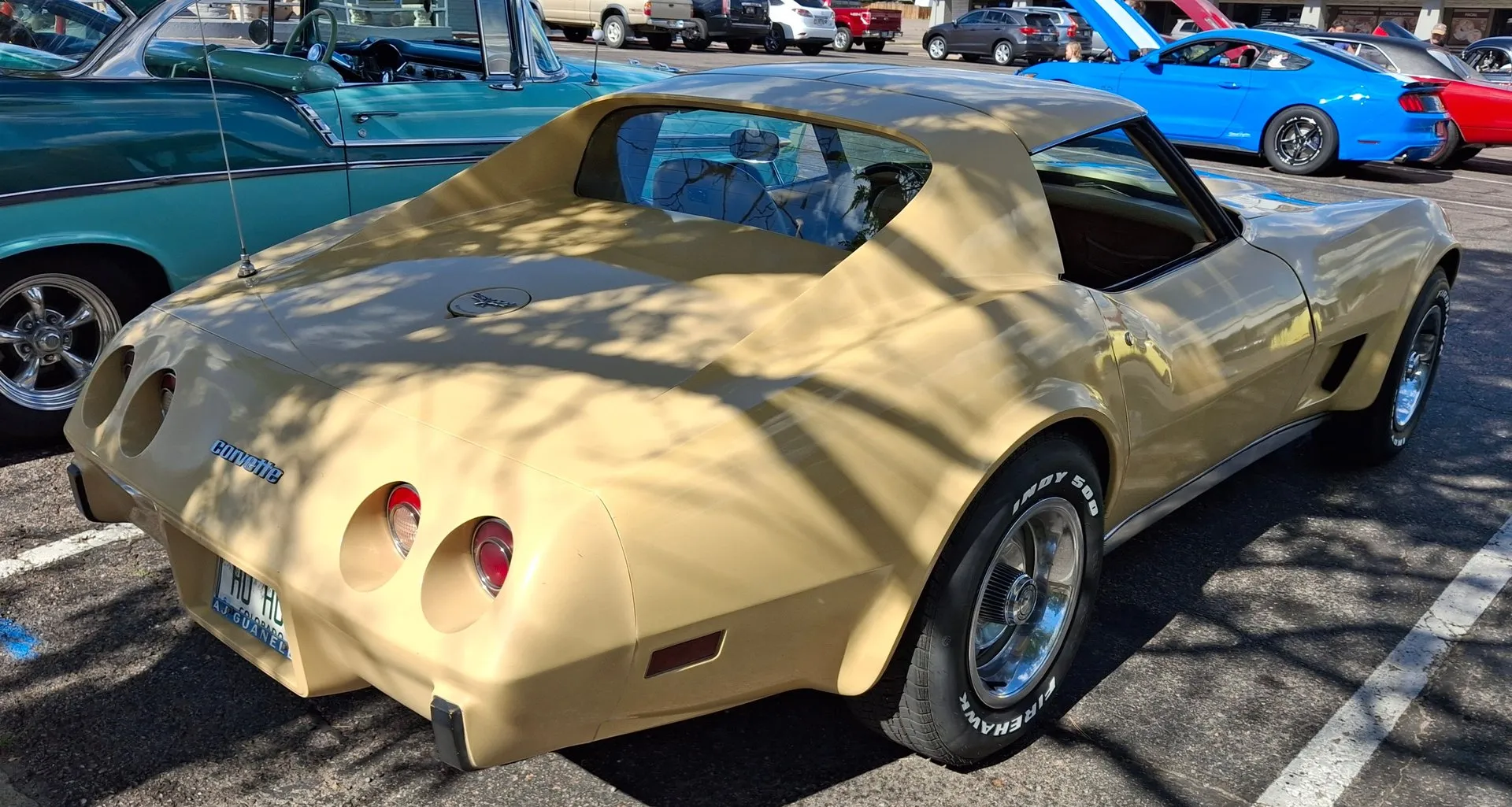
| 66 | Corvette Orange | 4,012 |
| 83 | Corvette Dark Red | 3,434 |
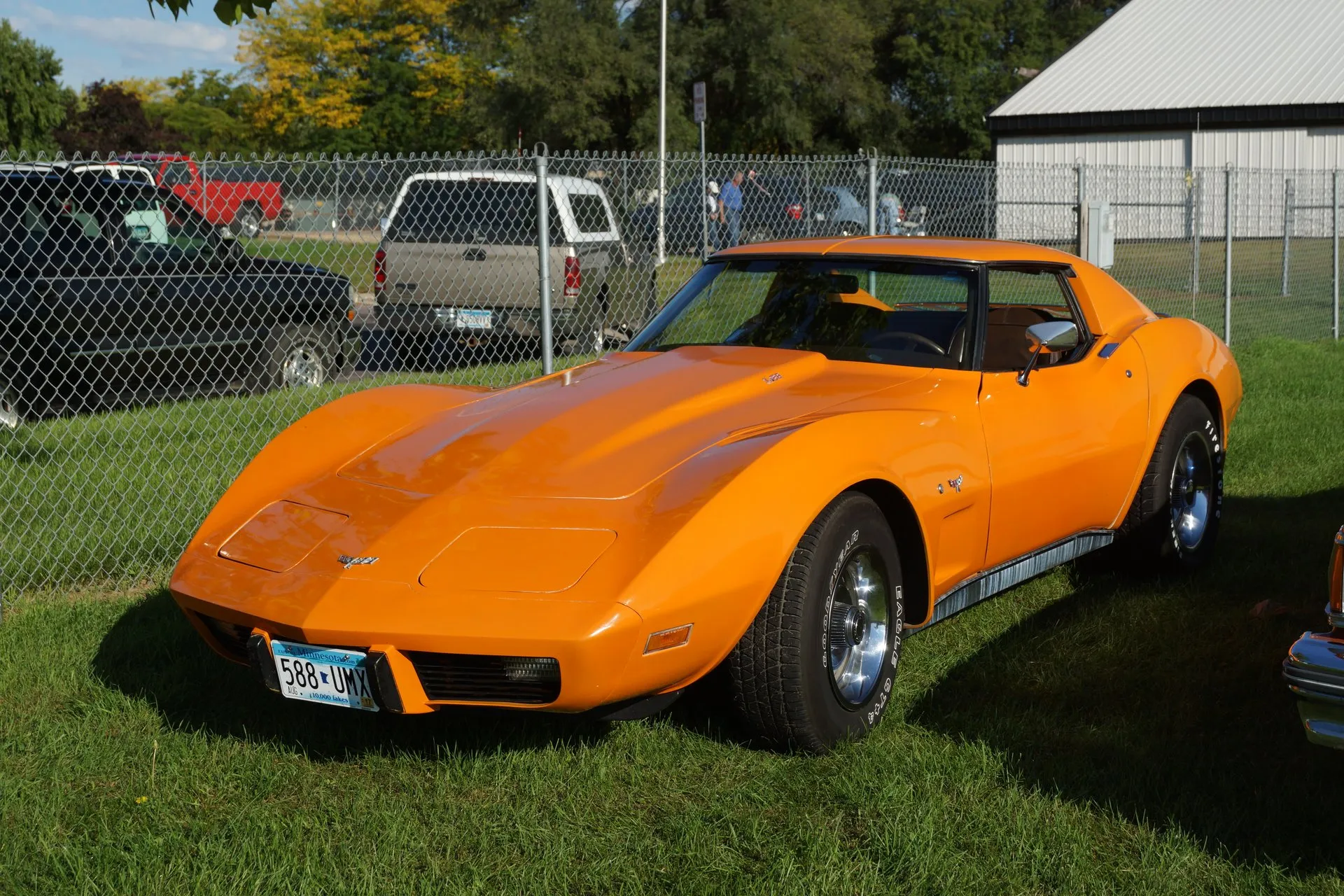
| 56 | Corvette Bright Yellow | 1,942 |
| 52 | Corvette Yellow | 71 |
| 41 | Corvette Chartreuse | 1 |
Black came back after a year off the 1976 chart. The yellows are another early-and-late story: owners say code 52 was used only at the start and gave way to code 56, citing a January 1977 paint maker’s bulletin (CorvetteForum, 2019–2021 (opens in new tab)). The counts fall short of production, because some cars had non-standard paint or primer only, so don’t add them up.
Section 06
Decoding and dating a 1977
The VIN plate sits on the left windshield pillar, per GM’s serial number page. It reads 1Z37, then the engine (L for the L48, X for the L82), 7 for 1977, S for St. Louis, and a serial from 400001 to 449213. How can you tell a 1977 L82? The fifth character is an X. An L there is an L48, whatever the hood says.
The engine pad, at the top front of the right cylinder bank, carries a plant letter (F for Flint), the month and day of assembly and a suffix. L48: CKZ (four-speed), CLA (automatic), CHD and CLC (California automatic), CKD and CLB (high-altitude automatic). L82: CLD (four-speed) and CLF (automatic). The block (3970010) and head (333882) castings are shared by both engines and with 1975 and 1976, so castings alone can’t date an engine or tell an L82 from an L48.
The trim tag, above the left door hinge, carries the paint code, the trim code and the build date. The paint code is there, not in the VIN.
What gets faked. With no special edition to copy, the dress-ups are L82 hood emblems on L48s, sold over the counter as the 1976 guide describes, and Stingray script that no 1977 left the factory with. The VIN’s fifth character and the pad suffix settle the engine.
The body helps: an upright rear window rules out a 1978 or later, and crossed flags with no script rule out a 1976, unless parts have been swapped. Some swaps are factory work: the Black Book says a significant number of late 1976s got 1977-type parts, especially inside.
Section 07
The horn-cap recall, the alarm bulletins and the floors
GM’s one recall for the 1977 is cosmetic with a safety reason. Campaign 77V115000 (opens in new tab), reported to NHTSA in July 1977, says the brushed-chrome horn cap and lock lever on cars with tilt-telescopic steering reflected about twice the glare the federal standard allowed, enough to distract a driver. Dealers fitted painted parts at no cost. The record lists 15,484 cars potentially affected, not every 1977.
NHTSA, the federal road safety agency, holds one owner complaint for a 1977, filed in March 2000: the car hydroplaned in heavy rain, struck a tree on the driver’s side, and the driver died; the filer said the fiberglass structure had not protected the occupant. The complaint file starts in September 1994, so it says nothing about how these cars behaved when new, and one record is not a pattern. Two more recalls cover replacement parts, Cardone rear calipers and Fram racing oil filters, and NHTSA’s bulletin files hold nothing for a 1977 Corvette.
Chevrolet’s own dealer bulletins, transcribed by Corvette Action Center, fill in the rest:
- 77-T-57 (October 1977): some cars set off the alarm by themselves, when corrosion between the new door-lock switch’s brass contactor ring and the lock grounded the circuit. It covers serial 427373, where the switch moved, to serial 441024 (opens in new tab), where the plant began greasing it. A 1977-only check.
- 77-T-48 (July 1977): “Corvette torque shake”, a vibration peaking around 55–60 mph under power on 1973–1977 cars, cured by resetting the rear camber.
- 78-T-42 (July 1978): a wavy rear bumper cover above the taillights on 1977–1978 cars, fixed with shims (
GM 473279, OEM). - 78-T-6 (February 1978): porous 1976–1978 YJ8 aluminum wheels that leak air slowly, sealed from inside the rim.
- 80-T-73 (January 1981): peeling black-painted aluminum moldings on 1977–1980 Chevrolets can be stripped and refinished. 1977 is the year the Corvette’s windshield moldings turned black.
The 1977 kept 1976’s partial steel underbody (GM’s data book gives its principal members as “steel front and plastic rear”), and owners report front floors rusted through. One new 1977 owner found a riveted patch over one pan and holes in the other, and owners told him to cut out the rot and weld in new steel (CorvetteForum, 2006 (opens in new tab)). The rest is the C3 list, from birdcage rust to vacuum headlights: Known C3 problems, in the C3 buyer’s guide.
Section 08
Under the car first: a 1977 checklist
- Frame and birdcage first, by the C3 checklist: kick panels off, the #2 body mounts, the rear kick-ups and the lower windshield corners.
- The floors, from inside and underneath: patches, fiberglass over steel, fresh undercoating.
- Water. Damp carpet or stains point to the T-tops or windshield.
- The VIN’s fifth character before paying for an L82: X, then a CLD or CLF pad suffix.
- The left front fender: a keyhole means a car built before March 21, 1977, and the alarm parts should match it.
- The alarm on a late car, serials 427373 to 441024: lock it with the key and listen for false alarms.
- The horn cap and lock lever on a tilt-telescopic wheel: painted, or the bright originals the recall replaced.
- The steering wheel against the column: the new wheel with N37, the 1976-style wheel without it.
- The trim tag: the build date against the serial, the paint code against the car.
- The paperwork, then an inspection on a lift by a shop that knows C3s. A window sticker beats any badge.
Section 09
1977 sale results and values
How much is a 1977 Corvette worth? On Bring a Trailer (opens in new tab), from January 1 to October 22, 2026, eleven 1977s were listed and 6 sold, median $12,633, at $9,500 to $22,000 (this site’s count of sold prices, without the buyer’s fee). Five more were bid to between $7,400 and $30,000 without selling, an LS1 swap among them. All six sold cars kept a 350 and their original type of gearbox:
- $22,000 (October 22): an L82 four-speed in Corvette Light Blue Metallic with Indigo Blue leather, air conditioning, the Gymkhana suspension and 23,000 miles shown, sold as a one-family car.
- $15,750 (July): a Corvette Dark Red automatic with air conditioning, aluminum wheels, the rack and 25,000 miles shown, the best-kept automatic of the six.
- $13,600 (March): a Corvette Dark Blue four-speed with headers and aftermarket exhaust and wheels.
- $11,666 (June): an L82 four-speed in worn black paint with an aftermarket hood, the other L82 sold.
- $9,500 (June and August): a black automatic with a Holley carburetor, and a yellow four-speed with headers.
Calendar 2025 ran higher: 8 sold of 12, median $13,388.50, topped by two L82 four-speeds at $19,100 (Corvette Orange, 61,000 miles shown) and $18,327 (black, 15,000 miles shown, with its window sticker and dealer invoice). Samples this small are market color, not a valuation or a forecast.
Hagerty’s price guide (opens in new tab), as the Internet Archive captured it, puts a #3 (Good) L48 coupe at $12,700 (January 2026), down from $13,700 in July 2025, and adds 10 percent for a four-speed and 2 percent for the Gymkhana suspension. classic.com shows no 1977-only figure; its value for 1973–1980 L82 cars was $20,817 on October 22, 2026 ($21,135 in February, as the C3 guide reports), a group that includes the stronger 1978–1980 L82s.
For scale, the C3 guide’s median for all 1973–1977 cars is $11,550 (13 sales, June to September 2026), the budget pick in the best Corvette years guide, and the 1976 guide counts a 2026 median of $10,500 (7 sold). Is the 1977 Corvette a good year? For Chevrolet, a record that held until 1979. For a buyer, it is the upright-window C3 with standard leather and the new cockpit, at about the 1973–1977 median.
Section 10
The fastback that replaced it for 1978
The 1977 was the last C3 with the upright rear window. Chevrolet’s September 1977 press release gave the 1978’s wraparound glass as 1,425 sq in against 293 on the 1977 (1978 kit), and the 1978 added 25th Anniversary emblems, glass roof panels, a 24-gallon tank, 185 and 220 hp and the Pace Car: see the 1978 Corvette guide, then the 1979 and 1980 guides. Owners say regular 1978 coupes kept the 1977-style seats.
Section 11
Which 1977 to buy: proof first, then the gearbox
The pick is an L82 four-speed with an X in the VIN, a CLD pad and paperwork. It is the strongest 1977 GM built, with a forged crank, four-bolt mains and a shorter standard axle than the 1976 L82, and the two documented, low-mileage ones that sold in 2025 brought $18,327 and $19,100, and a 23,000-mile one-family car brought $22,000 in October 2026, far above the worn and modified 1977s that fill the sale lists (see 1977 sale results and values). That gap is what condition and proof are worth. Hagerty adds 10 percent for any four-speed, so a solid L48 four-speed is the next best thing.
On a budget, a sound L48 automatic with air conditioning and the tilt-telescopic column, the car most 1977 buyers ordered, priced near the Bring a Trailer median and Hagerty’s $12,700. Parts for its 350 are everywhere, and it is the 1977 to make stronger without guilt: headers, a better cam and a freer exhaust take away nothing collectors pay for.
Don’t pay extra for early or late by itself. An orange engine or a fender keyhole is a fact to check, not a premium. Pay for floors, frame and birdcage, and walk away from soft steel unless the price covers the welding. Get the structure right and a 1977 is America’s sports car with its first standard leather, the new column and a tape deck, under T-tops that come off on the first warm day.
Section 12
Sources
- GM Heritage Center: 1977 Corvette vehicle information kit files.zipcorvette.com This site's library. GM's September 1976 dealer data book (serial numbers PDF page 6, exterior equipment 7, interior 8 and 9, extra-cost equipment 10, dimensions 13 and 14, weights 16, color combinations 20, body 21, power teams 31, engines 32, valve gear 35 and 36, fuel system 39, transmissions 44 and 45), a brochure page (46), the dealer order guide revised October 8, 1976 (48 to 50), the MVMA specification form revised February 1977 (74 to 106: power teams 76, engine 79, weights 98) and the Corvette Black Book pages GM reproduced (108: production, numbers and the year's facts; 109: options and colors).
- GM Heritage Center: 1976 Corvette vehicle information kit files.zipcorvette.com This site's library. The 1976 exterior equipment list with the Stingray script (PDF page 81) and its ammeter (83); the 1976 Black Book page with production, prices and options (18); the 1976 power teams (23).
- GM Heritage Center: 1978 Corvette vehicle information kit files.zipcorvette.com This site's library. The September 1977 press release: the 1978 rear glass against the 1977's (PDF page 30).
- NHTSA owner complaints, 1977 Chevrolet Corvette (opens in new tab) api.nhtsa.gov One complaint, filed March 2000; pulled October 22, 2026. NHTSA's complaint file begins in September 1994.
- NHTSA recalls, 1977 Chevrolet Corvette (opens in new tab) api.nhtsa.gov Pulled October 22, 2026. GM campaign 77V115000 (opens in new tab) (horn cap and lock lever, tilt-telescopic cars, 15,484 potentially affected); aftermarket campaigns 03E032000 (Cardone calipers) and 07E088000 (Fram oil filters).
- NHTSA manufacturer communications (TSB) file, received 1995–1999 (opens in new tab) static.nhtsa.gov No GM bulletin for a 1977 Corvette; the earliest Corvette model year in the file is 1984.
- Chevrolet dealer bulletin 77-I-38: anti-theft alarm system interim modifications, May 1977 (via Corvette Action Center) (opens in new tab) corvetteactioncenter.com The switch, horn and flasher moves, effective March 21, 1977. Transcriptions of Chevrolet's bulletins, here and in the entries that follow, are not GM or NHTSA originals.
- Chevrolet bulletin 77-T-57: anti-theft alarm switch protective grease, October 1977 (via Corvette Action Center) (opens in new tab) corvetteactioncenter.com False alarms from corrosion at the door-lock switch, serials 427373 to 441024.
- Chevrolet dealer bulletin 77-I-21: rear axle identification revision, March 1977 (via Corvette Action Center) (opens in new tab) corvetteactioncenter.com Chevrolet-wide axle code changes effective February 1, 1977.
- Chevrolet dealer bulletin 77-I-4: use of 1976 model ignition key sets in 1977 Chevrolet passenger vehicles, October 1976 (via Corvette Action Center) (opens in new tab) corvetteactioncenter.com All 1977 Chevrolet passenger cars, not the Corvette alone.
- Chevrolet dealer bulletin 77-T-48: vehicle vibration during acceleration, July 1977 (via Corvette Action Center) (opens in new tab) web.archive.org Internet Archive copy. 1973–1977 models.
- Chevrolet dealer bulletin 78-T-6: cast aluminum wheel porosity repair, February 1978 (via Corvette Action Center) (opens in new tab) web.archive.org Internet Archive copy. 1976–1978 YJ8 wheels.
- Chevrolet dealer bulletin 78-T-42: rear bumper cover wavy, July 1978 (via Corvette Action Center) (opens in new tab) corvetteactioncenter.com 1977–1978 models.
- Chevrolet dealer bulletin 80-T-73: refinishing exterior black painted aluminum moldings, January 1981 (via Corvette Action Center) (opens in new tab) corvetteactioncenter.com 1977–1980 Chevrolets.
- Corvette Action Center: 1977 Corvette production and performance numbers (opens in new tab) corvetteactioncenter.com The orange-to-blue engine paint change; the V54 count the Black Book doesn't print clearly; prices that rose during the year; the magazine performance figures as tabulated there. Also its 1977 identification (opens in new tab) page (early cars without fender emblems, the trim-tag date codes, the N37 steering wheel) and 1977 index (opens in new tab) (the 500,000th Corvette).
- Car and Driver: 1977 Chevrolet Corvette (short take) (opens in new tab) caranddriver.com Patrick Bedard, March 1977. The shorter column, the combined stalk, the longer shift lever, the blacked-out windshield moldings and the test car's $11,006 price.
- Hagerty (via IMSA): When is a Corvette a Sting Ray and not a Stingray? (opens in new tab) web.archive.org Brandan Gillogly, Hagerty, September 6, 2022, as syndicated by IMSA. Internet Archive copy of May 4, 2023. Stingray badges through 1976.
- Hagerty valuation tool: 1977 Chevrolet Corvette L48 coupe (opens in new tab) web.archive.org Internet Archive copy of February 16, 2026. #3 (Good) value $12,700 on the value graph dated January 2026, the quarterly series before it, the four-speed and Gymkhana adjustments, and the model notes (the 1976 wheel on cars without the tilt-telescopic column, the engine paint change).
- classic.com: 1977 Chevrolet Corvette C3 market (opens in new tab) classic.com The related 1973–1980 L82 market value, $20,817 on October 22, 2026.
- Bring a Trailer: Chevrolet Corvette C3 results (opens in new tab) bringatrailer.com 1977 listings only, January 1, 2025 to October 22, 2026. Counts and medians are this site's, from each listing's sold price without the buyer's fee. 2026 sales named in the text: the dark blue four-speed (opens in new tab) (March), the L82 four-speed (opens in new tab) (June), the black automatic (opens in new tab) (June), the Dark Red automatic (opens in new tab) (July) the yellow four-speed (opens in new tab) (August) and the Light Blue L82 four-speed (opens in new tab) (October 22). 2025 L82 four-speeds: Corvette Orange (opens in new tab) (February) and black with its window sticker (opens in new tab) (September).
- CorvetteForum thread: is mine an early or late 1977? (opens in new tab) corvetteforum.com July 2009. Alarm switch location, T-top weatherstrip, orange engines; owner claims.
- CorvetteForum thread: early 1977 or late 1977? (opens in new tab) corvetteforum.com April 2010. The trim tag's build-date code, the horn button finish, the non-tilt wheel.
- CorvetteForum thread: 1977 decode VIN (opens in new tab) corvetteforum.com October 2007 to March 2008. Early, middle and late cars by fender flags and alarm keyhole; the flat A/C compressor on late cars.
- CorvetteForum thread: 1977 nose and fender emblem locations (opens in new tab) corvetteforum.com February 2005.
- CorvetteForum thread: fender emblems on 77 Vettes (opens in new tab) corvetteforum.com April 2004.
- CorvetteForum thread: Stingray badge on a 1977 (opens in new tab) corvetteforum.com December 2012 to April 2018.
- CorvetteForum thread: any 1977 code 52 cars here? (opens in new tab) corvetteforum.com March 2019 to October 2021. The two yellows; owner claims.
- CorvetteForum thread: 77 L82 matching number help (opens in new tab) corvetteforum.com March 2017. Where the paint code lives; the standard-size radio.
- CorvetteForum thread: how to fix 77 floor pans (opens in new tab) corvetteforum.com August 2006. Owner-reported repair and price.